
Text
Noo-proOl Organization
U.S. Pottage Paid 3.1c
Permit No. 1
4
Orono, Maine
W abanaki
A llia n c e
Published by Diocesan Human Relations Services, Inc.
Wabanaki Alliance, 95 Main Street, Orono, Maine 04473.
May 1980
ADDRESS CORRECTION REQUESTED
40
*
Health center director
suspended six weeks
INDIAN ISLAND — A widening rift
between the tribal governor and health
center director exploded recently with the
suspension of the director, her adminis
trative assistant, and probation status for
three other health center employees.
Gov. Wilfred Pehrson and the Penob
scot tribal council suspended Dr. Eunice
Baumann - Nelson, head of Penobscot
Health and Social Services, and Denise
Mitchell, her assistant, until June 12.
Placed on probation for three months
were tribal nurse Ruth Davis, who has
elected to resign, records clerk Maynard
Krieder, and pediatric nurse practitioner
Phoebe Gray.
Baumann-Nelson and Mitchell were
suspended without pay.
A grievance hearing has been formally
requested through Timothy Love, a tribal
official temporarily placed in charge of the
health center.
Perhson declined comment on the
council action against health center staff,
stating that he did not think it was
“news.” Wabanaki Alliance learned that
Gov. Pehrson and Dr. Baumann-Nelson
have disagreed on many occasions in the
past, in particular regarding an incident
when staff left the premises without
authorization. At the time, Pehrson
(Continued on page 5)
Housing accounts deeply in debt
INDIAN TOWNSHIP and PLEASANT
POINT — The two Passamaquoddy reser
vations are each more than a half million
dollars in the red, Wabanaki Alliance has
learned.
Pleasant Point’ tribal housing author
s
ity fell short by ten units of a planned 40
unit development. Each unit costs about
$70,000.
Indian Township reportedly has cost
overruns totaling about $600,000. The
federal Department of Housing and Urban
Development (HUD), has tentatively
agreed to pay $280,000 of the overruns, on
the basis that this percentage was not the
fault of tribal officials.
The Township has painstakingly recon
structed its bookkeeping and accounts for
housing, to ensure that HUD would
continue its relationship with the tribe.
Pleasant Point Housing Director Clay
ton Cleaves has informed HUD that left
over materials could be sold by the tribe
for construction of a planned additional 20
units. Indian Township Housing Director
George Stevens said units are planned at
the Strip and Peter Dana Point.
A HUD official said that both reser
vations can qualify for additional funds
even though prior accounts are in arrears.
Indian Island is apparently in good
financial shape, with no overruns in the
Penobscot Nation Housing Authority.
“Force account," a procedure by which
tribal housing authorities employed tribal
members in construction, has been a
failure, the HUD official conceded. Some
of the overruns can be laid to force
account, he said.
In the future, housing will be built
through conventional contract with a
developer, the official said.
FIRST CATCH OF SPRING - These guys wasted no time in breaking out their fishing
gear and trying their skiJls on the bass at Indian Township. Pictured from the left are
Dale Newell, Dennis Tomah, Joshua Lake (holding onto his hat with one hand and
fishing pole with the other], Ryan Gabriel, and Jay Malec.
Lack of legal jurisdiction
leaves tribes unprotected
WASHINGTON — At Pleasant Point,
the tribal governor was patroling the
reservation himself, after most of his
police department either resigned in
frustration, or were fired.
At Indian Township, the hands of law
enforcement officers w ere “tied," by the
lack of legal jurisdiction over lesser
crimes.
What is plaguing the tw o Passamaquoddy reservations is the result of the
Sockabasin-Dana case last summer, in
which Maine’ supreme court said Indian
s
lands are not subject to state jurisdiction.
For major crimes, federal authorities
handle jurisdiction, but there is as yet no
mechanism to handle minor offenses.
At Pleasant Point, a rock was thrown
through a resident’ picture window, and
s
the glass door of the public safety
department was smashed. But at least.
Pleasant Point has been working toward a
federally sponsored tribal court, called
“CFR,” or Court of Offenses.
The Township is a different story.
There, residents voted in'a referendum to
continue state jurisdiction on the reserva
tion for a period of several years, but
apparently neglected to determine how
this could be arranged, prior to the vote.
Tribal lawyer Thomas Tureen could not be
reached for comment at press time.
G eorge T. Skibine, a U.S. Bureau of
Indian Affairs (BIA) official, said from his
Washington office that “nobody here
knew that there was some sort of agree
ment between the tribe and the state for
jurisdiction."
BIA Eastern Area Director Harry
Rainbolt, who was in Bangor this month
for a convention, reportedly told the
(Continued on page 8)
Governor rebuts his critics
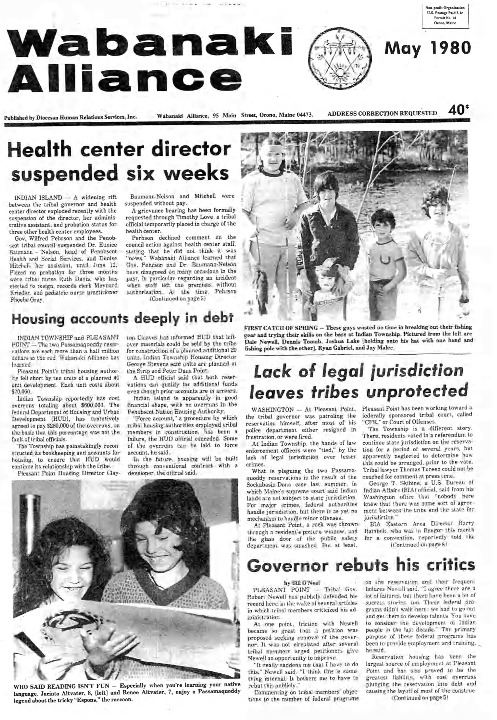
WHO SAID READING ISN’T FUN — Especially when you’ learning your native
re
language. Jaciuta Altvater, 8, (left] and Renee Altvater, 7, enjoy a Passamaquoddy
legend about the tricky “Espons,” the raccoon.
by Bill O’
Neal
PLEASANT POINT - Tribal Gov.
Robert Newell has publicly defended his
record here, in the wake of several articles
in which tribal mem bers criticized his ad
ministration.
At one point, friction with Newell
became so great that a petition was
proposed seeking removal of the gover
nor. It was not circulated after several
tribal members urged petitioners give
Newell an opportunity to improve.
“It really saddens me that I have to do
this,” Newell said. “I think this is som e
thing internal. It bothers me to have to
rebut this publicly."
Commenting on tribal mem bers’ objec
tions to the number of federal programs
on the reservation and their frequent
failures Newell said. “I agree there are a
lot of failures, but there have been a lot of
success stories, too. These federal pro
grams didn't walk here: we had to go out
and get them to develop talents. You have
to consider the development of Indian
people in the last decade." The primary
purpose of these federal programs has
been to provide employment and training,
he said.
Reservation housing has been the
largest source of employment at Pleasant
Point and has also proved to be the
greatest liability, with cost overruns
plunging the reservation into debt and
causing the layoff of most of the construe(Continued on page 5
)
Page 2
Wabanaki Alliance May 1980
Poetry
editorials
Accountability
Pleasant Point tribal council and governor Robert Newell have
come under fire recently for allegedly failing to keep tribal members
informed o f decisions being made on their behalf. They have been
accused o f not being available to answer questions people have about
tribal concerns and programs.
Governor Newell, in a rebuttal to his critics (printed elsewhere in
this issue) said he regrets having to go public with his comments. It is
this very attitude o f secrecy that prom pted critics to consider a
petition for his removal.
At this point drafters o f that petition have suspended it, waiting to
see if governor and council will becom e more responsive to their
needs. We feel the governor’ facing them publicly is a step in the
s
right direction.
Loggerheads
Unity, harmony, working together. These are easy words to mouth,
but much harder to put into practice. Indian culture has the
reputation o f teaching calm, effective interaction. This does not
mean peace always prevails.
War has broken out between the Governor’s office at Indian
Island, and the Penobscot Health and Social Services Department.
The apparent fued between Gov. Wilfred Pehrson and Dr. Eunice
Baumann-Nelson may at its core be no m ore than a personality
conflict. W e’re not taking sides, but we hope the adversary factions
can resolve their differences.
Nobody should allow disruption o f medical and social services to
tribal members. However, this on-going flap between the health
clinic and tribal government has already jeopardized services.
We don't know whether suspending the clinic director and her
assistant, plus putting several staff on probation threatens Indian
Health Service funding. We do know that Pehrson’ action brought
s
morale at the health center to a record low.
The clinic staff has vowed to stick together, and a grievance will be
filed. We don’ know if there is merit to the Governor and council’
t
s
complaints about the director and staff. He chose not to disclose the
matter to the press.
Whatever the complaints, to demoralize the entire staff o f the
health center seems unwarranted. All parties should seek to remedy
the situation immediately.
®
Dear Mother —
I love you —
and m iss you —
I’ sorry for
m
what I said
Mother Dear
you can’ take
t
back what was
said —
Dear Mother
I hope you
forgive —
P.S. H ove you —
Diane Newell Wilson
Untitled
0 native American, how did you view the life of your Mother?
Why did you take sparingly of nature’ supply?
s
Only for your ultimate gain, assuring later harvests?
Or did you truly respect Earth’ children in all their forms?
s
What ran w e learn from you that will soften our materiality—
That will enrich the qualities of our close environment—
Will sharpen our focus on our neighbor and brother?
What spiritual insights did you have which surpass our glitter?
Insights worthy of sincere respect, of emulation, not destruction.
Will you share your knowing as I seek with honesty?
Judith Schmidt, 1979
The People first
lems, and can be valuable to the on-going
by Sky Owl
life of the community and its accomplish
Penobscot Nation
ments. The grow ing population has creat
As long as elected officials and repre
sentatives need large sums of m oney to ed problem s that demand the utmost
achieve and retain office, this pow er will technical and social skill to resolve,
t
not diminish on planning major changes, it because these problems won’ resolve
themselves. They must be faced before
will only frustrate efforts to change.
they spawn others that in time envelop
To overcome this people must volun
tarily organi2e to make known and get the and destroy the community.
Community: an area in which people
kind of living conditions they would
with common culture share common
prefer.
Decisions are being made “for” people interest.
Voluntary boards and com mittees are
rather than “by” people, a large propor
tion of changes benefit a privileged sector. less subject to bureaucratic characteris
tics and are more successful: they are free
People need to b e part of the decision
making process, to recognize their value of domination and they will outnumber
bureaucrats in decision-making by putting
and rally to their own support.
Boards and committees should be made the needs of people above the survival of
the bureaucracies.
up of community-minded people, selected
T h e com m u nities, co m m itte e s and
by the people . . . not the same people on
boards that are dominated by a single
all boards and committees.
pow er structure will breed jealousy, frus
The development of a cooperative spirit
tration, hatred, discouragement.
is needed for dealing with common prob
F iddleh eads
Politics, the sagging economy, getting older and other ponderous
problems, what do they matter when measured against the fabled
fiddlehead?
Fiddleheading time has com e again to Maine, and the old Indian
tradition (long ago adopted by the white man) flourishes. While other
customs may languish, the quest o f these furled ferns continues
unabated.
In some cases, money is a motive, although nobody has made their
fortune picking the little green fiddles, which require hours of
picking to fill a burlap sack. It’ old fashioned backbreaking toil, the
s
kind your grandfather would say is “good for you.’ O f course, old
pros know that if you wet down your fiddleheads, they weigh just a
tad more ...
Most fiddleheaders, however, pick for the love o f it. They love the
outing, the picking, and the eating. Add butter, a little salt pork
maybe, and fry. Or steam. The aroma awakens the fiddlehead apetite
that lay dormant all winter. Spring is here, the river recedes from its
banks, and those cheerful green leprechauns poke their heads up
through the mud, branches and last year’ leaves.
s
Heading out at dawn by canoe is the best way to stalk the elusive
fiddlehead. The sweet fern is a little sonnet, a May minuet. Behold
the fiddlehead.
Mother
Mother Dear —
I’ sorry for
m
what w e two
said —
Behold the fiddlehead.
Wabanaki Alliance May 1980
Page 3
letters
A Cherokee's life
South Casco
To the editor:
I am writing this letter to you in appre
ciation for the months you have sent me
the Wabanaki news.
Although my heritage is not of the
Indians of Maine, my interest is high in
the folklore of all the Indian tribes. I am
Cherokee and have a proud heritage as
you well know. My father was born in
Baton Rouge, La., as w ere his brothers (2
)
and one sister. He was brought up as best
he could be by his people. When but a
young boy he and his father and mother
and brothers migrated to Louisville, Ky.
Here his father learned to make bricks
and eventually had his own brickyard. My
father got some education (formal) in
Louisville and eventually left home to go
to work selling surgical supplies for
American Surgical Supply Co.
He came to Maine in his travels and
went to work for Armour Co., Portland.
Me. He met my mother, a high school
student about to graduate, class of 1906
and they, after a lengthy courtship by
today’ standards married on New Year’
s
s
Eve 1914. I made my advent Sept. 13,
1919.
Among the artifacts and other momentos I have come across or have been told
about is a rather singular fact that my
great-great grandmother on my father's
side lived 1,650 moons or, as I have
figured out approximately 127 years if a
moon is as I assume, 28 days. This, I have
been told, made her the oldest living
Indian woman on record.
I admire the long life of Rev. F. C.
Slayton, age 110 and a chief of the
Cherokee tribe from Oklahoma. I read his
note to Wabanaki editor this a.m. Con
gratulations to him and his young bride of
7
8!
I am 60 years old, in excellent health at
this time and if the Great Spirit will look
with favor upon me I may have inherited
longevity also.
My father died at the age of 67 from
tobacco mosaic, a blood disease contracted
from overindulgence in smoking. It was at
the time of his death considered a form of
aggravated cancer of the blood.
Wabanaki Alliance
I was brought up by my grandparents, a
strick Anglican family of Scotch-English
background. These w ere my m other’
s
people. I want to g o on record in agree
ment with the lady who has brought up a
Sioux Indian boy — you don’ have to be
t
brought up by an Indian family to be a
good Indian. I feel that if one can follow
the teachings of any good family and ulti
mately pray, as in the Indian Prayer of the
January issue of Wabanaki news, that
displacement is of little importance.
I’ had my successes and failures, my
ve
victories and defeats and exposure to life
in general. What I learned from my
grandfather, grandmother, mother and
father stood by me when I needed to
review my childhood counseling.
I am definitely in favor o f the perman
ent establishment of Maine Indian land
claims area as a site to perpetuate Indian
philosophy, language, arts, crafts and
philosophy of living. The Indians have a
beautifully simple and sincere approach to
life and its problems and are perfectly able
to survive even in today’ highly technical
s
civilization or society.
I submit this letter to you in respect for
your sacrifices in the past in the media and
hope that success in the future will enable
you to continue to publish Wabanaki
Alliance.
Richard H. McKinney
The goings-on
Dan forth
To the editor:
I have been receiving Wabanaki Alli
ance since it has started and I enjoy it
very much, this is the only way I can hear
what is going on at the reservations and I
live only 35 miles from one of them, so
please keep sending.
Geraldine Tomah Oliver
Priceless
To the editor:Wabanaki Alliance is priceless, and that
says it all. Keep up the wonderful work.
Marge Hammond
Vol. 4, No. 5
May 1980
Published monthly by the Division of Indian Services [D1S] at the Indian Resource Center,
95 Main St., Orono, Maine 04473. Telephone [207] 866-4903. Typeset by Old Town/Oronc
Times. Printed by Ellsworth American.
Member — Maine Press Association
Steven Cartwright, Editor
William O ’
Neal, Associate Editor
Mary T. Byers
Brenda Polchies
Roberta Richter
Kathy Tomah
Reporters
Indian Island
Houlton
Pleasant Point
Indian Township
Phone 827-4543
Phone 532-7317
Phone 853-4654
Phone 796-2301
SHOVING OFF — Penobscot tribal members, with bags and buckets to fill, head up the
Penobscot River in search of fiddlehead ferns. The delicacy is plentiful on the river’
s
islands, where Indians only are allowed to pick them. May is fiddlehead month.
Devastation
Mattawamkeag
T o the editor:
Today I am deeply concerned for
Indian people. W e are being exposed to
a terrible disease. One that can be fatal
to us as a people. I am not sure how it
became active, but I am aware of a few
situations that prom ote it. The major
promoter is the non-Indian community.
It is a predominate belief in
“America” to day that you must be only
an individual and you must be con
cerned only for your needs. Millions of
“Americans” go to work daily with the
attitude being imposed upon us. We
must be very careful with this situation
because it lends support to another
situation. That is, the life support
system that we depend on: "federal
funding.'fYn order to be “eligible" we
must comply with regulations. And we
are constantly being advised by T e d s ’
that there is not enough money for all
Indians, so we must regulate out some
of the less desirable. Consequently, we
impose “definition” upon our people.
Definitions that separate us from each
other. Definitions that say a Passamaquoddy or Penobscot quarter blood is
more Indian than a Micmac or Maliseet
quarter blood, or that a quarter blood
Maliseet is more Indian if he or she is a*
member of the Houlton band. And the
divisions go on and on. The result being
that the strength of Indian people, the
strength of a tribe and the strength of
the families are ultimately devastated,
and we are reduced to only a group of
individuals that have only history in
common^
Unless we innoculate ourselves now
with large doses of caring for one
another we will become consumed by
society and eliminated as a people.
Tom Vicaire
Keep in touch . . .
Understanding Indians
Poughkeepsie. N.Y.
To the editor:
I would like to thank the Wabanaki
Alliance for the wonderful and much
appreciated assistance your paper gave
me with my research paper I was writing
on the Maine Indian land claims issue. My
report was very successful.
However, more importantly than this, I feel, is that in reading the Wabanaki
Alliance I have been made aware of the
real human struggles and triumphs of the
Indian peoples. Your paper portrays the
Indian situation in such a way that the
reader is filled with a deep admiration and
understanding for what it means to be an
Indian attempting to survive in today’
s
fastpaced, “barbaric" world. Stripped of
the violent or romantic stereotypes of the
past, the Indian situation is a desperate
and poignant one which warrants more
concerned public attention and involve
ment. However, I realized that therein lies
one of your greatest problems: most
people do not care, nor do they want to get
involved. Although I am a very patriotic
American, I am saddened and disillusion
ed by how often America falls short of its
freedom and equality ideals. The Indians
are just one example of a group of people
who are suffering because their needs are
often overlooked by the government.
All I want to say here is that I feel for
the Indians and their “cause." I think you
are a strong and proud breed of people.
Keep fighting for what is rightfully
yours! I'm with you all the way on the land
claims case! You deserve every part and
parcel of it.
Please accept this coniribulion and
continue my subscription to the W
’ahanaki
Alliacne so that I can keep abreast of the
Indian situation.
Catherine Robbins
Vassar College
Subscribe now!
M AIL T O W AB A N A K I ALLIANCE, 95 M AIN ST R EE T. O R O N O , M A IN E 04473
W A B A N A K I A L L IA N C E S U B S C R I P T IO N F O R M
DIS Board of Directors
Jean Chavaree |chairman]
Carroll Stevens, Central Maine Indian Assoc.
Albert Dana, Tribal Councilor
Timothy Love, Representative to State Legislature
Jeannette Neptune, Community Development Director
Jeannette LaPIante. Central Maine Indian Assoc.
Clair Sabattis, Assn, of Aroostook Indians
Brenda Polchies, Assn, of Aroostook Indians
Indian Island
Orrington
Indian Township
Indian Island
Indian Township
Old Town
Houlton
Houlton
DIS is an agency of Diocesan Human Relations Services, Inc. of Maine. Subscriptions to
rhi-e newspaper are available by writing to Wabanaki Alliance, 95 Main St., Orono, Me.
04473. Diocesan Human Relations Services and DIS are a non-profit corporation. Contri
butions are deductible for income tax purposes. Rates: $5 per year [12 issues]; $6 Canada
and overseas; S10 for institutions [schools, government, business, etc.]
(Make checks payable to Wabanaki Alliance)
I EN CLOSE:
$5 for one year
(Individual— U.S.)
$6 for one year
(Canada)
Street
City/Town and State
$10 for one year
(Institutional rate)
Zip Code
Donation (Amount)
Page-4
W ahanaki
Alliance May 1980
Will Wabanaki Indians share Black Hills fate?
by Freeman A. Morey
“Whatever befalls the earth befalls the
people of the earth. Humans did not
weave the web of life, we are merely a
strand in the web. Whatever we do to the
web we do to ourselves . . . tribe follows
tribe and nation follows nation like the
waves of the sea. It is the order of nature
and regret is useless. Your time of decay
may be distant, but it will surely come, for
even the whites whose God walked and
talked with them as friend to friend,
cannot be exempt from the common
destiny.
We may be family after all. W e will
see.”
Chief Sealth (Seattle)
1855 (translated)
“Whatever befalls the earth befalls the
people of the earth.”
These words, spoken well over a
hundred years ago, ring as true today as
they did yesterday. They will be even
more relevant tomorrow.
As we enter the 80’ war, hunger and
s
disease are taking a “back seat” to the
ever-growing and equally as dangerous
problem of nuclear and industrial pollution
and its effect on our environment.
Even now “acid rain” is falling on our
lakes and forests, and our green woods
and fields are being sprayed by all sorts qf
“pest” control chemicals.
Our brothers and sisters in the Black
Hills of South Dakota are fighting a tooth
and claw battle to prevent the beautiful
countryside they live in from becoming an
uninhabitable wasteland due to the rav
ages of uranium mining.
The “Black Hills Alliance International
Survival Gathering” July 18-27 in the
Black Hills) is trying to raise the level of
awareness of both the Indian and white
• communities.
Several interesting facts to consider
about the problem of uranium mining and
production are as follows:
1. The damaging health effects of low
level and high level radiation are not
reversible.
2. Exploring for uranium is a process of
drilling thousands of holes as much as
10,000 feet through underground rock
layers releasing deadly radon gas and
other radioactive materials into the water
and air.
3. Uranium milling waste is ore called
“tailings." These sand-like particles are 85
percent as radioactive as the original ore.
These millions of tons of w astes release
radon gas for 800,000 years.
4. Near the Cheyenne River in Edgemont. South Dakota, there are 7.5 million
tons of radioactive materials and mill
tailings, which release radon gas. In 1962,
200 tons of radioactive materials spilled
into the Cheyenne River and washed 25
miles downstream until they sank into
Angostura Reservoir. There has never
been any clean-up or concern shown for
the health and safety of the people who
drink this water.
The tailings at Edgemont are still
blowing in the wind and being washed
away by rain and snow.
5. A Pine Ridge, South Dakota, prelim
inary study by Women of All Red Nations
indicate alarming increases in birth de
fects, spontaneous abortions and cancer
deaths they believe are linked to the
contamination of the water supply by
radiation and chemical wastes.
6. The Tennessee Valley Authority has
reported that it will use at least 675
gallons of water per minute for its mineral
development. This destroys the natural
aquifers (an aquifer is an underground
water bearing rock formation) of the area
mined. T.V.A. admits that one of.its mines
will dewater the Lakota Nation’ aquifer
s
in 35 years or less.
BLACK HILLS ALLIANCE
Although much fussing and reporting is
done on nuclear power plant accidents, the
pollution involved is minute compared to
the daily release of uranium dust and gas
that is expelled from the uranium mines
via ventillation culverts.
If you missed the television special “The
Uranium Factor” I strongly urge you to
see it if it ever plays again.
Just the sight of many different mines,
most working 24 hours a day, and dis
charging clouds of radioactive dust
through ventilator pipes 2 or 3 feet across
are enough to drive home the extent of the
danger present.
What’ especially eye-opening is the
s
fact that this radioactive dust and gas
rides the wind, rain and snow in a easterly
direction, mingling with the pollution of
the Eastern factory towns to fall on our
beloved lakes and woods. We are not
mining uranium nor can our factory towns
com pete with the industrial pollution of
Detroit, Pittsburg, Chicago or any of the
other large industrial areas in the country.
Yet, it is us the acid rain falls on, not just
them. We can sit here in Maine (or the
Northeast in general) and think we have
clean water and woods we so proudly
refer to as “Vacationland.”
If the neglect of the dangers of radio
active and industrial waste continue as
they are today then the new name for
Maine will be “Wasteland.”
As greedy people are trying to exploit
the Black Hills for the “m oney” that lies
deep in the ground, so are the.same kind
of people trying to make themselves
richer by destroying our woodlands. In my
opinion the real reason behind the Spruce
Budworm Spraying is money, pure and
simple. Instead of letting nature take its
course and accepting the budworm for
what it is, the larger paper companies are
crying that we need more wood now, and
that they don’ have enough money to pay
t
for the spraying so the government (us)
have to carry the load. The fact is that
America does need wood. But, is it worth
the millions of dollars for spraying, plus
the harvesting cost, plus the chemical
pollution of our land. If we let the
budworm run its course it will go away in
a few years by itself, but this is too long to
wait for those who want money now.
What will they say when they have
developed a “super budworm’ that can t
be killed?
Throughout history, no group of people
have ever tried harder to adapt the land to
their needs rather than adapting to the
earth’ needs more than the rich and
s
powerful. When will the large industrial
pow ers realize that not only will their
workers perish but they themselves will
finally feel the sting of earth’ rebuttal of
s
their ways?
In my opinion the “status quo” has
always been the rich letting the poor live
in squalor and die so the rich can get
richer. Today, however, the scene is
changing, th e poor are still suffering to
serve the rich and rich still want more.
But, the “m ore” that they want will be the
downfall of us all. Yesterday’ hardships
s
of coal mining, field work and factory
labor are a drop in the bucket compared to
the dangers of radioactive and industrial
wastes.
When the pollution level reaches a
certain height there will be no turning
back for poor and rich alike. Radiation in
the air will not be contained like coal dust.
Even the big white house on the hill is
subject to air pollution just like the rest of
us.
Change is the natural process. If we are
not to die out as a species we must change
our actions and stop killing ourselves. If
we don’ the earth will make the change
t
for us and destroy us all. If this is to be, I
for one hope it com es soon, so the rest of
the plant and animal life m ight have a
chance to start again.
We must first identify the enemy
correctly. The enemy of the Indian is not
the white man, the enemy of the white
man is not the Indian.
Greed, apathy and unwillingness to give
a little now to reap a lot later are our real
enemies. Everywhere around us we see
examples of people working unnecessarily
dangerous jobs because they simply need
the money.
Let us realize that it is the greedy,
money and power hungry people that are
the enemy of us all. The idea that any one
race is responsible for our troubles is
ridiculous. Nuclear and industrial waste
dangers are not a scare or a myth. They
tell us the pesticides sprayed on our
woods are not harmful to man. That’ the
s
same story they told about “Agent
Orange” to our soldiers in Viet Nam.
Truthfully, if we sit back and do nothing
when we are aware of the severity of the
problems that face us, then we, yes we,
are our own worst enemies.
Navajo Nation opposes
federal relocation scheme
WINDOW ROCK, Arizona — Indian
health officials have warned the federal
government that eviction of thousands of
Navajo Indians from their Arizona reser
vation “presents a clear and present
threat to the mental and emotional
stability of the relocatees," according to a
press release from Navajo tribal govern
ment.
Dr. Martin Topper, an anthropologist
with the mental health branch of Indian
Health Service (IHS), said studies show
6,000 Navajo men, and women and
children facing relocation are showing “an
unusually high evidence” of serious
mental and emotional health problems. He
said the pending relocation bill will sig
nificantly add to their stress, the press
release stated.
Topper said Navajos waiting to be
evicted from their homeland because of a
land dispute with the Hopi Indians are
using government mental health facilities
on the Navajo Reservation. He said
depression among potential “relocatees” is
three times the average for the rest of the
Navajo Tribal leaders and others work
ing on the reservation are worried that
the congressionally-mandated eviction
will destroy the cultural fabric that ties
the Navajos together as a people, a tribal
spokesman said.
Navajo Tribal Chairman Peter Mac
Donald, who has been fighting the relo
cation plan from the beginning, urged
Congress not to proceed “with this in
human mandate, particularly in view of
these medical reports. The Navajo people
are sick at heart because they cannot
understand why Congress and the federal
government would want this to happen,”
he said.
Anti-nucleor rally
includes Indians
WASHINGTON -r- A massive demon
stration against use and development of
nuclear power in this country took place
here April 26, and a number of Indian
tribes w ere represented. Upholding In
dian treaties was one plank of the “anti
nuke” platform at the rally, that included
groups such as Black Hills Alliance of
South Dakota (a coalition of Indians and
non-Indians). Several Penobscots from
Indian Island attended, including Lorraine
Nelson, Martin Neptune and others. Folksinger Pete Seeger was among perform
ers. A longtime anti-nuclear activist, he
has for years supported Indians and their
causes.
SOME THINGS NEVER CHANGE - Pleasant Point youngsters Timmy Moore [left]
and Scooby Stanley spend the afternoon perfecting an ancient skill.
Wabanaki Alliance May 1980
Page 5
Commentary
In su pport o f claim s p rop osa l
by William C. Bullock, Jr.
I would like to offer the following
comments supporting the ratification by
our State House of Representatives and
Senate of the proposed land claims settle
ment.
The original ten tative settlem e n t
agreed upon several years ago called for a
financial payment of approximately $50
million from the federal government or
approximately $112 an acre. The current
package of $80 million works out to a per
acre cost in the neighborhood of approxi
mately $180 which, when one considers
the compounding of double digit inflation
and the increasing land values, does not
appear to be out of line.
The people of Maine and the Indian
people are indeed the innocent parties
here of an action that took place almost
200 years ago, with the real burden lying
upon the federal government. The federal
government got us into this can of worms
and it’ their responsibility to get us out.
s
Unlike the western states we have
never received any federal funds for our
Indian people from the Bureau of Indian
Affairs, and I look upon part of the $80
million from the federal government as
funds justly due our state for reimburse
ment of the financial cost that we have
paid for the human service needs of our
Indians over this period of time. Is $80
million such a substantial sum for a federal
government with a budget approaching
3 of a trillion dollars to pay a state with
As
one of the lowest per capita family
incomes in our nation to prevent it from
suffering the dire economic consequences
of a long and protracted court action or
the possibility again of our state and its
political subdivisions not having access to
the debt markets or people not being able
to buy and sell real estate?
While I am familiar with the state’
s
case, which does appear to be a strong
one, with a tremendous amount of
historical background and convincing legal
doctrines prepared by our attorney gen
eral’ staff over the last decade with
s
further help from outside counsel, the
facts are: we have yet to win in any
preliminary opinions in the courts. The
costs and uncertainties of a protracted
court trial, to me, are just not worth the
risk. .
The opponents to the settlement argue
that the 9,500 Indian claims pending in
Congress will likely result in congres
sional action abolishing aboriginal rights
of the American natives. This, to me, is a
ridiculous argument and wishful thinking. Bruce Francis, left, head of Passamaquoddy Forestry Department, battles a brush fire
Can you imagine the effects on the foreign with forester Russell Roy, at Indian Township. The blaze was quickly extinguished. The
policy of our country which has continued tribal fire engine was unable to assist due to mechanical problems.
to expound the subject of human rights as
one of our m ost important policies?
Lastly, there is concern regarding the
jurisdictional question of laws on Indian
lands. In this regard, the proposed
settlement worked out by Attorney
General Cohen will give our state much
greater control and jurisdiction than any
other state in the country over our Indian
people.
(Continued from page 1)
he said he is “still planning on doing it:
In order for our state to prosper in the
'80s, it is imperative that we get this land tion work force. Housing critics have hopefully in the near future.” He said ihe
charged that the tribe should not have major holdup in establishing the office is a
claims problem solved as soon and as ex
agreed to bear the cost of any overruns lack of space in the community building.
peditiously as possible.
Editor’ note: Mr. Bullock is president when the housing contract was made with Eugene Francis is being considered to run
s
of Merrill Trust Co. His comments are Department of Housing and Urban D e the office, Newell said, “if he wants to and
feels he can do it
excerpted from a speech last March. velopment (HUD).
Answering another complaint, Newell
According to Newell, “The only way we
According to Merrill bank officials, their
bank is the only one “to have publicly could get the force account project, was to denied that he or council circumvents the
agree to accept any deficits.” Under the personnel department in hiring and firing
come out in support of a fair and immedi
force account the tribe served as contrac employees. "Short-cut hiring only occurs
ate resolution to the claims.”
tor and was primarily responsible for for CETA (Comprehensive Employment
building the houses. As such, it was able and Training Act) projects, when we need
to hire reservation labor, and increased to fill a slot to avoid losing
He
denied rumors that it is common practice
employment to around 75 percent. “With
out federal programs, how would that for monies to be shifted from a healthy
program to foundering ones to keep them
(reservation employment) be,” he asked.
Newell blamed bureaucratic red tape going. “All of our programs have audits,"
and former project director, Robert he said.
The conflict over who has final author
Critics have accused Newell of fre
Bundy, for the overruns and consequent
ity at the health center has yet to be indebtedness. According to Newell, the quently being absent from his job and not
resolved. Pehrson reportedly maintains tribe foresaw a debt of $600,000 and asked being there to deal with questions and
that he is Baumann-Nelson’ superior, and HUD for extra mone/; however, HUD problems tribal members have. While nots
she is his employee. Dr. Baumann-Nelson projected a deficit of only $200,000 with denying his absences, Newell said the
also declined public comment.
the result that the tribe went into debt pressure of his office necessitated it. “At
One source close to the clinic's director and failed to complete the project.
the beginning of the job (as governor) I
said “it’ politics.”
s
“We have failed in building 40 homes, worked so hard that I got emotionally and
Another source commented, “I can't but we have built 30. and we’ negotiated physically sick," he said, "I finally had to
ve
believe they did this. It was not done completing the remaining 10 homes,” take a week off. When I came back, there
w ere so many people in my office with so
accorind to the policy and procedure” of Newell said.
the health and social services department,
Newell maintained that the failures many problems, I had to leave again. I
have worked hard all my life for the tribe.
which is funded through federal Indian have been a necessary part of the develop
Newell said in the last week he has been
ment of talent on the reservation and pre
Health Service.
Many observers w ere surprised that dicted that things would improve. “The working both night and day. Because ot
Gray, Kreider and Davis w ere placed on failures are due to inexperience. W e are recent firings and resignations on the
probation. Various undisclosed complaints getting more Indian people graduating police force, he said he has had to patrol
w ere lodged, but health center sources each year,” he said.
the reservation at night. “It's lonely work,
scoffed at the nature of the complaints.
Another area of complaint surrounds and that's the way I feel — alone. Alone. 1
Krieder acknowledged that he spoke out tribal competition with private businesses am virtually useless. My critics are
critically at a meeting. “The real thrust of on the reservation. Most vocal has been welcome to come help.”
it (the council action) was at Eunice and reservation resident Ralph Dana, who
Denise,” one source confirmed.
alleges that his trucking business has
Those suspended and those put on underbid the tribally run Tribal Trucking.
probation learned of their status first
Inc. on several occasions, yet not received
through the “grapevine,” and only later tribal contracts. Newell commented, “It
received notification by letter, one source
may be true what Ralph said, but
said.
payments on the trucks still had to be
Morale was low this month at the health
made.” He added that, during the first
center.
phase of force account housing, the tribe
In other clinic business, supervisor of incurred overruns of $100,000 and that
contract care Alan Sanborn, a Penobscot,
money earned by Tribal Trucking, Inc.
has been promoted to deputy director of was used to pay back a loan to cover the
Penobscot Health and Social Services,
debt.
replacing Paul W. Buckwalter who re
Alleged failure of governor and council
signed earlier this year.
to keep the tribe informed of financial
matters has also been charged. Newell
said that “after listening to some people, I
decided to set up a department with a
person to explain finances to anyone
interested." Although several months
Pleasant Point Governor Robert Newell
have elapsed since he first suggested this.
Health center staff
suspended six weeks
(Continued from page 1
)
ordered those staff members involved
fired, but Baumann-Nelson overturned
the order.
HAND CARVED INDIAN CRAFTS
Totem poles, Wabanaki war clubs,
canes, miniature totem poles, carved
letter openers with Indian heads. Also
some jewelry.
For more information call Claude
Dennis at 1-207-827-7674 or write to
Stan Neptune, 111 Oak Hill, Indian
Island, Old Town, Maine 04468.
Governor responds
to his critics
Page 8
Wabanaki Alliance May 1980
Reservations face
iurisdictional void
(Continued from page 1
)
Passamaquoddies at the Township that
there is no way state jurisdiction could be
applied to Indian territory of a federally
recognized tribe.
The question of jurisdiction at Indian
Township was argued at a recent m eeting
of tribal officials, Rainbolt, Skibine,
Tureen and others in Washington. Skibine
said the Department of the Interior
solicitor’ office ruled that state juris
s
diction cannot be used at Indian Town
ship.
A ruling written by Skibine appeared in
the Federal Register, and said in part:
“There is an urgent and compelling need
for judicial and law enforcement services
on the Pleasant Point and Indian Town
ship Indian reservations . . . justice is no
longer effectively administered under
state laws and by state law enforcement
authorities on either reservation.
“The withdrawal of these services has
left a void in the law and order program in
the two areas and could have serious
effect on the safety of their residents,"
Skibine wrote.
Indian Township police officer Darryl
Nicholas — the only officer with a nowrequired federal commission — said “the
officers, they’ all shook up about it.
re
What’ the sense of working?"
s
Skibine said “the tribe can always get
out of CFR (Code of Federal Regulations)
court if it wants to.” He also said that as
soon as Pleasant Point’ court is in
s
operation, it could handle Indian Town
ship cases.
Penobscots at Indian Island held their
first session of tribal court Dec. 13, 1979.
Obituaries
Indian boy
drow ns
ORNEVILLE — Three-year-old Willis
Pearl, son of Penobscot Indian, Catherine
Tomer Pearl, and Willis Pearl Sr., lost his
life in the waters of a stream. May 6.
The father has a heart condition and is
disabled, the mother is unemployed.
Donations to help m eet expenses for the
Bradford couple should be addressed to
Central Maine Indian Association, 95 Main
St., Orono, maine 04473. Already, the
Penobscot Nation at Indian Island has
agreed to donate $600.
WILLIS R. PEARL JR.
BRADFORD — Willis R. Pearl Jr., 3,
died unexpectedly at Orneville, May 6,
1980.
He was born at Milo, Dec. 3, 1976, the
son of Willis and Catherine (Tomer) Pearl.
Surviving, besides his parents of Brad
ford, are his paternal grandmother, Julia
Marshall of Bradford: maternal grand
mother, Margaret Neptune of Indian
Island; great-grandparents, Clarence and
Violet Francis of Indian Island; several
aunts and uncles. Funeral services were
held at the Lary Funeral Home in Milo the
Rev. Ann Stead officiating.
Burial will be in Hillside Cemtery,
Bradford.
Neptune, dead at 79,
respected dancer
by Ruby Richter
Area Reporter
PLEASANT POINT — James A. Nep
tune, a Passamaquoddy, died May 2. He
was respected in the tribe for his dancing,
craftsmanship, pride in being Indian, and
patience in teaching children.
He contributed many of his talents to
the Indian community. For many years he
worked in basket making, canoe building,
snowshoe making, moccasin and costume
making complete with intricate bead work
done by himself, in a way which gives
one a feeling of exultant joy, pride and
happiness.
In his younger years he worked in
Kennebunkport and later worked in the
woods, and at Chebeague Island, as care
taker, during the summer.
He helped his father working as a chef
in different summer resorts. He was also a
baseball player during his earlier years.
He had his own unique way of Indian
dancing.
H e hunted seals when there was a
bounty on them many years ago.
He worked on the Quoddy Dam initiat
ed by President Roosevelt.
He taught the young people the Indian
Dance by doing it with them. One had to
have strong muscular coordination to be
able to imitate his way of dancing.
JAMES A. NEPTUNE
PLEASANT POINT — James Augus
tine Neptune, 79, died May 2, 1980, at an
Eastport hospital after a long illness.
He was born at Pleasant Point July 6,
1900. He worked in the woods and was
active in Indian dances held at the reser
vation each year on special occasions. He
is survived by three sons, James Neptune
Jr. of Cambridge, Mass.; Sebattis of Eastport; Roy of Pleasant Point; one daughter,
Gloria Kelley of Portsmouth, Va.; several
grandchildren. A Mass of Christian burial
was celebrated at St. Ann’ Catholic
s
Church, with the Rev. Joseph Mullen,
S.J., officiating. Interment will be in the
Tribal Cemetery, Pleasant Point.
History in the m aking
His reflection visible in the shiny desk top, Gov. Joseph Brennan signs the Maine Indian
land claims act last month, in Augusta, following rapid passage in the House and Senate
by the Legislature. Looking on are legislators and m em bers of the Indian negotiating
team, from left: Allen Sockabasin, tribal Gov. R obert Newell, Joseph Nicholas, House
Speaker John Martin, Andrew Akins, Atty.-Gen. Richard Cohen, G eorge Stevens
[behind Cohen], Rep. Gerard Conley, Senate President Joseph Sewall, Sen. Samuel
Collins, Guy Phillips, Clayton Cleaves, tribal Gov. Harold Lewey, Carl Nicholas.
Tribal gro u p b ack s land claim s
BANGOR — A unanimous resolution
was passed this month supporting nego
tiated settlement of the Penobscot-Passamaquoddy land claims, at. a three-day
convention of United South and East
Tribes (USET).
The proposed 300,000 acre settlement
— with an $81.5 million price tag — has
been approved by the Maine Legislature
and is currently pending before Congress.
The appointment of Maine’ senior
s
Senator, Edmund S. Muskie, to the office
of Secretary of State, may or may not
affect the Congressional delegation’ ad
s
vocacy of the claims package. Muskie’
s
replacem en t, fed era l J u d g e G e org e
Mitchell of Bangor, was not seen by tribal
leaders as causing any major shift.
Mitchell as senator is expected to support
the negotiated settlement.
Meanwhile, state Sen. Andrew Red
mond of Madison is circulating a petition
opposing the claims settlement. The tribes
originally sought 12.5 million acres
through tribal lawyer Thomas Tureen.
In other U SET action, the Pleasant
Point Passamaquoddy Tribe was formally
admitted as members of the group. Indian
CATHERINE [SOCOBY] LORING
BANGOR —
Katherine Socoby, a
Passamaquoddy, died here May 15,
following a lengthy illness.
A native of Pleasant Point, she leaves
tw o sons, Lester Purdy of Indian Town
ship, and George Purdy of Lemont, Il
linois; and a brother, Russell Socoby of
PLEASANT POINT — Molly Newell
Houlton.
and Cather Lewey w ere among twentyDetails will appear in next month’
s
three graduating seniors of Shead Mem
Wabanaki Alliance.
orial High School taking part in a tour of
historic attractions in Washington, D.C.,
Tonto, d e a d at 62
Philadelphia, and New York.
Jay Silverheels, 62, who co-starred in
U.S. history was the theme of the trip,
the long-running “Lone Ranger” television which featured visits to the Washington
series as the faithful Indian sidekick Monument, Lincoln and Jefferson Mem
Tonto, died March 5 of complications from orials in D.C., Independence Hall and the
pneumonia.
Liberty Bell in Philadelphia, and the
He was 62 years old. A Mohawk Indian, Statue of Liberty in New York.
born on the Six Nations Indian R eser
vation in Canada, he got his first good
INDIAN JEWELRY
movie role in 1947, appearing with Tyrone
Indian-handmade quality wedding (or
Pow er in “Captain from Castile.” in the
friendship) bands. These are Zuni1950’ he starred as the Indian chief
s
made, with cut stones, fine quality, and
Geronimo in “Broken Arrow,” “Battle at
sterling silver. Describe your needs
Apache Pass” and “Walk the Proud
and exact size (estimate x size above
k
Land.”
your regular size) and I will do my best
In the 1960’ Silverheels founded the
s
to locate. Average cost will be $30 each
Indian Actors Workshop in Hollywood to
plus postage; none higher than $40. I
help ge t Indian actors roles. “He created
will send cost statement for your
the atmosphere for us to get into the
approval before shipping C.O.D. I wifi
industry,” an actress, Lois Red Elk, said.
also fill orders for other handmade
“Before that, Indian people had to play
Indian jew elry items if you describe
props, extras, background. There just
what you want.
weren’ any Indian people with speaking
t
Sue Stevens
parts.” Silverheels was a Golden Gloves
3812 Monroe N.E.
boxer, amateur wrestling champion and a
Albuquerque, N.M. 87110
professional lacrosse player in his youth.
Two Pleasant Point
seniors visit Capital
Township Passamaquoddies, and Indian
Island Penobscots, w ere already mem
bers.
It was the first U SET meeting ever in
the northeast. The Penobscot Nation was
host.
W A N TE D
Handmade miniatures suitable for fur
nishings in or around miniature houses
built to a scale of 1” = 1 foot.
Especially (but not exclusively) in
terested in baskets of all types, cradles,
birchbark items, or other things not
found in the ordinary toy shop. These
have to be well made, and to scale.
Prefer natural colors. Send a sketch,
photo or description, or better yet a
sample, and your asking price per item.
Business will be conducted on a C.O.D.
basis.
Sue Stevens
3812 Moiiroe N.E.
Albuquerque, N.M. 87110
CAN’ FIND A JOB?
T
TRY THE
Job Corps
Would you like to be trained as a ...
Bookkeeper
Secretary/Stenographer
Clerk Typist
Nursing Assistant
If you are 16 to 21 and not in school,
the Penobscot Job Corps Center has
training programs which may be of
interest to you.
The Penobscot Job Corps Center
provides all trainees with a place to
live, meals, health care and a cash
monthly stipend while you learn. And
when you finish, we'll also help you
find a job.
SOUND GOOD?
IT JS GOOD.
ASK FOR JOB CORPS
— in the Portland area— 775-7225
— in the Auburn area— 786-4190
— in the Bangor area— 947-0755
— or toll free anywhere in Maine
at 1-800-432-7307
ASK FOR
JOB CORPS RECRUITMENT
Page 6
Wabanaki Alliance May 1980
Maliseets march against
A young Indian woman makes poster for U.S.-Canadian border protest last month. Her
sign reads: “You import boat people and export aborigines!”
a
Demonstrators approaching the Canadian customs building at Andover, New Bruns
wick — opposite Fort Fairfield, Maine.
Poetry
Power
Three nations of power
USSR, US and China
all looking for a "shina”
Nostrodomus predicted an answer
in this answer a teaching
the answer land, everything and people
Gluskabe brought to the first people
land trust knowing
the day has past
the net I have cast
if you use power wrong
the unknown will get stronger
Born with altruism
the strength of teaching
Gluskabe reaching
no “prob,” just a job
with the strength we get
put it to use on the past
William W. McDougall
Yellowquill case
upheld Jay Treaty
Two years ago a significant U.S.
court ruling on an appeal by an Indian
woman supported the 1794 Jay Treaty
that protects Indians from deportation,
among other things.
The case of Jolene Yellowquill in
volved a charge of possession of heroin,
in Texas. The courts tried to deport
Yellowquill to Canada, where she was
born, but an appeal through lawyer
Lawrence Aschenbrenner brought a
ruling that she was “not subject to
deportation on any ground.” Deporta
tion proceedings against Yellowquill,
started Nov. 4,1977, were terminated.
CALLING MALISEETS
EVERYWHERE
URGENT CALL
W e must unite
Let’ stand up and be counted
s
For membership information contact:
M ALISEET NATION, INC.
P.O. BOX 154
MADAWASKA, MAINE 04756
by Steve Cartwright
TOBIQUE RESERVE, New Brunswick
— “Immigration, Immigration won’ you
t
leave us alone? Take your customs to your
white man, we’
ve got customs o f our
own.”
So sang several young Maliseet Indians
at a Maine-Canadian border demonstra
tion last month. Maliseets along with
Micmac, Passamaquoddy and Penobscot
sympathizers w ere protesting the at
tempted deportation of Raymond Sockabasin of Tobique, and other alleged vio
lations of the 1794 Jay Treaty, which said
Indians could “freely pass and repass” the
border.
If there is no border for Indians, then
how can an Indian be deported? That’ the
s
argument advanced by 75-80 Maliseets led
by Wayne Nicholas of Tobique. However,
as Nicholas readily admits, it’ not as
s
simple as that.
Brothers Raymond and Larry Sockabasin are the cause of the border demon
stration near Fort Fairfield, Maine, and
subsequent protest marches at Houlton
and Calais border crossings. They were
born at Indian Township Passamaquoddy
reservation. Raymond is wanted in Can
ada on charges of assault on a police
officer, and possession of liquor; for this,
Canadian authorities want to deport him,
along with Larry, charged with destruc
tion of property.
The Sockabasins would apparently be
luckier in the States. The U.S. has ratified
the Jay Treaty, but as historian James
Wherry of Houlton pointed out in an
article in the January 1980 Wabanaki
Alliance:
“The Canadian government’ response
s
to the question of Jay Treaty rights is
simple. The Supreme Court of Canada
ruled in 1956 that Article HI of the Jay
Treaty and Article IX of the Treaty of
Ghent (which would have reinstated the
Jay Treaty after the War of 1812) are not
applicable in Canada, since Canadian L eg
islation has not been passed to implement
or sanction the provisions of the Treaty.
This view of Canadian law makes Indians
subject to the provisions of the Im m igra
tion Act and Regulations in the same
manner as all other persons wishing to
enter Canada.
“The United States has taken a dif
ferent view of Jay Treaty rights. General
ly, American officials have tended to
wards an acknowledgement of the Jay
Treaty rights of North American Indians.”
Larry is currently jailed at the border
crossing where the jail happens to be
located. After a day of picketing U.S. and
Canadian customs buildings, marchers
sang an American Indian Movement
(AIM) song in front of the jail; inmates
cheered; the protestors w ere told to
disperse.
“What ignited this protest was the
(threatened) deportation of two sons of
Indian parents who are recognized band
members of the Tobique Indian Reserve,”
explained Nicholas. “Protestors firmly
believe that deportation was not warrant
ed as the charges laid under the criminal
code of Canada w ere of a minor nature.
Under no circumstances will the pro
testors protect or demonstrate on behalf
of criminals with serious offenses.
“Therefore, the main issues of the
national protest are, the imposed immi
gration laws disturbing the aboriginal
rights of all North American Indians,"
Nicholas said.
In an interview at his father’ house,
s
where he is staying, Raymond Sockabasin
said, “Everyone tells us that we’ Indians
re
and they can’ deport us. I was charged
t
with assault on a police officer. It was only
for 20 pints of beer. It’ about time
s
somebody spoke up. This ain’ ju st for me
t
and my brother. It’ for all the Indians of
s
the U.S. and Canada," Sockabasin said.
Sockabasin had already served a jail
sentence and been fined $100, prior to the
deportation order. “A lot of people feel
there’ harassment from the RCMP
s
(Royal Canadian Mounted Police) on the
reserve .. . the RCMP said I was the only
one they knew in the crowd," Sockabasin
said, adding that the policeman “said he
had to use physical force, but I was only
trying to defend myself ... up here at the
gas station, I was pulled out of the car
(Nov. 23,1979),’ he said.
’
Sockabasin said the RCMP constantly
reminds him of when a policeman was hit
with a rock a few years ago. Ironically, the
officer is Sockabasin’ brother-in-law.
s
(Continued on next page)
A father muses on
his sons' predicament
TOBIQUE RESERVE, New Brunswick
— How do you feel if your two sons are
facing deportation to another country?
That’ what Wabanaki Alliance asked
s
Raymond Nicholas, father of Larry and
Raymond Sockabasin, who face deporta
tion to the U.S., where they were born at
Indian Township.
Nicholas, father of ten, said bluntly, “I
can’ understand it. They want to deport
t
him on parole, but they won’ give him
t
bail.” He was referring to Larry, who has
the nickname “Muscles,” and who is
currently held in jail, (Larry was advised
by his lawyer to refuse parole if deporta
tion was a condition of it.)
Nicholas said he told the court he would
offer collateral in woods equipment worth
$30,000, but to no avail. “I said if it’ bail
s
I’ see what I can do. The judge wouldn’
ll
t
listen to me. It’ a funny feeling. You go
s
into court and you feel helpless,” Nicholas
said.
He is a proud father. “The boys never
got no help from the government. They
worked as boys. The boys used to have
ponies and ride them right up the stairs in
the house," chuckled Nicholas, who has
one of the only owner-built homes on the
reserve.
Nicholas was not married to Larry and
Raymond’ mother, but they were always
s
part of his family. “I don’ say they’
t
re
angels or anything like that, but they’
re
good kids. They’ got a lot of friends,
ve
they’ good hockey players," he said.
re
“Them boys never used no weapons or
anything,” Nicholas said, adding that
“young people like to fight, you know. I
fought all the time when I was in the
army." While living in New York, some
years ago, Larry was “number one” in
judo, and Raymond took third place in
competitions.
Nicholas said he is one of the only men
on the reserve not on government support
of some kind. A veteran woodsworker, he
operates his own logging operation on
Indian lands. Until now, he has never been
very concerned with outside issues. “I
never followed up on this treaty stuff
because I’ never been bothered crossing
ve
the border,” he said. "It upsets m e when I
think o f the injustice. I'd sooner see my
son six months in jail than kneel down to
anyone.”
Nicholas summed up his views by
recalling what he told a judge in court: “If
a truck turns over with ten cords of wood,
I can straighten out the truck and re-load
it. But when my son gets railroaded,
there’ nothing I can do.”
s
Wabanaki Alliance May 1980
Page 7
st Jay Treaty violations
(Continued from previous page)
A reporter for CBC asked Sockabasin if
he had been drinking when stopped by
police. Sockabasin hesitated, then said he
had quit a couple of months previous.
Sockabasin was under careful security of
Indian friends, and the interview was
guarded. However, RCMP apparently
agreed not to enter the reserve in search
of Sockabasin.
For a week and one half, Maliseets
supporting the Sockabasin brothers block
aded the road into Tobique Reserve,
allowing Indian persons access. Later last
month, the blockade was lifted, but a
group of Indians continued to camp in a
hastily built lean-to beside their home
made gate.
Nicholas said he favors nonviolence:
“We want to be very diplomatic about
this." But “we have several warriors
among us,” he warned.
According to Nicholas, part of the
problem of Indian rights and the deporta
tion order is Tobique R eserve Chief
George Francis, who is reportedly often
away in Ottawa. “When he gets a
program, he hires all his relatives, and it’
s
pure hell for non-supporters,” said Nich
olas, who himself worked for awhile with
Indian Affairs in Ottawa, and is a tribal
councilor. The reserve is reportedly
$170,000 in debt, and may not wish to
antagonize the Canadian government,
sources said.
Francis has taken no stand on the
deportation, and neither has the tribal
council. Nicholas, in frustration, said he
has appealed to Lloyd Axworthy, minister
of Immigration, “to investigate and cancel
the deportation order.”
A letter to Graydon Nicholas, chairman
of Union of New Brunswick Indians, had
produced no results, Wayne Nicholas said,
despite a request for immediate interven
tion and negotiation with the ministers of
Immigration, Citizenship and Indian Af
fairs (the assistant to the Indian Affairs
minister is himself an Indian).
Eva Saulis, -59, aunt to Larry and
Raymond Sockabasin, said “we’ going to
re
keep fighting. When there’ injustice for
s
any people, men or women, we speak out.
“They call us radicals . . . small-minded
women. That’ what George (Francis,
s
band chief) called us. You’ not free to
re
speak out," Saulis said. She and her niece
organized an Indian women’ march on
s
Ottawa last summer.
Bernard Sappier, the only tribal council
member to participate in the demonstra
tion, commented, “w e’ like to have more
d
people involved in this, because it’ very
s
important to us and our children."
Sappier worked 19 years at Indian
Township (Maine), and is married to the
former Edith Sockabasin of that reserva
tion. He said the Tobique Reserve of 750
people (35-50 of whom are “non-status”
Indians), have serious housing and educa
tional problems. People are depressed.
Tom Paul, a Micmac writer, comments:
“To be a citizen is to be an alien of another
country, or to be of European ancestry.
We, the native people are a sovereign
nation; we should not be classified as
citizens, and not as Canadians or Ameri
cans.
“To be classified as citizens is to be
subject to the Queen of England, there
fore: as a citizen, a native person is
vulnerable to the constitution, and there
fore will be subject to deportation and
genocide.
“The formula to solve this,” Paul writes
bitterly, “is to obliterate the word ‘
citizen’
and change it to ‘
superceding sovereign
nation’
.”
Nicholas and others want the Indian Act
in Canada revised, with Jay Treaty rights
recognized as they are in the U.S., so that
“nothing in the future like this will happen
again." The Indian Act was last amended
in 1952; it^vas revised in 1972; National
Indian Brotherhood, a Canadian organiza
tion, has been studying border crossing
status since 1973, but has made no major
proposals for change.
Demonstration leader Wayne Nicholas, center, talks with William McDougall, left, from
Indian Island, Wabanaki Alliance editor Steve Cartwright and others, in hastily built
shelter at Tobique Reserve.
'WHAT N£ >0|
youC n o
ant
OUR C t ur e:
ul
I D epor t
t he
On the picket line, Maliseets walk back and forth over the Maine-Canadian border near
Fort Fairfield.
COMMERCIAL
Tom Paul, Micmac, with wife and son Geronimo.
M icm ac recalls b ein g d e p o rte d
TOBIQUE RESERVE, New Brunswick
— Tom Paul, a Micmac from Eskasoni
Reserve in Cape Breton, brought his
family to a recent protest rally at the
Maine-Canadian border here. He is a
veteran Indian activist.
“I was deported m yself in 1962 from
Massachusetts to Canada. I was in trouble
too much with the law,” Paul, 36, remem
bered. “I’
ve been to Wounded Knee,
South Dakota, and I’
ve traveled to 47
states. W e go everywhere to support
native rights.”
Paul, who named his son Geronimo after
the 19th century Apache Indian chief,
observed that “there’ been a lot of change
s
since 15-20 years ago. Native people are
standing up for their rights.
“When the Canadian government de
ports an Indian person back into the U.S.,
it violates a treaty, and affects the whole
Wabanaki Confederacy. W e have our own
laws, our own religion . . . w e’ working
re
on re-forming the Confederacy. W e’
re
getting the constitution back . . . our own
laws.” he said.
Commenting on the deportation order
for Raymond and Larry Sockabasin, (see
story this issue) Paul said, “I think these
young boys — their criminal records
shouldn’ even be mentioned, because
t
they (Canadian government) are violating
their rights."
“I went to residential school ten years
(1949-1959). and they told us we were
savages and dirty. We w ere punished if
we spoke our language ... that’ why a lot
s
of them lost their language. They were
ashamed of themselves,” Paul said.
RESIDENTIAL
INDUSTRIAL
Hi Sockbeson & Son
BUILDERS
PRE-ENGINEERED BUILDINGS
CUSTOM BUILT HOMES/RENOVATIONS
CONCRETE WORK/MASONRY
FINISH & ROUGH CARPENTRY
GENERAL CONTRACTING/SUB-CONTRACTING
942-6630
947-4163
One Merchants Plaza - Bangor
Wabanaki Alliance May 1980
Page 9
A source of energy received daily
By Dr. Normand Laberge
PLEASANT POINT — Just as a
thermal electric plant relies on coal or oil
for a fuel source, a tidal project similarly
depends on the naturally occurring tides
for its source of potential energy.
However, a tidal project does not have
to purchase its fuel (tidal waters), where
as a thermal plant’ cost of operation is
s
substantially comprised of fuel expendi
tures. This basic difference between a
renewable energy resource and a limitedsupply resource has far-ranging impacts
on project economics when analyzed over
their respective lifetimes. This topic will
be discussed for the Half-Moon Cove tidal
project in terms of inflation, with regards
to the rapidly rising cost of conventional
fuels, and in terms of the resultant effects
on the cost of electricity.
In order to present a meaningful
comparison with a tidal power project, an
oil-fired plant has been selected on the
basis of having similar production charac
teristics. Today, a new oil-fired plant
would generate electricity for approxi
mately 4.70c per kilowatt-hour (kwh)
which is less than the 5.69c/kwh cost for a
tidal project. Half the production cost for
the oil plant is attributed to the fuel
expense with the remaining amount set
aside for operation and maintenance
(7.9%) and financing charges (42.1%). In
comparison, the tidal project requires
6.9% of its production cost for operation
and maintenance and 93.1% or 5.30c/kwh
for the payment of revenue bond-holders.
A tidal project is termed “capital-inten
sive,” since its production cost is primarily
constituted by actual construction ex
penses as indicated by the annual fin
ancing charges.
If the oil-fired plant produces power at a
lower rate, why should a tidal project be
constructed at a higher cost? The tidal
project would not be constructed if the
sole criteria is the production of the
cheapest pow er available at the present
time. But other considerations also have to
be factored into the decision making
process in order to best optimize the
future energy mix. Some of the major
factors that positively favor tidal power
plants are briefly described below:
— the conservation of limited-supply re
sources for priority utilization
— the construction of the least environ
mentally and socially damaging power
plant
— the development of renewable energy
resources on a regional basis
— the availability of long-term economic
returns in the event that inflation con
tinues at its present, or even moderate
level.
For these and other reasons, it is felt
that a tidal project has its place in the
regional energy network as both a hedge
against inflation and to provide electrical
self-sufficiency.
The two hypothetical plants previously
mentioned will be used to explain the
impacts of inflation on the resultant cost of
electricity. It should be remembered that
a project’ financing charge will remain
s
constant throughout the debt period
regardless of any changing economic con
ditions; however, both the cost of opera
tion and maintenance and the fuel cost will
be directly affected by the inflation rate.
For the case of oil-fired plants, the fuel
cost might increase at a rate faster than
inflation due to geo-political factors and to
the combined effects of increasing demand
and decreasing supply. Assuming that
inflation will increase at 6% per year for
each year after 1980, it can be shown that
the production cost from the tidal project
would be less that of oil-fired electricity
(5.89c/kwh versus 6.07c/kwh) after only
seven year of operation. If we continue
this exercise for thirty years, the tidal
project’ production cost would be less
s
than one-half the cost of oil-fired elec
tricity. The reason for this behavior is due
to the initial economic structure of a tidal
The instructor was Dick Parker. Sonja
Dorn of Indian Township took R oger
Sockabasin, Dino LaCoote, William Lola
and Allen Dorn Jr. to Calais to take this
course. There were 26 children from
Calais, Princeton, and Woodland who
participated in the course.
The expected physical lifetime of a tidal
project can be safely estimated at 50 years
and optimistically planned for up to 100
years. By comparison, a regularly used
oil-fired plant is expected to function from
35 to 40 years. This difference in operating
time also serves to enhance the long-term
benefits of a tidal project since two oilfired plants would be required to replace
one tidal power project. The second oilfired plant would cost much more than the
original plant due to the impact of inflation
on the construction cost. This comparison
is also valid for nuclear and coal pow er
plants but to a lesser degree since a tidal
project has a lower plant factor; i.e., in
operation for a shorter period of time.
The assumptions that have been used in
this analysis are particularly relevant
today in light of: (1) the on-going debate
over the desirability of nuclear power; (2)
uncertain fossil fuel supplies; (3) the
impact of inflation reflected by the fuel
adjustment charge on your electrical bill
as well as a decrease in the amount of dis
posable income; and (4) the recent
emphasis on the development of re
newable energy resources. The proposed
Half-Moon Cove project, due to its size,
will not have a significant impact on the
electrical mix for the State of Maine, but
since the plant would serve a largely rural
area, it would supply pow er from a decen
tralized and regional source. It should also
be noted that ancillary, or indirect bene
fits have been excluded from this quanti
tative economic analysis. Based solely on
the power production potential, the pro
The children were taught the rules and
regulations for hunting, how to use a
compass, the proper handling of a firearm
and a mini course on boat safety. The local
game wardens also helped in this course.
The students w ere taken to the Na
tional Guard Armory for target practice
and they also had to take a written test.
This is a six week, 12 hour course that
presently is given once a year.
The students received certificates and
patches for completing the Maine Hunter
Safety and Conservation Program.
tii
ANYONE CAN BUY
YOU DON’ HAVE TO
T
BE A VETERAN
See Your Local Real
Estate Broker Or
Contact
LOVE'S A * 4 0 0 0
INDIAN ISLAND
S e v e n tribes sue p ipelin e
Seven Indian tribes have filed suit in
Federal court in Seattle in an attempt to
block construction of the Northern Tier
Pipeline.
The tribes claim the construction of the
pipeline would “pose an imminent threat
of serious and irreparable harm." They
charged that Federal officials who ap
proved the pipeline failed to assess and
disclose serious impacts on their com
munities. “This failure to assess and dis
close is exacerbated by a failure to involve
tribal governments in the review and
decision making process,” they listed
dangers to salmon, steelhead and other
treaty fishing resources. The pipeline
would run under Puget Sound and cross
several streams in the Indians’area.
The seven tribes are the Skokomish,
Tulalip, Stillaguamish, Upper Skagit,
Swinomish and the Port Gamble and
Lower Elwha Bands of the Klallam
Indians.
Tires
Owned Homes For Sale |
in Washington County |
Equal Housing
OPPORTUNITY
Loving care for your car
Tune-ups
ject’ economics are competitive with con
s
ventional sources when averaged over a
ten year period. In the same way, it has
also been shown that economic prospects
for tidal power development increase
quite dramatically when taken over a
thirty year period.
When the Half-Moon Cove tidal project
is constructed it would re-establish a mile
stone in Washington County’ role as an
s
energy producer. Several hydroelectric
stations previously serviced the area until
the mid-l960’ when the last plant was
s,
decommissioned. Today, the residential
users of electricity in Washington County
have only two diesel plants producing
pow er in the region.
EDITOR’ NOTE: Dr. Laberge is co
S
ordinating a planned tidal power demon
stration project on Half-Moon Cove, at the
Passamaquoddy reservation.
VETERANS ADMINISTRATION
Five take gun safety course
INDIAN TOWNSHIP — Five Passamaquoddies completed the Gun Safety
Course at the WCVTI (Washington
County Vocational Technical Institute) in
Calais.
project’ capital investment which is
s
93.1% inflation proof as opposed to a
42.1% rate for the oil-fired plant. There
fore, even with a moderate inflation rate
with respect to today’ standards, a tidal
s
project will provide cheaper electricity in
the near term and also serve to level the
cost of the electrical mix.
Rt. 1, Houlton Road, Woodland
3 bedroom, garage — $28,000.00 — $500.00
D.P.
Main Street, Princeton
4 bedroom, garage, $29,500.00 — $500.00
D.P.
No. Lubec Road, Lubec
3 bedroom, garage — $31,500.00 — $500.00
D.P.
9 Academy Street, Calais
4 bedroom, ready to move into — $29,000.00
— $500.00 D.P.
All VA financed
13'/2 % interest rate
VETERANS ADMINISTRATION
LOAN GUARANTY DIVISION
TOGUS, MAINE 04330
Tel. 207-623-8411 Ext. 433
Page 10
VVabanaki Alliance May 1980
Track team holds first race
by Kathy Tomah
Area Reporter
INDIAN TOWNSHIP — The Rev.
Joseph Laughlin helped George Sabattus
initiate a cross-country track race re
cently.
Sabattus, 20, is trying to organize a
track team. The race took place at Peter
Dana Point so the community would see
the runners in hopes that they would
encourage them and also support this
sport. There were sixteen contestants:
Lewey Dana, Danny Lola, Dale Dana,
J.D. Newell, Wade Lola, Billy Nocholas,
John Mitchell, Clay Levesque, Richard
Stevens, John Socobasin, Carl Sabattus,
Joseph Socobasin, Dickie Sabattus, Greg
ory Mitchell, R oger Sockabasin, Carl
Nicholas.
Richard Stevens was the first runner to
complete the race and won first place in
the seventeen year old and up group.
Lewey Dana came in first in the 15-16 age
group; Clay Levesque in the 13-14 year old
age group and Billy Nicholas in the 10-12
age group.
St. Ann’ Church is sponsoring the
s
track team and Father Joe hopes that the
community will help out.
Richard Stevens of Indian Township wins a race held in conjunction with organizing of a
new track team at the Passamaquoddy reservation. Stevens won the age 17 and up
category. [Kathy Tomah Photo]
Governors show interest in paper
RUNNERS ALL - Front row, left to right, Billy Nicholas [10-12], Clay Levesque
[13-14], Lewey Dana [15-16], Richard Stevens [17 and up]. Back row, Danny Lola, Dale
Dana, Joseph Socobasin, Roger Sockabasin, Dickie Sabattus, Wade Lola and Gregory
Lola. [Kathy Tomah Photo]
Township Notes
by Kathy Tomah
This program is being administered and
Area Reporter
sponsored by the Indian Township Health
INDIAN TOWNSHIP — Sonja Dorn, a Service Program.
R egistered Nurse from Indian Township,
The Community Health Service of Indian
took a one week orientation course in Bar Township now issues a monthly newsletter.
Harbor on Diabetes from May 12 to May 16. Anyone interested in receiving the newsThe Indian Township Health Service will be letter should contact:
N EW SLETTER
running a special diabetic screening pro
Community Health Service
gram in the near future.
Box 301
Congratulations to Doris Chapman and
Princeton, Maine 04668
Mathew Dana for completing an 80 hour
E.M.T. course and also passing their state
exam. They are now fully qualified as
SPECIAL O N WOODSTOVES!
Emergency Medical Technicians.
The new physician’ assistant has been
s
KING W OODSTOVES
hired for the Indian Township Clinic.
Complete with automatic heaters
William Mathews, who is from Florida, will
Reg. $448.95 — Now $399.95
be working with the on-sight contract
medical physician and our RN, Sonja Dorn.
Laura Nicholas has been hired as the
WIC Director. This is a nutrition program
for infants, children and pregnant mothers.
The WIC program at Indian Township has
just undergone a management evaluation
from the WIC regional office in Massa
chusetts, and preliminary indications are
that the program is in excellent shape.
The C.F.N.P. (Community Food & Nutrilion Program), is off to a successful spring
gardening program.
One of the program goals is to encourage
residents of Indian Township to start home
gardening. Many people have taken advant
age of the various garden equipment which
is loaned to them by the C.F.N.P. program
along with the allocation of various seeds to
give everyone as much encouragement in
home growing of vegetables as possible.
Later in the gardening cycle, canning and
food preservation workshops will be offered
by the C.F.N.P. along with heavy emphasis
on community nutrition education.
ORONO — A resolution to assist in was discussed, as was a Community
seeking funds for Wabanaki Alliance Services Administration program called
newspaper was unanimously approved by ECAP, and $2,000 that must be raised for
Tribal Governors Inc. (TGI), at a meeting insurance on Maine Indian Transportation
Association (MITA) buses.
here this month.
The newspaper’ search for funds to
s
Attending the m eeting w ere TGI direc
continue publication beyond expiration of
a grant this fall was explained to TGI tor Allen J. Sockabasin, Pleasant Point Lt.
Gov. Cliv Dore, Central Maine Indian
mem bers by editor Steve Cartwright. He
said an annual budget of $40,000 is pro Association (CMIA) President Tom Vicaire, Indian Township Gov. Harold J.
jected.
In other business, TGI accepted the Lewey, Association of Aroostook Indians
resignation of bookkeeper Ann (Irene) (AAI) President Clair (Al) Sabattis, AAI
Pardilla, a Penobscot from Indian Island. Director Terry Polchies, and Indian
Contractual use of $285,315 from the Township Housing Authority Chairman
state Department of Indian Affairs budget R oger Gabriel.
CMIA to conduct off-reservation survey
If you have any questions
about the needs assessment or how the
information from it will be used, please
call the C.M.I.A. office 866-5587 or 7751872. The following people will be working
on the needs assessment so if they com e to
your door you will know who they are:
Irene Augustine, Marta Conlin, Carol
Farrenkopf, Angie Mitchell, Freeman
Morey, Betty Robinson, Sally Sturtevant,
Tom Thurlow.
All information will be kept completely
CMIA needs the cooperation of every confidential — names will be removed
person and every family in the area.
from the forms.
ORONO — Beginning in May, Central
Maine Indian Association will b e conduct
ing a Needs Assessm ent for any and all
off-reservation Indians in the southern 15
counties. The outreach workers will
attempt to reach every off-reservation
Indian (person) in the fifteen Counties —
the reason: to find out what people need
or would like in the way of services, what
problems people are having and what they
have to share with other Indian people.
HARDWARE
& GUN SHOP
TOM VICAIRE, Proprietor
The only Indian-owned hardware
business in the State of Maine
‘
‘We’ eager to do business with people
re
in the Indian community,” says Tom.
The store carries a full line o f tools,
electrical and plumbing supplies, paint
and housewares. Also, a selection o f fine
new and used guns.
See Our Garden Supplies and Tools
For all your hardware and
hunting needs, visit —
MATT AW AMKE AG HARDWARE &
GUN SHOP
and sample some good Indian hospitality
and-service.
Penobscot Valley Champs
The Old Town Indian Mites strike a pose with coaches Pat Soucy (left] and Joe Clavette.
Players are [front row left to right] Todd Clavette, Jason Richards, Shawn Sapiel, Miles
Francis, Mike Thibodeau, Joey Stetson and Todd Brown, [hack row] Nat Lord, Gene
Fadrigon, Chris Francis, Shannon Sapiel, Greta N eptune, Nick Sapiel, and Jeff Street.
Not pictured are Pan! Dow, Jason Pardilla and Kevin Chessa.
Wabanaki Alliance May 1980
A
AITA director quits post
0R0N 0 — Saying she “had no choice,”
Lorraine Nelson of Indian Island has
resigned as director of MITA, Maine
Indian Transportation Association. There
was no money to run buses, and no money
to pay her salary, she said.
Nelson had taken over MITA last year
from a former director, who was fired for
alleged mismanagement. As of press time,
buses were apparently still running.
MITA was set up in 1976 to serve
Aroostook County, Indian Township and
Pleasant Point reservations, Indian Island
reservation, and: Central Maine Indian
Association of Orono.
MITA has remained in financial diffi
culties since early this year, and a Federal
Highway Administration official said it is
up to Tribal Governors Inc., the agency in
charge of MITA, to sort things out.
Ray Pomeroy, the federal official, said
he is willing to m eet and work with Tribal
Governors (TGI), but that several at
tempts to set up m eetings failed. He said
several letters to TGI Chairman Robert
Newell, Pleasant Point governor, have
gone unanswered.
Commenting on Nelson’ resignation,
s
Pomeroy said “I don’ blame her for
t
quitting.” TGI has not com pleted its work,
Pomeroy said, and no additional funds will
be forthcoming until two transportation
grant studies have been completed.
Pomeroy said it is within TGI’ power to
s
complete the paperwork. In fact, he said
Nelson sent him a well-written pre
liminary draft. Pomeroy said MITA
accounts have not yet been clo sed .
Apparently, at least one area, Indian
Island, is considering operating their own
buses without the MITA umbrella. “It’ up
s
to them to make a decision. It’ their
s
service, and their buses, and their trans
portation,” Pomeroy said.
Benete case moves to federal court
BANGOR — T
h« Ciise .»f a man who
claims to be Micmac, wanted as a fugitive
from justice in California, has been trans
ferred to Federal District Court here, at
request of counsel.
Michaelangelo Giovanni Benete, alias
Michael Bennett, fled California where he
has been convicted of murder. He stayed
for awhile at Indian Island, where he
claimed he had the governor’ permission
s
to camp out, and where he also claimed he
was to be employed by a Penobscot man.
Lawyer Julio DeSanctis of Bangor
argued in a hearing at Maine Superior
Court that Bennett is not subject to state
jurisdiction since he was apprehended on
Indian Island, “Indian territory" that is
subject to Indian and federal authority.
DeSanctis referred to the landmark Sockabasin-Dana case last summer, in which
tw o Passamaquoddy Indians convicted of
arson w ere found to com e under federal,
Penobscot nurse ends 45-year career
INDIAN ISLAND - After nearly half a
century in the nursing profession, Ruth
Norma Attean Davis, tribal nurse, is
retiring.
Her otherwise unblemished career is
clouded at the end by being placed on
probation, along with other health center
employees, by Gov. Wilfred Pehrson, who
alleges insubordination. Many believe the
Governor was out of line in putting the
tribal nurse on notice. Ruth Davis did not
single out Pehrson’ action as a reason for
s
her resignation.
She retires May 16, as the nurse who
has treated scores of Indian Island resi
dents. She joined the fledgling Penobscot
Department of Health and Social Services
in October 1976, and has had a major hand
in the planning of the current modern
clinic and its varied programs.
With her characteristic good humor,
Davis said she “retired to come home, but
then I got involved.” She returned to the
Penobscot reservation in 1975, after living
in southern Maine and Massachusetts. She
worked briefly for Wabanaki Corporation
alcoholism agency.
“I’ very pleased about the improve
m
ments and that they have the health
center. It’ something they’ needed for
s
ve
a long time. When I first graduated (at
Mercy Hospital in Portland) I wanted to
come back and do it all,” Davis said. She
came home for one year, but times were
hard at Indian Island, and she left for
work off-reservation.
“I’ 66 and I think it’ about time to
m
s
slow down,” said Davis, who has been
married 43 years to retired machinist and
toolmaker Forrest Davis. But, she said,
eyes twinkling, “there’ a lot of people
s
around here that still know my telephone
number.”
WABANAKI CORPORATION
ALCOHOLISM COUNSELORS
AND THEIR LOCATIONS:
Old Town
866-5577
Rosalie Clark
Clarence Francis
866-55,77
Pleasant Point
Grace Roderick
853-2537
Ralph Dana
853-2537
Northern Maine
Alfred Dana
866-5577
Caribou Area
532-7317
Pious Perley
532-7317
Harriet Perley
Portland Area
George Paul
499-7589
Indian T ownship
Bernard Stevens
796-2301
James Mitchell
796-230’
Gazing through the window of the
examining room where she has gently
reassured frightened children, Davis re
m embered that her family owned a farm
on the present site of the tribal com
munity building. She and her brothers
sold the land to the tribe, long after the
house burned, and prize oxen w ere lost in
the fire. Her father was Mitchell (Old
Mitch) Attean; her mother, the former
Mary Louise Ranco, was raised on Olamon
Island and made baskets. Her grand
mother was Domekin Polis.
Resignation letter
from Ruth Davis
I hereby submit my resignation as
Tribal Nurse and Medical Administra
tor to be effective. May 16,1980.
I do not feel that I warrant probation
without a justifiable reason, which I
have not received. I refuse to accept
this action by my submitting of this
resignation.
I sincerely appreciate the honor of
serving m y people with my knowledge
and expertise but the unfair politics
associated with this position leaves me
with little respect for my “so called”
judges.
I feel I have fulfilled the responsi
bilities of m y position to the best of my
knowledge and capabilities, and I ac
knowledge the fact that I may have
made mistakes, a trait peculiar to
humans ... my sincere apologies.
F or forty-five years I worked among
the white culture with responsible
positions, and I never was submitted to
the degrading actions that I am
receiving from my own people, those
known as our governing body.
It is plain to understand why our
educated young people prefer to take
their expertise to other fields.
My only regret is that I m ust end, in
my retirement, a career, of which I am
very proud, by your expecting my sub
mission to your conditions.
k
INDIAN CRAFT V
s u p p l ie s
148 Page
rHtfc Catalog
cdee
g ig S " 3
r
.
_,
For free catalog,
»nte Dept
The world's largest
Indian Crafts Catalog.
More than 4,000 Items
to choose tram I
Trade Beads, Tin Cones,
Brass Beads, Moire Tafleta
Ribbon, Ermine Skins,
Bone Elk Teeth, Shawl
Fringe and Yam
< <JREY OWL f
Indian Craft Manufacturing Co. ^
150-02 Beaver Rd,Jamaica, N.Y. 212 5 2 6 - 3 6 6 0 ^
Page 1
1
Ruth Davis, R.N.
Ruth Davis was the 11th of 12 children*
of whom five survive. A brother, Joseph
S. Attean of Piscataway, N.J., will cele
brate his 84th birthday June 15. A son,
John, serves on Indian Island’ police
s
force, and a daughter, Ruth Johnson, lives
in Uniontown, Alabama. There are seven
grandchildren.
Davis’ father was a “river man,”
working the annual spring log drives. “My
folks spoke Indian all the time. I can
understand it, but I can’ speak it,” Davis
t
said.
She remembers walking up the hill to
high school in Old Town, after crossing the
river — by boat in warm weather, on the
sawdust-ice bridge in winter. Davis said
she has always been able to deal with nonIndians: “I don’ carry that chip on my
t
shoulder."
“Our mother always said, who cares if
they call you an Indian. You ARE an
Indian."
not state jurisdiction, because the crime
was committed on a reservation.
No date has been set for the Bennett
case in federal court. Bangor's federal
judge, George Mitchell, was recently ap
pointed U.S. Senator, replacing Sen.
Edmund S. Muskie who has been named
U.S. Secretary of State.
SPECIAL WINTER ASSISTANCE
PROGRAM
FOR SEASONAL WORKERS
A T TE N T IO N
You or someone you know may be
eligible for a new winter assistance
program for seasonal and migrant
workers.
This program is basically for in
dividuals and families who have not
received the regular fuel assistance
that the state of Maine has offered this
winter.
YOU MAY BE ELIGIBLE IF:
1. You or someone in your family has
worked at least 25 days in the last two
years in seasonal agriculture, woods
work, fishing, clamming, fish packing,
fir tipping, or other seasonal farm, fish
or forest occupations. This includes
clamdigging, berry raking, potato pick
ing, haying, working as a woodcutter
on someone else’ land or cutting wood
s
on your own land, work in food pro
cessing plants that is not year round,
etc. If you are not sure whether your
work qualifies you, get in touch and
ask.
WHAT KINDS OF ASSISTANCE
ARE AVAILABLE?
Under this program you may receive
assistance which will enable you to pay
for the following kinds of items and
services:
1. FUEL (any kind, including wood,
oil, kerosene, coal)
2. UTILITY BILLS which are due or
overdue
3. LP GAS
4. WARM CLOTHING AND
BLANKETS
5. STOVES AND REPAIRS TO
FURNACES AND HEATING
SYSTEMS
6. FOOD
7. M EDICAL CARE
8. Some RENT ASSISTANCE in
in special circumstances
If you think you or someone you
know may be eligible for the kinds o?
assistance outlined here, please send a
postcard to: ECAP Outreach Worker,
Route 1 Box 74-1, Steuben, Maine
.
04680. Give your name, address and
phone (if you have one). Or call: 5467293 or loll free in Maine at 1-800-4321766 for more information.
IMPORTANT! YOU MUST APPLY
BEFORE JUNE 30. 1980.
Cheryls Place
Now open for business. Selling novelties, toys, games, clothes, jewelry, small
appliances, etc.
There is a 10% discount for Native Americans, either bring this ad or your
hunting and fishing license for verification.
W e will donate $1.00 to Wabanaki Alliance for every person that brings this ad
and spends $5.00 or more.
O PEN FOR BUSINESS!
Cheryl Hodgkin and Tom Thurlow
820 G ray Road (Route 202)
South W indham , M aine 04082
Page 12
Wabanaki Alliance May 1980
Flashback photo
news notes
Township garden
planning underway
INDIAN TOW NSHIP - Last year, a
community garden was tried here for the
first time. This year, it will be different,
with individual gardens developed beside
homes. Tools and advice are available from
the tribal offices, according to community
health worker Martha A. Barstis. A
recent inventory turned up one roto-tiller,
six spades, eight hoes, two vinyl garden
hoses, one fertilizer spreader, five bags
fertilizer.
CMIA slates
board meeting
Central Maine Indian Association's
board of directors’m eeting will be held at
the Portland Public Safety Building
(Police Department) in the auditorium on
the second floor on June 14, at 2 p.m.
There is one opening to fill on the board
of directors. Please come and express
your concerns and views to the Board.
CMIA would like to know what you think
it should be doing.
Canoe crew
sets record
PLEASANT POINT — Nobody had
heard -of paddling from Pocomoonshine
Lake down the East Machias River, in
Washington County, to Jacksonville, in
less than tw o days.
“They shouldn’ have shown up till next
t
morning,” one tribal m em ber said.
Paddlers on the overnight trip w ere
Dale Mitchell, Chris Altvater, Edward
Bassett Jr., Louis Paul, Dana Altvater,
Donald Soctomah, and Dale Longfellow.
As if that weren’ enough, Dale Mitchell
t
said that the Rev. Joseph Laughlin, S.J.,
of Indian Township, is mulling over a
possible 500 mile canoe trip retracing old
Indian routes. Interested persons may
contact Mitchell or Father Joe.
CUDDLY KIDS — In this circa 1900 photo, Maliseet youngsters are, left to right, Frank
Deveau, Florence Deveau, and John Deveau posing at a photo studio in Houlton. All
w ere the children of James Deveau and Minnie Paul. Frank married first, Eva Paul, and
second, Waneta Tomah. Florence married Thomas Paul on March 1, 1927 and later
married Louis Francis Sappier on January 17,1946. With an uncertain orthography, the
nicknames of these three can be given: Frank=K-chi-dos, Florence=Bok-cheen,
John=Wooch-keen. [Original in the possession of Waneta Deveau, Bangor, Maine]
Island man given work
detail by tribal court
INDIAN ISLAND — The Penobscot
tribal court found Sebastian C. Francis,
Jr., Indian Island, guilty of criminal mis
chief, March 14, and sentenced him to a
three-day work detail. Francis was also
ordered to pay $85 restitution for damag
ing a radio antenna on a tribal police
cruiser. A charge of obstructing govern
ment administration will be dropped if the
other conditions are met.
In other recent court action, James
Neptune of Bangor, charged with litter
ing, Feb. 9, failed to appear, and a warrant
for his arrest was issued. The warrant
applies only to Indian Island.
John Banks, charged with speeding,
March 24,30 mph in a 20 mph zone, signed
a waiver and was fined $10. Laura Massey
received the same fine, for the same
offense, same date.
Bevan Baumann was fined $15 for
passing a stop sign, April 18.
Kirk Fields, charged with illegal posses
sion of alcohol, has requested a trial May
14, for the offense alleged April 13. Jerry
Pardilla of Indian Island will serve as
public defender.
In Penobscot Nation vs. Susie Neptune,
in which parking so as to obstruct was
alleged Jan. 27, Neptune was found
innocent. James Sappier was found in
nocent of the same offense, alleged Jan.
20.
In a “test case,” Alice Francis was found
innocent of operating under the influence
of liquor, for lack of jurisdiction, according
to tribal Judge Andrew Mead. The offense
was alleged Aug. 25, 1979, prior to estab
lishment of tribal jurisdiction on Indian
Island. Also found innocent, for offenses
alleged Aug. 25,1979, w ere Eloise Francis
and Janet Altvater, both charged with one
count each of assault and criminal mis
chief.
Philip Guimond, charged with speeding
in a school zone and operating after
suspension, has appealed a $150 fine to the
tribal law court. The speeding charge
refers to a Jan. 22 incident, the suspension
charge, Feb. 16. Guimond was found inno
cent of another operating after suspension
charge, alleged Jan. 22.
Carl Mitchell has appealed a $25 fine for
passing a stop sign, Feb. 17.
The tribal court has distributed 70
questionnaires for a jury drawing, June
11. A random 25 names will be selected.
Any off reservation tribal members
interested in serving as jurors should
contact court clerk Dorothy Foster.
DON'T MISS OUT
SUBSCRIBE NOW
JOB OPENING
Executive Director
Abnaki Girl Scout Council seeks an
Executive Director with Bachelor’
s
D egree plus experience in the areas of
administration, corporate planning,
staff supervision, finance management
and development.
If you are interested in applying,
contact Mrs. David Swett, President,
Rt. 2, Box 25, Orrington, Maine 04474.
No telephone calls will be accepted.
An equal opportunity employer.
SKITIKUK
OUTFITTERS
Specialists in Wilderness Travel
SALES - RENTALS
-
GU IDE SERVICE
Featuring IGAS Island Packs and Travelling Gear
COME BY AND SEE US
38 Main St.
Orono
866-4878
Track team winners
BANGOR — Three members of the
Andrew Sockalexis Track Team from
Indian Island took trophies in a 10
kilometer race this month.
Penobscot youngsters Jamie Knapp,
Chris Ranco and Greta Neptune placed in
the race. Knapp was first in the age 12 and
under category, with a time of 48:48.
Ranco, son of team coach Mike Ranco,
came in third after Knapp, with a 51:29
time. Neptune, alone in girls’ 12 and
under, won first place in 60:32.
Jeannette LaPlante, a Penobscot from
Old Town, won first place in the over-40
bracket, with a time of 49:31. She is a
board member of this newspaper. Editor
Steve Cartwright didn’ win anything in
t
the 20-29 category. His time was 41:58.
Two PassamaquodcJies
to graduate at Calais
INDIAN TOWNSHIP — Two Passamaquoddy students enrolled in Calais High
School will be graduating in June.
They are, Richard Stevens, son of Mr.
and Mrs. George Stevens Jr., and Carl
Nicholas Jr., son of Mr. and Mrs. Carl
Nicholas Sr.
Richard Stevens has already made
plans to enter the Navy as soon as he
graduates. He has enlisted for six years.
Carl Nicholas Jr. is planning to enroll in
the Police Academy in Utah.
G roup aids tribal b osses
WASHINGTON — Commissioner of
Indian Affairs William Hallett said that
Indian self-determination will be boosted
by President Carter’ Management Im
s
provement Council, which has agreed to
sponsor the Tribal Manager Corps (TMC).
The TMC project is designed to make
professional manager / administrators
from government agencies and private
industry available to work with tribes .
RUBBERMAID PARTIES
If you are interested in having a
Rubbermaid party or perhaps becom
ing a Rubbermaid dealer in your area
and want to make some extra money,
get in touch with:
DEBBIE MITCHELL
14 OAK HILL STREET
INDIAN ISLAND
OLD TOWN, MAINE 04468 '
Or call during the day at 827-5513.
JOB OPENING
Junior High School
Assistant Principal
Specific Qualifications and
Performance Responsibilities:
Masters Degree
At least 3 years successful
elementary or secondary teaching
experience
A ssists principal in the overall
administration of the school
(See attached Job Description)
^Im inistrator or Supervisor's Certi
fication Required.
Salary range according to degree and
experience.
Deadline for Applications: May 23,
1980.
Send application and copies of certi
fication, transcript, and references to:
Director of Instruction/Personnel
Bangor School Department
1375 Union Street
Bangor, Maine 04401
Telephone: 947-7386
An Equal Opportunity Employer
U.S. Pottage Paid 3.1c
Permit No. 1
4
Orono, Maine
W abanaki
A llia n c e
Published by Diocesan Human Relations Services, Inc.
Wabanaki Alliance, 95 Main Street, Orono, Maine 04473.
May 1980
ADDRESS CORRECTION REQUESTED
40
*
Health center director
suspended six weeks
INDIAN ISLAND — A widening rift
between the tribal governor and health
center director exploded recently with the
suspension of the director, her adminis
trative assistant, and probation status for
three other health center employees.
Gov. Wilfred Pehrson and the Penob
scot tribal council suspended Dr. Eunice
Baumann - Nelson, head of Penobscot
Health and Social Services, and Denise
Mitchell, her assistant, until June 12.
Placed on probation for three months
were tribal nurse Ruth Davis, who has
elected to resign, records clerk Maynard
Krieder, and pediatric nurse practitioner
Phoebe Gray.
Baumann-Nelson and Mitchell were
suspended without pay.
A grievance hearing has been formally
requested through Timothy Love, a tribal
official temporarily placed in charge of the
health center.
Perhson declined comment on the
council action against health center staff,
stating that he did not think it was
“news.” Wabanaki Alliance learned that
Gov. Pehrson and Dr. Baumann-Nelson
have disagreed on many occasions in the
past, in particular regarding an incident
when staff left the premises without
authorization. At the time, Pehrson
(Continued on page 5)
Housing accounts deeply in debt
INDIAN TOWNSHIP and PLEASANT
POINT — The two Passamaquoddy reser
vations are each more than a half million
dollars in the red, Wabanaki Alliance has
learned.
Pleasant Point’ tribal housing author
s
ity fell short by ten units of a planned 40
unit development. Each unit costs about
$70,000.
Indian Township reportedly has cost
overruns totaling about $600,000. The
federal Department of Housing and Urban
Development (HUD), has tentatively
agreed to pay $280,000 of the overruns, on
the basis that this percentage was not the
fault of tribal officials.
The Township has painstakingly recon
structed its bookkeeping and accounts for
housing, to ensure that HUD would
continue its relationship with the tribe.
Pleasant Point Housing Director Clay
ton Cleaves has informed HUD that left
over materials could be sold by the tribe
for construction of a planned additional 20
units. Indian Township Housing Director
George Stevens said units are planned at
the Strip and Peter Dana Point.
A HUD official said that both reser
vations can qualify for additional funds
even though prior accounts are in arrears.
Indian Island is apparently in good
financial shape, with no overruns in the
Penobscot Nation Housing Authority.
“Force account," a procedure by which
tribal housing authorities employed tribal
members in construction, has been a
failure, the HUD official conceded. Some
of the overruns can be laid to force
account, he said.
In the future, housing will be built
through conventional contract with a
developer, the official said.
FIRST CATCH OF SPRING - These guys wasted no time in breaking out their fishing
gear and trying their skiJls on the bass at Indian Township. Pictured from the left are
Dale Newell, Dennis Tomah, Joshua Lake (holding onto his hat with one hand and
fishing pole with the other], Ryan Gabriel, and Jay Malec.
Lack of legal jurisdiction
leaves tribes unprotected
WASHINGTON — At Pleasant Point,
the tribal governor was patroling the
reservation himself, after most of his
police department either resigned in
frustration, or were fired.
At Indian Township, the hands of law
enforcement officers w ere “tied," by the
lack of legal jurisdiction over lesser
crimes.
What is plaguing the tw o Passamaquoddy reservations is the result of the
Sockabasin-Dana case last summer, in
which Maine’ supreme court said Indian
s
lands are not subject to state jurisdiction.
For major crimes, federal authorities
handle jurisdiction, but there is as yet no
mechanism to handle minor offenses.
At Pleasant Point, a rock was thrown
through a resident’ picture window, and
s
the glass door of the public safety
department was smashed. But at least.
Pleasant Point has been working toward a
federally sponsored tribal court, called
“CFR,” or Court of Offenses.
The Township is a different story.
There, residents voted in'a referendum to
continue state jurisdiction on the reserva
tion for a period of several years, but
apparently neglected to determine how
this could be arranged, prior to the vote.
Tribal lawyer Thomas Tureen could not be
reached for comment at press time.
G eorge T. Skibine, a U.S. Bureau of
Indian Affairs (BIA) official, said from his
Washington office that “nobody here
knew that there was some sort of agree
ment between the tribe and the state for
jurisdiction."
BIA Eastern Area Director Harry
Rainbolt, who was in Bangor this month
for a convention, reportedly told the
(Continued on page 8)
Governor rebuts his critics
WHO SAID READING ISN’T FUN — Especially when you’ learning your native
re
language. Jaciuta Altvater, 8, (left] and Renee Altvater, 7, enjoy a Passamaquoddy
legend about the tricky “Espons,” the raccoon.
by Bill O’
Neal
PLEASANT POINT - Tribal Gov.
Robert Newell has publicly defended his
record here, in the wake of several articles
in which tribal mem bers criticized his ad
ministration.
At one point, friction with Newell
became so great that a petition was
proposed seeking removal of the gover
nor. It was not circulated after several
tribal members urged petitioners give
Newell an opportunity to improve.
“It really saddens me that I have to do
this,” Newell said. “I think this is som e
thing internal. It bothers me to have to
rebut this publicly."
Commenting on tribal mem bers’ objec
tions to the number of federal programs
on the reservation and their frequent
failures Newell said. “I agree there are a
lot of failures, but there have been a lot of
success stories, too. These federal pro
grams didn't walk here: we had to go out
and get them to develop talents. You have
to consider the development of Indian
people in the last decade." The primary
purpose of these federal programs has
been to provide employment and training,
he said.
Reservation housing has been the
largest source of employment at Pleasant
Point and has also proved to be the
greatest liability, with cost overruns
plunging the reservation into debt and
causing the layoff of most of the construe(Continued on page 5
)
Page 2
Wabanaki Alliance May 1980
Poetry
editorials
Accountability
Pleasant Point tribal council and governor Robert Newell have
come under fire recently for allegedly failing to keep tribal members
informed o f decisions being made on their behalf. They have been
accused o f not being available to answer questions people have about
tribal concerns and programs.
Governor Newell, in a rebuttal to his critics (printed elsewhere in
this issue) said he regrets having to go public with his comments. It is
this very attitude o f secrecy that prom pted critics to consider a
petition for his removal.
At this point drafters o f that petition have suspended it, waiting to
see if governor and council will becom e more responsive to their
needs. We feel the governor’ facing them publicly is a step in the
s
right direction.
Loggerheads
Unity, harmony, working together. These are easy words to mouth,
but much harder to put into practice. Indian culture has the
reputation o f teaching calm, effective interaction. This does not
mean peace always prevails.
War has broken out between the Governor’s office at Indian
Island, and the Penobscot Health and Social Services Department.
The apparent fued between Gov. Wilfred Pehrson and Dr. Eunice
Baumann-Nelson may at its core be no m ore than a personality
conflict. W e’re not taking sides, but we hope the adversary factions
can resolve their differences.
Nobody should allow disruption o f medical and social services to
tribal members. However, this on-going flap between the health
clinic and tribal government has already jeopardized services.
We don't know whether suspending the clinic director and her
assistant, plus putting several staff on probation threatens Indian
Health Service funding. We do know that Pehrson’ action brought
s
morale at the health center to a record low.
The clinic staff has vowed to stick together, and a grievance will be
filed. We don’ know if there is merit to the Governor and council’
t
s
complaints about the director and staff. He chose not to disclose the
matter to the press.
Whatever the complaints, to demoralize the entire staff o f the
health center seems unwarranted. All parties should seek to remedy
the situation immediately.
®
Dear Mother —
I love you —
and m iss you —
I’ sorry for
m
what I said
Mother Dear
you can’ take
t
back what was
said —
Dear Mother
I hope you
forgive —
P.S. H ove you —
Diane Newell Wilson
Untitled
0 native American, how did you view the life of your Mother?
Why did you take sparingly of nature’ supply?
s
Only for your ultimate gain, assuring later harvests?
Or did you truly respect Earth’ children in all their forms?
s
What ran w e learn from you that will soften our materiality—
That will enrich the qualities of our close environment—
Will sharpen our focus on our neighbor and brother?
What spiritual insights did you have which surpass our glitter?
Insights worthy of sincere respect, of emulation, not destruction.
Will you share your knowing as I seek with honesty?
Judith Schmidt, 1979
The People first
lems, and can be valuable to the on-going
by Sky Owl
life of the community and its accomplish
Penobscot Nation
ments. The grow ing population has creat
As long as elected officials and repre
sentatives need large sums of m oney to ed problem s that demand the utmost
achieve and retain office, this pow er will technical and social skill to resolve,
t
not diminish on planning major changes, it because these problems won’ resolve
themselves. They must be faced before
will only frustrate efforts to change.
they spawn others that in time envelop
To overcome this people must volun
tarily organi2e to make known and get the and destroy the community.
Community: an area in which people
kind of living conditions they would
with common culture share common
prefer.
Decisions are being made “for” people interest.
Voluntary boards and com mittees are
rather than “by” people, a large propor
tion of changes benefit a privileged sector. less subject to bureaucratic characteris
tics and are more successful: they are free
People need to b e part of the decision
making process, to recognize their value of domination and they will outnumber
bureaucrats in decision-making by putting
and rally to their own support.
Boards and committees should be made the needs of people above the survival of
the bureaucracies.
up of community-minded people, selected
T h e com m u nities, co m m itte e s and
by the people . . . not the same people on
boards that are dominated by a single
all boards and committees.
pow er structure will breed jealousy, frus
The development of a cooperative spirit
tration, hatred, discouragement.
is needed for dealing with common prob
F iddleh eads
Politics, the sagging economy, getting older and other ponderous
problems, what do they matter when measured against the fabled
fiddlehead?
Fiddleheading time has com e again to Maine, and the old Indian
tradition (long ago adopted by the white man) flourishes. While other
customs may languish, the quest o f these furled ferns continues
unabated.
In some cases, money is a motive, although nobody has made their
fortune picking the little green fiddles, which require hours of
picking to fill a burlap sack. It’ old fashioned backbreaking toil, the
s
kind your grandfather would say is “good for you.’ O f course, old
pros know that if you wet down your fiddleheads, they weigh just a
tad more ...
Most fiddleheaders, however, pick for the love o f it. They love the
outing, the picking, and the eating. Add butter, a little salt pork
maybe, and fry. Or steam. The aroma awakens the fiddlehead apetite
that lay dormant all winter. Spring is here, the river recedes from its
banks, and those cheerful green leprechauns poke their heads up
through the mud, branches and last year’ leaves.
s
Heading out at dawn by canoe is the best way to stalk the elusive
fiddlehead. The sweet fern is a little sonnet, a May minuet. Behold
the fiddlehead.
Mother
Mother Dear —
I’ sorry for
m
what w e two
said —
Behold the fiddlehead.
Wabanaki Alliance May 1980
Page 3
letters
A Cherokee's life
South Casco
To the editor:
I am writing this letter to you in appre
ciation for the months you have sent me
the Wabanaki news.
Although my heritage is not of the
Indians of Maine, my interest is high in
the folklore of all the Indian tribes. I am
Cherokee and have a proud heritage as
you well know. My father was born in
Baton Rouge, La., as w ere his brothers (2
)
and one sister. He was brought up as best
he could be by his people. When but a
young boy he and his father and mother
and brothers migrated to Louisville, Ky.
Here his father learned to make bricks
and eventually had his own brickyard. My
father got some education (formal) in
Louisville and eventually left home to go
to work selling surgical supplies for
American Surgical Supply Co.
He came to Maine in his travels and
went to work for Armour Co., Portland.
Me. He met my mother, a high school
student about to graduate, class of 1906
and they, after a lengthy courtship by
today’ standards married on New Year’
s
s
Eve 1914. I made my advent Sept. 13,
1919.
Among the artifacts and other momentos I have come across or have been told
about is a rather singular fact that my
great-great grandmother on my father's
side lived 1,650 moons or, as I have
figured out approximately 127 years if a
moon is as I assume, 28 days. This, I have
been told, made her the oldest living
Indian woman on record.
I admire the long life of Rev. F. C.
Slayton, age 110 and a chief of the
Cherokee tribe from Oklahoma. I read his
note to Wabanaki editor this a.m. Con
gratulations to him and his young bride of
7
8!
I am 60 years old, in excellent health at
this time and if the Great Spirit will look
with favor upon me I may have inherited
longevity also.
My father died at the age of 67 from
tobacco mosaic, a blood disease contracted
from overindulgence in smoking. It was at
the time of his death considered a form of
aggravated cancer of the blood.
Wabanaki Alliance
I was brought up by my grandparents, a
strick Anglican family of Scotch-English
background. These w ere my m other’
s
people. I want to g o on record in agree
ment with the lady who has brought up a
Sioux Indian boy — you don’ have to be
t
brought up by an Indian family to be a
good Indian. I feel that if one can follow
the teachings of any good family and ulti
mately pray, as in the Indian Prayer of the
January issue of Wabanaki news, that
displacement is of little importance.
I’ had my successes and failures, my
ve
victories and defeats and exposure to life
in general. What I learned from my
grandfather, grandmother, mother and
father stood by me when I needed to
review my childhood counseling.
I am definitely in favor o f the perman
ent establishment of Maine Indian land
claims area as a site to perpetuate Indian
philosophy, language, arts, crafts and
philosophy of living. The Indians have a
beautifully simple and sincere approach to
life and its problems and are perfectly able
to survive even in today’ highly technical
s
civilization or society.
I submit this letter to you in respect for
your sacrifices in the past in the media and
hope that success in the future will enable
you to continue to publish Wabanaki
Alliance.
Richard H. McKinney
The goings-on
Dan forth
To the editor:
I have been receiving Wabanaki Alli
ance since it has started and I enjoy it
very much, this is the only way I can hear
what is going on at the reservations and I
live only 35 miles from one of them, so
please keep sending.
Geraldine Tomah Oliver
Priceless
To the editor:Wabanaki Alliance is priceless, and that
says it all. Keep up the wonderful work.
Marge Hammond
Vol. 4, No. 5
May 1980
Published monthly by the Division of Indian Services [D1S] at the Indian Resource Center,
95 Main St., Orono, Maine 04473. Telephone [207] 866-4903. Typeset by Old Town/Oronc
Times. Printed by Ellsworth American.
Member — Maine Press Association
Steven Cartwright, Editor
William O ’
Neal, Associate Editor
Mary T. Byers
Brenda Polchies
Roberta Richter
Kathy Tomah
Reporters
Indian Island
Houlton
Pleasant Point
Indian Township
Phone 827-4543
Phone 532-7317
Phone 853-4654
Phone 796-2301
SHOVING OFF — Penobscot tribal members, with bags and buckets to fill, head up the
Penobscot River in search of fiddlehead ferns. The delicacy is plentiful on the river’
s
islands, where Indians only are allowed to pick them. May is fiddlehead month.
Devastation
Mattawamkeag
T o the editor:
Today I am deeply concerned for
Indian people. W e are being exposed to
a terrible disease. One that can be fatal
to us as a people. I am not sure how it
became active, but I am aware of a few
situations that prom ote it. The major
promoter is the non-Indian community.
It is a predominate belief in
“America” to day that you must be only
an individual and you must be con
cerned only for your needs. Millions of
“Americans” go to work daily with the
attitude being imposed upon us. We
must be very careful with this situation
because it lends support to another
situation. That is, the life support
system that we depend on: "federal
funding.'fYn order to be “eligible" we
must comply with regulations. And we
are constantly being advised by T e d s ’
that there is not enough money for all
Indians, so we must regulate out some
of the less desirable. Consequently, we
impose “definition” upon our people.
Definitions that separate us from each
other. Definitions that say a Passamaquoddy or Penobscot quarter blood is
more Indian than a Micmac or Maliseet
quarter blood, or that a quarter blood
Maliseet is more Indian if he or she is a*
member of the Houlton band. And the
divisions go on and on. The result being
that the strength of Indian people, the
strength of a tribe and the strength of
the families are ultimately devastated,
and we are reduced to only a group of
individuals that have only history in
common^
Unless we innoculate ourselves now
with large doses of caring for one
another we will become consumed by
society and eliminated as a people.
Tom Vicaire
Keep in touch . . .
Understanding Indians
Poughkeepsie. N.Y.
To the editor:
I would like to thank the Wabanaki
Alliance for the wonderful and much
appreciated assistance your paper gave
me with my research paper I was writing
on the Maine Indian land claims issue. My
report was very successful.
However, more importantly than this, I feel, is that in reading the Wabanaki
Alliance I have been made aware of the
real human struggles and triumphs of the
Indian peoples. Your paper portrays the
Indian situation in such a way that the
reader is filled with a deep admiration and
understanding for what it means to be an
Indian attempting to survive in today’
s
fastpaced, “barbaric" world. Stripped of
the violent or romantic stereotypes of the
past, the Indian situation is a desperate
and poignant one which warrants more
concerned public attention and involve
ment. However, I realized that therein lies
one of your greatest problems: most
people do not care, nor do they want to get
involved. Although I am a very patriotic
American, I am saddened and disillusion
ed by how often America falls short of its
freedom and equality ideals. The Indians
are just one example of a group of people
who are suffering because their needs are
often overlooked by the government.
All I want to say here is that I feel for
the Indians and their “cause." I think you
are a strong and proud breed of people.
Keep fighting for what is rightfully
yours! I'm with you all the way on the land
claims case! You deserve every part and
parcel of it.
Please accept this coniribulion and
continue my subscription to the W
’ahanaki
Alliacne so that I can keep abreast of the
Indian situation.
Catherine Robbins
Vassar College
Subscribe now!
M AIL T O W AB A N A K I ALLIANCE, 95 M AIN ST R EE T. O R O N O , M A IN E 04473
W A B A N A K I A L L IA N C E S U B S C R I P T IO N F O R M
DIS Board of Directors
Jean Chavaree |chairman]
Carroll Stevens, Central Maine Indian Assoc.
Albert Dana, Tribal Councilor
Timothy Love, Representative to State Legislature
Jeannette Neptune, Community Development Director
Jeannette LaPIante. Central Maine Indian Assoc.
Clair Sabattis, Assn, of Aroostook Indians
Brenda Polchies, Assn, of Aroostook Indians
Indian Island
Orrington
Indian Township
Indian Island
Indian Township
Old Town
Houlton
Houlton
DIS is an agency of Diocesan Human Relations Services, Inc. of Maine. Subscriptions to
rhi-e newspaper are available by writing to Wabanaki Alliance, 95 Main St., Orono, Me.
04473. Diocesan Human Relations Services and DIS are a non-profit corporation. Contri
butions are deductible for income tax purposes. Rates: $5 per year [12 issues]; $6 Canada
and overseas; S10 for institutions [schools, government, business, etc.]
(Make checks payable to Wabanaki Alliance)
I EN CLOSE:
$5 for one year
(Individual— U.S.)
$6 for one year
(Canada)
Street
City/Town and State
$10 for one year
(Institutional rate)
Zip Code
Donation (Amount)
Page-4
W ahanaki
Alliance May 1980
Will Wabanaki Indians share Black Hills fate?
by Freeman A. Morey
“Whatever befalls the earth befalls the
people of the earth. Humans did not
weave the web of life, we are merely a
strand in the web. Whatever we do to the
web we do to ourselves . . . tribe follows
tribe and nation follows nation like the
waves of the sea. It is the order of nature
and regret is useless. Your time of decay
may be distant, but it will surely come, for
even the whites whose God walked and
talked with them as friend to friend,
cannot be exempt from the common
destiny.
We may be family after all. W e will
see.”
Chief Sealth (Seattle)
1855 (translated)
“Whatever befalls the earth befalls the
people of the earth.”
These words, spoken well over a
hundred years ago, ring as true today as
they did yesterday. They will be even
more relevant tomorrow.
As we enter the 80’ war, hunger and
s
disease are taking a “back seat” to the
ever-growing and equally as dangerous
problem of nuclear and industrial pollution
and its effect on our environment.
Even now “acid rain” is falling on our
lakes and forests, and our green woods
and fields are being sprayed by all sorts qf
“pest” control chemicals.
Our brothers and sisters in the Black
Hills of South Dakota are fighting a tooth
and claw battle to prevent the beautiful
countryside they live in from becoming an
uninhabitable wasteland due to the rav
ages of uranium mining.
The “Black Hills Alliance International
Survival Gathering” July 18-27 in the
Black Hills) is trying to raise the level of
awareness of both the Indian and white
• communities.
Several interesting facts to consider
about the problem of uranium mining and
production are as follows:
1. The damaging health effects of low
level and high level radiation are not
reversible.
2. Exploring for uranium is a process of
drilling thousands of holes as much as
10,000 feet through underground rock
layers releasing deadly radon gas and
other radioactive materials into the water
and air.
3. Uranium milling waste is ore called
“tailings." These sand-like particles are 85
percent as radioactive as the original ore.
These millions of tons of w astes release
radon gas for 800,000 years.
4. Near the Cheyenne River in Edgemont. South Dakota, there are 7.5 million
tons of radioactive materials and mill
tailings, which release radon gas. In 1962,
200 tons of radioactive materials spilled
into the Cheyenne River and washed 25
miles downstream until they sank into
Angostura Reservoir. There has never
been any clean-up or concern shown for
the health and safety of the people who
drink this water.
The tailings at Edgemont are still
blowing in the wind and being washed
away by rain and snow.
5. A Pine Ridge, South Dakota, prelim
inary study by Women of All Red Nations
indicate alarming increases in birth de
fects, spontaneous abortions and cancer
deaths they believe are linked to the
contamination of the water supply by
radiation and chemical wastes.
6. The Tennessee Valley Authority has
reported that it will use at least 675
gallons of water per minute for its mineral
development. This destroys the natural
aquifers (an aquifer is an underground
water bearing rock formation) of the area
mined. T.V.A. admits that one of.its mines
will dewater the Lakota Nation’ aquifer
s
in 35 years or less.
BLACK HILLS ALLIANCE
Although much fussing and reporting is
done on nuclear power plant accidents, the
pollution involved is minute compared to
the daily release of uranium dust and gas
that is expelled from the uranium mines
via ventillation culverts.
If you missed the television special “The
Uranium Factor” I strongly urge you to
see it if it ever plays again.
Just the sight of many different mines,
most working 24 hours a day, and dis
charging clouds of radioactive dust
through ventilator pipes 2 or 3 feet across
are enough to drive home the extent of the
danger present.
What’ especially eye-opening is the
s
fact that this radioactive dust and gas
rides the wind, rain and snow in a easterly
direction, mingling with the pollution of
the Eastern factory towns to fall on our
beloved lakes and woods. We are not
mining uranium nor can our factory towns
com pete with the industrial pollution of
Detroit, Pittsburg, Chicago or any of the
other large industrial areas in the country.
Yet, it is us the acid rain falls on, not just
them. We can sit here in Maine (or the
Northeast in general) and think we have
clean water and woods we so proudly
refer to as “Vacationland.”
If the neglect of the dangers of radio
active and industrial waste continue as
they are today then the new name for
Maine will be “Wasteland.”
As greedy people are trying to exploit
the Black Hills for the “m oney” that lies
deep in the ground, so are the.same kind
of people trying to make themselves
richer by destroying our woodlands. In my
opinion the real reason behind the Spruce
Budworm Spraying is money, pure and
simple. Instead of letting nature take its
course and accepting the budworm for
what it is, the larger paper companies are
crying that we need more wood now, and
that they don’ have enough money to pay
t
for the spraying so the government (us)
have to carry the load. The fact is that
America does need wood. But, is it worth
the millions of dollars for spraying, plus
the harvesting cost, plus the chemical
pollution of our land. If we let the
budworm run its course it will go away in
a few years by itself, but this is too long to
wait for those who want money now.
What will they say when they have
developed a “super budworm’ that can t
be killed?
Throughout history, no group of people
have ever tried harder to adapt the land to
their needs rather than adapting to the
earth’ needs more than the rich and
s
powerful. When will the large industrial
pow ers realize that not only will their
workers perish but they themselves will
finally feel the sting of earth’ rebuttal of
s
their ways?
In my opinion the “status quo” has
always been the rich letting the poor live
in squalor and die so the rich can get
richer. Today, however, the scene is
changing, th e poor are still suffering to
serve the rich and rich still want more.
But, the “m ore” that they want will be the
downfall of us all. Yesterday’ hardships
s
of coal mining, field work and factory
labor are a drop in the bucket compared to
the dangers of radioactive and industrial
wastes.
When the pollution level reaches a
certain height there will be no turning
back for poor and rich alike. Radiation in
the air will not be contained like coal dust.
Even the big white house on the hill is
subject to air pollution just like the rest of
us.
Change is the natural process. If we are
not to die out as a species we must change
our actions and stop killing ourselves. If
we don’ the earth will make the change
t
for us and destroy us all. If this is to be, I
for one hope it com es soon, so the rest of
the plant and animal life m ight have a
chance to start again.
We must first identify the enemy
correctly. The enemy of the Indian is not
the white man, the enemy of the white
man is not the Indian.
Greed, apathy and unwillingness to give
a little now to reap a lot later are our real
enemies. Everywhere around us we see
examples of people working unnecessarily
dangerous jobs because they simply need
the money.
Let us realize that it is the greedy,
money and power hungry people that are
the enemy of us all. The idea that any one
race is responsible for our troubles is
ridiculous. Nuclear and industrial waste
dangers are not a scare or a myth. They
tell us the pesticides sprayed on our
woods are not harmful to man. That’ the
s
same story they told about “Agent
Orange” to our soldiers in Viet Nam.
Truthfully, if we sit back and do nothing
when we are aware of the severity of the
problems that face us, then we, yes we,
are our own worst enemies.
Navajo Nation opposes
federal relocation scheme
WINDOW ROCK, Arizona — Indian
health officials have warned the federal
government that eviction of thousands of
Navajo Indians from their Arizona reser
vation “presents a clear and present
threat to the mental and emotional
stability of the relocatees," according to a
press release from Navajo tribal govern
ment.
Dr. Martin Topper, an anthropologist
with the mental health branch of Indian
Health Service (IHS), said studies show
6,000 Navajo men, and women and
children facing relocation are showing “an
unusually high evidence” of serious
mental and emotional health problems. He
said the pending relocation bill will sig
nificantly add to their stress, the press
release stated.
Topper said Navajos waiting to be
evicted from their homeland because of a
land dispute with the Hopi Indians are
using government mental health facilities
on the Navajo Reservation. He said
depression among potential “relocatees” is
three times the average for the rest of the
Navajo Tribal leaders and others work
ing on the reservation are worried that
the congressionally-mandated eviction
will destroy the cultural fabric that ties
the Navajos together as a people, a tribal
spokesman said.
Navajo Tribal Chairman Peter Mac
Donald, who has been fighting the relo
cation plan from the beginning, urged
Congress not to proceed “with this in
human mandate, particularly in view of
these medical reports. The Navajo people
are sick at heart because they cannot
understand why Congress and the federal
government would want this to happen,”
he said.
Anti-nucleor rally
includes Indians
WASHINGTON -r- A massive demon
stration against use and development of
nuclear power in this country took place
here April 26, and a number of Indian
tribes w ere represented. Upholding In
dian treaties was one plank of the “anti
nuke” platform at the rally, that included
groups such as Black Hills Alliance of
South Dakota (a coalition of Indians and
non-Indians). Several Penobscots from
Indian Island attended, including Lorraine
Nelson, Martin Neptune and others. Folksinger Pete Seeger was among perform
ers. A longtime anti-nuclear activist, he
has for years supported Indians and their
causes.
SOME THINGS NEVER CHANGE - Pleasant Point youngsters Timmy Moore [left]
and Scooby Stanley spend the afternoon perfecting an ancient skill.
Wabanaki Alliance May 1980
Page 5
Commentary
In su pport o f claim s p rop osa l
by William C. Bullock, Jr.
I would like to offer the following
comments supporting the ratification by
our State House of Representatives and
Senate of the proposed land claims settle
ment.
The original ten tative settlem e n t
agreed upon several years ago called for a
financial payment of approximately $50
million from the federal government or
approximately $112 an acre. The current
package of $80 million works out to a per
acre cost in the neighborhood of approxi
mately $180 which, when one considers
the compounding of double digit inflation
and the increasing land values, does not
appear to be out of line.
The people of Maine and the Indian
people are indeed the innocent parties
here of an action that took place almost
200 years ago, with the real burden lying
upon the federal government. The federal
government got us into this can of worms
and it’ their responsibility to get us out.
s
Unlike the western states we have
never received any federal funds for our
Indian people from the Bureau of Indian
Affairs, and I look upon part of the $80
million from the federal government as
funds justly due our state for reimburse
ment of the financial cost that we have
paid for the human service needs of our
Indians over this period of time. Is $80
million such a substantial sum for a federal
government with a budget approaching
3 of a trillion dollars to pay a state with
As
one of the lowest per capita family
incomes in our nation to prevent it from
suffering the dire economic consequences
of a long and protracted court action or
the possibility again of our state and its
political subdivisions not having access to
the debt markets or people not being able
to buy and sell real estate?
While I am familiar with the state’
s
case, which does appear to be a strong
one, with a tremendous amount of
historical background and convincing legal
doctrines prepared by our attorney gen
eral’ staff over the last decade with
s
further help from outside counsel, the
facts are: we have yet to win in any
preliminary opinions in the courts. The
costs and uncertainties of a protracted
court trial, to me, are just not worth the
risk. .
The opponents to the settlement argue
that the 9,500 Indian claims pending in
Congress will likely result in congres
sional action abolishing aboriginal rights
of the American natives. This, to me, is a
ridiculous argument and wishful thinking. Bruce Francis, left, head of Passamaquoddy Forestry Department, battles a brush fire
Can you imagine the effects on the foreign with forester Russell Roy, at Indian Township. The blaze was quickly extinguished. The
policy of our country which has continued tribal fire engine was unable to assist due to mechanical problems.
to expound the subject of human rights as
one of our m ost important policies?
Lastly, there is concern regarding the
jurisdictional question of laws on Indian
lands. In this regard, the proposed
settlement worked out by Attorney
General Cohen will give our state much
greater control and jurisdiction than any
other state in the country over our Indian
people.
(Continued from page 1)
he said he is “still planning on doing it:
In order for our state to prosper in the
'80s, it is imperative that we get this land tion work force. Housing critics have hopefully in the near future.” He said ihe
charged that the tribe should not have major holdup in establishing the office is a
claims problem solved as soon and as ex
agreed to bear the cost of any overruns lack of space in the community building.
peditiously as possible.
Editor’ note: Mr. Bullock is president when the housing contract was made with Eugene Francis is being considered to run
s
of Merrill Trust Co. His comments are Department of Housing and Urban D e the office, Newell said, “if he wants to and
feels he can do it
excerpted from a speech last March. velopment (HUD).
Answering another complaint, Newell
According to Newell, “The only way we
According to Merrill bank officials, their
bank is the only one “to have publicly could get the force account project, was to denied that he or council circumvents the
agree to accept any deficits.” Under the personnel department in hiring and firing
come out in support of a fair and immedi
force account the tribe served as contrac employees. "Short-cut hiring only occurs
ate resolution to the claims.”
tor and was primarily responsible for for CETA (Comprehensive Employment
building the houses. As such, it was able and Training Act) projects, when we need
to hire reservation labor, and increased to fill a slot to avoid losing
He
denied rumors that it is common practice
employment to around 75 percent. “With
out federal programs, how would that for monies to be shifted from a healthy
program to foundering ones to keep them
(reservation employment) be,” he asked.
Newell blamed bureaucratic red tape going. “All of our programs have audits,"
and former project director, Robert he said.
The conflict over who has final author
Critics have accused Newell of fre
Bundy, for the overruns and consequent
ity at the health center has yet to be indebtedness. According to Newell, the quently being absent from his job and not
resolved. Pehrson reportedly maintains tribe foresaw a debt of $600,000 and asked being there to deal with questions and
that he is Baumann-Nelson’ superior, and HUD for extra mone/; however, HUD problems tribal members have. While nots
she is his employee. Dr. Baumann-Nelson projected a deficit of only $200,000 with denying his absences, Newell said the
also declined public comment.
the result that the tribe went into debt pressure of his office necessitated it. “At
One source close to the clinic's director and failed to complete the project.
the beginning of the job (as governor) I
said “it’ politics.”
s
“We have failed in building 40 homes, worked so hard that I got emotionally and
Another source commented, “I can't but we have built 30. and we’ negotiated physically sick," he said, "I finally had to
ve
believe they did this. It was not done completing the remaining 10 homes,” take a week off. When I came back, there
w ere so many people in my office with so
accorind to the policy and procedure” of Newell said.
the health and social services department,
Newell maintained that the failures many problems, I had to leave again. I
have worked hard all my life for the tribe.
which is funded through federal Indian have been a necessary part of the develop
Newell said in the last week he has been
ment of talent on the reservation and pre
Health Service.
Many observers w ere surprised that dicted that things would improve. “The working both night and day. Because ot
Gray, Kreider and Davis w ere placed on failures are due to inexperience. W e are recent firings and resignations on the
probation. Various undisclosed complaints getting more Indian people graduating police force, he said he has had to patrol
w ere lodged, but health center sources each year,” he said.
the reservation at night. “It's lonely work,
scoffed at the nature of the complaints.
Another area of complaint surrounds and that's the way I feel — alone. Alone. 1
Krieder acknowledged that he spoke out tribal competition with private businesses am virtually useless. My critics are
critically at a meeting. “The real thrust of on the reservation. Most vocal has been welcome to come help.”
it (the council action) was at Eunice and reservation resident Ralph Dana, who
Denise,” one source confirmed.
alleges that his trucking business has
Those suspended and those put on underbid the tribally run Tribal Trucking.
probation learned of their status first
Inc. on several occasions, yet not received
through the “grapevine,” and only later tribal contracts. Newell commented, “It
received notification by letter, one source
may be true what Ralph said, but
said.
payments on the trucks still had to be
Morale was low this month at the health
made.” He added that, during the first
center.
phase of force account housing, the tribe
In other clinic business, supervisor of incurred overruns of $100,000 and that
contract care Alan Sanborn, a Penobscot,
money earned by Tribal Trucking, Inc.
has been promoted to deputy director of was used to pay back a loan to cover the
Penobscot Health and Social Services,
debt.
replacing Paul W. Buckwalter who re
Alleged failure of governor and council
signed earlier this year.
to keep the tribe informed of financial
matters has also been charged. Newell
said that “after listening to some people, I
decided to set up a department with a
person to explain finances to anyone
interested." Although several months
Pleasant Point Governor Robert Newell
have elapsed since he first suggested this.
Health center staff
suspended six weeks
(Continued from page 1
)
ordered those staff members involved
fired, but Baumann-Nelson overturned
the order.
HAND CARVED INDIAN CRAFTS
Totem poles, Wabanaki war clubs,
canes, miniature totem poles, carved
letter openers with Indian heads. Also
some jewelry.
For more information call Claude
Dennis at 1-207-827-7674 or write to
Stan Neptune, 111 Oak Hill, Indian
Island, Old Town, Maine 04468.
Governor responds
to his critics
Page 8
Wabanaki Alliance May 1980
Reservations face
iurisdictional void
(Continued from page 1
)
Passamaquoddies at the Township that
there is no way state jurisdiction could be
applied to Indian territory of a federally
recognized tribe.
The question of jurisdiction at Indian
Township was argued at a recent m eeting
of tribal officials, Rainbolt, Skibine,
Tureen and others in Washington. Skibine
said the Department of the Interior
solicitor’ office ruled that state juris
s
diction cannot be used at Indian Town
ship.
A ruling written by Skibine appeared in
the Federal Register, and said in part:
“There is an urgent and compelling need
for judicial and law enforcement services
on the Pleasant Point and Indian Town
ship Indian reservations . . . justice is no
longer effectively administered under
state laws and by state law enforcement
authorities on either reservation.
“The withdrawal of these services has
left a void in the law and order program in
the two areas and could have serious
effect on the safety of their residents,"
Skibine wrote.
Indian Township police officer Darryl
Nicholas — the only officer with a nowrequired federal commission — said “the
officers, they’ all shook up about it.
re
What’ the sense of working?"
s
Skibine said “the tribe can always get
out of CFR (Code of Federal Regulations)
court if it wants to.” He also said that as
soon as Pleasant Point’ court is in
s
operation, it could handle Indian Town
ship cases.
Penobscots at Indian Island held their
first session of tribal court Dec. 13, 1979.
Obituaries
Indian boy
drow ns
ORNEVILLE — Three-year-old Willis
Pearl, son of Penobscot Indian, Catherine
Tomer Pearl, and Willis Pearl Sr., lost his
life in the waters of a stream. May 6.
The father has a heart condition and is
disabled, the mother is unemployed.
Donations to help m eet expenses for the
Bradford couple should be addressed to
Central Maine Indian Association, 95 Main
St., Orono, maine 04473. Already, the
Penobscot Nation at Indian Island has
agreed to donate $600.
WILLIS R. PEARL JR.
BRADFORD — Willis R. Pearl Jr., 3,
died unexpectedly at Orneville, May 6,
1980.
He was born at Milo, Dec. 3, 1976, the
son of Willis and Catherine (Tomer) Pearl.
Surviving, besides his parents of Brad
ford, are his paternal grandmother, Julia
Marshall of Bradford: maternal grand
mother, Margaret Neptune of Indian
Island; great-grandparents, Clarence and
Violet Francis of Indian Island; several
aunts and uncles. Funeral services were
held at the Lary Funeral Home in Milo the
Rev. Ann Stead officiating.
Burial will be in Hillside Cemtery,
Bradford.
Neptune, dead at 79,
respected dancer
by Ruby Richter
Area Reporter
PLEASANT POINT — James A. Nep
tune, a Passamaquoddy, died May 2. He
was respected in the tribe for his dancing,
craftsmanship, pride in being Indian, and
patience in teaching children.
He contributed many of his talents to
the Indian community. For many years he
worked in basket making, canoe building,
snowshoe making, moccasin and costume
making complete with intricate bead work
done by himself, in a way which gives
one a feeling of exultant joy, pride and
happiness.
In his younger years he worked in
Kennebunkport and later worked in the
woods, and at Chebeague Island, as care
taker, during the summer.
He helped his father working as a chef
in different summer resorts. He was also a
baseball player during his earlier years.
He had his own unique way of Indian
dancing.
H e hunted seals when there was a
bounty on them many years ago.
He worked on the Quoddy Dam initiat
ed by President Roosevelt.
He taught the young people the Indian
Dance by doing it with them. One had to
have strong muscular coordination to be
able to imitate his way of dancing.
JAMES A. NEPTUNE
PLEASANT POINT — James Augus
tine Neptune, 79, died May 2, 1980, at an
Eastport hospital after a long illness.
He was born at Pleasant Point July 6,
1900. He worked in the woods and was
active in Indian dances held at the reser
vation each year on special occasions. He
is survived by three sons, James Neptune
Jr. of Cambridge, Mass.; Sebattis of Eastport; Roy of Pleasant Point; one daughter,
Gloria Kelley of Portsmouth, Va.; several
grandchildren. A Mass of Christian burial
was celebrated at St. Ann’ Catholic
s
Church, with the Rev. Joseph Mullen,
S.J., officiating. Interment will be in the
Tribal Cemetery, Pleasant Point.
History in the m aking
His reflection visible in the shiny desk top, Gov. Joseph Brennan signs the Maine Indian
land claims act last month, in Augusta, following rapid passage in the House and Senate
by the Legislature. Looking on are legislators and m em bers of the Indian negotiating
team, from left: Allen Sockabasin, tribal Gov. R obert Newell, Joseph Nicholas, House
Speaker John Martin, Andrew Akins, Atty.-Gen. Richard Cohen, G eorge Stevens
[behind Cohen], Rep. Gerard Conley, Senate President Joseph Sewall, Sen. Samuel
Collins, Guy Phillips, Clayton Cleaves, tribal Gov. Harold Lewey, Carl Nicholas.
Tribal gro u p b ack s land claim s
BANGOR — A unanimous resolution
was passed this month supporting nego
tiated settlement of the Penobscot-Passamaquoddy land claims, at. a three-day
convention of United South and East
Tribes (USET).
The proposed 300,000 acre settlement
— with an $81.5 million price tag — has
been approved by the Maine Legislature
and is currently pending before Congress.
The appointment of Maine’ senior
s
Senator, Edmund S. Muskie, to the office
of Secretary of State, may or may not
affect the Congressional delegation’ ad
s
vocacy of the claims package. Muskie’
s
replacem en t, fed era l J u d g e G e org e
Mitchell of Bangor, was not seen by tribal
leaders as causing any major shift.
Mitchell as senator is expected to support
the negotiated settlement.
Meanwhile, state Sen. Andrew Red
mond of Madison is circulating a petition
opposing the claims settlement. The tribes
originally sought 12.5 million acres
through tribal lawyer Thomas Tureen.
In other U SET action, the Pleasant
Point Passamaquoddy Tribe was formally
admitted as members of the group. Indian
CATHERINE [SOCOBY] LORING
BANGOR —
Katherine Socoby, a
Passamaquoddy, died here May 15,
following a lengthy illness.
A native of Pleasant Point, she leaves
tw o sons, Lester Purdy of Indian Town
ship, and George Purdy of Lemont, Il
linois; and a brother, Russell Socoby of
PLEASANT POINT — Molly Newell
Houlton.
and Cather Lewey w ere among twentyDetails will appear in next month’
s
three graduating seniors of Shead Mem
Wabanaki Alliance.
orial High School taking part in a tour of
historic attractions in Washington, D.C.,
Tonto, d e a d at 62
Philadelphia, and New York.
Jay Silverheels, 62, who co-starred in
U.S. history was the theme of the trip,
the long-running “Lone Ranger” television which featured visits to the Washington
series as the faithful Indian sidekick Monument, Lincoln and Jefferson Mem
Tonto, died March 5 of complications from orials in D.C., Independence Hall and the
pneumonia.
Liberty Bell in Philadelphia, and the
He was 62 years old. A Mohawk Indian, Statue of Liberty in New York.
born on the Six Nations Indian R eser
vation in Canada, he got his first good
INDIAN JEWELRY
movie role in 1947, appearing with Tyrone
Indian-handmade quality wedding (or
Pow er in “Captain from Castile.” in the
friendship) bands. These are Zuni1950’ he starred as the Indian chief
s
made, with cut stones, fine quality, and
Geronimo in “Broken Arrow,” “Battle at
sterling silver. Describe your needs
Apache Pass” and “Walk the Proud
and exact size (estimate x size above
k
Land.”
your regular size) and I will do my best
In the 1960’ Silverheels founded the
s
to locate. Average cost will be $30 each
Indian Actors Workshop in Hollywood to
plus postage; none higher than $40. I
help ge t Indian actors roles. “He created
will send cost statement for your
the atmosphere for us to get into the
approval before shipping C.O.D. I wifi
industry,” an actress, Lois Red Elk, said.
also fill orders for other handmade
“Before that, Indian people had to play
Indian jew elry items if you describe
props, extras, background. There just
what you want.
weren’ any Indian people with speaking
t
Sue Stevens
parts.” Silverheels was a Golden Gloves
3812 Monroe N.E.
boxer, amateur wrestling champion and a
Albuquerque, N.M. 87110
professional lacrosse player in his youth.
Two Pleasant Point
seniors visit Capital
Township Passamaquoddies, and Indian
Island Penobscots, w ere already mem
bers.
It was the first U SET meeting ever in
the northeast. The Penobscot Nation was
host.
W A N TE D
Handmade miniatures suitable for fur
nishings in or around miniature houses
built to a scale of 1” = 1 foot.
Especially (but not exclusively) in
terested in baskets of all types, cradles,
birchbark items, or other things not
found in the ordinary toy shop. These
have to be well made, and to scale.
Prefer natural colors. Send a sketch,
photo or description, or better yet a
sample, and your asking price per item.
Business will be conducted on a C.O.D.
basis.
Sue Stevens
3812 Moiiroe N.E.
Albuquerque, N.M. 87110
CAN’ FIND A JOB?
T
TRY THE
Job Corps
Would you like to be trained as a ...
Bookkeeper
Secretary/Stenographer
Clerk Typist
Nursing Assistant
If you are 16 to 21 and not in school,
the Penobscot Job Corps Center has
training programs which may be of
interest to you.
The Penobscot Job Corps Center
provides all trainees with a place to
live, meals, health care and a cash
monthly stipend while you learn. And
when you finish, we'll also help you
find a job.
SOUND GOOD?
IT JS GOOD.
ASK FOR JOB CORPS
— in the Portland area— 775-7225
— in the Auburn area— 786-4190
— in the Bangor area— 947-0755
— or toll free anywhere in Maine
at 1-800-432-7307
ASK FOR
JOB CORPS RECRUITMENT
Page 6
Wabanaki Alliance May 1980
Maliseets march against
A young Indian woman makes poster for U.S.-Canadian border protest last month. Her
sign reads: “You import boat people and export aborigines!”
a
Demonstrators approaching the Canadian customs building at Andover, New Bruns
wick — opposite Fort Fairfield, Maine.
Poetry
Power
Three nations of power
USSR, US and China
all looking for a "shina”
Nostrodomus predicted an answer
in this answer a teaching
the answer land, everything and people
Gluskabe brought to the first people
land trust knowing
the day has past
the net I have cast
if you use power wrong
the unknown will get stronger
Born with altruism
the strength of teaching
Gluskabe reaching
no “prob,” just a job
with the strength we get
put it to use on the past
William W. McDougall
Yellowquill case
upheld Jay Treaty
Two years ago a significant U.S.
court ruling on an appeal by an Indian
woman supported the 1794 Jay Treaty
that protects Indians from deportation,
among other things.
The case of Jolene Yellowquill in
volved a charge of possession of heroin,
in Texas. The courts tried to deport
Yellowquill to Canada, where she was
born, but an appeal through lawyer
Lawrence Aschenbrenner brought a
ruling that she was “not subject to
deportation on any ground.” Deporta
tion proceedings against Yellowquill,
started Nov. 4,1977, were terminated.
CALLING MALISEETS
EVERYWHERE
URGENT CALL
W e must unite
Let’ stand up and be counted
s
For membership information contact:
M ALISEET NATION, INC.
P.O. BOX 154
MADAWASKA, MAINE 04756
by Steve Cartwright
TOBIQUE RESERVE, New Brunswick
— “Immigration, Immigration won’ you
t
leave us alone? Take your customs to your
white man, we’
ve got customs o f our
own.”
So sang several young Maliseet Indians
at a Maine-Canadian border demonstra
tion last month. Maliseets along with
Micmac, Passamaquoddy and Penobscot
sympathizers w ere protesting the at
tempted deportation of Raymond Sockabasin of Tobique, and other alleged vio
lations of the 1794 Jay Treaty, which said
Indians could “freely pass and repass” the
border.
If there is no border for Indians, then
how can an Indian be deported? That’ the
s
argument advanced by 75-80 Maliseets led
by Wayne Nicholas of Tobique. However,
as Nicholas readily admits, it’ not as
s
simple as that.
Brothers Raymond and Larry Sockabasin are the cause of the border demon
stration near Fort Fairfield, Maine, and
subsequent protest marches at Houlton
and Calais border crossings. They were
born at Indian Township Passamaquoddy
reservation. Raymond is wanted in Can
ada on charges of assault on a police
officer, and possession of liquor; for this,
Canadian authorities want to deport him,
along with Larry, charged with destruc
tion of property.
The Sockabasins would apparently be
luckier in the States. The U.S. has ratified
the Jay Treaty, but as historian James
Wherry of Houlton pointed out in an
article in the January 1980 Wabanaki
Alliance:
“The Canadian government’ response
s
to the question of Jay Treaty rights is
simple. The Supreme Court of Canada
ruled in 1956 that Article HI of the Jay
Treaty and Article IX of the Treaty of
Ghent (which would have reinstated the
Jay Treaty after the War of 1812) are not
applicable in Canada, since Canadian L eg
islation has not been passed to implement
or sanction the provisions of the Treaty.
This view of Canadian law makes Indians
subject to the provisions of the Im m igra
tion Act and Regulations in the same
manner as all other persons wishing to
enter Canada.
“The United States has taken a dif
ferent view of Jay Treaty rights. General
ly, American officials have tended to
wards an acknowledgement of the Jay
Treaty rights of North American Indians.”
Larry is currently jailed at the border
crossing where the jail happens to be
located. After a day of picketing U.S. and
Canadian customs buildings, marchers
sang an American Indian Movement
(AIM) song in front of the jail; inmates
cheered; the protestors w ere told to
disperse.
“What ignited this protest was the
(threatened) deportation of two sons of
Indian parents who are recognized band
members of the Tobique Indian Reserve,”
explained Nicholas. “Protestors firmly
believe that deportation was not warrant
ed as the charges laid under the criminal
code of Canada w ere of a minor nature.
Under no circumstances will the pro
testors protect or demonstrate on behalf
of criminals with serious offenses.
“Therefore, the main issues of the
national protest are, the imposed immi
gration laws disturbing the aboriginal
rights of all North American Indians,"
Nicholas said.
In an interview at his father’ house,
s
where he is staying, Raymond Sockabasin
said, “Everyone tells us that we’ Indians
re
and they can’ deport us. I was charged
t
with assault on a police officer. It was only
for 20 pints of beer. It’ about time
s
somebody spoke up. This ain’ ju st for me
t
and my brother. It’ for all the Indians of
s
the U.S. and Canada," Sockabasin said.
Sockabasin had already served a jail
sentence and been fined $100, prior to the
deportation order. “A lot of people feel
there’ harassment from the RCMP
s
(Royal Canadian Mounted Police) on the
reserve .. . the RCMP said I was the only
one they knew in the crowd," Sockabasin
said, adding that the policeman “said he
had to use physical force, but I was only
trying to defend myself ... up here at the
gas station, I was pulled out of the car
(Nov. 23,1979),’ he said.
’
Sockabasin said the RCMP constantly
reminds him of when a policeman was hit
with a rock a few years ago. Ironically, the
officer is Sockabasin’ brother-in-law.
s
(Continued on next page)
A father muses on
his sons' predicament
TOBIQUE RESERVE, New Brunswick
— How do you feel if your two sons are
facing deportation to another country?
That’ what Wabanaki Alliance asked
s
Raymond Nicholas, father of Larry and
Raymond Sockabasin, who face deporta
tion to the U.S., where they were born at
Indian Township.
Nicholas, father of ten, said bluntly, “I
can’ understand it. They want to deport
t
him on parole, but they won’ give him
t
bail.” He was referring to Larry, who has
the nickname “Muscles,” and who is
currently held in jail, (Larry was advised
by his lawyer to refuse parole if deporta
tion was a condition of it.)
Nicholas said he told the court he would
offer collateral in woods equipment worth
$30,000, but to no avail. “I said if it’ bail
s
I’ see what I can do. The judge wouldn’
ll
t
listen to me. It’ a funny feeling. You go
s
into court and you feel helpless,” Nicholas
said.
He is a proud father. “The boys never
got no help from the government. They
worked as boys. The boys used to have
ponies and ride them right up the stairs in
the house," chuckled Nicholas, who has
one of the only owner-built homes on the
reserve.
Nicholas was not married to Larry and
Raymond’ mother, but they were always
s
part of his family. “I don’ say they’
t
re
angels or anything like that, but they’
re
good kids. They’ got a lot of friends,
ve
they’ good hockey players," he said.
re
“Them boys never used no weapons or
anything,” Nicholas said, adding that
“young people like to fight, you know. I
fought all the time when I was in the
army." While living in New York, some
years ago, Larry was “number one” in
judo, and Raymond took third place in
competitions.
Nicholas said he is one of the only men
on the reserve not on government support
of some kind. A veteran woodsworker, he
operates his own logging operation on
Indian lands. Until now, he has never been
very concerned with outside issues. “I
never followed up on this treaty stuff
because I’ never been bothered crossing
ve
the border,” he said. "It upsets m e when I
think o f the injustice. I'd sooner see my
son six months in jail than kneel down to
anyone.”
Nicholas summed up his views by
recalling what he told a judge in court: “If
a truck turns over with ten cords of wood,
I can straighten out the truck and re-load
it. But when my son gets railroaded,
there’ nothing I can do.”
s
Wabanaki Alliance May 1980
Page 7
st Jay Treaty violations
(Continued from previous page)
A reporter for CBC asked Sockabasin if
he had been drinking when stopped by
police. Sockabasin hesitated, then said he
had quit a couple of months previous.
Sockabasin was under careful security of
Indian friends, and the interview was
guarded. However, RCMP apparently
agreed not to enter the reserve in search
of Sockabasin.
For a week and one half, Maliseets
supporting the Sockabasin brothers block
aded the road into Tobique Reserve,
allowing Indian persons access. Later last
month, the blockade was lifted, but a
group of Indians continued to camp in a
hastily built lean-to beside their home
made gate.
Nicholas said he favors nonviolence:
“We want to be very diplomatic about
this." But “we have several warriors
among us,” he warned.
According to Nicholas, part of the
problem of Indian rights and the deporta
tion order is Tobique R eserve Chief
George Francis, who is reportedly often
away in Ottawa. “When he gets a
program, he hires all his relatives, and it’
s
pure hell for non-supporters,” said Nich
olas, who himself worked for awhile with
Indian Affairs in Ottawa, and is a tribal
councilor. The reserve is reportedly
$170,000 in debt, and may not wish to
antagonize the Canadian government,
sources said.
Francis has taken no stand on the
deportation, and neither has the tribal
council. Nicholas, in frustration, said he
has appealed to Lloyd Axworthy, minister
of Immigration, “to investigate and cancel
the deportation order.”
A letter to Graydon Nicholas, chairman
of Union of New Brunswick Indians, had
produced no results, Wayne Nicholas said,
despite a request for immediate interven
tion and negotiation with the ministers of
Immigration, Citizenship and Indian Af
fairs (the assistant to the Indian Affairs
minister is himself an Indian).
Eva Saulis, -59, aunt to Larry and
Raymond Sockabasin, said “we’ going to
re
keep fighting. When there’ injustice for
s
any people, men or women, we speak out.
“They call us radicals . . . small-minded
women. That’ what George (Francis,
s
band chief) called us. You’ not free to
re
speak out," Saulis said. She and her niece
organized an Indian women’ march on
s
Ottawa last summer.
Bernard Sappier, the only tribal council
member to participate in the demonstra
tion, commented, “w e’ like to have more
d
people involved in this, because it’ very
s
important to us and our children."
Sappier worked 19 years at Indian
Township (Maine), and is married to the
former Edith Sockabasin of that reserva
tion. He said the Tobique Reserve of 750
people (35-50 of whom are “non-status”
Indians), have serious housing and educa
tional problems. People are depressed.
Tom Paul, a Micmac writer, comments:
“To be a citizen is to be an alien of another
country, or to be of European ancestry.
We, the native people are a sovereign
nation; we should not be classified as
citizens, and not as Canadians or Ameri
cans.
“To be classified as citizens is to be
subject to the Queen of England, there
fore: as a citizen, a native person is
vulnerable to the constitution, and there
fore will be subject to deportation and
genocide.
“The formula to solve this,” Paul writes
bitterly, “is to obliterate the word ‘
citizen’
and change it to ‘
superceding sovereign
nation’
.”
Nicholas and others want the Indian Act
in Canada revised, with Jay Treaty rights
recognized as they are in the U.S., so that
“nothing in the future like this will happen
again." The Indian Act was last amended
in 1952; it^vas revised in 1972; National
Indian Brotherhood, a Canadian organiza
tion, has been studying border crossing
status since 1973, but has made no major
proposals for change.
Demonstration leader Wayne Nicholas, center, talks with William McDougall, left, from
Indian Island, Wabanaki Alliance editor Steve Cartwright and others, in hastily built
shelter at Tobique Reserve.
'WHAT N£ >0|
youC n o
ant
OUR C t ur e:
ul
I D epor t
t he
On the picket line, Maliseets walk back and forth over the Maine-Canadian border near
Fort Fairfield.
COMMERCIAL
Tom Paul, Micmac, with wife and son Geronimo.
M icm ac recalls b ein g d e p o rte d
TOBIQUE RESERVE, New Brunswick
— Tom Paul, a Micmac from Eskasoni
Reserve in Cape Breton, brought his
family to a recent protest rally at the
Maine-Canadian border here. He is a
veteran Indian activist.
“I was deported m yself in 1962 from
Massachusetts to Canada. I was in trouble
too much with the law,” Paul, 36, remem
bered. “I’
ve been to Wounded Knee,
South Dakota, and I’
ve traveled to 47
states. W e go everywhere to support
native rights.”
Paul, who named his son Geronimo after
the 19th century Apache Indian chief,
observed that “there’ been a lot of change
s
since 15-20 years ago. Native people are
standing up for their rights.
“When the Canadian government de
ports an Indian person back into the U.S.,
it violates a treaty, and affects the whole
Wabanaki Confederacy. W e have our own
laws, our own religion . . . w e’ working
re
on re-forming the Confederacy. W e’
re
getting the constitution back . . . our own
laws.” he said.
Commenting on the deportation order
for Raymond and Larry Sockabasin, (see
story this issue) Paul said, “I think these
young boys — their criminal records
shouldn’ even be mentioned, because
t
they (Canadian government) are violating
their rights."
“I went to residential school ten years
(1949-1959). and they told us we were
savages and dirty. We w ere punished if
we spoke our language ... that’ why a lot
s
of them lost their language. They were
ashamed of themselves,” Paul said.
RESIDENTIAL
INDUSTRIAL
Hi Sockbeson & Son
BUILDERS
PRE-ENGINEERED BUILDINGS
CUSTOM BUILT HOMES/RENOVATIONS
CONCRETE WORK/MASONRY
FINISH & ROUGH CARPENTRY
GENERAL CONTRACTING/SUB-CONTRACTING
942-6630
947-4163
One Merchants Plaza - Bangor
Wabanaki Alliance May 1980
Page 9
A source of energy received daily
By Dr. Normand Laberge
PLEASANT POINT — Just as a
thermal electric plant relies on coal or oil
for a fuel source, a tidal project similarly
depends on the naturally occurring tides
for its source of potential energy.
However, a tidal project does not have
to purchase its fuel (tidal waters), where
as a thermal plant’ cost of operation is
s
substantially comprised of fuel expendi
tures. This basic difference between a
renewable energy resource and a limitedsupply resource has far-ranging impacts
on project economics when analyzed over
their respective lifetimes. This topic will
be discussed for the Half-Moon Cove tidal
project in terms of inflation, with regards
to the rapidly rising cost of conventional
fuels, and in terms of the resultant effects
on the cost of electricity.
In order to present a meaningful
comparison with a tidal power project, an
oil-fired plant has been selected on the
basis of having similar production charac
teristics. Today, a new oil-fired plant
would generate electricity for approxi
mately 4.70c per kilowatt-hour (kwh)
which is less than the 5.69c/kwh cost for a
tidal project. Half the production cost for
the oil plant is attributed to the fuel
expense with the remaining amount set
aside for operation and maintenance
(7.9%) and financing charges (42.1%). In
comparison, the tidal project requires
6.9% of its production cost for operation
and maintenance and 93.1% or 5.30c/kwh
for the payment of revenue bond-holders.
A tidal project is termed “capital-inten
sive,” since its production cost is primarily
constituted by actual construction ex
penses as indicated by the annual fin
ancing charges.
If the oil-fired plant produces power at a
lower rate, why should a tidal project be
constructed at a higher cost? The tidal
project would not be constructed if the
sole criteria is the production of the
cheapest pow er available at the present
time. But other considerations also have to
be factored into the decision making
process in order to best optimize the
future energy mix. Some of the major
factors that positively favor tidal power
plants are briefly described below:
— the conservation of limited-supply re
sources for priority utilization
— the construction of the least environ
mentally and socially damaging power
plant
— the development of renewable energy
resources on a regional basis
— the availability of long-term economic
returns in the event that inflation con
tinues at its present, or even moderate
level.
For these and other reasons, it is felt
that a tidal project has its place in the
regional energy network as both a hedge
against inflation and to provide electrical
self-sufficiency.
The two hypothetical plants previously
mentioned will be used to explain the
impacts of inflation on the resultant cost of
electricity. It should be remembered that
a project’ financing charge will remain
s
constant throughout the debt period
regardless of any changing economic con
ditions; however, both the cost of opera
tion and maintenance and the fuel cost will
be directly affected by the inflation rate.
For the case of oil-fired plants, the fuel
cost might increase at a rate faster than
inflation due to geo-political factors and to
the combined effects of increasing demand
and decreasing supply. Assuming that
inflation will increase at 6% per year for
each year after 1980, it can be shown that
the production cost from the tidal project
would be less that of oil-fired electricity
(5.89c/kwh versus 6.07c/kwh) after only
seven year of operation. If we continue
this exercise for thirty years, the tidal
project’ production cost would be less
s
than one-half the cost of oil-fired elec
tricity. The reason for this behavior is due
to the initial economic structure of a tidal
The instructor was Dick Parker. Sonja
Dorn of Indian Township took R oger
Sockabasin, Dino LaCoote, William Lola
and Allen Dorn Jr. to Calais to take this
course. There were 26 children from
Calais, Princeton, and Woodland who
participated in the course.
The expected physical lifetime of a tidal
project can be safely estimated at 50 years
and optimistically planned for up to 100
years. By comparison, a regularly used
oil-fired plant is expected to function from
35 to 40 years. This difference in operating
time also serves to enhance the long-term
benefits of a tidal project since two oilfired plants would be required to replace
one tidal power project. The second oilfired plant would cost much more than the
original plant due to the impact of inflation
on the construction cost. This comparison
is also valid for nuclear and coal pow er
plants but to a lesser degree since a tidal
project has a lower plant factor; i.e., in
operation for a shorter period of time.
The assumptions that have been used in
this analysis are particularly relevant
today in light of: (1) the on-going debate
over the desirability of nuclear power; (2)
uncertain fossil fuel supplies; (3) the
impact of inflation reflected by the fuel
adjustment charge on your electrical bill
as well as a decrease in the amount of dis
posable income; and (4) the recent
emphasis on the development of re
newable energy resources. The proposed
Half-Moon Cove project, due to its size,
will not have a significant impact on the
electrical mix for the State of Maine, but
since the plant would serve a largely rural
area, it would supply pow er from a decen
tralized and regional source. It should also
be noted that ancillary, or indirect bene
fits have been excluded from this quanti
tative economic analysis. Based solely on
the power production potential, the pro
The children were taught the rules and
regulations for hunting, how to use a
compass, the proper handling of a firearm
and a mini course on boat safety. The local
game wardens also helped in this course.
The students w ere taken to the Na
tional Guard Armory for target practice
and they also had to take a written test.
This is a six week, 12 hour course that
presently is given once a year.
The students received certificates and
patches for completing the Maine Hunter
Safety and Conservation Program.
tii
ANYONE CAN BUY
YOU DON’ HAVE TO
T
BE A VETERAN
See Your Local Real
Estate Broker Or
Contact
LOVE'S A * 4 0 0 0
INDIAN ISLAND
S e v e n tribes sue p ipelin e
Seven Indian tribes have filed suit in
Federal court in Seattle in an attempt to
block construction of the Northern Tier
Pipeline.
The tribes claim the construction of the
pipeline would “pose an imminent threat
of serious and irreparable harm." They
charged that Federal officials who ap
proved the pipeline failed to assess and
disclose serious impacts on their com
munities. “This failure to assess and dis
close is exacerbated by a failure to involve
tribal governments in the review and
decision making process,” they listed
dangers to salmon, steelhead and other
treaty fishing resources. The pipeline
would run under Puget Sound and cross
several streams in the Indians’area.
The seven tribes are the Skokomish,
Tulalip, Stillaguamish, Upper Skagit,
Swinomish and the Port Gamble and
Lower Elwha Bands of the Klallam
Indians.
Tires
Owned Homes For Sale |
in Washington County |
Equal Housing
OPPORTUNITY
Loving care for your car
Tune-ups
ject’ economics are competitive with con
s
ventional sources when averaged over a
ten year period. In the same way, it has
also been shown that economic prospects
for tidal power development increase
quite dramatically when taken over a
thirty year period.
When the Half-Moon Cove tidal project
is constructed it would re-establish a mile
stone in Washington County’ role as an
s
energy producer. Several hydroelectric
stations previously serviced the area until
the mid-l960’ when the last plant was
s,
decommissioned. Today, the residential
users of electricity in Washington County
have only two diesel plants producing
pow er in the region.
EDITOR’ NOTE: Dr. Laberge is co
S
ordinating a planned tidal power demon
stration project on Half-Moon Cove, at the
Passamaquoddy reservation.
VETERANS ADMINISTRATION
Five take gun safety course
INDIAN TOWNSHIP — Five Passamaquoddies completed the Gun Safety
Course at the WCVTI (Washington
County Vocational Technical Institute) in
Calais.
project’ capital investment which is
s
93.1% inflation proof as opposed to a
42.1% rate for the oil-fired plant. There
fore, even with a moderate inflation rate
with respect to today’ standards, a tidal
s
project will provide cheaper electricity in
the near term and also serve to level the
cost of the electrical mix.
Rt. 1, Houlton Road, Woodland
3 bedroom, garage — $28,000.00 — $500.00
D.P.
Main Street, Princeton
4 bedroom, garage, $29,500.00 — $500.00
D.P.
No. Lubec Road, Lubec
3 bedroom, garage — $31,500.00 — $500.00
D.P.
9 Academy Street, Calais
4 bedroom, ready to move into — $29,000.00
— $500.00 D.P.
All VA financed
13'/2 % interest rate
VETERANS ADMINISTRATION
LOAN GUARANTY DIVISION
TOGUS, MAINE 04330
Tel. 207-623-8411 Ext. 433
Page 10
VVabanaki Alliance May 1980
Track team holds first race
by Kathy Tomah
Area Reporter
INDIAN TOWNSHIP — The Rev.
Joseph Laughlin helped George Sabattus
initiate a cross-country track race re
cently.
Sabattus, 20, is trying to organize a
track team. The race took place at Peter
Dana Point so the community would see
the runners in hopes that they would
encourage them and also support this
sport. There were sixteen contestants:
Lewey Dana, Danny Lola, Dale Dana,
J.D. Newell, Wade Lola, Billy Nocholas,
John Mitchell, Clay Levesque, Richard
Stevens, John Socobasin, Carl Sabattus,
Joseph Socobasin, Dickie Sabattus, Greg
ory Mitchell, R oger Sockabasin, Carl
Nicholas.
Richard Stevens was the first runner to
complete the race and won first place in
the seventeen year old and up group.
Lewey Dana came in first in the 15-16 age
group; Clay Levesque in the 13-14 year old
age group and Billy Nicholas in the 10-12
age group.
St. Ann’ Church is sponsoring the
s
track team and Father Joe hopes that the
community will help out.
Richard Stevens of Indian Township wins a race held in conjunction with organizing of a
new track team at the Passamaquoddy reservation. Stevens won the age 17 and up
category. [Kathy Tomah Photo]
Governors show interest in paper
RUNNERS ALL - Front row, left to right, Billy Nicholas [10-12], Clay Levesque
[13-14], Lewey Dana [15-16], Richard Stevens [17 and up]. Back row, Danny Lola, Dale
Dana, Joseph Socobasin, Roger Sockabasin, Dickie Sabattus, Wade Lola and Gregory
Lola. [Kathy Tomah Photo]
Township Notes
by Kathy Tomah
This program is being administered and
Area Reporter
sponsored by the Indian Township Health
INDIAN TOWNSHIP — Sonja Dorn, a Service Program.
R egistered Nurse from Indian Township,
The Community Health Service of Indian
took a one week orientation course in Bar Township now issues a monthly newsletter.
Harbor on Diabetes from May 12 to May 16. Anyone interested in receiving the newsThe Indian Township Health Service will be letter should contact:
N EW SLETTER
running a special diabetic screening pro
Community Health Service
gram in the near future.
Box 301
Congratulations to Doris Chapman and
Princeton, Maine 04668
Mathew Dana for completing an 80 hour
E.M.T. course and also passing their state
exam. They are now fully qualified as
SPECIAL O N WOODSTOVES!
Emergency Medical Technicians.
The new physician’ assistant has been
s
KING W OODSTOVES
hired for the Indian Township Clinic.
Complete with automatic heaters
William Mathews, who is from Florida, will
Reg. $448.95 — Now $399.95
be working with the on-sight contract
medical physician and our RN, Sonja Dorn.
Laura Nicholas has been hired as the
WIC Director. This is a nutrition program
for infants, children and pregnant mothers.
The WIC program at Indian Township has
just undergone a management evaluation
from the WIC regional office in Massa
chusetts, and preliminary indications are
that the program is in excellent shape.
The C.F.N.P. (Community Food & Nutrilion Program), is off to a successful spring
gardening program.
One of the program goals is to encourage
residents of Indian Township to start home
gardening. Many people have taken advant
age of the various garden equipment which
is loaned to them by the C.F.N.P. program
along with the allocation of various seeds to
give everyone as much encouragement in
home growing of vegetables as possible.
Later in the gardening cycle, canning and
food preservation workshops will be offered
by the C.F.N.P. along with heavy emphasis
on community nutrition education.
ORONO — A resolution to assist in was discussed, as was a Community
seeking funds for Wabanaki Alliance Services Administration program called
newspaper was unanimously approved by ECAP, and $2,000 that must be raised for
Tribal Governors Inc. (TGI), at a meeting insurance on Maine Indian Transportation
Association (MITA) buses.
here this month.
The newspaper’ search for funds to
s
Attending the m eeting w ere TGI direc
continue publication beyond expiration of
a grant this fall was explained to TGI tor Allen J. Sockabasin, Pleasant Point Lt.
Gov. Cliv Dore, Central Maine Indian
mem bers by editor Steve Cartwright. He
said an annual budget of $40,000 is pro Association (CMIA) President Tom Vicaire, Indian Township Gov. Harold J.
jected.
In other business, TGI accepted the Lewey, Association of Aroostook Indians
resignation of bookkeeper Ann (Irene) (AAI) President Clair (Al) Sabattis, AAI
Pardilla, a Penobscot from Indian Island. Director Terry Polchies, and Indian
Contractual use of $285,315 from the Township Housing Authority Chairman
state Department of Indian Affairs budget R oger Gabriel.
CMIA to conduct off-reservation survey
If you have any questions
about the needs assessment or how the
information from it will be used, please
call the C.M.I.A. office 866-5587 or 7751872. The following people will be working
on the needs assessment so if they com e to
your door you will know who they are:
Irene Augustine, Marta Conlin, Carol
Farrenkopf, Angie Mitchell, Freeman
Morey, Betty Robinson, Sally Sturtevant,
Tom Thurlow.
All information will be kept completely
CMIA needs the cooperation of every confidential — names will be removed
person and every family in the area.
from the forms.
ORONO — Beginning in May, Central
Maine Indian Association will b e conduct
ing a Needs Assessm ent for any and all
off-reservation Indians in the southern 15
counties. The outreach workers will
attempt to reach every off-reservation
Indian (person) in the fifteen Counties —
the reason: to find out what people need
or would like in the way of services, what
problems people are having and what they
have to share with other Indian people.
HARDWARE
& GUN SHOP
TOM VICAIRE, Proprietor
The only Indian-owned hardware
business in the State of Maine
‘
‘We’ eager to do business with people
re
in the Indian community,” says Tom.
The store carries a full line o f tools,
electrical and plumbing supplies, paint
and housewares. Also, a selection o f fine
new and used guns.
See Our Garden Supplies and Tools
For all your hardware and
hunting needs, visit —
MATT AW AMKE AG HARDWARE &
GUN SHOP
and sample some good Indian hospitality
and-service.
Penobscot Valley Champs
The Old Town Indian Mites strike a pose with coaches Pat Soucy (left] and Joe Clavette.
Players are [front row left to right] Todd Clavette, Jason Richards, Shawn Sapiel, Miles
Francis, Mike Thibodeau, Joey Stetson and Todd Brown, [hack row] Nat Lord, Gene
Fadrigon, Chris Francis, Shannon Sapiel, Greta N eptune, Nick Sapiel, and Jeff Street.
Not pictured are Pan! Dow, Jason Pardilla and Kevin Chessa.
Wabanaki Alliance May 1980
A
AITA director quits post
0R0N 0 — Saying she “had no choice,”
Lorraine Nelson of Indian Island has
resigned as director of MITA, Maine
Indian Transportation Association. There
was no money to run buses, and no money
to pay her salary, she said.
Nelson had taken over MITA last year
from a former director, who was fired for
alleged mismanagement. As of press time,
buses were apparently still running.
MITA was set up in 1976 to serve
Aroostook County, Indian Township and
Pleasant Point reservations, Indian Island
reservation, and: Central Maine Indian
Association of Orono.
MITA has remained in financial diffi
culties since early this year, and a Federal
Highway Administration official said it is
up to Tribal Governors Inc., the agency in
charge of MITA, to sort things out.
Ray Pomeroy, the federal official, said
he is willing to m eet and work with Tribal
Governors (TGI), but that several at
tempts to set up m eetings failed. He said
several letters to TGI Chairman Robert
Newell, Pleasant Point governor, have
gone unanswered.
Commenting on Nelson’ resignation,
s
Pomeroy said “I don’ blame her for
t
quitting.” TGI has not com pleted its work,
Pomeroy said, and no additional funds will
be forthcoming until two transportation
grant studies have been completed.
Pomeroy said it is within TGI’ power to
s
complete the paperwork. In fact, he said
Nelson sent him a well-written pre
liminary draft. Pomeroy said MITA
accounts have not yet been clo sed .
Apparently, at least one area, Indian
Island, is considering operating their own
buses without the MITA umbrella. “It’ up
s
to them to make a decision. It’ their
s
service, and their buses, and their trans
portation,” Pomeroy said.
Benete case moves to federal court
BANGOR — T
h« Ciise .»f a man who
claims to be Micmac, wanted as a fugitive
from justice in California, has been trans
ferred to Federal District Court here, at
request of counsel.
Michaelangelo Giovanni Benete, alias
Michael Bennett, fled California where he
has been convicted of murder. He stayed
for awhile at Indian Island, where he
claimed he had the governor’ permission
s
to camp out, and where he also claimed he
was to be employed by a Penobscot man.
Lawyer Julio DeSanctis of Bangor
argued in a hearing at Maine Superior
Court that Bennett is not subject to state
jurisdiction since he was apprehended on
Indian Island, “Indian territory" that is
subject to Indian and federal authority.
DeSanctis referred to the landmark Sockabasin-Dana case last summer, in which
tw o Passamaquoddy Indians convicted of
arson w ere found to com e under federal,
Penobscot nurse ends 45-year career
INDIAN ISLAND - After nearly half a
century in the nursing profession, Ruth
Norma Attean Davis, tribal nurse, is
retiring.
Her otherwise unblemished career is
clouded at the end by being placed on
probation, along with other health center
employees, by Gov. Wilfred Pehrson, who
alleges insubordination. Many believe the
Governor was out of line in putting the
tribal nurse on notice. Ruth Davis did not
single out Pehrson’ action as a reason for
s
her resignation.
She retires May 16, as the nurse who
has treated scores of Indian Island resi
dents. She joined the fledgling Penobscot
Department of Health and Social Services
in October 1976, and has had a major hand
in the planning of the current modern
clinic and its varied programs.
With her characteristic good humor,
Davis said she “retired to come home, but
then I got involved.” She returned to the
Penobscot reservation in 1975, after living
in southern Maine and Massachusetts. She
worked briefly for Wabanaki Corporation
alcoholism agency.
“I’ very pleased about the improve
m
ments and that they have the health
center. It’ something they’ needed for
s
ve
a long time. When I first graduated (at
Mercy Hospital in Portland) I wanted to
come back and do it all,” Davis said. She
came home for one year, but times were
hard at Indian Island, and she left for
work off-reservation.
“I’ 66 and I think it’ about time to
m
s
slow down,” said Davis, who has been
married 43 years to retired machinist and
toolmaker Forrest Davis. But, she said,
eyes twinkling, “there’ a lot of people
s
around here that still know my telephone
number.”
WABANAKI CORPORATION
ALCOHOLISM COUNSELORS
AND THEIR LOCATIONS:
Old Town
866-5577
Rosalie Clark
Clarence Francis
866-55,77
Pleasant Point
Grace Roderick
853-2537
Ralph Dana
853-2537
Northern Maine
Alfred Dana
866-5577
Caribou Area
532-7317
Pious Perley
532-7317
Harriet Perley
Portland Area
George Paul
499-7589
Indian T ownship
Bernard Stevens
796-2301
James Mitchell
796-230’
Gazing through the window of the
examining room where she has gently
reassured frightened children, Davis re
m embered that her family owned a farm
on the present site of the tribal com
munity building. She and her brothers
sold the land to the tribe, long after the
house burned, and prize oxen w ere lost in
the fire. Her father was Mitchell (Old
Mitch) Attean; her mother, the former
Mary Louise Ranco, was raised on Olamon
Island and made baskets. Her grand
mother was Domekin Polis.
Resignation letter
from Ruth Davis
I hereby submit my resignation as
Tribal Nurse and Medical Administra
tor to be effective. May 16,1980.
I do not feel that I warrant probation
without a justifiable reason, which I
have not received. I refuse to accept
this action by my submitting of this
resignation.
I sincerely appreciate the honor of
serving m y people with my knowledge
and expertise but the unfair politics
associated with this position leaves me
with little respect for my “so called”
judges.
I feel I have fulfilled the responsi
bilities of m y position to the best of my
knowledge and capabilities, and I ac
knowledge the fact that I may have
made mistakes, a trait peculiar to
humans ... my sincere apologies.
F or forty-five years I worked among
the white culture with responsible
positions, and I never was submitted to
the degrading actions that I am
receiving from my own people, those
known as our governing body.
It is plain to understand why our
educated young people prefer to take
their expertise to other fields.
My only regret is that I m ust end, in
my retirement, a career, of which I am
very proud, by your expecting my sub
mission to your conditions.
k
INDIAN CRAFT V
s u p p l ie s
148 Page
rHtfc Catalog
cdee
g ig S " 3
r
.
_,
For free catalog,
»nte Dept
The world's largest
Indian Crafts Catalog.
More than 4,000 Items
to choose tram I
Trade Beads, Tin Cones,
Brass Beads, Moire Tafleta
Ribbon, Ermine Skins,
Bone Elk Teeth, Shawl
Fringe and Yam
< <JREY OWL f
Indian Craft Manufacturing Co. ^
150-02 Beaver Rd,Jamaica, N.Y. 212 5 2 6 - 3 6 6 0 ^
Page 1
1
Ruth Davis, R.N.
Ruth Davis was the 11th of 12 children*
of whom five survive. A brother, Joseph
S. Attean of Piscataway, N.J., will cele
brate his 84th birthday June 15. A son,
John, serves on Indian Island’ police
s
force, and a daughter, Ruth Johnson, lives
in Uniontown, Alabama. There are seven
grandchildren.
Davis’ father was a “river man,”
working the annual spring log drives. “My
folks spoke Indian all the time. I can
understand it, but I can’ speak it,” Davis
t
said.
She remembers walking up the hill to
high school in Old Town, after crossing the
river — by boat in warm weather, on the
sawdust-ice bridge in winter. Davis said
she has always been able to deal with nonIndians: “I don’ carry that chip on my
t
shoulder."
“Our mother always said, who cares if
they call you an Indian. You ARE an
Indian."
not state jurisdiction, because the crime
was committed on a reservation.
No date has been set for the Bennett
case in federal court. Bangor's federal
judge, George Mitchell, was recently ap
pointed U.S. Senator, replacing Sen.
Edmund S. Muskie who has been named
U.S. Secretary of State.
SPECIAL WINTER ASSISTANCE
PROGRAM
FOR SEASONAL WORKERS
A T TE N T IO N
You or someone you know may be
eligible for a new winter assistance
program for seasonal and migrant
workers.
This program is basically for in
dividuals and families who have not
received the regular fuel assistance
that the state of Maine has offered this
winter.
YOU MAY BE ELIGIBLE IF:
1. You or someone in your family has
worked at least 25 days in the last two
years in seasonal agriculture, woods
work, fishing, clamming, fish packing,
fir tipping, or other seasonal farm, fish
or forest occupations. This includes
clamdigging, berry raking, potato pick
ing, haying, working as a woodcutter
on someone else’ land or cutting wood
s
on your own land, work in food pro
cessing plants that is not year round,
etc. If you are not sure whether your
work qualifies you, get in touch and
ask.
WHAT KINDS OF ASSISTANCE
ARE AVAILABLE?
Under this program you may receive
assistance which will enable you to pay
for the following kinds of items and
services:
1. FUEL (any kind, including wood,
oil, kerosene, coal)
2. UTILITY BILLS which are due or
overdue
3. LP GAS
4. WARM CLOTHING AND
BLANKETS
5. STOVES AND REPAIRS TO
FURNACES AND HEATING
SYSTEMS
6. FOOD
7. M EDICAL CARE
8. Some RENT ASSISTANCE in
in special circumstances
If you think you or someone you
know may be eligible for the kinds o?
assistance outlined here, please send a
postcard to: ECAP Outreach Worker,
Route 1 Box 74-1, Steuben, Maine
.
04680. Give your name, address and
phone (if you have one). Or call: 5467293 or loll free in Maine at 1-800-4321766 for more information.
IMPORTANT! YOU MUST APPLY
BEFORE JUNE 30. 1980.
Cheryls Place
Now open for business. Selling novelties, toys, games, clothes, jewelry, small
appliances, etc.
There is a 10% discount for Native Americans, either bring this ad or your
hunting and fishing license for verification.
W e will donate $1.00 to Wabanaki Alliance for every person that brings this ad
and spends $5.00 or more.
O PEN FOR BUSINESS!
Cheryl Hodgkin and Tom Thurlow
820 G ray Road (Route 202)
South W indham , M aine 04082
Page 12
Wabanaki Alliance May 1980
Flashback photo
news notes
Township garden
planning underway
INDIAN TOW NSHIP - Last year, a
community garden was tried here for the
first time. This year, it will be different,
with individual gardens developed beside
homes. Tools and advice are available from
the tribal offices, according to community
health worker Martha A. Barstis. A
recent inventory turned up one roto-tiller,
six spades, eight hoes, two vinyl garden
hoses, one fertilizer spreader, five bags
fertilizer.
CMIA slates
board meeting
Central Maine Indian Association's
board of directors’m eeting will be held at
the Portland Public Safety Building
(Police Department) in the auditorium on
the second floor on June 14, at 2 p.m.
There is one opening to fill on the board
of directors. Please come and express
your concerns and views to the Board.
CMIA would like to know what you think
it should be doing.
Canoe crew
sets record
PLEASANT POINT — Nobody had
heard -of paddling from Pocomoonshine
Lake down the East Machias River, in
Washington County, to Jacksonville, in
less than tw o days.
“They shouldn’ have shown up till next
t
morning,” one tribal m em ber said.
Paddlers on the overnight trip w ere
Dale Mitchell, Chris Altvater, Edward
Bassett Jr., Louis Paul, Dana Altvater,
Donald Soctomah, and Dale Longfellow.
As if that weren’ enough, Dale Mitchell
t
said that the Rev. Joseph Laughlin, S.J.,
of Indian Township, is mulling over a
possible 500 mile canoe trip retracing old
Indian routes. Interested persons may
contact Mitchell or Father Joe.
CUDDLY KIDS — In this circa 1900 photo, Maliseet youngsters are, left to right, Frank
Deveau, Florence Deveau, and John Deveau posing at a photo studio in Houlton. All
w ere the children of James Deveau and Minnie Paul. Frank married first, Eva Paul, and
second, Waneta Tomah. Florence married Thomas Paul on March 1, 1927 and later
married Louis Francis Sappier on January 17,1946. With an uncertain orthography, the
nicknames of these three can be given: Frank=K-chi-dos, Florence=Bok-cheen,
John=Wooch-keen. [Original in the possession of Waneta Deveau, Bangor, Maine]
Island man given work
detail by tribal court
INDIAN ISLAND — The Penobscot
tribal court found Sebastian C. Francis,
Jr., Indian Island, guilty of criminal mis
chief, March 14, and sentenced him to a
three-day work detail. Francis was also
ordered to pay $85 restitution for damag
ing a radio antenna on a tribal police
cruiser. A charge of obstructing govern
ment administration will be dropped if the
other conditions are met.
In other recent court action, James
Neptune of Bangor, charged with litter
ing, Feb. 9, failed to appear, and a warrant
for his arrest was issued. The warrant
applies only to Indian Island.
John Banks, charged with speeding,
March 24,30 mph in a 20 mph zone, signed
a waiver and was fined $10. Laura Massey
received the same fine, for the same
offense, same date.
Bevan Baumann was fined $15 for
passing a stop sign, April 18.
Kirk Fields, charged with illegal posses
sion of alcohol, has requested a trial May
14, for the offense alleged April 13. Jerry
Pardilla of Indian Island will serve as
public defender.
In Penobscot Nation vs. Susie Neptune,
in which parking so as to obstruct was
alleged Jan. 27, Neptune was found
innocent. James Sappier was found in
nocent of the same offense, alleged Jan.
20.
In a “test case,” Alice Francis was found
innocent of operating under the influence
of liquor, for lack of jurisdiction, according
to tribal Judge Andrew Mead. The offense
was alleged Aug. 25, 1979, prior to estab
lishment of tribal jurisdiction on Indian
Island. Also found innocent, for offenses
alleged Aug. 25,1979, w ere Eloise Francis
and Janet Altvater, both charged with one
count each of assault and criminal mis
chief.
Philip Guimond, charged with speeding
in a school zone and operating after
suspension, has appealed a $150 fine to the
tribal law court. The speeding charge
refers to a Jan. 22 incident, the suspension
charge, Feb. 16. Guimond was found inno
cent of another operating after suspension
charge, alleged Jan. 22.
Carl Mitchell has appealed a $25 fine for
passing a stop sign, Feb. 17.
The tribal court has distributed 70
questionnaires for a jury drawing, June
11. A random 25 names will be selected.
Any off reservation tribal members
interested in serving as jurors should
contact court clerk Dorothy Foster.
DON'T MISS OUT
SUBSCRIBE NOW
JOB OPENING
Executive Director
Abnaki Girl Scout Council seeks an
Executive Director with Bachelor’
s
D egree plus experience in the areas of
administration, corporate planning,
staff supervision, finance management
and development.
If you are interested in applying,
contact Mrs. David Swett, President,
Rt. 2, Box 25, Orrington, Maine 04474.
No telephone calls will be accepted.
An equal opportunity employer.
SKITIKUK
OUTFITTERS
Specialists in Wilderness Travel
SALES - RENTALS
-
GU IDE SERVICE
Featuring IGAS Island Packs and Travelling Gear
COME BY AND SEE US
38 Main St.
Orono
866-4878
Track team winners
BANGOR — Three members of the
Andrew Sockalexis Track Team from
Indian Island took trophies in a 10
kilometer race this month.
Penobscot youngsters Jamie Knapp,
Chris Ranco and Greta Neptune placed in
the race. Knapp was first in the age 12 and
under category, with a time of 48:48.
Ranco, son of team coach Mike Ranco,
came in third after Knapp, with a 51:29
time. Neptune, alone in girls’ 12 and
under, won first place in 60:32.
Jeannette LaPlante, a Penobscot from
Old Town, won first place in the over-40
bracket, with a time of 49:31. She is a
board member of this newspaper. Editor
Steve Cartwright didn’ win anything in
t
the 20-29 category. His time was 41:58.
Two PassamaquodcJies
to graduate at Calais
INDIAN TOWNSHIP — Two Passamaquoddy students enrolled in Calais High
School will be graduating in June.
They are, Richard Stevens, son of Mr.
and Mrs. George Stevens Jr., and Carl
Nicholas Jr., son of Mr. and Mrs. Carl
Nicholas Sr.
Richard Stevens has already made
plans to enter the Navy as soon as he
graduates. He has enlisted for six years.
Carl Nicholas Jr. is planning to enroll in
the Police Academy in Utah.
G roup aids tribal b osses
WASHINGTON — Commissioner of
Indian Affairs William Hallett said that
Indian self-determination will be boosted
by President Carter’ Management Im
s
provement Council, which has agreed to
sponsor the Tribal Manager Corps (TMC).
The TMC project is designed to make
professional manager / administrators
from government agencies and private
industry available to work with tribes .
RUBBERMAID PARTIES
If you are interested in having a
Rubbermaid party or perhaps becom
ing a Rubbermaid dealer in your area
and want to make some extra money,
get in touch with:
DEBBIE MITCHELL
14 OAK HILL STREET
INDIAN ISLAND
OLD TOWN, MAINE 04468 '
Or call during the day at 827-5513.
JOB OPENING
Junior High School
Assistant Principal
Specific Qualifications and
Performance Responsibilities:
Masters Degree
At least 3 years successful
elementary or secondary teaching
experience
A ssists principal in the overall
administration of the school
(See attached Job Description)
^Im inistrator or Supervisor's Certi
fication Required.
Salary range according to degree and
experience.
Deadline for Applications: May 23,
1980.
Send application and copies of certi
fication, transcript, and references to:
Director of Instruction/Personnel
Bangor School Department
1375 Union Street
Bangor, Maine 04401
Telephone: 947-7386
An Equal Opportunity Employer