
Text
Org.
U.S. Postage
Paid
Orono, Maine
Permit No. 15
N o n -p ro fit
SUSAN H. SI EVENS
3312 x c:::.:s
ALBUfiL'Er.jUE, iil!
87110
W abanaki
A lliance
July 1979
Sockabasin-Dana case
Supreme Court ruling
seen as Indian victory
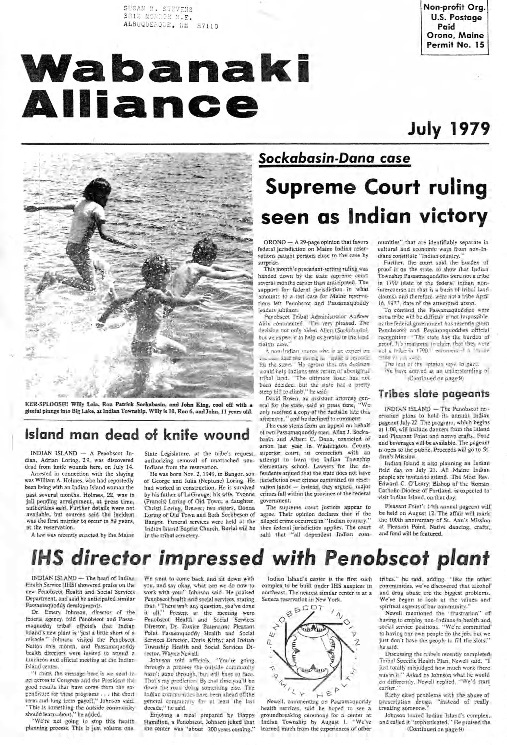
KER-SPLOOSH! Willy Lola, Ron Patrick Soekabasin, and John King, cool off with a
gleeful plunge into Big Lake, at Indian Township. Willy is 10, Ron 6, and John, 11 years old.
Island man dead of knife wound
INDIAN ISLAND — A Penobscot In
State Legislature, at the tribe's request,
dian, Adrian Loring, 29, was discovered
authorizing removal o f unattached nondead from knife wounds here, on July 1
4.
Indians from the reservation.
Arrested in connection with the slaying ’
He was born Nov. 2, 1949, in Bangor, son
was William A. Holmes, who had reportedly
o f George and Julia (Neptune) Loring. He
been living with an Indian Island woman the
had worked in construction. He is survived
by his father o f LaGrange; his wife, Yvonne
past several months. Holmes, 22, was in
(Francis) Loring o f Old Town; a daughter,
jail pending arraignment, at press time,
authorities said. Further details were not
Christi Loring, Brewer; two sisters, Donna
available, but sources said the incident
Loring o f Old Town and Beth Sockbeson of
was the first murder to occur in 89 years,
Bangor. Funeral services were held at the
at the reservation.
Indian Island Baptist Church. Burial will be
A law was recently enacted by the Maine
in the tribal cemetery.
ORONO — A 29-page opinion that favors
federal jurisdiction on Maine Indian reser
vations caught persons close to the case by
surprise.
This month’ precedent-setting ruling was
s
handed down by the state supreme court
several months earlier than anticipated. The
support for federal jurisdiction in what
amounts to a test case for Maine reserva
tions left Penobscot and Passamaquoddy
leaders jubilant.
Penobscot Tribal Administrator Andrew
Akin commented, “I'm very pleased. The
decision not only aided Allen (Soekabasin),
but we expect it to help us greatly in the land
claims case.”
A non-Indian source who is an expert on
this case said tile riding is, quite a setback
for the state.” He agreed that the decision
would help Indians seek return o f aboriginal
tribal land. “The ultimate issue has not
been decided, but the state has a pretty
steep hill to climb,” he said.
David Rosen, an assistant attorney gen
eral for the state, said at press time, "W e
only received a copy o f the decision late this
afternoon,” and he declined to comment.
The case stems from an appeal on behalf
o f two Passamaquoddy men, Allen J. Sockabasin and Albert C. Dana, convicted o f
arson last year in Washington County
superior court, in connection with an
attempt to burn the Indian Township
elementary school. Lawyers for the de
fen ders argued that the state does not have
jurisdiction over crimes committed on reser
vation lands — instead, they argued, major
crimes fall within the province o f the federal
government.
The supreme court justices appear to
agree. Their opinion declares that if the
alleged crime occurred in “ Indian country,”
then federal jurisdiction applies. The court
said that “all dependent Indian com
munities” that are identifiably separate in
cultural and economic ways from non-In
dians constitute “Indian country.”
Further, the court said the burden of
proof is on the state, to show that Indian
Township Passamaquoddies were not a tribe
in 1790 (date o f the federal Indian non
intercourse act that is a basis o f tribal land
claims), and therefore, were not a tribe April
16, 1977, date o f the attempted arson.
To contend the Passamaquoddies were
not a tribe will be difficult if not impossible,
as the federal government has recently given
Penobscots and Passamaquoddies official
recognition. “The state has the burden of
proof. It’ irrational to claim that they were
s
not a tribe in 1790,” commented a source
ciose lo the case.
The text o f the opinion says, in part:
"We have arrived at an understanding of
(Continued on page 9
)
Tribes slate pageants
INDIAN ISLAND — The Penobscot res
ervation plans to hold its annual Indian
pageant July 22. The program, which begins
at 1:00, will include dancers from the Island
and Pleasant Point and native crafts. Food
and beverages will be available. The pageant
is open to the public. Proceeds will go to St.
Ann’ Mission.
s
Indian Island is also planning an Indian
field day on July 21. All Maine Indian
people are invited to attend. The Most Rev.
Edward C. O ’
Leary, Bishop o f the Roman
Catholic Diocese o f Portland, is expected to
visit Indian Island, on that day.
Pleasant Point’ 14th annual pageant will
s
be held on August 12. The affair will mark
the 100th anniversary o f St. Ann’ Mission
s
at Pleasant Point. Native dancing, crafts',
and food will be featured.
IM director impressed with Penobscot plant
S
INDIAN ISLAND — The head o f Indian
Health Service (IHS) showered praise on the
new Penobscot Health and Social Services
Department, and said he anticipated similar
Passamaquoddy developments.
Dr. Emery Johnson, director o f the
federal agency, told Penobscot and Passa
maquoddy tribal officials that Indian
Island’ new plant is “just a little short o f a
s
miracle.” Johnson visited the Penobscot
Nation this month, and Passamaquoddy
health directors were invited to attend a
luncheon and official meeting at the Indian
Island center.
“I think the message here is we need to
get across to Congress and the President the
good results that have come from the ex
penditure for these programs . . . the short
term and long term payoff,” Johnson said.
“This is something the outside community
should learn about,” he added.
“We’ not going to stop this health
re
planning process. This is just volume one.
We want to come back and sit down with
you. and say okay, what can we do now to
work with you,” Johnson said. He praised
Penobscot health and social services, stating
that, “There isn’ any question, you’ done
t
ve
it all.” Present at the meeting were
Penobscot Health and Social Services
Director, Dr. Eunice Baumann; Pleasant
Point Passamquoddy Health and Social
Services Director, Doris Kirby; and Indian
Township Health and Social Services Di
rector, Wayne Newell.
Johnson told officials, “You’
re going
through a process the outside community
hasn’ gone through, but will have to face.
t
That’ my prediction. By that time you’ be
s
ll
down the road doing something else. The
Indian communities have been ahead o f the
general community for at least the last
decade,” he said.
Enjoying a meal prepared by Happy
Hamilton, a Penobscot, Johnson joked that
the center was “about 200 years coming.”
Indian Island’ center is the first such
s
complex to be built under IHS auspices in
northeast. The nearest similar center is at a
Seneca reservation in New York.
Newell, commenting on Passamaquoddy
health services, said he hoped to see a
groundbreaking ceremony for a center at
Indian Township by August 1 “We’
.
ve
learned much from the experiences o f other
tribes,” he said, adding, "like the other
communities, we’ discovered that alcohol
ve
and drug abuse are the biggest problems.
We’ begun to look at the values and
ve
spiritual aspects of our community.”
Newell mentioned the “frustration” of
having to employ non-Indians in health and
social service positions. “ We’ committed
re
to having our own people do the job, but we
just don’ have the people to fill the slots,”
t
he said.
Discussing the tribe’ recently completed
s
Tribal Specific Health Plan, Newell said, “I
just totally misjudged how much work there
was in it.” Asked by Johnson what he would
do differently, Newell replied, “ We’ start
d
earlier.”
Kirby cited problems with the abuse of
prescription drugs, “instead of really
treating someone.”
Johnson toured Indian Island’ complex,
s
and called it “sophisticated.” He praised the
(Continued on page 9)
Page 2
Wabanaki Alliance July 1979
editorials
Age of irony
We live in an age of many ironies. We read about an international
peace effort between world powers; and next to that story, news of a
new weapon to blow us off the face of the earth.
We encountered another kind of irony recently, in a Passamaquoddy reservation home. The television was blaring out a
“Western,” and a cowboy was drawling from under his ten-gallon
hat: “I don’ know Joe, but it looks like Indians to me.”
t
Several Indian youngsters were watching the show, impassively.
What was the TV saying to them? At least unconsciously, the TV was
telling these kids that Indians are bad news. We heard that one
Indian girl told her mother she was glad she did not live on an Indian
reservation — an idea she acquired from TV.
Textbooks and storybooks still portray Indians with ridicule,
exaggeration, or a humor that is ill-disguised prejudice. In 1979, one
might expect to be rid of such stereotypes. We still hear stupid jokes
about Indian chiefs, war dances, and so forth. (We confess to
enjoying a few of the jokes that turn the tables on the white man.)
People can be too picky. Obviously, jokes of all kinds will persist,
as will some unpleasant stereotypes and other instances of bad taste
and prejudice. Not all prejudice is negative: Nobody minds if we are
prejudiced in favor of watermelon on a hot day. It’ the destructive
s
myths that we must relinquish. It’ like pulling out those vicious
s
weeds in the garden — they’ tenacious, abundant, and sometimes
re
grow back.
We all need to make the conscious effort to provide models and
examples of understanding and mutual respect. As reasonable
people, we owe it to our children to destroy stereotypes, before those
stereotypes — the drunken Indian, the lazy Indian, the enemy Indian
— destroy the children. One way to do this is to insist on responsible
presentation of Indians in books, magazines, newspapers, radio and
TV.
To ask for fairness and respect is not asking too much. Not to
demand fair treatment is to allow destructive myths to continue. A
group of Indian persons have been meeting regularly the past couple
of months to edit and revise a textbook for Maine public school
students. This group has addressed itself to a chapter dealing with
Indians.
Many errors of both fact and attitude turned up in the original
draft. The Indian advisory group has corrected these misunder
standings and misinterpretations to the best of its ability. What will
emerge is a brief history o f Maine Indians that is responsible, fair,
accurate and respectful. Finally, a chapter of Indian history and
culture is being prepared by Indians.
There is absolutely nothing ironic about that.
Five-year-old Gary Neptnne wasn’t too scared, as a patient in the dental chair at Indian
Island. Gary is the son of Gloria and Gary Neptnne, Sr., of Old Town.
Healthy community
A story this month reports on a visit to Indian Island by the head
of Indian Health Service, a national agency that is funding health
centers at three reservations in Maine.
The director, Dr. Emery Johnson, is an affable, unpretentious
young man, who seems dedicated to his work. He praised the
Penobscots’ Indian Island complex, and offered encouragement to
the two planned Passamaquoddy health and social services centers,
yet to be built. While this sort of thing might sound all in a day’
s
work to outside persons, such is not the case.
The Indian Island health center is a breakthrough. At last,
Penobscots have direct medical and other services in their own
community. A dentist, a physician's assistant, a lab technician, a
nutritionist — the list goes on. There is a child care center, and space
for senior citizens and their luncheon meetings. Aside from all the
practical advantages, the Penobscot center is of appealing
architectural design, and creates a warm, friendly gathering place for
members and friends of the tribe.
Soon, possibly within a matter of a year or so, Passamaquoddies at
Pleasant Point and at Indian Township will share similar benefits.
Importantly, Indians in Maine are handling their own contracting
for goods and services, apart from the funding agency, Indian Health
Service.
Dr. Johnson said he had been advised that allowing Indians to take
charge of funding and planning was like throwing money away.
Fortunately, Johnson had more confidence than that. His confidence
was well placed.
The glow of Johnson’ praise is welcome, but Indians must
s
remember that goods and services alone do not make a healthy
community. Also essential is a fabric of community values. Wayne
Newell, director of health and social services at Indian Township,
pointed this out at a meeting with Johnson. Alcoholism and drug
abuse are still widespread, he emphasized, and community values
must resist these self-destructive patterns. Nurturing values must
replace the unhealthy habits, which include things like so-called junk
food, smoking and lack o f adequate exercises.
Doris Kirby, director of health and social services at Pleasant
Point, remarked that many persons are too dependent on
prescription drugs.
This brings us to a point worth considering. Health starts with the
individual, and his or her habits. Needless to say, a group of healthy
individuals is a healthy community.
MORE LETTERS ON PAGE FOUR
Wabanaki Alliance July 1979
Page 3
letters
F orgotten Indians
Bangor
To the editor:
This is a letter for the Indians that
everyone seems to, or would like to forget
about, including sometimes their relatives. I
don't have any statistics on how many o f our
brothers and sisters are in various institu
tions in the nation or even in Maine, but I
know the number is growing.
many have people willing to recognize them
and aid them? Even if it’ just writing a
s
letter to let them know they aren’ forgotten,
t
it would mean a great deal. There is no
cultural setting in any institution in the state
to let the Indian learn his culture, or study
his religion, or to help him (or her) take
pride in their race or to retain the pride they
have. The institutions are structured to strip
everyone of their pride, not just Indians
alone.
We are and always have been a proud
race. It is the Indian way to help its brothers
and sisters less fortunate than themselves. I
am asking that you contact any brother or
sister that you know of, that is in any type of
institution, and, if at all possible, to help in
any way. Please do.
The Indian is kin to the Indian, regardless
o f tribal affiliation, we must stand together!
There are many things, too numerous to
mention, that could be done to help, and
I’ sure that you good people reading this
m
will do what you can.
I do not know if you can or will publish
this letter, but I am in hope that you will. If
you need to edit it, do so. Also, if you could
get it published in other Indian papers,
please do so. If not my letter, then an
editorial or anything would do, just some
thing to remind the people that they have
brothers and sisters that need them and any
type o f support they can give.
Tom Thurlow
I am speaking from experience, as I am
now completing my second term of confine
ment at Maine State Prison. I am at the
pre-release center at Bangor. I am Passamaquoddy. I lived on Pleasant Point Reserva
tion many years ago with my mother, Gloria
Moore. I am 30 years old and in the process
o f my second divorce. I have been confined
for eight and one half months and have
three and one half months left till I am dis
charged. The only relative that has been to
visit me in this period is my cousin from
Pleasant Point, Raymond Moore. He took
time out of a very busy schedule, to see me
and see if I needed anything and to tell me
that I could go to his home for furloughs.
This was important to me and I would like
to take this opportunity to thank him very
much. I consider myself fortunate to know
and have as a relative, someone so generous
and unselfish. Don't you agree?
But what o f my countless brothers and
sisters that are confined in this state alone?
How many o f them aren’ so fortunate, how
t
Prison story re v ie w e d
Thomaston
To the editor:
I don't know if any other inmates have
expressed their thanks for your recent
interview with us. If not, I'd like to say
thank you, for myself as well as sending the
other inmates’gratitude. I thought you did a
good story, considering what you had to
work with.
I was disappointed with your evaluation
of the situation down here. Although my
opinions may be a little biased, I’d like to
bring out a few points you may have missed
or misinterperted.
First o f all Mr. Tompkins is not a
spokesman o f the Indian population down
here. I really resented that, especially since I
can speak very well for myself. Don’ get me
t
wrong as I think Mr. Tompkins is a very
good person. But nobody can speak for
another Indian except themselves.
Another point I think you missed, is the
discrimination and violation o f civil rights
inflicted on the average Indian inmate. That
is the greatest problem an Indian faces in
here. But like most things, everybody talks
about unity and helping their Indian
brother, but when it comes to action,
nobody really wants to do anything.
I’m really not bitter about it as it’ a harsh
s
reality o f life. I just feel sad that the average
Indian has allowed themselves to be brain
washed into thinking like a white man.
These are just my personal thoughts, and I
could never speak o f what's on another
Indian’ mind. One thing I can say, is the
s
average Indian doesn't use the gift of
inductive thinking. I think money and tech
nological advancement is more important to
them instead of their own humanity.. I hope
I’m wrong but like everything else, time will
tell.
I’ drawn up a 1983 civil rights com
ve
plaint against the prison. I couldn’ get any
t
legal help or afford a lawyer so I’ doing my
m
own legal work. I can do legal research, and
have a working knowledge o f the law.
Hopefully I’ win my case, that way these
ll
Indians in here will have a way to fight back.
As soon as I enter it in Federal Court, I
expect retaliation from the prison. How
severe it will be I don’ know. I really don’
t
t
care, as I’ convinced I’ in the right.
m
m
Whatever happens happens.
Brian J. Attean
UP AND OVER — These cartwheelers were spotted in the hall of the Indian Island
community building recently. They are Greta Neptune, left, of Indian Island, and Star
LaCoute, of Indian Township.
Positive influence
The real news
Mt. Pleasant, Michigan
To the editor:
As a recipient o f the “Alliance” for
approximately the past year, I wish to thank
you for your fine, informative publication.
I’ not sure how my name was added to the
m
list o f subscribers, but suspect my aunt, Jean
Watson, o f Milford, MI. (daughter o f Joseph
E. and Jane M. Ranco and granddaughter
o f Peter and Mary Jane Francis Ranco) has
seen to it that I keep informed. I greatly
appreciate the individual and collective
efforts which bring me the real news.
Winston-Salem, N.C.
Enclosed is a small contribution which I
To the editor:
hope will assist in maintaining those efforts.
Just received June issue o f Wabanaki I would also like to encourage at least the
Alliance. I believe every issue gets better. consideration o f a donation on the part of
Especially interested in the article page 4 all readers.
_ __
Jim Houston
“Stalking the Fiddlehead!’ I wonder if you
would send me the address o f Rev. Donald
Daigle. I would like to write him.
Togus
It would be difficult to say which part o f To the editor:
your paper I enjoy the most I read each issue
We have been informed by the Depart
from cover to cover. Especially interested in ment o f Indian Affairs that you publish such
each month’ flashback photo, but to be a journal. We would appreciate any infor
s
brief and to the point Wabanaki Alliance is mation you might send us.
Stu Groten
a great paper.
Veterans Administration
Augustus Webb
Published monthly by the Division of Indian Services [DIS] at the Indian Resource Center,
95 Main St., Orono, Me. 04473.
To the editor:
I look forward so much to the newspaper.
June’ issue was filled with so much good
s
stuff. Your article on the Thomaston in
mates was forthright and honest. I feel that
Wabanaki Alliance has been such a positive
influence binding people together and also a
spring board for social action.
Pat Tompkins
Steven Cartwright, Editor
William O ’
Neal, Ass’L Editor
Notes improvement
Wabanaki Alliance
Vol. 3, No. 7
DIS Board of Directors
Jean Chavaree [chairman]
John Bailey, Public Safety Coordinator
Albert Dana, Tribal Councilor
Timothy Love, Representative to State Legislature
Jeannette Neptune, Community Development Director
Teresa Sappier, Central Maine Indian Assoc.
Susan Desiderio, Assn, of Aroostook Indians
Maynard Polchies, President, Aroostook Indians
Melvin L. Vicaire, Central Maine Indian Assn.
Reuben C. Cleaves, Representative to State Legislature
July 1979
Indian Island
Pleasant Point
Indian Township
Indian Island
Indian Township
Orono
Houlton
Houlton
Mattawamkeag
Pleasant Point
DIS is an agency of Diocesan Human Relations Services, Inc. of Maine. Subscriptions to
this newspaper are available by writing to Wabanaki Alliance, 95 Main St., Orono, Me.
04473. Diocesan Human Relations Services and DIS are a non-profit corporation. Contri
butions are deductible for income tax purposes.
VA inquiry
Page 4
Wabanaki Alliance July 1979
letters
Indians spring back
To the editor:
Would you please let me know how much
it is to jstart a paper. I got my Indian paper
from my uncie but I want to start paying for
my newsletter that is coming to me now.
This note I wrote is something that just
came to my head. I’ not the best speller,
m
but I hope you like it. I have been married to
a white man for 14 years and it’ ending. I
s
don’ want you to use my real name but my
t
Indian name. I also want my sister to have a
newspaper too, so if you could let me know
the price I sure would appreciate hearing
from you.
There isn't enough room for an Indian,
why because I’m an Indian and living in a
white man’ world for (21) twenty-one years
s
before you know it you’ pushed aside.
re
Why? Because an Indian thinks one way
and a white man thinks another.
But we Indians always spring back no
matter how hard we are pushed. Why?
Because we are proud to be Indian.
Morning Star
(Penobscot)
Praise for Emma Francis
Bangor
To the editor:
I would like to let all o f the readers o f the
Wabanaki Alliance know what a fine job ,
Emma Francis has done in developing the
gymnastic program for the girls on the
Island. She has worked very hard on this for
the past two years. Emma went to many
board and council meetings to obtain
funding for the program, and then personal
ly saw to it that the girls were transported to
Bangor and back.
I am confident that the girls from the
Island and their parents join me, Vickie
Daigle, and the school in saying “Thank
you, Emma, for the great job you have
done!”
At this time I would also like to mention
how well the five girls and one boy did in
their gymnastic training. I am very proud of
them all: Tami, Sherri and Kim Mitchell,
Lee Ann Decora, John and Christa King.
Vickie Daigle
Rudy Ramirez
Indian query
Greensburg, Indiana
To the editor:
Picked up the Wabanaki Alliance paper
to read it and under the heading Letters to
the Editor: I read Creek Indian Query?
Now what in the hell is that?
I never wrote anything to your paper like
that.
Creek’ up your way? I’ not Creek. I’
s
m
m
Chippewa. I’ never changed.
ve
Some one made a mistake somewhere,
check it out ok?
Stewart Rodda
Le tte r o f tha nks
Gardiner
To the editor:
This is an open letter to all o f those
associated with the Maine Indian com
munity.
On behalf o f the sponsors and staff of the
Maine Studies Curriculum Project, I wish to
express my deep appreciation for the
generous contribution o f time and thought
given to the review and writing o f the Maine
Dirigo textbook and educational program
being produced by the Project.
The many hours o f travel, discussion,
writing, and review which were given so
freely by so many will make this book of
special value to Indians and non-Indians
alike. The chapters on the history of Maine
and the Wabanakis will fill a much
neglected area o f Maine history and correct
inaccuracies and misconceptions.
I wish to give a very special thank you to
the writing committee, to those who
attended the meetings and reviewed the
manuscripts, and to the American Friends
Service Committee for supporting and
assisting in coordinating the effort with my
office. It was a pleasure meeting all of you
and working with you.
Dean B. Bennett
Director
Maine Studies Curriculum Project
A donation
Oneida, Tenn.
To the editor:
Heard about your fine publication, the
“Wabanaki Alliance” newspaper. I’ very
d
much appreciate being put on your mailing
list. Will send donations from time to time.
Also, heard that you would like articles, etc.
to publish — have enclosed a copy o f our
“United Lenape Bands” Aims and Goals —
this, is what we try to follow as closely as
possible, in our U.L.B. I wrote these Aims
and Goals, and you have my permission to
copy any part or all o f it. If you would like
more articles on our U.L.B. — our work,
etc. I’ be more than happy to send
ll
material. Also, I have much raw material for
Indian arts and crafts work, such as buck
skins, buffalo horns, white tail and mule
deer antlers (in sets> bobcat and wolf hides
(all tanned) etc. If your members are
interested in securing some o f these items, I
could send you a price list. Will close for
now, so please put us on your mailing list
and send any information you may have,
that you think will be o f importance to us —
have enclosed SI.00 — to start with.
Chief Sam Gray W olf— U.L.B.
Rt. #2 Box 286
Oneida, Tennessee 37841
P.S. — your may print my name and
address, as I’ answer any and all letters
ll
from our Indian peoples.
The steepest mountain
To become a man you have to climb
the steepest mountain, the mountain of
manhood, for it will not be easy; it takes
great will, strength and courage to fight the
pain which awaits you climbing the roughest
trail.
To survive you must go on and on, learn
great wisdom as others encourage you not to
stop, for it is very dangeftms.
Once you have stopped, too weak to go
on, you will have no place to go, you can’ go
t
forward or back, therefore you must step
aside, clearing the path so that others can go
on fighting for their survival.
Staying there and wasting your life away,
not knowing what to do, but hanging your
ISLAND BEAUTY — Angela Lamberth, 7, stopped by on a visit with her grandfather,
Joseph Biscula, at Indian Island. Angela is from an even larger island ... in the Philippines,
where her father, David, is stationed with the Navy. Her mother, Mary, is thinking of buying
a house on Indian Island. Angela said she wants to move to the Island. The Philippines have
too many snails, beetles, lizards, bamboo vipers, and boa constrictors, she said. She said
she’ most looking forward to making her first snowball.
s
head low for no one to see.
For those who fought hard to reach the
top a great change comes over you as you
enter the square o f the four directions. You
have a chance to see life around you, to fast
and pray, thanking the Lord for having you
as a chosen one, to live a good life from there
on.
There you will be granted the powers of
love, courage, faith, wisdom to know the
strength to fight the evil and to have great
respect for everything and everyone around
you; to enjoy freedom like the great buffalo
of the endless plains.
Matthew Dana
Indian Township
A refugee Cherokee
Santa Barbara, Ca.
To the editor:
The Reorganization Act o f 1934 provided
for, freedom o f choice, each tribe could
reject it in a referendum held by secret
ballot. Tribes that accepted the 1934 Act
could organize under it for a local tribal
government. Under the Johnson O ’
Mally
Act that was also passed the same time that
the Reorganization Act of 1934. The tribes
came out from under federal jurisdiction
and could decide on allowing other political
subdivisions o f the states and private
agencies in to help the Indians build up
their economic enterprises, through this
flexible system o f contracts and o f being
given grants to help the Indian develop their
economic system. But they were given free
choice to decide on the non-federal help
under the Johnson O ’
Mally Act o f 1934 and
the Act o f 1934 called the Reorganization
Act o f 1934.
Under the Reorganization Act the tribes
who voted to come under this Act were also
allowed to organize under their local self
tribal government, but they were to call their
Indian owned and operated corporations
Federal Charted for Economic Enterprise
and an Indian Commissioner was appointed
his duties were to encourage Tribe self
government and tribal owned and operated
and worked cooperative enterprises, under
the Reorganization Act o f 1934, now it
seems to me the Indian people should get
their act together and first find out which
tribes voted to come under the Reorganiza
tion Act o f 1934 and which voted to come
under the Johnson O ’
Mally Act o f 1934.
We call ourselves Refugee Indians be
cause we or our representatives have never
given up our original title and ownership to
our land. We exist as a distinct national
community and we will never relinquish our
sovereignty to our ancestors’ claim o f land
sovereignty unless the United States Gov
ernment makes war upon our Bear Nation,
and they have to find us first since we are
Indian Refugees and spread across Ameri
ca, we consider all o f America our sovereign
right and home lands. We cannot be
dissolved as a free united Indian nation
because o f the expulsion from our lands, we
are refugees o f this land and we are still a
nation until we ourselves decide to relinguish title, which we will never do since
the blood and guts and flesh and bones of
our ancestors are mixed in this land and it
speaks to us and is alive to us and tells us we
still have sovereignty to this land and that
our rag-tailed disposessed people are still a
sovereign nation, needless to say we can’ get
t
federal jurisdiction on us because the
United States hasn’ had a Indian War with
t
us and beat us.
But we claim our right under the 1924 Act
that states every Indian born in lands
belonging to the U.S. is a citizen, so we
claim all the United States Constitutional
rights every other citizen has, we feel this is
about what white America does they claim
all their rights as an American here and still
cling to their white European roots and take
care o f the people overseas while the Native
Peoples o f this land get no human rights or
legal rights, so we feel we can help change
all this by our own special political
sovereignty, since we claim our Indian
Sovereignty we come directly under the
United States Constitution, which we re
spect in the fact that it is the only law o f this
country and the officials who are elected are
required to serve it, therefore we deal only
with the Constitution and Constitutional
Law for it is the true government, the men
come and go and only are servants to serve
it.
Pauline Grehalva
Refugee Cherokee
Diocesan camp offers scholarships
PORTLAND — A number o f half-scholarships are available this summer for Camp
Pesquasawasis at Poland Spring, operated
by Diocesan Human Relations Services, Inc.
Four two-week sessions are scheduled at
the camp, starting July 1 The co-ed camp
.
for ages six to 13 offers Red Cross
swimming, boating, sports, art, radio,
photography and worship services, with the
Rev. Frank Morin, chaplain.
For further information contact John DiBiase, director, 87 High Street, Portland.
Tribe to enforce
logging policy
By Steve Cartwright
INDIAN TOWNSHIP — The practice of
clearclutting areas of the 17,000 wooded
acres of the Passamaquoddy reservation
here became strictly illegal July 1, and other
new regulations protecting the tribe and
Indian woodsmen are equally stringent.
Bruce Francis, head o f the tribe’ recently
s
established Forestry Department, said he
has sought laws with “teeth” in them, plus
the authority to police all tribally held land.
Francis, the first Passamaquoddy Indian to
graduate from the University o f Maine at
Orono’ forestry school, has extended his
s
authority to stopping speeding vehicles
along Route 1 in the Township.
,
Among the tighter rules adopted by the
Joint Passamaquoddy Tribal Council is that,
“all timber harvesting on Indian Township
shall require a permit issued through the
Decal affixed to Indian forestry depart
ment’s pickup truck.
Passamaquoddy Indian Forestry Depart
ment.” Such a permit must describe the
area to be cut, a list of wood by species and
units, plus stumpage rate.
Only one permit may be held by a
contractor at any given time, the regulations
stipulate, only one crew is allowed per
logging contractor (not more than five
persons), and the majority o f crew members
must be enrolled in the Passamaquoddy
tribe. The new forestry department, “will be
responsible for seeing that all permit
requirements have been met.”
It’ a whole new ball game for Indian
s
Township, which shares its forest resources
with Pleasant Point Passamaquoddy reser
vation. Francis and other tribal officials
acknowledge that effective forest manage
ment has been a long time coming, and that
unregulated cutting has in the past led to
the devastation o f some o f the Indians’
prime woodlands.
Enforcement sounds easy on paper, but
Francis at press time had just one trained
forester working in his fledgling depart
ment, plus several assistants learning skills
on the job. One of those assistants, Joe
Socobasin, a Passamaquoddy, knows the
problems in a personal way.
"It’ their land. Why should anyone tell
s
them what to do with it,” Socobasin asked
rhetorically. He said his father is a
woodcutter at the Township, and father and
son don’ see eye to eye on forestry
t
management. Seasoned contractors, assign
ed lots for their own use by the tribe, may
not react favorable to sudden restrictions
and requirements that cramp their style.
Currently, there are four crews working
the Indian Township woods, and one of
them reportedly does not meet the require
ments of a majority of Indians involved. New
regulations had not been enforced at the
time this article was written.
The four pages o f regulations state that
only one skidder per crew will be permitted
any logging operation, and skidders “must
be owned or leased with an option to buy, by
a tribal member.” Also “each contractor is
responsible for the work of employees,
associates or helpers and for their compli
ance with the terms o f the permit and the
guidelines listed.”
Explicit procedures for cutting are set
forth: Trees eligible to be cut will be marked
at chest level, and at the stump, by forestry
Indian foresters, Russell Roy, left, Paula Bryant and Joe Socobasin stand beside skidder
department staff. In other words, all trees
and only those trees marked exclusively by that belongs to Joe’s father.
the forestry department may be harvested.
Logging being a year-round business at
Indian Township, the regulations require
snow be cleared from around trees before
they are felled. Trees must be limbed and
topped before being yarded.
The new rules demand that contractors
construct their own truck roads, installing
necessary bridges and culverts, and pay for
same. Plans for new roads must be okayed
by the forestry department. Any damage to
the roads attributable to logging operations
is the responsibility of the contractor.
Contractors must inform the department
who its purchasing agents are, and those
agents must supply forestry officials with a
copy o f scale slips. Stumpage values shall be
reported to the Department of Indian
Affairs. Copies o f stumpage checks must be
given to the forestry department for review.
Regulations declare that, “ Payments for
stumpage will be for the best products that
can be made.”
Orders regarding buildings and fire
prevention are straight and to the point.
Buildings shall not be constructed without
the department’ permission, and that
s
applies to trailers as well. Buildings or
trailers must be removed when a job is
completed. Fires can only be built on snow.
In case of forest fire, loggers and other
woods workers must drop what they’
re
doing and join firefighting efforts. Unless
otherwise covered, such persons will be paid
going rates for their assistance.
A woods road at Indian Township — 17,000 acres of timber land.
George Stanley of Pleasant Point enjoys log
ging; “You can bunt anytime you want to.”
Violations will apparently be dealt with
evenly and quickly. "Should it be found that
any contractor is in violation o f any o f the
aforementioned policies and procedures, the
Indian Township Forestry Department is
duly authorized by the Joint Passama
quoddy Tribal Council to 1 Halt the logging
)
operation o f the contractor in question until
the violation has been remedied; 2) Direct
the contractor to perform whatever tasks are
necessary to bring the operation within the
requirements.”
Hauling a heavy load along Route 1, Indian Township.
Page 6
Wabanaki Alliance July 1979
Township spared
budworm spray
INDIAN TOWNSHIP — The Passamaquoddy reservation here was all set to be
sprayed in the spruce budworm control pro
gram. but last minute changes in plans
prevented the poison from being applied to
10,000 wooded acres.
Tribal forestry department head, Bruce
Francis, said he had at first requested state
authorities to spray against the pest, but
later objected because of the kind o f spray.
“I'd given them the okay to go ahead,
with the idea that they’ spray Sevin. Then I
d
heard it was going to be Dylox,” Francis
said. He said tribal Gov. Harold Lewey
formally requested the state not spray any
areas of Indian Township.
Several Indians reportedly expressed
concern about spraying Indian Township,
where drinking water comes from lakes and
streams. Their concern may have influenced
Francis and Lewey to change their minds.
Tribal forester Russell Roy said there was
“too much standing water” in the woods to
safely spray Dylox.
The organic Sevin is seen as a safer
insecticide than the chemical Dylox. Dylox
is more toxic.
SPIT AND POLISH — Maxwell Stanley keeps the two fire engines at Pleasant Point ready
for action.
Boxers battle first round
at Indian Island
INDIAN ISLAND — The first Indian
invitational boxing tournament at the
Penobscot Nation drew a crowd o f more
than 100 paying spectators, and participants
from as far away as Boston. Maine Indians
fought well, and some scored high, in the
recent event.
The first bout went to an Indian
Township boy, Don Newell, with a TKO
over Jeff Brouser o f Lewiston. Newell weighs
120, his opponent 119 pounds.
of the recent first Indian Island invitational boxing meet were from left,
Chris Francis, Miles Francis, Kirk Francis and Danny Mitchell. The boys were sponsored by
the Penobscot tribal recreation department
Dana-Burf wed in outdoor rites
INDIAN TOWNSHIP — Dozens of
guests joined in celebrating the traditionalstyle wedding o f Samuel Dana, a Passamaquoddy, and Joann Burt, a Micmac, at Long
Lake Campground, June 9.
The bride is the daughter o f M. Patricia
Burt o f Portland. She is a graduate of
Deering High School, Portland, and Whea
ton College in Norton, Mass., where she
earned a degree in economics.
The groom is the son o f Albert and
Kirk Francis, 76 pounds, was the victor in
the fourth bout, against Tony LeBretton, 67.
Both are Indian Islanders. In the fifth
round, Brian Davidson, 80 pounds, lost to
Dennis Pickman o f Bangor, who held a ten
pound edge over his opponent.
Danny Mitchell o f Indian Island fought
Obituaries
Philomene Dana, o f Peter Dana Point. A
graduate of Higgins Classical Institute, he
plans to study business administration at
University o f Maine. The couple is living at
the campground, and will move into a new
home on the Dana Point road, when
completed.
Passamaquoddy tribal Gov. Harold Lew
ey presented the newlyweds with the gift of
an Indian basket.
Indian panel revises
history book
ORONO — A chapter o f Maine’ history
s
dealing with Indian people has been ex
tensively revised by a group o f concerned
Indians, meeting here regularly the past few
months.
The chapter delves into the history and
culture o f Indians in Maine, but was con
sidered innaccurate and misleading, prior to
the revisions by the ad-hoc committee. The
chapter will appear in Dingo, a school text
book that has been assembled and edited by
Dean B. Bennett o f Maine Studies Curricu
lum Project, Gardiner. Bennett said the
Bout two involved small fry: 60-pound
Miles Francis squared off against Chris
Francis, but the result was a no-contest
decision, between the two Indian Islanders.
In the third confrontation, local favorite
Sterling Lolar, 164 pounds, knocked out
Brian Polchies, 167, o f Boston. Lively
announcing was provided by Deraid Soloman o f Indian Island, a Maliseet who has
been away from the Island 25 years.
Frankie Cleaves o f Pleasant Point, in round
six. Mitchell, 112 pounds, beat Cleaves, 122
pounds. Joey Gamache, 98, from Lewiston,
boxed Steve Marshall, 105, from West
Quincy, Mass., in the seventh bout, but this
reporter lost track o f the score.
The eighth round found Mike Kyajonan,
132 pounds, a victor over Mike Stevens, 137,
o f Brockton, Mass. Mark “dance master”
Adams, a 150-pound Bangor boy, clobbered
Chris Morley, 141, from Boston, in the ninth
bout. Adams was judged best boxer o f the
evening.
Gary Giles, 152 pounds, from York, beat
Stewart Simon, 154, South Boston, in the
tenth match at the ring.
The “heavies” got their turn in the
eleventh and twelth bouts. By far the biggest
cheer o f the tournament went to a loser,
Dale Newell o f Indian Township, 220
pounds. Dale put up an impressive fight
against his 180-pound opponent, Chris
Clukey.
Finally, Howard Hunter, 208, o f Bangor,
outboxed Richard Poulette, 203, Dorches
ter, Mass.
The Indian Island exhibition was produ
c e d - by Jerry Thompson, a promoter from
Boston.
book, funded by the state Department o f
Education and Cultural Services, will prob
ably be published this fall.
MARY MAE LARRABEE
INDIAN TOWNSHIP — Mary Mae
Larrabee, 44, died unexpectedly June 15,
1979, at Peter Dana Point. She was born
May 30, 1935, at Peter Dana, daughter of
Lola and Rose Ann (Sopiel) Sockabasin. She
was a librarian and an teacher at the school
at Peter Dana Point. She is survived by her
husband, Wayne of Peter Dana; one step
son. Wayne Jr. o f Kittery; one daughter.
Lucinda Hood of Peter Dana; one step
daughter, Susanne of Kittery; four brothers.
David, Clayton, Rapheal and Patrick, all of
Peter Dana; three sisters, Florence Patoine
o f Brookton; Diane Campbell and Annabelle Stevens, both of Peter Dana; two
granddaughters, Tammy Mae .and Angela
Mary of Peter Dana.
A Mass o f Christian burial was celebrated
at St. Ann’ Church, Peter Dana, with the
s
Rev. Joseph Laughlin officiating; burial in
the tribal cemetery.
ROBERT A. TOMAH
The book will not only attempt to portray t
HOULTON — Robert A. Tomah, 38,
Indians fairly, but also deal with Francodied July 14,1979, at a Caribou hospital. He
Americans in Maine, and other aspects of
was born in Kingsclear, N.B., March 6,
state history.
1941, son o f Leo and Mary Ellen (Paul)
Serving on the volunteer committee were Tomah. He was a member o f St. Mary’
s
Andrea Nicholas o f Tobique reserve, in Church. He is survived by his father of
Canada; Brenda Polchies o f Houlton; and Houlton; two sons, Eric o f Big Cove, N.B.;
Carol Dana, Vivian Massey, Debra Mitchell,
Christopher o f Houlton; three daughters,
and Ann Pardilla, all o f Indian Island.
Robin and Mary Ann o f Big Cove, N.B.,
Alice o f Houlton; two brothers, Aubrey and
James o f Houlton; two sisters, Mrs. Eleanor
Perley of Houlton, Mrs. Deborah Haley of
Presque Isle. Mass was celebrated at St.
Mary’s Church, with the Rev. John E. Bellefontaine officiating. Interment will be in St.
Mary’ Cemetery, Houlton.
s
CM IA holds annual meeting
ORONO — Central Maine Indian Asso
ciation’ annual meeting is set at 7 p.m.,
s
Thursday, July 12, according to CMIA
director, Tom Vicaire.
Four positions will be filled in annual
elections, including the organization's vice
presidency, Vicaire said. “Everyone is
encouraged to attend,” he said. The meeting
will be held at Indian Resource Center, 95
Main St., Orono.
Kingsclear celebrates
KINGSCLEAR, New Brunswick — The
Maliseet reserve at Kingsclear will be
holding its annual Feast Day in honor of
Saint Anne on July 28. The celebration will
extend to the next day and wall include
races, fireworks, and other outdoor activities
as well as Indian dancing, picnics, and
religious ceremonies.
Everyone is invited.
Wabanaki Alliance July 1979
Page 7
200,000 oysters
for aquaculture
PLEASANT POINT — A total of 200.000
seed oysters were flown to Maine from
California recently, to be used in the
Passamaquoddy tribal acquaculture busi
ness.
Started last year, the business may be able
to market some 2.000 oysters this summer to
restaurants and other retailers. Project
director Norman Laberge said it takes three
to four years for the seed oysters to reach
saleable maturity. Last year the tribe
ordered 40.000 seed oysters.
Working in acquaculture this summer are
Passam aquoddies. Lenny Sapiel. Ann
Moore and Martin Francis. Jr.
Training funds available
Micmac lad finds Boston
has friendly Indian center
BOSTON — Francis Clair walked into
the Boston Indian Council building with a
grin. “ Francis! How are you doing,” was the
response.
Francis, an 18-year-old Micmac from Big
Cove reserve in New Brunswick, isn’ sur
t
prised when people know and greet him in
Boston. He recently hitch-hiked to Boston
Indian Council, from Canada, because he
felt like it. “I decided to come down here to
see what s happening.” Francis said.
Francis has a sunny outlook on life that
hides a difficult upbringing involving fights
with his father, and a foster home in
rredericton. N.B. He has completed ninth
grade, and is now pursuing more education
through special programs for dropouts.
Raised by grandparents. Francis left the
reserve at age 1 . He traveled to Maine to
5
pick potatoes, and has been raking blue
berries since age eight. His Fredericton
foster parents' house is the place he calls
home. At one time, he said. “ I went to my
father’ place (to live), but we started
s
drinking, fighting.”
Francis is unsure o f his future. He might
attend a trade school. He doesn’ think he
t
will ever forget Micmac and the “ mother
language.” He said, "there is something to
learn in cities,” and, “ I met all kinds o f Big
Covers around here.”
PRESQUE ISLE — Training funds are
available to eligible employers who are
selected to participate in the on-the-job
training program (OJT), of Aroostook
County Action Program (ACAP).
The OJT program, which is funded under
the Comprehensive Employment ana Train
ing Act (CETA). matches CETA eligible job
ready individuals with jobs and reimburses
the employer for 50 per cent o f the entry
level wage paid during the employee’
s
training period. This financial incentive
provides an opportunity to employers to
increase the number of their staff or to
replace an employee who has left the job.
Eligible OJT training sites will include
businesses of any size which provide year
round full-time employment. The length of
training will vary according to the job
description and skills required. ACAP Em
ployment and Training will provide em
ployability assessment to match the charac
teristics and skills of the trainee with the
employer's needs. OJT participants work
the employers full time work week and are
paid the em ployer’ usual entry wage rate
s
for the occupation. ACAP Employment and
Training will reimburse the employer, on a
monthly basis, for 50 per cent of entry level
wages for up to 26 weeks.
Any employer in Aroostook who would
like more information on the OJT program
is invited to call ACAP OJT coordinator,
Terry Condon at 764-3721. Condon will be
available to visit a place of business to
explain the OJT program.
Eskimo takes Church job
The Rev. Raymond Baine, 53, has become
district superintendent o f the United Meth
odist Church in Santa Ana, Calif.
This is the first such appointment outside
the Oklahoma Indian Missionary Confer
ence. O f native Alaskan descent, Baine will
lead 50 congregations and 27,432 persons.
TUREEN'S AIDE — Connie McCloud, a
native of Aruba in the Carribean, is em
ployed as an aide to Native American Rights
Fund lawyer Thomas N. Tureen, who is in
charge of Maine Indian land claims.
McCloud works at Tureen’s Portland
offices. A newcomer to Maine, she says she
is very fond of the state, but has been too
busy to do much sightseeing.
m d io n s w in re p re s e n ta tio n
The U.S. Justice Department has ob
tained a consent decree requiring Thurston
County, Neb., to create seven districts of
equal population to help restore Indian
membership on the board of supervisors.
In 1971 the county changed the method of
electing supervisors from seven single-mem
ber districts to at-large balloting. A suit
challenging that action was filed last year.
Indians make up 28 percent of Thurston
County’ population but compose 77 and 81
s
percent o f the population in two of the old
seven districts.
Indian children
a conference topic
FLAGSTAFF. Ariz. — - The Arizona CEC
Federation will host a topical conference on
the Exceptional Indian Child and Indian
Education.
The conference will be held in Flagstaff.
Oct. 12-13. 1979. Federation President
Elaine Peterson issues an invitation to all
individuals concerned with the education of
American Indian children and vouth.
Interested individuals may contact the
chairperson. Robert Horn. Round Rock
Trading Post. Chinle. Ariz. 86503.
Ways sought to Improve Indian housing
WASHINGTON — A plan to test wavs of
improving the design, quality and pro
duction of housing for American Indians is
being reworked to ensure it reflects the views
of Indians themselves, according to Depart
ment of Housing and Urban Development
Secretary Patricia Harris.
Indian opinion will be solicited to improve
the proposal or to devise an alternate
method.
Effectiveness of the effort will denend
largely upon the active cooperation of the
Indian community. Harris said. "W e expect
to use this additional time to solicit specific
comments and suggestions. The initiative
lies with the Indian people themselves."
In the meantime. HUD says it is prepared
to approve construction management pro
posals initiated by individual Indian housing
authorities.
*
BIA opens northwestern agency
WASHINGTON — A Bureau of Indian
Affairs agency has been established at
Hoquiam, Washington, to serve nine Indian
tribes located on the Olympic Peninsula,
assistant secretary for Indian Affairs,
Forrest J. Gerard announced.
Gerard said the new agency wall more
effectively meet the increasing tribal re
quests for services to Olympic Peninsula
reservations and will improve Bureau
performance in meeting responsibilities
under the provisions of the Indian Self-De
termination and Education Assistance Act.
In the past the Western Washington
Agency, located in Everett, Washington, has
served 21 tribes in its geographic juris
diction. Under the change announced today
the Western Washington Agency will be
renamed the Puget Sound Agency and will
continue to serve 12 tribes in the Puget
Sound Area. The agency in Hoquiam will be
called the Olympic Peninsula Agency.
WITH DISPATCH — Frances Cleaves, a dispatcher at Pleasant Point’ new municipal
s
building, is one of several persons who provide full-time dispatching for the Passamaquoddy
police and fire departments.
Page 8
Wabanaki Alliance July 1979
Health services take shape
on Maine reservations
By Bill O’
Neal
Five years ago the Maine reservations
counted themselves lucky to have even one
tribal nurse to care for their health needs.
Today, with federal recognition and the
influx o f dollars and counsel from Indian
Health Service (IHS), health care on the
reservations will soon rival or surpass most
Maine towns.
Indian Island already has a fully func
tioning health center, complete with exam
ining rooms, a dental office, laboratory,
counseling rooms and office space. Pleasant
Point is scheduled to begin building a
similar facility this month and will have it
completed in Nov., according to tribal lieu
tenant governor Giv Dore. It is estimated
that Indian Township’ center will be com
s
pleted sometime next year.
Services will range from examinations at
reservation health centers by physicians’
assistants to mental health and counseling
by trained staff. A key feature o f the new
health programs will be a referral system
through which patients coming into the
clinic will be referred to area doctors or
other health-related people, holding con
tracts to provide services with the tribe.
Each center wiH have physicians, dentists
and registered nurses on full or part-time
bases.
According to Eunice Baumanndirector of
the Penobscot health center on Indian
Island, patients entering the center are ex
amined by a physician’ assistant. They are
s
then referred, according to their ailments, to
one of more than 40 area doctors, con
tracted to work with the tribe. Any expenses
not covered by conventional medical insur
ance are picked up by IHS.
Eunice Baumann, director of Indian Island
health center.
Planned, or already operational, are
pharmacies and basic laboratory facilities to
do blood and urine analyses and to carry out
specific diagnostic screening as for diabetes,
otitis media (a respiratory ailment), and
other diseases found to exist in the Indian
community. Wayne Newell, director of
health and social services at Indian Town
ship, predicted that the Passamaquoddies
would emphasize screening and crisis-inter
vention “for a couple o f years, because the
problems have been ignored for so long.”
According to Baumann, studies in Maine
have shown that “medical problems of
Indians in Maine are not variant from other
lower socio-economic groups.”
Routine services offered at the centers will
be supplemented by visits from area
specialists who will hold clinics in their
fields.
Health education will also receive em
phasis for the first time on the reservation,
according to Pleasant Point health and
social services director, Doris Kirby. Coun
seling ranging from nutrition to applying for
social security benefits will be offered at the
centers. In addition, Indian Island is dis
tributing a regular health newsletter.
Each reservation will have community
health representatives (CHR) to act as
liaison between the health centers and tribal
members. They will be charged with going
into the homes and monitoring the health
needs in the community. According to
Newell, at Indian Township the CHR’ will
s
be required to speak Passamaquoddy.
Wayne A. Newell, director of Indian Town
ship health services.
partment o f Indian Affairs next fiscal year, Our tribal nurse goes to conferences on
the tribes have been left $200,000 short in native healing. It’ not that well-defined a
s
their budgets. At a recent meeting o f health field yet. Nobody’ going to prescribe
s
officials at Indian Island, Dr. Emery anything without m ore information, but it
Johnson, director o f IHS, stated that is something we plan to get into.”
previous court cases have shown that the
As Wayne Newell put it, “The good Lord
presence o f federal dollars may not be used doesn’ charge you for prescriptions (with
t
as a reason for withdrawing state funds,
native medicine); He just tells you where to
find it.”
Newell said it was too early to comment
on what action will be taken concerning the
state’ withdrawal, but said, “My personal
s
belief is to fight for those resources. At the
time the IHS contracts were planned, it was
with the assurance that the state would
continue services.” He termed the state’
s
INDIAN ISLAND — Teresa Sappier, a
action “a breach o f promise, not just to
lab technician at Penobscot Health and
Indians, but to the federal government.”
Social Services Department, plans to enroll
A primary concern on the reservations is
at Gallup Indian Medical Center, in Gallup,
increasing the number o f Indian personnel
New Mexico, starting next month.
working in the health centers. According to
The two-year program leads to a degree as
Newell this problem is being attacked by
a physician’ assistant, and is funded
s
encouraging reservation youths, going into
through the U.S. Indian Health Service.
higher education, to consider health fields
Sappier, a Penobscot, graduated from
and by “getting (reservation) people in now,
University of Maine at Orono with a degree
with an eye to later training.”
in microbiology. She has worked at the
Community response to the newly in
university’ Cutler medical center, and at
s
augurated programs has been slower than
Seaton Hospital, Waterville.
expected. At Indian Island, where most of
Sappier said she may return to Maine to
the services are established, Baumann at work after graduation. She is currently a
tributed the sluggishness to a lack o f under
member o f the Wabanaki Alliance board of
standing and confidence in the physician’ directors.
s
assistants or nurse practitioners. “I feel
people are put off by the term nurse prac
titioner,” she said. “It’ not the same thing
s
Health m eetin g
as a practical nurse,” she emphasized.
“They get two years specialized training.”
slated in Spokane
She also pointed out that the staff has a
physician backup with whom to confer.
“They are well enough trained to recognize
SPOKANE, Wash. — This city is the
their own limitations,” she said.
scheduled site o f a third annual Indian/
Despite the m odem facilities and syste
Alaska native health conference, July 22-26.
matic approach to medicine adopted by the Among featured speakers will be Emery
tribal planners, some money has been set Johnson, director of the federal Indian
aside to study Indian medicine. According Health Service (IHS), Howard E. Tommie o f
National Indian Health Board (NIHB), and
to Baumann, “There has been an en
couragement on the part of IH S all over John Echohawk, director of Native Ameri
the country to get back to native healing. can Rights Fund (NARF).
Terry Sappier to
enter IHS school
The one major health problem not
currently included in tribal health planning
is alcoholism. At present, Wabanaki Corp.,
a central organization serving all Maine
Indians, is the primary Indian agency
addressing the problem. Some tribal health
officials, however, expressed dissatisfaction
with the effectiveness o f the agency, which
has been plagued with personnel and
political problems, and suggested that at
some point alcoholism programs would be
managed at the reservation level. Indian
Health Service has been reluctant to fund an
alcoholism program on the reservation as
long as Wabanaki Corporation is operating.
The possibility exists that IHS will fund the
agency after a five year trial period,
however. Wabanaki Corp. is currently
funded by National Institute o f Alcoholism
and Alcohol Abuse (NIAAA).
Exactly who will be served by the
reservation health centers has not been
decided. Baumann said efforts are under
way to expand the Penobscot service
area, which currently includes only Indian
Island, Penobscot County, and half of
Aroostook County. She said IHS has been
asked to increase the area to any distance
“within easy driving" of the reservation,
which, she said, would permit most
Penobscots in the state to use the
facilities.
Newell indicated that Indian Township
will be responsible for Indian Township and
Aroostook County. He intends to send a
team to Fort Fairfield to establish an out
reach program. “Distance is a great
problem,” he said. Some sort o f arrange
ment may be worked out with the Associa
tion o f Aroostook Indians (AAI) located in
Houlton, he added. Outreach workers will
be used by the other reservations to a lesser
degree.
People eligible for Passamaquoddy health
center services include all Passamaquoddies
in the service area and some, but not all,
non-Passamaquoddy dependents. Newell
said an exchange o f services with the Pen
obscots is being discussed, but has not been
resolved.
Although the prognosis is good for Maine
Indian health programs, several concerns
still remain. With the state o f Maine
Doris Kirby, health and social services director at Pleasant Point Passamaquoddy reserva
tion, shares a smile with young friend, Carol Ann Taylor, seven.
planning to discontinue funds to the De
Wabanaki Alliance July 1979
Page 9
Health leader vows to
fight for state services
INDIAN ISLAND — Maine Gov.
Joseph E. Brennan seems to have un
knowingly antagonized a federal agency
in his zero-budget proposal for the De
partment o f Indian Affairs, and as a
result his plans may backfire.
The head of Indian Health Service
(IHS) said in a visit last month to Indian
Island that Maine has a “responsibility”
to continue funding health related
programs for Maine-based Indians.
Dr. Emery Johnson, IHS director, told
Wabanaki Alliance his agency is willing
to assist federally recognized Penobscot
and Passamaqouddy Indians in attempts
to have the second year budget for Indian
Affairs reinstated.
Johnson, U.S. Bureau o f Indian
Affairs official Harry Rainbolt, and
tribal leaders met in Bangor recently to
plan strategy. The state budget cut could
mean the loss o f $200,000 in contract
services, one official declared.
Brennan has budgeted $721,584 for
the first year o f the biennium, the same
funding level as last year. He has hinted
he may restore certain funds in the
second year, according to one tribal
representative.
James Meredith, an IHS official, said
the meeting in Bangor was “to provide
the tribes with what impact a reduction
o f services will have on the total
program.” Asked about legal action on
behalf of the tribes, Meredith com
mented, “This has been done in other
states and usually the tribes have won.
The American Indians as citizens are
entitled to their fair share."
Johnson said his agency has con
fronted state governments over similar
budget cutbacks in the past: “We
haven’ lost any o f them yet. I don’ see
t
t
any reason why this should be the first.”
Dr. Emery Johnson, head of Indian Health Service, meets with lab technician Teresa
Sappier, during tour of Indian Island health building.
Physician's helper joins health center
A group of officials meet on luncheon line; Penobscot tribal Gov. Wally Pehrson greets Jim
Meredith of IHS; also present, from left, Paul Buckwalter of Indian Island health services,
IHS Director Emery Johnson, [foreground]; tribal planners Timothy Love and Andrew
A k in s.
IHS impressed
(Continued from page 1
)
concept o f IHS contract projects, where
local officials design, develop and manage
health and social services. “We were told by
many people that we were just wasting our
money letting Indian communities design
their own health delivery systems.”
Accompanying Johnson on his visit were
Sonja (Soctomah) Dorn, a native of
Pleasant Point, has been hired by the tribal
health department headed by Passama
quoddy, Wayne Newell. Dom, 34, graduated
May 27 from St. Joseph’ School o f Diploma
s
Nursing in Bangor. A graduate of Shead
Memorial High School in Eastport, she
underwent LPN training in Fond-du-lac,
Wisconsin.
Her husband, Allen Dorn Sr., a Wiscon
sin native, graduated May 19, from Wash
ington County Vocational Technical In
stitute, with a degree in diesel mechanics.
The Dorns have three children, Tina, 14;
Allen Jr., 10, and Andrea, eight.
Sockabasin-Dana case
IHS officials James Meredith, who heads a
department dealing with southern and
(Continued from page 1
)
eastern tribes; project officer William
Millar; and Keith Enders, an environmental
the meaning, and scope, o f all dependent reservations were not addressed in the court
engineer with Meredith’ department. Dr.
s
Indian communities, as a criterion o f the opinion.
George Lythcott, a federal health official
existence o f Indian country, which leads us
“The ultimate issue has not been decided,
originally scheduled to visit Indian Island
to conclude that the term embodies an ex
but the state has a pretty steep hill to climb
with Johnson, was unable to attend.
pansive federal concern with matters af
. . . I think the odds are overwhelmingly in
fecting Indians which was not fully recog
favor o f the Indians,” said a source who
nized by the Superior Court when it failed to asked to remain anonymous. “It’ a pretty
s
arrest the judgments o f conviction now big decision as far as the northeast is con
before us. We therefore sustain the appeals cerned. It pretty much reinforces Passama
from those judgments and remand to the quoddy versus Morton,” the source said,
Superior Court for further inquiry, in ac
referring to a landmark decision in the Pencordance with guidelines hereinafter pro
obscot-Passamaquoddy land claims case.
vided, into the question whether the status That decision established that the 1790
o f the Passamaquoddy Tribe and its lands Nonintercourse act, making Congress re
brings this arson case within the jurisdiction sponsible for approving treaties with In
of the federal government to the exclusion of dians, applied to Passamaquoddies.
the jurisdiction o f the State o f Maine. ”
Sockabasin told Wabanaki Alliance that,
The supreme court has mandated that the “It has been a long haul for me.” He said it
Sockabasin-Dana case be remanded to was difficult to put into words his feelings
Washington County superior court, for a after three years o f fighting through the
hearing with Judge David Roberts, who courts. He said he had turned overnight
originally presided over .the case in a jury from a loser into a winner.
“I sacrificed a lot. I sacrificed my family,
trial. Informed sources said they were
certain federal jurisdiction on Maine Indian my kids, to prove a point. I feel an Indian
person shouldn’ have to do this,” Socka
t
reservations will be upheld.
basin said.
No one was certain what would happen to
“ Some o f us will go to any extent to prove
the defendents, but it appears unlikely they what’ right. Personally, I gave up my
s
will face a jail sentence, if given a new trial freedom to prove that the Indian people are
in U.S. district court, Bangor. Procedures right. And basically, we control our own
Sonja S. Dorn
for dealing with federal jurisdiction cases on destiny,” he said.
Indian nurse accepts tribal job
INDIAN TOWNSHIP - The health and
social services department here has its first
registered nurse, and she is a Passama
quoddy Indian.
INDIAN TOWNSHIP — The new physi
Campbell is living in Calais. He enjoys
cian’ assistant at the tribal health center bow hunting.
s
here says he is, “excited about getting things
off the ground.”
Barry Campbell, 30, has been hired by
Passamaquoddy Health and Social Services
Department. Busy ordering new equipment
and orienting himself to his work and fellow
staff, Campbell said, “It's a new thing for
me, setting up a clinic.
“Basically, my job is primary care, which
basically involves family, health, medical
history, physical exams,” he said. Campbell
will assist Dr. Ronald Heatherington, who
has a contract with the tribe to visit the’
health center thrice weekly.
Campbell, although non-Indian, was born
on a Klamath Indian reservation in Oregon.
He spent one year as a laboratory technician
in Ketchikan, Alaska. He graduated from
Alderson-Broaddus College, West Virginia,
and Portland (Oregon) Community College.
He studied at West Virginia University
Barry Campbell
Medical Center.
Page 10
Wabanaki Alliance July 1979
Youth show little interest in native medicine
INDIAN TOWNSHIP — Seventy-yearold Fred Tomah says he wouldn’ mind
t
showing young Passamaquoddy people the
art of Indian medicine; “but I don’ see
t
much interest,” he adds.
„
Did you know flagroot cures coughs,
colds, the flu and blood poisoning? Rockbreak, a moss, is good for kidney trouble.
Life of man is good for “almost everything,
if you know what it is, and where to find it.
Lady’ slippers can stop convulsions; and as
s
many people know, plantains cure cuts and
inflammation.
Fred said he took lady’ slipper one time,
s
and hospital officials were bewildered when
they could not draw blood. "They say
Indians used to-take it before going out to
do battle," he said.
Fred smokes cigarettes. He's tried to quit.
He’s a former river driver on the St. Croix.
Did you know that balsam fir pitch speeds
healing of wounds? A pine pitch “plaster,
well cooked, can mend a broken bone when
applied for a period of time. ’T’ had a
ve
broken rib I don't know how many times,
and a sore back." The pine pitch works.
Fred says.
Fred the medicine man boasted that
Sonja Dorn, Passamaquoddy nurse, asked
him about a sore throat. Use the roots of
golden thread, he advised. Milkweed is good
for warts. Everyone knows about arthritis,
but what to do? "Boil cedar boughs a
minute or two, then you let it steep. You
strain it. and tirink it three or four times a
day." You've got nothing to lose but your
arthritis. Fred says, adding, “I’
ve been
taking it right along.”
Fred says he is excited about an invitation
to display his knowledge at a Bar Harbor
fair this month (see story elsewhere in this
paper). Fred has four sons and four daught
ers by his first wife; four daughters and a
son by his second wife. He has 40 grand
children. His grandfather. Tomah Joseph
Tomah. worked for Franklin Delano Roose
velt at the president's Campabello Island
home. That’ where young Fred had his first
s
ice cream.
Indian Cookery
MOLASSES GLAZED BEANS
(Makes 8 servings)
2 cups dry great northern or pea (navy)
beans
5 cups water
IVi teaspoons salt
l i small onion, chopped
/
V cup brown sugar, packed
*
1teaspoon dry mustard
Vi cup molasses
2 tablespoons margarine or meat fat
drippings
Wash and drain beans.
Put beans and water in large pan and heat
to boiling. Boil 2 minutes. Remove from
heat. Cover and let stand 1hour.
Add salt. Cover and boil gently about IVi
hours until beans are tender.
Add rest of ingredients and more water if
needed for cooking. Stir gently to mix.
Cover and boil gently about 1 hour to
blend flavors. Uncover toward end of
cooking, if needed, to thicken liquid.
SUNFLOWER SEED CAKES
3 cups shelled sunflower seeds
6 tablespoons corn meal
2 teaspoons maple syrup
3 cups water
Vi cup oil
Simmer seeds in water in heavy saucepan,
covered, for 1 hour. Grind.
Mix syrup and corn meal into ground
seeds. 1 tablespoon at a time, making a soft
dough.
Shape dough into firm flat cakes 3" in
diameter.
Brown cakes in hot oil in heavy skillet on
both sides. Drain on brown paper and serve
hot.
Fred Tomah
P en obscot w o m a n
to attend scout m e et
INDIAN ISLAND — Vicki Almenas,
head of Penobscot Girl Scout chapter here,
plans to attend an American Indian' youth
seminar on scouting, at Pine Ridge, South
Dakota.
The conference at the Ogala Sioux reser
vation is scheduled July 30 to Aug. 2, and
will include workshops, a sun dance, inter
tribal powwow, arts and crafts fair, plus
leadership training. Chairman of the event
is Mark Ben, a Choctaw; vice chairman is
Tino Hernandez, Pima.
COME ON IN, THE WATER’ GREAT — Maria Sockabasin, three, who gives her name
S
as Pumpkin, js just waiting for a friend to come splash with her, at Peter Dana Point, Indian
Township.
HAM [Cured Pork] HASH
Makes 4 servings
3 tablespoons fat or oil
4 medium potatoes, finely chopped
2 medium carrots, finely chopped or
shredded
Vi small onion, finely chopped
About IVt cups finely chopped, cooked
cured pork salt, as desired.
Heat fat in large fry pan. Add potatoes,
and cook over low to medium heat until
browned on bottom.
Turn potatoes. Cover with carrots and
onion, then with pork.
Cook about 8 minutes longer until
potatoes are browned on bottom and are
tender.
Sprinkle with salt, if needed.
GOING, GOING . . - This home will be moved and saved, but others like it have been
demolished at Peter Dana Point, to make way for new housing on the Indian Township
Passamaquoddy reservation. The tribe received a $400,000 federal grant to raise 21 houses
cited as substandard. Those homes were built a number of years ago by the state, using
funds reserved for the tribe.
Wabaaaki Alliance July 1979
Page 1
1
New firetruck delivered
at Township
INDIAN TOWNSHIP — A first fire
engine for the Passamaquoddy tribe here,
was delivered recently by members o f the
National Guard.
The 1957 Ward LaFrance pumper was a
bargain at $7,000, with only 22,000 miles on
the engine, according to George W.
Mitchell, tribal public safety director. The
pumper comes from Middleton, Mass.,
where it belonged to that town’ fire depart
s
ment.
:
Mitchell said the pumper weighs ten tons
empty, and that its 600 gallon booster tank
was installed in 1977. The engine can pump
750 gallons per minute, and is equipped
with a 1200 watt transformer for night light
ing, and so forth. The truck will be stored in
the municipal building.
Indian Township residents interested in
joining a volunteer fire crew should contact
Mitchell at his office in the municipal
building, Peter Dana Point.
Selection of a fire chief is pending,
Mitchell said.
Rights of ex-offenders explained
PORTLAND — Can an ex-offender vote?
Change his or her name? Hold public
office? Can an ex-offender be licensed as a
barber, accountant, registered nurse? How
can an ex-offender get help in seeking em
ployment?
No members o f society are more deprived
o f their ordinary legal rights than ex-of
fenders, people convicted o f crimes who
have served their sentences and are no
longer under the jurisdiction o f the state. In
some states ex-felons cannot vote. In many
states, ex-offenders are barred from em
ployment in a diverse number o f jobs, from
engineer to manicurist to real estate broker.
At least one state has a law that prohibits a
“habitual criminal” from marrying.
“The Rights o f Ex-Offenders,” one of a
series of handbooks published by American
Civil Liberties Union, examines the rights of
such people in the crucial areas o f public
and private employment, marriage, divorce
and personal finance, insurance, armed
services enlistment, and such government
benefit programs as welfare and medicare.
Author David Rudenstine, who for five
years directed an ACLU sentencing and
parole project, also includes listings o f state
and national organizations which give job
and legal assistance to ex-offenders. In
addition, he provides tables which list
licensing restrictions for occupations in all
fifty states. State-by-state breakdowns of
procedures for regaining the right to vote
are included.
The handbook, written in an easily under
stood question-and-answer format, is avail
able from the Maine Civil Liberties Union,
97A Exchange Street, Portland, Me. 04101.
SPECIAL DELIVERY — Passamaquoddy public safety director, George Warren Mitchell,
right, accepts delivery of tribal firetruck from Lt. Col. Frank J. Amoroso of Portland,
commander of 133rd Engineer batallion, Maine National Guard. [Photo by Richard
Tompkins]
Tribal censorship seen problem of press
Rudy Bantista, editor o f the Kiowa Indian
News, was elected President of the Southern
Plains Indian Media Association, a recently
formed organization o f 18 Indian news
papers and media offices in Oklahoma and
Kansas.
Bantista said that the association would
work to, “improve communications among
Indian people and between Indians and the
non-Indian public.
“We want to improve our standards, ex
change news and provide technical assist
ance to those who need it.” He said.
“ Probably the toughest goal to meet will be
freedom of the Indian press and media. It
seems that regardless of what tribe we
represent, there is some form of censorship
exercised by the tribal government.” Other
officers elected are: vice presidents, Mary
Ann Anquoe, editor of the Tulsa Indian
News, and Rusty Coffee, production coor
dinator for the Kickapoo Tribe; secretary,
Susan Arkeketa, media newsletter, Okla
homa Indian Affairs Commission; treasurer,
Quinton Roman Nose, communications
director, Cheyenne-Arapahoe Tribe.
FEARSOME W ARRIOR? — Not likely, with a name like Pumpkin. Behind the bonnet
and war club is Frances V irginia Newell, 2, from I n d ia n Township.
Training session held for elderly
PLEASANT POINT MEMORIES are evoked in this 1930’s photo of Grace Dana, at about
age 12. Grace, who continues to make her home at the Passamaquoddy reservation, was
photographed by a Calais photographer who made the picture into a postcard. Note
buckskin dress and sealskin stretched on rack in background. [Photo courtesy of Richard
Emmert of Eastport, son-in-law of Grace Dana.]
PLEASANT POINT — A training pro
gram for “senior companions” took place
here June 4-15, at the Passamaquoddy
tribe s housing for elderly project. Three
Indian Township Passamaquoddy women
were among those volunteering to partici
pate in the program, which involves
spending time with, and assisting, older
residents. The three were, Mary Gabriel, 70;
Simon Gabriel, 75; and Irene Newell. A
variety o f topics concerning the elderly were
discussed at the Pleasant Point session.
which was attended by several experts on the
problems o f old age.
Two brothers graduate
SOUTH PORTLAND — Fred Snowman,
Jr., of South Portland, graduated recently
from the University o f Maine at Orono, with
a degree in business administration. His
younger brother, John Snowman, completed
high school this year. The Snowman
brothers are grandsons o f Mary Gabriel,
Passamaquoddy, of Indian Township.
Page 12
Wabanaki Alliance July 1979
Of canoes, guides, and home brew
INDIAN TOWNSHIP — Jim (Jimdee)
Jim's mother, Margaret Socoby, died
Mitchell likes best to talk about his grand -several years ago. Jim was born at Peter
father. Indian guide Joe Mell. He said ask Dana Point; his father died when he was
anyone at Grand Lake Stream about Joe three weeks old and he was placed with his
grandparents, a common Indian custom.
Mell, and the name would be recognized.
Jim was right. His grandfather was known Young Jim attended the Catholic schools at
for his fishing lore, and for his custom Peter Dana Point, and Pleasant Point.
wooden canoes. “Everybody wanted a Joe Passamaquoddy was not taught in the
Mell canoe. They were light and narrow, 14 schools then, as it is today. On the contrary,
or 15 feet. He used to make the canoes that “They claimed if you could speak English,
won the races on the Fourth o f July,” you can get along better,” Jim said.
comments Mitchell, who turned 61, June 9.
Peter Dana Point was a different place in
Eight years after getting off the bottle those days. The road, for example, was
(with a special Alcoholics Anonymous medal unpaved. “We had those Model T Fords,
to prove it), Jim Mitchell is fit as a fiddle. He Buicks, Oaklands, you name it. Sometimes
has worked as a welder in a shipyard, and the ruts would be so deep the wheels would
done a variety o f other jobs. These things just spin . . . Wallace Lewey, John Stevens’
don’ matter to him. But his voice is full of grandfather, had a horse in a stable over
t
respect and affection when he speaks o f Joe there. They’ go up to pull the car out,” Jim
d
Mell.
recalled. Sammy Tomah also kept a horse,
“He was an Indian guide, and he was a that could be pressed into service as a
caretaker for Underwood, the typewriter “wrecker” for stranded vehicles.
man. He went to New York City with Under
wood and I don’ know if it was 5th Avenue,
t
“Where the school is was all orchard. We
or what, but he said, ‘Mr. Underwood, used to steal the apples. Well, not really
where do all these people come from, and steal them. O f course, we were welcome to
who feeds them?’ ” Underwood bought Mell them,” Jim remembered with a grin. He
a felt hat, suit and so forth, for the occasion. liked the pace o f life: “Nowadays people live
A small flat stone marks the grave o f Joe too fast. The old people were quiet and
Mell, at Peter Dana Point cemetery. He died sensible.”
July 23, 1929, at age 77. His wife, Julian,
But not dull. “My grandfather always had
lived from 1849-1930, and her grave is
beside his. Both grandparents were special something going — canoes, paddles, ax
handles, snowshoes,” Jim said, adding that
tO Jim. “I lived with my grandmother and
v
grandfather until I was 12.1 didn’ know till Joe Mell swapped items with a generous
t
they died that they weren’ my mother and non-Indian family across the lake. “We had
t
Indian dancing. I remember the Fourth of
father.”
July in town. They had hot dog stands,
canoe fights," he said. Jim explained that
canoe fights consisted of jousting with poles,
fitted with a leather or canvas ball on one
end; the object, to capsize your opponent.
Without hurting him. other than his pride.
"Just about everybody made their own
home brew. I remember they had a raid one
time, and oh my, there were hogsheads.”
Jim recollects “bees beer,” a drink made
with barley. “We’ race back to camp, to
d
see who would get to the jugs first.”
Jim grew up in the "Reed place,” a home
near the reservation where he was bom, and
where his grandparents were employed by a
wealthy family. The son o f “colored
servants” was his own age, and Jim said, “I
remember when they used to make ice
cream in the old-fashioned maker. Him and
I would fight over the dasher.”
Memories swirl and mix, mostly bringing
a smile to Jim’ face. “My grandfather used
s
to play quite a bit; he had a violin.” Later,
Jim would join a carnival, then work as a
logger with Russians and Polish people,
using bucksaws.
Unlike other Passamaquoddy tribesmen,
Jim still lives in an old house along the strip
(Route 1 Divorced in 1957 from Frances
).
Sockabasin, the little house is enough for
him. A sister, Mary Gabriel, lives nearby.
He has another sister, Doris Smiley; and a
daughter, Roberta Richter, o f Pleasant
Point. Gov. Harold Lewey o f Indian Town
ship is his nephew and Godchild.
Nutrition Notes
By Natalie S. Mitchell, LPN
Fiber is an important constituent o f good
eating habits. Within our alimentary canal
(digestive system), fiber aids in the quick
passage for normal elimination.
Our intestines consist o f the small
intestines and the large intestines, known to
many as, “the bowels”. Each has separate
functions. Much o f the digestion o f impor
tant nutrients takes place within the small
intestine. The remaining food mass then
passes through to the large intestine. Here
the digestive juices and water are reabsor
bed so that the contents take on a solid form
for elimination.
Fiber is a part o f a plant that is unaffected
by digestive secretions in the small intestine
and passes to the large intestine undigested.
Fiber acts as a sponge within our intestines.
Fiber has the ability to decrease the amount
o f water, cholesterol and bile salts (import
ant for the digestion o f fats) that is absorbed
from the intestine. Because o f the bulkproducing affect o f fiber in the diet, a
person’ appetite is satisfied sooner than
s
eating low-fiber foods that have the same
caloric value. Also, eating fibrous foods
takes longer to chew, which tends to
decrease food intake. Low-fiber foods, in
contrast to the high-fiber foods, exert extra
effort on the intestinal wall. Much o f the
water is removed from the food mass within.
The colon must work harder to move the
feces along and constipation becomes an
immediate problem. If this condition con
tinues, serious consequences may arise.
Such diseases that may be attributed to
low-fiber intake are diverticulitis, hemorr
hoids, varicose veins due to abdominal
straining. Other diseases that are now under
study, due to low-fiber intake, are diabetes,
cancer o f the bowel, and coronary heart
disease.
Sources o f fiber are fruits and vegetables,
however the best sources come from the
bread and cereal groups. Daily additions to
the diet include two heaping tablespoons of
miller’ bran in cereals or soups, choice of
s
fiber-rich breakfast cereals, increased con
sumption o f potatoes, and a reduction of
sugar and white flour. Other sources are
All-bran, whole wheat bread, and whole
grains such as brown rice. Individuals
following this diet at first may pass more
flatulence (gas) and feel some discomfort,
but these symptoms will pass. In a few weeks
the amount o f fiber can be increased and
continued as a normal dietary habit.
R.l. Indian meeting set
PROVIDENCE, R. I. — A meeting will
be held, prior to the National Urban Indian
Council Convention in Denver, July 23, 1979
at 12 noon in the Conference Room o f the
J.F. Kennedy Federal Building, office o f the
Federal Regional Council/Indian Task
Force.
Jim Mitchell
Bi-lingual head
resigns job
INDIAN TOWNSHIP — Robert Leavitt
wiil be leaving his job as director of
Wabnaki Bi-lingual Education, effective
July 27, to take an educational post
elsewhere.
Leavitt is a veteran o f seven years as an
educator at Passamaquoddy schools, both at
Indian Township and Pleasant Point. For
the past couple o f years he has directed the
Passamaquoddy language instruction pro
gram, founded eight years ago by Wayne
Newell, a Passamaquoddy.
The expiration o f an operating grant for
the program is the main reason for his
resignation, Leavitt said. (The end o f the
funding period will not jeopardize the
program, but may eliminate Leavitt’
s
position.
Leavitt has accepted a job as director o f
Tri-County Regional Special Education
Services, and will be based in Dover-Foxcroft. His job will encompass seven school
districts. Leavitt and Newell both hold
master’ degrees in education from Harvard
s
University.
Leavitt and his family will relocate from
Perry, to a home they have purchased in
Dover-Foxcroft.
Penobscot News
By M. T. Byers
Congratulations to S.C. Francis and his
wife, Alice, and also to Donald Nelson and
Jocelyn Nelson, for two fine babies bom one
month apart.
A son was born to Alice and S.C., April
16, and a little girl was bom to Donald and
Jocelyn.
The Recreation Department held prize
fights on the Island. We can be very proud
of all who participated — Sterling Lolar,
Daniel Mitchell, Kirk and Miles Francis
won trophies — it was very exciting and
there was a good turnout. All deserve hon
orable mention for entering the ring.
Rainy day pursuits
In the past, the little girls made paper
dolls from catalogs and the Indian girls of
other tribes used to make them with a
cardboard back and paste. The dolls were
attached to the cardboard with flour and
water. It was said in those days that the girl
with the most paper dolls was the most
popular little girl on the Island.
Mrs. Irene McDougall recently returned
from a University o f Maine trip to England.
The Senior Citizens club held a food sale,
and it was a great success. Thanks are owed
to Mrs. Celina Newell for her help. The club
is planning another sale in August. Prof.
William B. Newell is a patient at St. Joseph’
s
Hospital, Bangor, and would appreciate
cards or a visit.
Penobscot Indian, Barbara J. Francis, has
been accepted by the Institute o f American
Indian Arts in Santa Fe, New Mexico. She
will begin her studies there in August. She
will be working toward a degree as a
museum curator. She hopes to work in an
Indian museum somewhere. The planned
Penobscot museum at Indian Island?
Alcoholism group to meet
MILWAUKEE —
A second annual
North American Indian Alcoholics An
onymous conference is planned in this city,
Aug. 24-26, at Plankington House. A flyer FUN AND FROLIC are part of Central Maine Indian Association’s Orono-based summer
said rates and other information are avail recreation program. Playing tether ball are from left, Renee Knapp, Rebecca Sockbeson,
able by writing United Conference, 1554 and Tracy Farrenkopf. Steve Googoo, a Micmac, is in charge of the program, assisted by
West Bruce Street, Milwaukee, Wise. 53204. Lisa and David Pardilla, and Sue LeClair. Games, swimming and arts and crafts are
“Bring dancing outfits,” the flyer advises. offered.
Wabanaki Alliance July 1979
Poetry
Open Your Eyes
Oh beautiful blue sky with your pillow's of
soft white clouds, what do you see below and
beyond you, I pray thee, tell me.
If I could talk, I would tell you, but ask
the majestic eagle that flies in my skies. He
can tell you.
Majestic Eagle, I beg o f thee, tell me what
you see below and beyond you.
My Friend! I can see the wind going
through my plumage that the Great Spirit
gave to me. I can sense the peace below, as I
travel my silent, gliding flight.
Oh! tell me more, my magnificent friend,
tell me more, I beg o f thee.
LIGHTS, ACTION, CAMERA — David A. Francis and Adelaide Newell pose for Brother
Larry Smith’ videotape camera. Brother Smith [standing] is taping conversations with
s
Passamaquoddy elders about what life was like when they were children.
Brother Smith videotapes lore
PLEASANT POINT — A project here is
designed to record the thoughts and faces of
older Indian persons who are a link with the
Passamaquoddy past.
The attempt to preserve history and
culture on videotape casettes is being made
by Brother Larry Smith, a Jesuit with St.
Ann’s Mission at the reservation.
Recently, Brother Larry met with Passamaquoddies David A. Francis and Adelaide
Newell. Newell, 60, was to be interviewed by
Francis, 63, but what occurred in the
morning videotape session was an informal
chat.
Newell remembers well the “hard times"
when she was a girl, growing up on the
reservation. She recalls eating gulls, and
gulls’eggs. “The kids now, like Martina (her
daughter), she won’ eat a muskrat or a
t
rabbit or any kind o f wildlife.”
Francis remembered: “We were all poor,
but nobody starved or went hungry, because
we all shared.” Many people made their
living weaving baskets, selling them to
tourists who arrived by steamer from
Boston, docking at Eastport. Others lived on
welfare, “just like today,” Francis said. The
state Indian agent, Justin Cove, had “ a big
store, with everything.”
“We were happy though,” Newell chimed
in. Both David and Adelaide recall Sister
Beatrice Rafferty, after whom the present
modern elementary school is named. Sister
Beatrice was only four feet tall, but she was
not to be disobeyed. “I’ box your ears,” she
ll
would tell school children. They knew she
meant it.
“There was no vandalism. There was so
much discipline. If you did something wrong
at school you’ be punished at home,”
d
Francis said.
Religion was taken seriously by everyone,
Brother Larry was told. “Everyone had more
faith in those days ... Corpus Cristi was like
the Fourth o f July. The men would cut trees
ten feet tall and stick them in the ground all
around the reservation. They were white
birch,” Francis said.
“When the priest elevated the chalice,
they’ set off a stick of dynamite,” he
d
recalled.
Newell and Francis also discussed legends
and “little people,” an aspect o f old Passa
maquoddy religion dating from before the
“blackrobes” arrived. Many Passama
quoddy people apparently still believe in the
existence o f mystical little people. They
point to a rock with inscriptions, and a rock
with animal footprints, and evidence that a
chain was dragged across it. If you hear the
swamp woman, there may be an impending
death in your family.
Brother Larry plans to interview other
Passamaquoddy elders, to build a resource
library o f information. He is working in
conjunction with Project Indian Pride,
headed by Passamaquoddy, Joseph A.
Nicholas o f Pleasant Point.
Phone call idea makes life less lonely
BANGOR — The Junior League of
Bangor, in cooperation with the volunteer
office o f Eastern Maine Medical Center, is
in the process o f organizing Telecare.
This telephone reassurance program is
a volunteer service which makes daily phone
contact, every day o f the year, with persons
who live alone to check on their well-being.
If the participant does not call the center (or
answer the phone) at the appointed time, an
emergency plan goes into immediate action.
As pre-arranged, a neighbor, next-of-kin, or
possibly a policeman makes a house call. If
a medical crisis is discovered, the partici
pant’ doctor is called and his relatives
s
notified.
“Telecare aims to help satisfy the natural
desire of people to live independently by
eliminating some o f the dangers that living
alone entails. For such people, a telephone
call at an arranged hour once a day, every
day, may mean the difference between life
and death, or between complete recupera
tion and permanent disablement,” accord
ing to Telecare director Sarah Clark.
“ We anticipate initiating Telecare on
June 1 1979 and will operate as a pilot
,
program for four months. During the pilot
stage we plan to avail the service to EMMC
discharged patients only, chiefly because we
need a controlled situation and time-frame
in which we can smoothly establish and
develop this new service,” she said.
Dartmouth powwow held
HANOVER, N.H. — New England In
dians gathered here recently for a weekend
powwow and fair. Several Penobscot and
Passamaquoddy Indians from Maine at
tended the annual event at Dartmouth
College, a prestigious private college that
offers a native American program.
Symposium on jurisdiction
BELLINGHAM, Wash. — A three day
symposium on tribal sovereignty and juris
diction took place here last month, at
Western Washington University. On the
roster o f speakers were Vine Deloria, Jr.
noted Indian author, and Slade Gorton.
When I drift against the royal blue ceiling
that the Great Spirit gave to us, I can see the
Hand o f The Master Artist — .the greatest
artist the world has ever known. I can see
the countless numbers of greens, the trees
lifting lofty green boughs to the Great Spirit
in praise, or the green-carpeted floors of
.valleys and canyons stretching across the
land, as far as eye can see.
How beautiful it sounds! Please go on.
Each one o f these green floors is splashed
with the colors o f the rainbow; and you
know the Great Spirit made the rainbow.
Yes, ah yes, I know.
All this is broken only by a crystal, clear
stream flowing through lush valleys, never
ending, but joining hands with a brother
stream, and racing on toward the blue-green
Pacific Ocean, or the green Atlantic.
I have seen the sparkle o f the Great
Lakes, and the lofty grandeur o f the Rocky
Mountains, and the hazy beauty o f the
Appalachian peaks.
Oh if only I could be an eagle, then I too
could see all this.
My Friend. The Great Spirit gave you
eyes. Open them! You can see all this and
much more. D on’ you understand! I can
t
give you only the cover to this great book. I
could wish that I had your legs in place of
my wings. Then I could walk, rather than
fly. And this, Friend, would permit me to see
1 finest points o f all, that I have described.
the
Page 13
The Indian Epoch-Clock
Machine
In an obsecrated land we ventured, touched
by the pulse o f time
Unaware the hands were drawing, a circle
around my mind
Perfect as the wheel it is, digits brand my
head you see
The nerves o f night that often kill, the man
that you call me
With shaft and shadows frozen in square, an
illusion a maze and bright
And thru my soul a current flows,
magnifying, electrifying night
Now in my soul I feel your pain, a path a
thousand men have gone
w'ho felt the epitaph upon your face, the
scars old time has drawn
Too you, void o f empathy, non-Indian, take
a long look and see
3ut for the grace o f your so called God, it
could be you instead o f me
My clock a horse in synchronized pace, a
poet in awkward rhyme
Carrying the Universe within his chest,
going forward, disregarding time
Now here I am just a Machine, ticking away
and tocking
With a lifetime o f truth and lies, and yet, the
Epoch clock keeps on walking
Back and forth in his steel cacoon, like a
Pendulum swinging fro
Forever going nowhere it seems, but where
on Earth is there to go? Inside this
goddam machine...
Richard A. Tompkins
Indian Township
Ben’ Basket
s
“Where’ you get the pack basket?”
d
I ask, knowing. I can barely see it,
stashed among sporting gear
in the back o f the station wagon.
Not only that I have one myself,
rather you can tell from the woven
sheen of the ash,
the glow released in working the wood.
“Neptune.” The reply flat, nasal Ohio.
For as long as I dared,
I left mine unvarnished, displaying
to every visitor, friend or not,
a miracle o f light caught in the weave.
If you open your eyes, you could see the
By Robert Alan Bums
gentle breeze dancing through the verdant
Gardiner
valleys; scrutinize the birds you take for From Ben Neptune, Fiddlehead Poetry
granted, but never really see; observe their Books, No. 252, Fredericton, N.B., 1978.
intricate designs and colors: The Great
Spirit painted them.
Look at the stream I can see. Look well!
,You could see the trout jumping for flies, or
the muskrat swimming to get the grasses
along the stream’ bank for her young. You
s
could see these, whereas I can’ from up
t
here. Open your eyes!
Look around, look about, my Human
Friend, and you will see the Great Spirit’
s
marvelous pictures laid out for you to see.
Stop wishing to be something else! Be what
'the Great Spirit intended you to be.
Thank You! Thank you, for making me
see, my Majestic Eagle friend (as he faded
from sight in His endless flight).
I
Don Daigle
Indian Island
Life
One spring morning I was startled to see
the papery shell moving back and forth. I set
my laundry basket aside and watched the
long struggle o f a butterfly emerging from
the cocoon. At last it crawled out. Gradually
it folded out its moist wrings, fluttering them
for two hours as it rested on the twig. Shortly
before noon, the butterfly lifted from the
bush and flew away to explore the glories of
the spring season.
Pauline Mitchell
Indian Island
Father Cote leaves Island post
INDIAN ISLAND — After 18 months at
St. Ann’ Parish, the Rev. David P. Cote is
s
leaving Indian Island, to take a job as
program director at a school in Hinkley.
A replacement at the Indian Island
Catholic Church has not yet been selected,
according to officials at the Roman Catholic
Diocese in Portland.
Father Cote, a graduate o f Boston College
School o f Social Work, will be program
director at Hinkley Home-School-Farm, a
private residential care facility for emo
tionally disturbed children.
Page 14
Wabanaki Alliance July 1979
Penobscot sisters
recall Fourth, old ways
INDIAN ISLAND — They are full of
spunk, and talent runs in the family. They
are the former Lewey sisters; proud to be
Penobscot Indian, still practicing the fine
art o f basketrv.
Eunice Lewey Attean Crowley, 59, bristles
at the idea that members of the tribe don’
t
weave baskets anymore. She does, and her
son, Gary, gathers the ash from the woods
— which then must be pounded by a
neighbor and split, using guages and
“crooked" knives handmade by Gary
Attean.
“I definitely don't like these stories about
nobody on the Island making baskets
anymore,” Eunice said.
“ I’ a full-blooded Indian. My father was
m
a Passamaquoddy. A Lewey. My mother as a
Nicola. I was born here on Indian Island
and went to school here,” states Eunice. She
doesn't mince words. “ A lot of girls got
married young to get away,” she recalls.
Francine Lewey Murphy sat in the
kitchen and sipped lemonade while her
sister, Eunice, wove a basket. “ I left here
when I was 17. There was nothing here,” she
said emphatically. “ Perhaps if I’d stayed
here, I’d be up there in the boneyard with
the rest of them.”
The sisters w-ere discussing the old days in
Eunice's kitchen, part of the old tribal
council house. The building has been
extensively modified and is unrecognizable
as anything but a home. Old beams are
visible in places.
Remembers Eunice: “My husband, Elmer
Attean, was an engineer on the railroad —
New York, New Haven and Hartford — we
purchased this place in 1953. It was all
rundown. There was no bathroom. No
nothing. So we renovated the house. I left
here in '58, and the house was vsndalized.
“This was the old council house. It was
vandalized by people right here on the
reservation. I returned in '66 and I repaired
it. I rented it, but they moved out in the
middle of winter, and it was vandalized
again.
“I came back in '72 and we did what we
could until we ran out of money,” Eunice
said. “ I cannot get any help repairing it
because I'm not sole owner.
"This was the old fort, right through here.
According to the traditionals, this was
supposed to be sacred ground. This building
is over 125 years old. The old Indians used it
for meetings,” she said, adding that the
tribal hall stood nearby, but was demolished
a few years ago.
Eunice said life wasn’ easy on the Island
t
when she was growing up. “ Most o f my life
was spent away because you had to, to
work." she said. Eunice recently worked as
assistant cook for Indian Island senior
citizens, but has lately been doing baskets
exclusively.
‘‘ started about five years old, making toy
I
baskets. We were taught to clean the sweetgrass. Then we graduated from toys to
bookmarks. It wasn’ until I was in my teens
t
I made the big baskets. When we made a
basket, if my mother wasn’ satisfied, it had
t
to be ripped out and done over, until she was
satisfied,” Eunice remembered. Later, she
learned the art of split ash basketry.
“I made baskets ail my life, even when I
was away from the reservation. At one time,
I had to make baskets for a living and I
didn’ like that much. I was up to 12 at
t
night.” As Eunice wove a large basket,
sunlight streaming through the window, she
said proudly, “My son went to the woods
and he got this ash for me. And he made my
guages for me. There are about 15 or 20
people here that still make baskets.” Her
cousin, Fred Nicola of Indian Island,
pounds the ash with a mechanical device in
his bam.
Asked about passing her skills along,
Eunice commented, “They want to learn
and I can’ teach them,” because there is no
t
way to earn a living teaching basketry. “I
could teach anyone to weave, but it’ in the
s
preparation o f the stuff,” that the difficul
ties lie, she said.
Eunice, who has several physical ail
ments. said her basket making is good
therapy for her. Eunice markets most of her
baskets out-of-state. Francine said basketry
is becoming “a lost art.”
In the early days, Island people had less
material goods, but they seemed to have
ample good times. "You had that home
made root beer. O f course, the men had
their own kind of beer.”
The sense o f community at Indian Island
changed after the bridge to the mainland
was built about 1950. Eunice said, “They
didn’ have TV, and they didn’ have the
t
t
bridge. You made your own fun. Fourth of
July used to be really something.”
Francine remembers “some beautiful
houses here.” She said many o f the older
homes have been tom down. Francine said
“May walks” were popular, and involved
picnic outings. Corpus Christi was a gigantic
celebration in which nearly everybody
participated.
The Lewey sisters recall that both parents,
Irene Nicola and John Charles Lewey, spoke
Indian fluently. They speak respectfully of
their parents. “We were taught to be selfsufficient and proud,” Eunice said.
Now both women have come home.
Francine Lewey Morphy, left, and Eunice Lewey Crowley, display two of Eunice’ baskets,
s
beside old council house that is now the Crowley home.
Aroostook
News
By Brenda Polchies
HOULTON — A six hour Life Seminar
for young people was held Monday, June
25th at St. Anthony’ Hall, St. Mary's
s
Church. This seminar was sponsored by the
Dept, of Indian Affairs and put on by Orv
Owens and Associates, Inc. of Alexandria,
Virginia. The sem inar’ basic function is to
s
inform and prepare young people to face life
on a realistic basis without resorting to
outside synthetic influences to cope. Un
married Indian and non-Indian students
between the ages of 13 and 21 from
Aroostook County and Canada were invited
to participate.
The Association of Aroostook Indians in
the Houlton area is currently conducting a
day camp from their new location at the
Bowdoin Street School for Indian children
between the ages o f 3 to 7. The hours are
from 9 a.m. to 3 p.m. Tues., Wed., and
Thurs. of each week and will continue until
the second week in August. Counselors have
been made available, varied day camp
activities are being featured, and a snack is
provided.
The gals o f the ladies’ softball team, the
Indians, held another all day carwash
Saturday, June 16th at SampsdU’s parking
lot. The funds from this carwash are to help
pay for the gals’ uniforms.
Temporary telephone listing for the
Association of Aroostook Indians in Houl
ton is 532-7369 or 532-7301.
Vose explains position
PERRY — A story in last month's
Wabanaki Alliance stating that State Rep.
Harry Vose of Perry favored state retention
o f the railroad line though Pleasant Point
reservation has been termed misleading by
Vose.
Although Vose reaffirmed his desire that
the state keep possession of the tracks,
which have been temporarily abandoned by
Maine Central Railroad, he denied that his
reason was to keep the tracks available for
the proposed Pittston oil refinery, as
mentioned in the article.
“Pittston did not approach me,” Vose
said. “They would probably benefit, but
that was definitely not my interest (in
opposing return of the railroad property to
the Passamaquoddy tribe).” Vose said he
favored keeping the tracks operational to
serve the industrial park-port complex,
planned in neighboring Eastport.
The railroad, according to Vose is not
considered abandoned until the railroad
commissioner declares it not to be fulfilling
a purpose.
Tidal power may
get added funds
Eunice Lewey [Crowley] appears to be guarding the Old Town float, in this 1943 view of
Indian Island. Actually, someone had handed her the rifle for the photo — nobody
remembers why. Note the absence of the bridge between Old Town and the reservation. It
was not built until seven years later. [Photo courtesy of Eunice Crowley]
PLEASANT POINT — Half Moon Cove
tidal power project may receive $150,000
from federal sources, in addition to $100,000
already slated for the proposed electrical
generating station.
Project director Normand Laberge said
the Department o f Energy has already
assured him an additional $50,000, and that
another $100,000 should be forthcoming
through one or more government agencies.
Laberge had originally sought $250,000 as a
planning and engineering grant for the
tribal project. An additional $150,000 worth
of grants would bring available funds up to
that figure.
Total construction costs are estimated at
$13 million for a five megawatt plant,
operating on twin turbines using the huge
rise and fall o f downeast tides. The dem
onstration plant could be on line by 1985,
Laberge said.
ED ITO R — Richard Tompkins, a Mkmac,
has been hired as editor of Passamaquoddy
Spirit, newsletter of Indian Township reser
vation. So far, he has published two issues.
He said he is grateful to the families of
George Warren Mitchell, Raphael Sockabasin and John Sockabasin, for assistance in
settling into the community. Tompkins is
living at Long Lake Campground.
Page 15
Wabanaki Alliance July 1979
advertisements
\
TCnCE TIN TID
WHY SHOULD I
JOIN THE
Th
PEACE CORPS?
Opportunity.
For yourself,
as well as others.
■Sfc
• Two years debt-free. All e x p e n s e s are paid for you,
including housing, medical, dental, subsistence, and
insurance costs.
• A bonus. At the end of tw o years in service, you will
r ec ei ve $3,000 as a readjustment allowance.
• Status. When you finish P e a c e C orp s servi ce you will
r e c e i v e o n e year's preferred status for federal jobs.
Many pro fessionals b e g a n their international c a r ee r s
with similar volunteer assignments.
Wabanaki Alliance, Maine's only
Indian newpaper, now offers advertising
at reasonable rates, with preference given
to Indian persons and Indian businesses.
Take advantage of an opportunity to
reach about 2,500 readers — most of
them Indian persons — through a
display advertisement o f your choice.
Call or write us for rates and other
information.
WABANAKI ALLIANCE
95 Main St.
Orono, Maine 04473
Tel. [207] 866-4903
SUBSCRIBE T O
WABANAKI
ALLIANCE
News of
Maine Indian Country
Find out today what opportunities await you in the P ea ce
Corps. Call collect or write: P e a c e Corps, 1405-M John
McCormack POUCH, Boston, MA 02109.
(617) 223-7366. Ext. 4.
FARRELL’S PASSAMAQUODDY
DENTAL LAB
Now Open for Business
We Handle All Removable Denture
Work, including repairs
(18 years experience)
For appointment call
853-4363
EVENINGS
Mike and Alvera Farrell
Pleasant Point
Perry, Maine
TH E WABNAKI BILINGUAL
EDU CATION PROGRAM
announces the following openings
to be filled in Aug., 1979:
1. Program director/staff developer
2. Materials and curriculum developer
For applications and further
information please contact
ROBT. M. LEAVITT.
Indian Township School
Indian Township, Maine 04668
Phone: 1-207-796-2362
VETERANS ADMINISTRATION
Owned Homes For Sale
Throughout The State
Equal Housing
OPPORTUNITY
Minimum Cash Down Payment
Financing Available Through V.A.
30 Year Loans — No Closing Costs
9V2% Interest.
Anyone Can Buy
You Don't Have To Be A Veteran
See Your Local Real Estate Broker
Or Contact
VETERANS ADMINISTRATION
LOAN GUARANTY DIVISION
TOGUS, MAINE 04330
Tel. 207-623-8411 Ext. 433
m
H OU SE FOR SALE
or for rent
W est Street
INDIAN ISLAND
Contact Elizabeth Ranco
Boothbay Harbor, Me.
Do you have a
drinking problem?
Wabanaki Corporation offers an alco
holism program for Indian people who
need help because of problems with
alcohol.
If you have such a problem and need
help, or know of someone in need, please
contact the Alcoholism Counselor in your
community or area.
Indian Island — Alcoholism Counselors
— Clarence Francis — Rosalie Murphy
— 207-866-5577.
Indian Township — Alcoholism Coun
selors — Martha Barstis — Bernard
I Stevens — 207-796-2321.
Association of Aroostook Indians —
Alcoholism Counselors — Pious Perley
— Harriet Perley — 207-762-3571.
Pleasant Point — Alcoholism Counse
lors — Grace Roderick — Angelina
Robichaud — 207-853-2537.
Central Maine Indian Association —
Alcoholism Counselor — Alfred Dana —
207-269-2653 or 207-866-5577.
Jesuit to attend
Indian meetings
PLEASANT POINT — Brother Larry
Smith, S.J., a Jesuit with St. Ann's Mission
here, recently attended a conference of
Indian religious leaders. He. attended a
native clergy conference of Jesuits from the
U.S., Canada and Mexico, at Thunder Bay,
Ontario, June 8-10. He plans to attend a
National Association o f Native Religious
meetings, Aug. 14-19, at Holy Rosary
Mission, Pine Ridge, S.D.
NATIVE AMERICAN STUDIES
AT BERKELEY
The Native American Studies pro
gram at Berkeley is one of the most i
successful program s in the Nation. The
department offers a Bachelor of Arts
degree with emphasis in the areas of
History and Culture, Law, Govern
ment, Community Development: and i
Social Instructions.
i
The NAS major opens up a new i
perspective to Native Americans and
i
non-Native Americans.
Counseling and advice regarding
admission procedures, financial aid,
housing, and tutoring are available
through the NAS counseling unit.
i
For more information, contact:
Margaret DeOcampo Eisenbise
Native American Studies
3415 Dwinelle Hall
University of California
i
Berkeley, CA 94720
(415) 642-0245
HOUSE IN BOOTHBAY HARBOR
*
*
*
*
For sale or for rent
Contact
ELIZABETH RANCO
Boothbay Harbor
Tel.: 633-4194
NOTICE
JOB OPENINGS
The American Indian Community
House, Inc., is seeking a qualified
Individual to act as Program Director for
their Indian Health Service program.
Must possess an awareness of Indian
values and unique problems which affect
health care delivery to Indian people in
an urban setting. Must have at least two
years management and supervisory ex
perience. BS/BA degree in a health or
social service area preferable but will also
accept prior experience in the health and
social service field in lieu of degree.
*
*
*
The American Indian Community
House, Inc., is seeking a Registered
Nurse for their Indian Health Service
Program. This person will be responsible
for pre-screening o f clients, making
home visits to the sick and elderly and
developing a health information system.
Must possess a current license to practice
and have a strong background in medical
procedure on the preventative health
care level.
Interested applicants should submit
resumes no later than August 17, 1979
to:
Walletta M. Bear, Acting Director
Indian Health Service Program
American Indian Community House, Inc.
10 East 38th Street
New York, New York 10016
An appeal to cooks
Wabanaki Alliance is proud to print
Natalie Mitchell’s Nutrition Notes, but
we realize there is another side to good
health, namely, good eating.
We hereby invite our readers to submit
their favorite recipes for traditional
Indian foods, or any other foods. We
promise to print as many of them as we
can. in a new regular cooking column.
We also need a name for this column, so
send in your ideas. If you would like the
job of doing this monthly food column
for Wabanaki Alliance, the newspaper
will pay you a small fee. Write us, at 95
Main St.. Orono, Maine 04473. Or Call
866-4903.
Page 16
Wabanaki Alliance July 1979
Flashback photo
A FAVORITE AT THE FOURTH OF JULY was this Fassamaqnoddy Indian float, which
joined the Independence Day parade at Calais, in photo taken about 1947. Note the many
1979 Indian events listed
WASHINGTON — The 1979 calendar of
Indian fairs, exhibits, ceremonials, dances,
feasts and other celebrations is now avail
able, U.S. Bureau of Indian Affairs said.
Most of the events in the state-by-state
listings occur in the summer or fall months
and are open to tourists and other visitors.
The pocket-size booklet lists more than 500
items, giving the nature o f the activity, dates
and locations.
The booklet also contains some summary
information about Indians in the United
States and the addresses o f Bureau of
Indian Affairs’field offices.
The calendar may be obtained for S2.30
from the Superintendent o f Documents,
U.S. Government Printing Office, Wash
ington, D.C. 20402. The stock number is
024-002-0067-5.
news notes
Gymnastics classes set
INDIAN ISLAND — Weekly gymnastics
classes for Penobscot Indian children
started this month at the tribal communitybuilding here.
The class meets Wednesdays, at 4:30
p.m., according to instructor Vickie Daigle,
who operates the Vickie Daigle School of
Dance in Bangor. The classes are being
sponsored by the Indian Island elementary
school, she said. There are openings for 20
children in the eight week program. The
first class was scheduled July 5, because of
the July 4 holiday. A regular fall gymnastics
program for Indian Island youngsters will
be announced later.
Summer program involves Indian youth
WASHINGTON— People-to-People pro
grams, funded by President Eisenhower in
1956, include the High School Student
Ambassador program, the Sister City pro
gram, the International Pen Pal program,
and the medical ship, HOPE. These pro
grams are “non-partisan, non-political and
non-profit programs aimed at developing
international friendships in an attempt to
build a world of lasting peace,” according to
a U.S. Bureau o f Indian Affairs (BIA) press
release.
Groups of highly recommended high
school students are being formed in local
communities to participate in the 1979
Student Ambassador program. "It seems
only fitting that American Indian students.
spectators applauding. Also, onlookers atop a building, and inside second story windows,
[Photo courtesy of Virgie Johnson]
the first Americans, join other students from
across the nation in the roll of Student Am
bassadors. Since most American Indian
families cannot afford the full $2,700 per
student cost o f participation, we are seeking
scholarship donations or sponsorships which
can fill the void between an Indian student’
s
family contribution and the actual cost of
participation in the 1979 Ambassador pro
gram,” the release said.
The first Santa Fe, N.M. group par
ticipated in the 16-year-old Student Am
bassador program during the summer of
1978. Three Indian students contributed to
the 1978 program, and their participation
reports and artistic sketches of their ad
ventures earned two of them college credits.
Indian council
to meet in Bangor
WASHINGTON — National Advisory
Council on Indian Education (NACIE) will
hold its next full council meeting on July
16-18, 1979, in Bangor.
The meeting will take place at the Holiday
Inn, 500 Main Street, Bangor, Maine 04401
(207) 947-8651.
Meeting times are 9:00 a.m. to 5:00 p.m.
daily and will be opened to the public.
The entire day o f Wednesday, July 18, will
be reserved for public hearings. Title IV
project directors, Parts A, B, and C, from
the Northeastern and Eastern States, are
invited to present "written testimony”
summarizing the goals and objectives o f
their current title IV projects; a description
of the amount of Title IV funds spent; and a
list of program accomplishments.
Indian gam es in August
PERTH-ANDOVER — The 1979 New
Brunswick Indian Summer Games will be
held at the Tobique Indian Reserve near
here Aug. 8-12.
More than 700 athletes are expected to
participate m the Games which will offer
competition in baseball softball, track and
field, golf, archery, horseshoes, canoeing,
basketball, volleyball, tennis and cultural
events.
BIA opens office
WASHINGTON — Bureau o f Indian
Affairs will establish an office o f technical
assistance and training at Brigham City,
Utah, on the campus o f the BIA-operated
Intermountain Indian School. U.S. Interior
Secretary Cecil Andrus formally approved
the new unit.
Assistant Secretary for Indian Affairs
Forrest Gerard said, “The implementation
o f the Indian self-determination policy has
resulted in increased program responsibility
and authority at the local reservation level.
Consequently, the need for technical assist
ance and training has greatly increased at
this level, also. The new office at Brigham
City will be responsive to this need.”
Lumbee album issued
PEMBROKE, N.C. — “-Proud to be a
Lumbee,” the first album about the
experiences o f the Lumbee Indians of
Robeson County, was recently released by
the Lumbee Indian Education Project of
Lumbee Regional Development Association,
Inc. in Pembroke. It has been acclaimed by
Indian educators and area church leaders as
a valuable asset to the education of Indian
children and as a moving religious album.
The album consists of 11 contemporary
songs written and performed by Willie
Lowery, Miriam Oxendine and several
Indian youths. It was produced through the
Lumbee Indian Education project of LRDA
with foundation monies and contributions
from the Fayetteville Presbytery and the
Pembroke Area Presbyterian Ministry of
North Carolina.
U.S. Postage
Paid
Orono, Maine
Permit No. 15
N o n -p ro fit
SUSAN H. SI EVENS
3312 x c:::.:s
ALBUfiL'Er.jUE, iil!
87110
W abanaki
A lliance
July 1979
Sockabasin-Dana case
Supreme Court ruling
seen as Indian victory
KER-SPLOOSH! Willy Lola, Ron Patrick Soekabasin, and John King, cool off with a
gleeful plunge into Big Lake, at Indian Township. Willy is 10, Ron 6, and John, 11 years old.
Island man dead of knife wound
INDIAN ISLAND — A Penobscot In
State Legislature, at the tribe's request,
dian, Adrian Loring, 29, was discovered
authorizing removal o f unattached nondead from knife wounds here, on July 1
4.
Indians from the reservation.
Arrested in connection with the slaying ’
He was born Nov. 2, 1949, in Bangor, son
was William A. Holmes, who had reportedly
o f George and Julia (Neptune) Loring. He
been living with an Indian Island woman the
had worked in construction. He is survived
by his father o f LaGrange; his wife, Yvonne
past several months. Holmes, 22, was in
(Francis) Loring o f Old Town; a daughter,
jail pending arraignment, at press time,
authorities said. Further details were not
Christi Loring, Brewer; two sisters, Donna
available, but sources said the incident
Loring o f Old Town and Beth Sockbeson of
was the first murder to occur in 89 years,
Bangor. Funeral services were held at the
at the reservation.
Indian Island Baptist Church. Burial will be
A law was recently enacted by the Maine
in the tribal cemetery.
ORONO — A 29-page opinion that favors
federal jurisdiction on Maine Indian reser
vations caught persons close to the case by
surprise.
This month’ precedent-setting ruling was
s
handed down by the state supreme court
several months earlier than anticipated. The
support for federal jurisdiction in what
amounts to a test case for Maine reserva
tions left Penobscot and Passamaquoddy
leaders jubilant.
Penobscot Tribal Administrator Andrew
Akin commented, “I'm very pleased. The
decision not only aided Allen (Soekabasin),
but we expect it to help us greatly in the land
claims case.”
A non-Indian source who is an expert on
this case said tile riding is, quite a setback
for the state.” He agreed that the decision
would help Indians seek return o f aboriginal
tribal land. “The ultimate issue has not
been decided, but the state has a pretty
steep hill to climb,” he said.
David Rosen, an assistant attorney gen
eral for the state, said at press time, "W e
only received a copy o f the decision late this
afternoon,” and he declined to comment.
The case stems from an appeal on behalf
o f two Passamaquoddy men, Allen J. Sockabasin and Albert C. Dana, convicted o f
arson last year in Washington County
superior court, in connection with an
attempt to burn the Indian Township
elementary school. Lawyers for the de
fen ders argued that the state does not have
jurisdiction over crimes committed on reser
vation lands — instead, they argued, major
crimes fall within the province o f the federal
government.
The supreme court justices appear to
agree. Their opinion declares that if the
alleged crime occurred in “ Indian country,”
then federal jurisdiction applies. The court
said that “all dependent Indian com
munities” that are identifiably separate in
cultural and economic ways from non-In
dians constitute “Indian country.”
Further, the court said the burden of
proof is on the state, to show that Indian
Township Passamaquoddies were not a tribe
in 1790 (date o f the federal Indian non
intercourse act that is a basis o f tribal land
claims), and therefore, were not a tribe April
16, 1977, date o f the attempted arson.
To contend the Passamaquoddies were
not a tribe will be difficult if not impossible,
as the federal government has recently given
Penobscots and Passamaquoddies official
recognition. “The state has the burden of
proof. It’ irrational to claim that they were
s
not a tribe in 1790,” commented a source
ciose lo the case.
The text o f the opinion says, in part:
"We have arrived at an understanding of
(Continued on page 9
)
Tribes slate pageants
INDIAN ISLAND — The Penobscot res
ervation plans to hold its annual Indian
pageant July 22. The program, which begins
at 1:00, will include dancers from the Island
and Pleasant Point and native crafts. Food
and beverages will be available. The pageant
is open to the public. Proceeds will go to St.
Ann’ Mission.
s
Indian Island is also planning an Indian
field day on July 21. All Maine Indian
people are invited to attend. The Most Rev.
Edward C. O ’
Leary, Bishop o f the Roman
Catholic Diocese o f Portland, is expected to
visit Indian Island, on that day.
Pleasant Point’ 14th annual pageant will
s
be held on August 12. The affair will mark
the 100th anniversary o f St. Ann’ Mission
s
at Pleasant Point. Native dancing, crafts',
and food will be featured.
IM director impressed with Penobscot plant
S
INDIAN ISLAND — The head o f Indian
Health Service (IHS) showered praise on the
new Penobscot Health and Social Services
Department, and said he anticipated similar
Passamaquoddy developments.
Dr. Emery Johnson, director o f the
federal agency, told Penobscot and Passa
maquoddy tribal officials that Indian
Island’ new plant is “just a little short o f a
s
miracle.” Johnson visited the Penobscot
Nation this month, and Passamaquoddy
health directors were invited to attend a
luncheon and official meeting at the Indian
Island center.
“I think the message here is we need to
get across to Congress and the President the
good results that have come from the ex
penditure for these programs . . . the short
term and long term payoff,” Johnson said.
“This is something the outside community
should learn about,” he added.
“We’ not going to stop this health
re
planning process. This is just volume one.
We want to come back and sit down with
you. and say okay, what can we do now to
work with you,” Johnson said. He praised
Penobscot health and social services, stating
that, “There isn’ any question, you’ done
t
ve
it all.” Present at the meeting were
Penobscot Health and Social Services
Director, Dr. Eunice Baumann; Pleasant
Point Passamquoddy Health and Social
Services Director, Doris Kirby; and Indian
Township Health and Social Services Di
rector, Wayne Newell.
Johnson told officials, “You’
re going
through a process the outside community
hasn’ gone through, but will have to face.
t
That’ my prediction. By that time you’ be
s
ll
down the road doing something else. The
Indian communities have been ahead o f the
general community for at least the last
decade,” he said.
Enjoying a meal prepared by Happy
Hamilton, a Penobscot, Johnson joked that
the center was “about 200 years coming.”
Indian Island’ center is the first such
s
complex to be built under IHS auspices in
northeast. The nearest similar center is at a
Seneca reservation in New York.
Newell, commenting on Passamaquoddy
health services, said he hoped to see a
groundbreaking ceremony for a center at
Indian Township by August 1 “We’
.
ve
learned much from the experiences o f other
tribes,” he said, adding, "like the other
communities, we’ discovered that alcohol
ve
and drug abuse are the biggest problems.
We’ begun to look at the values and
ve
spiritual aspects of our community.”
Newell mentioned the “frustration” of
having to employ non-Indians in health and
social service positions. “ We’ committed
re
to having our own people do the job, but we
just don’ have the people to fill the slots,”
t
he said.
Discussing the tribe’ recently completed
s
Tribal Specific Health Plan, Newell said, “I
just totally misjudged how much work there
was in it.” Asked by Johnson what he would
do differently, Newell replied, “ We’ start
d
earlier.”
Kirby cited problems with the abuse of
prescription drugs, “instead of really
treating someone.”
Johnson toured Indian Island’ complex,
s
and called it “sophisticated.” He praised the
(Continued on page 9)
Page 2
Wabanaki Alliance July 1979
editorials
Age of irony
We live in an age of many ironies. We read about an international
peace effort between world powers; and next to that story, news of a
new weapon to blow us off the face of the earth.
We encountered another kind of irony recently, in a Passamaquoddy reservation home. The television was blaring out a
“Western,” and a cowboy was drawling from under his ten-gallon
hat: “I don’ know Joe, but it looks like Indians to me.”
t
Several Indian youngsters were watching the show, impassively.
What was the TV saying to them? At least unconsciously, the TV was
telling these kids that Indians are bad news. We heard that one
Indian girl told her mother she was glad she did not live on an Indian
reservation — an idea she acquired from TV.
Textbooks and storybooks still portray Indians with ridicule,
exaggeration, or a humor that is ill-disguised prejudice. In 1979, one
might expect to be rid of such stereotypes. We still hear stupid jokes
about Indian chiefs, war dances, and so forth. (We confess to
enjoying a few of the jokes that turn the tables on the white man.)
People can be too picky. Obviously, jokes of all kinds will persist,
as will some unpleasant stereotypes and other instances of bad taste
and prejudice. Not all prejudice is negative: Nobody minds if we are
prejudiced in favor of watermelon on a hot day. It’ the destructive
s
myths that we must relinquish. It’ like pulling out those vicious
s
weeds in the garden — they’ tenacious, abundant, and sometimes
re
grow back.
We all need to make the conscious effort to provide models and
examples of understanding and mutual respect. As reasonable
people, we owe it to our children to destroy stereotypes, before those
stereotypes — the drunken Indian, the lazy Indian, the enemy Indian
— destroy the children. One way to do this is to insist on responsible
presentation of Indians in books, magazines, newspapers, radio and
TV.
To ask for fairness and respect is not asking too much. Not to
demand fair treatment is to allow destructive myths to continue. A
group of Indian persons have been meeting regularly the past couple
of months to edit and revise a textbook for Maine public school
students. This group has addressed itself to a chapter dealing with
Indians.
Many errors of both fact and attitude turned up in the original
draft. The Indian advisory group has corrected these misunder
standings and misinterpretations to the best of its ability. What will
emerge is a brief history o f Maine Indians that is responsible, fair,
accurate and respectful. Finally, a chapter of Indian history and
culture is being prepared by Indians.
There is absolutely nothing ironic about that.
Five-year-old Gary Neptnne wasn’t too scared, as a patient in the dental chair at Indian
Island. Gary is the son of Gloria and Gary Neptnne, Sr., of Old Town.
Healthy community
A story this month reports on a visit to Indian Island by the head
of Indian Health Service, a national agency that is funding health
centers at three reservations in Maine.
The director, Dr. Emery Johnson, is an affable, unpretentious
young man, who seems dedicated to his work. He praised the
Penobscots’ Indian Island complex, and offered encouragement to
the two planned Passamaquoddy health and social services centers,
yet to be built. While this sort of thing might sound all in a day’
s
work to outside persons, such is not the case.
The Indian Island health center is a breakthrough. At last,
Penobscots have direct medical and other services in their own
community. A dentist, a physician's assistant, a lab technician, a
nutritionist — the list goes on. There is a child care center, and space
for senior citizens and their luncheon meetings. Aside from all the
practical advantages, the Penobscot center is of appealing
architectural design, and creates a warm, friendly gathering place for
members and friends of the tribe.
Soon, possibly within a matter of a year or so, Passamaquoddies at
Pleasant Point and at Indian Township will share similar benefits.
Importantly, Indians in Maine are handling their own contracting
for goods and services, apart from the funding agency, Indian Health
Service.
Dr. Johnson said he had been advised that allowing Indians to take
charge of funding and planning was like throwing money away.
Fortunately, Johnson had more confidence than that. His confidence
was well placed.
The glow of Johnson’ praise is welcome, but Indians must
s
remember that goods and services alone do not make a healthy
community. Also essential is a fabric of community values. Wayne
Newell, director of health and social services at Indian Township,
pointed this out at a meeting with Johnson. Alcoholism and drug
abuse are still widespread, he emphasized, and community values
must resist these self-destructive patterns. Nurturing values must
replace the unhealthy habits, which include things like so-called junk
food, smoking and lack o f adequate exercises.
Doris Kirby, director of health and social services at Pleasant
Point, remarked that many persons are too dependent on
prescription drugs.
This brings us to a point worth considering. Health starts with the
individual, and his or her habits. Needless to say, a group of healthy
individuals is a healthy community.
MORE LETTERS ON PAGE FOUR
Wabanaki Alliance July 1979
Page 3
letters
F orgotten Indians
Bangor
To the editor:
This is a letter for the Indians that
everyone seems to, or would like to forget
about, including sometimes their relatives. I
don't have any statistics on how many o f our
brothers and sisters are in various institu
tions in the nation or even in Maine, but I
know the number is growing.
many have people willing to recognize them
and aid them? Even if it’ just writing a
s
letter to let them know they aren’ forgotten,
t
it would mean a great deal. There is no
cultural setting in any institution in the state
to let the Indian learn his culture, or study
his religion, or to help him (or her) take
pride in their race or to retain the pride they
have. The institutions are structured to strip
everyone of their pride, not just Indians
alone.
We are and always have been a proud
race. It is the Indian way to help its brothers
and sisters less fortunate than themselves. I
am asking that you contact any brother or
sister that you know of, that is in any type of
institution, and, if at all possible, to help in
any way. Please do.
The Indian is kin to the Indian, regardless
o f tribal affiliation, we must stand together!
There are many things, too numerous to
mention, that could be done to help, and
I’ sure that you good people reading this
m
will do what you can.
I do not know if you can or will publish
this letter, but I am in hope that you will. If
you need to edit it, do so. Also, if you could
get it published in other Indian papers,
please do so. If not my letter, then an
editorial or anything would do, just some
thing to remind the people that they have
brothers and sisters that need them and any
type o f support they can give.
Tom Thurlow
I am speaking from experience, as I am
now completing my second term of confine
ment at Maine State Prison. I am at the
pre-release center at Bangor. I am Passamaquoddy. I lived on Pleasant Point Reserva
tion many years ago with my mother, Gloria
Moore. I am 30 years old and in the process
o f my second divorce. I have been confined
for eight and one half months and have
three and one half months left till I am dis
charged. The only relative that has been to
visit me in this period is my cousin from
Pleasant Point, Raymond Moore. He took
time out of a very busy schedule, to see me
and see if I needed anything and to tell me
that I could go to his home for furloughs.
This was important to me and I would like
to take this opportunity to thank him very
much. I consider myself fortunate to know
and have as a relative, someone so generous
and unselfish. Don't you agree?
But what o f my countless brothers and
sisters that are confined in this state alone?
How many o f them aren’ so fortunate, how
t
Prison story re v ie w e d
Thomaston
To the editor:
I don't know if any other inmates have
expressed their thanks for your recent
interview with us. If not, I'd like to say
thank you, for myself as well as sending the
other inmates’gratitude. I thought you did a
good story, considering what you had to
work with.
I was disappointed with your evaluation
of the situation down here. Although my
opinions may be a little biased, I’d like to
bring out a few points you may have missed
or misinterperted.
First o f all Mr. Tompkins is not a
spokesman o f the Indian population down
here. I really resented that, especially since I
can speak very well for myself. Don’ get me
t
wrong as I think Mr. Tompkins is a very
good person. But nobody can speak for
another Indian except themselves.
Another point I think you missed, is the
discrimination and violation o f civil rights
inflicted on the average Indian inmate. That
is the greatest problem an Indian faces in
here. But like most things, everybody talks
about unity and helping their Indian
brother, but when it comes to action,
nobody really wants to do anything.
I’m really not bitter about it as it’ a harsh
s
reality o f life. I just feel sad that the average
Indian has allowed themselves to be brain
washed into thinking like a white man.
These are just my personal thoughts, and I
could never speak o f what's on another
Indian’ mind. One thing I can say, is the
s
average Indian doesn't use the gift of
inductive thinking. I think money and tech
nological advancement is more important to
them instead of their own humanity.. I hope
I’m wrong but like everything else, time will
tell.
I’ drawn up a 1983 civil rights com
ve
plaint against the prison. I couldn’ get any
t
legal help or afford a lawyer so I’ doing my
m
own legal work. I can do legal research, and
have a working knowledge o f the law.
Hopefully I’ win my case, that way these
ll
Indians in here will have a way to fight back.
As soon as I enter it in Federal Court, I
expect retaliation from the prison. How
severe it will be I don’ know. I really don’
t
t
care, as I’ convinced I’ in the right.
m
m
Whatever happens happens.
Brian J. Attean
UP AND OVER — These cartwheelers were spotted in the hall of the Indian Island
community building recently. They are Greta Neptune, left, of Indian Island, and Star
LaCoute, of Indian Township.
Positive influence
The real news
Mt. Pleasant, Michigan
To the editor:
As a recipient o f the “Alliance” for
approximately the past year, I wish to thank
you for your fine, informative publication.
I’ not sure how my name was added to the
m
list o f subscribers, but suspect my aunt, Jean
Watson, o f Milford, MI. (daughter o f Joseph
E. and Jane M. Ranco and granddaughter
o f Peter and Mary Jane Francis Ranco) has
seen to it that I keep informed. I greatly
appreciate the individual and collective
efforts which bring me the real news.
Winston-Salem, N.C.
Enclosed is a small contribution which I
To the editor:
hope will assist in maintaining those efforts.
Just received June issue o f Wabanaki I would also like to encourage at least the
Alliance. I believe every issue gets better. consideration o f a donation on the part of
Especially interested in the article page 4 all readers.
_ __
Jim Houston
“Stalking the Fiddlehead!’ I wonder if you
would send me the address o f Rev. Donald
Daigle. I would like to write him.
Togus
It would be difficult to say which part o f To the editor:
your paper I enjoy the most I read each issue
We have been informed by the Depart
from cover to cover. Especially interested in ment o f Indian Affairs that you publish such
each month’ flashback photo, but to be a journal. We would appreciate any infor
s
brief and to the point Wabanaki Alliance is mation you might send us.
Stu Groten
a great paper.
Veterans Administration
Augustus Webb
Published monthly by the Division of Indian Services [DIS] at the Indian Resource Center,
95 Main St., Orono, Me. 04473.
To the editor:
I look forward so much to the newspaper.
June’ issue was filled with so much good
s
stuff. Your article on the Thomaston in
mates was forthright and honest. I feel that
Wabanaki Alliance has been such a positive
influence binding people together and also a
spring board for social action.
Pat Tompkins
Steven Cartwright, Editor
William O ’
Neal, Ass’L Editor
Notes improvement
Wabanaki Alliance
Vol. 3, No. 7
DIS Board of Directors
Jean Chavaree [chairman]
John Bailey, Public Safety Coordinator
Albert Dana, Tribal Councilor
Timothy Love, Representative to State Legislature
Jeannette Neptune, Community Development Director
Teresa Sappier, Central Maine Indian Assoc.
Susan Desiderio, Assn, of Aroostook Indians
Maynard Polchies, President, Aroostook Indians
Melvin L. Vicaire, Central Maine Indian Assn.
Reuben C. Cleaves, Representative to State Legislature
July 1979
Indian Island
Pleasant Point
Indian Township
Indian Island
Indian Township
Orono
Houlton
Houlton
Mattawamkeag
Pleasant Point
DIS is an agency of Diocesan Human Relations Services, Inc. of Maine. Subscriptions to
this newspaper are available by writing to Wabanaki Alliance, 95 Main St., Orono, Me.
04473. Diocesan Human Relations Services and DIS are a non-profit corporation. Contri
butions are deductible for income tax purposes.
VA inquiry
Page 4
Wabanaki Alliance July 1979
letters
Indians spring back
To the editor:
Would you please let me know how much
it is to jstart a paper. I got my Indian paper
from my uncie but I want to start paying for
my newsletter that is coming to me now.
This note I wrote is something that just
came to my head. I’ not the best speller,
m
but I hope you like it. I have been married to
a white man for 14 years and it’ ending. I
s
don’ want you to use my real name but my
t
Indian name. I also want my sister to have a
newspaper too, so if you could let me know
the price I sure would appreciate hearing
from you.
There isn't enough room for an Indian,
why because I’m an Indian and living in a
white man’ world for (21) twenty-one years
s
before you know it you’ pushed aside.
re
Why? Because an Indian thinks one way
and a white man thinks another.
But we Indians always spring back no
matter how hard we are pushed. Why?
Because we are proud to be Indian.
Morning Star
(Penobscot)
Praise for Emma Francis
Bangor
To the editor:
I would like to let all o f the readers o f the
Wabanaki Alliance know what a fine job ,
Emma Francis has done in developing the
gymnastic program for the girls on the
Island. She has worked very hard on this for
the past two years. Emma went to many
board and council meetings to obtain
funding for the program, and then personal
ly saw to it that the girls were transported to
Bangor and back.
I am confident that the girls from the
Island and their parents join me, Vickie
Daigle, and the school in saying “Thank
you, Emma, for the great job you have
done!”
At this time I would also like to mention
how well the five girls and one boy did in
their gymnastic training. I am very proud of
them all: Tami, Sherri and Kim Mitchell,
Lee Ann Decora, John and Christa King.
Vickie Daigle
Rudy Ramirez
Indian query
Greensburg, Indiana
To the editor:
Picked up the Wabanaki Alliance paper
to read it and under the heading Letters to
the Editor: I read Creek Indian Query?
Now what in the hell is that?
I never wrote anything to your paper like
that.
Creek’ up your way? I’ not Creek. I’
s
m
m
Chippewa. I’ never changed.
ve
Some one made a mistake somewhere,
check it out ok?
Stewart Rodda
Le tte r o f tha nks
Gardiner
To the editor:
This is an open letter to all o f those
associated with the Maine Indian com
munity.
On behalf o f the sponsors and staff of the
Maine Studies Curriculum Project, I wish to
express my deep appreciation for the
generous contribution o f time and thought
given to the review and writing o f the Maine
Dirigo textbook and educational program
being produced by the Project.
The many hours o f travel, discussion,
writing, and review which were given so
freely by so many will make this book of
special value to Indians and non-Indians
alike. The chapters on the history of Maine
and the Wabanakis will fill a much
neglected area o f Maine history and correct
inaccuracies and misconceptions.
I wish to give a very special thank you to
the writing committee, to those who
attended the meetings and reviewed the
manuscripts, and to the American Friends
Service Committee for supporting and
assisting in coordinating the effort with my
office. It was a pleasure meeting all of you
and working with you.
Dean B. Bennett
Director
Maine Studies Curriculum Project
A donation
Oneida, Tenn.
To the editor:
Heard about your fine publication, the
“Wabanaki Alliance” newspaper. I’ very
d
much appreciate being put on your mailing
list. Will send donations from time to time.
Also, heard that you would like articles, etc.
to publish — have enclosed a copy o f our
“United Lenape Bands” Aims and Goals —
this, is what we try to follow as closely as
possible, in our U.L.B. I wrote these Aims
and Goals, and you have my permission to
copy any part or all o f it. If you would like
more articles on our U.L.B. — our work,
etc. I’ be more than happy to send
ll
material. Also, I have much raw material for
Indian arts and crafts work, such as buck
skins, buffalo horns, white tail and mule
deer antlers (in sets> bobcat and wolf hides
(all tanned) etc. If your members are
interested in securing some o f these items, I
could send you a price list. Will close for
now, so please put us on your mailing list
and send any information you may have,
that you think will be o f importance to us —
have enclosed SI.00 — to start with.
Chief Sam Gray W olf— U.L.B.
Rt. #2 Box 286
Oneida, Tennessee 37841
P.S. — your may print my name and
address, as I’ answer any and all letters
ll
from our Indian peoples.
The steepest mountain
To become a man you have to climb
the steepest mountain, the mountain of
manhood, for it will not be easy; it takes
great will, strength and courage to fight the
pain which awaits you climbing the roughest
trail.
To survive you must go on and on, learn
great wisdom as others encourage you not to
stop, for it is very dangeftms.
Once you have stopped, too weak to go
on, you will have no place to go, you can’ go
t
forward or back, therefore you must step
aside, clearing the path so that others can go
on fighting for their survival.
Staying there and wasting your life away,
not knowing what to do, but hanging your
ISLAND BEAUTY — Angela Lamberth, 7, stopped by on a visit with her grandfather,
Joseph Biscula, at Indian Island. Angela is from an even larger island ... in the Philippines,
where her father, David, is stationed with the Navy. Her mother, Mary, is thinking of buying
a house on Indian Island. Angela said she wants to move to the Island. The Philippines have
too many snails, beetles, lizards, bamboo vipers, and boa constrictors, she said. She said
she’ most looking forward to making her first snowball.
s
head low for no one to see.
For those who fought hard to reach the
top a great change comes over you as you
enter the square o f the four directions. You
have a chance to see life around you, to fast
and pray, thanking the Lord for having you
as a chosen one, to live a good life from there
on.
There you will be granted the powers of
love, courage, faith, wisdom to know the
strength to fight the evil and to have great
respect for everything and everyone around
you; to enjoy freedom like the great buffalo
of the endless plains.
Matthew Dana
Indian Township
A refugee Cherokee
Santa Barbara, Ca.
To the editor:
The Reorganization Act o f 1934 provided
for, freedom o f choice, each tribe could
reject it in a referendum held by secret
ballot. Tribes that accepted the 1934 Act
could organize under it for a local tribal
government. Under the Johnson O ’
Mally
Act that was also passed the same time that
the Reorganization Act of 1934. The tribes
came out from under federal jurisdiction
and could decide on allowing other political
subdivisions o f the states and private
agencies in to help the Indians build up
their economic enterprises, through this
flexible system o f contracts and o f being
given grants to help the Indian develop their
economic system. But they were given free
choice to decide on the non-federal help
under the Johnson O ’
Mally Act o f 1934 and
the Act o f 1934 called the Reorganization
Act o f 1934.
Under the Reorganization Act the tribes
who voted to come under this Act were also
allowed to organize under their local self
tribal government, but they were to call their
Indian owned and operated corporations
Federal Charted for Economic Enterprise
and an Indian Commissioner was appointed
his duties were to encourage Tribe self
government and tribal owned and operated
and worked cooperative enterprises, under
the Reorganization Act o f 1934, now it
seems to me the Indian people should get
their act together and first find out which
tribes voted to come under the Reorganiza
tion Act o f 1934 and which voted to come
under the Johnson O ’
Mally Act o f 1934.
We call ourselves Refugee Indians be
cause we or our representatives have never
given up our original title and ownership to
our land. We exist as a distinct national
community and we will never relinquish our
sovereignty to our ancestors’ claim o f land
sovereignty unless the United States Gov
ernment makes war upon our Bear Nation,
and they have to find us first since we are
Indian Refugees and spread across Ameri
ca, we consider all o f America our sovereign
right and home lands. We cannot be
dissolved as a free united Indian nation
because o f the expulsion from our lands, we
are refugees o f this land and we are still a
nation until we ourselves decide to relinguish title, which we will never do since
the blood and guts and flesh and bones of
our ancestors are mixed in this land and it
speaks to us and is alive to us and tells us we
still have sovereignty to this land and that
our rag-tailed disposessed people are still a
sovereign nation, needless to say we can’ get
t
federal jurisdiction on us because the
United States hasn’ had a Indian War with
t
us and beat us.
But we claim our right under the 1924 Act
that states every Indian born in lands
belonging to the U.S. is a citizen, so we
claim all the United States Constitutional
rights every other citizen has, we feel this is
about what white America does they claim
all their rights as an American here and still
cling to their white European roots and take
care o f the people overseas while the Native
Peoples o f this land get no human rights or
legal rights, so we feel we can help change
all this by our own special political
sovereignty, since we claim our Indian
Sovereignty we come directly under the
United States Constitution, which we re
spect in the fact that it is the only law o f this
country and the officials who are elected are
required to serve it, therefore we deal only
with the Constitution and Constitutional
Law for it is the true government, the men
come and go and only are servants to serve
it.
Pauline Grehalva
Refugee Cherokee
Diocesan camp offers scholarships
PORTLAND — A number o f half-scholarships are available this summer for Camp
Pesquasawasis at Poland Spring, operated
by Diocesan Human Relations Services, Inc.
Four two-week sessions are scheduled at
the camp, starting July 1 The co-ed camp
.
for ages six to 13 offers Red Cross
swimming, boating, sports, art, radio,
photography and worship services, with the
Rev. Frank Morin, chaplain.
For further information contact John DiBiase, director, 87 High Street, Portland.
Tribe to enforce
logging policy
By Steve Cartwright
INDIAN TOWNSHIP — The practice of
clearclutting areas of the 17,000 wooded
acres of the Passamaquoddy reservation
here became strictly illegal July 1, and other
new regulations protecting the tribe and
Indian woodsmen are equally stringent.
Bruce Francis, head o f the tribe’ recently
s
established Forestry Department, said he
has sought laws with “teeth” in them, plus
the authority to police all tribally held land.
Francis, the first Passamaquoddy Indian to
graduate from the University o f Maine at
Orono’ forestry school, has extended his
s
authority to stopping speeding vehicles
along Route 1 in the Township.
,
Among the tighter rules adopted by the
Joint Passamaquoddy Tribal Council is that,
“all timber harvesting on Indian Township
shall require a permit issued through the
Decal affixed to Indian forestry depart
ment’s pickup truck.
Passamaquoddy Indian Forestry Depart
ment.” Such a permit must describe the
area to be cut, a list of wood by species and
units, plus stumpage rate.
Only one permit may be held by a
contractor at any given time, the regulations
stipulate, only one crew is allowed per
logging contractor (not more than five
persons), and the majority o f crew members
must be enrolled in the Passamaquoddy
tribe. The new forestry department, “will be
responsible for seeing that all permit
requirements have been met.”
It’ a whole new ball game for Indian
s
Township, which shares its forest resources
with Pleasant Point Passamaquoddy reser
vation. Francis and other tribal officials
acknowledge that effective forest manage
ment has been a long time coming, and that
unregulated cutting has in the past led to
the devastation o f some o f the Indians’
prime woodlands.
Enforcement sounds easy on paper, but
Francis at press time had just one trained
forester working in his fledgling depart
ment, plus several assistants learning skills
on the job. One of those assistants, Joe
Socobasin, a Passamaquoddy, knows the
problems in a personal way.
"It’ their land. Why should anyone tell
s
them what to do with it,” Socobasin asked
rhetorically. He said his father is a
woodcutter at the Township, and father and
son don’ see eye to eye on forestry
t
management. Seasoned contractors, assign
ed lots for their own use by the tribe, may
not react favorable to sudden restrictions
and requirements that cramp their style.
Currently, there are four crews working
the Indian Township woods, and one of
them reportedly does not meet the require
ments of a majority of Indians involved. New
regulations had not been enforced at the
time this article was written.
The four pages o f regulations state that
only one skidder per crew will be permitted
any logging operation, and skidders “must
be owned or leased with an option to buy, by
a tribal member.” Also “each contractor is
responsible for the work of employees,
associates or helpers and for their compli
ance with the terms o f the permit and the
guidelines listed.”
Explicit procedures for cutting are set
forth: Trees eligible to be cut will be marked
at chest level, and at the stump, by forestry
Indian foresters, Russell Roy, left, Paula Bryant and Joe Socobasin stand beside skidder
department staff. In other words, all trees
and only those trees marked exclusively by that belongs to Joe’s father.
the forestry department may be harvested.
Logging being a year-round business at
Indian Township, the regulations require
snow be cleared from around trees before
they are felled. Trees must be limbed and
topped before being yarded.
The new rules demand that contractors
construct their own truck roads, installing
necessary bridges and culverts, and pay for
same. Plans for new roads must be okayed
by the forestry department. Any damage to
the roads attributable to logging operations
is the responsibility of the contractor.
Contractors must inform the department
who its purchasing agents are, and those
agents must supply forestry officials with a
copy o f scale slips. Stumpage values shall be
reported to the Department of Indian
Affairs. Copies o f stumpage checks must be
given to the forestry department for review.
Regulations declare that, “ Payments for
stumpage will be for the best products that
can be made.”
Orders regarding buildings and fire
prevention are straight and to the point.
Buildings shall not be constructed without
the department’ permission, and that
s
applies to trailers as well. Buildings or
trailers must be removed when a job is
completed. Fires can only be built on snow.
In case of forest fire, loggers and other
woods workers must drop what they’
re
doing and join firefighting efforts. Unless
otherwise covered, such persons will be paid
going rates for their assistance.
A woods road at Indian Township — 17,000 acres of timber land.
George Stanley of Pleasant Point enjoys log
ging; “You can bunt anytime you want to.”
Violations will apparently be dealt with
evenly and quickly. "Should it be found that
any contractor is in violation o f any o f the
aforementioned policies and procedures, the
Indian Township Forestry Department is
duly authorized by the Joint Passama
quoddy Tribal Council to 1 Halt the logging
)
operation o f the contractor in question until
the violation has been remedied; 2) Direct
the contractor to perform whatever tasks are
necessary to bring the operation within the
requirements.”
Hauling a heavy load along Route 1, Indian Township.
Page 6
Wabanaki Alliance July 1979
Township spared
budworm spray
INDIAN TOWNSHIP — The Passamaquoddy reservation here was all set to be
sprayed in the spruce budworm control pro
gram. but last minute changes in plans
prevented the poison from being applied to
10,000 wooded acres.
Tribal forestry department head, Bruce
Francis, said he had at first requested state
authorities to spray against the pest, but
later objected because of the kind o f spray.
“I'd given them the okay to go ahead,
with the idea that they’ spray Sevin. Then I
d
heard it was going to be Dylox,” Francis
said. He said tribal Gov. Harold Lewey
formally requested the state not spray any
areas of Indian Township.
Several Indians reportedly expressed
concern about spraying Indian Township,
where drinking water comes from lakes and
streams. Their concern may have influenced
Francis and Lewey to change their minds.
Tribal forester Russell Roy said there was
“too much standing water” in the woods to
safely spray Dylox.
The organic Sevin is seen as a safer
insecticide than the chemical Dylox. Dylox
is more toxic.
SPIT AND POLISH — Maxwell Stanley keeps the two fire engines at Pleasant Point ready
for action.
Boxers battle first round
at Indian Island
INDIAN ISLAND — The first Indian
invitational boxing tournament at the
Penobscot Nation drew a crowd o f more
than 100 paying spectators, and participants
from as far away as Boston. Maine Indians
fought well, and some scored high, in the
recent event.
The first bout went to an Indian
Township boy, Don Newell, with a TKO
over Jeff Brouser o f Lewiston. Newell weighs
120, his opponent 119 pounds.
of the recent first Indian Island invitational boxing meet were from left,
Chris Francis, Miles Francis, Kirk Francis and Danny Mitchell. The boys were sponsored by
the Penobscot tribal recreation department
Dana-Burf wed in outdoor rites
INDIAN TOWNSHIP — Dozens of
guests joined in celebrating the traditionalstyle wedding o f Samuel Dana, a Passamaquoddy, and Joann Burt, a Micmac, at Long
Lake Campground, June 9.
The bride is the daughter o f M. Patricia
Burt o f Portland. She is a graduate of
Deering High School, Portland, and Whea
ton College in Norton, Mass., where she
earned a degree in economics.
The groom is the son o f Albert and
Kirk Francis, 76 pounds, was the victor in
the fourth bout, against Tony LeBretton, 67.
Both are Indian Islanders. In the fifth
round, Brian Davidson, 80 pounds, lost to
Dennis Pickman o f Bangor, who held a ten
pound edge over his opponent.
Danny Mitchell o f Indian Island fought
Obituaries
Philomene Dana, o f Peter Dana Point. A
graduate of Higgins Classical Institute, he
plans to study business administration at
University o f Maine. The couple is living at
the campground, and will move into a new
home on the Dana Point road, when
completed.
Passamaquoddy tribal Gov. Harold Lew
ey presented the newlyweds with the gift of
an Indian basket.
Indian panel revises
history book
ORONO — A chapter o f Maine’ history
s
dealing with Indian people has been ex
tensively revised by a group o f concerned
Indians, meeting here regularly the past few
months.
The chapter delves into the history and
culture o f Indians in Maine, but was con
sidered innaccurate and misleading, prior to
the revisions by the ad-hoc committee. The
chapter will appear in Dingo, a school text
book that has been assembled and edited by
Dean B. Bennett o f Maine Studies Curricu
lum Project, Gardiner. Bennett said the
Bout two involved small fry: 60-pound
Miles Francis squared off against Chris
Francis, but the result was a no-contest
decision, between the two Indian Islanders.
In the third confrontation, local favorite
Sterling Lolar, 164 pounds, knocked out
Brian Polchies, 167, o f Boston. Lively
announcing was provided by Deraid Soloman o f Indian Island, a Maliseet who has
been away from the Island 25 years.
Frankie Cleaves o f Pleasant Point, in round
six. Mitchell, 112 pounds, beat Cleaves, 122
pounds. Joey Gamache, 98, from Lewiston,
boxed Steve Marshall, 105, from West
Quincy, Mass., in the seventh bout, but this
reporter lost track o f the score.
The eighth round found Mike Kyajonan,
132 pounds, a victor over Mike Stevens, 137,
o f Brockton, Mass. Mark “dance master”
Adams, a 150-pound Bangor boy, clobbered
Chris Morley, 141, from Boston, in the ninth
bout. Adams was judged best boxer o f the
evening.
Gary Giles, 152 pounds, from York, beat
Stewart Simon, 154, South Boston, in the
tenth match at the ring.
The “heavies” got their turn in the
eleventh and twelth bouts. By far the biggest
cheer o f the tournament went to a loser,
Dale Newell o f Indian Township, 220
pounds. Dale put up an impressive fight
against his 180-pound opponent, Chris
Clukey.
Finally, Howard Hunter, 208, o f Bangor,
outboxed Richard Poulette, 203, Dorches
ter, Mass.
The Indian Island exhibition was produ
c e d - by Jerry Thompson, a promoter from
Boston.
book, funded by the state Department o f
Education and Cultural Services, will prob
ably be published this fall.
MARY MAE LARRABEE
INDIAN TOWNSHIP — Mary Mae
Larrabee, 44, died unexpectedly June 15,
1979, at Peter Dana Point. She was born
May 30, 1935, at Peter Dana, daughter of
Lola and Rose Ann (Sopiel) Sockabasin. She
was a librarian and an teacher at the school
at Peter Dana Point. She is survived by her
husband, Wayne of Peter Dana; one step
son. Wayne Jr. o f Kittery; one daughter.
Lucinda Hood of Peter Dana; one step
daughter, Susanne of Kittery; four brothers.
David, Clayton, Rapheal and Patrick, all of
Peter Dana; three sisters, Florence Patoine
o f Brookton; Diane Campbell and Annabelle Stevens, both of Peter Dana; two
granddaughters, Tammy Mae .and Angela
Mary of Peter Dana.
A Mass o f Christian burial was celebrated
at St. Ann’ Church, Peter Dana, with the
s
Rev. Joseph Laughlin officiating; burial in
the tribal cemetery.
ROBERT A. TOMAH
The book will not only attempt to portray t
HOULTON — Robert A. Tomah, 38,
Indians fairly, but also deal with Francodied July 14,1979, at a Caribou hospital. He
Americans in Maine, and other aspects of
was born in Kingsclear, N.B., March 6,
state history.
1941, son o f Leo and Mary Ellen (Paul)
Serving on the volunteer committee were Tomah. He was a member o f St. Mary’
s
Andrea Nicholas o f Tobique reserve, in Church. He is survived by his father of
Canada; Brenda Polchies o f Houlton; and Houlton; two sons, Eric o f Big Cove, N.B.;
Carol Dana, Vivian Massey, Debra Mitchell,
Christopher o f Houlton; three daughters,
and Ann Pardilla, all o f Indian Island.
Robin and Mary Ann o f Big Cove, N.B.,
Alice o f Houlton; two brothers, Aubrey and
James o f Houlton; two sisters, Mrs. Eleanor
Perley of Houlton, Mrs. Deborah Haley of
Presque Isle. Mass was celebrated at St.
Mary’s Church, with the Rev. John E. Bellefontaine officiating. Interment will be in St.
Mary’ Cemetery, Houlton.
s
CM IA holds annual meeting
ORONO — Central Maine Indian Asso
ciation’ annual meeting is set at 7 p.m.,
s
Thursday, July 12, according to CMIA
director, Tom Vicaire.
Four positions will be filled in annual
elections, including the organization's vice
presidency, Vicaire said. “Everyone is
encouraged to attend,” he said. The meeting
will be held at Indian Resource Center, 95
Main St., Orono.
Kingsclear celebrates
KINGSCLEAR, New Brunswick — The
Maliseet reserve at Kingsclear will be
holding its annual Feast Day in honor of
Saint Anne on July 28. The celebration will
extend to the next day and wall include
races, fireworks, and other outdoor activities
as well as Indian dancing, picnics, and
religious ceremonies.
Everyone is invited.
Wabanaki Alliance July 1979
Page 7
200,000 oysters
for aquaculture
PLEASANT POINT — A total of 200.000
seed oysters were flown to Maine from
California recently, to be used in the
Passamaquoddy tribal acquaculture busi
ness.
Started last year, the business may be able
to market some 2.000 oysters this summer to
restaurants and other retailers. Project
director Norman Laberge said it takes three
to four years for the seed oysters to reach
saleable maturity. Last year the tribe
ordered 40.000 seed oysters.
Working in acquaculture this summer are
Passam aquoddies. Lenny Sapiel. Ann
Moore and Martin Francis. Jr.
Training funds available
Micmac lad finds Boston
has friendly Indian center
BOSTON — Francis Clair walked into
the Boston Indian Council building with a
grin. “ Francis! How are you doing,” was the
response.
Francis, an 18-year-old Micmac from Big
Cove reserve in New Brunswick, isn’ sur
t
prised when people know and greet him in
Boston. He recently hitch-hiked to Boston
Indian Council, from Canada, because he
felt like it. “I decided to come down here to
see what s happening.” Francis said.
Francis has a sunny outlook on life that
hides a difficult upbringing involving fights
with his father, and a foster home in
rredericton. N.B. He has completed ninth
grade, and is now pursuing more education
through special programs for dropouts.
Raised by grandparents. Francis left the
reserve at age 1 . He traveled to Maine to
5
pick potatoes, and has been raking blue
berries since age eight. His Fredericton
foster parents' house is the place he calls
home. At one time, he said. “ I went to my
father’ place (to live), but we started
s
drinking, fighting.”
Francis is unsure o f his future. He might
attend a trade school. He doesn’ think he
t
will ever forget Micmac and the “ mother
language.” He said, "there is something to
learn in cities,” and, “ I met all kinds o f Big
Covers around here.”
PRESQUE ISLE — Training funds are
available to eligible employers who are
selected to participate in the on-the-job
training program (OJT), of Aroostook
County Action Program (ACAP).
The OJT program, which is funded under
the Comprehensive Employment ana Train
ing Act (CETA). matches CETA eligible job
ready individuals with jobs and reimburses
the employer for 50 per cent o f the entry
level wage paid during the employee’
s
training period. This financial incentive
provides an opportunity to employers to
increase the number of their staff or to
replace an employee who has left the job.
Eligible OJT training sites will include
businesses of any size which provide year
round full-time employment. The length of
training will vary according to the job
description and skills required. ACAP Em
ployment and Training will provide em
ployability assessment to match the charac
teristics and skills of the trainee with the
employer's needs. OJT participants work
the employers full time work week and are
paid the em ployer’ usual entry wage rate
s
for the occupation. ACAP Employment and
Training will reimburse the employer, on a
monthly basis, for 50 per cent of entry level
wages for up to 26 weeks.
Any employer in Aroostook who would
like more information on the OJT program
is invited to call ACAP OJT coordinator,
Terry Condon at 764-3721. Condon will be
available to visit a place of business to
explain the OJT program.
Eskimo takes Church job
The Rev. Raymond Baine, 53, has become
district superintendent o f the United Meth
odist Church in Santa Ana, Calif.
This is the first such appointment outside
the Oklahoma Indian Missionary Confer
ence. O f native Alaskan descent, Baine will
lead 50 congregations and 27,432 persons.
TUREEN'S AIDE — Connie McCloud, a
native of Aruba in the Carribean, is em
ployed as an aide to Native American Rights
Fund lawyer Thomas N. Tureen, who is in
charge of Maine Indian land claims.
McCloud works at Tureen’s Portland
offices. A newcomer to Maine, she says she
is very fond of the state, but has been too
busy to do much sightseeing.
m d io n s w in re p re s e n ta tio n
The U.S. Justice Department has ob
tained a consent decree requiring Thurston
County, Neb., to create seven districts of
equal population to help restore Indian
membership on the board of supervisors.
In 1971 the county changed the method of
electing supervisors from seven single-mem
ber districts to at-large balloting. A suit
challenging that action was filed last year.
Indians make up 28 percent of Thurston
County’ population but compose 77 and 81
s
percent o f the population in two of the old
seven districts.
Indian children
a conference topic
FLAGSTAFF. Ariz. — - The Arizona CEC
Federation will host a topical conference on
the Exceptional Indian Child and Indian
Education.
The conference will be held in Flagstaff.
Oct. 12-13. 1979. Federation President
Elaine Peterson issues an invitation to all
individuals concerned with the education of
American Indian children and vouth.
Interested individuals may contact the
chairperson. Robert Horn. Round Rock
Trading Post. Chinle. Ariz. 86503.
Ways sought to Improve Indian housing
WASHINGTON — A plan to test wavs of
improving the design, quality and pro
duction of housing for American Indians is
being reworked to ensure it reflects the views
of Indians themselves, according to Depart
ment of Housing and Urban Development
Secretary Patricia Harris.
Indian opinion will be solicited to improve
the proposal or to devise an alternate
method.
Effectiveness of the effort will denend
largely upon the active cooperation of the
Indian community. Harris said. "W e expect
to use this additional time to solicit specific
comments and suggestions. The initiative
lies with the Indian people themselves."
In the meantime. HUD says it is prepared
to approve construction management pro
posals initiated by individual Indian housing
authorities.
*
BIA opens northwestern agency
WASHINGTON — A Bureau of Indian
Affairs agency has been established at
Hoquiam, Washington, to serve nine Indian
tribes located on the Olympic Peninsula,
assistant secretary for Indian Affairs,
Forrest J. Gerard announced.
Gerard said the new agency wall more
effectively meet the increasing tribal re
quests for services to Olympic Peninsula
reservations and will improve Bureau
performance in meeting responsibilities
under the provisions of the Indian Self-De
termination and Education Assistance Act.
In the past the Western Washington
Agency, located in Everett, Washington, has
served 21 tribes in its geographic juris
diction. Under the change announced today
the Western Washington Agency will be
renamed the Puget Sound Agency and will
continue to serve 12 tribes in the Puget
Sound Area. The agency in Hoquiam will be
called the Olympic Peninsula Agency.
WITH DISPATCH — Frances Cleaves, a dispatcher at Pleasant Point’ new municipal
s
building, is one of several persons who provide full-time dispatching for the Passamaquoddy
police and fire departments.
Page 8
Wabanaki Alliance July 1979
Health services take shape
on Maine reservations
By Bill O’
Neal
Five years ago the Maine reservations
counted themselves lucky to have even one
tribal nurse to care for their health needs.
Today, with federal recognition and the
influx o f dollars and counsel from Indian
Health Service (IHS), health care on the
reservations will soon rival or surpass most
Maine towns.
Indian Island already has a fully func
tioning health center, complete with exam
ining rooms, a dental office, laboratory,
counseling rooms and office space. Pleasant
Point is scheduled to begin building a
similar facility this month and will have it
completed in Nov., according to tribal lieu
tenant governor Giv Dore. It is estimated
that Indian Township’ center will be com
s
pleted sometime next year.
Services will range from examinations at
reservation health centers by physicians’
assistants to mental health and counseling
by trained staff. A key feature o f the new
health programs will be a referral system
through which patients coming into the
clinic will be referred to area doctors or
other health-related people, holding con
tracts to provide services with the tribe.
Each center wiH have physicians, dentists
and registered nurses on full or part-time
bases.
According to Eunice Baumanndirector of
the Penobscot health center on Indian
Island, patients entering the center are ex
amined by a physician’ assistant. They are
s
then referred, according to their ailments, to
one of more than 40 area doctors, con
tracted to work with the tribe. Any expenses
not covered by conventional medical insur
ance are picked up by IHS.
Eunice Baumann, director of Indian Island
health center.
Planned, or already operational, are
pharmacies and basic laboratory facilities to
do blood and urine analyses and to carry out
specific diagnostic screening as for diabetes,
otitis media (a respiratory ailment), and
other diseases found to exist in the Indian
community. Wayne Newell, director of
health and social services at Indian Town
ship, predicted that the Passamaquoddies
would emphasize screening and crisis-inter
vention “for a couple o f years, because the
problems have been ignored for so long.”
According to Baumann, studies in Maine
have shown that “medical problems of
Indians in Maine are not variant from other
lower socio-economic groups.”
Routine services offered at the centers will
be supplemented by visits from area
specialists who will hold clinics in their
fields.
Health education will also receive em
phasis for the first time on the reservation,
according to Pleasant Point health and
social services director, Doris Kirby. Coun
seling ranging from nutrition to applying for
social security benefits will be offered at the
centers. In addition, Indian Island is dis
tributing a regular health newsletter.
Each reservation will have community
health representatives (CHR) to act as
liaison between the health centers and tribal
members. They will be charged with going
into the homes and monitoring the health
needs in the community. According to
Newell, at Indian Township the CHR’ will
s
be required to speak Passamaquoddy.
Wayne A. Newell, director of Indian Town
ship health services.
partment o f Indian Affairs next fiscal year, Our tribal nurse goes to conferences on
the tribes have been left $200,000 short in native healing. It’ not that well-defined a
s
their budgets. At a recent meeting o f health field yet. Nobody’ going to prescribe
s
officials at Indian Island, Dr. Emery anything without m ore information, but it
Johnson, director o f IHS, stated that is something we plan to get into.”
previous court cases have shown that the
As Wayne Newell put it, “The good Lord
presence o f federal dollars may not be used doesn’ charge you for prescriptions (with
t
as a reason for withdrawing state funds,
native medicine); He just tells you where to
find it.”
Newell said it was too early to comment
on what action will be taken concerning the
state’ withdrawal, but said, “My personal
s
belief is to fight for those resources. At the
time the IHS contracts were planned, it was
with the assurance that the state would
continue services.” He termed the state’
s
INDIAN ISLAND — Teresa Sappier, a
action “a breach o f promise, not just to
lab technician at Penobscot Health and
Indians, but to the federal government.”
Social Services Department, plans to enroll
A primary concern on the reservations is
at Gallup Indian Medical Center, in Gallup,
increasing the number o f Indian personnel
New Mexico, starting next month.
working in the health centers. According to
The two-year program leads to a degree as
Newell this problem is being attacked by
a physician’ assistant, and is funded
s
encouraging reservation youths, going into
through the U.S. Indian Health Service.
higher education, to consider health fields
Sappier, a Penobscot, graduated from
and by “getting (reservation) people in now,
University of Maine at Orono with a degree
with an eye to later training.”
in microbiology. She has worked at the
Community response to the newly in
university’ Cutler medical center, and at
s
augurated programs has been slower than
Seaton Hospital, Waterville.
expected. At Indian Island, where most of
Sappier said she may return to Maine to
the services are established, Baumann at work after graduation. She is currently a
tributed the sluggishness to a lack o f under
member o f the Wabanaki Alliance board of
standing and confidence in the physician’ directors.
s
assistants or nurse practitioners. “I feel
people are put off by the term nurse prac
titioner,” she said. “It’ not the same thing
s
Health m eetin g
as a practical nurse,” she emphasized.
“They get two years specialized training.”
slated in Spokane
She also pointed out that the staff has a
physician backup with whom to confer.
“They are well enough trained to recognize
SPOKANE, Wash. — This city is the
their own limitations,” she said.
scheduled site o f a third annual Indian/
Despite the m odem facilities and syste
Alaska native health conference, July 22-26.
matic approach to medicine adopted by the Among featured speakers will be Emery
tribal planners, some money has been set Johnson, director of the federal Indian
aside to study Indian medicine. According Health Service (IHS), Howard E. Tommie o f
National Indian Health Board (NIHB), and
to Baumann, “There has been an en
couragement on the part of IH S all over John Echohawk, director of Native Ameri
the country to get back to native healing. can Rights Fund (NARF).
Terry Sappier to
enter IHS school
The one major health problem not
currently included in tribal health planning
is alcoholism. At present, Wabanaki Corp.,
a central organization serving all Maine
Indians, is the primary Indian agency
addressing the problem. Some tribal health
officials, however, expressed dissatisfaction
with the effectiveness o f the agency, which
has been plagued with personnel and
political problems, and suggested that at
some point alcoholism programs would be
managed at the reservation level. Indian
Health Service has been reluctant to fund an
alcoholism program on the reservation as
long as Wabanaki Corporation is operating.
The possibility exists that IHS will fund the
agency after a five year trial period,
however. Wabanaki Corp. is currently
funded by National Institute o f Alcoholism
and Alcohol Abuse (NIAAA).
Exactly who will be served by the
reservation health centers has not been
decided. Baumann said efforts are under
way to expand the Penobscot service
area, which currently includes only Indian
Island, Penobscot County, and half of
Aroostook County. She said IHS has been
asked to increase the area to any distance
“within easy driving" of the reservation,
which, she said, would permit most
Penobscots in the state to use the
facilities.
Newell indicated that Indian Township
will be responsible for Indian Township and
Aroostook County. He intends to send a
team to Fort Fairfield to establish an out
reach program. “Distance is a great
problem,” he said. Some sort o f arrange
ment may be worked out with the Associa
tion o f Aroostook Indians (AAI) located in
Houlton, he added. Outreach workers will
be used by the other reservations to a lesser
degree.
People eligible for Passamaquoddy health
center services include all Passamaquoddies
in the service area and some, but not all,
non-Passamaquoddy dependents. Newell
said an exchange o f services with the Pen
obscots is being discussed, but has not been
resolved.
Although the prognosis is good for Maine
Indian health programs, several concerns
still remain. With the state o f Maine
Doris Kirby, health and social services director at Pleasant Point Passamaquoddy reserva
tion, shares a smile with young friend, Carol Ann Taylor, seven.
planning to discontinue funds to the De
Wabanaki Alliance July 1979
Page 9
Health leader vows to
fight for state services
INDIAN ISLAND — Maine Gov.
Joseph E. Brennan seems to have un
knowingly antagonized a federal agency
in his zero-budget proposal for the De
partment o f Indian Affairs, and as a
result his plans may backfire.
The head of Indian Health Service
(IHS) said in a visit last month to Indian
Island that Maine has a “responsibility”
to continue funding health related
programs for Maine-based Indians.
Dr. Emery Johnson, IHS director, told
Wabanaki Alliance his agency is willing
to assist federally recognized Penobscot
and Passamaqouddy Indians in attempts
to have the second year budget for Indian
Affairs reinstated.
Johnson, U.S. Bureau o f Indian
Affairs official Harry Rainbolt, and
tribal leaders met in Bangor recently to
plan strategy. The state budget cut could
mean the loss o f $200,000 in contract
services, one official declared.
Brennan has budgeted $721,584 for
the first year o f the biennium, the same
funding level as last year. He has hinted
he may restore certain funds in the
second year, according to one tribal
representative.
James Meredith, an IHS official, said
the meeting in Bangor was “to provide
the tribes with what impact a reduction
o f services will have on the total
program.” Asked about legal action on
behalf of the tribes, Meredith com
mented, “This has been done in other
states and usually the tribes have won.
The American Indians as citizens are
entitled to their fair share."
Johnson said his agency has con
fronted state governments over similar
budget cutbacks in the past: “We
haven’ lost any o f them yet. I don’ see
t
t
any reason why this should be the first.”
Dr. Emery Johnson, head of Indian Health Service, meets with lab technician Teresa
Sappier, during tour of Indian Island health building.
Physician's helper joins health center
A group of officials meet on luncheon line; Penobscot tribal Gov. Wally Pehrson greets Jim
Meredith of IHS; also present, from left, Paul Buckwalter of Indian Island health services,
IHS Director Emery Johnson, [foreground]; tribal planners Timothy Love and Andrew
A k in s.
IHS impressed
(Continued from page 1
)
concept o f IHS contract projects, where
local officials design, develop and manage
health and social services. “We were told by
many people that we were just wasting our
money letting Indian communities design
their own health delivery systems.”
Accompanying Johnson on his visit were
Sonja (Soctomah) Dorn, a native of
Pleasant Point, has been hired by the tribal
health department headed by Passama
quoddy, Wayne Newell. Dom, 34, graduated
May 27 from St. Joseph’ School o f Diploma
s
Nursing in Bangor. A graduate of Shead
Memorial High School in Eastport, she
underwent LPN training in Fond-du-lac,
Wisconsin.
Her husband, Allen Dorn Sr., a Wiscon
sin native, graduated May 19, from Wash
ington County Vocational Technical In
stitute, with a degree in diesel mechanics.
The Dorns have three children, Tina, 14;
Allen Jr., 10, and Andrea, eight.
Sockabasin-Dana case
IHS officials James Meredith, who heads a
department dealing with southern and
(Continued from page 1
)
eastern tribes; project officer William
Millar; and Keith Enders, an environmental
the meaning, and scope, o f all dependent reservations were not addressed in the court
engineer with Meredith’ department. Dr.
s
Indian communities, as a criterion o f the opinion.
George Lythcott, a federal health official
existence o f Indian country, which leads us
“The ultimate issue has not been decided,
originally scheduled to visit Indian Island
to conclude that the term embodies an ex
but the state has a pretty steep hill to climb
with Johnson, was unable to attend.
pansive federal concern with matters af
. . . I think the odds are overwhelmingly in
fecting Indians which was not fully recog
favor o f the Indians,” said a source who
nized by the Superior Court when it failed to asked to remain anonymous. “It’ a pretty
s
arrest the judgments o f conviction now big decision as far as the northeast is con
before us. We therefore sustain the appeals cerned. It pretty much reinforces Passama
from those judgments and remand to the quoddy versus Morton,” the source said,
Superior Court for further inquiry, in ac
referring to a landmark decision in the Pencordance with guidelines hereinafter pro
obscot-Passamaquoddy land claims case.
vided, into the question whether the status That decision established that the 1790
o f the Passamaquoddy Tribe and its lands Nonintercourse act, making Congress re
brings this arson case within the jurisdiction sponsible for approving treaties with In
of the federal government to the exclusion of dians, applied to Passamaquoddies.
the jurisdiction o f the State o f Maine. ”
Sockabasin told Wabanaki Alliance that,
The supreme court has mandated that the “It has been a long haul for me.” He said it
Sockabasin-Dana case be remanded to was difficult to put into words his feelings
Washington County superior court, for a after three years o f fighting through the
hearing with Judge David Roberts, who courts. He said he had turned overnight
originally presided over .the case in a jury from a loser into a winner.
“I sacrificed a lot. I sacrificed my family,
trial. Informed sources said they were
certain federal jurisdiction on Maine Indian my kids, to prove a point. I feel an Indian
person shouldn’ have to do this,” Socka
t
reservations will be upheld.
basin said.
No one was certain what would happen to
“ Some o f us will go to any extent to prove
the defendents, but it appears unlikely they what’ right. Personally, I gave up my
s
will face a jail sentence, if given a new trial freedom to prove that the Indian people are
in U.S. district court, Bangor. Procedures right. And basically, we control our own
Sonja S. Dorn
for dealing with federal jurisdiction cases on destiny,” he said.
Indian nurse accepts tribal job
INDIAN TOWNSHIP - The health and
social services department here has its first
registered nurse, and she is a Passama
quoddy Indian.
INDIAN TOWNSHIP — The new physi
Campbell is living in Calais. He enjoys
cian’ assistant at the tribal health center bow hunting.
s
here says he is, “excited about getting things
off the ground.”
Barry Campbell, 30, has been hired by
Passamaquoddy Health and Social Services
Department. Busy ordering new equipment
and orienting himself to his work and fellow
staff, Campbell said, “It's a new thing for
me, setting up a clinic.
“Basically, my job is primary care, which
basically involves family, health, medical
history, physical exams,” he said. Campbell
will assist Dr. Ronald Heatherington, who
has a contract with the tribe to visit the’
health center thrice weekly.
Campbell, although non-Indian, was born
on a Klamath Indian reservation in Oregon.
He spent one year as a laboratory technician
in Ketchikan, Alaska. He graduated from
Alderson-Broaddus College, West Virginia,
and Portland (Oregon) Community College.
He studied at West Virginia University
Barry Campbell
Medical Center.
Page 10
Wabanaki Alliance July 1979
Youth show little interest in native medicine
INDIAN TOWNSHIP — Seventy-yearold Fred Tomah says he wouldn’ mind
t
showing young Passamaquoddy people the
art of Indian medicine; “but I don’ see
t
much interest,” he adds.
„
Did you know flagroot cures coughs,
colds, the flu and blood poisoning? Rockbreak, a moss, is good for kidney trouble.
Life of man is good for “almost everything,
if you know what it is, and where to find it.
Lady’ slippers can stop convulsions; and as
s
many people know, plantains cure cuts and
inflammation.
Fred said he took lady’ slipper one time,
s
and hospital officials were bewildered when
they could not draw blood. "They say
Indians used to-take it before going out to
do battle," he said.
Fred smokes cigarettes. He's tried to quit.
He’s a former river driver on the St. Croix.
Did you know that balsam fir pitch speeds
healing of wounds? A pine pitch “plaster,
well cooked, can mend a broken bone when
applied for a period of time. ’T’ had a
ve
broken rib I don't know how many times,
and a sore back." The pine pitch works.
Fred says.
Fred the medicine man boasted that
Sonja Dorn, Passamaquoddy nurse, asked
him about a sore throat. Use the roots of
golden thread, he advised. Milkweed is good
for warts. Everyone knows about arthritis,
but what to do? "Boil cedar boughs a
minute or two, then you let it steep. You
strain it. and tirink it three or four times a
day." You've got nothing to lose but your
arthritis. Fred says, adding, “I’
ve been
taking it right along.”
Fred says he is excited about an invitation
to display his knowledge at a Bar Harbor
fair this month (see story elsewhere in this
paper). Fred has four sons and four daught
ers by his first wife; four daughters and a
son by his second wife. He has 40 grand
children. His grandfather. Tomah Joseph
Tomah. worked for Franklin Delano Roose
velt at the president's Campabello Island
home. That’ where young Fred had his first
s
ice cream.
Indian Cookery
MOLASSES GLAZED BEANS
(Makes 8 servings)
2 cups dry great northern or pea (navy)
beans
5 cups water
IVi teaspoons salt
l i small onion, chopped
/
V cup brown sugar, packed
*
1teaspoon dry mustard
Vi cup molasses
2 tablespoons margarine or meat fat
drippings
Wash and drain beans.
Put beans and water in large pan and heat
to boiling. Boil 2 minutes. Remove from
heat. Cover and let stand 1hour.
Add salt. Cover and boil gently about IVi
hours until beans are tender.
Add rest of ingredients and more water if
needed for cooking. Stir gently to mix.
Cover and boil gently about 1 hour to
blend flavors. Uncover toward end of
cooking, if needed, to thicken liquid.
SUNFLOWER SEED CAKES
3 cups shelled sunflower seeds
6 tablespoons corn meal
2 teaspoons maple syrup
3 cups water
Vi cup oil
Simmer seeds in water in heavy saucepan,
covered, for 1 hour. Grind.
Mix syrup and corn meal into ground
seeds. 1 tablespoon at a time, making a soft
dough.
Shape dough into firm flat cakes 3" in
diameter.
Brown cakes in hot oil in heavy skillet on
both sides. Drain on brown paper and serve
hot.
Fred Tomah
P en obscot w o m a n
to attend scout m e et
INDIAN ISLAND — Vicki Almenas,
head of Penobscot Girl Scout chapter here,
plans to attend an American Indian' youth
seminar on scouting, at Pine Ridge, South
Dakota.
The conference at the Ogala Sioux reser
vation is scheduled July 30 to Aug. 2, and
will include workshops, a sun dance, inter
tribal powwow, arts and crafts fair, plus
leadership training. Chairman of the event
is Mark Ben, a Choctaw; vice chairman is
Tino Hernandez, Pima.
COME ON IN, THE WATER’ GREAT — Maria Sockabasin, three, who gives her name
S
as Pumpkin, js just waiting for a friend to come splash with her, at Peter Dana Point, Indian
Township.
HAM [Cured Pork] HASH
Makes 4 servings
3 tablespoons fat or oil
4 medium potatoes, finely chopped
2 medium carrots, finely chopped or
shredded
Vi small onion, finely chopped
About IVt cups finely chopped, cooked
cured pork salt, as desired.
Heat fat in large fry pan. Add potatoes,
and cook over low to medium heat until
browned on bottom.
Turn potatoes. Cover with carrots and
onion, then with pork.
Cook about 8 minutes longer until
potatoes are browned on bottom and are
tender.
Sprinkle with salt, if needed.
GOING, GOING . . - This home will be moved and saved, but others like it have been
demolished at Peter Dana Point, to make way for new housing on the Indian Township
Passamaquoddy reservation. The tribe received a $400,000 federal grant to raise 21 houses
cited as substandard. Those homes were built a number of years ago by the state, using
funds reserved for the tribe.
Wabaaaki Alliance July 1979
Page 1
1
New firetruck delivered
at Township
INDIAN TOWNSHIP — A first fire
engine for the Passamaquoddy tribe here,
was delivered recently by members o f the
National Guard.
The 1957 Ward LaFrance pumper was a
bargain at $7,000, with only 22,000 miles on
the engine, according to George W.
Mitchell, tribal public safety director. The
pumper comes from Middleton, Mass.,
where it belonged to that town’ fire depart
s
ment.
:
Mitchell said the pumper weighs ten tons
empty, and that its 600 gallon booster tank
was installed in 1977. The engine can pump
750 gallons per minute, and is equipped
with a 1200 watt transformer for night light
ing, and so forth. The truck will be stored in
the municipal building.
Indian Township residents interested in
joining a volunteer fire crew should contact
Mitchell at his office in the municipal
building, Peter Dana Point.
Selection of a fire chief is pending,
Mitchell said.
Rights of ex-offenders explained
PORTLAND — Can an ex-offender vote?
Change his or her name? Hold public
office? Can an ex-offender be licensed as a
barber, accountant, registered nurse? How
can an ex-offender get help in seeking em
ployment?
No members o f society are more deprived
o f their ordinary legal rights than ex-of
fenders, people convicted o f crimes who
have served their sentences and are no
longer under the jurisdiction o f the state. In
some states ex-felons cannot vote. In many
states, ex-offenders are barred from em
ployment in a diverse number o f jobs, from
engineer to manicurist to real estate broker.
At least one state has a law that prohibits a
“habitual criminal” from marrying.
“The Rights o f Ex-Offenders,” one of a
series of handbooks published by American
Civil Liberties Union, examines the rights of
such people in the crucial areas o f public
and private employment, marriage, divorce
and personal finance, insurance, armed
services enlistment, and such government
benefit programs as welfare and medicare.
Author David Rudenstine, who for five
years directed an ACLU sentencing and
parole project, also includes listings o f state
and national organizations which give job
and legal assistance to ex-offenders. In
addition, he provides tables which list
licensing restrictions for occupations in all
fifty states. State-by-state breakdowns of
procedures for regaining the right to vote
are included.
The handbook, written in an easily under
stood question-and-answer format, is avail
able from the Maine Civil Liberties Union,
97A Exchange Street, Portland, Me. 04101.
SPECIAL DELIVERY — Passamaquoddy public safety director, George Warren Mitchell,
right, accepts delivery of tribal firetruck from Lt. Col. Frank J. Amoroso of Portland,
commander of 133rd Engineer batallion, Maine National Guard. [Photo by Richard
Tompkins]
Tribal censorship seen problem of press
Rudy Bantista, editor o f the Kiowa Indian
News, was elected President of the Southern
Plains Indian Media Association, a recently
formed organization o f 18 Indian news
papers and media offices in Oklahoma and
Kansas.
Bantista said that the association would
work to, “improve communications among
Indian people and between Indians and the
non-Indian public.
“We want to improve our standards, ex
change news and provide technical assist
ance to those who need it.” He said.
“ Probably the toughest goal to meet will be
freedom of the Indian press and media. It
seems that regardless of what tribe we
represent, there is some form of censorship
exercised by the tribal government.” Other
officers elected are: vice presidents, Mary
Ann Anquoe, editor of the Tulsa Indian
News, and Rusty Coffee, production coor
dinator for the Kickapoo Tribe; secretary,
Susan Arkeketa, media newsletter, Okla
homa Indian Affairs Commission; treasurer,
Quinton Roman Nose, communications
director, Cheyenne-Arapahoe Tribe.
FEARSOME W ARRIOR? — Not likely, with a name like Pumpkin. Behind the bonnet
and war club is Frances V irginia Newell, 2, from I n d ia n Township.
Training session held for elderly
PLEASANT POINT MEMORIES are evoked in this 1930’s photo of Grace Dana, at about
age 12. Grace, who continues to make her home at the Passamaquoddy reservation, was
photographed by a Calais photographer who made the picture into a postcard. Note
buckskin dress and sealskin stretched on rack in background. [Photo courtesy of Richard
Emmert of Eastport, son-in-law of Grace Dana.]
PLEASANT POINT — A training pro
gram for “senior companions” took place
here June 4-15, at the Passamaquoddy
tribe s housing for elderly project. Three
Indian Township Passamaquoddy women
were among those volunteering to partici
pate in the program, which involves
spending time with, and assisting, older
residents. The three were, Mary Gabriel, 70;
Simon Gabriel, 75; and Irene Newell. A
variety o f topics concerning the elderly were
discussed at the Pleasant Point session.
which was attended by several experts on the
problems o f old age.
Two brothers graduate
SOUTH PORTLAND — Fred Snowman,
Jr., of South Portland, graduated recently
from the University o f Maine at Orono, with
a degree in business administration. His
younger brother, John Snowman, completed
high school this year. The Snowman
brothers are grandsons o f Mary Gabriel,
Passamaquoddy, of Indian Township.
Page 12
Wabanaki Alliance July 1979
Of canoes, guides, and home brew
INDIAN TOWNSHIP — Jim (Jimdee)
Jim's mother, Margaret Socoby, died
Mitchell likes best to talk about his grand -several years ago. Jim was born at Peter
father. Indian guide Joe Mell. He said ask Dana Point; his father died when he was
anyone at Grand Lake Stream about Joe three weeks old and he was placed with his
grandparents, a common Indian custom.
Mell, and the name would be recognized.
Jim was right. His grandfather was known Young Jim attended the Catholic schools at
for his fishing lore, and for his custom Peter Dana Point, and Pleasant Point.
wooden canoes. “Everybody wanted a Joe Passamaquoddy was not taught in the
Mell canoe. They were light and narrow, 14 schools then, as it is today. On the contrary,
or 15 feet. He used to make the canoes that “They claimed if you could speak English,
won the races on the Fourth o f July,” you can get along better,” Jim said.
comments Mitchell, who turned 61, June 9.
Peter Dana Point was a different place in
Eight years after getting off the bottle those days. The road, for example, was
(with a special Alcoholics Anonymous medal unpaved. “We had those Model T Fords,
to prove it), Jim Mitchell is fit as a fiddle. He Buicks, Oaklands, you name it. Sometimes
has worked as a welder in a shipyard, and the ruts would be so deep the wheels would
done a variety o f other jobs. These things just spin . . . Wallace Lewey, John Stevens’
don’ matter to him. But his voice is full of grandfather, had a horse in a stable over
t
respect and affection when he speaks o f Joe there. They’ go up to pull the car out,” Jim
d
Mell.
recalled. Sammy Tomah also kept a horse,
“He was an Indian guide, and he was a that could be pressed into service as a
caretaker for Underwood, the typewriter “wrecker” for stranded vehicles.
man. He went to New York City with Under
wood and I don’ know if it was 5th Avenue,
t
“Where the school is was all orchard. We
or what, but he said, ‘Mr. Underwood, used to steal the apples. Well, not really
where do all these people come from, and steal them. O f course, we were welcome to
who feeds them?’ ” Underwood bought Mell them,” Jim remembered with a grin. He
a felt hat, suit and so forth, for the occasion. liked the pace o f life: “Nowadays people live
A small flat stone marks the grave o f Joe too fast. The old people were quiet and
Mell, at Peter Dana Point cemetery. He died sensible.”
July 23, 1929, at age 77. His wife, Julian,
But not dull. “My grandfather always had
lived from 1849-1930, and her grave is
beside his. Both grandparents were special something going — canoes, paddles, ax
handles, snowshoes,” Jim said, adding that
tO Jim. “I lived with my grandmother and
v
grandfather until I was 12.1 didn’ know till Joe Mell swapped items with a generous
t
they died that they weren’ my mother and non-Indian family across the lake. “We had
t
Indian dancing. I remember the Fourth of
father.”
July in town. They had hot dog stands,
canoe fights," he said. Jim explained that
canoe fights consisted of jousting with poles,
fitted with a leather or canvas ball on one
end; the object, to capsize your opponent.
Without hurting him. other than his pride.
"Just about everybody made their own
home brew. I remember they had a raid one
time, and oh my, there were hogsheads.”
Jim recollects “bees beer,” a drink made
with barley. “We’ race back to camp, to
d
see who would get to the jugs first.”
Jim grew up in the "Reed place,” a home
near the reservation where he was bom, and
where his grandparents were employed by a
wealthy family. The son o f “colored
servants” was his own age, and Jim said, “I
remember when they used to make ice
cream in the old-fashioned maker. Him and
I would fight over the dasher.”
Memories swirl and mix, mostly bringing
a smile to Jim’ face. “My grandfather used
s
to play quite a bit; he had a violin.” Later,
Jim would join a carnival, then work as a
logger with Russians and Polish people,
using bucksaws.
Unlike other Passamaquoddy tribesmen,
Jim still lives in an old house along the strip
(Route 1 Divorced in 1957 from Frances
).
Sockabasin, the little house is enough for
him. A sister, Mary Gabriel, lives nearby.
He has another sister, Doris Smiley; and a
daughter, Roberta Richter, o f Pleasant
Point. Gov. Harold Lewey o f Indian Town
ship is his nephew and Godchild.
Nutrition Notes
By Natalie S. Mitchell, LPN
Fiber is an important constituent o f good
eating habits. Within our alimentary canal
(digestive system), fiber aids in the quick
passage for normal elimination.
Our intestines consist o f the small
intestines and the large intestines, known to
many as, “the bowels”. Each has separate
functions. Much o f the digestion o f impor
tant nutrients takes place within the small
intestine. The remaining food mass then
passes through to the large intestine. Here
the digestive juices and water are reabsor
bed so that the contents take on a solid form
for elimination.
Fiber is a part o f a plant that is unaffected
by digestive secretions in the small intestine
and passes to the large intestine undigested.
Fiber acts as a sponge within our intestines.
Fiber has the ability to decrease the amount
o f water, cholesterol and bile salts (import
ant for the digestion o f fats) that is absorbed
from the intestine. Because o f the bulkproducing affect o f fiber in the diet, a
person’ appetite is satisfied sooner than
s
eating low-fiber foods that have the same
caloric value. Also, eating fibrous foods
takes longer to chew, which tends to
decrease food intake. Low-fiber foods, in
contrast to the high-fiber foods, exert extra
effort on the intestinal wall. Much o f the
water is removed from the food mass within.
The colon must work harder to move the
feces along and constipation becomes an
immediate problem. If this condition con
tinues, serious consequences may arise.
Such diseases that may be attributed to
low-fiber intake are diverticulitis, hemorr
hoids, varicose veins due to abdominal
straining. Other diseases that are now under
study, due to low-fiber intake, are diabetes,
cancer o f the bowel, and coronary heart
disease.
Sources o f fiber are fruits and vegetables,
however the best sources come from the
bread and cereal groups. Daily additions to
the diet include two heaping tablespoons of
miller’ bran in cereals or soups, choice of
s
fiber-rich breakfast cereals, increased con
sumption o f potatoes, and a reduction of
sugar and white flour. Other sources are
All-bran, whole wheat bread, and whole
grains such as brown rice. Individuals
following this diet at first may pass more
flatulence (gas) and feel some discomfort,
but these symptoms will pass. In a few weeks
the amount o f fiber can be increased and
continued as a normal dietary habit.
R.l. Indian meeting set
PROVIDENCE, R. I. — A meeting will
be held, prior to the National Urban Indian
Council Convention in Denver, July 23, 1979
at 12 noon in the Conference Room o f the
J.F. Kennedy Federal Building, office o f the
Federal Regional Council/Indian Task
Force.
Jim Mitchell
Bi-lingual head
resigns job
INDIAN TOWNSHIP — Robert Leavitt
wiil be leaving his job as director of
Wabnaki Bi-lingual Education, effective
July 27, to take an educational post
elsewhere.
Leavitt is a veteran o f seven years as an
educator at Passamaquoddy schools, both at
Indian Township and Pleasant Point. For
the past couple o f years he has directed the
Passamaquoddy language instruction pro
gram, founded eight years ago by Wayne
Newell, a Passamaquoddy.
The expiration o f an operating grant for
the program is the main reason for his
resignation, Leavitt said. (The end o f the
funding period will not jeopardize the
program, but may eliminate Leavitt’
s
position.
Leavitt has accepted a job as director o f
Tri-County Regional Special Education
Services, and will be based in Dover-Foxcroft. His job will encompass seven school
districts. Leavitt and Newell both hold
master’ degrees in education from Harvard
s
University.
Leavitt and his family will relocate from
Perry, to a home they have purchased in
Dover-Foxcroft.
Penobscot News
By M. T. Byers
Congratulations to S.C. Francis and his
wife, Alice, and also to Donald Nelson and
Jocelyn Nelson, for two fine babies bom one
month apart.
A son was born to Alice and S.C., April
16, and a little girl was bom to Donald and
Jocelyn.
The Recreation Department held prize
fights on the Island. We can be very proud
of all who participated — Sterling Lolar,
Daniel Mitchell, Kirk and Miles Francis
won trophies — it was very exciting and
there was a good turnout. All deserve hon
orable mention for entering the ring.
Rainy day pursuits
In the past, the little girls made paper
dolls from catalogs and the Indian girls of
other tribes used to make them with a
cardboard back and paste. The dolls were
attached to the cardboard with flour and
water. It was said in those days that the girl
with the most paper dolls was the most
popular little girl on the Island.
Mrs. Irene McDougall recently returned
from a University o f Maine trip to England.
The Senior Citizens club held a food sale,
and it was a great success. Thanks are owed
to Mrs. Celina Newell for her help. The club
is planning another sale in August. Prof.
William B. Newell is a patient at St. Joseph’
s
Hospital, Bangor, and would appreciate
cards or a visit.
Penobscot Indian, Barbara J. Francis, has
been accepted by the Institute o f American
Indian Arts in Santa Fe, New Mexico. She
will begin her studies there in August. She
will be working toward a degree as a
museum curator. She hopes to work in an
Indian museum somewhere. The planned
Penobscot museum at Indian Island?
Alcoholism group to meet
MILWAUKEE —
A second annual
North American Indian Alcoholics An
onymous conference is planned in this city,
Aug. 24-26, at Plankington House. A flyer FUN AND FROLIC are part of Central Maine Indian Association’s Orono-based summer
said rates and other information are avail recreation program. Playing tether ball are from left, Renee Knapp, Rebecca Sockbeson,
able by writing United Conference, 1554 and Tracy Farrenkopf. Steve Googoo, a Micmac, is in charge of the program, assisted by
West Bruce Street, Milwaukee, Wise. 53204. Lisa and David Pardilla, and Sue LeClair. Games, swimming and arts and crafts are
“Bring dancing outfits,” the flyer advises. offered.
Wabanaki Alliance July 1979
Poetry
Open Your Eyes
Oh beautiful blue sky with your pillow's of
soft white clouds, what do you see below and
beyond you, I pray thee, tell me.
If I could talk, I would tell you, but ask
the majestic eagle that flies in my skies. He
can tell you.
Majestic Eagle, I beg o f thee, tell me what
you see below and beyond you.
My Friend! I can see the wind going
through my plumage that the Great Spirit
gave to me. I can sense the peace below, as I
travel my silent, gliding flight.
Oh! tell me more, my magnificent friend,
tell me more, I beg o f thee.
LIGHTS, ACTION, CAMERA — David A. Francis and Adelaide Newell pose for Brother
Larry Smith’ videotape camera. Brother Smith [standing] is taping conversations with
s
Passamaquoddy elders about what life was like when they were children.
Brother Smith videotapes lore
PLEASANT POINT — A project here is
designed to record the thoughts and faces of
older Indian persons who are a link with the
Passamaquoddy past.
The attempt to preserve history and
culture on videotape casettes is being made
by Brother Larry Smith, a Jesuit with St.
Ann’s Mission at the reservation.
Recently, Brother Larry met with Passamaquoddies David A. Francis and Adelaide
Newell. Newell, 60, was to be interviewed by
Francis, 63, but what occurred in the
morning videotape session was an informal
chat.
Newell remembers well the “hard times"
when she was a girl, growing up on the
reservation. She recalls eating gulls, and
gulls’eggs. “The kids now, like Martina (her
daughter), she won’ eat a muskrat or a
t
rabbit or any kind o f wildlife.”
Francis remembered: “We were all poor,
but nobody starved or went hungry, because
we all shared.” Many people made their
living weaving baskets, selling them to
tourists who arrived by steamer from
Boston, docking at Eastport. Others lived on
welfare, “just like today,” Francis said. The
state Indian agent, Justin Cove, had “ a big
store, with everything.”
“We were happy though,” Newell chimed
in. Both David and Adelaide recall Sister
Beatrice Rafferty, after whom the present
modern elementary school is named. Sister
Beatrice was only four feet tall, but she was
not to be disobeyed. “I’ box your ears,” she
ll
would tell school children. They knew she
meant it.
“There was no vandalism. There was so
much discipline. If you did something wrong
at school you’ be punished at home,”
d
Francis said.
Religion was taken seriously by everyone,
Brother Larry was told. “Everyone had more
faith in those days ... Corpus Cristi was like
the Fourth o f July. The men would cut trees
ten feet tall and stick them in the ground all
around the reservation. They were white
birch,” Francis said.
“When the priest elevated the chalice,
they’ set off a stick of dynamite,” he
d
recalled.
Newell and Francis also discussed legends
and “little people,” an aspect o f old Passa
maquoddy religion dating from before the
“blackrobes” arrived. Many Passama
quoddy people apparently still believe in the
existence o f mystical little people. They
point to a rock with inscriptions, and a rock
with animal footprints, and evidence that a
chain was dragged across it. If you hear the
swamp woman, there may be an impending
death in your family.
Brother Larry plans to interview other
Passamaquoddy elders, to build a resource
library o f information. He is working in
conjunction with Project Indian Pride,
headed by Passamaquoddy, Joseph A.
Nicholas o f Pleasant Point.
Phone call idea makes life less lonely
BANGOR — The Junior League of
Bangor, in cooperation with the volunteer
office o f Eastern Maine Medical Center, is
in the process o f organizing Telecare.
This telephone reassurance program is
a volunteer service which makes daily phone
contact, every day o f the year, with persons
who live alone to check on their well-being.
If the participant does not call the center (or
answer the phone) at the appointed time, an
emergency plan goes into immediate action.
As pre-arranged, a neighbor, next-of-kin, or
possibly a policeman makes a house call. If
a medical crisis is discovered, the partici
pant’ doctor is called and his relatives
s
notified.
“Telecare aims to help satisfy the natural
desire of people to live independently by
eliminating some o f the dangers that living
alone entails. For such people, a telephone
call at an arranged hour once a day, every
day, may mean the difference between life
and death, or between complete recupera
tion and permanent disablement,” accord
ing to Telecare director Sarah Clark.
“ We anticipate initiating Telecare on
June 1 1979 and will operate as a pilot
,
program for four months. During the pilot
stage we plan to avail the service to EMMC
discharged patients only, chiefly because we
need a controlled situation and time-frame
in which we can smoothly establish and
develop this new service,” she said.
Dartmouth powwow held
HANOVER, N.H. — New England In
dians gathered here recently for a weekend
powwow and fair. Several Penobscot and
Passamaquoddy Indians from Maine at
tended the annual event at Dartmouth
College, a prestigious private college that
offers a native American program.
Symposium on jurisdiction
BELLINGHAM, Wash. — A three day
symposium on tribal sovereignty and juris
diction took place here last month, at
Western Washington University. On the
roster o f speakers were Vine Deloria, Jr.
noted Indian author, and Slade Gorton.
When I drift against the royal blue ceiling
that the Great Spirit gave to us, I can see the
Hand o f The Master Artist — .the greatest
artist the world has ever known. I can see
the countless numbers of greens, the trees
lifting lofty green boughs to the Great Spirit
in praise, or the green-carpeted floors of
.valleys and canyons stretching across the
land, as far as eye can see.
How beautiful it sounds! Please go on.
Each one o f these green floors is splashed
with the colors o f the rainbow; and you
know the Great Spirit made the rainbow.
Yes, ah yes, I know.
All this is broken only by a crystal, clear
stream flowing through lush valleys, never
ending, but joining hands with a brother
stream, and racing on toward the blue-green
Pacific Ocean, or the green Atlantic.
I have seen the sparkle o f the Great
Lakes, and the lofty grandeur o f the Rocky
Mountains, and the hazy beauty o f the
Appalachian peaks.
Oh if only I could be an eagle, then I too
could see all this.
My Friend. The Great Spirit gave you
eyes. Open them! You can see all this and
much more. D on’ you understand! I can
t
give you only the cover to this great book. I
could wish that I had your legs in place of
my wings. Then I could walk, rather than
fly. And this, Friend, would permit me to see
1 finest points o f all, that I have described.
the
Page 13
The Indian Epoch-Clock
Machine
In an obsecrated land we ventured, touched
by the pulse o f time
Unaware the hands were drawing, a circle
around my mind
Perfect as the wheel it is, digits brand my
head you see
The nerves o f night that often kill, the man
that you call me
With shaft and shadows frozen in square, an
illusion a maze and bright
And thru my soul a current flows,
magnifying, electrifying night
Now in my soul I feel your pain, a path a
thousand men have gone
w'ho felt the epitaph upon your face, the
scars old time has drawn
Too you, void o f empathy, non-Indian, take
a long look and see
3ut for the grace o f your so called God, it
could be you instead o f me
My clock a horse in synchronized pace, a
poet in awkward rhyme
Carrying the Universe within his chest,
going forward, disregarding time
Now here I am just a Machine, ticking away
and tocking
With a lifetime o f truth and lies, and yet, the
Epoch clock keeps on walking
Back and forth in his steel cacoon, like a
Pendulum swinging fro
Forever going nowhere it seems, but where
on Earth is there to go? Inside this
goddam machine...
Richard A. Tompkins
Indian Township
Ben’ Basket
s
“Where’ you get the pack basket?”
d
I ask, knowing. I can barely see it,
stashed among sporting gear
in the back o f the station wagon.
Not only that I have one myself,
rather you can tell from the woven
sheen of the ash,
the glow released in working the wood.
“Neptune.” The reply flat, nasal Ohio.
For as long as I dared,
I left mine unvarnished, displaying
to every visitor, friend or not,
a miracle o f light caught in the weave.
If you open your eyes, you could see the
By Robert Alan Bums
gentle breeze dancing through the verdant
Gardiner
valleys; scrutinize the birds you take for From Ben Neptune, Fiddlehead Poetry
granted, but never really see; observe their Books, No. 252, Fredericton, N.B., 1978.
intricate designs and colors: The Great
Spirit painted them.
Look at the stream I can see. Look well!
,You could see the trout jumping for flies, or
the muskrat swimming to get the grasses
along the stream’ bank for her young. You
s
could see these, whereas I can’ from up
t
here. Open your eyes!
Look around, look about, my Human
Friend, and you will see the Great Spirit’
s
marvelous pictures laid out for you to see.
Stop wishing to be something else! Be what
'the Great Spirit intended you to be.
Thank You! Thank you, for making me
see, my Majestic Eagle friend (as he faded
from sight in His endless flight).
I
Don Daigle
Indian Island
Life
One spring morning I was startled to see
the papery shell moving back and forth. I set
my laundry basket aside and watched the
long struggle o f a butterfly emerging from
the cocoon. At last it crawled out. Gradually
it folded out its moist wrings, fluttering them
for two hours as it rested on the twig. Shortly
before noon, the butterfly lifted from the
bush and flew away to explore the glories of
the spring season.
Pauline Mitchell
Indian Island
Father Cote leaves Island post
INDIAN ISLAND — After 18 months at
St. Ann’ Parish, the Rev. David P. Cote is
s
leaving Indian Island, to take a job as
program director at a school in Hinkley.
A replacement at the Indian Island
Catholic Church has not yet been selected,
according to officials at the Roman Catholic
Diocese in Portland.
Father Cote, a graduate o f Boston College
School o f Social Work, will be program
director at Hinkley Home-School-Farm, a
private residential care facility for emo
tionally disturbed children.
Page 14
Wabanaki Alliance July 1979
Penobscot sisters
recall Fourth, old ways
INDIAN ISLAND — They are full of
spunk, and talent runs in the family. They
are the former Lewey sisters; proud to be
Penobscot Indian, still practicing the fine
art o f basketrv.
Eunice Lewey Attean Crowley, 59, bristles
at the idea that members of the tribe don’
t
weave baskets anymore. She does, and her
son, Gary, gathers the ash from the woods
— which then must be pounded by a
neighbor and split, using guages and
“crooked" knives handmade by Gary
Attean.
“I definitely don't like these stories about
nobody on the Island making baskets
anymore,” Eunice said.
“ I’ a full-blooded Indian. My father was
m
a Passamaquoddy. A Lewey. My mother as a
Nicola. I was born here on Indian Island
and went to school here,” states Eunice. She
doesn't mince words. “ A lot of girls got
married young to get away,” she recalls.
Francine Lewey Murphy sat in the
kitchen and sipped lemonade while her
sister, Eunice, wove a basket. “ I left here
when I was 17. There was nothing here,” she
said emphatically. “ Perhaps if I’d stayed
here, I’d be up there in the boneyard with
the rest of them.”
The sisters w-ere discussing the old days in
Eunice's kitchen, part of the old tribal
council house. The building has been
extensively modified and is unrecognizable
as anything but a home. Old beams are
visible in places.
Remembers Eunice: “My husband, Elmer
Attean, was an engineer on the railroad —
New York, New Haven and Hartford — we
purchased this place in 1953. It was all
rundown. There was no bathroom. No
nothing. So we renovated the house. I left
here in '58, and the house was vsndalized.
“This was the old council house. It was
vandalized by people right here on the
reservation. I returned in '66 and I repaired
it. I rented it, but they moved out in the
middle of winter, and it was vandalized
again.
“I came back in '72 and we did what we
could until we ran out of money,” Eunice
said. “ I cannot get any help repairing it
because I'm not sole owner.
"This was the old fort, right through here.
According to the traditionals, this was
supposed to be sacred ground. This building
is over 125 years old. The old Indians used it
for meetings,” she said, adding that the
tribal hall stood nearby, but was demolished
a few years ago.
Eunice said life wasn’ easy on the Island
t
when she was growing up. “ Most o f my life
was spent away because you had to, to
work." she said. Eunice recently worked as
assistant cook for Indian Island senior
citizens, but has lately been doing baskets
exclusively.
‘‘ started about five years old, making toy
I
baskets. We were taught to clean the sweetgrass. Then we graduated from toys to
bookmarks. It wasn’ until I was in my teens
t
I made the big baskets. When we made a
basket, if my mother wasn’ satisfied, it had
t
to be ripped out and done over, until she was
satisfied,” Eunice remembered. Later, she
learned the art of split ash basketry.
“I made baskets ail my life, even when I
was away from the reservation. At one time,
I had to make baskets for a living and I
didn’ like that much. I was up to 12 at
t
night.” As Eunice wove a large basket,
sunlight streaming through the window, she
said proudly, “My son went to the woods
and he got this ash for me. And he made my
guages for me. There are about 15 or 20
people here that still make baskets.” Her
cousin, Fred Nicola of Indian Island,
pounds the ash with a mechanical device in
his bam.
Asked about passing her skills along,
Eunice commented, “They want to learn
and I can’ teach them,” because there is no
t
way to earn a living teaching basketry. “I
could teach anyone to weave, but it’ in the
s
preparation o f the stuff,” that the difficul
ties lie, she said.
Eunice, who has several physical ail
ments. said her basket making is good
therapy for her. Eunice markets most of her
baskets out-of-state. Francine said basketry
is becoming “a lost art.”
In the early days, Island people had less
material goods, but they seemed to have
ample good times. "You had that home
made root beer. O f course, the men had
their own kind of beer.”
The sense o f community at Indian Island
changed after the bridge to the mainland
was built about 1950. Eunice said, “They
didn’ have TV, and they didn’ have the
t
t
bridge. You made your own fun. Fourth of
July used to be really something.”
Francine remembers “some beautiful
houses here.” She said many o f the older
homes have been tom down. Francine said
“May walks” were popular, and involved
picnic outings. Corpus Christi was a gigantic
celebration in which nearly everybody
participated.
The Lewey sisters recall that both parents,
Irene Nicola and John Charles Lewey, spoke
Indian fluently. They speak respectfully of
their parents. “We were taught to be selfsufficient and proud,” Eunice said.
Now both women have come home.
Francine Lewey Morphy, left, and Eunice Lewey Crowley, display two of Eunice’ baskets,
s
beside old council house that is now the Crowley home.
Aroostook
News
By Brenda Polchies
HOULTON — A six hour Life Seminar
for young people was held Monday, June
25th at St. Anthony’ Hall, St. Mary's
s
Church. This seminar was sponsored by the
Dept, of Indian Affairs and put on by Orv
Owens and Associates, Inc. of Alexandria,
Virginia. The sem inar’ basic function is to
s
inform and prepare young people to face life
on a realistic basis without resorting to
outside synthetic influences to cope. Un
married Indian and non-Indian students
between the ages of 13 and 21 from
Aroostook County and Canada were invited
to participate.
The Association of Aroostook Indians in
the Houlton area is currently conducting a
day camp from their new location at the
Bowdoin Street School for Indian children
between the ages o f 3 to 7. The hours are
from 9 a.m. to 3 p.m. Tues., Wed., and
Thurs. of each week and will continue until
the second week in August. Counselors have
been made available, varied day camp
activities are being featured, and a snack is
provided.
The gals o f the ladies’ softball team, the
Indians, held another all day carwash
Saturday, June 16th at SampsdU’s parking
lot. The funds from this carwash are to help
pay for the gals’ uniforms.
Temporary telephone listing for the
Association of Aroostook Indians in Houl
ton is 532-7369 or 532-7301.
Vose explains position
PERRY — A story in last month's
Wabanaki Alliance stating that State Rep.
Harry Vose of Perry favored state retention
o f the railroad line though Pleasant Point
reservation has been termed misleading by
Vose.
Although Vose reaffirmed his desire that
the state keep possession of the tracks,
which have been temporarily abandoned by
Maine Central Railroad, he denied that his
reason was to keep the tracks available for
the proposed Pittston oil refinery, as
mentioned in the article.
“Pittston did not approach me,” Vose
said. “They would probably benefit, but
that was definitely not my interest (in
opposing return of the railroad property to
the Passamaquoddy tribe).” Vose said he
favored keeping the tracks operational to
serve the industrial park-port complex,
planned in neighboring Eastport.
The railroad, according to Vose is not
considered abandoned until the railroad
commissioner declares it not to be fulfilling
a purpose.
Tidal power may
get added funds
Eunice Lewey [Crowley] appears to be guarding the Old Town float, in this 1943 view of
Indian Island. Actually, someone had handed her the rifle for the photo — nobody
remembers why. Note the absence of the bridge between Old Town and the reservation. It
was not built until seven years later. [Photo courtesy of Eunice Crowley]
PLEASANT POINT — Half Moon Cove
tidal power project may receive $150,000
from federal sources, in addition to $100,000
already slated for the proposed electrical
generating station.
Project director Normand Laberge said
the Department o f Energy has already
assured him an additional $50,000, and that
another $100,000 should be forthcoming
through one or more government agencies.
Laberge had originally sought $250,000 as a
planning and engineering grant for the
tribal project. An additional $150,000 worth
of grants would bring available funds up to
that figure.
Total construction costs are estimated at
$13 million for a five megawatt plant,
operating on twin turbines using the huge
rise and fall o f downeast tides. The dem
onstration plant could be on line by 1985,
Laberge said.
ED ITO R — Richard Tompkins, a Mkmac,
has been hired as editor of Passamaquoddy
Spirit, newsletter of Indian Township reser
vation. So far, he has published two issues.
He said he is grateful to the families of
George Warren Mitchell, Raphael Sockabasin and John Sockabasin, for assistance in
settling into the community. Tompkins is
living at Long Lake Campground.
Page 15
Wabanaki Alliance July 1979
advertisements
\
TCnCE TIN TID
WHY SHOULD I
JOIN THE
Th
PEACE CORPS?
Opportunity.
For yourself,
as well as others.
■Sfc
• Two years debt-free. All e x p e n s e s are paid for you,
including housing, medical, dental, subsistence, and
insurance costs.
• A bonus. At the end of tw o years in service, you will
r ec ei ve $3,000 as a readjustment allowance.
• Status. When you finish P e a c e C orp s servi ce you will
r e c e i v e o n e year's preferred status for federal jobs.
Many pro fessionals b e g a n their international c a r ee r s
with similar volunteer assignments.
Wabanaki Alliance, Maine's only
Indian newpaper, now offers advertising
at reasonable rates, with preference given
to Indian persons and Indian businesses.
Take advantage of an opportunity to
reach about 2,500 readers — most of
them Indian persons — through a
display advertisement o f your choice.
Call or write us for rates and other
information.
WABANAKI ALLIANCE
95 Main St.
Orono, Maine 04473
Tel. [207] 866-4903
SUBSCRIBE T O
WABANAKI
ALLIANCE
News of
Maine Indian Country
Find out today what opportunities await you in the P ea ce
Corps. Call collect or write: P e a c e Corps, 1405-M John
McCormack POUCH, Boston, MA 02109.
(617) 223-7366. Ext. 4.
FARRELL’S PASSAMAQUODDY
DENTAL LAB
Now Open for Business
We Handle All Removable Denture
Work, including repairs
(18 years experience)
For appointment call
853-4363
EVENINGS
Mike and Alvera Farrell
Pleasant Point
Perry, Maine
TH E WABNAKI BILINGUAL
EDU CATION PROGRAM
announces the following openings
to be filled in Aug., 1979:
1. Program director/staff developer
2. Materials and curriculum developer
For applications and further
information please contact
ROBT. M. LEAVITT.
Indian Township School
Indian Township, Maine 04668
Phone: 1-207-796-2362
VETERANS ADMINISTRATION
Owned Homes For Sale
Throughout The State
Equal Housing
OPPORTUNITY
Minimum Cash Down Payment
Financing Available Through V.A.
30 Year Loans — No Closing Costs
9V2% Interest.
Anyone Can Buy
You Don't Have To Be A Veteran
See Your Local Real Estate Broker
Or Contact
VETERANS ADMINISTRATION
LOAN GUARANTY DIVISION
TOGUS, MAINE 04330
Tel. 207-623-8411 Ext. 433
m
H OU SE FOR SALE
or for rent
W est Street
INDIAN ISLAND
Contact Elizabeth Ranco
Boothbay Harbor, Me.
Do you have a
drinking problem?
Wabanaki Corporation offers an alco
holism program for Indian people who
need help because of problems with
alcohol.
If you have such a problem and need
help, or know of someone in need, please
contact the Alcoholism Counselor in your
community or area.
Indian Island — Alcoholism Counselors
— Clarence Francis — Rosalie Murphy
— 207-866-5577.
Indian Township — Alcoholism Coun
selors — Martha Barstis — Bernard
I Stevens — 207-796-2321.
Association of Aroostook Indians —
Alcoholism Counselors — Pious Perley
— Harriet Perley — 207-762-3571.
Pleasant Point — Alcoholism Counse
lors — Grace Roderick — Angelina
Robichaud — 207-853-2537.
Central Maine Indian Association —
Alcoholism Counselor — Alfred Dana —
207-269-2653 or 207-866-5577.
Jesuit to attend
Indian meetings
PLEASANT POINT — Brother Larry
Smith, S.J., a Jesuit with St. Ann's Mission
here, recently attended a conference of
Indian religious leaders. He. attended a
native clergy conference of Jesuits from the
U.S., Canada and Mexico, at Thunder Bay,
Ontario, June 8-10. He plans to attend a
National Association o f Native Religious
meetings, Aug. 14-19, at Holy Rosary
Mission, Pine Ridge, S.D.
NATIVE AMERICAN STUDIES
AT BERKELEY
The Native American Studies pro
gram at Berkeley is one of the most i
successful program s in the Nation. The
department offers a Bachelor of Arts
degree with emphasis in the areas of
History and Culture, Law, Govern
ment, Community Development: and i
Social Instructions.
i
The NAS major opens up a new i
perspective to Native Americans and
i
non-Native Americans.
Counseling and advice regarding
admission procedures, financial aid,
housing, and tutoring are available
through the NAS counseling unit.
i
For more information, contact:
Margaret DeOcampo Eisenbise
Native American Studies
3415 Dwinelle Hall
University of California
i
Berkeley, CA 94720
(415) 642-0245
HOUSE IN BOOTHBAY HARBOR
*
*
*
*
For sale or for rent
Contact
ELIZABETH RANCO
Boothbay Harbor
Tel.: 633-4194
NOTICE
JOB OPENINGS
The American Indian Community
House, Inc., is seeking a qualified
Individual to act as Program Director for
their Indian Health Service program.
Must possess an awareness of Indian
values and unique problems which affect
health care delivery to Indian people in
an urban setting. Must have at least two
years management and supervisory ex
perience. BS/BA degree in a health or
social service area preferable but will also
accept prior experience in the health and
social service field in lieu of degree.
*
*
*
The American Indian Community
House, Inc., is seeking a Registered
Nurse for their Indian Health Service
Program. This person will be responsible
for pre-screening o f clients, making
home visits to the sick and elderly and
developing a health information system.
Must possess a current license to practice
and have a strong background in medical
procedure on the preventative health
care level.
Interested applicants should submit
resumes no later than August 17, 1979
to:
Walletta M. Bear, Acting Director
Indian Health Service Program
American Indian Community House, Inc.
10 East 38th Street
New York, New York 10016
An appeal to cooks
Wabanaki Alliance is proud to print
Natalie Mitchell’s Nutrition Notes, but
we realize there is another side to good
health, namely, good eating.
We hereby invite our readers to submit
their favorite recipes for traditional
Indian foods, or any other foods. We
promise to print as many of them as we
can. in a new regular cooking column.
We also need a name for this column, so
send in your ideas. If you would like the
job of doing this monthly food column
for Wabanaki Alliance, the newspaper
will pay you a small fee. Write us, at 95
Main St.. Orono, Maine 04473. Or Call
866-4903.
Page 16
Wabanaki Alliance July 1979
Flashback photo
A FAVORITE AT THE FOURTH OF JULY was this Fassamaqnoddy Indian float, which
joined the Independence Day parade at Calais, in photo taken about 1947. Note the many
1979 Indian events listed
WASHINGTON — The 1979 calendar of
Indian fairs, exhibits, ceremonials, dances,
feasts and other celebrations is now avail
able, U.S. Bureau of Indian Affairs said.
Most of the events in the state-by-state
listings occur in the summer or fall months
and are open to tourists and other visitors.
The pocket-size booklet lists more than 500
items, giving the nature o f the activity, dates
and locations.
The booklet also contains some summary
information about Indians in the United
States and the addresses o f Bureau of
Indian Affairs’field offices.
The calendar may be obtained for S2.30
from the Superintendent o f Documents,
U.S. Government Printing Office, Wash
ington, D.C. 20402. The stock number is
024-002-0067-5.
news notes
Gymnastics classes set
INDIAN ISLAND — Weekly gymnastics
classes for Penobscot Indian children
started this month at the tribal communitybuilding here.
The class meets Wednesdays, at 4:30
p.m., according to instructor Vickie Daigle,
who operates the Vickie Daigle School of
Dance in Bangor. The classes are being
sponsored by the Indian Island elementary
school, she said. There are openings for 20
children in the eight week program. The
first class was scheduled July 5, because of
the July 4 holiday. A regular fall gymnastics
program for Indian Island youngsters will
be announced later.
Summer program involves Indian youth
WASHINGTON— People-to-People pro
grams, funded by President Eisenhower in
1956, include the High School Student
Ambassador program, the Sister City pro
gram, the International Pen Pal program,
and the medical ship, HOPE. These pro
grams are “non-partisan, non-political and
non-profit programs aimed at developing
international friendships in an attempt to
build a world of lasting peace,” according to
a U.S. Bureau o f Indian Affairs (BIA) press
release.
Groups of highly recommended high
school students are being formed in local
communities to participate in the 1979
Student Ambassador program. "It seems
only fitting that American Indian students.
spectators applauding. Also, onlookers atop a building, and inside second story windows,
[Photo courtesy of Virgie Johnson]
the first Americans, join other students from
across the nation in the roll of Student Am
bassadors. Since most American Indian
families cannot afford the full $2,700 per
student cost o f participation, we are seeking
scholarship donations or sponsorships which
can fill the void between an Indian student’
s
family contribution and the actual cost of
participation in the 1979 Ambassador pro
gram,” the release said.
The first Santa Fe, N.M. group par
ticipated in the 16-year-old Student Am
bassador program during the summer of
1978. Three Indian students contributed to
the 1978 program, and their participation
reports and artistic sketches of their ad
ventures earned two of them college credits.
Indian council
to meet in Bangor
WASHINGTON — National Advisory
Council on Indian Education (NACIE) will
hold its next full council meeting on July
16-18, 1979, in Bangor.
The meeting will take place at the Holiday
Inn, 500 Main Street, Bangor, Maine 04401
(207) 947-8651.
Meeting times are 9:00 a.m. to 5:00 p.m.
daily and will be opened to the public.
The entire day o f Wednesday, July 18, will
be reserved for public hearings. Title IV
project directors, Parts A, B, and C, from
the Northeastern and Eastern States, are
invited to present "written testimony”
summarizing the goals and objectives o f
their current title IV projects; a description
of the amount of Title IV funds spent; and a
list of program accomplishments.
Indian gam es in August
PERTH-ANDOVER — The 1979 New
Brunswick Indian Summer Games will be
held at the Tobique Indian Reserve near
here Aug. 8-12.
More than 700 athletes are expected to
participate m the Games which will offer
competition in baseball softball, track and
field, golf, archery, horseshoes, canoeing,
basketball, volleyball, tennis and cultural
events.
BIA opens office
WASHINGTON — Bureau o f Indian
Affairs will establish an office o f technical
assistance and training at Brigham City,
Utah, on the campus o f the BIA-operated
Intermountain Indian School. U.S. Interior
Secretary Cecil Andrus formally approved
the new unit.
Assistant Secretary for Indian Affairs
Forrest Gerard said, “The implementation
o f the Indian self-determination policy has
resulted in increased program responsibility
and authority at the local reservation level.
Consequently, the need for technical assist
ance and training has greatly increased at
this level, also. The new office at Brigham
City will be responsive to this need.”
Lumbee album issued
PEMBROKE, N.C. — “-Proud to be a
Lumbee,” the first album about the
experiences o f the Lumbee Indians of
Robeson County, was recently released by
the Lumbee Indian Education Project of
Lumbee Regional Development Association,
Inc. in Pembroke. It has been acclaimed by
Indian educators and area church leaders as
a valuable asset to the education of Indian
children and as a moving religious album.
The album consists of 11 contemporary
songs written and performed by Willie
Lowery, Miriam Oxendine and several
Indian youths. It was produced through the
Lumbee Indian Education project of LRDA
with foundation monies and contributions
from the Fayetteville Presbytery and the
Pembroke Area Presbyterian Ministry of
North Carolina.