
Text
Non-profit Organization
U.S. Postage Paid 3.1c
Permit No. 15
Orono, Maine
A llia n ce
September 1979
Tribes to set up
Indian courts
BANGOR — Tribal leaders, land claims
lawyer Thomas N. Tureen, and a gaggle of
federal officials met at the federal building
here this month, to consider ways in which a
tribal court system can be established on
Maine’ three Indian reservations.
s
The meeting marks a determined step
toward tribal sovereignty for Penobscots and
Passamaquoddies. The Penobscot tribe
couid set up courts within a month, officials
said.
Assistant U.S. Attorney James W. Brannigan, serving Maine’ northern district, told
s
Wabanaki Alliance the purpose o f the
meeting was to “establish a viable system of
justice on the reservations . . . to start in
motion the orderly machinery o f criminal
jurisdiction in view o f the Sockabasin-Dana
case.”
Brannigan referred to the arson case of
Allen J. Sockabasin and Albert C. Dana,
Passamaquoddies who were convicted of
trying to bum the Indian Township school.
In an appeal o f their cases, the Maine
supreme court ruled that the crime occurred
in “Indian country,” and was subject to
federal, not state jurisdiction. No further
action has been taken against Sockabasin or
Dana, and Brannigan said the supreme
court decision leaves a “void” in jurisdiction
over Indians. The state has appealed the
court ruling to the U.S. supreme court.
Another test case involves William A.
Holmes, a non-Indian charged with man-
slaughter in the death o f Penobscot, Adrian
Loring, at Indian Island. Holmes’ lawyer
claimed state jurisdiction did not apply to
Holmes, and the courts agreed. Holmes
would face a maximum 20 year prison
sentence under Maine law; a maximum 10
year sentence under federal law (Major
Crimes Act, and Assimilated Crimes Act).
There are other cases “now in limbo,”
according to Brannigan.
While the Penobscots have already voted
to pursue tribal courts to handle lesser
crimes (larger crimes will come under
federal jurisdiction), the Passamaquoddies
had not reached a decision yet on how to
handle misdemeanors. Passamaquoddies
reportedly were faced with “internal prob
lems” in choosing between a U.S. Bureau of
Indian Affairs court, or a tribal court. They
were expected to opt for tribal courts,
following the Penobscots’example.
Attending the recent Bangor meeting
were John Bailey, public safety coordinator
at Pleasant Point; Kirk Loring, head warden
at Indian Island; George Warren Mitchell,
public safety director at Indian Township;
Harry Rainbolt, Eugene Suarez Sr., and
Patrick Hayes o f Bureau o f Indian Affairs;
Hans Walker Jr., U.S. Interior Department;
Tureen, Brannigan, and Assistant U.S.
Attorney William H. Brouder Jr. Also
attending were FBI agent James J. Dunn of
Boston, and local agents.
(Continued on page 6)
Indians receive communion from Pope
BOSTON — Five Passamaquoddy In
dians from Pleasant Point traveled to see
Pope John Paul II at Boston Common, Oct.
1 and received the eucharist.
.
Four o f them were children: Rachel
Nicholas, a seventh grader; Margo Richter
and Merlin Francis, students at Lee
Academy: and Tommy Brown, a pupil at
Pembroke elementary school. Accompany
ing them was Grace Bailey, eucharistic
minister at St. Ann's. Pleasant Point, and
cook at the reservation school; and the Rev.
Joseph Mullen, priest at St. Ann's. The
children led a procession prior to com
munion.
100th Anniversary
The Sisters o f Mercy at St. Ann’
s,
Pleasant Point, will celebrate the 100th
anniversary o f their arrival, in ceremonies
Oct. 7, at the reservation. Auxiliary Bishop
Amedee Proulx o f the Catholic Diocese of
Portland will attend. Events start at 1 a.m.,
1
with a dinner, and traditional dancing at 2
p.m.
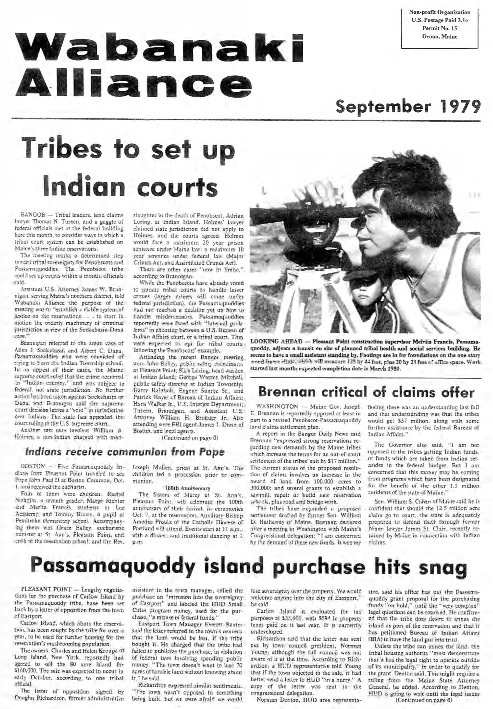
LOOKING AHEAD — Pleasant Point construction supervisor Melvim Francis, Passamaqnoddy, adjusts a transit on site of planned tribal health and social services building. He
seems to have a small assistant standing by. Footings are in for foundations on the one story
wood fra*?e clinic., which will measure 123 by 44 feet, p!os 20 by 23 feet e!office space. Work
started last month; expected completion date is March 1980.
Brennan criticai of claims offer
WASHINGTON — Maine Gov. Joseph
E. Brennan is reportedly opposed at least in
part to a revised Penobscot-Passamaquoddy
land claims settlement plan.
A report in the Bangor Daily News said
Brennan “expressed strong reservations re
garding new demands by the Maine tribes
which increase the terms for an out-of-court
settlement o f the tribes’suit by $17 million.”
The current status o f the proposed resolu
tion o f claims involves an increase in the
award o f land from 100,000 acres to
300.000; and several grants to establish a
sawmill, repair or build new reservation
schools, plus road and bridge work.
The tribes have expanded a proposed
settlement drafted by former Sen. William
D. Hathaway of Maine. Brennan declared
after a meeting in Washington with Maine’
s
Congressional delegation: “ I am concerned
by the demand o f these new funds. It was my
feeiing there w an understanding last fail
fas
and that understanding was that the tribes
wouid get $37 million, along with some
further assistance by the federal Bureau of
Indian Affairs.”
The Governor also said, “ 1 am not
opposed to the tribes getting Indian funds,
or funds which are taken from Indian setasides in the federal budget. But I am
concerned that this money may be coming
from programs which have been designated
for the benefit o f the other 1.1 million
residents o f the state o f Maine.”
Sen. William S. Cohen o f Maine said he is
confident that should the 12.5 million acre
claim go to court, the state is adequately
prepared to defend itself through former
Nixon lawyer James St. Clair, recently re
tained by Maine in connection with Indian
claims.
Passamaquoddy island purchase hits snag
PLEASANT POINT — Lengthy negotia
tions for the purchase o f Carlow Island by
the Passamaquoddy tribe, have been set
back by a letter o f opposition from the town
o f Eastport.
Carlow Island, which abuts the reserva
tion, has been sought by the tribe for over a
year, to be used for further housing for the
reservation’ mushrooming population.
s
The owners, Charles and Helen Kroupa of
Long Island, New York, reportedly had
agreed to sell the 80 acre island for
$160,000. The sale was expected to occur in
early October, according to one tribal
official.
The letter o f opposition, signed by
Douglas Richardson, former administrative
assistant to the town manager, called the
purchase an “intrusion into the sovereignty
o f Eastport” and labeled the HUD Small
Cities program money, used for the pur
chase, "a misuse o f federal funds.”
Eastport Town Manager Everett Baxter
said the letter referred to the town’ concern
s
that the land would be lost, if the tribe
bought it. He charged that the tribe had
failed to publicize the purchase, in violation
o f federal laws involving spending public
money. "The town doesn’ want to lose 70
t
acres o f taxable land without knowing about
it,” he said.
Richardson expressed similar sentiments.
“The town wasn’ opposed to something
t
being built, but we were afraid we would
lose sovereignty over the property. We would
welcome anyone into the city of Eastport,”
he said.
Carlow Island is evaluated for tax
purposes at $33,000, with $594 in property
taxes paid on it last year. It is currently
undeveloped.
Richardson said that the letter was sent
out by town council president, Norman
Young, although the full council was not
aware o f it at the time. According to Rich
ardson, a HUD representative told Young
that if the town objected to the sale, it had
better send a letter to HUD “in a hurry.” A
copy o f the letter was sent to the
congressional delegation.
Norman Denton, HUD area representa
tive, said his office has put the Passama
quoddy grant proposal for the purchasing
funds “on hold,” until the “very complex”
legal questions can be resolved. He confirm
ed that the tribe does desire to annex the
island as part of the reservation and that it
has petitioned Bureau of Indian Affairs
(BIA) to have the land put into trust.
Unless the tribe can annex the land, the
tribal housing authority “must demonstrate
that it has the legal right to operate outside
of its municipality,” in order to qualify for
the grant, Denton said. This might require a
ruling from the Maine State Attorney
General, he added. According to Denton,
HUD is going to wait until the legal issues
(Continued on page 6)
Page 2
Wabanaki Alliance September 1979
editorials
A question of right
The following comments appeared as a letter to the editor in the
Bangor Daily News o f Sept. 12. 1979, in response to questions raised
in a previous letter.
— How do the Indians prove that the land is theirs?
It is our belief and the belief o f the federal government, and many
other prominent individuals both within this state, and out, that the
State o f Massachusetts violated the legal rights o f the Penobscot *and
Passamaqouddy Indian Nations by taking, by threat o f war,
approximately 12.5 million acres o f hunting territories from the
Province o f Quebec to Passamaquoddy Bay. The federal government
did not approve these transactions which was, and is, required by
federal law.
— How do we prove that it isn’ theirs, or do we try?
t
That’ one for someone else, but we don’ believe it can be done
s
t
should the occasion ever arise.
— How many Indians are there in ..the State o f maine?
1,500 Penobscots (total membership), 2,000 Passamaquoddies
(total membership),
1,100 Micmacs (State o f Maine population),
900 Maliseets (State o f Maine population).
— If we gave the Indians their land back and the money they ask
for why do we still have to give them food stamps, state aid, federal
funds for their energy savings projects, etc.? When our white people
can’ get any of this without going through a lot o f red tape and still
t
don’ get it, all they seem to say is we want, we get; now we have.
t
If you gave us all o f our land back and no money, you could keep
your food stamps, state aid, and federal energy saving projects.
Other than that, most Indian people who are fortunate enough to
have jobs still pay state and federal income taxes, and help fund the
same public assistance programs you d o with your paid tax dollars;
not all Indians use public assistance any more than non-Indians.
— With all they have received from us, why can’ they make it on
t
their own; that is what they said they could d o if they had it.
Ninety-five percent o f all we ever received from the state and fed
eral governments has been welfare. Only recently have we begun to
dig ourselves from a pit o f depression to the exercise o f our sovereign
rights.
Consider what you received from us in sovereign violation o f your
own laws in 1794, 1796, 1818, 1820, 1833, 1915; all land transactions,
the earlier ones by threat o f war and the others in typical fashion, “by
hook or crook.” Now, you “make it.”
Finally, you ought not be so critical o f the people overseas: after
all, I’ sure there was a time in the history o f this country when your
m
ancestry was some o f those “people overseas” in need, or why else did
they come to this land?
W ho knows, it could have been in the early times when your people
were without, and the Indian people trusted them a little too much.
Tim Love
Penobscot Nation
Indian Island
WEBS IN THE SEA — Billy Altvater’ fishing weir in Passamaqnoddy Bay stands as a link
s
between the Passamaqnoddy fishing heritage of the past and the tribe’ plans to turn back
s
to the sea in the future. These plans include a fish processing plant, fishing boats, a marina,
an aquaculture program, and a tidal power plant
What money can't buy
The recreation department at Pleasant Point is an oddity, as tribal
agencies go. M ost o f its staff receives no money, yet they throw
themselves into their work with great spirit. In the absence o f the
massive federal funding enjoyed by many other agencies, recreation
materials and money are hard to com e by and appreciated all the
more. Necessity breeds ingenuity, and the department survives by its
own wits. Operating in an apolitical atmosphere, the recreation
program allows people to forget their differences and com e together
for awhile as a community.
Spirit, sharing, frugality, community; all these characteristics are
found in the recreation department. They read like a page from the
past when, the elders tell us, people wanted each other, not money.
The present may be rapidly catching up with recreation director
Linwood (Red) Sapiel as plans to tap Bureau o f Indian Affairs (BIA)
resources take shape. A large community park with many
recreational facilities is even on the board.
Few would dispute that Sapiel and his staff o f dedicated volunteers
deserve the financial support. The recreation department provides
Pleasant Point kids with healthy options for spending youthful
energy. It also stands as one o f the very few deterrents to alcohol and
drug abuse currently on the reservation today. These services alone
make the department worth a healthy injection o f funds.
Red Sapiel has said that whatever money is granted him would be
used more for equipment than salaries. Still, if the recreation depart
ment is fortunate enough to receive a sizeable grant, one would hope
the department’s most valuable asset is not lost in the onslaught o f
new opportunities.
Money cannot buy dedication.
Page 3
Wabanaki Alliance September 1979
letters
Common ground
A suggestion
Warren, Ohio
To the editor:
We have been receiving the Wabanaki
Alliance now for about two years. There is
no doubt that it is the best Indian
newspaper that we get. It is the only one that
has such a varied format.
The main reason that I am writing is
to make one suggestion. In many o f the past
issues you have done some very fine articles
on some of the local craftsmen: (Billy
Altvater, Passamaquoddy, baskets; Edna
Becker, Penobscot, baskets; Mary Gabriel,
Passamaquoddy, baskets; Newell Tomah,
Passamaquoddy, canoes; Francine Lewey
Murphy and Eunice Lewey Crowley, Penob
scot, baskets). I am sure that not only our
selves, but other readers, would like to order
some o f these beautiful crafts, providing the
individuals would want to sell them.
I am suggesting that you publish in your
paper a list o f these individuals or even
better, compile a booklet o f all the crafts
people in the area, their speciality, their
address and prices. We have wanted to
order some crafts from that area for a long
time but had little luck with the already
established craft outlets.
Thank you again for a wonderful paper
and I hope that someday you will be able to
include the suggestion in it.
David Carbaugh
Warren City Schools
Apology to Colcord
Cooper
To the editor:
Hello. I have moved to Maine recently, till
now I never had the chance to see your
paper. I’ been getting Akwesasne Notes
ve
for a few years and I’ heard Wabanaki
d
Alliance mentioned in it every so often, but
never had an address.
So while I was down at the Common
Ground Fair in Litchfield a couple week
ends ago, I came across your paper at the
AFSC booth. At the moment I have no job
— I can spare a small amount for a dona
tion. I would appreciate receiving Wabanaki
Alliance in the future. Also have you ever
run a column on Indian herbal medicines?
It's all right out there, and it seems it could
be real beneficial for those o f us looking for
a better way. Just a thought.
Steve Hendershott
Island to give away
Ravenna, Ky.
To the editor:
As the XAT (a quasi-religious, almost
ineffable spiritual force) publicity director,
my principal duty has been in the operation
of an information clearing house.
Recently, I have learned from a reliable
source that a retired U.S. Naval commander
is interested in selling or “giving” an island
off the coast o f Maine to an American
Indian group if the circumstances were
appropriate.
The information is vague, but the island is
Maiden, N.C.
To the editor:
r e a l. I t a p p e a r s t o b e 2 0 t o S O
This is an open letter o f apology to
west of Belfast. I have seen a photograph of
Charley Colcord.
the island and know the name. There is
After examining Thunderbird’ (Webber)
s
some confidentiality required in the ob
so-called rolls 1found there to be only 5 or 6
taining of this property.
people who might be classified as Lumbee
This letter is to let the native American
people, many whites and many blacks but
population in your area know about this 50only 5 or 6 Lumbee’s out of approx. 40.000.
plus acre island.
He is trying to get money from H.E.W.
And the XAT Public Information Office
and various organizations for his so-called
here is sponsoring the formation o f the
nation which is not recognized by the B.I.A.
Kentucky Indian Council (to be modeled
or the Lumbee people.
after the Tennessee Indian Council), the
I have found the Lumbee’ have not now
s
sponsoring o f an Arts and Crafts Center
or ever voted for a chief, which is the only
with a retail and wholesale service outlet
democratic way o f having a true leader
near the old trading post site Ay-Wah-Nee
representing the people.
and the development of a housing corpora
I hope you and others will forgive me but.
tion, which has a possible 48-unit Farmers
Charley Colcord is speaking o f the same
Home Administration 515/Housing and
Webber who has called himself chief o f the
Urban Development Section Eight project
Cherokees, Creeks, and now Lumbee.
near the proposed Arts and Crafts Center in
If anyone needs more information I
Estill County, Kentucky that can be
suggest they contact John Shapari in the
obtained.
B.I.A. he knows o f this Thunderbird
Anyone interested in any o f these pro
Webber.
posals might contact me.
Again Charley I am sorry.
Samuel E. Naive
Jim Chavis
Wabanaki Alliance
Vol. 3, No. 9
September 1979
Published monlhlj by the Division of Indian Services [DIS] at the Indian Resource Center,
95 Main St., Orono, Me. 04473.
Steven Cartwright, Editor
William O’Neal, Ass’L Editor
DIS Board of Directors
Jean Chavaree [chairman]
John Bailey, Public Safety Coordinator
Albert Dana, Tribal Councilor
Timothy Love, Representative to State Legislature
Jeannette Neptune, Community Development Director
Jeannette LaPlante, Central Maine Indian Assoc.
Susan Desiderio, Assn, of Aroostook Indians
Maynard Polchies, President, Aroostook Indians
Melvin L. Vicaire, Central Maine Indian Assn.
Reuben C. Cleaves, Representative to State Legislature
Sept. 30, 1979: One hundred years of service
The Rev. Joseph Laughlin [left] and Auxiliary Bishop Amedee Proulx are flanked by Indian
Township children and the Sisters of Mercy as they celebrate the 100th anniversary of the
Sisters’presence at the Township. [Photo by Allen J. Sockabasin]
Great concern
Sault Ste. Marie, Mich.
To the editor:
Please send me information and the price
of your publication, Wabanaki Alliance. I
have followed the fight your people have
waged for your land rights with great
concern. My people, too, are in the middle
o f several court battles over land rights. I am
Sioux City, Iowa
To the editor:
I'm writing you about my brother Stewart
Rodda.
As I read in your nice paper about our
Indian blood: I don’ know who this Red
t
Eagle Steere is but we are not Sioux and
•V TTercrtlwrxydr-uTiuic^ttnu m o u T t r ioia uj> d n o
L
have*been more successful in the courts than I have proof also o f our Choctaw blood; our
the Chippewa o f the Upper Peninsula of great-great-great grandmother. This Red
Michigan.
Eagle Steere is not reporting it right, is all
Cathy Mertoli wrong. Such trash should not be allowed in
your wonderful paper. I’ really good and
m
mad at such stuff.
N ew sp aper folds
Lorraine (Fire Eyes) Thompson
Vancouver, B.C.
To the editor :
This is to inform you that due to the
dissolution o f our Society that the publica
tions you have been sending us can now
stop, so please delete us from your mailing
list.
We thank you for your interest in our
Society and its former publication ‘
Nesika.
Joy Hall
Native Media Society
Scholar likes paper
DIS is an agency of Diocesan Human Relations Services, Inc. of Maine. Subscriptions to
this newspaper are available by writing to Wabanaki Alliance, 95 Main St, Orono, Me.
04473. Diocesan Human Relations Services and DIS are a non-profit corporation. Contri
butions are deductible for income tax purposes.
Notes relatives
Hartford, Ct.
To the editor:
Please put me on your mailing list. On a
recent visit to Wells, Maine, we saw an issue,
August 1979. In it is a picture on the back
page, of Indians on the Mowhawk Trail.
Many are our relatives. We would like an
issue o f the August 1979 publication if
possible.
Joan F. Tomah
Amherst, Mass.
To the editor:
Thank you for my copy (Vol. 3, No. 8) of
Wabanaki Alliance. As an anthropologist —
and person — interested in native American
affairs I would like to continue receiving
your paper on a regular basis. To this end I
enclose a ten dollar contribution.
Jean Ludtke
Cherokee confederacy
Indian Island
Pleasant Point
Indian Township
Indian Island
Indian Township
Orono
Houlton
Houlton
Mattawamkeag
Pleasant Point
Defends brother
Leesburg, Ga.
To the editor:
The Southeastern Cherokee Confederacy,
Inc. was incorporated here in Georgia, Nov.
12, 1976. We received our proclamation
from Governor George Busbee o f Georgia
Dec. 20, 1976. We are accepting members
with 1/16 or more o f Indian heritage, but
they can’ belong to two tribes at one time.
t
For more information write to Chief
William “ Rattlesnake” Jackson, South
eastern Cherokee Confederacy, Leesburg,
Georgia.
William “ Rattlesnake” Jackson
Corrections
A story in the August issue about a potluck supper sponsored by Central Maine
Indian Association incorrectly identified
Linda Collinson as an outreach worker. She
is health and social services director for the
off-reservation organization.
*
*
*
Last month’s Wabanaki Alliance describ
ed Longest Walk baby, Amassiliget Pimoset
Francis McDonald, as having a Maliseet
and Penobscot name. Actually, Amassiliget
means longest walk in Micmac, and Pimoset
is “one who walks” in Passamaquoddy.
Also, the story omitted mention of the proud
father, Duma McDonald. Our apologies.
*
*
*
A black cat, shown with Penobscot
medicine man, Sonabeh. in a picture in the
August Wabanaki Alliance was incorrectly
listed as belonging to Sonabeh. The cat, who
has no name, belongs to another Indian
Island resident, Burnell Mitchell.
Page 4
Wabanaki Alliance September 1979
Pleasant Point sports
open to all
The recreation department may be on the
eve o f a financial breakthrough, with the
advent o f Bureau o f Indian Affairs (BIA)
money onto the reservation.
With an eye to BIA support, the tribe is
planning a community park which would
largely be run by the recreation department.
The park would include a multi-purpose
play field, a children’ playground and
s
wading pool, foot paths and bridges in
natural settings, and even a ski slope. Sapiel
said that the natural area may include a
freshwater pond, stocked with fish.
If the park is to become a reality, Sapiel
estimated that approximately $380,000 BIA
dollars will be required. Meanwhile, for the
first time, Sapiel is approaching tribal
government with a $5,000 to $6,000 budget
request to cover the entire year, rather than
seeking funds on a contingency basis as in
the past. “ We don’ want a lot o f money for
t
salaries,” he added, noting that his staff
works for nothing.
Sapiel sees his responsibility as more than
providing fun for the youngsters in the com
munity. “We’ here to teach them some
re
thing for when they go into other communi
Pleasant Point Recreation Director Red Sapiel monitors a young athlete’s progress on the
ties, so they can adjust and fit.” He also tries weights.
to engender a feeling of belonging in the
community. “When we ran the little league,
I played everyone, regardless o f ability, even
in championship games, so they would feel a
part o f the team. I like to take everyone to
MARY A. SAPIEL
smith for 40 years. He was a U.S. Army
the (awards) banquets just to give them the
INDIAN ISLAND — Mary A. Sapiel, 53, veteran. He is survived by his wife, Edna
feel,” he said. “That’ my role on this reser
s
,
vation, instead of (making) championship o f River Street, Indian Island, died Sept. 1 (Love) Becker, o f Indian Island; one son,
1979. She was bom on Indian Island, May Fred H. o f Indian Island; three daughters,
teams.” Sapiel hastened to point out that
the Pleasant Point teams have good records, 24, 1926, the daughter o f Howard and Nora Catherine Belair o f Norwalk, Conn., Mary
(Paul) Ranco. She was a member o f St. Ann Louise Prouty of Shelton, Conn., Mary
anyway.
Church and the St. Ann Society o f Indian Elizabeth Mastri o f New Haven, Conn.; 29
Sapiel is concerned about the use o f alco
Island. She is survived by her husband, grandchildren; five great-grandchildren.
hol and drugs by reservation youths. “This
Nicholas Sapiel o f Indian Island; two sons, Funeral services were held at St. Anne’
s
is why we got involved in drug abuse (pre
vention)," he said. “We saw some o f our Nicholas and David o f Indian Island; two Catholic Church, Indian Island.
daughters, Mrs. Hope Fitt o f Charleston,
Interment was in the tribal cemetery,
kids smoking dope." His concern led him
S.C.. and Mrs. Theresa Snell o f Tacoma, Indian Island.
and one o f his staff, Inez Nicholas, to begin
Wash.; one brother, Irving Ranco o f Indian
training to become alcohol and drug abuse
Island; two sisters, Mrs. Gloria Hutchinson
counselors. In conjunction with the reserva
ANTHONY J. TOMAH
tion Department o f Health and Social o f Manchester, N.H., Mrs. Alice Sockabasin
PLEASANT POINT —
Anthony J.
Services he also plans to start an Al-Teen o f Indian Island; 10 grandchildren; sev Tomah, 58, died Sept. 24, 1979 at an
eral nieces, nephews and cousins. Funeral
program, which works similarly to Alco
Red Sapiel takes time to reflect on his pro
services were held at St. Ann’ Church of Augusta hospital following a long illness, he
s
holics Anonymous.
gram’ future.
s
Indian Island, with the Rev. David Cote was bom at Princeton, July 26,1921, the son
Sapiel, a Penobscot, bom on Indian
officiating. Burial will be in the tribal o f Francis and Mary (Lola) Tomah.
With the exception o f Sapiel’ salary, the Island, moved to Pleasant Point to live with
s
He served in the Canadian Army and later
his wife, Mary Nicholas. He has held such cemetery.
department receives no regular funds. Con
in the U.S. Armed Forces during World
sequently, Sapiel must make periodic perilous jobs as log driver and steeplejack,
War H.
VALENTINE PAUL BECKER
appearances before tribal council or call and served a stint in the Marines. However,
Survivors include one brother, Newell
INDIAN ISLAND — Valentine Paul
local businessmen to ask for money or when he got back to the reservation, his love Becker. 66, o f 123 Oak Hill Road, died at Tomah, Sr. o f Pleasant Point; several nieces
equipment. He said he has also had luck o f children grew into his present work with his residence Aug. 28.
and nephews.
getting coaches from University o f Maine at the kids.
A Mass o f Christian burial was celebrated
He was born Sept. 7, 1912, in New
Sapiel admitted that sometimes the job Rochelle. N.Y., son o f Valentine and Cath
Machias to donate time to training reserva
at St. Ann’ Catholic Church with the Rev.
s
tion sports such as volleyball, gymnastics, gets to be too much for him. " I get upset. erine (Hickey) Becker. He had been em
Joseph Mullen officiating. Interment was in
and tennis. Travel is the biggest expense, he When that happens, I take a couple o f days ployed at Owens-Illinois and was a gun
the Tribal Cemetery, Pleasant Point.
off, and go home to visit my mother.”
said.
By Bill O ’
Neal
PLEASANT POINT — Linwood (Red)
'Sapiel runs one o f the most under-funded,
highly successful departments on the reser
vation. With an all-volunteer army of
helpers and whatever money he can scrape
up, he wages a yearly war on boredom,
delinquency, and fat.
As director o f Pleasant Point’ recreation
s
department, Sapiel is charged with com
munity programs ranging from little league
for the youngsters to bus tours and beano
for the elders.
Sapiel can usually be found sitting behind
a large, blunt cigar, which he chomps on
while he talks. He has a slow way of
speaking, which belies a schedule that some
times keeps him going 70 hours per week.
He is currently organizing the winter
sports program. “The big thing here is
volleyball,” he said. He estimated that 140
people would be playing on at least eight
reservation teams. The usual winter sports
such as basketball will also be offered,
Sapiel said.
A winter sports carnival is planned,
although no details have been worked out.
Indian dancing and crafts will be offered by
Sapiel’ wife, Mary. There may also be a
s
course in aerobic dancing, which combines
dance and exercise.
Obituaries
Canning workshop perks interest
HEALTH WORKERS — Martha Barstis, left, and Doris Chapman, are employed by
Passamaquoddy Health and Social Services at Indian Township. Barstis is a community
health representative, a job that involves follow-up on patients, home visits, counseling and
referrals. Chapman works in a senior companionship program with the elderly of the tribe.
By Kathy Tomah
Area Correspondent
INDIAN TOWNSHIP — On Tuesday,
August 21st and 28th, there was a canning
session held at the Indian Township School
at Peter Dana Point. The co-ordinator for
this was Sonja Dom, and her two assistants
Martha Barstis and Doris Chapman, both
community health representatives.
Sarah Wilson, extension agent for Wash
ington County in Machias, conducted these
two sessions.
The participants were shown the pro
cedure in using a pressure canner for
carrots, beets, string beans, zucchini and
tomatoes; the freezing o f broccoli, com and
blueberries. They were shown how to
prepare pickled beets and green tomato
pickles (chow-chow) that are processed in
hot water.
Also, Diane Francis of Pleasant Point
volunteered her time by coming down and
showing them how to make blueberry jam.
The participants were: Ann Socobasin,
Annabelle Sockabasin, Sylvia Tomah, Aud
rey Sacoby, Joan Dana, Frances Tomah,
Janet Neptune, Beverly Sopiel, Brenda
Dana, Blanche Sockabasin, Alice Lola,
Ramona Soctomah, Lillian Stevens, Linda
Neptune, Irene Newell, Patricia Sockabasin.
The purpose o f this session was to help
interest people in growing their own gardens
which would enable them to can and freeze
their surplus vegetables. Sarah Wilson
stated that it was a wonderful group and
that they worked very hard and participated
with great interest.
Rights commission
names new director
WASHINGTON — Jacob Schlitt, 51, has
been hired to head a New England Regional
Office o f the U.S. Commission on Civil
Rights, Staff Director Louis Nunez an
nounced recently.
He and a staff o f six civil rights specialists
and support personnel moved into their
permanent headquarters, 55 Summer St.,
Boston, August 1
.
Wahanaki Alliance September 1979
Page 5
A spiritual challenge to priests, Indians
By Br. Larry Smith, S J.
During August I spent two weeks in South
Dakota. One week was spent in Plainview,
South Dakota at the Sioux Spiritual Center
making my annual eight-day retreat, and
another week at Holy Rosary Mission (Red
Cloud Indian School) in Pine Ridge, South
Dakota; where Fr. Joe Laughlin and I met
with the National Association of Native
Religious. This group of Indian priests,
brothers and sisters, are an inspiring group
with whom I try to get together every
summer.
We had Mass each morning at sunrise out
on a hill while facing the East and the rising
sun. Our final mass o f the get-together,
however, was the most inspiring for me. Un
fortunately, because o f rainy weather we had
to have the mass indoors. One of the Sioux
Sisters was celebrating twenty-five years as a
Franciscan Sister, and the Mass was the
spiritual celebration o f her anniversary. The
main celebrant o f the mass was Fr. John
Hascall who is a Chippewa Indian priest
from Minnesota. Father John is also what
we would call a “healing priest" in the spirit
o f the charismatic renewal. Most interesting
is the fact that he is also the officially recog
nized traditional medicine man for his
Ojibway Indian people.
These Indian Catholic spiritual leaders
are an amazing group o f people. It is
important to note, however, that the
Wabanaki people o f Maine have also had a
long, important, though unrecognized his
tory of catholic Indian spiritual leaders
who freely embraced the Catholic faith and
were vehemently loyal to that faith. To show
you what I mean, I would like to quote from
an article written in 1913 in The Indian
Sentinel, a national Catholic Indian maga
zine:
“In the beginning of the 18th century the
governor o f Massachusetts, anxious to win
the alliance o f the Abnakis in war and 'to
accomplish their defection from the Catholic
faith, offered to rebuild at his own expense
the church at Norridgewock which the
English had destroyed. The governor laid
down one condition, namely, that the
Indians should dismiss their missionary and
accept one of his choice. The Indian envoy
indignantly replied:
“When you first came here, you saw me
long before the French governors, but
neither your predecessors nor your ministers
ever spoke to me o f prayer or the Great
Spirit. They saw my furs, my beaver and
moose skins, and o f this alone they thought;
these alone they sought, and so eagerly that
I have not been able to supply them enough.
When I had much they were my friends, and
only then. One day my canoe missed the
route; I lost my path, and wandered a long
way at random, until I landed near Quebec,
in a great village o f the Algonquins, where
the Black-gowns were teaching. Scarcely
had I arrived, when one of them came to see
me. I was loaded with furs, but the Blackgown of France disdained to look at them; he
spoke to me o f the Great Spirit, o f heaven,
o f hell, o f the prayer, which is the only way
to reach heaven. I heard with pleasure and
was so delighted with his words that I
remained in the village near him. At last the
prayer pleased me and I was instructed. I
solicited Baptism and was Baptised by the
Black-gown. I then returned home to my
people and related all that had happened.
All envied my happiness and wished to
partake it; they, too, went to the Black-gown
to be baptized. Thus have the French acted.
Had you spoken to me o f the prayer as soon
as we met, I should be now so unhappy as to
pray like you, for I could not have told
whether your prayer was good or bad. Now I
hold to the prayer o f the French; I agree to
it; I shall be faithful to it, even until the
earth is burnt and destroyed. Keep your
men, your gold, and your minister; I will go
to my French father.’
The real apoctle, an Indian
Charles Meiskwat, an Indian, is the real
apostle, the pioneer o f faith, among the
Abankis. From Sillery, the Jesuit mission on
the St. Lawrence, where he had led a truly
saintly life, Charles set out for Maine
wilderness on an embassy o f mercy. He had
heard that a party o f non-christian Abnakis
were being tortured by non-christian Algon
quins in spite o f the fact that they belonged
to the same Algic family, as their language
would show. Charles lost his companion.
Nicolet, who was drowned in a rapid, but.
undaunted, he hurried on in quest o f his
countrymen. He found them, rescued the
victims who were just then being tortured,
and brought them back in triumph to
Sillery. Here they were first cared for
physically. Then they were instructed in the
“prayer” by the Sisters and priests. When
they had recovered and been instructed,
they sent Charles with one of their number
to carry the good tidings o f their rescue and
the Kennebec . . . Such was the real
beginning o f Abnaki missions, which date
from 1642.
The catechist, or deacon, as he is called
among the Abnakis, has been a great factor
in the spread and preservation o f the faith.
At Old Town the memory o f the saintly,
prayerful Sak Bason Swasson is held in
benediction. He was the governor, a man of
majestic mien. He is said to have been a
direct descendent of Baron de Castine who
married Sagamore Madocawando’ daught
s
er. He daily made the stations of the cross.
He spent over an hour in this exercise every
day. It was for his people, he explained.
“Among the Passamaquoddies, Toma
Dana was the rival o f Bishop Healy in
apostolic work. The Indian could sing all the
Mass. Once when he joined with the bishop
in intoning vespers, it was a great success.
Toma delcared ‘Me and the bishop sing
good today. We can’ beat nobody.’ He
t
meant that no one could excel these two. . . .
It is certain that for a number of years the
Abnakis were without a missionary devoted
exclusively to them. They sent delegation
after delegation to get a priest to come to
them....
“The testimony of Father Maloney, who
knew the Indians of Maine at their best
and at their worst, may well conclude this
account of these people whose ancestors
were the first fruits o f the harvest o f souls
among the Indian tribes o f the north, the
wampum belt, the pledge given that many
tribes would surrender to the cross o f Christ.
Father Maloney writes:
“As for the Indians themselves, I found
them a warm-hearted, simple, grateful
people, towards those whom they found
sincere with them, but suspicious, crafty,
and entirely untrustoworthy in regard to
those who were in any way tricky in their
dealings with them. In one word, they are
staunch friends, and can be inveterate
enemies. They never forget a kindness, nor
do they forget, although they may for
give, an injury. My memories o f them are
of the happiest. Never did I have warmer
friends than the Indian friends o f the
Passamaquoddy tribe.”
This account written over sixty-five years
ago shows us very clearly that due to the lack
o f priests, the Catholic Church would never
have taken root and survived in Maine if it
were not for the dedication and persistence
o f the Indian people themselves and their
faith-filled catechists or “deacons.”
In the years to come, perhaps within our
lifetime, the number o f priests will continue
to drop, until the day comes when there will
be no priest to live and work on a full-time
basis with the Indian people. When that day
comes, will the Indian people o f Maine have
the dedicated Catholic spiritual leaders, the
catechists and deacons, that their ancestors
had 100 years ago, or will the Catholic
Church just fade away and cease to exist
among the Indian people? Only you can
answer that question.
EDITOR’ NOTE: Brother Larry Smith,
S
a Jesuit, is deacon at St. Ann’ Indian
s
Mission, Pleasant Point Passamaquoddy
reservation. He would like readers to know
he has a videotape available o f the events
described in his report.
Family portrait; Front row, from left, Nicole, Mitchell and Kristin Johnson, with parents
Ruth and Lonnie.
Letter describes racial tension for Indian child
Uniontown, Alabama
To the editor:
I would greatly appreciate it, if you would
print this letter. You may edit or rewrite
anything in it. I am writing emotionally
right now as I am heartsick.
Thurs!, Sept. 6,1was to put my 8 year old
daughter, Kristin, on a plane back to the
reservation. The Uniontown school system is
in a turmoil and it is not even safe to send
my daughter to school here. In a school
enrollment of approximately 1,190 there will
be no white children in the Uniontown
school system, as we are the only Native
Americans in Uniontown there will be no
Indians either. The 1,190 students will all be
black. Last year Kristin attended a school
with a ratio o f 78 per cent negro to 22 per
cent white. The federal government decided
to consolidate the Uniontown schools on
Aug. 27, which means Kristin would be
bused to an all-black school. Every single
non-black family has either moved, or
enrolled their children in private schools. I
cannot afford either alternative at this time.
If I send her to any other public school
system, her school records will not be re
leased, and she will get no credit or grades.
This is the government’ way o f enforcing
s
the zoning regulations, and I face a $500
fine for contempt of court.
I am enclosing an article so you will know
what I’ talking about. Kristin attended
m
Uniontown High School. This article does
not reflect all that we have found out
through phone calls, personal visits and
attorneys’ advice. My daughter’s best
friends’parents had to sign legal guardian
ship papers over to her sister in order that
U.H.S would release their school records for
them to attend school in Marengo County.
They also cannot afford to move right now.
Initial enrollment fees for private school
start at $200 to $850, with monthly tuition of
$75 to $130 a month. This does not include
food, clothing or transportation. My son,
Mitchell, 5 years, cannot start kindergarten,
as it is not mandatory and there are no
vacancies. One school told me they were not
taking any more white students (classifying
Mitch white because his father is white)
another school said they had filled their
minority qualifications (classifying Mitch,
Native American).
Black students have threatened “ any
student, black or white coming from Uniontown High into Hatch, or Uniontown
Elementary. The police have found knives,
lead pipes and pistols on students enrolled
at Hatch. Four rapes occurred at Uniontown
Elementary last year. The Ku Klux Klan has
stated it will march on Uniontown on the
opening school day. Uniontown is a time
bomb right now. What choice do I have? I
cannot take a chance on Kristin being hurt.
Her father is deeply hurt to think that he
unintentionally exposed her to this situa(Continued on page 1)3)
age 6
Wabanaki Alliance September 1979
CA IA eyes Charleston
A
for vocational school
ORONO — Central Maine Indian Asso
ciation has applied for usage rights to the
abandoned Charleston Air Force Station
(CAFS).
The off-reservation organization has sub
mitted tentative proppsals to establish a
high school and vocational education facility
there, with some health services also offered.
The proposal is similar to one CMIA
developed early this year for Dow Am
munition Storage Annex which is still
pending.
Donna Loring, CMIA president and
David Rudolph, planner for CMIA, both
favor .he Charleston site, although the
agency’ board o f directors has not formally
s
approved the shift o f location.
According to Rudolph CAFS has numer
ous advantages over Dow. Unlike Dow, he
said, the land is already developed and all
the necessary construction has already been
done. Also, no rezoning effort is necessary as
at Dow. The only disadvantage Rudolph
cited was the distance from major Indian
populations served by CMIA.
Although several other groups have pre
viously applied for the land, including the
Young Adult Conservation Corps (YACC) at
Indian Island, currently only the state
Department o f Inland Fisheries and the
Department o f Mental Health and Correc
tions are competing with CMIA for the
facility.
Fisheries wants the land primarily as a
green belt buffer for nearby wildlife man
agement projects it is conducting. Correc
tions is viewing the site as a possible
minimum security prison.
The proposed vocational school would
offer primarily management courses in the
areas of hotel management, agriculture,
manufacturing research, alternate energy
technology, building, road maintenance,
water/sewer systems, and heavy equipment.
The courses would emphasize on the job
training, Rudolph said, with much of the
training being accomplished as routine
maintenance of the Charleston facility.
Rudolph said the school would also contract
its services to the surrounding communities.
Indian court
system planned
(Continued from page 1
)
The Penobscot tribe is making final prep
arations at Indian Island to establish a
tribal court system which could be function
ing by early October.
Meetings were being held at press time to
consider what sort o f court and which legal
codes would be adopted, and a general
meeting o f the tribe had been called to vote
on the proposals.
According to Timothy Love, a tribal
official working on the proposals, the Code
of Federal Regulations, a federal body of
laws used by some other tribes, was rejected
because Bureau of Indian Affairs (BIA)
would control the court. The Bureau, how
ever. will fund the expense o f running the
courts. Love added.
Love said the tribe would probably adopt
Maine state hunting and fishing ordinances
in addition, to Indian legislation already on
the books. The Maine criminal code cov
ering misdemeanors and state traffic code
would also probably be used, he said.
According to Love, the tribal court will be
able to try civil cases and misdemeanors, but
not felonies. The state and the tribes are
currently embroiled over whether felonies
committed on the reservations are subject to
state or federal prosecution.
Non-Indians cannot be tried in tribal
courts for any but civil offenses. Love said
MOOSEMEAT stew was among dishes offered at Central Maine Indian Association “getthe tribe is considering changing fish and
acquainted” potluck supper, held at Orono. Here, CMIA board member Bridget Woodward
game violations to civil offenses so that nonis ready to serve.
Indians can be tried in the Island courts.
The nearness of hunting season was respon
sible for the push to ratify the new courts, he
said.
One general court, with a chief judge and
associate judge, along with an appellate
court with three judges, are planned. A
lawyer to act as consultant to the court is
also expected to be included in the system.
Judges in tribal courts need not have legal
degrees. Love said. No final decision has
reason why a settlement couldn’ resolve
t
(Continued from page 1
)
been reached on who the judges will be,
disputes over land such as this,” he said.
although Love mentioned Penobscot Gerald
are sorted out. He could not predict how
Asked what the state’ position on juris
s
Pardilla. who has had paralegal training, as
long that would be.
diction over Carlow Island would be, Pater
a possibility.
son said, “I could speculate but I’ rather
d
Asked to comment on the sale o f Carlow
According to Love, the Island appellate
not say.”
court “has the final say” in cases tried on Island, Maine Ass't. Atty. Gen. John
The HUD grant would allocate $100,000
Paterson stated, “ I had never heard o f it
the Island. He added that the only re
to Pleasant Point for the purchase, plus
strictions on the court system are the Indian until this message.” He said the status of $25,000 for planning. The tribe would have
Civil Rights Act and Indian Bill of Rights, Carlow Island, if purchased by the Passama to come up with the remaining funds else
which, he said, are modeled along lines of quoddies, will probably be "a subject of
where.
dispute."
the US Constitution.
Pleasant Point lieutenant governor Cliv
Although courts cannot be set up for a
Paterson said the “best possible solution” Dore declined comment on negotiations
month, at least, summonses can be issued
over the land and the legal questions raised,
would be to have Indian jurisdiction for any
immediately, he said. Referring to the
lands in Maine defined in a negotiated other than to say the issue was “very
possibility o f other Maine tribal courts, Love
settlement of land claims. “There’s no delicate.”
said, "The Passamaquoddies are right
behind us.”
Sale of Carlow
Island opposed
Quakers meel with Indians
ORONO — Several Indian persons told
Quakers at a meeting here that while help is
welcome, Indians should be making deci
sions to preserve their autonomy and
culture.
Tom Vicaire, director o f Central Maine
Indian Association, said, “ Respect for the
abilities and needs o f the Indian com
munities (could) stimulate initiative.” Pro
jects should allow "more involvement from
the Indian community,” he told members of
the American Friends Service Committee,
and other Quakers.
"I think we badly need Indian input,”
said Mary Griffith, staff worker for the
Friends committee on Indians. Griffith has
helped develop a film and slide show on
Maine Indians, and has formed a committee
on curriculum and education.
THE BEGINNING — Some of the first contributions to the Penobscot museum being built
at Indian Island. Missing is a sacred mask, which could not be photographed.
Barbara Moffatt, a Quaker official and
special guest speaker, said Friends have
been concerned about American Indians for
many years, at first working to bring relief to
Hopi and Navajo tribes. In the 1950’
s,
Quakers brought social and technical
assistance to Sioux Indians at Pine Ridge,
S.D. Friends have also worked on Indian
fishing rights in the northwest, and have had
a long relationship with Maine Indians, she
said.
Others speaking were Sipsis (Eugenia
Thompson) o f Indian Island, who asked not
to be quoted on her remarks, and John
Nicholas, Pleasant Point Passamaquoddy
school board chairman, who said, “The way
I see it, the affluent society is killing us.”
Also attending were Andrea and Darryl
Nicholas, Canadian Indians, and Daniel
Francis from Pleasant Point.
Andrew Grannell, moderatdr o f the
meeting, stated that, “A real bond o f trust
has been established here.”
Wabanaki Alliance September 1979
Page 7
Conflict over space may
leave some pupils
out of school
INDIAN ISLAND — Confusion and mis
understanding seem to surround the Pen
obscot day care and kindergarten programs,
and the losers might be young children who
can’ join either program for lack o f space
t
and funds, and new eligibility requirements.
The story starts seven years ago, when the
Indian Island elementary school began an
early childhood program. Funded through
federal Title 20 money, the program has
been conducted by Laura Massey, only full
time Indian teacher on the school’ staff.
s
Last spring, a program started at the
recently constructed Penobscot Health and
Social Services building. A day care service
for 2 - - year olds, the new program runs
V1 5
year-round and is funded partly through
Title 20 funds. That’ where there’ a rub.
s
s
The Indian Island school was informed
several months ago that Title 20 funds must
be used for year-round day care, and the
early childhood program was ineligible for
the funding. But the problem isn’ just
t
funds, according to school principal Sr.
Helen McKeough. She said day care cannot
enroll enough children to take up the slack
created by changes in the school’ early
s
childhood program.
In the past, the school childhood program
has served four year olds and five year olds
(kindergarten). Kate Nelligan, day care
director, has a current limit o f 20 slots for
children; her present enrollment is 16. “The
service we’ providing here is one o f a social
re
nature. It's for children of working par
ents,” she explained.
Sister Helen, on the other hand, em
phasizes that the school’ program is educa
s
tional, not a social service. “Parents are
really worried. They thought that their
children were going into a developmental
program like we had here,” Sister Helen
said.
“At this point the school board is very
concerned,” said Sister Helen, noting that
the community has confidence in its board.
The fate o f the early childhood program and
its pupils has been discussed at recent
school board meetings.
"The school board said, we’ afraid
re
there’ be all kinds o f kids ... I’ been told
ll
ve
some of the new housing will open up in
November,” Sister Helen said. She said she
does not want to be "overlapping or com
peting” with day care, but feels the school
program filled a need that day care does not.
She said Indian Island is “a community very
much interested in education.”
The school board has discussed obtaining
funding through the Indian Child Welfare
Act, but this source seems uncertain.
“We’ looking for solid funding so that we
re
can run an early childhood program that
can operate in conjunction with the school,
as part of the school system, but without the
restrictions of Title 20 funds,” Sister Helen
elaborated.
Nelligan does not quite understand Sister
Helen’ concerns, and says that if more
s
funding for day care can be obtained, her
program could be enlarged to an enrollment
of 28. Guidelines require 35 square feet of
space per child indoors, plus a ratio of one
adult to five children. Nelligan has three
assistants. “We provide a home-away-fromhome setting, where kids spend more
working hours than at home,” she said.
Nelligan pointed to a letter o f Aug. 3,
1978, from Linda Schumacher o f the
Augusta Title 20 office, informing health
and social services official Paul Buckwalter
the school early childhood program should
“actively investigate other funding.” Ap
parently, this did not occur. Title 20 pays 60
per cent of day care costs, with the balance
made up from federal CETA money, and a
grant from the Episcopal United Thank
GodTund.
Building problems
Other problems have plagued the Island
school program. Crowding at the Indian
Island school led to construction o f tempor
ary early childhood classrooms in the gym
nasium, prompting Sister Helen to observe
that students were “crammed in like sar
dines.”
The picture brightened when tribal ad
ministrator Andrew Akins informed the
school board that a wing o f a new wooden
building could be used by Laura Massey's
program. (Her program will include those
children five years old as o f Oct. 1
5.)
The new building would be ready for
occupancy by the time school opened in
September, Sister Helen was told. Yet as
Wabanaki Alliance went to press, the build
ing was still without a roof, doors or
windows. “We had been guaranteed that the
log building (constructed by Young Adult
Conservation Corps (YACC) as a bunkhouse) would be ready for occupancy by the
first week o f August,” said Sister Helen,
adding, “The last date I heard was Thanks
giving. I don’ know if that’ true or false.”
t
s
In preparation for the expected new
space, the temporary rooms in the gym were
dismantled by Manfred Francis, school cus
todian. Already, the school board turned
over $24,000 from its education budget for
heating and plumbing the YACC-built
building.
“At this very moment we have no kin
dergarten. And the administration, which is
myself and the school board, are very con
cerned because the children are not attend
ing classes,” Sister Helen said.
EDITOR’S FOOTNOTE: An interim
kindergarten, taught by Laura Massey and
assistant Adrian Francis, started Sept. 24, in
St. Ann’ Church parish hall. Thirteen
s
children were registered for the two-shift
program, 9-11 a.m., and 12-2 p.m. When
classes eventually start in the new building,
the day will begin with breakfast, about 8
a.m., and end at 2 p.m. An entirely new ele
mentary school is incorporated in future
planning for the tribe, possibly aided by a
land claims settlement.
CMIA offers home to Indians
far from reservation
PORTLAND — “Just being there," is the
greatest service outreach worker Andrea
(Angie) Mitchell feels she. performs for
Indians in the Portland area.
Mitchell and Linda Naples staff the
southern Maine branch o f Central Maine
Indian Association (CMIA). Their duties
include advising Indians on legal matters,
referring people to appropriate social
agencies, helping people trace their back
grounds, and providing emergency food,
clothing, and fuel. CMIA has recently added
an alcoholism counselor, George Paul, to its
staff.
Naples said she wishes she could offer
more. “I would like to be able to offer
emergency funds or a place to stay. The
closest place for Indians in need now is jail,”
she said.
The two women serve around 300 families
in the area. “ Most of the people who come
in have been here for some time,” Mitchell
said. “We’ dealing with city people.”
re
Like the families they serve, Mitchell and
Naples have been away from the reservation
a long time. Naples, who is a sister of
Pleasant Point housing director Clayton
Cleaves, said she has retained about 75 per
cent o f her native Passamaquoddy tongue.
With her two children Naples has settled
into city life. “I try to hold on to a little of
the reservation,” she said, but admitted,
“you have to conform to white society.”
Mitchell, sister o f George Mitchell of
Indian Island said it took her a year and a
half to adjust to life in the city. “ When you
hit the pavement, you don’ see that friendly
t
smile (as on the reservation),” she said.
“Having CMIA down here puts me in touch
with Indian people. That's the beautiful
thing about this job.” Her apartment has so
many Indian artifacts, it’ called Angie’
s
s
tepee, she said.
With six kids to support, Mitchell is now
well-adjusted to life away from the reserva
tion. She guessed it would take a while for
her to adapt, if she moved back.
“ I was thinking o f moving back, but my
kids wanted to finish high school with their
friends,” she said, adding, “One good thing
about the reservation is you can always come
home.”
Indian art school gets new boss
WASHINGTON — Jon C. Wade, an
enrolled member o f the Santee Sioux Tribe,
has been appointed President o f the Insti
tute of American Indian Arts (IAIA) at
Santa Fe, New Mexico, Acting Deputy
Commissioner o f Indian Affairs Sidney
Mills announced.
Wade has been director o f the Division of
Education Assistance for the Bureau of
Indian Affairs since 1975. He had previously
been Superintendent of the Phoenix Indian
School and educational assistance officer for
the BIA's Aberdeen. South Dakota area
office.
The art institute, started in 1962, is a
post-secondary school serving Indians from
all tribes.
Wade. 40, completed course requirements
for a Ph.D. in Educational Administration
at the University of Minnesota in 1971. He
received a Bachelor o f Science in Mathema
tics at Northern State College, South
Dakota and a Master of Arts from the Uni
versity o f South Dakota.
Wade was a member o f the Special
Education Subcommittee o f the National
Council on Indian Opportunity and from
1964 to 1966 served as Vice Chairman of the
Flandreau Santee Sioux Tribe.
CMIA outreach workers Angie Mitchell and lln d a Naples Demonstrate the enthnsiasm
which keeps their office going.
Page 8
Wabanaki Alliance September 1979
Evacuees From War-torn France
M r;. M o lly A rc h a m b a u d a n d h e r litt le s ix - y e a r t - o ld d a u g h ter . Jean, h a v e ju s t a r r iv e d f r o m t h e ir h o m e in R oy a n , F ra n ce, a n d a r e a t
th e h o m e o i t h e t e r m e r s sister, M rs. W a lie A k in s in O ld T o w n .
t o O ld T o w n f o r t h e d u r a t io n o i t h e w a r - p e r h a p s lo n t er.
a r r iv e d in L is b o n fr o m w h ich p o r t t h e y s a ile d f o r A m erica.
Mrs. A r c h a m b a u d a n d h e r d a u Eh t e r a r r iv e d o n t h e S. S. M a n h a t t a n a n d c a m e
T ra v e lin £ f r o m J u ly fir s t by foo t, u u f o n , railw ay , a n d a m b u la n c e t h e y fin a lly
Molly Spoiled Elk (Archambaud] and daughter Jean, as they appeared in Bangor Daily
News story of July 23, 3940, in which Molly recounted their dangerous escape from Naziinvaded France. Her French journalist husband disappeared, and was never heard from
again.
Life of Spotted Elk
tragic, triumphant
By Steve Cartwright
News photo of the woman who fled Nazioccupied France with six-year-old daughter
INDIAN ISLAND — Perhaps all artists
Jean. In the latter photo, Molly at 36 has a
live with irony and contradiction. Molly
face that reveals grief, pain and grim deter
Spotted Elk led an extraordinary life of
mination. She is still a woman o f remark
outward success and inward fear and pain.
able beauty, but there is no joy in her eyes.
She suffered, even as she was hailed as a
Molly’ daughter, Jean, now a resident o f
s
spectacular dancer.
Tennessee, seems to have a few o f her
More than a Penobscot Indian dancer of
mother’ enigmatic qualities. She is a
s
grace and skill, Molly was a poet, singer,
spiritual person, and says she can use
writer of diaries, recorder of Indian medi
certain psychic powers if she chooses. These
cines and traditions, intellectual and moth
mysterious powers may be inherited from
er. It is through her daughter, Jean
Indian forebears, passing through Molly. In
(Archambaud) Moore, that this reporter was
any case. Molly was strong willed and
allowed a glimpse of a fascinating woman.
capable in her own right.
Mary became “Molly" in the Penobscot
Jean and this reporter talked in an up
language that has no “r,” and Spotted Elk
stairs bedroom of a slightly decadent Indian
was Molly’ Indian stage name. She was the
s
Island house that in its day was probably the
daughter of Philamin and Horace Nelson of
finest on the reservation. It has many carved
Indian Island. Born Nov. 17, 1903. she died
wooden features and a handsome staircase.
73 years later. Feb. 21. 1977. They were
It is spacious yet practical — much larger
stormy, often desperate years, with periods
than the average Indian house o f the 19th
of homelessness, bereavement and low self
century, which was often only two or three
esteem.
rooms.
Horace Nelson was a Dartmouth edu
Jean has considered selling the property,
cated engineer for the Sewall company of
but has mixed feelings. It is her physical tie
Old Town, and was twice governor o f the
to the tribe, in some respects. And a tie to
Penobscot tribe. He was the first Penobscot
her mother, who was, candidly, a better
to graduate from Old Town High School.
dancer than she was a mother.
Philamin, known as Meme, bore eight
Jean’ eyes shine with the same deep
s
children: Mary Alice (Molly Dellis). Wini
intelligence that is revealed in photos of
fred (Apid) January, Francis, Mildred
Molly. “ Mama was a really private person,”
Akins, the late John Nelson, Eunice
she recalled. “Any insight into the person I
Baumann. Peter Nelson, and Horace Jr.,
had to gain after her death.” That is a
who died at age six o f tomaine poisoning.
surprising statement from an only child.
Francis (Blun) Nelson, deceased, attended
Mildred Akins, Molly's sister, recalled
Columbia and the University o f Pennsyl
that "she was a leader. She scrubbed floors
vania, becoming a teacher. Peter became an
to take her dancing lessons, down to
engineer in Germany, and Apid, who now
Bangor.” She made baskets as did her
lives on the west coast, was in show business
sisters. Actually, Mildred remembers, “she
like her sister Molly.
wanted to amount to something as a writer.”
All these details may sound dry. But to
Perhaps that was part o f her attraction to a
look at a photo Molly Spotted Elk . . . is a
journalist.
moving, haunting experience. A young and
Molly was a stubbornly independent
very beautiful woman as a scantily clad
child, who carved out a life for herself even
dancer in Paris; then a 1940 Bangor Daily
though it wasn't the life she dreamed about.
caught a glimpse of a man who seemed to
shadow her. The man resembled her father,
she said.
“My father was a very well known jour
nalist. When he left — we had already left
— he would’ been put in prison if he’
ve
d
been caught. He worked with the Boy Scouts
and the Red Cross," Jean said. O f course, a
free Paris journalist was a threat to the Nazi
regime. Mildred Akins said she believed
Archambaud died in a prison camp.
Molly told a reporter in 1940: “He knows
that I would try to get here and if he is alive
will contact me when he can.”
Molly plunged into her work with re
newed intensity, perhaps to ease the loss of
her husband. "Mama came home about
once a year.” Jean said, adding without
malice, "she was like a visiting aunt.”
“And then she was home when I was 13 to
16, during her (mental) illness. She was a
very shy. introverted person. And she'd been
hurt a lot. She always felt her intelligence
was low. She was brilliant; she would put it
down.
"She would refer to herself as ’
this
thing’.”
“My mother saved every letter I ever
wrote her, and believe me that was a hell o f a
lot. And in almost every one I was begging
her to come," Jean remembered. The
burden of Molly’ life weighed on her. But
s
still she was creative, productive.
“She started making a dictionary. I
believe possibly she was working on it in
France. Some is in French and Penobscot,
some is in English and Penobscot. Maybe
she would have done more . . . but illness
caught up with her.” Jean said.
“ My mother may have been considered
crazy, but she has a lot o f background on
communism,” Jean said. In the 1940 inter
view, Molly warned o f danger in the U.S. “A
German newspaper man told us that for 10
years work had been carried on in America.
The same thing is happening here that
happened in European countries — the
Fifth Column is at work. The communist
groups are working even among the Indians
in this country." she said, alleging a Nazicommunist alliance.
America should clear out all people who
are not naturalized citizens — if people do
not wish to become citizens and bear arms
for this country they should be sent out of
the country,” she declared.
In her old age, Molly crafted Indian dolls,
some o f which are in the collection o f the
Smithsonian Institution. “She refused to
make any baskets; she had to make so many
when she was little,” Jean said.
Jean is married to a retired Air Force
sergeant, Harvey Moore, from Whitney,
Texas. He now works for Capitol Inter
national Airways as a mechanic. They have
one daughter, Barbara Jean o f Indian
Island. A son. John, is dead. Jean has no
intention o f moving home to Indian Island,
but she continues the psychic legacy o f her
mother, grandmother, all o f them healers.
Commenting on the steel one lane bridge
to Old Town, Jean said, “ My grandfather
said when it was built, there goes paradise.”
Jean has saved boxes and trunks full of
papers and memorabilia from her mother’
s
life. Some material dealing with Indian
legends has been donated to the University
of Maine. A dancer, poet, scholar, story
teller...a healer who could not heal herself;
Molly Spotted Elk died 16 days after the
death o f her mother, who tripped and fell on
the staircase.
Besides dancing, she acted in silent movies.
She had the lead in Paramount’ “The
s
Silent Enemy,” an Indian film. She per
formed at nightclubs, concerts, recitals. She
performed with the Provincetown Players,
and in Keith’ vaudeville “Indian Revue.”
s
She acted in Shubert’ “ Broadway Nights.”
s
It was the Paris Colonial Exposition,
Theatre De Danse, that set the course of
Molly's later life. She tried to pursue her
literary passion. She attended the University
o f Pennsylvania after graduation from Old
Town High School. She later collaborated
with her husband, working in the French
newspaper office.
In Paris, the tragedy began to unfold.
As a young dancer working “tous les
soirs” in Paris, as one poster proclaimed,
Molly met John Archambaud, political
writer for Le Paris Soir. Fascinated with
Indians — he often sketched them — John
fell in love with the lithe young dancer.
Happy matrimony was soon shattered by the
war. As the Bangor Daily News headline put
it: “Mrs. Molly Archambaud and Six-YearOld Daughter Flee From Royan on French
Coast; Nearly Month o f Desperate Travel
ing; France Looks to Britain for Release
Says Wife of Paris Newspaperman.”
Intertwined with Molly’ flight from
s
France with little Jean in tow, was a growing
fear of communism, of dark forces that
were taking over the world. In her last years,
at Indian Island, Molly felt those forces were
closing in.
The July 23, 1940, Bangor Daily News in
terview refers to a “month o f terror” for
mother and daughter, "as (Molly) and her
child made their way from their home at
Royan on the French coast to Lisbon, Portu
gal.” From Lisbon, they sailed to America
and safety.
Meanwhile. John Archambaud “left their
home looking for work,” and that was the
last Molly and Jean saw o f him. Or perhaps Frank Saulis, grandfather of Molly Spotted
not. Jean said she has a couple o f times Elk.
Wabanald Alliance September 1979
N ew priest
named at Island
Poems of Spotted Elk
Moon looks down on a White Fox!
We knew we loved the night, its mystery,
Its enchantment and its holiness. Remember, dear how we
Climbed, panting and laughing, to the hill-top
Above a town, and how, we would drop
Our soul felt legacies on each small house twinkling
In the valley and knew the joy they’ bring.
d
If, they, by unknown power could come true?
And how the stars closed in, and then ... then you
Would pick a handful for my crown, and we
Forgot the little houses, lost in ecstasy.
Alone
You taught me to laugh at sorrow
To smile, to feel theJieart o f life’ song
s
To breath in the essence of tomorrow
Thru this whole day long.
I climbed the hill tonight with Jean and tried to play,
To tell her you were there up in the moon, with words you used to say ...
We stayed until the lights went out and the clear night grew still.
And as we walked back from the hill, the moon and you were still up there ...
Yes, we loved the night, the day, the little house unknown
We were to call our home, where curly heads like Jean to children grown
Would frolic through its cheerful doors, and scented flower pathways,
And you content with Jean, to ... thank’ G od for what he gave you ... always.
s
Always, the night, the moon, the day, with Faith, Love, and God, to cling again
A hill, that same hill we climbed, hand in hand.
To bless ... the legacy, you gave to me to shelter in a little house.
Geegis
That you must seek the mountain and the snow
And grasp those worlds that gleam afar,
So that our child, may glimpse a star
And learn o f you, o f heights, so she may go
Out to the rim o f life wide open sea
Sicking, following you, the boundaries o f a life.
Prayers are whispered that never leave the tongue
For love is more than words upon the lips —
Faith o f a small child’ rhythmic prayer
s
And still, and still — you love us ever, still —
Her baby glee shall ever belong to me
Her childhood laughter o f a girl
And smiles o f luscious maidenhood
Beloved, father will ever belong to you.
And for us, the tears o f her maturity.
I know not when the day shall be,
I know not when our eyes may meet;
What welcome you may give to me,
Or will your words be sad or sweet,
it may not be 'til years have passed,
till eyes are dim and tresses gray;
The world is wide, but love, at last,
Our hearts, our souls, must unite someday.
PORTLAND — The Chancery of the
Roman Catholic Diocese has announced
that the Rev. John D. Civiello will assume
duties as priest of St. Ann’ parish, Indian
s
Island, starting in October.
Father Civiello succeeds the Rev. David
Cote, who has taken a job at Hinkley HomeFarm-School. Father Civiello is a Millinocket
native who prepared for the ministry at St.
John’ Seminary, Brighton, Mass. He was
s
ordained to the priesthood by Archbishop
Peter L. Gerety in 1968, at St. Martin of
Tours, Millinocket.
For several months in 1968, Father
Civiello was chaplain at Mercy Hospital,
Portland. He was then appointed associate
pastor o f St. John’ parish, Bangor. In 1977
s
he became pastor o f St. M ary’ parish,
s
Westbrook.
Penobscot man's
conviction upheld
despite racial slur
ToJean
If you try to forget (nay, you can ’ forget)
t
The lazy golden days dusted with sun.
When birds flapped through our world, one by one.
Rose calling to the air, their strong wings wet:
If you try to forget the way the sun slid low
Into the yonder world behind some hill or lake,
And raveled, crimson clouds, burned in its wake —
If you try to forget (nay, you can’ I know)
t,
Just how the moonlight sifted down between
The restless clouds, and kissed our faces with its lights
Or how the stars spilled down the sky at night
And their winds, slipped among the trees unseen
You can't forget, for we shall in silence speak one day
And fired — so much to remember, with everything to say
We knew, sweet.
How nourished here through such long time
We knew we gave our love sublime
And gave that strength o f feeling deep and great.
Above all human estimate!
Poems by Molly Spotted Elk
(Mary Archambaud),
Penobscot, 1903-1977.
Township principal s e e k s unity
INDIAN TOWNSHIP — A new principal
has been appointed at Indian Township
elementary school, and she hopes to work
for “ unity” and reflect the wishes o f the
Passamaquoddy community.
Sister Anselma Colford, o f St. Ann's
Catholic Mission, has replaced Sr. Janet
Campbell as principal o f the reservation
school. An Augusta native. Sister Anselma
has taught school since 1957, and has been a
member o f the Sisters o f Mercy 25 years. “ I
really have enjoyed working everywhere I’
ve
been.” said the graduate o f St. Joseph’
s
College, who holds a degree in elementary
education. She has taught in Benedicta, and
at Pleasant Point.
The Indian Township school has been a
focal point o f controversy in the Passama
quoddy community, sustaining vandalism,
theft, and a lack of confidence that led to
some Indian parents removing their child
ren to the nearby Princeton school. “ Can we
just let our children learn, without (outside
forces causing conflict),” Sister Anselma
asked, in an interview.
“What I understand from the parents is
that they want their children to get an
education with the least amount o f trauma
possible. With the materials, the supplies,
the staff — except for the classrooms — we
should be able to provide the education
parents want," she said, explaining that the
school needs more space, and there are
plans for expansion.
“ I’ seen many positive things happen.
ve
There’ only one reason this group o f people
s
Page 9
Tribal planning session set
WASHINGTON — A week long seminar
on aspects of tribal planning is scheduled to
be held in Seattle. Wash., Oct. 8-12. It will
be co-sponsored bv Economic Development
Administration, a branch of the U.S. Com
merce Department and Administration for
Native Americans, an arm of Health,
Education and Welfare.
PORTLAND — Remarks by an assistant
district attorney in Penobscot County were
not a “calculated resort to racial prejudice,”
according to a ruling this month by Maine
supreme court Judge James P. Archibald.
The comments by assistant District At
torney R. Christopher Almy referred to a
Penobscot, Roy Dana, 23, from Indian
Island, convicted on several charges in
connection with a burglary. Almy said at
Dana’ earlier trial that a doctor who testi
s
fied was a “fine eminent doctor,” while
Dana was “an Indian . . . can you imagine
how those two probably met and how they
got along," Almy asked the jury.
The doctor was Dr. John Ordway, chief
psychiatrist at Eastern Maine Medical
Center in Bangor. The supreme court ruling
said trial Judge David G. Roberts acted
properly in refusing a trial for Dana, an
inmate at Maine State Prison in Thomaston.
Ontario medicine man
drowns picking rice
A brief story in the New York Times of
Sept. 16, noted that a 42-year-old Indian
hired by Lake of the Woods Hospital in
Kenora,- Ontario, drowned while gathering
wild rice. Sept. 8. His job at the 200-bed
hospital included ritual offerings and visions
from the Great Spirit. George Councillor,
the medicine man, was reportedly supported
by doctors at the hospital. A new Indian
healer may be hired, to serve 5,000 area
Indians.
Indian Olympics kick off at UMO
ORONO — University o f Maine was the
site of the first annual New England Indian
Junior Olympics. Organized by Boston In
dian Council (BIC), the competition drew
participation from BIC, Mashpee, Brock
ton, Mass., Indian Island, and Pleasant
Point.
Sr. Anselma Colford
is together, and that’ for the good o f the
s
children," Sister Anselma said. One o f her
problems since starting work Aug. 26, was
that the teachers were paid for a full week in
which they did not work, due to confusion
about the schedule.
“ My whole style o f administration is to be
in touch with the people. I mean in touch
with the community where I live,” Sister
Anselma said.
She said moving from her previous teach
ing assignment at Pleasant Point to Indian
Township was "not a difficult transition,"
partly because o f a joint school board.
The three day event included numerous
running heats, shot put. long jump, and
softball throw. Boys and girls were divided
into three competitive classes, respectively,
according to age.
Canoe racing and swimming had been
planned, but difficulties with organization
forced cancelation of these events until next
year, according to Pleasant Point recreation
director Linwood (Red) Sapiel. An expanded
roster of games, including more traditional
ly Indian events, is planned next year, when
the meet will be held at Springfield College
in Boston.
Indian Island dominated the running
with Sherri Mitchell, Chris Ranco. Kim
Mitchell, Joseph Knapp, James Knapp,
Debbie Clavette, and Greta Neptune taking
top honors in most of the dashes. Flora
Sapiel, Pleasant Point, and Derek Stevens,
BIC. were first in the 12 and 13 year old
class, while Robert Peters. Mashpee. outran
the pack in most of the running events for 1
4
year-olds and over.
In field events, Sherri Mitchell and
Dennis Pehrson of Indian Island won the
shot put event, while Dann Tiexera,
Mashpee. Doug Pocknett, Mashpee. Sherri
Mitchell. John Olson. BIC. Alan Lola,
Indian Island, and Debbie Clavette reached
the farthest marks in long jumping. Phillip
Nicholas and James Sapiel. both from
Pleasant Point, won the softball throwing
events.
A grant for S6.000 was used to defray
traveling expenses. Visiting participants
were housed at the Indian Island community
building.
The three day affair was topped off with
an awards banquet. According to Red
Sapiel, the most valuable experience for the
kids was meeting the varsity players at the
University. “The little kids were always
looking up at them,” he said.
Page 10
Wabanaki Alliance September 1979
Old legend sheds light
on Carter rabbit episode
The following story was sent to us by
Eleanor Sewell o f Albuquerque, New Mex
ico. President Carter’ recent attack on a
s
rabbit, while out canoeing, brought to mind
the old stories told to her by her mother,
whose maiden name was Beavers.
you’ just a fool. Keep on thinking, and, at
re
last, outwit the problem. But first identify
your weakness. Don’ be your foes’best tool.
t
Be able to accomplish with emest wisdom as
you rule. Now this rabbit is meddog. Yes, he
can make much, much magic; never leave
tracks when out walking, changes into gray
grandfathers with long and venerable ears.
His feats are filled with humor as he outwits
the villians to cause the good to conquer and
force the bad to yield. Now he can cause evil
doers to feast in false domains, then he
makes all this to vanish and leaves nothing
they've obtained. His foes all sit and ponder
how it has all disappeared. How they
relished their illusions o f their grandeur that
seemed to be all theirs beyond a doubt, until
they woke and found it was all a dream the
rabbit had created to delay their evil
schemes and cause his foes to weaken as
false dreamers always do. His humor and his
wit combined and always followed through,
like the shamans o f old. He created those
illusions o f success; they felt secure in
comfort, as I’ told, so they woke up in the
ve
morning, hungry, shivering in the cold.
In the old time the Algonquin people of
the sunrise country fought the cannibal
stone giants 1200 years before Columbus
thought he had found our land. The de
struction of the giants by the legendary
Gluskap has been told each generation by
the grandfathers o f old. Tales told, retold by
hundreds of his humor, and his valor and
his magic in the forming o f the islands and
the shores. Rock mountains and the rivers,
which he rent to form their courses, all
testify that Gluskap was the grandest giant
of all. Everything that was, had spirit
dwelling in its very being. Every creature,
every feature of the earth and the sky above
was the domain of gentle Gluskap, the
benevolent, yet mighty, whose head could
touch the stars, while never leaving those
below. The people still revere the memory of
this superhuman man, for his goodness and
Now, the spirit o f rabbit still is living, old
humor still remain to give some logic to the
planet that surrounds us; how each creature ones say, and comes to help or hamper all
fits the plan. The Wabanaki legends tell of the forces now in sway. He can change from
good and first-born Gluskap, and how he an old man to a duck, from duck into canoe,
fought his evil brother wolf before the birth in any way, at any time his need to win is
of man. Gluskap made first man and due. And now to bring him up to date,
woman from the wooden trunk of ash tree, grandmothers do believe, rabbit has come
while the giant in eagle’ plumage sat on the again because o f their great need. Passamas
rock near heaven, blowing wind to sail the quoddy, Penobscot both fight to save their
sea. The legends of the spirit in wolf, and lands, while Presidents and governors play
owl, or in beaver and in turtle still teach the law with card shark hands. Now is rabbit the
s
young to listen, and to learn to meet each attacker o f the President’ canoe? Does he
problem with a method o f outwitting forces swim, and bite, and do all things rabbits
that would seek control, and of the wily never do? He can, you know, if he but wills;
spirits that teach the young to conquer all so Presidents, give thought to promises that
weak and human foibles that make them fit you have made. They musn’t go for naught;
for rabbit has appeared again. The people
a role.
are in need. It’s time to be creative, sir, and
The rabbit, sly Mahtoqehs, gives ex
amples of great wisdom and proves that honest as your creed. The rabbit has
appeared again. Don’ strike out with your
t
; imitating other creatures is no tool. Be crea
tive, be inventive is his motto to the listeners. oar, the rabbit will outwit and win, as he has
Never give up to the challenge when at first done before.
KAKAKOK — These ravens have been with Joan Dana’ family at Peter Dana Point since
s
they were nestlings. They were given to the Dana’ by a woodsman, who found them after
s
felling a tree last Spring. Although they were free to leave, they followed the family when it
moved to its new home. Andrew Dana is shown giving them lunch. If no one comes out to
feed them, they fly down to the porch and knock on the door with their beaks.
Dartmouth strives to serve Indians
HANOVER, N.H. — Dartmouth College,
founded in 1769 to teach area Indians, is
again trying to help that population, after
decades o f inattention.
A report in a recent issue o f Talking Leaf,
an Indian newspaper, said that Michael
Vietnam veteran heads Indian organization
ORONO — Central Maine Indian Asso
ciation’ (CMIA) new president is a former
s
Penobscot County deputy sheriff and served
in Vietnam with the U.S. Army, and
happens to be a woman. Looking decep
tively shy, Donna Loring, a Penobscot,
brings a toughness to her job which she may
well need.
As lines begin to be drawn between Tribal
Governors, Inc. (TGI) and Indian Island
over who will control such programs as
CETA and Maine Indian Transportation
Association (MITA), CMIA appears likely
to be caught in the crossfire.
Loring said she hopes she can steer the
off-reservation agency clear o f such con
flicts. “I think if everyone can put their
differences aside, TGI can go a long way,”
she said.
"CMIA has been overlooked since it was
started,” she said. “I would like to see
CMIA become better known.” She plans on
“advocating with the governors” to be more
aware of off-reservation Indians and their
needs. A public relations position has been
established to raise the agency’s profile.
Although she has served for three years on
the CMIA board, Loring said she is still
overwhelmed with what she must learn for
her new job. Buried under the paper work,
she said she has had little time to think
about the future. “I’ kind o f like to see
d
them provide more direct services; things
you can see happening,” she said.
CMIA has an emergency food allocation
program, which Loring complains is a “oneshot deal.” She would like to expand the
program, using government surplus food, so
the program could be run on a “non-crisis”
basis.
Among CMIA’ other services are a
s
winter emergency energy program, North
east Indian Family Support (NIFS) project,
summer day camps, a prison GED and pre
release counseling program, and providing
technical assistance to other agencies. It was
largely through CMIA’s assistance that
Northeast Indian Cultural Awareness Train
ing (NICAT) program was funded.
One o f CMIA’s primary functions is
referring people to other agencies which can
help them. Three outreach workers are
based in CMIA’ Orono office, with two
s
more at the Portland office.
New CMIA president Donna Loring with executive director Melvin [Tom] Vicaire.
Donna Loring has taken the reins o f
CMIA at a time when budget cuts threaten
the need for expanded services, and political
pressures are mounting on all sides, but
then, with her background, pressure is
nothing new to her.
Dorris, chairman o f Dartmouth’ Native
s
American Studies, is optimistic. Dorris
talked about the “courageous position” of
college president John Kemeny, who recom
mitted Dartmouth to furthering Indian
education.
Originally a men’ school, co-ed Dart
s
mouth has dropped its long standing Indian
logo after student protest. Dartmouth has
hosted four conventions in recent years, on
Indian land claims, Indian treaties and
international law, tribal leadership, Indian
arts.
Dorris said Indian graduates are working
on a variety o f things, from "Maine land
claims to consulting for Hollywood film
makers, but still no chiefs.”
Wampanoags plan
antinuke vigil
MASHPEE, Mass. —
A group of
Wampanoag Indians plan to demonstrate
their opposition to the construction o f the
Seabrook, N.H., nuclear power plant, on
Oct. 6, at Seabrook.
A statement in the Mashpee Wampanoag
newsletter, Mittark, said: “The traditional
and spiritual leaders and elders o f the
Wampanoag Nation, following the Instruc
tions o f the Creator to protect and care for
our Sacred Mother the Earth, invite all
native, natural-world people to stand with
us.
“ We invite all traditional native leaders
and elders to join us in the creation o f a
spiritual encampment at the Seabrook
occupation October 6, to make our presence
and our message known and felt there and
throughout the world. In accordance with
our spiritual instructions, we must have no
weapons, no violence, no alcohol or drugs.
Our commitment to peace must be as
dedicated as our commitment to our Mother
Earth and the unborn generations,” the
statement said.
Wabanaki Alliance September 1979
%
Page 11
Indian bus service told
to repay questionable expenses
By Bill O’Neal
ORONO — Maine Indian Transportation
Association (MITA) has been granted a six
month extension of funding, provided it re
imburse the government for monies alleged
ly mismanaged. The reimbursement man
date resulted from an audit of MITA which
showed failure to document some of its early
expenditures and the use of MITA funds for
ineligible purposes. Nicholas Sapiel, Jr.,
MITA director during that period, was sub
sequently fired.
Sources close to MITA said it was initially
estimated that Tribal Governors, Inc. (TGI),
which sponsors MITA, would have to
reimburse more than 515,000. A current
review, however, has turned up sufficient
documentation to reduce the payback figure
to $4,000-55,000, according to the source.
Federal
Highway A dm inistration
(FHWA), which, awarded MITA its twoyear, $362,213 grant, is conducting a review
of the missing receipts and other docu
ments. Ray Pomeroy, FHWA contract
director, expressed confidence that MITA
would have little difficulty getting the
$20,000 extension money.
According to MITA director Lorraine
Nelson, MITA has also received a federal
Title 20 grant through Maine Department
of Human Services. The grant will run on a
three month trial basis, and then be for an "It's still at the talking stage,” he said.
The possible localization o f MITA con
indefinite period, if no problems arise. Ex
plaining the trial period, Pomeroy said, tinues a pattern which began with Indian
Island's takeover o f its own CETA pro
"They ran into the problem on documen
tation here, too,” again referring to the grams, and reflects a deteriorating relation
ship between the Island and TGI. Penobscot
period prior to Nelson’ directorship.
s
With the expiration of the FHWA grant, tribal Gov. Wilfred Pehrson was recently
M ITA’s main hope for funding is a United fired as TGI president and reportedly is not
attending TG I meetings.
Metropolitan Transportation Administra
According to Ranco, letting each group
tion (UMTA) section 18 grant administered
handle its own contract would reduce
through the Maine Department of Trans
portation. The money will be distributed administrative overhead and permit better
through regional offices in approximately control over the individual programs.
William Seekins. who is doing a five-year
eight regions throughout the state. Each
regional office will award the grants on a planning projection for MITA, favors main
competitive basis. Whether TGI will apply taining “one central figure,” feeling it could
for the contracts for its five constituents or better manage intricate government regu
they will apply as individual entities is still a lations. Seekins is a consultant for Hancock
County Regional Planning Committee,
question.
A DOT report on MITA recommended which will also be in charge of allocation of
Section 18 funds to transportation agencies
that administrative control o f MITA be
taken over by the five reservation and off- in this region.
Even if MITA is able to obtain Section 18
reservation groups using it. A TGI meeting
was scheduled at press time to decide funds, Pomeroy said it would have to match
45 per cent of its operations allocation and
whether or not to decentralize MITA.
15 per cent of its capital improvements allo
Michael Ranco, Penobscot community
cation. He said that CETA, revenue sharing
planner, said Indian Island is writing its
monies given to the state for Indian
own contract, in case TGI decides to
programs, and Department of Indian
decentralize. According to Ranco, TGI
Affairs money could be used to match the
would become a conduit for money, but
federal dollars.
would have little to do with administration.
Pomeroy predicted that Section 18 money
would not be enough for M ITA’ budget. He
s
predicted that even if they find other sources
o f outside funding, ‘‘ tribes are still going
the
to have to come up with some money (of
their own).”
The D O T study also noted that delays in
payment of bills by MITA were causing
problems with local businesses and recom
mended that each of the five agencies pay
bills directly, being reimbursed later by
MITA. TGI rejected this suggestion.
If TGI decides to turn over administrative
control to each reservation and off-reservation group, payment would be made at the
local level. CMIA and Indian Island,
together, are slated to receive 40 per cent of
the Section 18 money, with the two Passamaquoddy reservations and Association of
Aroostook Indians picking up 60 per cent.
One possible source of revenue under
consideration is charging fares for riding the
MITA buses. Seekins pointed out that
people covered by agencies contracting with
MITA would be issued ride tickets. Pomeroy
added that if D O T funds are involved,
MITA will have to verify that Indians and
non-Indians alike are being served. Accord
ing to Nelson, non-Indian organizations
such as the Independent Living Center in
Bangor have contracted for MITA services.
Township N otes
By Kathy Tomah
Area Correspondent
On Tuesdays and Thursdays at the
community building at 40-hour Crash
Injury Management course <C.M.I.) is being
conducted for Indian Township through
Washington County Vocational Technical
Institute (WCVTI).
Judy Clark, a registered nurse, and
Donald B. Hampton, Downeast Regional
Coordinator for Emergency Medical Serv
ices are conducting this course. Also, the
assistant instructors from the Princeton
rescue squad are volunteering their time.
Sonja Dorn, a registered nurse from Indian
Township, contacted these people for these
sessions.
The first few sessions were for training of
CPR (Cardio-pulmonary resuscitation), the
method for reviving a person suffering
cardiac arrest. The students will also be
instructed in childbirth, treating stroke and
•
shock victims, bandaging to control or stop
bleeding, treating fractures and splinting,
administering oxygen, psychological first
aid (which is very important), and extrica
tion from a vehicle after an accident.
They are being taught basic life support,
so, when an emergency arises, they will be
able to stabilize a person prior to his being
transported to the hospital.
When these people have completed the
(CIM) course, they can apply to become
licensed ambulance attendants. The certify
ing agency is WCVTI. People taking this
course are: Larry Lester, Anthony Cote, Joe
Socobasin, Nicholas Dana, Rose Neptune,
Martha Barstis, Allen Dorn, Lawrence LaCoote, Karen Buchanan, Kathy Brady,
Raphael Sockabasin, Russell Roy, Doris
Chapman, Peta MacArthur, Reggie Newell,
Rick Anderson, Mathew Dana, Cheryl
Bacon, Louis Dorogi, Paula Bryant, Sherry
Beach, Carl Nicholas, Jr., David Tomah,
Sonja Dorn, Darryl Nicholas, Norman
Nicholson.
This is a federal and state-funded pro
gram, approved through the Department of
Transportation in Augusta. The main ob
jective is to upgrade emergency and medical
service throughout the state o f Maine.
Donald B. Hampton works in Washing
ton and Hancock counties. Anyone interest
ed in having this course presented in these
counties can contact him at Emergency
Medical Services in Lubec or go through
WCVTI.
VA booklet available
New reporter
Wabanaki Alliance is pleased to add Kathy
Tomah to its growing list of area corres
pondents. Tomah was born in Woodland
and is a graduate of Woodland High School.
She has lived at the Township for 10 years
and has one son, Eddie. Her journalistic
experience includes a photography course
taken at Washington County Vocational
Technical Institute [WCVTI].
TOGUS — A Veterans Administration
booklet explaining a variety of benefits
offered to veterans and their dependents is
available for $1.50. The 71 page information
booklet can be obtained by contacting the
Superintendent of Documents, U.S. Gov
ernment printing office, Washington, D.C.
20402. Facts on job and education services,
as well as medical and other benefits, are
explained in the booklet. M aine’ toll free
s
VA information telephone number is 1-800452-1935. This newspaper was notified of
the VA booklet by a reader and veteran,
Katherine L. Smith of Chevy Chase, Md.
WHEELIE — Bernard Joseph Dana, nine, of Pleasant Point, exhibits biking skill in front of
Passamaquoddy tribal building.
Means opposes money for Black Hills
PIERRE. S.D. — Russell Means, spokes
man for radical Indians, said at a recent
Sioux meeting here that a 5105 million
settlement for the Black Hills — former
Indian land — should be voted down.
Means said that the land taken from the
Sioux in 1877 was, “Our graveyard, our
church, the center of our universe and the
birthplace of our people ... (it is) everything
we hold sacred and dear, and this is the
reason it is not for sale."
According to the Fort Laramie Treaty of
1868, three fourths of adult male members
of each tribe must vote to accept the settle
ment. That treaty gave the Black Hills to the
Sioux in perpetuity, but after the discovery
oi gold. Indians were told to give up their
land or starve.
Bureau of Indian Affairs official Robert
Pennington, asked if the Sioux would get
their land back if they turned down the
monetary settlement, responded: “That’s
obviously a key question and I haven’ the
t
foggiest idea.”
Not one of the six tribal chairmen favored
the monetary settlement. “If we don’ unite
t
to regain our land, then we’ going to have
re
traded the land which makes us sovereign
for a few rusty car bodies and a few good
drunks. We would ask all tribes to join with
us in not selling that land, said Elijah Whirl
wind Horse, Oglala Sioux chairman.
Page 12
Wabanaki Alliance September 1979
Houlton Indians remembered
By James D. Wherry
The families o f the Houlton Band of
Maliseets and Micmacs have, over the years,
lived at various locations which have been
known as the Houlton Indian Reserva
tions.
The history of these reservations presents
a fascinating story as told by the elders of
the Houlton Indian community. The elderly
people remain the primary and the most
interesting source on historical information
on Aroostook Indian people. At all times,
confirmation o f details in the history is
provided by town reports and church
records. One such story begins in the early
years immediately following the turn o f the
century. It is individual members o f the
Tomah family who figure importantly in
developments during those years.
Today, Louise Polchies (who was bom a
Tomah) remembers aspects o f Houlton life
during the first years o f the 20th century.
Bom in 1893, she maintains a very clear
mind and a fit body, performing much the
same household tasks as someone half a
century younger. She remembers that
around 1901, her parents (Frank and
Catherine Tomah) moved their family into
an apartment over a store in Paddy Hollow.
As a young girl, her earliest recollections of
Indian neighbors are of the John Stevens
family who lived next door. Louise does not
remember well what her father, Frank, did
to earn a living during this period. But,
sometime early on, Frank Tomah got a job
working for the Houlton Water Company.
Louis Sappier, who was also living nearby,
may have been a help to Frank in finding
this job because Louis had been with the
Water Company since about 1900. These
jobs with the Water Company must have
been subject to seasonal lay-offs, for we find
Frank Tomah and Louis Sappier occasion
ally picking up work with the town of
Houlton.
The Frank Tomah family lived in the
Paddy Holly apartment for five or six years
and then moved to the Foxcroft Road. Here,
Frank Tomah built a clapboard house on
the unused pasture land of the Kenney
Farm. By 1906, the Foxcroft Road settle
ment developed into a small Indian settle
ment with five families living there from
about 1906-1908. By this time, Frank
Tomah and his wife Catherine (Francis) had
Poetry
Untitled
firefly flickery high
land once more,
a spot in the sky
Louis Sappier, Frank Francis, Noel Bear,
John Bernard, Thomas Joseph, John Stevens
and Louis Sopiel had houses on the County
Road Indian Reservation.
The sources o f income were fairly varied
for these families. At least, Louis Sappier
and Frank Tomah worked for the Houlton
Water Company. Thomas Tomah and
Thomas Joseph worked at the lumber mill
which was located on the “Flats” (Bridge
Street). The mill was owned by a Wilson.
Peter Tomah worked at the woolen mill
which was located along the Meduxnekeag
River. Peter was later promoted to foreman.
Many o f the women and older girls worked
as house cleaners for local households.
Many o f the young boys and girls, who had
not started working, attended school at the
Bowdoin Street Schoolhouse (where the
Association o f Aroostook Indians now has
INDIANS IN HOULTON — This picture was taken in circa 1906 at the Foxcroft Road its offices). Many o f the men and the older
boys who had quit school received jobs as
“Indian Reservation.” Depicted in picture left to right are Sarah Tomah, Phillip Tomah,
Louise Tomah, Elizabeth Tomah, Benny Tomah, Sarah Atwin, Simon Atwin, Tom Bear, day laborers for the town o f Houlton. And
Frank Tomah, Tom Forlis [Fallis], Sappier Sappier, Frank Francis, Louis Francis, Agnes always the Fall harvest presented seasonal
[Francis] Forlis, Mary [Paul] Francis, Mrs. Sappier, Leo Tomah, and Peter Tomah. All were employment picking potatoes. At all times
Maliseets except for Tom Forlis who was a Micmac from the Miramichi Valley, and who o f the year, the men could supplement their
had married a Maliseet girl, Agnes Francis.
[Photo courtesy Brenda Polchies] income by making axe handles which sold
for five cents a piece, and potato baskets
which sold for 25 cents to 50 cents a basket.
seven children; Peter, Benjamin, Leo, depicted in this photograph but who was The raw materials for these products were
Phillip, Louise, Sarah and Elizabeth. Frank not a resident is Tom Bear. Tom Bear is relatively easy to obtain for it has been the
Tomah’ brother, Thomas Tomah and his described by those who remember him as a long-held custom that Indians can take the
s
wife Nellie Paul also had a house on the hermit who lived and hunted in the ash from anyone’ property. Most of the
s
Foxcroft Road and they had six children; woods o f Aroostook County. But his men had rifles and they would bring in fresh
Charlie, Gabe, Andrew, Grace, Julia and newphew, Noel Bear, lived on the Fox
game which was shared among the Indian
Bessie. Catherine Tomah's brother, Frank croft Road and Tom would on occasion families. Joseph Francis who lived not far
“Weasel” Francis and his wife, Mary “Mali come to town for a visit. O f the individuals way on the “Flats” supported his family
Beliceman” Paul, lived there with their depicted in the photograph, only Leo with a fairly unique form o f employment. He
children, Gary, Louis and Agnes. Their Tomah and Louise Tomah Polchies are still played the country fiddle and his services
daughter Agnes had in 1903 married a alive.
were apparently much in demand in the
Micmac man, Thomas Forlis, and they
Around 1908, the Foxcroft Road Indian Houlton area. Many o f the older people
continued to live with Frank and Mary Reservation was abandoned and following remember Noel Bear as being pretty clever.
Francis. Mary Francis’ aunt, Mrs. Alice the lead o f Frank Tomah, the men built new He was able to continue making his living
s
Sappier lived in the fourth house with her houses on land just east o f the Houlton Pro
the old “Indian Way.” Louise Polchies
two sons, Louis Sappier, and Sappier testant Cemetery along the County Road. remembers with fondness that her father,
“Double Sap” Sappier, and her two grand This new settlement which received the Frank Tomah, worked hard to provide a
children from her daughter Catherine’ first addition o f several more Indian families decent living for his family and was reward
s
marriage, Simon Atwin and Sarah Atwin. In became known as the County Road Indian ed with the respect o f his Indian and nonthe last house, lived Catherine Sappier with Reservation. Louise Tomah Polchies re
Indian neighbors.
her second husband Noel Bear and their members her father, Frank, building a fairly
EDITO R’ NOTE: James Wherry is
S
children, Lawrence, Joseph, Josie and Mary. substantial house within a grove o f white currently compiling a history for the
The photo taken on the Foxcroft Road birch trees. Their are still many people alive Association o f Aroostook Indians (AAI) in
Indian Reservation about 1906 depicts some today who remember the beauty and Houlton. A native o f Pittsburgh, Pa., he
o f the people who lived on the Foxcroft pleasantness o f this location. Besides Frank holds a master’s degree in anthropology
Road at that time. One person who is Tomah, the families o f Thomas Tomah, from University o f New Brunswick.
Aroostook County
In beauty, we North American
Indians search.
In beauty, we seek.
In beauty we find
My people. Seek and ye shall find.
Tilly West
Ashland
Friend
frost leaves
etched in glass
sparkled away
in sun’ bath
s
wart toad
fat, short toad
hunched in earth
blinking
sea gulls sail
home
after a long fish
winging so slow
their belly’s full
moss gree
dotted red flower
wet stones
earth smells were
our joy
Red Hawk 1975
My brother is in need o f a friend
So I wish I could get on down
there where he’ crying by the river
s
head in his hands tonight.
The sky is weeping drops o f grey
for him lost in the river’ flow
s
Lord knows the hills are layin’
layin' out to hold him
and in the forest the wind can’ freeze his
t
tears.
He won't know but I’ gone on down
ve
there where he’ crying by the waters
s
tonight,
cause I’ in the hills gone down to hold him
m
and in the gentle evening rain
in the warmth o f my friend’s tears.
Nancy D. Hanson
Saco
C’MON, LET’S SLIDE — Faye Gabriel, a teacher aide at Indian Township’ kindergarten
s
program, proves that grown-ups can zoom down the slide, too.
Wabanaki Alliance September 1979
Page 13
Overruns trigger
50 per cent layoff
PLEASANT POINT — Lack o f funds has
forced Pleasant Point Housing Authority to
lay off 50 per cent o f its force account
employees and abandon 10 o f 40 Phase IV
houses, planned for completion within the
year.
Housing Authority director Reuben (Clay
ton) Cleaves said Department o f Housing
and Urban Development (HUD) will decide
in October whether to grant additional
funds for the project’ completion. The
s
amount to be requested has not been
determined, Cleaves said, although the over
run amounted to 20 per cent
Additional funds have been granted once
before for the project, although only half of
what was requested. “ With closer observa
tion by HUD, all this could have been
avoided,” Cleaves said, adding, “It’ not all
s
HUD’ fault.”
s
In other housing business, Cleaves said
attorney James Mitchell is “about 80 per
cent finished” with his research in bringing
suit against IBEC, an Oklahoma-based
contractor, which built an earlier phase of
housing at Pleasant Point in 1974. Defects
later turned up.
Aroostook News
By Brenda Polchies
x
Area Correspondent
HOULTON — A general membership
meeting of the Association of Aroostook
Indian (AAI) was held Sunday. Aug. 12, to
hold elections for officers and board of
directors. The meeting was conducted at the
AAl's new offices located at the Bowdoin
Street School with members from Caribou,
Presque Isle, Ashland, and Houlton in
attendance. Maynard Polchies, President,
officially opened the meeting after which
Commissioner of Indian Affairs Charles
Rhynard conducted the meeting on a parlia
mentary procedure basis. The following
NEW HOUSING is under construction at Pleasant Point, where Fred Francis, on ladder, officers and board of directors have been
elected to serve two year terms: Maynard
and Ron Segien, are employed in the 40-unit federally funded project.
Polchies. President; Joyce Tompkins, VicePresident; John Joseph, Treasurer; Dora
Phillips, Secretary; Clair Sabatis, Russell
Sacoby, Joseph Tomah, Paul Tomah, Fred
Tomah, Leonard Sabatis, Mary Joseph,
Betty Joseph, and Mary London.
One noticeable aspect was lack of board
membership representation from northern
(Continued from page 5)
is glad to be going back to the reservation,
Aroostook County. The general membership
tion. He now has a well-paying job, we have but wishes she didn’ have to. What
t
session began at 1:30 p.m. and continued
a nice home. After a year o f struggling we confusion this must cause in an 8-year-old
into early evening when an official board of
were finally getting ahead a little. When he mind. Hopefully, we will have something
directors meeting was held. Friends and
comes home Sept. 21 — he is an engineer on settled by Christmas.
guests were welcome during the general
a boat— we are going to the Choctaw Reser
Walk in Harmony,
membership meeting and refreshments were
vation in Philadelphia, Mississippi to see
Ruth (Davis) Johnson
served.
about housing, jobs, etc. We will be leaving P.S. Please continue to send Wabanaki. No
*
*
*
his family and relatives. He does not wish to matter where I move I will have my mail
A joint project by the Citizens for Youth
move back to Maine righ^now.
forwarded, and I need news from home,
and the Association of Aroostook Indians is
I really don't know why I’ writing this. I now, more than ever!
m
being implemented for this coming school
hope someone benefits. I ask all parents to
One more thing, as o f Friday, Aug. 31, all
year. A total of 40 children from the ages of
consider carefully before moving away from but two white teachers have resigned from
5 to 14 are being involved in a preventative
the reservations. Find out about the school Uniontown school system. No others have
afterschool recreational and tutorial pro
systems. My husband thought he was been hired.
gram dealing with delinquent and other
bringing us to a better life. But, when we
referred youth. This project will work closely
made the decision to move to Alabama there
UPDATE: Kristin Johnson’ aunt, Ruth
s
with the Juvenile Intake Division, Mental
was no adequate housing at home, and we Davis o f Indian Island, informed Wabanaki
Health and Corrections; MSAD 29; MSAD
did not know this would happen here.
Alliance that the Johnson family has tenta
70; the Courts, and the local police de
I’ cried as much as I can cry now. I have tively decided to move to a southern
ve
partment. The facilities o f Camp Little
to get busy and find somewhere to live away Choctaw Indian reservation, where they
Ponderosa will be used along with town
from Uniontown.
received a warm reception. Kristin will not
facilities such as the library, recreation
To everyone who loves me, please help be sent to live with Mrs. Davis, at Indian
center, school facilities, and AAI counseling
Kristin to overcome her homesickness. She Island.
services.
This preventative program is in the form
o f animals, specifically horses, that the
children will be working with and taking
care of after school hours between 3 and 6
Indian child caught in
racial conflict at school
State S eek s R elea se
From Island School C a se
OLD TOWN — The Maine Attorney
G eneral’ office has filed a motion in U.S.
s
District Court to be removed as a defendant
in a suit filed to bar the teaching o f religion
at the Indian Island School.
Four Penobscot Indians brought the suit
and included the state as a co-defendent,
along with the Island school board and
principal, state education Commissioner H.
Sawin Millett.and Edward DiCenso, super
intendent o f the Maine Indian Education.
In its motion the state questioned whether
it had a requirement to test constitutionality
o f teaching at the school and, therefore, was
liable for failure to make such tests.
Hugh Calkins, representing the plaintiffs
and the Maine Civil Liberties Union
(MCLU) in the case, said he didn't feel
determining constitutionality “should be the
responsibility o f individual parents in every
school district.”
The state’ motion for dismissal has been
s
postponed until October, pending return of
the judge hearing the case. Calkins said that
even if the state is released from the case,
suit will be continued against the remaining
defendants.
Although officials at the school have
proposed a “moral guidance” course as an
' alternative to religion class, Calkins said he
has not been able to learn anything specific
about the course. “ We don’ know what the
t
curriculum is. We are trying to find out
what the school has done,” he said. “We
may have to use court discovery procedures”
to find out, he said.
According to Calkins, after the state’
s
motion is resolved, he will proceed with the
case in court.
p.m. Since more juvenile offenses are
occurring after school hours, it is felt by
everyone that if these delinquent children
are occupied by school during the daytime
and are occupied after school by this
program, the children would be too exhaust
ed to want to cause trouble. There is a full
schedule o f equitation lesson plans in
beginning, intermediate, and advanced
jumping; tutorial services are available; arts
and crafts will be implemented, and an
Indian Culture program is planned. The
main services the Assoication o f Aroostook
Indians will be providing is transportation
and two counselors.
*
*
*
Daniel Mitchell o f Indian Island, Old
Town, would very much like to get ahold of
some good quality Aroostook County ash
logs. Mr. Mitchell is planning to spend some
long winter evenings making baskets in his
shop but he has come upon the problem of
finding very few ash logs in Penobscot
County and what he does find, are o f very
poor quality. Can anyone in Aroostook
County accomodate him? He is willing to
compensate for the ash. Mr. M itchell’
s
address is P.O. Box 126, Indian Island, Old
Town, Maine 04468 — Tel. 827-7494.
*
*
*
Louie Paul is new Alcoholism Counselor
for the Association o f Aroostook Indians at
Houlton. He is available to assist clients who
have problems with alcohol and drugs. He
can be reached at 207-532-7317 Ext. 21,
Monday through Friday.
SAD 29 in Houlton has been awarded a
federal grant to meet the special educational
needs o f Indian children during the coming
school year. The local district has received
$10,329 to fund a tutorial program for
Indian students, grades 7-12.
Mark Chaplin has been hired to perform
tutorial duties and other related aspects
dealing with Indian children in junior high
and on the high school level. Indian students
residing in Houlton, Hammond, Littleton,
and Monticello who have problems or need
assistance with schoolwork, are encouraged
to contact Chaplin at Houlton High School,
Tel. 532-6551 or drop in to visit at the
library.
State loses jurisdiction in manslaughter case
BANGOR — The accused killer of an
Indian Island man, in a manslaughter
incident alleged at Indian Island, must
be tried by federal authorities, and not
the state courts, according to a ju dge’
s
ruling.
Justice Edward Stem ruled in Penob
scot County superior court, Aug. 31, that
the accused, William A. Holmes, 22, a
reported non-Indian, does not come
under state jurisdiction because Indian
reservations are subject to federal juris
diction under the Major Crimes Act.
Holmes is charged with killing Adrian
M. Loring, 29, a Penobscot Indian.
The state argued through Deputy Atty.
Gen. John Gleason that the case against
Holmes should be stayed until an appeal
of another case involving jurisdiction,
known as the Sockabasin-Dana case, is
resolved. The state has appealed to the
U.S. supreme court a unanimous state
supreme court decision in SockabasinDana that upheld federal jurisdiction in
“ Indian country.”
Both the Holmes case, and the Socka
basin-Dana case which involved an arson
conviction at Indian Township, are
significant because they reinforce the
Penobscot-Passamaquoddy claim to 12.5
million acres o f northern Maine.
Page 14
Wabanaki Alliance September 1979
Indians had few crime waves in early times
By William B. Newell
In order to understand why crime was
nearly absent among American Indian
tribes, before the coming o f the white man
to America, it is first o f all necessary to
know something o f the background of the
various Indian groups with reference to their
social life and their moral and ethical
standards. When we have done this we can
appreciate better the truth o f the statement
that crime played a small part in the life of
the Indian. One o f the principal theories
upon which man’ life, with relation to his
s
social conduct towards his fellowman was
based, among Indians, was the fact that
“Man’ rights and privileges never exceeded
s
his duties and responsibilities.” In modern
times our point of view o f this question
differs from that o f the Indian in that we
think only o f our rights and privileges and
shun our duties and responsibilities. If we
cannot look upon one as being just as
important as the other then there is bound
to be discord and friction among men.
Greed, selfishness, and inequality will
develop resulting in the breeding o f deceit,
trickery, unfaithfulness, and the desire to
secure unto one's self advantages over one’
s
fellowman in everything in life. This perhaps
is the one outstanding cause o f most crime
that exists in society today. The fact that this
cause did not exist in Indian society
accounts to a certain extent for the absence
of crime. Great criminologists today admit
that greed, jealousy, and the desire to have
more than our fellowman breeds more crimethan any one other cause.
Sharing resources
Naturally if men assume the position that
they are not interested in having more than
their fellowmen then there is never any
cause for disagreement among men. It is
said that among Indians when one Indian
was hungry, in a nation, all were hungry,
and when one Indian had plenty all had
plenty. There was no question o f maldistri
bution of wordly goods or o f economic
comforts. In order that they all share in the
benefits o f the various economic sources all
participated in securing economic benefits
for the entire group and not for any one
single individual. To illustrate how strong
this trait of character was among Indians it
has been told many times how individuals
meeting with misfortune became imme
diately the responsibility o f the entire group
and if a man’s house should bum down it
would be immediately rebuilt and furnished
before anything else was done for the group.
The Jesuit fathers tell us that if an accident
should happen to a hunter’ equipment,
s
such as the breaking of his bow or gun the
nearest man to him would insist that he
accept his gun or other equipment. Even if a
man should-lose his coat or jacket his
nearest neighbor would feel that it was
his duty to see that this man had a coat, a
jacket, a gun, or any other thing that was
deprived of him through an accident or mis
fortune. Even in gambling, which most
tribes loved, it is a well known fact that after
an individual had won all o f his opponent’
s
wordly goods he usually always distributed
everything that he won to all the losers
keeping nothing for himself. Among some
tribes it was a part o f their religion to always
make it a point to return all gambling gains.
Crime did not exist
But in addition to the fact that this ethical
standard accounted for the absence o f much
crime among North American peoples there
were many other reasons why crime did not
exist among Indians. Criminologists try to
prove that much o f our crime today is due to
the pathological disintergration of men
tality. Psychologists in their research among
criminals, delinquents, and “mental de
ficients,” show that a large percentage o f all
criminal types are not mentally responsible
for their actions when committing crime.
If the mental condition of man is largely
responsible for his criminal tendencies, then
we can definitely say, that here was a very
deciding factor in favor o f the absence of
crime among Indians. In other words,
practically all early writers of American
Indian life tell us that their observations
clearly indicated that there was a complete
absence o f diseases that had any tendency to
destroy or weaken the mind o f man in
America. They speak o f the total absence of
insane or idiotic among them. The neurotic
was, o f course, unknown among Indians,
and Indian peoples have been spoken o f as
being the least emotional o f all races. Civili
zation today is faced with a new threat to its
survival and that is the vast number o f
neurotics that have developed during the
past generation. The cause o f this, as we well
know, is the speed with which we are asked
to keep pace in modem life. We are told that
at the rate we-are going, in another 100 years
one half o f our population will be taking
care o f the other half who will be insane.
One authority who is not so optimistic, has
gone so far as to say that in another 100
years we will all be insane. Well, if it is a
weak mind that causes crime then in time
we will all be criminals. But, the interesting
point about this discussion is the fact that
there were no mental diseases among
Indians and consequently no crime from
this cause. Above all, there were no sexual
diseases among the American peoples until
such diseases were introduced to this
country by the Europeans. The absence of
the criminally insane, the mentally deficient,
irresponsibles, and neurotics, most certainly
was a very great factor in keeping down the
This then accounts for not only the
absence of crime but also for the fact that
there were no houses o f correction, prisons,
courts, codes of law, police officers, and all
the other departments that go to make up
modern jurisprudence. It might be well to
mention also that there were no homes for
old people because the American Indian
cared for his aged. Neither was tthere any
orphan asylums because children were never
disowned or abandoned.
Among practically every Indian tribe in
North America there existed a single moral
standard with reference to sex relationship
which is significantly different from the
European dual standard which exists today
with regards to the moral conduct o f man
and wife.
Witchcraft, adultery
Lewis H. Morgan tells us that there were
only three major crimes among Indians that
were universally known, witchcraft, murder,
and adultery. Thieves and liars -were
practically unknown among Indians. These
were considered great criminals among
them, and among many tribes a liar suffered
death as a punishment for lying and among
others his house was burnt together with all
his belongings. We are fortunate that this
crime is not considered so great among
modern peoples because if it were few o f us
would have any houses left. It was also
considered a lie among the American
peoples to not keep one’ promise when
s
given. Thieves were practically unknown
among Indians and according to their
ethical code a thief was considered the
lowest o f mortals. His punishment usually
was exile or ostracism. Consequently these
crimes were not committed.
With the encroachment o f European
morals and ethics in the life o f the Indian it
is expected that the Indian will change, and
in fact has already changed to a great
extent, but it would be a wonderful thing if
some o f these sterling qualities that existed
in the ethical culture, before it was contam
inated by European ethics and morals,
could be retained by him. Father Pierre
number o f crimes that might be committed
by Indians from these causes.
Another factor that would account for the
absence o f crime among Indians besides their
natural virtues o f libertfjism, truthfulness,
absence o f dissimulation, and other virtues,
was their ideas o f personal rights and
property rights. I have already intimated
that their economic wants were always
considered as being communistic and that
what one Indian had they all had, but I did
not mean to imply that respect for the
personal property o f each individual was not
present in their life. As a matter o f fact,
personal property rights did exist and no
Indian would think o f infringing on his
neighbor’ personal rights or belongings.
s
Their wants were few and their possessions
so small that there never was much occasion
for one Indian to desire the things o f others.
Furthermore, it was a part of their inborn
nature not to have this feeling of desire and
greed for things that others have, that we
moderns are possessed with.
Use of drugs
Other factors that exist in modern society,
and which it is claimed are specific causes of
crime, and which did not exist in Indian
society, was the use o f alcoholic beverages,
drugs, and narcotics. There were no drugs
or drinks used among Indians that would in
any way disturb man’ reason or ability to
s
know what he was doing at all times. The
one narcotic that the Indian did use,
tobacco, was generally used for ceremonial
purposes and we have reason to believe that
it was never used to excess by any Indian, at
least not to the extent that it would in any
way impair his sense o f reason. Peyote was
not universally used in North America and
prior to 1850 was unknown to Indians north
of Mexico. "Tests thus far made indicate
that it possesses varied and valuable
medicinal properties.” Peyote is not a
violent drug and seems to have no physical
effect on man’ constitution.
s
If we analyze the reasons advanced by
modern criminologists for the prevalence of
crime in modern society and then apply
these reasons to American aboriginal society
we find that they do not fit in the picture
and are not a true basis for crime in Indian
life. Perhaps after all the criminologists are
correct in their deductions, and their
reasons given for the excessive amount of
crime in present day society are exactly
correct, since these causes for crime did not
exist in aboriginal life, and the fact that
there was a scarcity of crime among the
aboriginal peoples o f America.
Biard, the Jesuit priest, exclaimed over 300
years ago, “For in truth these people are not
thieves and would to God that the Christians
who go among them would not set them a
bad example in this respect.”
Does civilization pay?
A study o f Indian culture might point the
way to the future peace and happiness o f the
world in helping us to better understand
how the Indian eliminated crime and then
follow in his footsteps. If we analyze the
present world situation, with reference to
social and moral conditions, especially with
reference to crime and human relations, we
have to admit that European nations are
even as barbarous, cruel, and inhuman as
they were when America was first discover
ed. Their greed for power and riches and
control, their lack o f appreciation o f human
life, illustrated in the slaughter of Jews and
Ethiopians by Germans and Italians, their
intolerance for the thoughts and rights of
others, their mad rush to invent even greater
devises to kill, and exterminate their
brothers and fellowmen, their gradual
mental and physical collapse, the disinter
gration o f human relationships, all these
illustrate a greater degree o f barbarism
among the peoples o f the old world than has
ever been known in the history of the world.
Modern races are far more blood-thirsty
than they were 300 years ago, more crime
exists, and more criminals are born every
day.
Crime and its causes seem to increase
with the advance o f civilization. We might
ask ourselves the question, “Does our kind
o f civilization pay?” rather than “Does
crime pay?” M odem science has done a
great deal to forstall the collapse o f civiliza
tion from physical diseases but practically
nothing has been done with reference to
social and mental diseases, and the stabiliz
ing o f human relationships. — Ta-ka-rakwi-ne-ken-ne.
EDITOR’S NOTE — William Newell is a
Penobscot Indian and retired anthropology
professor, living at Indian Island. This
article was first published in 1936.
TRIBE’ NAMESAKE — David and Mary Lamberth [she is a Penobscot Indian from
S
Indian Island], christened their sailboat ‘
Penobscot.’ On board in the photo, taken at Subic
Bay Yacht Club in the Philippines, is Mary, daughter Angela, and son Paul. David is
stationed at the Subic Bay U.S. Navy base, and the family looks forward to sailing in a
paradise of 7,000 tropical islands. They hope to return to the “States” by May 1980. As for
the boat’ name, “Can you think of a better way to spread the word about the Penobscots?”
s
Mary asks.
Wabanaki Alliance September 1979
Page 15
VETERANS ADMINISTRATION
Owned Homes For Sale
Throughout The State
Equal Housing
OPPORTUNITY
Minimum Cash Down Payment
Financing Available Through V,A.
30 Year Loans — No Closing Costs
9V2% Interest.
Anyone Can Buy
You Don't Have To Be A Veteran
See Your Local Real Estate Broker
Or Contact
VETERANS ADMINISTRATION
LOAN GUARANTY DIVISION
TOGUS, MAINE 04330
Tel. 207-623-8411 Ext. 433
advertisements
WHY SHOULD I
JOIN THE
PEACE CORPS?
Opportunity.
For yourself,
as well as others.
Tw o ye a rs d e b t-fre e . A ll exp e n se s a re p a id fo r you,
in c lu d in g h o usin g, m e d ica l, d e n ta l, su b sisten ce, and
in su ra n ce costs.
A bonus. A t th e end o f tw o ye a rs in se rvice , yo u w ill
re c e iv e $ 3 ,0 0 0 as a re a d ju s tm e n t a llo w a n c e .
Status. W hen you fin is h Peace Corps s e rv ic e you w ill
re c e iv e one y e a r's p re fe rre d sta tu s fo r fe d e ra l jobs.
M a n y p ro fe s s io n a ls began th e ir in te rn a tio n a l ca re e rs
w ith s im ila r v o lu n te e r a ssig n m e n ts.
Find o u t to d a y w h a t o p p o rtu n itie s a w a it yo u in th e Peace
Corps. C all c o lle c t o r w r ite : Peace Corps, 1405-M John
M cC o rm ack POUCH, B oston, M A 02 10 9.
(617) 223-7366. Ext. 4.
Who's Who among Indian women compiled
WICHITA FALLS, Texas— Nominations
are being sought for the first “W ho’ Who
s
Among American Indian-Alaska Native
Women,” to be published next spring.
The search for professional Indian women
is being conducted nationwide. The listing
will be circulated as a guide for employment
and appointments on national, regional and
community levels.
As a resource, the publication will identify
the profcessional expertise o f Indian wo
men, needed by prospective employers and
policy planners in both private and public
sectors.
The project, funded by W om en’ Educa
s
tional Equity Act (WEEA), is being devel
oped in cooperation with a team of
consultant-advisors who were selected to
provide a broad based diversity in perspec
tive, profession, geography, age and organi
zation affiliation.
The team o f consultants includes Mar
jorie Bear D on’ Walk, Salish-Kootenai and
t
Chippewa of Billings, Montana; Rosemary
Christensen. Chippewa o f Minneapolis, Min
nesota; Jacqueline Ferron Delahunt, Rose
bud Sioux o f Tumwater, Washington;
Agnes Dill, Isleta-Laguna o f New Mexico.
U
s
c
r
I
e
Write Dept. 74
World’s largest
Indian Crafts
catalog. Kits and
readymade items.
Books, records,
furs, feathers, beads.
More than 4,000
items to choose.
GREY OWL
Indian Craft Manufacturing Co.
150-02 Beaver Road, Jamaica, N.Y.
2 2 526-3660
1
SUBSCRIBE TO
PUBLIC NOTICE
The Legal Services Corporation is a
private non-profit corporation estab
lished by Congress to provide financial
support for legal assistance to poor
people in civil matters. The Corporation
will be allocating limited funds starting
January 1 1980 to provide additional
,
legal services to serve eligible Native
Americans residing on or near various
Indian reservations throughout the
United States.
Indian Reservations in Maine under
consideration for this purpose include
the Passamaquoddy and Penobscot res
ervations.
The views of, and proposals from, all
interested groups will be considered.
Grant application forms and additional
information may be obtained by written
request to:
A. John Wabaunsee
Assistant Regional Director
for the Indian Desk
Legal Services Corporation
1726 Champa Street, Suite 500
Denver, Colorado 80202
All proposals must be received by
October 15, 1979. The public will have
an opportunity to review and discuss
proposals at an open meeting, in or near
the service area under consideration. The
time and place o f each meeting will be
announced at a later date.
POSITION AVAILABLE
IMMEDIATE OPENING
Associate Director of film on Indian
people o f Maine.
This person will work with the pro
ducer to research, script, shoot and edit a
film which will explore Indian life and
identity in Maine. Ideas, enthusiasm and
commitment are more important than
previous film experience. Contact Jay
Kent at Tribal Governors Inc., 93 Main
St., Orono 04473 or call 866-5526 or 8277019.
Project Director is Owanah Anderson,
Choctaw, a native of Oklahoma. President
o f National Committee on Indian Work for
the Episcopal Church, Anderson serves on'
President Carter’ Advisory Committee oin
s
Women, which focuses on issues o f employ
ment, education and health services.
Nominations should be forwarded to
National W omen’ Program Development,
s
Inc., 2304 Midwestern Parkway, Wichita
Falls, TX 76308.
WABANAKI
ALLIANCE
News of
Maine Indian Country
Do you have a
drinking problem?
« ..
Wabanaki Corporation offers an alco
holism program for Indian people who
need help because o f problems with
alcohol.
If you have such a problem and need
help, or know of someone in need, please
contact the Alcoholism Counselor in your
community or area.
Indian Island — Alcoholism Counselors
— Clarence Francis — Rosalie Murphy
— 207-866-5577.
Indian Township — Alcoholism Coun
selors — James Mitchell — Bernard
Stevens — 207-796-2321.
Association of Aroostook Indians —
Alcoholism Counselors — Pious Perley
— Harriet Perley — 207-762-3571.
Pleasant Point — Alcoholism Counse
lors — Grace Roderick — Angelina
Robichaud — 207-853-2537.
Central Maine Indian Association —
Alcoholism Counselor — Alfred Dana —
207-269-2653 or 207-866-5577.
PLACE AN AD
Wabanaki Alliance, M aine’ only
s
Indian newpaper, now offers advertising
at reasonable rates, with preference given
to Indian persons and Indian businesses.
Take advantage o f an opportunity to
reach about 2, 00 readers — most of
them Indian persons — through a
display advertisement of your choice.
Call or write us for rates and other
information.
WABANAKI ALLIANCE
95 Main St.
Orono, Maine 04473
Tel. [207] 866-4903
Page 16
Wabanaki Alliance September 1979
M ash pee claim
appeal denied
Flashback photo
WASHINGTON — The U.S. supreme
court upheld without comment a recent
ruling that the Wampanoag tribe of Mash
pee. Mass., has no legal right to sue for
ownership of the town, plus $500 million
from current non-Indian landowners.
The ruling had first been made in a lower
court. Tribal council chairman Russell
Peters said. "I think it’ really a miscarriage
s
of justice. Civil justice is not very civil.” U.S.
district court Judge Walter J. Skinner
dismissed the Mashpee case last year after a
jury concluded Wampanoags did not legally
constitute a tribe, as defined by the federal
government.
Mashpee Indians were the majority in the
town until real estate developers moved in,
about ten years ago. Indians sought 11,000
acres.
Indian history
text readied
Island sch ool days 50 years a g o
This photo of pupils at Indian Island school, taken a half century
ago, yields the names of many contemporary grandparents of
Penobscot students at the elementary school. School began again
recently, in the same building as pictured above. There were 76
students posing for this photo; today there are going to be just
about the same number enrolled at Indian Island, but the school
no longer has a seventh and eighth grade. Those wide-eyed,
loveable faces are, from left, front row seated: Eleanor Tomer,
Thelma Neptune, Inez Love, Clara Dennis, Joan Lolar, Annie
Orson, Rita Francis, Helen Mitchell, Jerry Francis, Kenneth Paul,
Donald Nelson, Carl Francis, John Mitchell, Leon Lolar, Pat Shay,
“Happy” Hamilton. Front row, standing, from left, are Catherine
Bimkins, Gloria Ranco, Yvonne Lolar, Louise Banks, Connie
Francis, Francine Lewey, Phyllis Pherson, Evelyn Dennis,
Franklin Neptune, Harry Hamilton, Norman Nelson, Leslie
Banks, Ernest Goslin, Irving Ranco, Clement Neptune, John
Nelson Jr., Joe Ranco Jr. Third row, from left, are Julia Neptune,
Shirley Ranco, Francis Gardner, Gloria Mitchell, Catherine
Phillips, Berenice Nelson, Theresa Love, Ernestine Francis, Phillip
Lolar, Pious Tomah, Melvin Neptune, Norman Lolar, Nick Sapiel,
Warren Mitchell, Bernard Banks, Femald Neptune. Fourth row,
from left, Ida Francis, Marie Dennis, Eunice Lewey, Arlene
Nicholas, Madeline Bernard, Regina Mitchell, Ernestine Tomah,
Rose Francis,. David Sapiel, Arthur Neptune, Paul Hamilton,
Peter Nelson, Joe Sapiel, Paul Francis, William Bernard. Back
row, Beatrice Phillips, Hilda Mitchell, Marvis Lewey, Josephine
Sappier, Ramona Sappier, Mitch Bernard, Manfred Francis,
Morris Mitchell, Bobby Hamilton, Eugene Loring, Donald
Francis, Lawrence Sockalexis. [Photo courtesy of Jean Archambaud Moore]
news notes
Small business seminar
ORONO — Department of Indian Af
fairs, in cooperation with Small Business
Administration (SBA), is sponsoring a
seminar on starting and operating small
businesses and applying for SBA loans.
Speakers will include area businessmen
and SBA representatives. The meeting is
scheduled for Wednesday, Nov. 14, from 10
a.m. until 4 p.m. and will be held at the
Indian Resource Center, 95 Main Street,
Orono.
All people interested in attending are
asked to contact Russell Socoby at Depart
ment of Indian Affairs, Houlton, Maine
04730, telephone 532-6577.
Social service workshops
for Indians slated
ORONO — A series of two day work
shops will consider improving social service
delivery to Maine Indians, according to Gail
Dana, director o f Northeast Indian Cultural
Awareness Training program at University
of Maine. Workshops are scheduled Oct.
15-16, in Portland; Oct. 22-23, in Presque
Isle; and Oct. 29-30. in Machias. To register
or get further information, call Orono, 5812539.
CMIA updates lists
ORONO — Central Maine Indian Asso
ciation (CMIA) is updating its mailing list.
Anyone interested in being added to the list
is invited to contact CMIA at 95 Main
Street, Orono, Maine 04473, or phone at
866-5587 or 866-5588.
AUGUSTA — A new version of Maine
Indians and their part in the state’ history
s
is being prepared in a final draft, for
publication in a planned Maine history text
book called "Dirigo.”
Dean B. Bennett, director of the project,
said he hopes to see Dirigo used by Maine’
s
450-500 junior high school classes dealing
with state history and culture. ‘‘ e’
W re
moving along. I'm shooting that it'll be out
by spring. Right now I’ deep in the editing
m
process.” he said. A teacher's guide is also
in preparation, to accompany the hard
bound text. ‘‘ looks to me like it'll
It
probably be a month or so before we go to a
printer.” he added.
Asked about such a history becoming
quickly out-of-date, as new events transpire,
Bennett said that he thought a good history
book should be revised every five years.
Bennett, himself a teacher, hopes to embark
on another project soon, involving a curricu
lum for natural science.
Governor Lew ey named
USET board member
INDIAN TOWNSHIP — Passamaquoddy
tribal Gov. Harold Lewey has been ap
pointed a board member o f United South
eastern Tribes (USET). an organization that
aids its members in political and legislative
matters. Last year the Passamaquoddy and
Penobscot tribes were admitted as new
members o f USET. Lewey attended a
national meeting Sept. 25-26. in Nashville,
Tenn.
Tureen says Bell
showed sympathy
PORTLAND— Lawyer Thomas N. Tur
een says the resignation of U.S. Atty. Gen.
Griffin B. Bell— often seen as opposed to
Maine Indian land claims— is not some
thing to celebrate.
Tureen, who represents the Penobscot
and Passamaquoddy tribes in their 12.5
million acre claim, told a reporter that Bell
championed certain Indian causes. He
acknowledged there have been "complaints
about him from time to time," but said Bell
wrote a supportive letter clarifying the
"nature of federal trust responsibility” just
prior to his retirement from office.
President Carter accepted Bell’s quitting
with "genuine regret." although Bell has
criticized the President as "just not very
good with people," according to the New
York Times.
Carter named Bell's chief deputy, Benja
min R. Civiletti, as the new attorney general.
ANOTHER AGE is recalled by this early photo of Molly Spotted Elk, a Penobscot Indian
whose career included vaudeville, journalism, study of her people, traditional medicine,
poetry and a courageous escape from France during World War H. See feature story on
page 8
.
U.S. Postage Paid 3.1c
Permit No. 15
Orono, Maine
A llia n ce
September 1979
Tribes to set up
Indian courts
BANGOR — Tribal leaders, land claims
lawyer Thomas N. Tureen, and a gaggle of
federal officials met at the federal building
here this month, to consider ways in which a
tribal court system can be established on
Maine’ three Indian reservations.
s
The meeting marks a determined step
toward tribal sovereignty for Penobscots and
Passamaquoddies. The Penobscot tribe
couid set up courts within a month, officials
said.
Assistant U.S. Attorney James W. Brannigan, serving Maine’ northern district, told
s
Wabanaki Alliance the purpose o f the
meeting was to “establish a viable system of
justice on the reservations . . . to start in
motion the orderly machinery o f criminal
jurisdiction in view o f the Sockabasin-Dana
case.”
Brannigan referred to the arson case of
Allen J. Sockabasin and Albert C. Dana,
Passamaquoddies who were convicted of
trying to bum the Indian Township school.
In an appeal o f their cases, the Maine
supreme court ruled that the crime occurred
in “Indian country,” and was subject to
federal, not state jurisdiction. No further
action has been taken against Sockabasin or
Dana, and Brannigan said the supreme
court decision leaves a “void” in jurisdiction
over Indians. The state has appealed the
court ruling to the U.S. supreme court.
Another test case involves William A.
Holmes, a non-Indian charged with man-
slaughter in the death o f Penobscot, Adrian
Loring, at Indian Island. Holmes’ lawyer
claimed state jurisdiction did not apply to
Holmes, and the courts agreed. Holmes
would face a maximum 20 year prison
sentence under Maine law; a maximum 10
year sentence under federal law (Major
Crimes Act, and Assimilated Crimes Act).
There are other cases “now in limbo,”
according to Brannigan.
While the Penobscots have already voted
to pursue tribal courts to handle lesser
crimes (larger crimes will come under
federal jurisdiction), the Passamaquoddies
had not reached a decision yet on how to
handle misdemeanors. Passamaquoddies
reportedly were faced with “internal prob
lems” in choosing between a U.S. Bureau of
Indian Affairs court, or a tribal court. They
were expected to opt for tribal courts,
following the Penobscots’example.
Attending the recent Bangor meeting
were John Bailey, public safety coordinator
at Pleasant Point; Kirk Loring, head warden
at Indian Island; George Warren Mitchell,
public safety director at Indian Township;
Harry Rainbolt, Eugene Suarez Sr., and
Patrick Hayes o f Bureau o f Indian Affairs;
Hans Walker Jr., U.S. Interior Department;
Tureen, Brannigan, and Assistant U.S.
Attorney William H. Brouder Jr. Also
attending were FBI agent James J. Dunn of
Boston, and local agents.
(Continued on page 6)
Indians receive communion from Pope
BOSTON — Five Passamaquoddy In
dians from Pleasant Point traveled to see
Pope John Paul II at Boston Common, Oct.
1 and received the eucharist.
.
Four o f them were children: Rachel
Nicholas, a seventh grader; Margo Richter
and Merlin Francis, students at Lee
Academy: and Tommy Brown, a pupil at
Pembroke elementary school. Accompany
ing them was Grace Bailey, eucharistic
minister at St. Ann's. Pleasant Point, and
cook at the reservation school; and the Rev.
Joseph Mullen, priest at St. Ann's. The
children led a procession prior to com
munion.
100th Anniversary
The Sisters o f Mercy at St. Ann’
s,
Pleasant Point, will celebrate the 100th
anniversary o f their arrival, in ceremonies
Oct. 7, at the reservation. Auxiliary Bishop
Amedee Proulx o f the Catholic Diocese of
Portland will attend. Events start at 1 a.m.,
1
with a dinner, and traditional dancing at 2
p.m.
LOOKING AHEAD — Pleasant Point construction supervisor Melvim Francis, Passamaqnoddy, adjusts a transit on site of planned tribal health and social services building. He
seems to have a small assistant standing by. Footings are in for foundations on the one story
wood fra*?e clinic., which will measure 123 by 44 feet, p!os 20 by 23 feet e!office space. Work
started last month; expected completion date is March 1980.
Brennan criticai of claims offer
WASHINGTON — Maine Gov. Joseph
E. Brennan is reportedly opposed at least in
part to a revised Penobscot-Passamaquoddy
land claims settlement plan.
A report in the Bangor Daily News said
Brennan “expressed strong reservations re
garding new demands by the Maine tribes
which increase the terms for an out-of-court
settlement o f the tribes’suit by $17 million.”
The current status o f the proposed resolu
tion o f claims involves an increase in the
award o f land from 100,000 acres to
300.000; and several grants to establish a
sawmill, repair or build new reservation
schools, plus road and bridge work.
The tribes have expanded a proposed
settlement drafted by former Sen. William
D. Hathaway of Maine. Brennan declared
after a meeting in Washington with Maine’
s
Congressional delegation: “ I am concerned
by the demand o f these new funds. It was my
feeiing there w an understanding last fail
fas
and that understanding was that the tribes
wouid get $37 million, along with some
further assistance by the federal Bureau of
Indian Affairs.”
The Governor also said, “ 1 am not
opposed to the tribes getting Indian funds,
or funds which are taken from Indian setasides in the federal budget. But I am
concerned that this money may be coming
from programs which have been designated
for the benefit o f the other 1.1 million
residents o f the state o f Maine.”
Sen. William S. Cohen o f Maine said he is
confident that should the 12.5 million acre
claim go to court, the state is adequately
prepared to defend itself through former
Nixon lawyer James St. Clair, recently re
tained by Maine in connection with Indian
claims.
Passamaquoddy island purchase hits snag
PLEASANT POINT — Lengthy negotia
tions for the purchase o f Carlow Island by
the Passamaquoddy tribe, have been set
back by a letter o f opposition from the town
o f Eastport.
Carlow Island, which abuts the reserva
tion, has been sought by the tribe for over a
year, to be used for further housing for the
reservation’ mushrooming population.
s
The owners, Charles and Helen Kroupa of
Long Island, New York, reportedly had
agreed to sell the 80 acre island for
$160,000. The sale was expected to occur in
early October, according to one tribal
official.
The letter o f opposition, signed by
Douglas Richardson, former administrative
assistant to the town manager, called the
purchase an “intrusion into the sovereignty
o f Eastport” and labeled the HUD Small
Cities program money, used for the pur
chase, "a misuse o f federal funds.”
Eastport Town Manager Everett Baxter
said the letter referred to the town’ concern
s
that the land would be lost, if the tribe
bought it. He charged that the tribe had
failed to publicize the purchase, in violation
o f federal laws involving spending public
money. "The town doesn’ want to lose 70
t
acres o f taxable land without knowing about
it,” he said.
Richardson expressed similar sentiments.
“The town wasn’ opposed to something
t
being built, but we were afraid we would
lose sovereignty over the property. We would
welcome anyone into the city of Eastport,”
he said.
Carlow Island is evaluated for tax
purposes at $33,000, with $594 in property
taxes paid on it last year. It is currently
undeveloped.
Richardson said that the letter was sent
out by town council president, Norman
Young, although the full council was not
aware o f it at the time. According to Rich
ardson, a HUD representative told Young
that if the town objected to the sale, it had
better send a letter to HUD “in a hurry.” A
copy o f the letter was sent to the
congressional delegation.
Norman Denton, HUD area representa
tive, said his office has put the Passama
quoddy grant proposal for the purchasing
funds “on hold,” until the “very complex”
legal questions can be resolved. He confirm
ed that the tribe does desire to annex the
island as part of the reservation and that it
has petitioned Bureau of Indian Affairs
(BIA) to have the land put into trust.
Unless the tribe can annex the land, the
tribal housing authority “must demonstrate
that it has the legal right to operate outside
of its municipality,” in order to qualify for
the grant, Denton said. This might require a
ruling from the Maine State Attorney
General, he added. According to Denton,
HUD is going to wait until the legal issues
(Continued on page 6)
Page 2
Wabanaki Alliance September 1979
editorials
A question of right
The following comments appeared as a letter to the editor in the
Bangor Daily News o f Sept. 12. 1979, in response to questions raised
in a previous letter.
— How do the Indians prove that the land is theirs?
It is our belief and the belief o f the federal government, and many
other prominent individuals both within this state, and out, that the
State o f Massachusetts violated the legal rights o f the Penobscot *and
Passamaqouddy Indian Nations by taking, by threat o f war,
approximately 12.5 million acres o f hunting territories from the
Province o f Quebec to Passamaquoddy Bay. The federal government
did not approve these transactions which was, and is, required by
federal law.
— How do we prove that it isn’ theirs, or do we try?
t
That’ one for someone else, but we don’ believe it can be done
s
t
should the occasion ever arise.
— How many Indians are there in ..the State o f maine?
1,500 Penobscots (total membership), 2,000 Passamaquoddies
(total membership),
1,100 Micmacs (State o f Maine population),
900 Maliseets (State o f Maine population).
— If we gave the Indians their land back and the money they ask
for why do we still have to give them food stamps, state aid, federal
funds for their energy savings projects, etc.? When our white people
can’ get any of this without going through a lot o f red tape and still
t
don’ get it, all they seem to say is we want, we get; now we have.
t
If you gave us all o f our land back and no money, you could keep
your food stamps, state aid, and federal energy saving projects.
Other than that, most Indian people who are fortunate enough to
have jobs still pay state and federal income taxes, and help fund the
same public assistance programs you d o with your paid tax dollars;
not all Indians use public assistance any more than non-Indians.
— With all they have received from us, why can’ they make it on
t
their own; that is what they said they could d o if they had it.
Ninety-five percent o f all we ever received from the state and fed
eral governments has been welfare. Only recently have we begun to
dig ourselves from a pit o f depression to the exercise o f our sovereign
rights.
Consider what you received from us in sovereign violation o f your
own laws in 1794, 1796, 1818, 1820, 1833, 1915; all land transactions,
the earlier ones by threat o f war and the others in typical fashion, “by
hook or crook.” Now, you “make it.”
Finally, you ought not be so critical o f the people overseas: after
all, I’ sure there was a time in the history o f this country when your
m
ancestry was some o f those “people overseas” in need, or why else did
they come to this land?
W ho knows, it could have been in the early times when your people
were without, and the Indian people trusted them a little too much.
Tim Love
Penobscot Nation
Indian Island
WEBS IN THE SEA — Billy Altvater’ fishing weir in Passamaqnoddy Bay stands as a link
s
between the Passamaqnoddy fishing heritage of the past and the tribe’ plans to turn back
s
to the sea in the future. These plans include a fish processing plant, fishing boats, a marina,
an aquaculture program, and a tidal power plant
What money can't buy
The recreation department at Pleasant Point is an oddity, as tribal
agencies go. M ost o f its staff receives no money, yet they throw
themselves into their work with great spirit. In the absence o f the
massive federal funding enjoyed by many other agencies, recreation
materials and money are hard to com e by and appreciated all the
more. Necessity breeds ingenuity, and the department survives by its
own wits. Operating in an apolitical atmosphere, the recreation
program allows people to forget their differences and com e together
for awhile as a community.
Spirit, sharing, frugality, community; all these characteristics are
found in the recreation department. They read like a page from the
past when, the elders tell us, people wanted each other, not money.
The present may be rapidly catching up with recreation director
Linwood (Red) Sapiel as plans to tap Bureau o f Indian Affairs (BIA)
resources take shape. A large community park with many
recreational facilities is even on the board.
Few would dispute that Sapiel and his staff o f dedicated volunteers
deserve the financial support. The recreation department provides
Pleasant Point kids with healthy options for spending youthful
energy. It also stands as one o f the very few deterrents to alcohol and
drug abuse currently on the reservation today. These services alone
make the department worth a healthy injection o f funds.
Red Sapiel has said that whatever money is granted him would be
used more for equipment than salaries. Still, if the recreation depart
ment is fortunate enough to receive a sizeable grant, one would hope
the department’s most valuable asset is not lost in the onslaught o f
new opportunities.
Money cannot buy dedication.
Page 3
Wabanaki Alliance September 1979
letters
Common ground
A suggestion
Warren, Ohio
To the editor:
We have been receiving the Wabanaki
Alliance now for about two years. There is
no doubt that it is the best Indian
newspaper that we get. It is the only one that
has such a varied format.
The main reason that I am writing is
to make one suggestion. In many o f the past
issues you have done some very fine articles
on some of the local craftsmen: (Billy
Altvater, Passamaquoddy, baskets; Edna
Becker, Penobscot, baskets; Mary Gabriel,
Passamaquoddy, baskets; Newell Tomah,
Passamaquoddy, canoes; Francine Lewey
Murphy and Eunice Lewey Crowley, Penob
scot, baskets). I am sure that not only our
selves, but other readers, would like to order
some o f these beautiful crafts, providing the
individuals would want to sell them.
I am suggesting that you publish in your
paper a list o f these individuals or even
better, compile a booklet o f all the crafts
people in the area, their speciality, their
address and prices. We have wanted to
order some crafts from that area for a long
time but had little luck with the already
established craft outlets.
Thank you again for a wonderful paper
and I hope that someday you will be able to
include the suggestion in it.
David Carbaugh
Warren City Schools
Apology to Colcord
Cooper
To the editor:
Hello. I have moved to Maine recently, till
now I never had the chance to see your
paper. I’ been getting Akwesasne Notes
ve
for a few years and I’ heard Wabanaki
d
Alliance mentioned in it every so often, but
never had an address.
So while I was down at the Common
Ground Fair in Litchfield a couple week
ends ago, I came across your paper at the
AFSC booth. At the moment I have no job
— I can spare a small amount for a dona
tion. I would appreciate receiving Wabanaki
Alliance in the future. Also have you ever
run a column on Indian herbal medicines?
It's all right out there, and it seems it could
be real beneficial for those o f us looking for
a better way. Just a thought.
Steve Hendershott
Island to give away
Ravenna, Ky.
To the editor:
As the XAT (a quasi-religious, almost
ineffable spiritual force) publicity director,
my principal duty has been in the operation
of an information clearing house.
Recently, I have learned from a reliable
source that a retired U.S. Naval commander
is interested in selling or “giving” an island
off the coast o f Maine to an American
Indian group if the circumstances were
appropriate.
The information is vague, but the island is
Maiden, N.C.
To the editor:
r e a l. I t a p p e a r s t o b e 2 0 t o S O
This is an open letter o f apology to
west of Belfast. I have seen a photograph of
Charley Colcord.
the island and know the name. There is
After examining Thunderbird’ (Webber)
s
some confidentiality required in the ob
so-called rolls 1found there to be only 5 or 6
taining of this property.
people who might be classified as Lumbee
This letter is to let the native American
people, many whites and many blacks but
population in your area know about this 50only 5 or 6 Lumbee’s out of approx. 40.000.
plus acre island.
He is trying to get money from H.E.W.
And the XAT Public Information Office
and various organizations for his so-called
here is sponsoring the formation o f the
nation which is not recognized by the B.I.A.
Kentucky Indian Council (to be modeled
or the Lumbee people.
after the Tennessee Indian Council), the
I have found the Lumbee’ have not now
s
sponsoring o f an Arts and Crafts Center
or ever voted for a chief, which is the only
with a retail and wholesale service outlet
democratic way o f having a true leader
near the old trading post site Ay-Wah-Nee
representing the people.
and the development of a housing corpora
I hope you and others will forgive me but.
tion, which has a possible 48-unit Farmers
Charley Colcord is speaking o f the same
Home Administration 515/Housing and
Webber who has called himself chief o f the
Urban Development Section Eight project
Cherokees, Creeks, and now Lumbee.
near the proposed Arts and Crafts Center in
If anyone needs more information I
Estill County, Kentucky that can be
suggest they contact John Shapari in the
obtained.
B.I.A. he knows o f this Thunderbird
Anyone interested in any o f these pro
Webber.
posals might contact me.
Again Charley I am sorry.
Samuel E. Naive
Jim Chavis
Wabanaki Alliance
Vol. 3, No. 9
September 1979
Published monlhlj by the Division of Indian Services [DIS] at the Indian Resource Center,
95 Main St., Orono, Me. 04473.
Steven Cartwright, Editor
William O’Neal, Ass’L Editor
DIS Board of Directors
Jean Chavaree [chairman]
John Bailey, Public Safety Coordinator
Albert Dana, Tribal Councilor
Timothy Love, Representative to State Legislature
Jeannette Neptune, Community Development Director
Jeannette LaPlante, Central Maine Indian Assoc.
Susan Desiderio, Assn, of Aroostook Indians
Maynard Polchies, President, Aroostook Indians
Melvin L. Vicaire, Central Maine Indian Assn.
Reuben C. Cleaves, Representative to State Legislature
Sept. 30, 1979: One hundred years of service
The Rev. Joseph Laughlin [left] and Auxiliary Bishop Amedee Proulx are flanked by Indian
Township children and the Sisters of Mercy as they celebrate the 100th anniversary of the
Sisters’presence at the Township. [Photo by Allen J. Sockabasin]
Great concern
Sault Ste. Marie, Mich.
To the editor:
Please send me information and the price
of your publication, Wabanaki Alliance. I
have followed the fight your people have
waged for your land rights with great
concern. My people, too, are in the middle
o f several court battles over land rights. I am
Sioux City, Iowa
To the editor:
I'm writing you about my brother Stewart
Rodda.
As I read in your nice paper about our
Indian blood: I don’ know who this Red
t
Eagle Steere is but we are not Sioux and
•V TTercrtlwrxydr-uTiuic^ttnu m o u T t r ioia uj> d n o
L
have*been more successful in the courts than I have proof also o f our Choctaw blood; our
the Chippewa o f the Upper Peninsula of great-great-great grandmother. This Red
Michigan.
Eagle Steere is not reporting it right, is all
Cathy Mertoli wrong. Such trash should not be allowed in
your wonderful paper. I’ really good and
m
mad at such stuff.
N ew sp aper folds
Lorraine (Fire Eyes) Thompson
Vancouver, B.C.
To the editor :
This is to inform you that due to the
dissolution o f our Society that the publica
tions you have been sending us can now
stop, so please delete us from your mailing
list.
We thank you for your interest in our
Society and its former publication ‘
Nesika.
Joy Hall
Native Media Society
Scholar likes paper
DIS is an agency of Diocesan Human Relations Services, Inc. of Maine. Subscriptions to
this newspaper are available by writing to Wabanaki Alliance, 95 Main St, Orono, Me.
04473. Diocesan Human Relations Services and DIS are a non-profit corporation. Contri
butions are deductible for income tax purposes.
Notes relatives
Hartford, Ct.
To the editor:
Please put me on your mailing list. On a
recent visit to Wells, Maine, we saw an issue,
August 1979. In it is a picture on the back
page, of Indians on the Mowhawk Trail.
Many are our relatives. We would like an
issue o f the August 1979 publication if
possible.
Joan F. Tomah
Amherst, Mass.
To the editor:
Thank you for my copy (Vol. 3, No. 8) of
Wabanaki Alliance. As an anthropologist —
and person — interested in native American
affairs I would like to continue receiving
your paper on a regular basis. To this end I
enclose a ten dollar contribution.
Jean Ludtke
Cherokee confederacy
Indian Island
Pleasant Point
Indian Township
Indian Island
Indian Township
Orono
Houlton
Houlton
Mattawamkeag
Pleasant Point
Defends brother
Leesburg, Ga.
To the editor:
The Southeastern Cherokee Confederacy,
Inc. was incorporated here in Georgia, Nov.
12, 1976. We received our proclamation
from Governor George Busbee o f Georgia
Dec. 20, 1976. We are accepting members
with 1/16 or more o f Indian heritage, but
they can’ belong to two tribes at one time.
t
For more information write to Chief
William “ Rattlesnake” Jackson, South
eastern Cherokee Confederacy, Leesburg,
Georgia.
William “ Rattlesnake” Jackson
Corrections
A story in the August issue about a potluck supper sponsored by Central Maine
Indian Association incorrectly identified
Linda Collinson as an outreach worker. She
is health and social services director for the
off-reservation organization.
*
*
*
Last month’s Wabanaki Alliance describ
ed Longest Walk baby, Amassiliget Pimoset
Francis McDonald, as having a Maliseet
and Penobscot name. Actually, Amassiliget
means longest walk in Micmac, and Pimoset
is “one who walks” in Passamaquoddy.
Also, the story omitted mention of the proud
father, Duma McDonald. Our apologies.
*
*
*
A black cat, shown with Penobscot
medicine man, Sonabeh. in a picture in the
August Wabanaki Alliance was incorrectly
listed as belonging to Sonabeh. The cat, who
has no name, belongs to another Indian
Island resident, Burnell Mitchell.
Page 4
Wabanaki Alliance September 1979
Pleasant Point sports
open to all
The recreation department may be on the
eve o f a financial breakthrough, with the
advent o f Bureau o f Indian Affairs (BIA)
money onto the reservation.
With an eye to BIA support, the tribe is
planning a community park which would
largely be run by the recreation department.
The park would include a multi-purpose
play field, a children’ playground and
s
wading pool, foot paths and bridges in
natural settings, and even a ski slope. Sapiel
said that the natural area may include a
freshwater pond, stocked with fish.
If the park is to become a reality, Sapiel
estimated that approximately $380,000 BIA
dollars will be required. Meanwhile, for the
first time, Sapiel is approaching tribal
government with a $5,000 to $6,000 budget
request to cover the entire year, rather than
seeking funds on a contingency basis as in
the past. “ We don’ want a lot o f money for
t
salaries,” he added, noting that his staff
works for nothing.
Sapiel sees his responsibility as more than
providing fun for the youngsters in the com
munity. “We’ here to teach them some
re
thing for when they go into other communi
Pleasant Point Recreation Director Red Sapiel monitors a young athlete’s progress on the
ties, so they can adjust and fit.” He also tries weights.
to engender a feeling of belonging in the
community. “When we ran the little league,
I played everyone, regardless o f ability, even
in championship games, so they would feel a
part o f the team. I like to take everyone to
MARY A. SAPIEL
smith for 40 years. He was a U.S. Army
the (awards) banquets just to give them the
INDIAN ISLAND — Mary A. Sapiel, 53, veteran. He is survived by his wife, Edna
feel,” he said. “That’ my role on this reser
s
,
vation, instead of (making) championship o f River Street, Indian Island, died Sept. 1 (Love) Becker, o f Indian Island; one son,
1979. She was bom on Indian Island, May Fred H. o f Indian Island; three daughters,
teams.” Sapiel hastened to point out that
the Pleasant Point teams have good records, 24, 1926, the daughter o f Howard and Nora Catherine Belair o f Norwalk, Conn., Mary
(Paul) Ranco. She was a member o f St. Ann Louise Prouty of Shelton, Conn., Mary
anyway.
Church and the St. Ann Society o f Indian Elizabeth Mastri o f New Haven, Conn.; 29
Sapiel is concerned about the use o f alco
Island. She is survived by her husband, grandchildren; five great-grandchildren.
hol and drugs by reservation youths. “This
Nicholas Sapiel o f Indian Island; two sons, Funeral services were held at St. Anne’
s
is why we got involved in drug abuse (pre
vention)," he said. “We saw some o f our Nicholas and David o f Indian Island; two Catholic Church, Indian Island.
daughters, Mrs. Hope Fitt o f Charleston,
Interment was in the tribal cemetery,
kids smoking dope." His concern led him
S.C.. and Mrs. Theresa Snell o f Tacoma, Indian Island.
and one o f his staff, Inez Nicholas, to begin
Wash.; one brother, Irving Ranco o f Indian
training to become alcohol and drug abuse
Island; two sisters, Mrs. Gloria Hutchinson
counselors. In conjunction with the reserva
ANTHONY J. TOMAH
tion Department o f Health and Social o f Manchester, N.H., Mrs. Alice Sockabasin
PLEASANT POINT —
Anthony J.
Services he also plans to start an Al-Teen o f Indian Island; 10 grandchildren; sev Tomah, 58, died Sept. 24, 1979 at an
eral nieces, nephews and cousins. Funeral
program, which works similarly to Alco
Red Sapiel takes time to reflect on his pro
services were held at St. Ann’ Church of Augusta hospital following a long illness, he
s
holics Anonymous.
gram’ future.
s
Indian Island, with the Rev. David Cote was bom at Princeton, July 26,1921, the son
Sapiel, a Penobscot, bom on Indian
officiating. Burial will be in the tribal o f Francis and Mary (Lola) Tomah.
With the exception o f Sapiel’ salary, the Island, moved to Pleasant Point to live with
s
He served in the Canadian Army and later
his wife, Mary Nicholas. He has held such cemetery.
department receives no regular funds. Con
in the U.S. Armed Forces during World
sequently, Sapiel must make periodic perilous jobs as log driver and steeplejack,
War H.
VALENTINE PAUL BECKER
appearances before tribal council or call and served a stint in the Marines. However,
Survivors include one brother, Newell
INDIAN ISLAND — Valentine Paul
local businessmen to ask for money or when he got back to the reservation, his love Becker. 66, o f 123 Oak Hill Road, died at Tomah, Sr. o f Pleasant Point; several nieces
equipment. He said he has also had luck o f children grew into his present work with his residence Aug. 28.
and nephews.
getting coaches from University o f Maine at the kids.
A Mass o f Christian burial was celebrated
He was born Sept. 7, 1912, in New
Sapiel admitted that sometimes the job Rochelle. N.Y., son o f Valentine and Cath
Machias to donate time to training reserva
at St. Ann’ Catholic Church with the Rev.
s
tion sports such as volleyball, gymnastics, gets to be too much for him. " I get upset. erine (Hickey) Becker. He had been em
Joseph Mullen officiating. Interment was in
and tennis. Travel is the biggest expense, he When that happens, I take a couple o f days ployed at Owens-Illinois and was a gun
the Tribal Cemetery, Pleasant Point.
off, and go home to visit my mother.”
said.
By Bill O ’
Neal
PLEASANT POINT — Linwood (Red)
'Sapiel runs one o f the most under-funded,
highly successful departments on the reser
vation. With an all-volunteer army of
helpers and whatever money he can scrape
up, he wages a yearly war on boredom,
delinquency, and fat.
As director o f Pleasant Point’ recreation
s
department, Sapiel is charged with com
munity programs ranging from little league
for the youngsters to bus tours and beano
for the elders.
Sapiel can usually be found sitting behind
a large, blunt cigar, which he chomps on
while he talks. He has a slow way of
speaking, which belies a schedule that some
times keeps him going 70 hours per week.
He is currently organizing the winter
sports program. “The big thing here is
volleyball,” he said. He estimated that 140
people would be playing on at least eight
reservation teams. The usual winter sports
such as basketball will also be offered,
Sapiel said.
A winter sports carnival is planned,
although no details have been worked out.
Indian dancing and crafts will be offered by
Sapiel’ wife, Mary. There may also be a
s
course in aerobic dancing, which combines
dance and exercise.
Obituaries
Canning workshop perks interest
HEALTH WORKERS — Martha Barstis, left, and Doris Chapman, are employed by
Passamaquoddy Health and Social Services at Indian Township. Barstis is a community
health representative, a job that involves follow-up on patients, home visits, counseling and
referrals. Chapman works in a senior companionship program with the elderly of the tribe.
By Kathy Tomah
Area Correspondent
INDIAN TOWNSHIP — On Tuesday,
August 21st and 28th, there was a canning
session held at the Indian Township School
at Peter Dana Point. The co-ordinator for
this was Sonja Dom, and her two assistants
Martha Barstis and Doris Chapman, both
community health representatives.
Sarah Wilson, extension agent for Wash
ington County in Machias, conducted these
two sessions.
The participants were shown the pro
cedure in using a pressure canner for
carrots, beets, string beans, zucchini and
tomatoes; the freezing o f broccoli, com and
blueberries. They were shown how to
prepare pickled beets and green tomato
pickles (chow-chow) that are processed in
hot water.
Also, Diane Francis of Pleasant Point
volunteered her time by coming down and
showing them how to make blueberry jam.
The participants were: Ann Socobasin,
Annabelle Sockabasin, Sylvia Tomah, Aud
rey Sacoby, Joan Dana, Frances Tomah,
Janet Neptune, Beverly Sopiel, Brenda
Dana, Blanche Sockabasin, Alice Lola,
Ramona Soctomah, Lillian Stevens, Linda
Neptune, Irene Newell, Patricia Sockabasin.
The purpose o f this session was to help
interest people in growing their own gardens
which would enable them to can and freeze
their surplus vegetables. Sarah Wilson
stated that it was a wonderful group and
that they worked very hard and participated
with great interest.
Rights commission
names new director
WASHINGTON — Jacob Schlitt, 51, has
been hired to head a New England Regional
Office o f the U.S. Commission on Civil
Rights, Staff Director Louis Nunez an
nounced recently.
He and a staff o f six civil rights specialists
and support personnel moved into their
permanent headquarters, 55 Summer St.,
Boston, August 1
.
Wahanaki Alliance September 1979
Page 5
A spiritual challenge to priests, Indians
By Br. Larry Smith, S J.
During August I spent two weeks in South
Dakota. One week was spent in Plainview,
South Dakota at the Sioux Spiritual Center
making my annual eight-day retreat, and
another week at Holy Rosary Mission (Red
Cloud Indian School) in Pine Ridge, South
Dakota; where Fr. Joe Laughlin and I met
with the National Association of Native
Religious. This group of Indian priests,
brothers and sisters, are an inspiring group
with whom I try to get together every
summer.
We had Mass each morning at sunrise out
on a hill while facing the East and the rising
sun. Our final mass o f the get-together,
however, was the most inspiring for me. Un
fortunately, because o f rainy weather we had
to have the mass indoors. One of the Sioux
Sisters was celebrating twenty-five years as a
Franciscan Sister, and the Mass was the
spiritual celebration o f her anniversary. The
main celebrant o f the mass was Fr. John
Hascall who is a Chippewa Indian priest
from Minnesota. Father John is also what
we would call a “healing priest" in the spirit
o f the charismatic renewal. Most interesting
is the fact that he is also the officially recog
nized traditional medicine man for his
Ojibway Indian people.
These Indian Catholic spiritual leaders
are an amazing group o f people. It is
important to note, however, that the
Wabanaki people o f Maine have also had a
long, important, though unrecognized his
tory of catholic Indian spiritual leaders
who freely embraced the Catholic faith and
were vehemently loyal to that faith. To show
you what I mean, I would like to quote from
an article written in 1913 in The Indian
Sentinel, a national Catholic Indian maga
zine:
“In the beginning of the 18th century the
governor o f Massachusetts, anxious to win
the alliance o f the Abnakis in war and 'to
accomplish their defection from the Catholic
faith, offered to rebuild at his own expense
the church at Norridgewock which the
English had destroyed. The governor laid
down one condition, namely, that the
Indians should dismiss their missionary and
accept one of his choice. The Indian envoy
indignantly replied:
“When you first came here, you saw me
long before the French governors, but
neither your predecessors nor your ministers
ever spoke to me o f prayer or the Great
Spirit. They saw my furs, my beaver and
moose skins, and o f this alone they thought;
these alone they sought, and so eagerly that
I have not been able to supply them enough.
When I had much they were my friends, and
only then. One day my canoe missed the
route; I lost my path, and wandered a long
way at random, until I landed near Quebec,
in a great village o f the Algonquins, where
the Black-gowns were teaching. Scarcely
had I arrived, when one of them came to see
me. I was loaded with furs, but the Blackgown of France disdained to look at them; he
spoke to me o f the Great Spirit, o f heaven,
o f hell, o f the prayer, which is the only way
to reach heaven. I heard with pleasure and
was so delighted with his words that I
remained in the village near him. At last the
prayer pleased me and I was instructed. I
solicited Baptism and was Baptised by the
Black-gown. I then returned home to my
people and related all that had happened.
All envied my happiness and wished to
partake it; they, too, went to the Black-gown
to be baptized. Thus have the French acted.
Had you spoken to me o f the prayer as soon
as we met, I should be now so unhappy as to
pray like you, for I could not have told
whether your prayer was good or bad. Now I
hold to the prayer o f the French; I agree to
it; I shall be faithful to it, even until the
earth is burnt and destroyed. Keep your
men, your gold, and your minister; I will go
to my French father.’
The real apoctle, an Indian
Charles Meiskwat, an Indian, is the real
apostle, the pioneer o f faith, among the
Abankis. From Sillery, the Jesuit mission on
the St. Lawrence, where he had led a truly
saintly life, Charles set out for Maine
wilderness on an embassy o f mercy. He had
heard that a party o f non-christian Abnakis
were being tortured by non-christian Algon
quins in spite o f the fact that they belonged
to the same Algic family, as their language
would show. Charles lost his companion.
Nicolet, who was drowned in a rapid, but.
undaunted, he hurried on in quest o f his
countrymen. He found them, rescued the
victims who were just then being tortured,
and brought them back in triumph to
Sillery. Here they were first cared for
physically. Then they were instructed in the
“prayer” by the Sisters and priests. When
they had recovered and been instructed,
they sent Charles with one of their number
to carry the good tidings o f their rescue and
the Kennebec . . . Such was the real
beginning o f Abnaki missions, which date
from 1642.
The catechist, or deacon, as he is called
among the Abnakis, has been a great factor
in the spread and preservation o f the faith.
At Old Town the memory o f the saintly,
prayerful Sak Bason Swasson is held in
benediction. He was the governor, a man of
majestic mien. He is said to have been a
direct descendent of Baron de Castine who
married Sagamore Madocawando’ daught
s
er. He daily made the stations of the cross.
He spent over an hour in this exercise every
day. It was for his people, he explained.
“Among the Passamaquoddies, Toma
Dana was the rival o f Bishop Healy in
apostolic work. The Indian could sing all the
Mass. Once when he joined with the bishop
in intoning vespers, it was a great success.
Toma delcared ‘Me and the bishop sing
good today. We can’ beat nobody.’ He
t
meant that no one could excel these two. . . .
It is certain that for a number of years the
Abnakis were without a missionary devoted
exclusively to them. They sent delegation
after delegation to get a priest to come to
them....
“The testimony of Father Maloney, who
knew the Indians of Maine at their best
and at their worst, may well conclude this
account of these people whose ancestors
were the first fruits o f the harvest o f souls
among the Indian tribes o f the north, the
wampum belt, the pledge given that many
tribes would surrender to the cross o f Christ.
Father Maloney writes:
“As for the Indians themselves, I found
them a warm-hearted, simple, grateful
people, towards those whom they found
sincere with them, but suspicious, crafty,
and entirely untrustoworthy in regard to
those who were in any way tricky in their
dealings with them. In one word, they are
staunch friends, and can be inveterate
enemies. They never forget a kindness, nor
do they forget, although they may for
give, an injury. My memories o f them are
of the happiest. Never did I have warmer
friends than the Indian friends o f the
Passamaquoddy tribe.”
This account written over sixty-five years
ago shows us very clearly that due to the lack
o f priests, the Catholic Church would never
have taken root and survived in Maine if it
were not for the dedication and persistence
o f the Indian people themselves and their
faith-filled catechists or “deacons.”
In the years to come, perhaps within our
lifetime, the number o f priests will continue
to drop, until the day comes when there will
be no priest to live and work on a full-time
basis with the Indian people. When that day
comes, will the Indian people o f Maine have
the dedicated Catholic spiritual leaders, the
catechists and deacons, that their ancestors
had 100 years ago, or will the Catholic
Church just fade away and cease to exist
among the Indian people? Only you can
answer that question.
EDITOR’ NOTE: Brother Larry Smith,
S
a Jesuit, is deacon at St. Ann’ Indian
s
Mission, Pleasant Point Passamaquoddy
reservation. He would like readers to know
he has a videotape available o f the events
described in his report.
Family portrait; Front row, from left, Nicole, Mitchell and Kristin Johnson, with parents
Ruth and Lonnie.
Letter describes racial tension for Indian child
Uniontown, Alabama
To the editor:
I would greatly appreciate it, if you would
print this letter. You may edit or rewrite
anything in it. I am writing emotionally
right now as I am heartsick.
Thurs!, Sept. 6,1was to put my 8 year old
daughter, Kristin, on a plane back to the
reservation. The Uniontown school system is
in a turmoil and it is not even safe to send
my daughter to school here. In a school
enrollment of approximately 1,190 there will
be no white children in the Uniontown
school system, as we are the only Native
Americans in Uniontown there will be no
Indians either. The 1,190 students will all be
black. Last year Kristin attended a school
with a ratio o f 78 per cent negro to 22 per
cent white. The federal government decided
to consolidate the Uniontown schools on
Aug. 27, which means Kristin would be
bused to an all-black school. Every single
non-black family has either moved, or
enrolled their children in private schools. I
cannot afford either alternative at this time.
If I send her to any other public school
system, her school records will not be re
leased, and she will get no credit or grades.
This is the government’ way o f enforcing
s
the zoning regulations, and I face a $500
fine for contempt of court.
I am enclosing an article so you will know
what I’ talking about. Kristin attended
m
Uniontown High School. This article does
not reflect all that we have found out
through phone calls, personal visits and
attorneys’ advice. My daughter’s best
friends’parents had to sign legal guardian
ship papers over to her sister in order that
U.H.S would release their school records for
them to attend school in Marengo County.
They also cannot afford to move right now.
Initial enrollment fees for private school
start at $200 to $850, with monthly tuition of
$75 to $130 a month. This does not include
food, clothing or transportation. My son,
Mitchell, 5 years, cannot start kindergarten,
as it is not mandatory and there are no
vacancies. One school told me they were not
taking any more white students (classifying
Mitch white because his father is white)
another school said they had filled their
minority qualifications (classifying Mitch,
Native American).
Black students have threatened “ any
student, black or white coming from Uniontown High into Hatch, or Uniontown
Elementary. The police have found knives,
lead pipes and pistols on students enrolled
at Hatch. Four rapes occurred at Uniontown
Elementary last year. The Ku Klux Klan has
stated it will march on Uniontown on the
opening school day. Uniontown is a time
bomb right now. What choice do I have? I
cannot take a chance on Kristin being hurt.
Her father is deeply hurt to think that he
unintentionally exposed her to this situa(Continued on page 1)3)
age 6
Wabanaki Alliance September 1979
CA IA eyes Charleston
A
for vocational school
ORONO — Central Maine Indian Asso
ciation has applied for usage rights to the
abandoned Charleston Air Force Station
(CAFS).
The off-reservation organization has sub
mitted tentative proppsals to establish a
high school and vocational education facility
there, with some health services also offered.
The proposal is similar to one CMIA
developed early this year for Dow Am
munition Storage Annex which is still
pending.
Donna Loring, CMIA president and
David Rudolph, planner for CMIA, both
favor .he Charleston site, although the
agency’ board o f directors has not formally
s
approved the shift o f location.
According to Rudolph CAFS has numer
ous advantages over Dow. Unlike Dow, he
said, the land is already developed and all
the necessary construction has already been
done. Also, no rezoning effort is necessary as
at Dow. The only disadvantage Rudolph
cited was the distance from major Indian
populations served by CMIA.
Although several other groups have pre
viously applied for the land, including the
Young Adult Conservation Corps (YACC) at
Indian Island, currently only the state
Department o f Inland Fisheries and the
Department o f Mental Health and Correc
tions are competing with CMIA for the
facility.
Fisheries wants the land primarily as a
green belt buffer for nearby wildlife man
agement projects it is conducting. Correc
tions is viewing the site as a possible
minimum security prison.
The proposed vocational school would
offer primarily management courses in the
areas of hotel management, agriculture,
manufacturing research, alternate energy
technology, building, road maintenance,
water/sewer systems, and heavy equipment.
The courses would emphasize on the job
training, Rudolph said, with much of the
training being accomplished as routine
maintenance of the Charleston facility.
Rudolph said the school would also contract
its services to the surrounding communities.
Indian court
system planned
(Continued from page 1
)
The Penobscot tribe is making final prep
arations at Indian Island to establish a
tribal court system which could be function
ing by early October.
Meetings were being held at press time to
consider what sort o f court and which legal
codes would be adopted, and a general
meeting o f the tribe had been called to vote
on the proposals.
According to Timothy Love, a tribal
official working on the proposals, the Code
of Federal Regulations, a federal body of
laws used by some other tribes, was rejected
because Bureau of Indian Affairs (BIA)
would control the court. The Bureau, how
ever. will fund the expense o f running the
courts. Love added.
Love said the tribe would probably adopt
Maine state hunting and fishing ordinances
in addition, to Indian legislation already on
the books. The Maine criminal code cov
ering misdemeanors and state traffic code
would also probably be used, he said.
According to Love, the tribal court will be
able to try civil cases and misdemeanors, but
not felonies. The state and the tribes are
currently embroiled over whether felonies
committed on the reservations are subject to
state or federal prosecution.
Non-Indians cannot be tried in tribal
courts for any but civil offenses. Love said
MOOSEMEAT stew was among dishes offered at Central Maine Indian Association “getthe tribe is considering changing fish and
acquainted” potluck supper, held at Orono. Here, CMIA board member Bridget Woodward
game violations to civil offenses so that nonis ready to serve.
Indians can be tried in the Island courts.
The nearness of hunting season was respon
sible for the push to ratify the new courts, he
said.
One general court, with a chief judge and
associate judge, along with an appellate
court with three judges, are planned. A
lawyer to act as consultant to the court is
also expected to be included in the system.
Judges in tribal courts need not have legal
degrees. Love said. No final decision has
reason why a settlement couldn’ resolve
t
(Continued from page 1
)
been reached on who the judges will be,
disputes over land such as this,” he said.
although Love mentioned Penobscot Gerald
are sorted out. He could not predict how
Asked what the state’ position on juris
s
Pardilla. who has had paralegal training, as
long that would be.
diction over Carlow Island would be, Pater
a possibility.
son said, “I could speculate but I’ rather
d
Asked to comment on the sale o f Carlow
According to Love, the Island appellate
not say.”
court “has the final say” in cases tried on Island, Maine Ass't. Atty. Gen. John
The HUD grant would allocate $100,000
Paterson stated, “ I had never heard o f it
the Island. He added that the only re
to Pleasant Point for the purchase, plus
strictions on the court system are the Indian until this message.” He said the status of $25,000 for planning. The tribe would have
Civil Rights Act and Indian Bill of Rights, Carlow Island, if purchased by the Passama to come up with the remaining funds else
which, he said, are modeled along lines of quoddies, will probably be "a subject of
where.
dispute."
the US Constitution.
Pleasant Point lieutenant governor Cliv
Although courts cannot be set up for a
Paterson said the “best possible solution” Dore declined comment on negotiations
month, at least, summonses can be issued
over the land and the legal questions raised,
would be to have Indian jurisdiction for any
immediately, he said. Referring to the
lands in Maine defined in a negotiated other than to say the issue was “very
possibility o f other Maine tribal courts, Love
settlement of land claims. “There’s no delicate.”
said, "The Passamaquoddies are right
behind us.”
Sale of Carlow
Island opposed
Quakers meel with Indians
ORONO — Several Indian persons told
Quakers at a meeting here that while help is
welcome, Indians should be making deci
sions to preserve their autonomy and
culture.
Tom Vicaire, director o f Central Maine
Indian Association, said, “ Respect for the
abilities and needs o f the Indian com
munities (could) stimulate initiative.” Pro
jects should allow "more involvement from
the Indian community,” he told members of
the American Friends Service Committee,
and other Quakers.
"I think we badly need Indian input,”
said Mary Griffith, staff worker for the
Friends committee on Indians. Griffith has
helped develop a film and slide show on
Maine Indians, and has formed a committee
on curriculum and education.
THE BEGINNING — Some of the first contributions to the Penobscot museum being built
at Indian Island. Missing is a sacred mask, which could not be photographed.
Barbara Moffatt, a Quaker official and
special guest speaker, said Friends have
been concerned about American Indians for
many years, at first working to bring relief to
Hopi and Navajo tribes. In the 1950’
s,
Quakers brought social and technical
assistance to Sioux Indians at Pine Ridge,
S.D. Friends have also worked on Indian
fishing rights in the northwest, and have had
a long relationship with Maine Indians, she
said.
Others speaking were Sipsis (Eugenia
Thompson) o f Indian Island, who asked not
to be quoted on her remarks, and John
Nicholas, Pleasant Point Passamaquoddy
school board chairman, who said, “The way
I see it, the affluent society is killing us.”
Also attending were Andrea and Darryl
Nicholas, Canadian Indians, and Daniel
Francis from Pleasant Point.
Andrew Grannell, moderatdr o f the
meeting, stated that, “A real bond o f trust
has been established here.”
Wabanaki Alliance September 1979
Page 7
Conflict over space may
leave some pupils
out of school
INDIAN ISLAND — Confusion and mis
understanding seem to surround the Pen
obscot day care and kindergarten programs,
and the losers might be young children who
can’ join either program for lack o f space
t
and funds, and new eligibility requirements.
The story starts seven years ago, when the
Indian Island elementary school began an
early childhood program. Funded through
federal Title 20 money, the program has
been conducted by Laura Massey, only full
time Indian teacher on the school’ staff.
s
Last spring, a program started at the
recently constructed Penobscot Health and
Social Services building. A day care service
for 2 - - year olds, the new program runs
V1 5
year-round and is funded partly through
Title 20 funds. That’ where there’ a rub.
s
s
The Indian Island school was informed
several months ago that Title 20 funds must
be used for year-round day care, and the
early childhood program was ineligible for
the funding. But the problem isn’ just
t
funds, according to school principal Sr.
Helen McKeough. She said day care cannot
enroll enough children to take up the slack
created by changes in the school’ early
s
childhood program.
In the past, the school childhood program
has served four year olds and five year olds
(kindergarten). Kate Nelligan, day care
director, has a current limit o f 20 slots for
children; her present enrollment is 16. “The
service we’ providing here is one o f a social
re
nature. It's for children of working par
ents,” she explained.
Sister Helen, on the other hand, em
phasizes that the school’ program is educa
s
tional, not a social service. “Parents are
really worried. They thought that their
children were going into a developmental
program like we had here,” Sister Helen
said.
“At this point the school board is very
concerned,” said Sister Helen, noting that
the community has confidence in its board.
The fate o f the early childhood program and
its pupils has been discussed at recent
school board meetings.
"The school board said, we’ afraid
re
there’ be all kinds o f kids ... I’ been told
ll
ve
some of the new housing will open up in
November,” Sister Helen said. She said she
does not want to be "overlapping or com
peting” with day care, but feels the school
program filled a need that day care does not.
She said Indian Island is “a community very
much interested in education.”
The school board has discussed obtaining
funding through the Indian Child Welfare
Act, but this source seems uncertain.
“We’ looking for solid funding so that we
re
can run an early childhood program that
can operate in conjunction with the school,
as part of the school system, but without the
restrictions of Title 20 funds,” Sister Helen
elaborated.
Nelligan does not quite understand Sister
Helen’ concerns, and says that if more
s
funding for day care can be obtained, her
program could be enlarged to an enrollment
of 28. Guidelines require 35 square feet of
space per child indoors, plus a ratio of one
adult to five children. Nelligan has three
assistants. “We provide a home-away-fromhome setting, where kids spend more
working hours than at home,” she said.
Nelligan pointed to a letter o f Aug. 3,
1978, from Linda Schumacher o f the
Augusta Title 20 office, informing health
and social services official Paul Buckwalter
the school early childhood program should
“actively investigate other funding.” Ap
parently, this did not occur. Title 20 pays 60
per cent of day care costs, with the balance
made up from federal CETA money, and a
grant from the Episcopal United Thank
GodTund.
Building problems
Other problems have plagued the Island
school program. Crowding at the Indian
Island school led to construction o f tempor
ary early childhood classrooms in the gym
nasium, prompting Sister Helen to observe
that students were “crammed in like sar
dines.”
The picture brightened when tribal ad
ministrator Andrew Akins informed the
school board that a wing o f a new wooden
building could be used by Laura Massey's
program. (Her program will include those
children five years old as o f Oct. 1
5.)
The new building would be ready for
occupancy by the time school opened in
September, Sister Helen was told. Yet as
Wabanaki Alliance went to press, the build
ing was still without a roof, doors or
windows. “We had been guaranteed that the
log building (constructed by Young Adult
Conservation Corps (YACC) as a bunkhouse) would be ready for occupancy by the
first week o f August,” said Sister Helen,
adding, “The last date I heard was Thanks
giving. I don’ know if that’ true or false.”
t
s
In preparation for the expected new
space, the temporary rooms in the gym were
dismantled by Manfred Francis, school cus
todian. Already, the school board turned
over $24,000 from its education budget for
heating and plumbing the YACC-built
building.
“At this very moment we have no kin
dergarten. And the administration, which is
myself and the school board, are very con
cerned because the children are not attend
ing classes,” Sister Helen said.
EDITOR’S FOOTNOTE: An interim
kindergarten, taught by Laura Massey and
assistant Adrian Francis, started Sept. 24, in
St. Ann’ Church parish hall. Thirteen
s
children were registered for the two-shift
program, 9-11 a.m., and 12-2 p.m. When
classes eventually start in the new building,
the day will begin with breakfast, about 8
a.m., and end at 2 p.m. An entirely new ele
mentary school is incorporated in future
planning for the tribe, possibly aided by a
land claims settlement.
CMIA offers home to Indians
far from reservation
PORTLAND — “Just being there," is the
greatest service outreach worker Andrea
(Angie) Mitchell feels she. performs for
Indians in the Portland area.
Mitchell and Linda Naples staff the
southern Maine branch o f Central Maine
Indian Association (CMIA). Their duties
include advising Indians on legal matters,
referring people to appropriate social
agencies, helping people trace their back
grounds, and providing emergency food,
clothing, and fuel. CMIA has recently added
an alcoholism counselor, George Paul, to its
staff.
Naples said she wishes she could offer
more. “I would like to be able to offer
emergency funds or a place to stay. The
closest place for Indians in need now is jail,”
she said.
The two women serve around 300 families
in the area. “ Most of the people who come
in have been here for some time,” Mitchell
said. “We’ dealing with city people.”
re
Like the families they serve, Mitchell and
Naples have been away from the reservation
a long time. Naples, who is a sister of
Pleasant Point housing director Clayton
Cleaves, said she has retained about 75 per
cent o f her native Passamaquoddy tongue.
With her two children Naples has settled
into city life. “I try to hold on to a little of
the reservation,” she said, but admitted,
“you have to conform to white society.”
Mitchell, sister o f George Mitchell of
Indian Island said it took her a year and a
half to adjust to life in the city. “ When you
hit the pavement, you don’ see that friendly
t
smile (as on the reservation),” she said.
“Having CMIA down here puts me in touch
with Indian people. That's the beautiful
thing about this job.” Her apartment has so
many Indian artifacts, it’ called Angie’
s
s
tepee, she said.
With six kids to support, Mitchell is now
well-adjusted to life away from the reserva
tion. She guessed it would take a while for
her to adapt, if she moved back.
“ I was thinking o f moving back, but my
kids wanted to finish high school with their
friends,” she said, adding, “One good thing
about the reservation is you can always come
home.”
Indian art school gets new boss
WASHINGTON — Jon C. Wade, an
enrolled member o f the Santee Sioux Tribe,
has been appointed President o f the Insti
tute of American Indian Arts (IAIA) at
Santa Fe, New Mexico, Acting Deputy
Commissioner o f Indian Affairs Sidney
Mills announced.
Wade has been director o f the Division of
Education Assistance for the Bureau of
Indian Affairs since 1975. He had previously
been Superintendent of the Phoenix Indian
School and educational assistance officer for
the BIA's Aberdeen. South Dakota area
office.
The art institute, started in 1962, is a
post-secondary school serving Indians from
all tribes.
Wade. 40, completed course requirements
for a Ph.D. in Educational Administration
at the University of Minnesota in 1971. He
received a Bachelor o f Science in Mathema
tics at Northern State College, South
Dakota and a Master of Arts from the Uni
versity o f South Dakota.
Wade was a member o f the Special
Education Subcommittee o f the National
Council on Indian Opportunity and from
1964 to 1966 served as Vice Chairman of the
Flandreau Santee Sioux Tribe.
CMIA outreach workers Angie Mitchell and lln d a Naples Demonstrate the enthnsiasm
which keeps their office going.
Page 8
Wabanaki Alliance September 1979
Evacuees From War-torn France
M r;. M o lly A rc h a m b a u d a n d h e r litt le s ix - y e a r t - o ld d a u g h ter . Jean, h a v e ju s t a r r iv e d f r o m t h e ir h o m e in R oy a n , F ra n ce, a n d a r e a t
th e h o m e o i t h e t e r m e r s sister, M rs. W a lie A k in s in O ld T o w n .
t o O ld T o w n f o r t h e d u r a t io n o i t h e w a r - p e r h a p s lo n t er.
a r r iv e d in L is b o n fr o m w h ich p o r t t h e y s a ile d f o r A m erica.
Mrs. A r c h a m b a u d a n d h e r d a u Eh t e r a r r iv e d o n t h e S. S. M a n h a t t a n a n d c a m e
T ra v e lin £ f r o m J u ly fir s t by foo t, u u f o n , railw ay , a n d a m b u la n c e t h e y fin a lly
Molly Spoiled Elk (Archambaud] and daughter Jean, as they appeared in Bangor Daily
News story of July 23, 3940, in which Molly recounted their dangerous escape from Naziinvaded France. Her French journalist husband disappeared, and was never heard from
again.
Life of Spotted Elk
tragic, triumphant
By Steve Cartwright
News photo of the woman who fled Nazioccupied France with six-year-old daughter
INDIAN ISLAND — Perhaps all artists
Jean. In the latter photo, Molly at 36 has a
live with irony and contradiction. Molly
face that reveals grief, pain and grim deter
Spotted Elk led an extraordinary life of
mination. She is still a woman o f remark
outward success and inward fear and pain.
able beauty, but there is no joy in her eyes.
She suffered, even as she was hailed as a
Molly’ daughter, Jean, now a resident o f
s
spectacular dancer.
Tennessee, seems to have a few o f her
More than a Penobscot Indian dancer of
mother’ enigmatic qualities. She is a
s
grace and skill, Molly was a poet, singer,
spiritual person, and says she can use
writer of diaries, recorder of Indian medi
certain psychic powers if she chooses. These
cines and traditions, intellectual and moth
mysterious powers may be inherited from
er. It is through her daughter, Jean
Indian forebears, passing through Molly. In
(Archambaud) Moore, that this reporter was
any case. Molly was strong willed and
allowed a glimpse of a fascinating woman.
capable in her own right.
Mary became “Molly" in the Penobscot
Jean and this reporter talked in an up
language that has no “r,” and Spotted Elk
stairs bedroom of a slightly decadent Indian
was Molly’ Indian stage name. She was the
s
Island house that in its day was probably the
daughter of Philamin and Horace Nelson of
finest on the reservation. It has many carved
Indian Island. Born Nov. 17, 1903. she died
wooden features and a handsome staircase.
73 years later. Feb. 21. 1977. They were
It is spacious yet practical — much larger
stormy, often desperate years, with periods
than the average Indian house o f the 19th
of homelessness, bereavement and low self
century, which was often only two or three
esteem.
rooms.
Horace Nelson was a Dartmouth edu
Jean has considered selling the property,
cated engineer for the Sewall company of
but has mixed feelings. It is her physical tie
Old Town, and was twice governor o f the
to the tribe, in some respects. And a tie to
Penobscot tribe. He was the first Penobscot
her mother, who was, candidly, a better
to graduate from Old Town High School.
dancer than she was a mother.
Philamin, known as Meme, bore eight
Jean’ eyes shine with the same deep
s
children: Mary Alice (Molly Dellis). Wini
intelligence that is revealed in photos of
fred (Apid) January, Francis, Mildred
Molly. “ Mama was a really private person,”
Akins, the late John Nelson, Eunice
she recalled. “Any insight into the person I
Baumann. Peter Nelson, and Horace Jr.,
had to gain after her death.” That is a
who died at age six o f tomaine poisoning.
surprising statement from an only child.
Francis (Blun) Nelson, deceased, attended
Mildred Akins, Molly's sister, recalled
Columbia and the University o f Pennsyl
that "she was a leader. She scrubbed floors
vania, becoming a teacher. Peter became an
to take her dancing lessons, down to
engineer in Germany, and Apid, who now
Bangor.” She made baskets as did her
lives on the west coast, was in show business
sisters. Actually, Mildred remembers, “she
like her sister Molly.
wanted to amount to something as a writer.”
All these details may sound dry. But to
Perhaps that was part o f her attraction to a
look at a photo Molly Spotted Elk . . . is a
journalist.
moving, haunting experience. A young and
Molly was a stubbornly independent
very beautiful woman as a scantily clad
child, who carved out a life for herself even
dancer in Paris; then a 1940 Bangor Daily
though it wasn't the life she dreamed about.
caught a glimpse of a man who seemed to
shadow her. The man resembled her father,
she said.
“My father was a very well known jour
nalist. When he left — we had already left
— he would’ been put in prison if he’
ve
d
been caught. He worked with the Boy Scouts
and the Red Cross," Jean said. O f course, a
free Paris journalist was a threat to the Nazi
regime. Mildred Akins said she believed
Archambaud died in a prison camp.
Molly told a reporter in 1940: “He knows
that I would try to get here and if he is alive
will contact me when he can.”
Molly plunged into her work with re
newed intensity, perhaps to ease the loss of
her husband. "Mama came home about
once a year.” Jean said, adding without
malice, "she was like a visiting aunt.”
“And then she was home when I was 13 to
16, during her (mental) illness. She was a
very shy. introverted person. And she'd been
hurt a lot. She always felt her intelligence
was low. She was brilliant; she would put it
down.
"She would refer to herself as ’
this
thing’.”
“My mother saved every letter I ever
wrote her, and believe me that was a hell o f a
lot. And in almost every one I was begging
her to come," Jean remembered. The
burden of Molly’ life weighed on her. But
s
still she was creative, productive.
“She started making a dictionary. I
believe possibly she was working on it in
France. Some is in French and Penobscot,
some is in English and Penobscot. Maybe
she would have done more . . . but illness
caught up with her.” Jean said.
“ My mother may have been considered
crazy, but she has a lot o f background on
communism,” Jean said. In the 1940 inter
view, Molly warned o f danger in the U.S. “A
German newspaper man told us that for 10
years work had been carried on in America.
The same thing is happening here that
happened in European countries — the
Fifth Column is at work. The communist
groups are working even among the Indians
in this country." she said, alleging a Nazicommunist alliance.
America should clear out all people who
are not naturalized citizens — if people do
not wish to become citizens and bear arms
for this country they should be sent out of
the country,” she declared.
In her old age, Molly crafted Indian dolls,
some o f which are in the collection o f the
Smithsonian Institution. “She refused to
make any baskets; she had to make so many
when she was little,” Jean said.
Jean is married to a retired Air Force
sergeant, Harvey Moore, from Whitney,
Texas. He now works for Capitol Inter
national Airways as a mechanic. They have
one daughter, Barbara Jean o f Indian
Island. A son. John, is dead. Jean has no
intention o f moving home to Indian Island,
but she continues the psychic legacy o f her
mother, grandmother, all o f them healers.
Commenting on the steel one lane bridge
to Old Town, Jean said, “ My grandfather
said when it was built, there goes paradise.”
Jean has saved boxes and trunks full of
papers and memorabilia from her mother’
s
life. Some material dealing with Indian
legends has been donated to the University
of Maine. A dancer, poet, scholar, story
teller...a healer who could not heal herself;
Molly Spotted Elk died 16 days after the
death o f her mother, who tripped and fell on
the staircase.
Besides dancing, she acted in silent movies.
She had the lead in Paramount’ “The
s
Silent Enemy,” an Indian film. She per
formed at nightclubs, concerts, recitals. She
performed with the Provincetown Players,
and in Keith’ vaudeville “Indian Revue.”
s
She acted in Shubert’ “ Broadway Nights.”
s
It was the Paris Colonial Exposition,
Theatre De Danse, that set the course of
Molly's later life. She tried to pursue her
literary passion. She attended the University
o f Pennsylvania after graduation from Old
Town High School. She later collaborated
with her husband, working in the French
newspaper office.
In Paris, the tragedy began to unfold.
As a young dancer working “tous les
soirs” in Paris, as one poster proclaimed,
Molly met John Archambaud, political
writer for Le Paris Soir. Fascinated with
Indians — he often sketched them — John
fell in love with the lithe young dancer.
Happy matrimony was soon shattered by the
war. As the Bangor Daily News headline put
it: “Mrs. Molly Archambaud and Six-YearOld Daughter Flee From Royan on French
Coast; Nearly Month o f Desperate Travel
ing; France Looks to Britain for Release
Says Wife of Paris Newspaperman.”
Intertwined with Molly’ flight from
s
France with little Jean in tow, was a growing
fear of communism, of dark forces that
were taking over the world. In her last years,
at Indian Island, Molly felt those forces were
closing in.
The July 23, 1940, Bangor Daily News in
terview refers to a “month o f terror” for
mother and daughter, "as (Molly) and her
child made their way from their home at
Royan on the French coast to Lisbon, Portu
gal.” From Lisbon, they sailed to America
and safety.
Meanwhile. John Archambaud “left their
home looking for work,” and that was the
last Molly and Jean saw o f him. Or perhaps Frank Saulis, grandfather of Molly Spotted
not. Jean said she has a couple o f times Elk.
Wabanald Alliance September 1979
N ew priest
named at Island
Poems of Spotted Elk
Moon looks down on a White Fox!
We knew we loved the night, its mystery,
Its enchantment and its holiness. Remember, dear how we
Climbed, panting and laughing, to the hill-top
Above a town, and how, we would drop
Our soul felt legacies on each small house twinkling
In the valley and knew the joy they’ bring.
d
If, they, by unknown power could come true?
And how the stars closed in, and then ... then you
Would pick a handful for my crown, and we
Forgot the little houses, lost in ecstasy.
Alone
You taught me to laugh at sorrow
To smile, to feel theJieart o f life’ song
s
To breath in the essence of tomorrow
Thru this whole day long.
I climbed the hill tonight with Jean and tried to play,
To tell her you were there up in the moon, with words you used to say ...
We stayed until the lights went out and the clear night grew still.
And as we walked back from the hill, the moon and you were still up there ...
Yes, we loved the night, the day, the little house unknown
We were to call our home, where curly heads like Jean to children grown
Would frolic through its cheerful doors, and scented flower pathways,
And you content with Jean, to ... thank’ G od for what he gave you ... always.
s
Always, the night, the moon, the day, with Faith, Love, and God, to cling again
A hill, that same hill we climbed, hand in hand.
To bless ... the legacy, you gave to me to shelter in a little house.
Geegis
That you must seek the mountain and the snow
And grasp those worlds that gleam afar,
So that our child, may glimpse a star
And learn o f you, o f heights, so she may go
Out to the rim o f life wide open sea
Sicking, following you, the boundaries o f a life.
Prayers are whispered that never leave the tongue
For love is more than words upon the lips —
Faith o f a small child’ rhythmic prayer
s
And still, and still — you love us ever, still —
Her baby glee shall ever belong to me
Her childhood laughter o f a girl
And smiles o f luscious maidenhood
Beloved, father will ever belong to you.
And for us, the tears o f her maturity.
I know not when the day shall be,
I know not when our eyes may meet;
What welcome you may give to me,
Or will your words be sad or sweet,
it may not be 'til years have passed,
till eyes are dim and tresses gray;
The world is wide, but love, at last,
Our hearts, our souls, must unite someday.
PORTLAND — The Chancery of the
Roman Catholic Diocese has announced
that the Rev. John D. Civiello will assume
duties as priest of St. Ann’ parish, Indian
s
Island, starting in October.
Father Civiello succeeds the Rev. David
Cote, who has taken a job at Hinkley HomeFarm-School. Father Civiello is a Millinocket
native who prepared for the ministry at St.
John’ Seminary, Brighton, Mass. He was
s
ordained to the priesthood by Archbishop
Peter L. Gerety in 1968, at St. Martin of
Tours, Millinocket.
For several months in 1968, Father
Civiello was chaplain at Mercy Hospital,
Portland. He was then appointed associate
pastor o f St. John’ parish, Bangor. In 1977
s
he became pastor o f St. M ary’ parish,
s
Westbrook.
Penobscot man's
conviction upheld
despite racial slur
ToJean
If you try to forget (nay, you can ’ forget)
t
The lazy golden days dusted with sun.
When birds flapped through our world, one by one.
Rose calling to the air, their strong wings wet:
If you try to forget the way the sun slid low
Into the yonder world behind some hill or lake,
And raveled, crimson clouds, burned in its wake —
If you try to forget (nay, you can’ I know)
t,
Just how the moonlight sifted down between
The restless clouds, and kissed our faces with its lights
Or how the stars spilled down the sky at night
And their winds, slipped among the trees unseen
You can't forget, for we shall in silence speak one day
And fired — so much to remember, with everything to say
We knew, sweet.
How nourished here through such long time
We knew we gave our love sublime
And gave that strength o f feeling deep and great.
Above all human estimate!
Poems by Molly Spotted Elk
(Mary Archambaud),
Penobscot, 1903-1977.
Township principal s e e k s unity
INDIAN TOWNSHIP — A new principal
has been appointed at Indian Township
elementary school, and she hopes to work
for “ unity” and reflect the wishes o f the
Passamaquoddy community.
Sister Anselma Colford, o f St. Ann's
Catholic Mission, has replaced Sr. Janet
Campbell as principal o f the reservation
school. An Augusta native. Sister Anselma
has taught school since 1957, and has been a
member o f the Sisters o f Mercy 25 years. “ I
really have enjoyed working everywhere I’
ve
been.” said the graduate o f St. Joseph’
s
College, who holds a degree in elementary
education. She has taught in Benedicta, and
at Pleasant Point.
The Indian Township school has been a
focal point o f controversy in the Passama
quoddy community, sustaining vandalism,
theft, and a lack of confidence that led to
some Indian parents removing their child
ren to the nearby Princeton school. “ Can we
just let our children learn, without (outside
forces causing conflict),” Sister Anselma
asked, in an interview.
“What I understand from the parents is
that they want their children to get an
education with the least amount o f trauma
possible. With the materials, the supplies,
the staff — except for the classrooms — we
should be able to provide the education
parents want," she said, explaining that the
school needs more space, and there are
plans for expansion.
“ I’ seen many positive things happen.
ve
There’ only one reason this group o f people
s
Page 9
Tribal planning session set
WASHINGTON — A week long seminar
on aspects of tribal planning is scheduled to
be held in Seattle. Wash., Oct. 8-12. It will
be co-sponsored bv Economic Development
Administration, a branch of the U.S. Com
merce Department and Administration for
Native Americans, an arm of Health,
Education and Welfare.
PORTLAND — Remarks by an assistant
district attorney in Penobscot County were
not a “calculated resort to racial prejudice,”
according to a ruling this month by Maine
supreme court Judge James P. Archibald.
The comments by assistant District At
torney R. Christopher Almy referred to a
Penobscot, Roy Dana, 23, from Indian
Island, convicted on several charges in
connection with a burglary. Almy said at
Dana’ earlier trial that a doctor who testi
s
fied was a “fine eminent doctor,” while
Dana was “an Indian . . . can you imagine
how those two probably met and how they
got along," Almy asked the jury.
The doctor was Dr. John Ordway, chief
psychiatrist at Eastern Maine Medical
Center in Bangor. The supreme court ruling
said trial Judge David G. Roberts acted
properly in refusing a trial for Dana, an
inmate at Maine State Prison in Thomaston.
Ontario medicine man
drowns picking rice
A brief story in the New York Times of
Sept. 16, noted that a 42-year-old Indian
hired by Lake of the Woods Hospital in
Kenora,- Ontario, drowned while gathering
wild rice. Sept. 8. His job at the 200-bed
hospital included ritual offerings and visions
from the Great Spirit. George Councillor,
the medicine man, was reportedly supported
by doctors at the hospital. A new Indian
healer may be hired, to serve 5,000 area
Indians.
Indian Olympics kick off at UMO
ORONO — University o f Maine was the
site of the first annual New England Indian
Junior Olympics. Organized by Boston In
dian Council (BIC), the competition drew
participation from BIC, Mashpee, Brock
ton, Mass., Indian Island, and Pleasant
Point.
Sr. Anselma Colford
is together, and that’ for the good o f the
s
children," Sister Anselma said. One o f her
problems since starting work Aug. 26, was
that the teachers were paid for a full week in
which they did not work, due to confusion
about the schedule.
“ My whole style o f administration is to be
in touch with the people. I mean in touch
with the community where I live,” Sister
Anselma said.
She said moving from her previous teach
ing assignment at Pleasant Point to Indian
Township was "not a difficult transition,"
partly because o f a joint school board.
The three day event included numerous
running heats, shot put. long jump, and
softball throw. Boys and girls were divided
into three competitive classes, respectively,
according to age.
Canoe racing and swimming had been
planned, but difficulties with organization
forced cancelation of these events until next
year, according to Pleasant Point recreation
director Linwood (Red) Sapiel. An expanded
roster of games, including more traditional
ly Indian events, is planned next year, when
the meet will be held at Springfield College
in Boston.
Indian Island dominated the running
with Sherri Mitchell, Chris Ranco. Kim
Mitchell, Joseph Knapp, James Knapp,
Debbie Clavette, and Greta Neptune taking
top honors in most of the dashes. Flora
Sapiel, Pleasant Point, and Derek Stevens,
BIC. were first in the 12 and 13 year old
class, while Robert Peters. Mashpee. outran
the pack in most of the running events for 1
4
year-olds and over.
In field events, Sherri Mitchell and
Dennis Pehrson of Indian Island won the
shot put event, while Dann Tiexera,
Mashpee. Doug Pocknett, Mashpee. Sherri
Mitchell. John Olson. BIC. Alan Lola,
Indian Island, and Debbie Clavette reached
the farthest marks in long jumping. Phillip
Nicholas and James Sapiel. both from
Pleasant Point, won the softball throwing
events.
A grant for S6.000 was used to defray
traveling expenses. Visiting participants
were housed at the Indian Island community
building.
The three day affair was topped off with
an awards banquet. According to Red
Sapiel, the most valuable experience for the
kids was meeting the varsity players at the
University. “The little kids were always
looking up at them,” he said.
Page 10
Wabanaki Alliance September 1979
Old legend sheds light
on Carter rabbit episode
The following story was sent to us by
Eleanor Sewell o f Albuquerque, New Mex
ico. President Carter’ recent attack on a
s
rabbit, while out canoeing, brought to mind
the old stories told to her by her mother,
whose maiden name was Beavers.
you’ just a fool. Keep on thinking, and, at
re
last, outwit the problem. But first identify
your weakness. Don’ be your foes’best tool.
t
Be able to accomplish with emest wisdom as
you rule. Now this rabbit is meddog. Yes, he
can make much, much magic; never leave
tracks when out walking, changes into gray
grandfathers with long and venerable ears.
His feats are filled with humor as he outwits
the villians to cause the good to conquer and
force the bad to yield. Now he can cause evil
doers to feast in false domains, then he
makes all this to vanish and leaves nothing
they've obtained. His foes all sit and ponder
how it has all disappeared. How they
relished their illusions o f their grandeur that
seemed to be all theirs beyond a doubt, until
they woke and found it was all a dream the
rabbit had created to delay their evil
schemes and cause his foes to weaken as
false dreamers always do. His humor and his
wit combined and always followed through,
like the shamans o f old. He created those
illusions o f success; they felt secure in
comfort, as I’ told, so they woke up in the
ve
morning, hungry, shivering in the cold.
In the old time the Algonquin people of
the sunrise country fought the cannibal
stone giants 1200 years before Columbus
thought he had found our land. The de
struction of the giants by the legendary
Gluskap has been told each generation by
the grandfathers o f old. Tales told, retold by
hundreds of his humor, and his valor and
his magic in the forming o f the islands and
the shores. Rock mountains and the rivers,
which he rent to form their courses, all
testify that Gluskap was the grandest giant
of all. Everything that was, had spirit
dwelling in its very being. Every creature,
every feature of the earth and the sky above
was the domain of gentle Gluskap, the
benevolent, yet mighty, whose head could
touch the stars, while never leaving those
below. The people still revere the memory of
this superhuman man, for his goodness and
Now, the spirit o f rabbit still is living, old
humor still remain to give some logic to the
planet that surrounds us; how each creature ones say, and comes to help or hamper all
fits the plan. The Wabanaki legends tell of the forces now in sway. He can change from
good and first-born Gluskap, and how he an old man to a duck, from duck into canoe,
fought his evil brother wolf before the birth in any way, at any time his need to win is
of man. Gluskap made first man and due. And now to bring him up to date,
woman from the wooden trunk of ash tree, grandmothers do believe, rabbit has come
while the giant in eagle’ plumage sat on the again because o f their great need. Passamas
rock near heaven, blowing wind to sail the quoddy, Penobscot both fight to save their
sea. The legends of the spirit in wolf, and lands, while Presidents and governors play
owl, or in beaver and in turtle still teach the law with card shark hands. Now is rabbit the
s
young to listen, and to learn to meet each attacker o f the President’ canoe? Does he
problem with a method o f outwitting forces swim, and bite, and do all things rabbits
that would seek control, and of the wily never do? He can, you know, if he but wills;
spirits that teach the young to conquer all so Presidents, give thought to promises that
weak and human foibles that make them fit you have made. They musn’t go for naught;
for rabbit has appeared again. The people
a role.
are in need. It’s time to be creative, sir, and
The rabbit, sly Mahtoqehs, gives ex
amples of great wisdom and proves that honest as your creed. The rabbit has
appeared again. Don’ strike out with your
t
; imitating other creatures is no tool. Be crea
tive, be inventive is his motto to the listeners. oar, the rabbit will outwit and win, as he has
Never give up to the challenge when at first done before.
KAKAKOK — These ravens have been with Joan Dana’ family at Peter Dana Point since
s
they were nestlings. They were given to the Dana’ by a woodsman, who found them after
s
felling a tree last Spring. Although they were free to leave, they followed the family when it
moved to its new home. Andrew Dana is shown giving them lunch. If no one comes out to
feed them, they fly down to the porch and knock on the door with their beaks.
Dartmouth strives to serve Indians
HANOVER, N.H. — Dartmouth College,
founded in 1769 to teach area Indians, is
again trying to help that population, after
decades o f inattention.
A report in a recent issue o f Talking Leaf,
an Indian newspaper, said that Michael
Vietnam veteran heads Indian organization
ORONO — Central Maine Indian Asso
ciation’ (CMIA) new president is a former
s
Penobscot County deputy sheriff and served
in Vietnam with the U.S. Army, and
happens to be a woman. Looking decep
tively shy, Donna Loring, a Penobscot,
brings a toughness to her job which she may
well need.
As lines begin to be drawn between Tribal
Governors, Inc. (TGI) and Indian Island
over who will control such programs as
CETA and Maine Indian Transportation
Association (MITA), CMIA appears likely
to be caught in the crossfire.
Loring said she hopes she can steer the
off-reservation agency clear o f such con
flicts. “I think if everyone can put their
differences aside, TGI can go a long way,”
she said.
"CMIA has been overlooked since it was
started,” she said. “I would like to see
CMIA become better known.” She plans on
“advocating with the governors” to be more
aware of off-reservation Indians and their
needs. A public relations position has been
established to raise the agency’s profile.
Although she has served for three years on
the CMIA board, Loring said she is still
overwhelmed with what she must learn for
her new job. Buried under the paper work,
she said she has had little time to think
about the future. “I’ kind o f like to see
d
them provide more direct services; things
you can see happening,” she said.
CMIA has an emergency food allocation
program, which Loring complains is a “oneshot deal.” She would like to expand the
program, using government surplus food, so
the program could be run on a “non-crisis”
basis.
Among CMIA’ other services are a
s
winter emergency energy program, North
east Indian Family Support (NIFS) project,
summer day camps, a prison GED and pre
release counseling program, and providing
technical assistance to other agencies. It was
largely through CMIA’s assistance that
Northeast Indian Cultural Awareness Train
ing (NICAT) program was funded.
One o f CMIA’s primary functions is
referring people to other agencies which can
help them. Three outreach workers are
based in CMIA’ Orono office, with two
s
more at the Portland office.
New CMIA president Donna Loring with executive director Melvin [Tom] Vicaire.
Donna Loring has taken the reins o f
CMIA at a time when budget cuts threaten
the need for expanded services, and political
pressures are mounting on all sides, but
then, with her background, pressure is
nothing new to her.
Dorris, chairman o f Dartmouth’ Native
s
American Studies, is optimistic. Dorris
talked about the “courageous position” of
college president John Kemeny, who recom
mitted Dartmouth to furthering Indian
education.
Originally a men’ school, co-ed Dart
s
mouth has dropped its long standing Indian
logo after student protest. Dartmouth has
hosted four conventions in recent years, on
Indian land claims, Indian treaties and
international law, tribal leadership, Indian
arts.
Dorris said Indian graduates are working
on a variety o f things, from "Maine land
claims to consulting for Hollywood film
makers, but still no chiefs.”
Wampanoags plan
antinuke vigil
MASHPEE, Mass. —
A group of
Wampanoag Indians plan to demonstrate
their opposition to the construction o f the
Seabrook, N.H., nuclear power plant, on
Oct. 6, at Seabrook.
A statement in the Mashpee Wampanoag
newsletter, Mittark, said: “The traditional
and spiritual leaders and elders o f the
Wampanoag Nation, following the Instruc
tions o f the Creator to protect and care for
our Sacred Mother the Earth, invite all
native, natural-world people to stand with
us.
“ We invite all traditional native leaders
and elders to join us in the creation o f a
spiritual encampment at the Seabrook
occupation October 6, to make our presence
and our message known and felt there and
throughout the world. In accordance with
our spiritual instructions, we must have no
weapons, no violence, no alcohol or drugs.
Our commitment to peace must be as
dedicated as our commitment to our Mother
Earth and the unborn generations,” the
statement said.
Wabanaki Alliance September 1979
%
Page 11
Indian bus service told
to repay questionable expenses
By Bill O’Neal
ORONO — Maine Indian Transportation
Association (MITA) has been granted a six
month extension of funding, provided it re
imburse the government for monies alleged
ly mismanaged. The reimbursement man
date resulted from an audit of MITA which
showed failure to document some of its early
expenditures and the use of MITA funds for
ineligible purposes. Nicholas Sapiel, Jr.,
MITA director during that period, was sub
sequently fired.
Sources close to MITA said it was initially
estimated that Tribal Governors, Inc. (TGI),
which sponsors MITA, would have to
reimburse more than 515,000. A current
review, however, has turned up sufficient
documentation to reduce the payback figure
to $4,000-55,000, according to the source.
Federal
Highway A dm inistration
(FHWA), which, awarded MITA its twoyear, $362,213 grant, is conducting a review
of the missing receipts and other docu
ments. Ray Pomeroy, FHWA contract
director, expressed confidence that MITA
would have little difficulty getting the
$20,000 extension money.
According to MITA director Lorraine
Nelson, MITA has also received a federal
Title 20 grant through Maine Department
of Human Services. The grant will run on a
three month trial basis, and then be for an "It's still at the talking stage,” he said.
The possible localization o f MITA con
indefinite period, if no problems arise. Ex
plaining the trial period, Pomeroy said, tinues a pattern which began with Indian
Island's takeover o f its own CETA pro
"They ran into the problem on documen
tation here, too,” again referring to the grams, and reflects a deteriorating relation
ship between the Island and TGI. Penobscot
period prior to Nelson’ directorship.
s
With the expiration of the FHWA grant, tribal Gov. Wilfred Pehrson was recently
M ITA’s main hope for funding is a United fired as TGI president and reportedly is not
attending TG I meetings.
Metropolitan Transportation Administra
According to Ranco, letting each group
tion (UMTA) section 18 grant administered
handle its own contract would reduce
through the Maine Department of Trans
portation. The money will be distributed administrative overhead and permit better
through regional offices in approximately control over the individual programs.
William Seekins. who is doing a five-year
eight regions throughout the state. Each
regional office will award the grants on a planning projection for MITA, favors main
competitive basis. Whether TGI will apply taining “one central figure,” feeling it could
for the contracts for its five constituents or better manage intricate government regu
they will apply as individual entities is still a lations. Seekins is a consultant for Hancock
County Regional Planning Committee,
question.
A DOT report on MITA recommended which will also be in charge of allocation of
Section 18 funds to transportation agencies
that administrative control o f MITA be
taken over by the five reservation and off- in this region.
Even if MITA is able to obtain Section 18
reservation groups using it. A TGI meeting
was scheduled at press time to decide funds, Pomeroy said it would have to match
45 per cent of its operations allocation and
whether or not to decentralize MITA.
15 per cent of its capital improvements allo
Michael Ranco, Penobscot community
cation. He said that CETA, revenue sharing
planner, said Indian Island is writing its
monies given to the state for Indian
own contract, in case TGI decides to
programs, and Department of Indian
decentralize. According to Ranco, TGI
Affairs money could be used to match the
would become a conduit for money, but
federal dollars.
would have little to do with administration.
Pomeroy predicted that Section 18 money
would not be enough for M ITA’ budget. He
s
predicted that even if they find other sources
o f outside funding, ‘‘ tribes are still going
the
to have to come up with some money (of
their own).”
The D O T study also noted that delays in
payment of bills by MITA were causing
problems with local businesses and recom
mended that each of the five agencies pay
bills directly, being reimbursed later by
MITA. TGI rejected this suggestion.
If TGI decides to turn over administrative
control to each reservation and off-reservation group, payment would be made at the
local level. CMIA and Indian Island,
together, are slated to receive 40 per cent of
the Section 18 money, with the two Passamaquoddy reservations and Association of
Aroostook Indians picking up 60 per cent.
One possible source of revenue under
consideration is charging fares for riding the
MITA buses. Seekins pointed out that
people covered by agencies contracting with
MITA would be issued ride tickets. Pomeroy
added that if D O T funds are involved,
MITA will have to verify that Indians and
non-Indians alike are being served. Accord
ing to Nelson, non-Indian organizations
such as the Independent Living Center in
Bangor have contracted for MITA services.
Township N otes
By Kathy Tomah
Area Correspondent
On Tuesdays and Thursdays at the
community building at 40-hour Crash
Injury Management course <C.M.I.) is being
conducted for Indian Township through
Washington County Vocational Technical
Institute (WCVTI).
Judy Clark, a registered nurse, and
Donald B. Hampton, Downeast Regional
Coordinator for Emergency Medical Serv
ices are conducting this course. Also, the
assistant instructors from the Princeton
rescue squad are volunteering their time.
Sonja Dorn, a registered nurse from Indian
Township, contacted these people for these
sessions.
The first few sessions were for training of
CPR (Cardio-pulmonary resuscitation), the
method for reviving a person suffering
cardiac arrest. The students will also be
instructed in childbirth, treating stroke and
•
shock victims, bandaging to control or stop
bleeding, treating fractures and splinting,
administering oxygen, psychological first
aid (which is very important), and extrica
tion from a vehicle after an accident.
They are being taught basic life support,
so, when an emergency arises, they will be
able to stabilize a person prior to his being
transported to the hospital.
When these people have completed the
(CIM) course, they can apply to become
licensed ambulance attendants. The certify
ing agency is WCVTI. People taking this
course are: Larry Lester, Anthony Cote, Joe
Socobasin, Nicholas Dana, Rose Neptune,
Martha Barstis, Allen Dorn, Lawrence LaCoote, Karen Buchanan, Kathy Brady,
Raphael Sockabasin, Russell Roy, Doris
Chapman, Peta MacArthur, Reggie Newell,
Rick Anderson, Mathew Dana, Cheryl
Bacon, Louis Dorogi, Paula Bryant, Sherry
Beach, Carl Nicholas, Jr., David Tomah,
Sonja Dorn, Darryl Nicholas, Norman
Nicholson.
This is a federal and state-funded pro
gram, approved through the Department of
Transportation in Augusta. The main ob
jective is to upgrade emergency and medical
service throughout the state o f Maine.
Donald B. Hampton works in Washing
ton and Hancock counties. Anyone interest
ed in having this course presented in these
counties can contact him at Emergency
Medical Services in Lubec or go through
WCVTI.
VA booklet available
New reporter
Wabanaki Alliance is pleased to add Kathy
Tomah to its growing list of area corres
pondents. Tomah was born in Woodland
and is a graduate of Woodland High School.
She has lived at the Township for 10 years
and has one son, Eddie. Her journalistic
experience includes a photography course
taken at Washington County Vocational
Technical Institute [WCVTI].
TOGUS — A Veterans Administration
booklet explaining a variety of benefits
offered to veterans and their dependents is
available for $1.50. The 71 page information
booklet can be obtained by contacting the
Superintendent of Documents, U.S. Gov
ernment printing office, Washington, D.C.
20402. Facts on job and education services,
as well as medical and other benefits, are
explained in the booklet. M aine’ toll free
s
VA information telephone number is 1-800452-1935. This newspaper was notified of
the VA booklet by a reader and veteran,
Katherine L. Smith of Chevy Chase, Md.
WHEELIE — Bernard Joseph Dana, nine, of Pleasant Point, exhibits biking skill in front of
Passamaquoddy tribal building.
Means opposes money for Black Hills
PIERRE. S.D. — Russell Means, spokes
man for radical Indians, said at a recent
Sioux meeting here that a 5105 million
settlement for the Black Hills — former
Indian land — should be voted down.
Means said that the land taken from the
Sioux in 1877 was, “Our graveyard, our
church, the center of our universe and the
birthplace of our people ... (it is) everything
we hold sacred and dear, and this is the
reason it is not for sale."
According to the Fort Laramie Treaty of
1868, three fourths of adult male members
of each tribe must vote to accept the settle
ment. That treaty gave the Black Hills to the
Sioux in perpetuity, but after the discovery
oi gold. Indians were told to give up their
land or starve.
Bureau of Indian Affairs official Robert
Pennington, asked if the Sioux would get
their land back if they turned down the
monetary settlement, responded: “That’s
obviously a key question and I haven’ the
t
foggiest idea.”
Not one of the six tribal chairmen favored
the monetary settlement. “If we don’ unite
t
to regain our land, then we’ going to have
re
traded the land which makes us sovereign
for a few rusty car bodies and a few good
drunks. We would ask all tribes to join with
us in not selling that land, said Elijah Whirl
wind Horse, Oglala Sioux chairman.
Page 12
Wabanaki Alliance September 1979
Houlton Indians remembered
By James D. Wherry
The families o f the Houlton Band of
Maliseets and Micmacs have, over the years,
lived at various locations which have been
known as the Houlton Indian Reserva
tions.
The history of these reservations presents
a fascinating story as told by the elders of
the Houlton Indian community. The elderly
people remain the primary and the most
interesting source on historical information
on Aroostook Indian people. At all times,
confirmation o f details in the history is
provided by town reports and church
records. One such story begins in the early
years immediately following the turn o f the
century. It is individual members o f the
Tomah family who figure importantly in
developments during those years.
Today, Louise Polchies (who was bom a
Tomah) remembers aspects o f Houlton life
during the first years o f the 20th century.
Bom in 1893, she maintains a very clear
mind and a fit body, performing much the
same household tasks as someone half a
century younger. She remembers that
around 1901, her parents (Frank and
Catherine Tomah) moved their family into
an apartment over a store in Paddy Hollow.
As a young girl, her earliest recollections of
Indian neighbors are of the John Stevens
family who lived next door. Louise does not
remember well what her father, Frank, did
to earn a living during this period. But,
sometime early on, Frank Tomah got a job
working for the Houlton Water Company.
Louis Sappier, who was also living nearby,
may have been a help to Frank in finding
this job because Louis had been with the
Water Company since about 1900. These
jobs with the Water Company must have
been subject to seasonal lay-offs, for we find
Frank Tomah and Louis Sappier occasion
ally picking up work with the town of
Houlton.
The Frank Tomah family lived in the
Paddy Holly apartment for five or six years
and then moved to the Foxcroft Road. Here,
Frank Tomah built a clapboard house on
the unused pasture land of the Kenney
Farm. By 1906, the Foxcroft Road settle
ment developed into a small Indian settle
ment with five families living there from
about 1906-1908. By this time, Frank
Tomah and his wife Catherine (Francis) had
Poetry
Untitled
firefly flickery high
land once more,
a spot in the sky
Louis Sappier, Frank Francis, Noel Bear,
John Bernard, Thomas Joseph, John Stevens
and Louis Sopiel had houses on the County
Road Indian Reservation.
The sources o f income were fairly varied
for these families. At least, Louis Sappier
and Frank Tomah worked for the Houlton
Water Company. Thomas Tomah and
Thomas Joseph worked at the lumber mill
which was located on the “Flats” (Bridge
Street). The mill was owned by a Wilson.
Peter Tomah worked at the woolen mill
which was located along the Meduxnekeag
River. Peter was later promoted to foreman.
Many o f the women and older girls worked
as house cleaners for local households.
Many o f the young boys and girls, who had
not started working, attended school at the
Bowdoin Street Schoolhouse (where the
Association o f Aroostook Indians now has
INDIANS IN HOULTON — This picture was taken in circa 1906 at the Foxcroft Road its offices). Many o f the men and the older
boys who had quit school received jobs as
“Indian Reservation.” Depicted in picture left to right are Sarah Tomah, Phillip Tomah,
Louise Tomah, Elizabeth Tomah, Benny Tomah, Sarah Atwin, Simon Atwin, Tom Bear, day laborers for the town o f Houlton. And
Frank Tomah, Tom Forlis [Fallis], Sappier Sappier, Frank Francis, Louis Francis, Agnes always the Fall harvest presented seasonal
[Francis] Forlis, Mary [Paul] Francis, Mrs. Sappier, Leo Tomah, and Peter Tomah. All were employment picking potatoes. At all times
Maliseets except for Tom Forlis who was a Micmac from the Miramichi Valley, and who o f the year, the men could supplement their
had married a Maliseet girl, Agnes Francis.
[Photo courtesy Brenda Polchies] income by making axe handles which sold
for five cents a piece, and potato baskets
which sold for 25 cents to 50 cents a basket.
seven children; Peter, Benjamin, Leo, depicted in this photograph but who was The raw materials for these products were
Phillip, Louise, Sarah and Elizabeth. Frank not a resident is Tom Bear. Tom Bear is relatively easy to obtain for it has been the
Tomah’ brother, Thomas Tomah and his described by those who remember him as a long-held custom that Indians can take the
s
wife Nellie Paul also had a house on the hermit who lived and hunted in the ash from anyone’ property. Most of the
s
Foxcroft Road and they had six children; woods o f Aroostook County. But his men had rifles and they would bring in fresh
Charlie, Gabe, Andrew, Grace, Julia and newphew, Noel Bear, lived on the Fox
game which was shared among the Indian
Bessie. Catherine Tomah's brother, Frank croft Road and Tom would on occasion families. Joseph Francis who lived not far
“Weasel” Francis and his wife, Mary “Mali come to town for a visit. O f the individuals way on the “Flats” supported his family
Beliceman” Paul, lived there with their depicted in the photograph, only Leo with a fairly unique form o f employment. He
children, Gary, Louis and Agnes. Their Tomah and Louise Tomah Polchies are still played the country fiddle and his services
daughter Agnes had in 1903 married a alive.
were apparently much in demand in the
Micmac man, Thomas Forlis, and they
Around 1908, the Foxcroft Road Indian Houlton area. Many o f the older people
continued to live with Frank and Mary Reservation was abandoned and following remember Noel Bear as being pretty clever.
Francis. Mary Francis’ aunt, Mrs. Alice the lead o f Frank Tomah, the men built new He was able to continue making his living
s
Sappier lived in the fourth house with her houses on land just east o f the Houlton Pro
the old “Indian Way.” Louise Polchies
two sons, Louis Sappier, and Sappier testant Cemetery along the County Road. remembers with fondness that her father,
“Double Sap” Sappier, and her two grand This new settlement which received the Frank Tomah, worked hard to provide a
children from her daughter Catherine’ first addition o f several more Indian families decent living for his family and was reward
s
marriage, Simon Atwin and Sarah Atwin. In became known as the County Road Indian ed with the respect o f his Indian and nonthe last house, lived Catherine Sappier with Reservation. Louise Tomah Polchies re
Indian neighbors.
her second husband Noel Bear and their members her father, Frank, building a fairly
EDITO R’ NOTE: James Wherry is
S
children, Lawrence, Joseph, Josie and Mary. substantial house within a grove o f white currently compiling a history for the
The photo taken on the Foxcroft Road birch trees. Their are still many people alive Association o f Aroostook Indians (AAI) in
Indian Reservation about 1906 depicts some today who remember the beauty and Houlton. A native o f Pittsburgh, Pa., he
o f the people who lived on the Foxcroft pleasantness o f this location. Besides Frank holds a master’s degree in anthropology
Road at that time. One person who is Tomah, the families o f Thomas Tomah, from University o f New Brunswick.
Aroostook County
In beauty, we North American
Indians search.
In beauty, we seek.
In beauty we find
My people. Seek and ye shall find.
Tilly West
Ashland
Friend
frost leaves
etched in glass
sparkled away
in sun’ bath
s
wart toad
fat, short toad
hunched in earth
blinking
sea gulls sail
home
after a long fish
winging so slow
their belly’s full
moss gree
dotted red flower
wet stones
earth smells were
our joy
Red Hawk 1975
My brother is in need o f a friend
So I wish I could get on down
there where he’ crying by the river
s
head in his hands tonight.
The sky is weeping drops o f grey
for him lost in the river’ flow
s
Lord knows the hills are layin’
layin' out to hold him
and in the forest the wind can’ freeze his
t
tears.
He won't know but I’ gone on down
ve
there where he’ crying by the waters
s
tonight,
cause I’ in the hills gone down to hold him
m
and in the gentle evening rain
in the warmth o f my friend’s tears.
Nancy D. Hanson
Saco
C’MON, LET’S SLIDE — Faye Gabriel, a teacher aide at Indian Township’ kindergarten
s
program, proves that grown-ups can zoom down the slide, too.
Wabanaki Alliance September 1979
Page 13
Overruns trigger
50 per cent layoff
PLEASANT POINT — Lack o f funds has
forced Pleasant Point Housing Authority to
lay off 50 per cent o f its force account
employees and abandon 10 o f 40 Phase IV
houses, planned for completion within the
year.
Housing Authority director Reuben (Clay
ton) Cleaves said Department o f Housing
and Urban Development (HUD) will decide
in October whether to grant additional
funds for the project’ completion. The
s
amount to be requested has not been
determined, Cleaves said, although the over
run amounted to 20 per cent
Additional funds have been granted once
before for the project, although only half of
what was requested. “ With closer observa
tion by HUD, all this could have been
avoided,” Cleaves said, adding, “It’ not all
s
HUD’ fault.”
s
In other housing business, Cleaves said
attorney James Mitchell is “about 80 per
cent finished” with his research in bringing
suit against IBEC, an Oklahoma-based
contractor, which built an earlier phase of
housing at Pleasant Point in 1974. Defects
later turned up.
Aroostook News
By Brenda Polchies
x
Area Correspondent
HOULTON — A general membership
meeting of the Association of Aroostook
Indian (AAI) was held Sunday. Aug. 12, to
hold elections for officers and board of
directors. The meeting was conducted at the
AAl's new offices located at the Bowdoin
Street School with members from Caribou,
Presque Isle, Ashland, and Houlton in
attendance. Maynard Polchies, President,
officially opened the meeting after which
Commissioner of Indian Affairs Charles
Rhynard conducted the meeting on a parlia
mentary procedure basis. The following
NEW HOUSING is under construction at Pleasant Point, where Fred Francis, on ladder, officers and board of directors have been
elected to serve two year terms: Maynard
and Ron Segien, are employed in the 40-unit federally funded project.
Polchies. President; Joyce Tompkins, VicePresident; John Joseph, Treasurer; Dora
Phillips, Secretary; Clair Sabatis, Russell
Sacoby, Joseph Tomah, Paul Tomah, Fred
Tomah, Leonard Sabatis, Mary Joseph,
Betty Joseph, and Mary London.
One noticeable aspect was lack of board
membership representation from northern
(Continued from page 5)
is glad to be going back to the reservation,
Aroostook County. The general membership
tion. He now has a well-paying job, we have but wishes she didn’ have to. What
t
session began at 1:30 p.m. and continued
a nice home. After a year o f struggling we confusion this must cause in an 8-year-old
into early evening when an official board of
were finally getting ahead a little. When he mind. Hopefully, we will have something
directors meeting was held. Friends and
comes home Sept. 21 — he is an engineer on settled by Christmas.
guests were welcome during the general
a boat— we are going to the Choctaw Reser
Walk in Harmony,
membership meeting and refreshments were
vation in Philadelphia, Mississippi to see
Ruth (Davis) Johnson
served.
about housing, jobs, etc. We will be leaving P.S. Please continue to send Wabanaki. No
*
*
*
his family and relatives. He does not wish to matter where I move I will have my mail
A joint project by the Citizens for Youth
move back to Maine righ^now.
forwarded, and I need news from home,
and the Association of Aroostook Indians is
I really don't know why I’ writing this. I now, more than ever!
m
being implemented for this coming school
hope someone benefits. I ask all parents to
One more thing, as o f Friday, Aug. 31, all
year. A total of 40 children from the ages of
consider carefully before moving away from but two white teachers have resigned from
5 to 14 are being involved in a preventative
the reservations. Find out about the school Uniontown school system. No others have
afterschool recreational and tutorial pro
systems. My husband thought he was been hired.
gram dealing with delinquent and other
bringing us to a better life. But, when we
referred youth. This project will work closely
made the decision to move to Alabama there
UPDATE: Kristin Johnson’ aunt, Ruth
s
with the Juvenile Intake Division, Mental
was no adequate housing at home, and we Davis o f Indian Island, informed Wabanaki
Health and Corrections; MSAD 29; MSAD
did not know this would happen here.
Alliance that the Johnson family has tenta
70; the Courts, and the local police de
I’ cried as much as I can cry now. I have tively decided to move to a southern
ve
partment. The facilities o f Camp Little
to get busy and find somewhere to live away Choctaw Indian reservation, where they
Ponderosa will be used along with town
from Uniontown.
received a warm reception. Kristin will not
facilities such as the library, recreation
To everyone who loves me, please help be sent to live with Mrs. Davis, at Indian
center, school facilities, and AAI counseling
Kristin to overcome her homesickness. She Island.
services.
This preventative program is in the form
o f animals, specifically horses, that the
children will be working with and taking
care of after school hours between 3 and 6
Indian child caught in
racial conflict at school
State S eek s R elea se
From Island School C a se
OLD TOWN — The Maine Attorney
G eneral’ office has filed a motion in U.S.
s
District Court to be removed as a defendant
in a suit filed to bar the teaching o f religion
at the Indian Island School.
Four Penobscot Indians brought the suit
and included the state as a co-defendent,
along with the Island school board and
principal, state education Commissioner H.
Sawin Millett.and Edward DiCenso, super
intendent o f the Maine Indian Education.
In its motion the state questioned whether
it had a requirement to test constitutionality
o f teaching at the school and, therefore, was
liable for failure to make such tests.
Hugh Calkins, representing the plaintiffs
and the Maine Civil Liberties Union
(MCLU) in the case, said he didn't feel
determining constitutionality “should be the
responsibility o f individual parents in every
school district.”
The state’ motion for dismissal has been
s
postponed until October, pending return of
the judge hearing the case. Calkins said that
even if the state is released from the case,
suit will be continued against the remaining
defendants.
Although officials at the school have
proposed a “moral guidance” course as an
' alternative to religion class, Calkins said he
has not been able to learn anything specific
about the course. “ We don’ know what the
t
curriculum is. We are trying to find out
what the school has done,” he said. “We
may have to use court discovery procedures”
to find out, he said.
According to Calkins, after the state’
s
motion is resolved, he will proceed with the
case in court.
p.m. Since more juvenile offenses are
occurring after school hours, it is felt by
everyone that if these delinquent children
are occupied by school during the daytime
and are occupied after school by this
program, the children would be too exhaust
ed to want to cause trouble. There is a full
schedule o f equitation lesson plans in
beginning, intermediate, and advanced
jumping; tutorial services are available; arts
and crafts will be implemented, and an
Indian Culture program is planned. The
main services the Assoication o f Aroostook
Indians will be providing is transportation
and two counselors.
*
*
*
Daniel Mitchell o f Indian Island, Old
Town, would very much like to get ahold of
some good quality Aroostook County ash
logs. Mr. Mitchell is planning to spend some
long winter evenings making baskets in his
shop but he has come upon the problem of
finding very few ash logs in Penobscot
County and what he does find, are o f very
poor quality. Can anyone in Aroostook
County accomodate him? He is willing to
compensate for the ash. Mr. M itchell’
s
address is P.O. Box 126, Indian Island, Old
Town, Maine 04468 — Tel. 827-7494.
*
*
*
Louie Paul is new Alcoholism Counselor
for the Association o f Aroostook Indians at
Houlton. He is available to assist clients who
have problems with alcohol and drugs. He
can be reached at 207-532-7317 Ext. 21,
Monday through Friday.
SAD 29 in Houlton has been awarded a
federal grant to meet the special educational
needs o f Indian children during the coming
school year. The local district has received
$10,329 to fund a tutorial program for
Indian students, grades 7-12.
Mark Chaplin has been hired to perform
tutorial duties and other related aspects
dealing with Indian children in junior high
and on the high school level. Indian students
residing in Houlton, Hammond, Littleton,
and Monticello who have problems or need
assistance with schoolwork, are encouraged
to contact Chaplin at Houlton High School,
Tel. 532-6551 or drop in to visit at the
library.
State loses jurisdiction in manslaughter case
BANGOR — The accused killer of an
Indian Island man, in a manslaughter
incident alleged at Indian Island, must
be tried by federal authorities, and not
the state courts, according to a ju dge’
s
ruling.
Justice Edward Stem ruled in Penob
scot County superior court, Aug. 31, that
the accused, William A. Holmes, 22, a
reported non-Indian, does not come
under state jurisdiction because Indian
reservations are subject to federal juris
diction under the Major Crimes Act.
Holmes is charged with killing Adrian
M. Loring, 29, a Penobscot Indian.
The state argued through Deputy Atty.
Gen. John Gleason that the case against
Holmes should be stayed until an appeal
of another case involving jurisdiction,
known as the Sockabasin-Dana case, is
resolved. The state has appealed to the
U.S. supreme court a unanimous state
supreme court decision in SockabasinDana that upheld federal jurisdiction in
“ Indian country.”
Both the Holmes case, and the Socka
basin-Dana case which involved an arson
conviction at Indian Township, are
significant because they reinforce the
Penobscot-Passamaquoddy claim to 12.5
million acres o f northern Maine.
Page 14
Wabanaki Alliance September 1979
Indians had few crime waves in early times
By William B. Newell
In order to understand why crime was
nearly absent among American Indian
tribes, before the coming o f the white man
to America, it is first o f all necessary to
know something o f the background of the
various Indian groups with reference to their
social life and their moral and ethical
standards. When we have done this we can
appreciate better the truth o f the statement
that crime played a small part in the life of
the Indian. One o f the principal theories
upon which man’ life, with relation to his
s
social conduct towards his fellowman was
based, among Indians, was the fact that
“Man’ rights and privileges never exceeded
s
his duties and responsibilities.” In modern
times our point of view o f this question
differs from that o f the Indian in that we
think only o f our rights and privileges and
shun our duties and responsibilities. If we
cannot look upon one as being just as
important as the other then there is bound
to be discord and friction among men.
Greed, selfishness, and inequality will
develop resulting in the breeding o f deceit,
trickery, unfaithfulness, and the desire to
secure unto one's self advantages over one’
s
fellowman in everything in life. This perhaps
is the one outstanding cause o f most crime
that exists in society today. The fact that this
cause did not exist in Indian society
accounts to a certain extent for the absence
of crime. Great criminologists today admit
that greed, jealousy, and the desire to have
more than our fellowman breeds more crimethan any one other cause.
Sharing resources
Naturally if men assume the position that
they are not interested in having more than
their fellowmen then there is never any
cause for disagreement among men. It is
said that among Indians when one Indian
was hungry, in a nation, all were hungry,
and when one Indian had plenty all had
plenty. There was no question o f maldistri
bution of wordly goods or o f economic
comforts. In order that they all share in the
benefits o f the various economic sources all
participated in securing economic benefits
for the entire group and not for any one
single individual. To illustrate how strong
this trait of character was among Indians it
has been told many times how individuals
meeting with misfortune became imme
diately the responsibility o f the entire group
and if a man’s house should bum down it
would be immediately rebuilt and furnished
before anything else was done for the group.
The Jesuit fathers tell us that if an accident
should happen to a hunter’ equipment,
s
such as the breaking of his bow or gun the
nearest man to him would insist that he
accept his gun or other equipment. Even if a
man should-lose his coat or jacket his
nearest neighbor would feel that it was
his duty to see that this man had a coat, a
jacket, a gun, or any other thing that was
deprived of him through an accident or mis
fortune. Even in gambling, which most
tribes loved, it is a well known fact that after
an individual had won all o f his opponent’
s
wordly goods he usually always distributed
everything that he won to all the losers
keeping nothing for himself. Among some
tribes it was a part o f their religion to always
make it a point to return all gambling gains.
Crime did not exist
But in addition to the fact that this ethical
standard accounted for the absence o f much
crime among North American peoples there
were many other reasons why crime did not
exist among Indians. Criminologists try to
prove that much o f our crime today is due to
the pathological disintergration of men
tality. Psychologists in their research among
criminals, delinquents, and “mental de
ficients,” show that a large percentage o f all
criminal types are not mentally responsible
for their actions when committing crime.
If the mental condition of man is largely
responsible for his criminal tendencies, then
we can definitely say, that here was a very
deciding factor in favor o f the absence of
crime among Indians. In other words,
practically all early writers of American
Indian life tell us that their observations
clearly indicated that there was a complete
absence o f diseases that had any tendency to
destroy or weaken the mind o f man in
America. They speak o f the total absence of
insane or idiotic among them. The neurotic
was, o f course, unknown among Indians,
and Indian peoples have been spoken o f as
being the least emotional o f all races. Civili
zation today is faced with a new threat to its
survival and that is the vast number o f
neurotics that have developed during the
past generation. The cause o f this, as we well
know, is the speed with which we are asked
to keep pace in modem life. We are told that
at the rate we-are going, in another 100 years
one half o f our population will be taking
care o f the other half who will be insane.
One authority who is not so optimistic, has
gone so far as to say that in another 100
years we will all be insane. Well, if it is a
weak mind that causes crime then in time
we will all be criminals. But, the interesting
point about this discussion is the fact that
there were no mental diseases among
Indians and consequently no crime from
this cause. Above all, there were no sexual
diseases among the American peoples until
such diseases were introduced to this
country by the Europeans. The absence of
the criminally insane, the mentally deficient,
irresponsibles, and neurotics, most certainly
was a very great factor in keeping down the
This then accounts for not only the
absence of crime but also for the fact that
there were no houses o f correction, prisons,
courts, codes of law, police officers, and all
the other departments that go to make up
modern jurisprudence. It might be well to
mention also that there were no homes for
old people because the American Indian
cared for his aged. Neither was tthere any
orphan asylums because children were never
disowned or abandoned.
Among practically every Indian tribe in
North America there existed a single moral
standard with reference to sex relationship
which is significantly different from the
European dual standard which exists today
with regards to the moral conduct o f man
and wife.
Witchcraft, adultery
Lewis H. Morgan tells us that there were
only three major crimes among Indians that
were universally known, witchcraft, murder,
and adultery. Thieves and liars -were
practically unknown among Indians. These
were considered great criminals among
them, and among many tribes a liar suffered
death as a punishment for lying and among
others his house was burnt together with all
his belongings. We are fortunate that this
crime is not considered so great among
modern peoples because if it were few o f us
would have any houses left. It was also
considered a lie among the American
peoples to not keep one’ promise when
s
given. Thieves were practically unknown
among Indians and according to their
ethical code a thief was considered the
lowest o f mortals. His punishment usually
was exile or ostracism. Consequently these
crimes were not committed.
With the encroachment o f European
morals and ethics in the life o f the Indian it
is expected that the Indian will change, and
in fact has already changed to a great
extent, but it would be a wonderful thing if
some o f these sterling qualities that existed
in the ethical culture, before it was contam
inated by European ethics and morals,
could be retained by him. Father Pierre
number o f crimes that might be committed
by Indians from these causes.
Another factor that would account for the
absence o f crime among Indians besides their
natural virtues o f libertfjism, truthfulness,
absence o f dissimulation, and other virtues,
was their ideas o f personal rights and
property rights. I have already intimated
that their economic wants were always
considered as being communistic and that
what one Indian had they all had, but I did
not mean to imply that respect for the
personal property o f each individual was not
present in their life. As a matter o f fact,
personal property rights did exist and no
Indian would think o f infringing on his
neighbor’ personal rights or belongings.
s
Their wants were few and their possessions
so small that there never was much occasion
for one Indian to desire the things o f others.
Furthermore, it was a part of their inborn
nature not to have this feeling of desire and
greed for things that others have, that we
moderns are possessed with.
Use of drugs
Other factors that exist in modern society,
and which it is claimed are specific causes of
crime, and which did not exist in Indian
society, was the use o f alcoholic beverages,
drugs, and narcotics. There were no drugs
or drinks used among Indians that would in
any way disturb man’ reason or ability to
s
know what he was doing at all times. The
one narcotic that the Indian did use,
tobacco, was generally used for ceremonial
purposes and we have reason to believe that
it was never used to excess by any Indian, at
least not to the extent that it would in any
way impair his sense o f reason. Peyote was
not universally used in North America and
prior to 1850 was unknown to Indians north
of Mexico. "Tests thus far made indicate
that it possesses varied and valuable
medicinal properties.” Peyote is not a
violent drug and seems to have no physical
effect on man’ constitution.
s
If we analyze the reasons advanced by
modern criminologists for the prevalence of
crime in modern society and then apply
these reasons to American aboriginal society
we find that they do not fit in the picture
and are not a true basis for crime in Indian
life. Perhaps after all the criminologists are
correct in their deductions, and their
reasons given for the excessive amount of
crime in present day society are exactly
correct, since these causes for crime did not
exist in aboriginal life, and the fact that
there was a scarcity of crime among the
aboriginal peoples o f America.
Biard, the Jesuit priest, exclaimed over 300
years ago, “For in truth these people are not
thieves and would to God that the Christians
who go among them would not set them a
bad example in this respect.”
Does civilization pay?
A study o f Indian culture might point the
way to the future peace and happiness o f the
world in helping us to better understand
how the Indian eliminated crime and then
follow in his footsteps. If we analyze the
present world situation, with reference to
social and moral conditions, especially with
reference to crime and human relations, we
have to admit that European nations are
even as barbarous, cruel, and inhuman as
they were when America was first discover
ed. Their greed for power and riches and
control, their lack o f appreciation o f human
life, illustrated in the slaughter of Jews and
Ethiopians by Germans and Italians, their
intolerance for the thoughts and rights of
others, their mad rush to invent even greater
devises to kill, and exterminate their
brothers and fellowmen, their gradual
mental and physical collapse, the disinter
gration o f human relationships, all these
illustrate a greater degree o f barbarism
among the peoples o f the old world than has
ever been known in the history of the world.
Modern races are far more blood-thirsty
than they were 300 years ago, more crime
exists, and more criminals are born every
day.
Crime and its causes seem to increase
with the advance o f civilization. We might
ask ourselves the question, “Does our kind
o f civilization pay?” rather than “Does
crime pay?” M odem science has done a
great deal to forstall the collapse o f civiliza
tion from physical diseases but practically
nothing has been done with reference to
social and mental diseases, and the stabiliz
ing o f human relationships. — Ta-ka-rakwi-ne-ken-ne.
EDITOR’S NOTE — William Newell is a
Penobscot Indian and retired anthropology
professor, living at Indian Island. This
article was first published in 1936.
TRIBE’ NAMESAKE — David and Mary Lamberth [she is a Penobscot Indian from
S
Indian Island], christened their sailboat ‘
Penobscot.’ On board in the photo, taken at Subic
Bay Yacht Club in the Philippines, is Mary, daughter Angela, and son Paul. David is
stationed at the Subic Bay U.S. Navy base, and the family looks forward to sailing in a
paradise of 7,000 tropical islands. They hope to return to the “States” by May 1980. As for
the boat’ name, “Can you think of a better way to spread the word about the Penobscots?”
s
Mary asks.
Wabanaki Alliance September 1979
Page 15
VETERANS ADMINISTRATION
Owned Homes For Sale
Throughout The State
Equal Housing
OPPORTUNITY
Minimum Cash Down Payment
Financing Available Through V,A.
30 Year Loans — No Closing Costs
9V2% Interest.
Anyone Can Buy
You Don't Have To Be A Veteran
See Your Local Real Estate Broker
Or Contact
VETERANS ADMINISTRATION
LOAN GUARANTY DIVISION
TOGUS, MAINE 04330
Tel. 207-623-8411 Ext. 433
advertisements
WHY SHOULD I
JOIN THE
PEACE CORPS?
Opportunity.
For yourself,
as well as others.
Tw o ye a rs d e b t-fre e . A ll exp e n se s a re p a id fo r you,
in c lu d in g h o usin g, m e d ica l, d e n ta l, su b sisten ce, and
in su ra n ce costs.
A bonus. A t th e end o f tw o ye a rs in se rvice , yo u w ill
re c e iv e $ 3 ,0 0 0 as a re a d ju s tm e n t a llo w a n c e .
Status. W hen you fin is h Peace Corps s e rv ic e you w ill
re c e iv e one y e a r's p re fe rre d sta tu s fo r fe d e ra l jobs.
M a n y p ro fe s s io n a ls began th e ir in te rn a tio n a l ca re e rs
w ith s im ila r v o lu n te e r a ssig n m e n ts.
Find o u t to d a y w h a t o p p o rtu n itie s a w a it yo u in th e Peace
Corps. C all c o lle c t o r w r ite : Peace Corps, 1405-M John
M cC o rm ack POUCH, B oston, M A 02 10 9.
(617) 223-7366. Ext. 4.
Who's Who among Indian women compiled
WICHITA FALLS, Texas— Nominations
are being sought for the first “W ho’ Who
s
Among American Indian-Alaska Native
Women,” to be published next spring.
The search for professional Indian women
is being conducted nationwide. The listing
will be circulated as a guide for employment
and appointments on national, regional and
community levels.
As a resource, the publication will identify
the profcessional expertise o f Indian wo
men, needed by prospective employers and
policy planners in both private and public
sectors.
The project, funded by W om en’ Educa
s
tional Equity Act (WEEA), is being devel
oped in cooperation with a team of
consultant-advisors who were selected to
provide a broad based diversity in perspec
tive, profession, geography, age and organi
zation affiliation.
The team o f consultants includes Mar
jorie Bear D on’ Walk, Salish-Kootenai and
t
Chippewa of Billings, Montana; Rosemary
Christensen. Chippewa o f Minneapolis, Min
nesota; Jacqueline Ferron Delahunt, Rose
bud Sioux o f Tumwater, Washington;
Agnes Dill, Isleta-Laguna o f New Mexico.
U
s
c
r
I
e
Write Dept. 74
World’s largest
Indian Crafts
catalog. Kits and
readymade items.
Books, records,
furs, feathers, beads.
More than 4,000
items to choose.
GREY OWL
Indian Craft Manufacturing Co.
150-02 Beaver Road, Jamaica, N.Y.
2 2 526-3660
1
SUBSCRIBE TO
PUBLIC NOTICE
The Legal Services Corporation is a
private non-profit corporation estab
lished by Congress to provide financial
support for legal assistance to poor
people in civil matters. The Corporation
will be allocating limited funds starting
January 1 1980 to provide additional
,
legal services to serve eligible Native
Americans residing on or near various
Indian reservations throughout the
United States.
Indian Reservations in Maine under
consideration for this purpose include
the Passamaquoddy and Penobscot res
ervations.
The views of, and proposals from, all
interested groups will be considered.
Grant application forms and additional
information may be obtained by written
request to:
A. John Wabaunsee
Assistant Regional Director
for the Indian Desk
Legal Services Corporation
1726 Champa Street, Suite 500
Denver, Colorado 80202
All proposals must be received by
October 15, 1979. The public will have
an opportunity to review and discuss
proposals at an open meeting, in or near
the service area under consideration. The
time and place o f each meeting will be
announced at a later date.
POSITION AVAILABLE
IMMEDIATE OPENING
Associate Director of film on Indian
people o f Maine.
This person will work with the pro
ducer to research, script, shoot and edit a
film which will explore Indian life and
identity in Maine. Ideas, enthusiasm and
commitment are more important than
previous film experience. Contact Jay
Kent at Tribal Governors Inc., 93 Main
St., Orono 04473 or call 866-5526 or 8277019.
Project Director is Owanah Anderson,
Choctaw, a native of Oklahoma. President
o f National Committee on Indian Work for
the Episcopal Church, Anderson serves on'
President Carter’ Advisory Committee oin
s
Women, which focuses on issues o f employ
ment, education and health services.
Nominations should be forwarded to
National W omen’ Program Development,
s
Inc., 2304 Midwestern Parkway, Wichita
Falls, TX 76308.
WABANAKI
ALLIANCE
News of
Maine Indian Country
Do you have a
drinking problem?
« ..
Wabanaki Corporation offers an alco
holism program for Indian people who
need help because o f problems with
alcohol.
If you have such a problem and need
help, or know of someone in need, please
contact the Alcoholism Counselor in your
community or area.
Indian Island — Alcoholism Counselors
— Clarence Francis — Rosalie Murphy
— 207-866-5577.
Indian Township — Alcoholism Coun
selors — James Mitchell — Bernard
Stevens — 207-796-2321.
Association of Aroostook Indians —
Alcoholism Counselors — Pious Perley
— Harriet Perley — 207-762-3571.
Pleasant Point — Alcoholism Counse
lors — Grace Roderick — Angelina
Robichaud — 207-853-2537.
Central Maine Indian Association —
Alcoholism Counselor — Alfred Dana —
207-269-2653 or 207-866-5577.
PLACE AN AD
Wabanaki Alliance, M aine’ only
s
Indian newpaper, now offers advertising
at reasonable rates, with preference given
to Indian persons and Indian businesses.
Take advantage o f an opportunity to
reach about 2, 00 readers — most of
them Indian persons — through a
display advertisement of your choice.
Call or write us for rates and other
information.
WABANAKI ALLIANCE
95 Main St.
Orono, Maine 04473
Tel. [207] 866-4903
Page 16
Wabanaki Alliance September 1979
M ash pee claim
appeal denied
Flashback photo
WASHINGTON — The U.S. supreme
court upheld without comment a recent
ruling that the Wampanoag tribe of Mash
pee. Mass., has no legal right to sue for
ownership of the town, plus $500 million
from current non-Indian landowners.
The ruling had first been made in a lower
court. Tribal council chairman Russell
Peters said. "I think it’ really a miscarriage
s
of justice. Civil justice is not very civil.” U.S.
district court Judge Walter J. Skinner
dismissed the Mashpee case last year after a
jury concluded Wampanoags did not legally
constitute a tribe, as defined by the federal
government.
Mashpee Indians were the majority in the
town until real estate developers moved in,
about ten years ago. Indians sought 11,000
acres.
Indian history
text readied
Island sch ool days 50 years a g o
This photo of pupils at Indian Island school, taken a half century
ago, yields the names of many contemporary grandparents of
Penobscot students at the elementary school. School began again
recently, in the same building as pictured above. There were 76
students posing for this photo; today there are going to be just
about the same number enrolled at Indian Island, but the school
no longer has a seventh and eighth grade. Those wide-eyed,
loveable faces are, from left, front row seated: Eleanor Tomer,
Thelma Neptune, Inez Love, Clara Dennis, Joan Lolar, Annie
Orson, Rita Francis, Helen Mitchell, Jerry Francis, Kenneth Paul,
Donald Nelson, Carl Francis, John Mitchell, Leon Lolar, Pat Shay,
“Happy” Hamilton. Front row, standing, from left, are Catherine
Bimkins, Gloria Ranco, Yvonne Lolar, Louise Banks, Connie
Francis, Francine Lewey, Phyllis Pherson, Evelyn Dennis,
Franklin Neptune, Harry Hamilton, Norman Nelson, Leslie
Banks, Ernest Goslin, Irving Ranco, Clement Neptune, John
Nelson Jr., Joe Ranco Jr. Third row, from left, are Julia Neptune,
Shirley Ranco, Francis Gardner, Gloria Mitchell, Catherine
Phillips, Berenice Nelson, Theresa Love, Ernestine Francis, Phillip
Lolar, Pious Tomah, Melvin Neptune, Norman Lolar, Nick Sapiel,
Warren Mitchell, Bernard Banks, Femald Neptune. Fourth row,
from left, Ida Francis, Marie Dennis, Eunice Lewey, Arlene
Nicholas, Madeline Bernard, Regina Mitchell, Ernestine Tomah,
Rose Francis,. David Sapiel, Arthur Neptune, Paul Hamilton,
Peter Nelson, Joe Sapiel, Paul Francis, William Bernard. Back
row, Beatrice Phillips, Hilda Mitchell, Marvis Lewey, Josephine
Sappier, Ramona Sappier, Mitch Bernard, Manfred Francis,
Morris Mitchell, Bobby Hamilton, Eugene Loring, Donald
Francis, Lawrence Sockalexis. [Photo courtesy of Jean Archambaud Moore]
news notes
Small business seminar
ORONO — Department of Indian Af
fairs, in cooperation with Small Business
Administration (SBA), is sponsoring a
seminar on starting and operating small
businesses and applying for SBA loans.
Speakers will include area businessmen
and SBA representatives. The meeting is
scheduled for Wednesday, Nov. 14, from 10
a.m. until 4 p.m. and will be held at the
Indian Resource Center, 95 Main Street,
Orono.
All people interested in attending are
asked to contact Russell Socoby at Depart
ment of Indian Affairs, Houlton, Maine
04730, telephone 532-6577.
Social service workshops
for Indians slated
ORONO — A series of two day work
shops will consider improving social service
delivery to Maine Indians, according to Gail
Dana, director o f Northeast Indian Cultural
Awareness Training program at University
of Maine. Workshops are scheduled Oct.
15-16, in Portland; Oct. 22-23, in Presque
Isle; and Oct. 29-30. in Machias. To register
or get further information, call Orono, 5812539.
CMIA updates lists
ORONO — Central Maine Indian Asso
ciation (CMIA) is updating its mailing list.
Anyone interested in being added to the list
is invited to contact CMIA at 95 Main
Street, Orono, Maine 04473, or phone at
866-5587 or 866-5588.
AUGUSTA — A new version of Maine
Indians and their part in the state’ history
s
is being prepared in a final draft, for
publication in a planned Maine history text
book called "Dirigo.”
Dean B. Bennett, director of the project,
said he hopes to see Dirigo used by Maine’
s
450-500 junior high school classes dealing
with state history and culture. ‘‘ e’
W re
moving along. I'm shooting that it'll be out
by spring. Right now I’ deep in the editing
m
process.” he said. A teacher's guide is also
in preparation, to accompany the hard
bound text. ‘‘ looks to me like it'll
It
probably be a month or so before we go to a
printer.” he added.
Asked about such a history becoming
quickly out-of-date, as new events transpire,
Bennett said that he thought a good history
book should be revised every five years.
Bennett, himself a teacher, hopes to embark
on another project soon, involving a curricu
lum for natural science.
Governor Lew ey named
USET board member
INDIAN TOWNSHIP — Passamaquoddy
tribal Gov. Harold Lewey has been ap
pointed a board member o f United South
eastern Tribes (USET). an organization that
aids its members in political and legislative
matters. Last year the Passamaquoddy and
Penobscot tribes were admitted as new
members o f USET. Lewey attended a
national meeting Sept. 25-26. in Nashville,
Tenn.
Tureen says Bell
showed sympathy
PORTLAND— Lawyer Thomas N. Tur
een says the resignation of U.S. Atty. Gen.
Griffin B. Bell— often seen as opposed to
Maine Indian land claims— is not some
thing to celebrate.
Tureen, who represents the Penobscot
and Passamaquoddy tribes in their 12.5
million acre claim, told a reporter that Bell
championed certain Indian causes. He
acknowledged there have been "complaints
about him from time to time," but said Bell
wrote a supportive letter clarifying the
"nature of federal trust responsibility” just
prior to his retirement from office.
President Carter accepted Bell’s quitting
with "genuine regret." although Bell has
criticized the President as "just not very
good with people," according to the New
York Times.
Carter named Bell's chief deputy, Benja
min R. Civiletti, as the new attorney general.
ANOTHER AGE is recalled by this early photo of Molly Spotted Elk, a Penobscot Indian
whose career included vaudeville, journalism, study of her people, traditional medicine,
poetry and a courageous escape from France during World War H. See feature story on
page 8
.