
Text
Non-profit Organization
U.S. Postage Paid 3.1c
Permit No. 15
Orono, Maine
A llia n ce
August 1979
US court affirms tribal
immunity from suit
PORTLAND— Maine Indians might not
find a better ally of tribal sovereignty, or
supporter o f their land claims, than the U.S.
Court o f Appeals.
Earlier this year, the appeals court— with
federal district Judge Edward T. Gignoux
presiding— released an opinion setting forth
the Passamaquoddy tribe’ right to immuni
s
ty from lawsuit. That immunity is one o f the
remaining sovereign powers o f recognized
Indian tribes in the U.S.
The court's 1 page opinion upheld a
3
previous decision dismissing a suit brought
against the Passamaquoddy tribe by a
lawyer who was indirectly associated with
the first stages of the current 12.5 million
acre Indian claim to northern Maine.
Thomas N. Tureen, lawyer for the Maine
Indian land claim, told Wabanaki Alliance
he was pleased and encouraged by the court
ruling o f May 17, which he said reaffirms
“Passamaquoddy vs. Morton," a corner
stone o f the land case and federal recogni
tion o f the tribes.
The appeals court ruling dealt with a suit
brought by Massachusetts lawyer John S.
Bottomly, formerly associated with the
Passamaquoddy tribe's initial efforts to
claim damages for alienated lands. (Bottom
ly worked for Don C. Gellers, who first
represented the tribe and was later busted
on a marijuana charge. Gellers fled the
country', and Tureen took over the land
claims case.)
The State o f Maine, represented by
Deputy Atty. Gen. John M. R. Paterson,
squared off against the tribe and federal
government, arguing the Passamaquoddies
may not be a tribe, but simply an association
(Continued on page 5
)
Penobscots sever ties,
form own CETA agency
INDIAN ISLAND — Penobscot tribal
government has been awarded a Compre
hensive Employment and Training Act
(CETA) prime sponsorship. The new status
makes Indian Island independent o f the
CETA program o f Tribal Governors, Inc.,
(TGI) a coalition o f Maine tribes, which
currently handles CETA monies for reserva
tions and off-reservation organizations.
The move o f Penobscot Indian CETA to
Indian Island promoted speculation that the
Penobscots might be planning a complete
withdrawal from TGI. Penobscot Governor
Wilfred Pehrson, however, denied any such
move is contemplated.
“There are other areas for TGI as a
group. I see TGI as a conduit for starting
programs and running them until the tribes
can take them over. I see it (TGI) as a
learning process. I would like to see MITA
(Maine Indian Transportation Association)
stay within TGI for another two or three
years so we can learn how to run it.”
Pehrson rejected the idea that Penobscot
withdrawal from TG I’ CETA program
s
would lead to the dissolution o f the
organization. Penobscot tribal planner Mi
chael Ranco agreed that the formation o f a
separate CETA program would not hurt
TGI. “I don’ feel it will break up. It’ not
t
s
just a CETA organization,” he said. TGI
also sponsors Maine Indian Manpower,
MITA, a nutrition program and a weatherization program.
TGI response to the Penobscot with
drawal was immediate. Pehrson, who was
TGI president, was fired and replaced by
Robert Newell, governor of Pleasant Point
Passamaquoddy reservation. Although the
reason given Pehrson for his dismissal was
that he would be in conflictof interest as
head o f two groups, each with a CETA
program, he said he felt his firing was in re
taliation for the Penobscot’ seeking control
s
o f the CETA program.
j.’ . ucvi »npage 4
n
)
State s e e k s jurisdiction ruling
AUGUSTA— The state attorney general’ office will reportedly ask the
s
U S,, supreme court to decide whether Maine has criminal jurisdiction on
Indian reservations within the state.
The planned appeal com es on the heels of a Maine supreme court opinion
that the state did not have jurisdiction over Aden J. Sockabasin, a
Passamaquoddy convicted of arson at Indian Township reservation. If Maine
files petitions for appeal to the high court, they must be submitted by Oct. 1.
At some later date, the supreme court Would decide whether to hear the case.
Thejunsdictm n issue touches on the Passamaquoddy-Penobscot claims to
12.5 million acres of Maine, in which the tribes maintain they have a sovereign
right to aboriginal lands. So far, court rulings have supported tribal
sovereignty.
We are dealing here with the m ost serious question affecting the state’
s
sovereignty over the criminal laws.” commented Atty. Gen. Richard S. Cohen.
He said he has met with U.S. attorney for Maine, George Mitchell, to discuss
handling of cases that may be dismissed for lack of state jurisdiction.
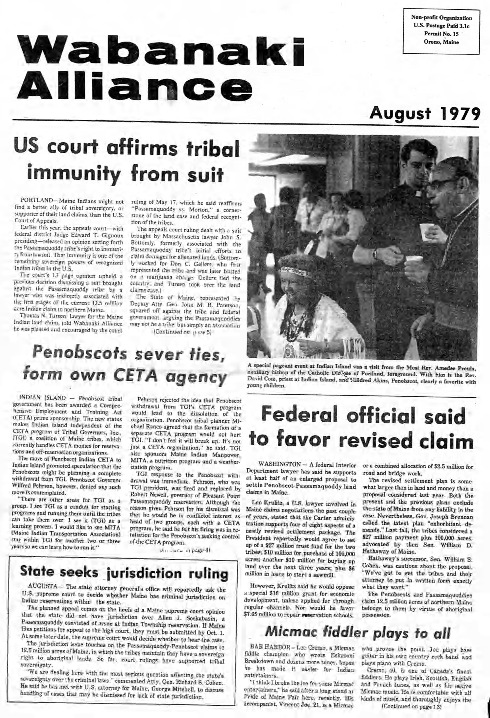
A special pageant M i l at Indian Island v a s a visit from the Most Rev. Amedee Prostht,
auxiliary bislrcp of the Catholic Diajqse o f Portland, foreground. With him is the Rev.
David Cote, priest at Indian Island, andCMildted Akins, Penobscot, clearly a favorite with
young children.
Federal official said
to favor revised claim
WASHINGTON — A federal Interior
Department lawyer has said he supports
at least half of an enlarged proposal to
s e ttle P e n obscot-P assam aq u odd y land
claims in Maine.
Leo Krulitz, a U.S. lawyer involved in
Maine claims negotiations the past couple
of years, stated that the Carter adminis
tration supports four of eight aspects of a
newly revised settlem ent package. The
President reportedly would agree to set
up of a $27 million trust fund for the two
tribes; $10 million for purchase of 100,000
acres; another $10 million for buying up
land over the next three years; plus $6
million in loans to start a sawmill
However, Krulitz said he would oppose
a special $16 million grant for economic
development, unless applied for through
regular channels. Nor would he favor
$7.65 million to repair reservation schools.
or a combined allocation of $2.5 million for
road and bridge work.
The revised settlem ent plan is som e
what larger than in land and money than a
proposal considered last year. Both the
present and the previous plans exclude
the state of Maine from any liability in the
case. Nevertheless, Gov. Joseph Brennan
called the latest plan “exhorbitant de
mands. Last fall, the tribes considered a
$27 million payment plus 100,000 acres,
advocated by then Sen. William D.
Hathaway of Maine.
Hathaway’ successor, Sen. William S.
s
Cohen, was cautious about the proposal.
“W e’ got to ge t the tribes and their
ve
attorney to put in written form exactly
what they want.”
The Penobscots and Passamaquoddies
claim 12.5 million acres of northern Maine
belongs to them by virtue of aboriginal
possession.
Niicmac tiddler plays to all
BAR HARBOR— Lee Cremo, a Micmac
fiddle champion who wrote Eskasoni
Breakdown and dozens more tunes, hopes
he has made it easier for Indian
entertainers.
“I think I broke the ice for some Micmac
entertainers,” he said after a long stand at
Pride of Maine Fair here, recently. Hid
accompanist, Vincent Joe, 21, is a Micmac
who proves the point. Joe plays bass
guitar in his own country rock band, and
plays piano with Cremo.
Cremo, 40, is one of Canada’ finest
s
fiddlers. He plays Irish, Scottish, English
and French tunes, as well as his native
Micmac music. H e is comfortable with all
kinds of music, and thoroughly enjoys the
(Continued on page 13)
Page 2
Wabanaki Alliance August 1979
Worthwhile pursuits
Dear Indian Community:
This m essage is an appeal to you to save and support Wabanaki
Wilderness Pursuits, a program of Wabanaki Corporation in Orono. In
this issue we publish a story about a trip down the Allagash waterway.
Perhaps the words of participants, and the pictures, say more than we
can say here.
However, the plain facts are that Wilderness Pursuits is in trouble.
The outdoor youth program is funded through the summer only. If it
folds— and that’ what will happen if nothing changes— Indians will
s
have lost a fine opportunity for young persons to learn through
experience.
What do boys and girls learn in Wilderness Pursuits? Sometimes
what they learn is not as tangible as how to repair a diesel engine, or
how to balance an account book. Participants might learn how to
balance a canoe through rapids, or repair a tent or build a good fire,
but probably those things are less important in the long run.
In the long run, Indian youth in Wilderness Pursuits may begin to
understand themselves and each other. They learn cooperation,
teamwork, and self-reliance. As each challenge is overcome, they gain
confidence. They can climb that mountain. They can cook a meal for
1 . They can tackle some of the problems in life; maybe not alone, but
2
together. These are human values our schools often fail to instill in
young people.
We see many "achievers” in school. We see many dropouts. Even
the achiever benefits from Wilderness Pursuits. He may learn there is
more to life than a shining report card. In our opinion, an act of
human kindness is worth a pile of report cards.
Chances are, a youth who learns to trust in himself, will naturally do
better in school, home and work. Wilderness Pursuits is not the only
answer to many problems young people have, but it ’ a start. It
s
exposes them to themselves.
In Wilderness Pursuits, there is no frying through drugs, alcohol, TV
or radio. Even cigarettes are banned. One must be honest; one must
confront one’
s-feelings, and the feelings of those around oneself. Today,
there seems to be too many escapes. Too many chances not to be
honest in relationships.
Wilderness Pursuits is one place where dishonesty just w on’ work.
t
That applies to instructors, too. The trip leaders stand to gain as much
as the youthful participants in WP courses. The director of WP, Nick
Dow, says he has had a problem with recruiting Indian youth for his
courses. In fact, he recently took a group of Boston area Indian youth
on a trip. A number of Maine persons dropped out of that particular
course. It was their loss, more than his.
Wilderness Pursuits is a kind of education all too rare today. When it
ends, the Indian community will be the poorer.
Quotable
Some tribal publications avoid issues. They print handouts from
the tribal office, carry notices of local social events and meetings,
report the scores of kids’ athletic events and fill the pages with other
trivia. These publications have no problems with tribal officials.
They can’ be killed. They are already dead.
t
An Indian newspaper should probably be edited by God. And He
would get fired.
_ Vince Lovett, Bureau of
Indian Affairs staff, writing
in an article published in this
newspaper.
Passamaquoddy basketmaking demonstration at Pride of Maine Fair, Bar Harbor. [Kathy
Carreiro photo]
A fair to rem em ber
W e’ sorry for anyone who missed the “Pride of Maine” fair at
re
Bat* Harbor last month. The three day event included an honest
tribute to Passamaquoddy skills and culture.
A selected group of Indians presented various aspects of Indian
lore, such as cooking, drums, basketry, language and herbal
medicine. A special bonus was a Micmac fiddler and his piano
accompanist. Throughout, the fair recognized Indian people and
their way of life with respect and an attempt at understanding.
Indians were only a part of the fair, but those who participated and
demonstrated their skills were vital and interesting. The Indian
presentations at the fair were clearly the result of long and thoughtful
planning by College o f the Atlantic, which sponsored the one-time
multi-cultural celebration with the aid of federal funds.
Along with Franco-Americans, fishermen, musicians and others,
Passamaquoddies contributed their share of entertainment and
enlightenment. At least a dozen Indian persons attended the fair as
visitors, rather than performers or exhibitors. Unfortunately,
attendance at the entire fair was very light. This meant both low
revenue for the sponsors, and the sad fact of few persons viewing a
wonderful display of Maine life, past and present.
Deserving special mention are Wayne Newell, Passamaquoddy
linguist and health director; Joan and Martin Dana, cook and drum
maker respectively; linguist David (Martin) Francis; bilingual
director Robert Leavitt; Fred Tomah, medicine man; and Micmac
musicians Lee Cremo and Vincent Joe.
Also. Elizabeth and Dyke Sopiel, basket weaver and ash-pounder,
respectively; and cook Blanche Socobasin.
Pride of Maine was, to our knowledge, the first Maine fair to do
justice to Indian traditional crafts and practices. There was dancing,
ceremonial dress, legends. . .and who could resist muskrat stew? (It
tastes great, honest.)
The fair was flawed by poor attendance— and by the lack of
Penobscot representation in the Indian booths and demonstrations.
Certainly the Penobscots were and are today a visible part of M aine’
s
heritage.
Nevertheless, the fair qualifies as one of the finest we have seen.
Wabanaki Alliance August 1979
letters
Wants answer
Florence, Arizona
To the editor:
I’ pleased very much to be getting your
m
paper, which I love very much.
And I now have the good fortune o f some
money, so am sending a $5 money order for
my continued receiving o f this paper.
As you know I am a prisoner here in
Arizona and there’ not much money to be
s
made here. I have written several letters in
the past to different Indian and alcoholic
services, and unfortunately got no answer.
Yet, by your editorials, others get answers
with less newsworthiness and importance
than mine. I suppose most of the fault lies in
the people I wrote. But why do they adver
tise in your paper if they never answer their
mail? Makes your paper look bad when they
do that. Surely your paper does not advocate
incompetence.
Again I thank you for the paper. I like it
very much. Have a good day and may the
Great Spirit bless you all.
George Slagger, Jr.
Thanks to all
Lancaster, Pa.
To the editor:
Thanks to all for the wonderful vacation I
had in June and July at Peter Dana Point
and Pleasant Point Reserves.
I enjoyed the fiddleheads, moose and deer
meat, picking sweet grass, beading, swim
ming and meeting all my relatives and dear
friends.
Special thanks to my sisters, Mary
Graham and Martha Malec, for letting me
stay in their homes during my stay in Maine.
Georgina C. Keller and Family
Recipe offer
Plymouth, Mass.
To the editor:
Thank you for your Wabanaki Alliance
newspaper. Enclosed is a $2 check. You
don’ say how much this newspaper is, so I
t
took a chance and sent $2. I have plenty of
food recipes I would like to send to you.
Some are books of recipes o f all kinds.
Would you want them?
Mary Campbell
The favorite
Southwest Harbor
To the editor:
I am now at the end o f my first year of
subscription to the Wabanaki Alliance. It is
my favorite of all the publications and
newspapers that I read.
Instead o f just telling you how beautiful a
paper it is. I’ tell you it has enlightened my
ll
outlook on my people. I have begun to get
involved in the ways of the people. Your
paper helps so much because I have never
lived on Indian Island but my Grandmother
did. She is full-blooded Penobscot and my
Father is half, but I never was subjected to
my Indian heritage until I married a
Penobscot a year ago. I had been searching
my identity since I was about sixteen. I am
still searching for proof o f Penobscot blood
on paper because there are some records
missing.
I am optimistic about our future. More
people are getting involved in preserving our
culture, but we still have a long way to go.
As long as we continue to remember that the
land and our children must go hand in
hand, we’ be all right.
ll
Please continue to send me the Wabanaki
Alliance. It means more to me than just
something to read.
Tom M. Newman
Petition to White House
New York City
To the editor:
With this letter I would like to inform you
on how we stand with our petition
campaign.
On June 5th, 1979 I was in the Office of
the White House in Washington, D.C.
where I delivered the first bunch o f signed
petitions (total o f twenty thousand eight
hundred signatures) also a letter to the
President asking for the meeting, with a list
of ihe traditional Native Americans that are
willing to meet with the President.
The proposal will now be submitted to all
the various members in the White House
and to President Carter. It looks like we
have a good chance. The Office o f theWhite
House will get back to me within 4 to 6
weeks with some resuits, and I hope with a
date for the meeting. I was told that a
convenient time for the White House will be
in October 1979 due to the fact that the
previous months are fully scheduled. This is
a good time also for theTraditional People.
In the meantime the campaign is going on
because we need to make the petition
stronger. So please stay with us, your
continuing help is badly needed. I will keep
you posted on our progress. You can call me
collect; I will love to talk with you, exchange
ideas and make some plans for the
immediate future.
Maria Debegnac
Rage 3
Checking it out
Santa Barbara, Ca.
To the editor:
I get to read your newsletter that you
send to our Chief and I really enjoy it and
think it’ one of the best Indian
s
newsletters today, and this is why I am
sending you this evidence on this person
from Greensburg, Indiana, that told your
paper to “check it out,” in your July 1979
issue.
In 1976 Joan Manning and Stewart
Rodda had an organization at Westport,
Indiana called American Indian Defense.
Stewart Rodda at that time claimed to be
Choctaw and Sioux, and Joan Manning
stated she was Cherokee.
Now they have m oved their organiza
tion to Greensburg, Indiana and Joan
Manning states she is still Cherokee, but
now Stewart Rodda states he’ a
s
Chippewa and has never changed. What
has happened to the Sioux he claimed to
be in 1976?
No harm meant, Stewart Rodda, just
“checking it out” as you requested
publicly.
Red Eagle Steere
Baptized family
Hartford, Conn.
To the editor:
Please put my name on your mailing list. I
have known members o f the Francis family
for almost 25 years, and baptized about 1
1
o f them.
Enclosed is a donation of $5.00.
Rev. Thomas W. Shea
A donation
Tampa, Florida
To the editor:
Please enter my subscription to your
Indian news magazine. My donation for
$1.50 in check attached.
Clara Pickett
A voice for inmates
Thomaston
To the editor:
I just finished reading the latest issue of
Wabanaki Alliance and was very pleased
with its contents. The letters to the editor
which you published were very good.
Hopefully these letters will reach the right
people and they will respond to them.
Post that paper
We are finally getting the Indians
together down here and could use some
Perth, N.B.
outside support. What we actually need for
To the editor:
support yet I don’ know, as we are just
t
I would like to subscribe to your Indian
getting our minds together. We have a few
paper, what are your yearly rates? Do let me
vague ideas floating around but nothing
hear from you real soon.
really concrete yet.
Anthony J. Saulis
We do have a newsletter but we would
need some financial assistance to get it
started. We are going to call it the Sunrise
Wabanaki Alliance
Vol. 3, No. 8
August 1979 People. All we need is money for printing
and distribution costs. We have some very
gifted Indians in here and should have no
Published monthly by the Division of Indian Services [DIS] at the Indian Resource Center,
problem putting together a very good
95 Main St., Orono, Me. 04473.
newsletter. Our main goal is to reach the
Native American Indians out there. We
Steven Cartwright, Editor
would like to let people know what we are up
William O ’
Neal, Ass’L Editor
against in here, what we are trying to do
about it. and share some of our feelings with
DIS Board of Directors
other Indians. In a sense, we are asking for
Indian Island
Jean Chavaree [chairman]
donations to get our first issue out and some
Pleasant Point
John Bailey, Public Safety Coordinator
help in distributing our newsletter to the
Indian Township
Albert Dana, Tribal Councilor
Maine Indian population.
Indian Island
Timothy Love, Representative to State Legislature
I'm telling you about this because 1 think
Indian Township
Jeannette Neptune, Community Development Director
Orono your newspaper would be able to help us get
Jeannette LaPlante, Central Maine Indian Assoc.
off the ground. 1 also know that you can
Houlton
Susan Desiderio, Assn, of Aroostook Indians
reach the right people to help us get started.
Houlton
Maynard Polchies, President, Aroostook Indians
We are trying to do something construc
Mattawamkeag
Melvin L. Vicaire, Central Maine Indian Assn.
tive. while we are doing time. If further
Pleasant Point
Reuben C. Cleaves, Representative to State Legislature
information is needed, please contact me.
DIS is an agency of Diocesan Human Relations Services, Inc. of Maine. Subscriptions to
There are only seven o f us to start this, but I
this newspaper are available by writing to Wabanaki Alliance, 95 Main St., Orono, Me.
feel confident we can do the job and do it
04473. Diocesan Human Relations Services and DIS are a non-profit corporation. Contri
well.
butions are deductible for income tax purposes.
Brian J. Attean
RHONDA DAIGLE graduated from the
University of Maine at Orono in May, with a
degree in business administration. She is the
daughter of Louis and Carolyn Daigle of
Stillwater. Her grandparents, Louis and
Doris [Sapiel] Daigle Sr., were formerly of
Indian Island.
Indian Island. Rhonda is employed as
administrative secretary at Northeast Re
gional Institute, Lincoln.
Tracing ancestry
Southbury, Ct.
To the editor:
I have been trying to trace my Indian
ancestry, I understand the ancestry is on my
father’s side.
My name — Lorraine Mazzacane. Par
ents — Fred Dwinells and Edna Joudrey.
Grandparents — Andrew Dwinells and
Mary Ann Hazeltine. Great-grandparents —
William Hazeltine and Ann P. Young.
Ann P. Young is supposedly full-blooded
Indian and born in Montville, Maine. At
present I have no dates, but I assume
mid-1800’
s.
Your address was given to me by Orlaine
Hartmann o f the American Indians for
Development, Inc., Meriden, Ct.
Any information you can give me will be
greatly appreciated.
Lorraine Mazzacane
Remarkable story
Fayette
To the editor:
Your article on the tragic death o f David
Tomer is one o f the most remarkable pieces
of journalism I have read. The fact that you
investigated the actions o f the Old Town
police and solicited local opinion raises a
serious point as regards journalistic bias.
My congratulations. The beauty o f it is that
it clearly illustrates the solidarity o f the
Native American community and the frus
trations they deal with daily in their
relations with the political powers that be.
I happen to be a white Anglo-Saxon-Celt
who identifies with oppressed peoples,
suspicious o f those who show a comfortable
apathy as they deal with their daily lives. My
hope is that one day people of the world will
direct their energies towards the Evil Spirit,
who influences the malevolent temporal
rulers o f the world who would keep their
subjects miserable in order to fulfill
themselves, with the help of the Light of
Lights.
Keep up the good fight.
Greg Boardman
SU BSCRIBE T O
WABANAKI
ALLIANCE
News o f
Maine Indian Country
Page 4
Wabanaki Alliance August 1979
letters
A first edition
Indian art school
Newark, N.J.
To the editor:
I am sending you a copy of the first
edition of our newspaper. Please feel free to
utilize any information you might need.
Please put us on your mailing list so we can
continue to communicate. Also could we
have permission to utilize graphics or infor
mation from your paper? Thank you.
Keep in touch.
Sarah Hines
Editor
Miracle
Santa Fe, N.M.
To the editor:
We would like to call for your assistance
again in disseminating information that is of
utmost importance to many o f your readers.
It is an attempt to clarify misinformation
that has been flooding the media.
Shortly after the beginning of the year a
local Indian organization made application
to contract the school as a local high school
instad o f the national art-educational facility
that we have/ been operating for the past
sixteen years. It was deternined that IAIA
would continue in its present format while
sharing facilities with another Indian educa
tion project. Unfortunately, the determina
tion came at a very late date and in the
midst of much miscommunication. Through
error, on June 12th the Washington Office
issued a news release indicating that we
would not accept new students and would
only <x>ntinue to serve those who were
previously enrolled in the program. The
release o f this information will have the
most adverse effect on the educational
program. We will continue to offer the full
two-year program and it is imperative that
prospective students are aware of this. The
future of the school is in jeopardy if we are
unable to spread the good news before the
beginning o f the school year.
We feel that this information will not only
enable Indian youths in your area to take
advantage o f the outstanding art education
programs being offered, but will also be
exciting news for Indian parents and art
eductators in your area.
Sincerely,
Henry Gobin
Institute o f American
Indian Arts
Black Hills alliance
To the editor:
We have received reports from the Wash
ington Spot Light newspaper of the capital,
that the President is a member o f the Inter
national Trilateral Commission and that the
Carter administration is pushing interna
tional energy developing corporations, in
stead of American energy corporations. The
Sioux Indians o f the Black Hills Alliance,
have contacted us and told us that this inter
national trilateral commission had written
up a full report on their Black Hills and the
surrounding areas and designated them as a
national sacrifice area for the nation’
s
energy problem.
This is outrageous, and is illegal, because
even if it’ true that the President is a
s
member of the International Trilateral
Commission, he or this international com
mission cannot designate these Sioux-owned
lands. The Carter Administration can only
serve America and America’ national prob
s
lems according to our Constitution, and the
U.S. Constitution does not give the Carter
administration the authority to be in
violation of the Fifth Amendment. The
Carter administration cannot even designate
these Sioux-owned Black Hills as any type or
kind of a sacrifice:
The Sioux have their Indian Treaties and
the U.S. Constitution to uphold their owner
ship. Also, the U.S. Claims Commission in
1974 further proved ownership of these
Black Hills and it’ written forever more in
s
their case records, the U.S. Claims Com
mission tried to give the Sioux 17 million
dollars for compensation o f gold taken out
of them a century ago. This settlement was
refused and hung around until June 1979,
when Chief Judge Daniel Friedman of the
United States Court, upheld an award for
this compensation o f 100 million dollars,
and this judge stated that a Sioux and U.S.
'treaty of 1868 reserved certain lands in
South Dakota including seven million acres
in the Black Hills area, for the undisturbed
and absolute use and occupation of the
Sioux Indians. This is also further proof of
the Sioux on their legal ownership of these
Black Hills, besides their sovereignty in their
treaties and also having been living on these
lands from time unremembered. They need
support against the planned uranium
mining.
These same energy corporations have
contaminated the Indian reservation lands
of Arizona and New Mexico, and radioactive
tailings are laying right on top o f the earth.
We have written our congressman Robert
Lagermarsino and asked that he ask
congress or some branch of the government
to put radioactive materials in empty mine
shafts and then take ten feet of earth off the
ground where they were laying, and dump it
also down some mine shaft and then cement
it over. We are waiting for his answer to us
on this. This would at least be better than
having this stuff laying in small mountains
upon the open reservation lands to be blown
about in every breeze and to run all over in
the rain or snow. The children are getting
sick from it.
Arthur Greywolf
FOUNDATIONS FOR THE FUTURE — What is now just a hole in the ground, will soon
be a new home at Indian Island, part of a large expansion program on the Island.
Tribe g e t s con trol o f CETA
(Continued from page 1
)
Pehrson said he felt the TGI action to
remove him was improper since the meeting
was called without his approval as president.
He indicated that he did not regret the loss
of the seat, because o f a busy schedule, and
probably would not fight it. He said he
would continue to be a member o f TGI. “I
can work with any one of them down there
on a one to one basis, or as a group,” he
maintained.
Ranco offered several reasons for the
Penobscot prime sponsorship. “Because
most everyone is back (on the reservation,
'ther than distributed throughout the
‘
e), we feel we can control our own
Gerard eyes BIA
role in tribal politics
WASHINGTON— Interior Assistant Sec
retary Forrest Gerard has been mulling
the role o f Bureau of Indian Affairs (BIA) in
tribal politics.
Gerard cited the Supreme Court’s Mar
tinez decision, denying federal courts au
thority to interfere in alleged civil rights
violations by tribal governments and Con
gress’ denying BIA that authority. He
added, “Too often, tribal governments and
their existing institutions are not yet really
adequate to ensure the relief that the
Supreme Court assumed existed. The result
has been a partial void in the checks and
balances of the governmental process.”
According to a BIA press release, Gerard
further said that “on several occasions
recently, violence had been attributable to
the inability o f the tribal government to
peacefully and expeditiously resolve these
internal matters.”
Passamaquoddy
in Hartford exhibit
HARTFORD, Ct.— Elizabeth Sopiel, 69,
a Passamaquoddy from Indian Township,
.will display her basketry skills at the
University o f Hartford, Aug. 8 to Sept. 12.
The exhibit is called Eastern American
Indian Basketry, “a continuing tradition.”
The show is sponsored by Hartford Art
School, a division o f the university.
Circle hires new editor
BOSTON— A Turtle Mountain Chippewa
Indian has been hired to edit The Circle,
publication o f the Boston Indian Council.
She is Louise Erdrich, a graduate ofDartmouth College who began work in July.
Assisting her is Ed Gaffney. The newspaper
was previously edited by Jack Hayes.
Planning figures released from Washing
ton show that TG I’ CETA allocation may
s
be less than half the preceding year, with
cuts as much as two-thirds in Titles II and
VI. An official at the national CETA office
in Washington cautioned that planning
figures are “mythical” and are mere projec
tions for planning budgets. No definite
figures could be known until the CETA bill
clears Congress, he said. The allocations
could be higher, he added.
Planning figures reveal that the Penob
scot CETA program is projected to receive
$83,346. Ranco estimated, if the Penobscots
had remained under TGI, they would have
received around $64,000. TGI, which has
the second oldest CETA sponsorship in the
state, has been tentatively allocated $234,572.
Ranco predicted that administrative over
head would be lower with the new prime
sponsorship, particularly if CETA can be
linked with Bureau o f Indian Affairs (BIA)
programs.
He predicted that the structure would be
similar to TG I’ CETA program, but with a
s
heavier emphasis on career development
than T G I’ which he characterized as
s,
emphasizing administration.
BIA educators m eet
Michael Ranco
programs. Inter-tribal programs served the
purpose o f getting funds. We don’ have to
t
join forces anymore,” he said. He said at
least one off-reservation group, Central
Maine Indian Association (CMIA), would be
able to use the Indian Island CETA
program for Penobscot County residents,
but the details had not been worked out.
Although a recent cut in CETA appro
priations by Congress, threatened to force
the*Penobscots back into the TGI CETA
program, the cuts occurred predominately
in areas not relied on by the Penobscots,
Ranco said, adding that the cuts would
probably affect TG I much more. TGI Manpower director Allen Sockabasin said he
could not comment until “I see something in
black and white.”
According to Ranco, the Penobscots will
receive more money as independent CETA
sponsors, than under the TGI umbrella.
WASHINGTON— Bureau o f Indian Af
fairs education administrators nationwide
met August 7-9 in Duluth, Minn., to discuss
new federal laws affecting Indian education
programs, BIA director o f Indian Education
programs, Earl Barlow said.
Barlow said that major changes in Indian
education programs will be introduced in
the 1979-80 school year through the
implementation o f the Education Amend
ments Act o f 1978 (P.L. 95-561). He said
that the Bureau’s education programs were
also being affected by legislation on the
education of the handicapped (P.L. 94-142)
and the Indian Tribally Controlled Com
munity College Act (P.L. 95-471).
The three-day program consisted of
workshops and presentations on the regula
tions and implementation procedures for
these Acts and discussions o f other matters
pertaining to Indian education programs,
Barlow said that the sessions were
important “because the administrators are
the individuals responsible for making the
programs work at the local level— in
classrooms where children come to learn.”
He said that the administrators would be
bringing information from the meeting back
to their teachers, dormitory supervisors,
school boards and other persons involved in
the education o f Indian students.
Wabanaki Alliance August 1979
Page 5
Making tribal sovereignty a reality
By Richard V. LaCourse
“looking at the country and the right wing
swing and the backlash movement in
Indian affairs.” He could not look at the
anti-Indian backlash in isolation from
these conservative economics, including
those espoused by the people to whom
President Carter was listening.
“The trends seemed to be away from
Created in June 1977, it operates as a those things done in America since the
Youth Project field arm. Project coordin New Deal,” he continued. “Instead, now
s
ator is Daniel Bomberry, a Cayuga-Salish it’ tax incentives being given to corpor
Indian born in British Columbia who holds ations. Indian budgets are the ones most
likely to be attacked. I was concerned
a master’ degree in political science and
s
economics. Since 1977, TSP has funded 20 with what it all meant for tribal survival.”
H e was also looking at the environ
American Indian projects in 10 states,
provided technical assistance to them, and mental crisis and the potential for some
path through it coming from Indian people
begun publication of a newsletter. Native
Self-sufficiency, which reaches over 800 as the potential leadership in the
tribes, Indian organizations and indivi environmental movement. “All these
crises are close in our lifetimes and those
duals.
of our children,” he believes.
Of its genesis, Bomberry stated it was
It all came together for Bomberry when
established by the Youth Project following he read John Mohawk’ essay. The
s
a period when he withdrew from social
Sovereignty We Seek Can Be Real.
activism as director of the Native
Mohawk is editor of Akwesasne Notes,
American Studies Program at California
one of the nation’ largest American
s
State College in Sonoma where he taught
Indian newspapers published on the
and also studied historic California Indian
Mohawk Nation land at Roosevelton, N.Y.
land claims. By 1977, he had pondered a
with many international subscribers.
building political, economic, and environ
In early 1977, Bomberry proposed his
mental crisis which was deeply affecting
plan to the Youth Project and it was
American Indian tribes. “Maybe it’
s
accepted for action. “The Youth Project,”
necessary for a number of people to
he stated, “was willing to take a chance, it
withdraw for a while and recollect,” he
is a reputable group, and its support made
said.
it easier for us to establish our credi
“A lot stemmed from my frustrations in bility.”
working in Indian affairs,” Bomberry
Policy-making authority for T SP’
s
explained. “I was amazed by the contin
activities is held by six Indian board
uous talking about concepts and what we mem bers— five men and a woman (see
needed to do— with little actually being box)— to whom the Youth Project has
done. I was interested in seeing people given powers outside its umbrella. In its
and Indian country going out and actually first two-year period, TSP has received
doing things.”
funds from widely varying sources
“Behind it was a political and economic including the Norman Foundation, the
critique of my own,” stated Bomberry, Field and Shalan Foundations, the Akbar
GUERNEVILLE, Ca.— The Native
American Tribal Sovereignty Program
(TSP), is an arm of the Youth Project.
It is a unique public foundation designed
to weigh and meet the needs of approved
American Indian projects.
Fund, the Eastman Fund, and several
individual donors. TSP recently received
13 VISTA volunteers through an ACTION
grant to the Youth Project who are
assigned to work with TSP Indian
projects in four states.
The Policy Board has established the
following Indian “sovereignty-enhancing”
project areas as funding priorities:
Land and natural resource Jssues.
These include efforts to reclaim and live
on aboriginal tribal lands and to protect
them and natural resources from incur
sions on tribal water rights and spoilation
by destructive energy development:
Redevelopment o f self-reliant tribal
economies. This is addressed through
creation of traditional and innovative
means for food production, use of
appropriate technologies to m eet those
goals such as solar greenhouses and
wind-powered energy, and to explore
methods for alternate energy uses;
Restoration o f traditional tribal govern
mental forms. This includes revival of
traditional indigenous forms of Indian
community political organizations, as well
as modifications of existing tribal govern
ments along traditional lines rather than
“government by Bureau of Indian Affairsdominated tribal councils.”
TSP began publication in June 1978 of
its bimonthly newsletter. Native SelfSufficiency, to provide information on old
and new technologies, alternative energy
resources, gardening, small-scale farm
ing, health, cooperatives, and alternative
housing. It is available from TSP by
writing Editor, Native Self Sufficiency,
P.O. Box 1044, Guerneville, CA 95466.
Subscription is $6 per year for individuals,
$15 for organizations.
By early spring of 1979, T SP had
targeted and funded 20 projects of which
15 are clear successes. “W e don’ maintain
t
a strict checklist of things to which a
project must comply," said Bomberry.
“It’ largely the results of field visits by
s
m yself or a policy board member.”
Bomberry said nearly 50 such on-site
visits w ere made in TSP's first 18 months.
“Our funding is very small. W e fund for
three months at a time. W e work out
time-phased objectives (with grantees)
and review each phase after that time. We
also do joint checking accounts with the
projects under contracts which spell out
agreements, limitations, and performance
checks. We require monthly reports.”
T SP provides m odest seed funds to
selected Indian projects and amplifies it
with additional funds by providing access
to other foundations using the expertise of
the Youth Project, as well as to churches,
corporations, private donors and the
federal government. “Our role with the
federal government is pretty limited,”
said Bomberry. “M ost of the Indian
groups around the nation are on top of the
federal funding picture.”
Am ong TSP’ approved projects are:
s
D IS S E M IN A T IO N OF IN F O R M A
TION: A regular news feature on
applied technologies is now carried by
AKW ESASNE NOTES, one of the nation’
s
only tw o national Indian newspapers (the
other being W ASSAJA in San Francisco,
California). Based on the Mohawk Nation
lands in New York, NOTES is also
working with the Federation of Survival
Schools (FSS) in Minneapolis, Minnesota,
to prepare A Survival School Survival
Book by students and staff on traditional
lifeways and modern adaptations for
Indian youth. The Federation has 14
m em ber schools. In Oakland, California,
the Center for Investigative Reporting
conducted a journalistic investigation of
the Interstate Congress for Equal Rights
(Continued on page 14)
Tribal im m unity
(Continued from page 1
)
o f Indian persons. The court responded that
tribal status was not the issue, because
Bottomly clearly recognized Passamaquoddies as a tribe in his suit, and in business
dealings.
“While appellant could have sued the
tribe as an entity and its members as
individuals, thus having it both ways, he did
not do so,’’the court opinion said.
The court opinion supports an earlier
district court decision to dismiss the
Bottomly suit for “want o f jurisdiction.”
Bottomly had originally sued the U.S., State
o f Maine, and even Bottomly’ co-counsel,
s
Gellers, but all these actions were dismissed
on grounds of sovereign immunity, the 11th
Amendment and “failure to complete
service o f process.” Only the suit against the
tribe was appealed, resulting in the appeals
court opinion.
“ We conclude,” the opinion said, “as did
the court below, that appellant clearly
brought suit against the tribe as an entity,
and not as a collection of individuals. The
Passamaquoddy Indians’ tribal status is
therefore to be assumed for purposes of
deciding the issue squarely raised by this
suit: whether this particular tribe enjoys
protection from suit by virtue of sovereign
immunity.”
The state declared the doctrine of
sovereign immunity did not apply to
Passamaquoddies, who are “merely rem
nants or fragments o f once independent
tribes.”
But the court disagreed. Calling the
state’ arguments “unpersuasive,” the ap
s
peals court said the state and Bottomly
“fundamentally misconceive basic princi
ples o f federal Indian law.” The court said
Indians need not be granted explicit federal
recognition and sovereign immunity, but
rather, “The powers o f Indian tribes are
inherent powers o f a limited sovereignty
which has never [been] extinguished.”
The court continued, “Our cases recog
nize that the Indian tribes have not given up
their full sovereignty.. .the sovereignty that
the Indian tribes retain is o f a unique and
limited character.” At any time, Congress
could remove tribal rights, but until
Congress so acts, those rights are retained
by Indians, the court said.
It is clear that Congress has taken no
action to deprive the Passamaquoddy
Indians of their inherent immunity from
suit,” the court stated, adding that erosion
o f time and a history o f neglect by Congress
did not constitute divestiture o f tribal
sovereignty.
Finally, the court opinion concludes, the
previous dismissal o f the Bottomly case was
justified in light of the tribe’ immunity
s
from suit, and the Passamaquoddy tribe is The White Hoase hosted a special meeting this month of Maine Indian leaders and the
Maine congressional delegation, along with federal officials, to discuss Penobscot-Passaclearly entitled to sovereign immunity.
maquoddy land claims. From left, are U.S. Interior Department Solictor Leo Krulitz,
Interior Secretary Cecil D. Andrus, Sen. Edmund S. Muskie, Presidential Advisor Robert
Lipshutz, Rep. David F. Emery, Sen. William S. Cohen, and Rep. Olympia J. Snowe. In
foreground, from left, are Passamaquoddy tribal Governors Harold Lewey and Robert
Newell; tribal lawyer Thomas N. Tureen, Penobscot Gov. Wilfred Pehrson. [Photo by Allen
J. Sockabasin]
w
Off-reservation
potluck planned
ORONO— Central Maine Indian As
sociation (CMIA) mem bers and friends
are invited to join a potluck supper, and
regular board meeting, Thursday, Sept.
13, at Indian Resource Center, 95 Maine
S t, Orono.
The supper is set to begin at 5 p.m., and
people are urged to bring a food of thenchoice. Children are welcome, according to
Marta Conlin, CMIA outreach worker. If
anyone has a transportation problem, call
Marta at 866-5587. The current president
of CMIA is Donna Loring.
Township has education aide
INDIAN TOWNSHIP— Stephen Newell,
26, a Passamaquoddy, has replaced Samuel
Dana as director o f education and economic
development for the tribe.
Newell told Wabanaki Alliance he will
work closely with education guidance
counselor Joseph Stewart, at the Township.
Newell and his wife reside in Nasonville,
with their two children, Steve, three, and
Jason, seven. Jason will attend school in
Princeton, rather than Indian Township
elementary school, his father said. The elder
Newell said he prefers the non-Indian school
for his son.
Newell obtained a high school equivalency
diploma, and attended Bangor Community
College. His predecessor, Dana, is attending
the University o f Maine at Orono.
Page 6
Wabanaki Alliance August 1979
G o v ern o r sig n s pardon
fo r Indian se e k in g job
By Bill O ’
Neal
AUGUSTA— John Dana looks the same
this month as he did last, but he s feeling
much better.
Because o f a shooting incident five years
ago and a resulting assault conviction, many
elected offices, jobs, and other privileges of
citizenship were until last month out of
Dana’ reach.
s
Although he served his time (he was
released after 45 days because o f good
behavior), and has a wife and family and a
steady job, the stigma of that rash moment
years earlier continued to affect his life.
With the signing o f a pardon by Maine
Gov. Joseph E. Brennan in late July, Dana
has become a full member o f society again
and at last has been allowed to forget the
mistake he made.
It took two meetings with the Governor’
s
pardon and commutation committee, plus a
fretful 10 day wait before the pardon was
granted. At his first meeting, a nervous
Dana arrived at the state house an hour and
one half early after a 200-mile drive, only to
be told he had failed to advertise his pardon
request in area newspapers and, therefore,
could not be granted a hearing.
His second hearing went .more smoothly,
with many of his friends and family coming
to speak in his behalf. Albert Dana, his
father, said he had seen John change a lot
since the shooting incident. “Those things
happen. Youngsters don’ realize how
t
serious it is. Since he’s been out, he s
improved a great deal.”
Dana said he was motivated to seek the
pardon out of a desire to serve on the
Pleasant Point tribal police force. To do that
he needed a clean record. Ironically, he said
his interest in police work developed from
his associations with the police during his
jail sentence.
According to David Redmond, chairman
of the pardon committee, decisions are
based on consideration of the petitioner’
s
conduct since release, the gravity o f the
crime, community sentiment, and testimony
o f people at the pardon hearings. He said
pardons are granted to approximately one
out o f every four petitioners.
It looks as though the committee made
the right decision in Dana’ case. When
s
asked what he did to celebrate when he
heard of his pardon, he replied, “Nothing, I
just went to work as usual,” at Young Adult
Conservation Corps.
1980 census to tally Maine Indians
O R O N O — Officials o f the U.S. Bureau of
the Census hope to be more accurate in 1980
than they were in 1970, when Maine s
Indian population was estimated at about
400 persons.
Actually, the figure is probably closer to
4,000, so perhaps a zero was dropped.
A preliminary explanation of the census
taking was given by Richard Chin Ning, a
New England area census specialist, who
met recently with Central Maine Indian
Association director Melvin L. Vicaire.
Ning said "Maine is my responsibility,”
and that Indians are one o f four minority
“target groups” of the 1980 census. We
want to get in touch with local community
leaders to solicit their help in the census. If a
local community leader says the census is
important, and we need the statistics...
then people will support it,” Ning said.
Ning hopes to “ alleviate some fears ab^ut
the census.” He said people frequently
refuse to answer questions from fear of the
Internal Revenue Service, or because of
some previous difficulty with the law. There
is no need to fear the census or any
consequences o f it, and confidientiality will
be respected. Ning told Vicaire.
Richard Ning
"An organization such as CMIA (Central
Maine Indian Association) uses census
statistics to document needs,” Ning pointed
out. Many federal agencies, such as health
and housing, rely on such statistics in
awarding grants and other monies.
Ning, one o f eight regional community
service specialists, said $50 billion annually
is appropriated on the basis of census
figures. The cost o f conducting the 1980
census will be about $1 billion, he said. That
figure is four times the cost o f the 1970
census.
Official “census day” is April 1 1980.
,
The bureau will attempt to count all persons
across the U.S., plus all housing units. It’
s
estimated there are 222 million people in 86
million units of housing. The census is
expected to be completed nine months after
census day. A national temporary work
force o f 280,000 persons will be hired to take
and tabulate census data.
In Maine, Ning explained, some Indians
will be treated separately from the general
population. "People on reservations are
asked to fill out the initial form, but hold it
till the census taker comes by.” Off-reserva
tion Indians will receive forms in the same
manner as non-Indians.
Ning said reservation Indians will either
receive a “short form” plus a supplemental
form, or a "long form” only. The short form
consists of 19 questions; the long form has
67 questions. In larger communities, many
forms will be mailed out, and recipients will
be asked to mail in completed forms.
However, Maine is “very rural, and some
how it’ more effective to do the census
s
conventionally (with a door-to-door census
taker),” Ning said.'
Don’ throw it away
t
“We really have to get the word out to our
people to fill out the form. Don’ throw it in
t
the can,” said Vicaire, echoing Ning’
s
statement that statistics are needed to justify
needs and thereby receive funds from
federal agencies.
Vincaire said census figures are "vital
now, especially because of the coming of
BIA services to Maine Indians.. .we’ got
ve
a lot of work to do in getting the word out.
because we have very little leverage to work
with.” CMlA’s Micmac and Maliseet
Indian Indian membership is not eligible for
BIA funds or services in Maine.
Vicaire said that nationally, 60 percent of
Indian people live off reservation, but here
in Maine it’s more like 75 percent.” He
warned that if off-reservation Indians are
missed in the census, they stand to lose
various benefits plus their official identity as
Aroostook News
By Brenda Polchies
Area Correspondent
ARIBOU— I want to apologize to the
f at the Association o f Aroostook
ians in Caribou for neglecting to inform
public o f the day camp coming out of
t location on Water Street. A schedule is
ig maintained similar to the day camp at
niton.
ieventeen children between the ages of
=e and seven are being served with varied
r camp activities such as visiting sites of
;rest, indoor activities are featured and a
lunch is provided. The sessions will be
three days a week, Tuesday, Wednesday.
J Thursday, from 9 a.m. to 3 p.m. This
np will also continue until the second
ek in August. Counselors from Caribou
d Houlton working with the Indian
ildren are Joannie Spitzer, Eugene Saunrs. Cheryl Martin, Paula Doak. Barbara
hillinger, Mary London, Tracy Trecartin,
d Sally Joseph.
HOULTON— On June 23, a delegation
>m the Association of Aroostook Indians
at Houlton and the Citizens for Youth
attended a hearing before the Maine
Criminal Justice Planning and Assistance
Agency at Augusta. Maine, to testify in favor
o f a joint project which has been submitted
by the two groups for funding. A favorable
confirmation has been received from that
agency by the group had to appear before
the full board which met on July 31, where a
final decision was confirmed.
SINCLAIR— Sunday August 5. Family
Day activities were held at Kamp Karawq^
nee. Mud Lake, with family, friends. ar*d
campers in attendence and enjoying an eas*
going all day affair o f swimming, Indian
dancing, games, and canoeing. Bob Bryan
of the Quebec-Labrador Mission Founda
tion provided a plane ride and showed a film
of the two sessions of the Maine Indian
Summer Camp. Bryan informed the guests
and campers that this film will be presented
on the Educational TV network in Maine,
sometime in February 1980. Crafts done by
Indian children were on display in the main
lodge, and food was served at noon.
MANY RETURNS — That was the happy wish for William and Celina Newell, married 58
years as of Aug. 22. The couple was presented with a special cake, and piano serenade by
Marylou Paul, at a senior citizens luncheon at Indian Island. Celina received a new ring
from her husband. She was especially fond of the “ sweetheart roses” in a bouquet. The
Newells were married in 1921, at SL James Methodist Church in Montreal. Celina said the
new ring is supposed to be “good for 58 years more.”
Wabanaki Alliance August 1979
Page 7
The trials of a tribal newspaper
COMMENTARY
By Vince Lovett
The Navajo Times is hardly a typical
tribal newspaper. A 40-page tab weekly with
its own printing facility, an annual budget of
almost $500,000, serving the largest Indian
tribe is vastly different from the mimeo
graphed newsletters o f some groups or the
other smaller, less frequently published
papers of other tribes.
Nonetheless, the recently published story
about the Navajo Times done in its special
issue about the press on and around the
reservation describes problems and criti
cisms that would fit most tribal papers.
Though there are great differences in the
style and quality o f Indian publications and
varied situations from reservation to reser
vation, there are at least three common
problems for Indian editors and staffs:
• Indian newspapers are dependent on
tribal chairmen and tribal governing bodies
for essential financial support;
• Indian newspapers are poor;
• There are not enough trained, capable
Indian journalists.
Dependence on tribal officials
If Richard Nixon had been owner and
publisher o f the Washington Post, the
burglary o f the Democrats’ Watergate
campaign headquarters might have re
mained forever an unimportant, third-rate
crime story.
The founding editor o f the first Indian
newspaper— the Cherokee Phoenix begun
150 years ago— had problems with tribal
officials. When Cherokee Editor Elias
Boudinot editorialized that the tribe should
consider migration to new land to get away
from the surrounding settlers, the Principal
Chief of the Cherokees, who was against
migration, ousted him from his job.
Unfortunately, this was not the end of
Editor Boudinot's trouples. Some years later
in Oklahoma, he was murdered by a group
o f young Cherokees who were bitter over the
removal to O k lahom a— and som ehow
blamed him because he had suggested that
migration might be considered.
Editors still get fired— but rarely mur
dered today. Papers, however, may be killed.
Columnist Mike Royko. one o f the stars o f
the recently deceased Chicago Daily News,
said that paper was killed by too much
courage. He said the paper’ early, consist
s
ent and strong promotion o f racial justice
cost it— especially in the budding years of
the black movement— a loss o f readers from
which it could never recover.
Trying to report the news about the tribal
government is difficult when that govern
ment provides the funds to pay the printer
and his editor’ salary. Editorializing about
s
tribal government matters is even harder.
borne tribal publications avoid issues.
They print handouts from the tribal office,
carry notices of local social events and
meetings, report the scores o f kids’ athletic
events and fill the pages with other trivia.
These publications have no problems with
tribal officials. They can’ be killed. They
t
are already dead.
An Indian Newspaper should be edited by
God. And He would probably get fired.
To be good, a newspaper has to deal with
issues, with problems and needs in the
community. It should be an advocate of
community causes; it should be a scold and
a critic, a preacher and a 'cheerleader. It
should help the community be better
informed, more involved and alive. It has to
be a paper for the people— which means it is
not a house organ, a propaganda mill for the
tribal council.
How, then, does the editor o f an Indian
paper handle this bomb ticking away in his
office waiting to go off the first time he
publishes someting the tribal chairman
doesn’ like?
t
Gingerly. Somewhere between a crusader
GETTING INTO THEIR W ORK — These Youth Conservation Corps [YCC] workers have
their hands filled harvesting the beans from the Indian Island community garden. Pictured I
to r are Victor Wood, Rachel Sockbeson, Lynn LaPointe, and Tina Sullivan. According to
team leader, Eva Love, last year the garden was vandalized, so no time is wasted in bringing
in the crops. All produce is given to the elders of the tribe.
SfA official named temporary director
WASHINGTON— BIA chief Forrest Ger
ard has appointed Sidney L. Mills, Director
of the Bureau of Indian Affairs’ Albuquer
que Area, as acting deputy commissioner of
Indian Affairs.
In this job Mills will direct day-to-day
B1A operations, until a permanent commis
sioner is named.
Mills replaces Martin E. Seneca, who has
been the acting BIA head since October,
1978. Seneca has announced his intention to
resign from the Bureau as o f September 30.
He returned to his former position as
director o f trust responsibilities July 30.
Gerard said that he asked Mills to assume
the duties as Acting Deputy Commissioner
prior to Seneca’ resignation “in order to
s
effect an orderly transition.” He expressed
appreciation to both Seneca and Mills “for
their extra measure o f performance.”
Mills, an enrolled member o f the Oglala
Sioux Tribe, was assistant to the commis
sioner o f Indian Affairs prior to his
appointment in Albuquerque in March
1978.
A Navy veteran. Mills, 54, entered Federal
service in. 1973 in the Aberdeen, South
Dakota Area Office. He was supply and
contract officer and, for almost a year,
acting deputy area director before transfer
ring to Washington, D.C., in August 1975.
and a coward there is a good place for an
editor.
There are a few things that can be done to
ameliorate this inherently difficult situation.
Editors should pray for humility, courage,
and a deep love o f truth.
They should try to develop in the
community and among tribal officials an
understanding and appreciation o f the role
o f a community newspaper.
Most tribal officials, it should be noted,
are good people who genuinely care about
the well-being o f the community. Conse
quently, if they see the paper— though it
stirs discussion and even criticism o f the
govement— as a community asset, they may
support it.
Intelligent support from the people is
pure gold. It usually takes some years to
establish a tradition o f good joumalsim in a
community. Once there, it is beautiful. Then
people can disagree vehemently with the
newspaper and still understand that it is
doing its job. Then tribal officials need to
respect the paper.
Try to go beyond the middle of the road.
There is frequently a tendency in situations
o f this kind to exaggerate the lack of
tolerance among officials. Editors impose
restraints on themselves which are more
severe than they need be. There is no need to
seek early martyrdom, but there isn’ much
t
point in continuing to breathe if you can’
t
live a little.
Poverty of Indian Newspapers
Poverty is not the worst affliction for a
newspaper. As William Allen White's
Emporia Gazette demonstrated, a newspa
per can be poor, small and very good. And
there are many atrocious wealthy papers.
Some limitations caused by lack o f money
can also be blessings. The need to use
editorial/news space economically can lead
to good, tight editing and selection o f news.
Lack o f space usually means competition
between local and national news— otherwise
known as the “battle o f the relevant versus
the significant.”
The loss o f timeliness, when you can
afford to publish only monthly or bi-weekly,
is a hard problem. It is worse when slow
mechanical processes cause a several-day
lag between editing and publishing. Then
you have to write or select material that will
“ keep.” If you can’ be first, you have to
t
seek other qualities.
Because they are poor, Indian newspapers
need to spend the money they have
wisely— trying to be a good “poor” paper.
Function must be emphasized. A clean,
attractive-looking product— which expen
sive equipment can make possible— is
certainly desirable, but the news/editorial
content is what makes or breaks the paper.
Spend the money on content.
Cooperative efforts should be helpful.
What one newspaper could not afford,
maybe five or 10 or 40 could. The American
Indian Press Assn. (AIPA) News Service
died in 1975 in part because the Indian
newspapers did not support it financially.
Efforts toward reestablishing Indian press
organizations and pooling resources need to
be promoted.
Small numbers of Indian journalists
When a person takes certain courses in
college and then goes through medical
school, he comes out a doctor. Change the
courses and routine somewhat, and people
come out engineers or accountants or
lawyers.
Go through journalism school, though,
and you come out someone-who-studiedjournalism. No one really knows what a
journalist is— or how one is created.
Brendan Gill, in his chronicle “ Here at
the New Yorker,” described the people who
staffed that famous magazine as “congeni
tal unemployables.” They were immensely
talented people who would have found it
difficult to fit their talents into most other
job situations.
There is, clearly, a craft to be learned for
would-be Indian journalists— either in
school or on the job. Newspapers are not
literature. But reporting an event, telling
someone what happened demands skillful
writing. It also requires perceptive “seeing
and hearing” and the understanding to
separate wheat from chaff.
Many o f the best newspapermen have not
been journalism grads. A lot o f them never
made it through college.
There are more Indians receiveing formal
education and training, and this will help
them to more easily move into newspaper
work. Indian tribes and people are becom
ing more aware o f the importance of
communication and the media. In time,
consequently, the shortage of Indian jour
nalists should be ended.
For immediate needs, the best tool for
promoting training seminars arrd otherwise
dealing with the problems would be an
effective Indian press organization.
EDITOR'S NOTE: Vincent J. Lovett is
an information specialist since 1974 with the
public Information Office o f the Bureau of
Indian Affairs (BIA) in Washington. D.C.
He has also represented the BlA’ informa
s
tion functions at gatherings o f Indian
journalists— and knows firsthand whereof
he writes in this analytical essay written for
Red Current. From 1971 to 1974 he worked
at the top levels o f the BIA Education
Division, and during this time he won a top
award in 1973 from the Federal Editors’
Assn, for his publication on Indian educa
tion. He has served in the Peace Corps, and
worked in the field of the Catholic press. He
was co-founder of the National Catholic
Reporter and editor o f a diocesan newspa
per in Kansas City, Mo.
Congress asked to
fund native cures
WASHINGTON— The American Indian
medicine man is making a comeback and
should be given equal status with doctors in
Indian Health Service Hospitals, Congress
was told by John Powless, Deputy Director
o f the National Indian Health Board,
He made the recommendation, in testi
mony before the Senate Indian Affairs
Committee. The panel, chaired by Sen. John
Melcher. D-Mont.. is holding hearings on
the Indian Helath Service and Indian health
problems in general. Powless said what he
called "Traditional Medicine” has been
largely ignored by the service in trying to
meet Indian health needs. “ However, it has
never been put aside by the Indian people.”
Dr. Everett Rhoades, a Professor of
Medicine at the University o f Oklahoma,
testified the “major deficiencies” of the
Health Service would be “readily correctable
with adequate funding.”
Rhoades, a Kiowa Indian, warned against
taking-Indian criticism o f the service too
seriously. He said "kicking” both the Health
Service and the Bureau o f Indian Affairs
“sometimes reaches the level o f sport by
certain Indian people and groups.” "None
o f them really want an abolition o f either of
these organizations,” he said. Rhoades also
recommended against giving tribes control
o f health programs, saying, “Indian bureau
crats are just as insensitive to patient needs
as are non-Indian ones.”
Business loans
topic of workshop
HOULTON— Indians interested in apply
ing for federal Small Business Administra
tion (SBA) loans are urged to contact a state
Indian Affairs department official.
Russell Socoby, director of the state
Indian office in Houlton, said he wants to
schedule a regular workshop next month
(September) for all interested groups or
individuals. The meeting will probably take
place at Indian Resource Center, 95 Main
St., Orono. Socoby said any kind o f business
venture may be eligible for SBA aid.
Socoby may be contacted by calling
532-6577. An official o f the SBA will attend
the workshop, he said.
Page 8
Wabanaki Alliance August 1979
Six days down the Allagash River
By Steve Cartwright
ALLAGASH WILDERNESS — Some
times we paddled in silence. Not really
silence, because the birds, trees, and wind
and waves were a constant chorus, but we
ourselves were quiet. After miles o f paddling
lakes and rivers, one no longer exclaims over
details.
On the Allagash, things have their place
and purpose, and the canoeist can find a
oneness with himself, the river and his com
panions. We were 12 canoes, 1 men and
1
boys, and we spent six days paddling some
90 miles.
We were 10 Indians and one non-Indian,
me. We were o f course all very different
people, and we maintained some o f those
differences throughout our camping experi
ence. But some of the differences dis
appeared in the chemistry o f a group
sharing its needs, wants and rewards.
A moment arrived, a couple o f days into
the trip, that I will probably never forget.
We had constructed a sweat lodge out o f
saplings and a tarp, plus cedar boughs to sit
on. A pit had been dug for hot stones, and
darkness had come. The traditional cere
mony had begun. At a certain point, persons
seated in a close circle said what mattered to
them.
One member o f our group said he was at
first concerned about my presence, being
non-Indian. I was shaken. What would he
say next? Then he said he felt comfortable,
because we shared in the spirit o f the sweat
lodge and what it represents. Hearing this, I
felt the warmth o f a circle, o f nature and her
world through which we were traveling.
Let me reassure the reader that I in no
way fancied myself “playing Indian.”
Instead. I seemed to see myself better; to be
more direct and honest with myself and with
others. We are what we are. What we are is
strong and good, if we will allow these
qualities to guide us.
My observations are personal, but I think
they apply to the philosophy of Wilderness
Pursuits. This was not just an ordinary
outing. We were six adults and five young
Everybody on the trip had a part in planning. At this mealtime discussion, Nick Dow, left,
gestures, while Barry Nelson, right, and others, hold council.
Perfect place for a snooze.
people (we had planned for more boys, but
they dropped out before we started). Wild
erness Pursuits runs courses for Indian
youth that are designed to both encourage
and challenge boys and girls to face their
lives and problems and “take it on,” as
some WP leaders say.
It works. Wilderness Pursuits take young
persons away from alcohol, drugs, television
(the plug-in drug) and many other influ
ences. Even cigarettes are forbidden for staff
and enrollees alike.
Paddling a canoe provides an ideal
example o f the WP lesson: One has to coor
dinate one’ stroke with fellow paddler,
s
’make joint decisions, rely on that other
^person, use wits and skill, and overcome
such formidable opponents as Chase Rapids
— five miles o f rough water. Actually, what
'you or I might have to overcome is fear,
doubt or anger. Learning how to deal with
feelings in real situations is a vital part of
WP.
Not all o f the trip consists o f heavy
encounters and overcoming obstacles real or
imagined. There was the frisbee toss over
open water, where one o f us, I don’
t
remember who, gracefully jumped and
caught the frisbee, but the canoe was not
under him as he “landed.”
The swimming was great. Our mid-July
cruise down the Allagash was so hot and
sometimes muggy that we would often
plunge from our canoes, then clamber back
in. There was a running battle over which
team prepared the best meal. And the worst.
We ate well, although I have an aversion to
freeze-dried stuff. The coffee would curl
your toenails.
One memorable evening I sat alone by the
canoes pulled up near our camp, and
listened while an instructor drummed
Indian music on a Dunkin' Donuts plastic
bucket, and another man danced. Both
sang. Later we watched a lightning storm,
the bolts seeming very close to us, electrify
ing the night sky.
We paddled with the same partner the
entire distance o f the trip, except for Nick
Dow, WP director, who paddled his own
canoe, solo, often standing up. The canoe
crews o f two seemed to merge in group
activities and at camp, but the two
Passamaquoddy boys stayed apart. I joined
them at their request, sleeping in their tent.
(Continued on next page)
Six days...
Wabanaki Alliance August 1979
Page 9
(Continued from preceding page)
Still, perhaps we needed more time to bring
all of us together in trusting relationships.
I kept few notes on this trip; a combina
tion o f being lazy and busy with the chores
o f camping and canoeing. I did write down
that we saw at close range: moose, a large
owl, squirrels, two immense bullfrogs,
several hawks, gulls, songbirds, loons (they
laughed and laughed, and invariably ans
wered our imitations), a trout, chubs, snakes
and deer. I know I left something out.
Was I tired? Yes, but I kept quiet about
it. I got blisters on my hands from the
paddle, but I kept paddling. Later the
blisters became calluses, o f which I was
proud. My backside got sore too, and I
wrapped lifejacket and sleeping bag around
the canoe seat. I certainly didn’ suffer, and
t
the exercise was good for me.
I confess to envy for the Passamaqouddy
lads. They could paddle circles around me,
with me paddling as if my life depended on
it. As far as I could tell, they weren’ even
t
sweating. I will recommend that these
fellows paddle UP the Allagash next time.
The fishing was lousy, although our
director fished a rod and reel from the river.
The weather was splendid sunshine, with a
couple of evening drizzles that failed to
dampen spirits. The mosquitos were seldom
thick. After several days and nights, I began
to feel there was no finer way to travel than
by canoe, and no finer destination than the
next campsite, and no finer company than
Louis, Sapa, Mark, Kirk, Jim, Andrew, Pat,
Barry, Everett and Nick.
The trip ended, yet something intangible
stays with us.
Andrew Sockbeson, bow, and Barry Nelson run rapids.
In their words continued...
called, converse freely in Passama
quoddy. Sapa is the son of Alice Lola, and
was on his second W ilderness Pursuits
trip. His first, to Katahdin, he didn’ like.
t
(“I like this one,” he said.) He has
two brothers and five sisters. Sapa is
reserved about his feelings, but intimated
he takes pleasure in getting to know new
people, and he “likes to paddle around.”
Actually, Sapa and Louis w ere inseperable on the trip, and seemed to feel those
not of their tribe and community were
This locomotive used to haul wood between Umbazooksus and Eagle Lakes, along with a outsiders to be approached cautiously.
sister engine. The massive relics of the timber industry are abandoned near Eagle Lake.
Sapa said his favorite activities include
Above, Wilderness Pursuits hijacks the train. From left, Ernest [Sapa] Lola, Andrew Sock
game hunting, basketball and baseball.
beson, Jim Sapiel, Everett Sapiel, Kirk Fields, Nick Dow, Louis Dana, Mark Ranco Pat
Neither boy knew much about the
Almenas, Barry Nelson.
boarding school they will attend this fall.
Kirk Fields, Penobscot, is 17, and has
been on three or four Wilderness Pursuits
courses. Going into his senior year at Old
Town High School, Kirk said, ‘ m going
T
to go to college for sure.” Kirk lives on
Indian Island, the son of Nancy Lola
Nelson and Kenneth Nelson. H e has
two brothers and one sister. A steady,
mature person, he said, “I like this, out
here, because you ge t to know people. You
Paddling isn ’ always serious work. Sometimes a splash or some other prank broke the
t
pleasant monotony. Pat Almenas, left; Everett and Jim Sapiel.
In their own words
ALLAGASH W ILDERNESS — Six
boys on a six day journey down the
Allagash waterway naturally had differ
ent points of view, but a common thread
knitted their feelings together into a unity
that grew with each new experience.
The youngest participant was Jim
Sapiel, 14, a Penobscot from Indian Island.
He paddled in the security of a canoe
manned by his brother Everett, a
Wilderness Pursuits instructor. Jim had a
quiet smile, a readiness to help out. He
never lost his shyness completely, but
that didn’ stop him from enjoying playing
t
frisbee from canoe to canoe. H e said he
likes to go camping with his brothers,
when not busy as an Old Town Junior
High School student. He likes a 75cc
Honda motorcycle.
Mark Ranco, 17, is a Penobscot who
lives with his aunt, Ann Pardilla, at Indian
Island. A serious young man, he recalls his
late grandmother, Margert Rancox. “She
smartened me up a lot. No dating,” he
said. He would like to play professional
sports, or perhaps become a commercial
artist. A John Bapst High School student,
he is a fullback and halfback in football,
and plays basketball and hockey.
Mark said the Allagash trip was his
third; “It makes you appreciate home a lot
more, and thank God for what you have,”
he said.
The expert paddlers of the trip were
two Passamaquoddy participants, and
they didn’ mind demonstrating their skill.
t
Almost always joking and joshing were
Louis Dana, 15, and Ernest (Sapa) Lola,
16. They both live at Indian Township, and
have attended Calais High School. This
fall they will attend Intermountain School,
a Bureau of Indian Affairs boarding
school.
Louis isn’ ju st a good paddler. He is an
t
Indian dancer. His brother Martin is
known for drum-making, and made wings
and a tail for Louis to perform the Eagle
dance. His oldest brother, Andrew is an
artist. The son of Joan Dana, Louis has six
brothers and three sisters. He loves to
hunt and fish, and is an outfielder for the
Dana Point Indians baseball team (two
brothers are team members).
Louis and Sapa, as he prefers to be
can think a lot, and it builds up your
self-esteem and confidence.”
Andrew Sockbeson, A PassamaquoddyPenobscot, is 18 and lives in Bangor. He is
the son of Beth and Albert Sockbeson, is a
senior at John Bapst High, and will
probably go to college. He said he is
contemplating marine biology, and may
apply to Dartmouth, University of Ver
mont, or Boston University.
H e joined a previous Wilderness
Pursuits course, traveling by canoe from
Lincoln to Old Town. An articulate,
outgoing person, Andy say's that on the
trip, “You meet new people. These trips,
you learn.. .different things. Everybody
pulls his own w eight
“Just being out, having fun; it’ a new
s
adventure, really,” Andy said. Comment
ing on a traditional sweat lodge ceremony
held at one Allagash campsite, he
observed that he became more aware of
his Indian identity: “I think I care about it
more, now that I understand it better.
You understand it better when you’
ve
experience^ >t ”
Page 1
0
Wabanaki Alliance August 1979
Indians should define who is Indian,
educator tells NACIE panel
get done. It’ the Indian people that suffer,”
s
she said.
In the wake o f those comments, a
resolution brought by NACIE member Joy
Hanley. Navajo, was passed. It calls for
adequate construction funds for reservation
schools, so that in 5-7 years Indian children
will have adequate schools.
Peterson explained. “ We’ on a limited
re
budget but our commitment is there. We're
committed to Indian education."
Another Indian affiliated with Harvard
testified that "the history o f New England
Indians has not been told.” Claudette
Bradley, a Connecticut Shagticoke. said that
although small, her tribe "has never been
terminated by a local government, a state
government or a federal government. We
havfe never abandoned our land.”
A doctoral candidate at Harvard who
hopes to develop an Indian math curricu
lum. Bradley said that elders of the New
England tribes are "bearers o f history,” and
something should be done to preserve it.
Bradley. 37, works with Dr. Richard
McCann in the Boston regional office o f the
Department o f Health, Education and
Welfare. She is under contract to assess
Indian needs in New England. Area tribes counselor to Indian students at University of Maine.
include Penobscot and Passamaquoddy,
indigenous to Maine (also Micmacs and
Bradley grew up in Stratford, Ct. Her arrangement by tribal official Timothy
Maliseets in Maine, originally from Can
ada); Pequots, Golden Hill and Shagticoke tribe has 400 acres at Kent and is pursuing a Love. Other NACIE members at the Bangor
in Connecticut; Wampanoags in Massachu land claim for an additional 1,300 acres. meeting were Earl Oxendine, Lumbee; Fred
Big Jim. Alaska native; Violet Rau, Yaki
setts; Abenakis in Vermont and Narragan- That claim includes grounds o f Kent School
setts in Rhode Island. Bradley said there are for Boys, o f which Indian author Vine ma; Robert Swan, Chippewa; Ruby Ludwig,
Oklahoma; Thomas Thompson, Blackfoot;
20.000 Indians in New England, 3,000 of Deloria is an alumnus.
Patricia McGee. Yavopai; Maxine R. Edmo,
Bradley praised another Indian group,
which are children.
the Boston Indian Council, “conceived by 12 Shoshone-Bannock; and Wayne Newell,
Commenting on a Lumbee slide show at
alcoholics in the South End who wanted a Passamaquoddy from Indian Township. Dr.
the NACIE meeting. Bradley said. " If we
Michael P. Doss. NACIE director, greeted
place for Indian kids to go.” Bradley is on
reflect on the film we saw, we saw Indian
the BIC board o f directors. Present at the former Harvard classmates Newell and Tom
kids in a classroom. But they were learning
NACIE meeting was BIC director Clif Batiste, director o f Administration for
leisure skills. like dancing. What about
Native Americans.
Saunders. Sioux, and other staff, including
herbal medicine?
Barbara Gentry, Wampanoag. who present
“ How well do we understand culture? In
ed a slide show, facts and figures, assisted by
the area o f education, the white way of
Vicki Howe. Micmac from Canada.
"1 feel every day we’ losing Indian learning is that we must learn the three R’s.
re
Mary Jo Lopez, unable to attend the
history." she said.
The Indian way o f learning is integrated in
NACIE meeting, submitted a letter describ
"I have been invited to develop a resource the environment and is centered on the
ing financial troubles her Mashpee (Wam
data bank for Indian women. That's just elders.” Bradley said.
panoag) Indian education project. Also not
Indian women, but it’ a start," Peterson
s
“ We think that we go out into the world
present, but submitting testimony, was
said, adding, “ People think that Indians and understand the world after reading miles
David Rudolph, o f Central Maine Indian
aren't achievers, although we all know and miles o f print,” she said.
Association.
different.”
Bradley raised questions about the role of
Ruth Dial Woods, Lumbee, described
Peterson also cautioned persons at the education: "Is it an acculturation process to
with the aid o f slides a federally funded
meeting to avoid jargon and evasive put Indians into the mainstream, or can we
Indian teaching project in Lumberton, N.C.
language. "Let’ get down to the nitty gritty. use it for self-determination, so that we’ be
s
ll
Woods said under new requirements
If it's dishonest, say it’ dishonest. Couch it here in 1.000 years? Are we encouraging
s
8,000 Indian students may have to be
in bureacratic language and itJust doesn’ them to go into acculturation or a revival?”
t
certified, along with 450 Indian teachers
and 17 Indian administrators. This, Woods
said, is burdensome and unfair.
A NACIE member, John Rouillard,
Claudette Bradley
Sioux, disagreed. "Unfortunate though it is,
Speeches included a presentation by
I think it’ necessary," he said.
s
Edward DiCenso, Maine Indian Education
Mary Brown, Narragansett. cited the
success o f Indian cultural programs in superintendent.
Rhode Island schools.
Ross Dixon, president o f Inupiat Univer
sity on Alaska’s North Slope, told NACIE
members he is trying "to preserve Eskimo
culture and to prepare Eskimos for the
western world. You name it, we teach it,” he
ORONO — An appeal ta Indian families
said.
is being made by Central Maine Indian
When you have Penobscots 10 miles away. Association (CMIA) for foster care.
I'm sure they aren’ overwhelmed by
t
For two years, CMIA has sought Indian
' Bangor. But Eskimos from isolated villages parents who would be willing to accept an
are overwhelmed when they come to Barrow'. Indian child into their home. The results are
Isolation is an extremely important part of disappointing, according to outreach worker
the problems we have,” Dixon said.
Linda Collinson. She said only three Indian
Other problems for Dixon include the families have responded to appeals.
cost o f building materials, which must be
Collinson said “red tape” involved is
flown in by jet. “The most important aspect minimal, and will be handled by trained
o f the North Slope is not the cold, not the CMIA staff. Under foster care guidelines, a
isolation, it’ the bowhead whale,” said family will receive payments for support o f a
s
Dixon, adding that an Eskimo told him, foster child.
A Lumbee Indian, Earl Oxendine, left, brought his family from North Carolina to NACIE “ We get our identity from the bowhead
Interested persons should contact Collin
meeting in Bangor, and then joined Wayne Newell, second from right, at Indian Township, whale.”
son or Carol Farrenkopf, at CMIA, 95 Main
The full NACIE group toured the St., Orono, Maine. Telephone 207/866where Newell is head of health and social services. Oxendine’ wife, Betty, daughter, Carla,
s
Penobscot reservation on Indian Island with 5587.
and son, Earl Jr., were with him.
BANGOR— Under current federal policy,
Indians will “breed themselves into a
smaller pool, rather than expand and
prosper.” said an Indian official o f the
nation’ most prestigious college.
s
Frank Ryan, director o f Harvard’ Indian
s
graduate program, told a meeting of
National Advisory Council on Indian Edu
cation (NACIE). that "the federal govern
ment is conscientously trying to deprive
Indians o f their benefits.”
Ryan discussed "what constitutes an
Indian." and his or her relationship to the
federal government as individual, and as
tribal member. He said "defining tribal
membership is a sovereign power o f the
tribe.
"As a matter o f international law. the
United States should not muck around in
Indian law anyway.” Ryan stated. He said
treaties with tribes have been held to have
the same status as treaties with sovereign
powers.
Ryan told the council— meeting in Maine
for the first time ever— that he would like to
see the United Nations General Assembly
bring charges of genocide against the U.S.,
“but we can't make that known to the U.N.
because our President says it’ a domestic
s
responsibility,” Ryan said.
Ryan argued that a minimum quarterblood requirement to be eligible for federal
Indian services is “blatently wrong,” and
that “it’ unclear why the government would
s
. provide a racial classification for eligibility
for services.”
He said federal constitutional protection
can be withheld from Indians even though
they are U.S. citizens.
Ryan was one o f several persons repre
senting Indian groups or agencies from
Maine to Alaska to testify before the NACIE
panel. NACIE chairman Viola G. Peterson,
a Miami Indian, said during the three days
of testimony and discussion that she is
concc-jned about cultural resources.
Foster Indian
homes sought
Wabanaki Alliance August 1979
Page 1
1
Passamaquoddy man seeks
grant to build bark canoes
PLEASANT POINT— Museums have
them, as do a few lucky individuals. But
Maine Indians do not build them anymore.
The skills o f creating a birch bark canoe are
slipping into oblivion.
A Passamaquoddy Indian here wants to
preserve not only canoe building skills, but a
birch bark tradition as well. Eddie Bassett
Jr., 24, who grew up in Massachusetts but
now lives in a brick house at Pleasant Point,
has attended otie year o f boatbuilding
school and now wants to work independent
ly. specializing in bark canoes.
Bassett needs another year to graduate
from the boatbuilding program at Washing
ton County Vocational Technical Institute
in Eastport. but first he wants to start the
revival o f birch bark canoes. He has
ap plied— through tribal Lt.Gov. Cliv
Dore— for a National Endowment for the
Arts grant. He is searching for any sources
o f information on bark canoes that he can
get his hands on..
Already. Bassett has talked with Pleasant
Point resident Newell Tomah, 66, who
builds model bark canoes. According to
Bassett. Tomah said he was interested in
teaching his own sons first. Bassett also
talked with a Passamaquoddy man who
gathered birch bark for Henri Vaillancourt
of New Hampshire, a non-Indian who has
mastered bark canoe traditions.
Bassett hopes to have a couple of fellow
apprentices. "It's not just me involved in
this. Instead of getting into all this
technology, we’d like to get back to the old
ways. People could get an interest in this
stuff. To me that is what’ good for people,”
s
he said.
Obituary
MATTHEW SILLIBOY
HOULTON— Matthew Silliboy, a Micmac, 50, died Aug. 4, 1979, in a drowning
accident at Princeton.
He was born in Ederton. N.B., Feb. 22,
1929, the son o f Stephen and Mary (Phillips)
Silliboy. He was a member o f St; Mary's
Church.
He is survived by five brothers, John of
Houlton, James o f Big Cove, N.B., Joseph
and Richard, both o f Littleton, Peter of
Houston, Texas; one sister, Rose Polchies of
Houlton; several nieces and nephews.
Funeral Mass was celebrated at St. Mary’
s
Church, with the Rev. John E. Bellefontaine
officiating. Interment was in St. Mary’s
Cemetery, Houlton.
Bassett first learned about bark canoe
building from Clint Tuttle, a boatbuilding
school instructor. He will welcome anyone
else’ advice, and can be reached through
s
the tribal office, or by writing to him at
Pleasant Point.
Building fiberglass canoes, or buying
them ready-made, may be easier than
attempting a birch bark canoe. Yet Bassett
said he is sure he wants to build bark
canoes. He talks about real “satisfaction"
from learning the art, then sharing it among
interested persons. "It's going to be
something for everybody, and I want to get
as much material as possible," he said.
“ I might in the future even try to get a
book together," said Bassett, son o f Edward
R. Bassett o f Massachusetts, and nephew of
Edward L. Bassett o f Pleasant Point. Bassett
Jr. lives with a friend, and his young son
Ki-Nap. which means "not afraid" in
Passamaquoddy. "The name doesn’ fit him
t
yet,” Bassett said with a laugh.
Wabanaki Corp
undergoes audit
ORONO— Although an expenditure of Two Penobscot youngsters dance the feather dance during the pageant at Indian Island.
s
money reportedly cannot be justified, a full Each of Maine’ three reservations hosted pageants, giving outsiders a glimpse of Indian
audit o f Wabanaki Corporation books will culture and hospitality.
present no big problems, the director says.
Steve Francis, in charge o f the corpora
tion, said money was spent for an allegedly
improper purpose (support o f a religious
organization), and that this expenditure will
show in the audit. He said that he was not
By Natalie S. Mitchell
worried about the results o f a full organiza
tion-wide audit. Such an audit has not been
Although there are many opinions of calories. This does not mean by way of
conducted in several years, he said. The
breastfeeding; what can be more natural sweets, but preferably by way of protein.
financial records o f Wabanaki Corp. were
for a baby than its own mother’ milk? She should increase her protein to 4
s
turned over this month to a Bangor auditor.
First, it contains colostrum that is actually servings a day, eat 5 - 7 servings of fresh
present before the milk is actually fruits and vegetables. There may be
ommissions of certain vegetables that are
produced. This substance contains vita
LaPlante joins board
mins and special immune substances that gas forming, such as cabbage, tomatoes,
ORONO — A Penobscot, Jeannette help the baby to defend itself from many onions, etc. Since milk contains calcium,
(Daigle) LaPlante of Old Town, has been diseases. Breast milk is absorbed into the protein, thiamine (B2), vitamin D, and
phosphorus, the nursing mother should
appointed to represent Central Maine system quicker than cow’ milk, because
s
Indian Association on this newspaper’
s of the natural sugar in milk called, lactose. increase her milk intake to a quart a day,
board of-directors.
It is also convenient to the mother because because the baby is taking in these
LaPlante succeeds Teresa Sappier, who she doesn’ have to prepare formulas and essential nutrients when breast feeding.
t
has moved from the area to attend an Indian it isn’ expensive. Physiologically, after This can be counted as the added protein
t
Health Service school in New Mexico. giving birth, the uterus is stretched. intake, also. If she is worried about
LaPlante is a service representative for Breastfeeding will help bring the uterus gaining weight, she should substitute
Social Security, in Bangor. She joins Melvin
back to it’ non-pregnant state. This skim milk or cottage cheese for whole
s
L. Vicaire, Central Maine Indian Associa
occurs as the result of stimulation of the milk. Iron is also important during
tion director, in representing CMIA on the
posterior pituitary gland to produce a breastfeeding. Foods high in iron are
Division o f Indian Services board.
eggs, molasses, raisins, and red lean
hormone called oxytocin. This hormone
contracts the breast cells to let down the meats. Cereals, whole grain breads
contain important B vitamins and iron and
milk into the ducts, so the infant can feed
have less additives contained in them than
and also contracts the uterus from
repeated stimulation. Lastly, there is an enriched breads and cereals. They also
provide roughage that can aid to relieve
emotional satisfaction for the infant and
mother relationship, with the feeling of constipation. Fluid intake should include 8
- 10 cups a day. This may include milk,
was director o f the Catholic Division of contentment and closeness.
soups, water, coffee (in moderation) and
Indian Services (DIS). He worked for DIS
Nutritionally, the mother has to in
from September 1973 until August 1976, crease her caloric intake to about 500 juices.
and during that time published Wabanaki
Alliance, predecessor o f this newspaper.
Depew said he planned to sell his Orono
home and return with his family to
Montana, where he had previously worked
CARIBOU— A total o f 59 Micmac and Camp Karawanee. The foundation was
in journalism.
Maliseet Indian children were enrolled this previously known as Quebec-Labrador Mis
“ I’ worked for the tribes for many summer at Camp Karawanee, where an sion.
ve
Campers at Karawanee joined in the
years. I’ enjoyed working for the Bishop, Indian program is located between Caribou
ve
usual activities o f games, hikes, swimming
and directly for the tribes,” Depew said, and Fort Kent in Aroostook County.
adding that he was ready for a change in
According to camp director Ellen Mustin, and canoeing.
employment.
27 children ages 12-15 attended a two and
TGI was organized in 1974, so that tribes one half week session, and 42 youngsters
could present a total population to be served ages eight to 11. participated in a two week New arrival at Indian Island
o f at least 1.000 persons— not possible program. Nine Indian counselors worked on
unless reservations were combined, and the staff, she said.
off-reservation associations represented. AINDIAN ISLAND— A healthy baby boy
The Karawanee program ended this
long with Passamaquoddies, TGI includes month with a special field day. Parents and
with a head of black hair was born July 1 ,
8
representatives from Central Maine Indian guests attended, including Maine Commis
to Carol Dana and Stanley Neptune o f Oak
Association, and Association o f Aroostook sioner o f Indian Affairs Charles Rhynard.
hill. Kwenuhwet weighed ten pounds at
Indians. TGI and Indian manpower suc
birth, and was 23 inches tall. The baby was
Rhynard visited via plane, piloted by Bob
ceeded federal Operation Mainstream pro
named by Violet and Clarence Francis of
Brien,‘^formerly one half o f the “ Bert
grams, which existed at Maine’ three and I” comedy team, is director ot
s
Indian Island, who picked a Penobscot word
reservations from 1962-1973.
meaning "long hair.”
Quebec-Labrador Foundation, which funds
Nutrition Notes
N ew Indian M anpow er,
TGI officia ls n am ed
ORONO— The top job in a joint tribal
agency that funnels federal funds to Indian
programs has changed hands.
Former Passamaquoddy tribal governor
Allen J. Sockabasin has replaced David
Depew, a Montana native, as director of
Indian manpower services for Tribal Gover
nors Inc. (TGI), the joint tribal funding
agency. Sockabasin, formerly a resident of
Indian Township, has been TGI coordina
tor, a newlv-created position.
In other action. Pleasant Point Passama
quoddy Gov. Robert Newell has been elected
president o f TGI.
Sockabasin. 34, recently sold his reserva
tion home. He has been residing in the
Bangor area. He told Wabanaki Alliance
that he is considering moving his offices to a
Hammond Street location in that city. TGI
bankrolls several program s, including
Maine Indian Transportation Association
(MITa ) and Maine Indian Manpower’
,
s
Migrant and Seasonal Farmworkers.
Depew has been Indian manpower direc
tor for the past three years, and prior to that
Aroostook camp serves Indian kids
Page 1
2
Wabanaki Alliance August 1979
Paper company
claim questioned
M1LLINOCKET— A Penobscot Indian
inadvertently brought a land title test case to
district court here last month. The judge
ruled there is "reasonable doubt” Great
Northern Paper Co. has more claim to the
Debsconeag Deadwater area than does the
Penobscot tribe.
The ruling falls firmly in favor o f Indians,
and authorities say it has significant
implications in the current Penobscot-Passamaquoddv land claims case.
The doubt was sparked by Ronald Fran
cis— known as Sonahbeh to Indians— a
Penobscot from Indian Island who was
caught at Debsconeag with a campfire and
no permit. A permit to build a fire is
required under state statute, but Sonabeh
was found not guilty.
Judge Jessie H. Briggs, youngest female
judge in the state and only the second
woman to be appointed to the bench in
Maine, said the district attorney, represent
ing the state, had failed to prove the paper
company had title “superior to the original
title o f the Penobscot tribe.”
Briggs based her decision on arguments
advanced in court by Thomas N.Tureen.
lawyer for the Maine tribes in the 12.5
million acre land suit. Tureen said an 1818
treaty giving land to Massachusetts (later
slate o f Maine) was invalid because it
violated a 1790 Non-Intercourse Act. That
act says Congress must ratify all treaties
with Indians; the act is the basis of
Penobscot-Passamaquoddy claims to abor
iginal territory.
Tureen told Wabanaki Alliance the
Briggs decision shows that the land in
question was the “tribe’ land aboriginally,”
s
and that it was “taken without federal
consent." He said that “what’s significant
about the case is it’ the first case in which
s
we’ presented the facts o f the Non-Inter
ve
course Act.”
While Tureen was elated at the outcome
o f the case, state officials were reportedly
distraught. The Bangor Daily News reported
Atty. Gen. Richard Cohen as saying he
“violently disagreed” with the decision.
Tureen said Briggs’ ruling is attributable
to a July Maine Supreme Court opinion
supporting federal jurisdiction on Indian
reservations. That ruling, stemming from an
appeal by convicted arsonists Allen Sockabasin and Albert Dana o f Indian Township,
set a "very important legal precedent
because it overruled prior decisions of the
Maine Supreme Court,” Tureen said.
The Dana-Sockabasin decision "essen
tially established that reservations are
Indian country" and subject to federal
jurisdiction under the Major Crimes Act,”
Tureen explained. He said Briggs' decision
on the fire permit requirement was rein Medicine man Sonabeh [Ronald Francis], relaxes in doorway of his workshop, where he does
forced by the high court’s recognition of woodcarving in the company of his cat, and occasionally an apprentice worker.
“ Indian country.”
An ironic twist is that Sonahbeh appar
ently had no notion o f testing aboriginal title
at Debsconeag. He told Briggs in court that
he built his campfire withqut a permit
"because it was so close to shore.”
Sonahbeh, 66. is a self-employed woodcarver. He has a knowledge o f traditional
design and ceremonial practices.
WASHINGTON— Extinguishment of all their work. Through their patience,
past Narragansett Indian claims in Rhode leadership and commitment, they have
Island has been announced by the Interior
achieved something which has so far
escaped other affected eastern seaboard
Department.
Under term s of the Rhode Island Indian states— the out of court settlement of an
Claims Settlement Act, the Narragansett Indian land claim.”
Indians will receive 1,800 acres of land in
The Indians filed suit in 1975 for 3200
Charlestown, Rhode Island, in return for acres of land in Charlestown which it
claimed had passed out of tribal ownership
took County districts received federal funds the relinquishment of all their land claims.
The Act, which President Carter signed in 1880 in violation of the Trade and
for Indian pupils.
Intercourse Act of 1790. That law says
into law on Septem ber 30, 1978, imple
Also receiving funds were Indian Island
ments a settlement negotiated by the that conveyances of Indian land are
elementary school, $12,784; Beatrice Raffer
ty school at Pleasant Point, $18,818; and Narragansett Indians, the State of Rhode invalid unless approved by the Federal
Indian Tow nship elementary school, Island, private landowners and the town government.
An Indian-controlled corporation will get
council.
$14,727.
“The parties'to this settlem ent are to be 900 acres of land from the state and will
DiCenso said the federal funds constitute
continuing support o f Maine programs. He congratulated,” said Secretary Andrus. buy another 900 acres in private owner
said any school with some Indian enrollment “Governor J. Joseph Garrahy, the Narra
ship with $3.5 million the Federal
in the state is eligible to apply for the funds. gansett leaders, the Rhode Island General government -will provide. In return, the
There are reportedly about 800 Indian Assembly, the state’ congessional dele
agreement authorized the extinguishment
s
students in the state, o f which 445 attend gation, the town council and private of all Narragansett claims in Rhode
reservation schools.
landowners can all feel justifiably proud of Island.
O ld N arragan sett
claim s ex tin gu ish ed
S ch ools g e t grant to
teach Indian h erita ge
CALAIS— The federal Education office
has awarded $56,658 for Indian students in
Maine schools, but one area of Maine was
left out.
Caribou, where many Indian families
reside, was apparently late in applying for
funds, and at press time had not been
allocated funds. However, Maine Indian
Education Supt. Edward DiCenso said there
is still hope the Caribou area will receive
funds.
Houlton's District 29 was awarded
$10,329 this year. Formerly, seven Aroos
State hires ex-Nixon
lawyer for claims suit
AUGUSTA — The man who defended
disgraced former President Richard M.
Nixon has been retained by the state to
defend Maine in the event the 12.5 million
acre Penobscot-Passamaquoddy land claim
goes to court.
James St. Clair, Nixon’ defense lawyer
s
during the Watergate scandal, recently
represented the town o f Mashpee, Mass., in
a case where Wampanoag Indians failed to
s win tribal recognition as a prerequisite to
^bringing a land claim in Mashpee.
St. Clair’ retention by the state was
s
announced at press time by state Atty. Gen.
- Richard S. Cohen. Cohen said St. Clair will
.
not be involved in efforts to achieve a
negotiated out-of-court settlement, current
ly under review by the Maine Congressional
delegation.
Cohen made no public mention o f wddely
BUMPS ON A LOG — These Indian Island kids and some visitors find a common vantage known lawyer Edward Bennett Williams,
who was retained by former Gov. James B.
point to view the Pageant at Indian Island.
Longley in connection with Indian claims.
In april 1978, Wabanaki Alliance reported
that Longley was allegedly advised by
Williams not to fight the Indian claim in
court — advice that Longley apparently did
not wish to hear.
St. Clair, like Williams, is an expensive
lawyer, with a fee that may be several
hundred dollars per hour. Last year, the
attorney general sought $200,000 from the
Legislature, to hire lawyers for the land
claims case. Cohen would not reveal St.
Clair’ fee.
s
Thomas N. Tureen, lawyer for the tribes,
said in a public radio interview that the state
has long been aware that Indians will take
their claims to court, if a negotiated settle
ment cannot be reached. He said a current
settlement plan “is the last chance for
Maine to get out o f it free,” while at the
same time benefiting from an “economic
stimulus” in the form of a cash award to the
tribes.
Wabanaki Alliance August 1979
Micmac musician has
has varied repertoire
Joe plays rock, classical, folk and Indian
music, although, he said, “I don’ know
t
how to read it that much.” He has six
sisters and this season, the family is
raking blueberries in Maine. Joe’ grand
s
father, age 73, plays concertina. Joe has
played music since age seven.
Cremo will gleefully joke and brag
about his career, but is actually a m odest
man. “It’ hard to build a name," he said,
s
adding that he “might be champion at
certain styles,” but he shied from the title
of champion fiddler.
Vincent Joe, a versatile man on keyboard.
(Continued from page 1
)
variety. He clearly enjoyed the crowd at
Bar Harbor.
“Som e people ask me, why I don’ smile
t
in front of them, on the TV set and
everything. Well, it’ because I used to
s
play hockey, and I kissed a puck going
about 150 miles per hour,” Cremo says. “I
was going to be a p riest Just once,” he
said.
Cremo has lived a life similar to many
Micmacs. H e com posed Eskasoni Break
down while picking potatoes in Aroostook
County. He estimates he knows hundreds
of tunes, although he only began to learn
how to read music three years ago. He has
played fiddle since childhood — “music is
in my blood" — grow ing up at Chapel
Island, Nova Scotia, in a family of 12
children.
“If the people enjoy what I’ doing, it’
m
s
worth more than money,” said Cremo, a
school bus driver and service station
worker who has an Irish wife and a son,
3, and daughter, 7. “If there w ere 25 hours
in a day I could use them," he commented,
as he boarded his deluxe van with Joe, to
head home to Eskasoni for a reservation
dance.
Flames level house
INDIAN TOWNSHIP— A small, vacant
wooden dwelling was burned flat, recently,
at Peter Dana Point on the Passamaquoddy
reservation.
The small house was formerly occupied by
John Tomah, according to tribal public
safety director George W. Mitchell. Tomah
now lives at senior citizens housing, Mitchell
said. The old house had been a storage area
near the tribe’ ballfield. The fire was
s
apparently a case o f arson. There were no
injuries reported.
Sioux tribe wins
$100 million claim
WASHINGTON— The 60,000 member
Sioux Nation has been awarded more than
$100 million by the U.S. Court o f Claims as
compensation for land confiscated by the
U.S. Government over a century ago.
In a 5-2 ruling, the Court said the Sioux
were entitled to $17.5 million, fair market
value for the Black Hills o f South Dakota
when they were illegally seized in 1877, plus
5 percent annual interest. Total settlement
could reach $132.5 million.
The decision can be appealed to the U.S.
Supreme Court.
Lee Cremo, Micmac fiddler extraordinary.
Vincent Joe says simply that Cremo
wins every fiddle contest he enters.
Cremo plays on two violins. “One of
them, the new one I have, took the man 22
years to make it.” It comes from
Amsterdam. The other is German, with
steel strings, and “sounds like a tin can
compared to the good one.”
Seasonal job
program explained
Court upholds 50-50
fishing rights for Indians
By Vince Lovett
The U.S. Supreme Court recently upheld
Judge George Boldt’s 1974 decision that
Washington Indian tribes were entitled by
treaty to half the harvest o f fish in the
Indians’ usual and accustomed fishing
places. The court modified the Boldt ruling
by requiring all fish caught by the Indians,
including those caught for ceremonial and
subsistence purposes, to count against their
fifty percent. The court also supported
Boldt’s actions to enforce his ruling when
state officials were either unwilling or
unable to enforce his orders. The opinion,
written by Justice Stevens, stated: “The
Federal court unquestionably has the power
to enter the various orders that state official
and private parties have chosen to ignore,
and even to displace local enforcement of
those orders if necessary to remedy the
violations of Federal law bound by the
court.” Interior Assistant Secretary Forrest
Gerard, commenting on the decision, made
the point that, "Judge Boldt’ initial
s
decision was not a ‘
gift’ or a ‘
special grant’
to the tribes . . . His decision was based on
the treaties that the tribes had entered into
as equal partners with the United States
Government.. . the tribes made substantial
concessions, including surrender o f control
o f vast areas o f land, in return for retention
o f their ‘
right o f taking fish at usual and
accustomed grounds and stations . . . in
common with all citizens o f the Territory.’ ”
The following excerpts are from the
syllabus prepared by the Reporter o f Deci
sions and released with the opinion pre
pared by Justice Stevens and the dissent
written by Justice Powell.
“The language o f the treaties securing a
‘
right of taking fish ... in common with all
citizens o f the Territory’ was not intended
merely to guarantee the Indians access to
usual and accustomed fishing sites and an
‘
equal opportunity' for individual Indians,
along with non-Indians, to try to catch fish,
but instead secures to the Indian tribes a
right to harvest a share o f each run of
anadromous fish that passes through tribal
fishing areas . . . An equitable measure of
the common right to take fish should
PRESQUE ISLE— The Aroostook Coun
ty Action Program, Inc., says that recent
changes in CETA guidelines will enable
more Aroostook youth to participate in the
ACAP Migrant and Seasonal Farmworker
Youth Program.
The ACAP youth program, funded
through the Penobscot Employment and
Training Administration, provides career
alternatives for seasonal farmworkers by
offering training and jobs to disadvantaged
youth.
Participants will receive training and paid
experience at public or private non-profit
worksites. In addition, enrollees will be
offered job counseling and testing, career
information, basic and remedial education,
and occupational and training referral
services.
Eligibility guidelines for ACAP Migrant
and Seasonal Farmworker Youth Program
are: (I) the applicant must be between 16
and 21 years old; (2)the applicant must be a
high school junior, senior, or dropout; (3)
the applicant or any family member must
have worked at least 25 days OR earned at
least $400 during any consecutive 12 month
period over the past 24 months in farm
related work, such as potato, pea, hay,
blueberry and/or apple harvesting. Time
spent performing soil preparation services,
including fertilizer application, plowing,
planting, and spraying crops may also be
counted; (4) at least half o f the family’
s
earned income during any 12 consecutive
months of the past 24 months must have
been from agricultural earnings; and (5) the
applicant must have been economically
disadvantaged according to CETA guide
lines concerning family size and income
during the selected 12 consecutive months of
the past 24 months.
Interested individuals may apply for the
ACAP Migrant and Seasonal Farmworker
Youth Program.
initially divide the harvestable portion of
each run that passes through a ‘
usual and
accustomed’place into approximately equal
treaty and nontreaty shares . . . the District
Court erred in excluding fish taken by the
Indians on their reservations from their
share o f the runs, and in excluding fish
caught for the Indians’ ceremonial and sub
sistence needs.
“If the spirit of cooperation motivating
the State Attorney General’ representation
s
to this Court that definitive resolution o f the
basic federal question of construction o f the
treaties will allow state compliance with
federal court orders is not confirmed by the
conduct o f state officials, the District Court
has the power to undertake the necessary
remedial steps and to enlist the aid of
appropriate federal law enforcement agents
in carrying out those steps.”
However, some Washington, D.C. attor
neys involved in Indian affairs have ex
pressed concern about the Supreme Court’
s
recent ruling on the Boldt decision. On the
surface, the ruling seemed a victory for the
Indian tribes, but certain language in the
opinion has created doubts. The problem is
that while the Court supported Boldt’ fiftys
fifty apportionment as an “equitable mea
sure” o f treaty and non-treaty shares, it
qualifies this by adding that the treaty share
should then be reduced “if tribal needs may
be satisfied by a lesser amount."
The opinion subsequently states: “Ac
cordingly, while the maximum possible allo
cation to the Indians is fixed at 50 percent,
the minimum is not; the latter will, upon
proper submissions to the District Court, be
modified in response to changing circum
stances.” A footnote to this statement
asserts that, “Because the 50 percent figure
is only a ceiling, it is not correct to
characterize our holding ‘ guaranteeing
as
the Indians a specified percentage’ o f the
fish" as Justice Powell had said in the
dissenting opinion. What criteria will be
used to determine the Indian tribal needs
for fish and who will make the determina
tion o f Indian needs? One lawyer predicted
that these questions will bring the issue back
to another Supreme Court.
Passamaquoddies take diving course
PLEASANT POINT— Five young men at
the reservation here participated this month
in a condensed diving course entitled,
underwater collecting techniques,
Enrolled were Dale Mitchell, Reginald
Stanley, Martin Francis, Donnell Dana and
Robert Murphy. The course is worth one
academic credit, and was co-sponsored by
Suffolk University Marine Science Institute
at Cobscook Bay, and University o f Maine
at Machias, according to Veronica Moore of
the Pleasant Point BIA education office.
One participant, Stanley, has worked in
the tribal aquaculture program, and may
use his new skills in gathering oysters. The
diving course was taught by Gerald
Comeau.
Longest Walk baby is one year old
BOSTON — He is only one year old,
but Amassiliget (“longest walk” in Maliseet) seem s to be a proud Indian.
He celebrated his birthday July 20, at
Boston Indian Council. A t one point,
Amassiliget Pim oset (“one who walks” in
, Penobscot) Francis McDonald started
banging on a drum, Indian style. He did so
to the delight of his mother, Carla Francis,
a secretary at BIC. Last summer she
joined the Longest Walk rally for Indian
rights, in Washington, D.C.
Amassiliget was born unexpectedly at
an Indian campground near the capital. He
was born in a bus, after eight hours labor.
Says Carla, “Som e day he will know where
he was born, and that will mean a lot to
Amassiliget. He is so proud of his Indian
culture and knowing he is Indian."
Carla is the daughter of Harold Francis
and Lorraine Polchies Francis of Maine.
She is Maliseet-Penobscot
“Amassiliget noticed the trees moving
one day. He laughed and reached for
them. It made me think of when he was
Carla Francis and Amassiliget.
born... the experience was so spiritual;
and it was the best gift I ever received. It
was meant to be, Carla said.
Page 1
4
Wabanaki Alliance August 1979
Exploring aspects
of tribal sovereignty
(Continued from page 5
)
lodges, roundhouses, and other traditional
ways of healing.
TRADITIONAL GOVERNMENT: The
prime project in this category is the work
of the Lakota Treaty Council, comprised
of Oglala Sioux “chiefs and headmen" on
South Dakota’ Pine Ridge Reservation,
s
site of the 1973 occupation of Wounded
Knee Village. A hotbed of contention
b e tw e en trad ition al and m od ern ist
factions, the reservation is the second
largest of America’ Indian reservations.
s
Aims of the Project include restoration of
the traditional Sioux form of government
in place of the Indian Reorganization Act
government approved by the Interior
Department, and control of the sacred
Black Hills. Clearly the most controversial
of T SP’ approved projects, it has not,
s
AWAY GAME — The Pleasant Point Passamaquoddy women’s softball team visited Klngshowever, widened factional differences,
clear Maliseet Reserve, in New Brunswick, recently, during the Kingsclear annual pageant.
stated Bomberry. “There’ a new spirit of
s
cooperation there. The siting of three
[Photo by Allen J. Sockabasin]
VISTA volunteers required the consent of
the Tribal Council and they gave that
consent.” Bomberry said the possibility of
new uranium development in the Black
J
.
several years legislation has been introduced
Hills and high public controversies
MINNEAPOLIS, Minn. — An education
which would abrogate or amend legislation
group here has stated its opposition to in
between tribes and the state of the
that specifically benefits ^ndian people. The
cluding Bureau o f Indian Affairs (BIA)
“piecemealing” of jurisdiction over coun
original legislation was based on tne Gov
education programs in a proposed federal
ties overlapping the reservation drew the
ernment to Government relation that tribes
A G R IC U L TU R A L P R O D U C T IO N :
Department o f Education.
various factions together after the Lakota
established with the U.S. verified by the Four Navajo communities in Arizona
A letter to Congressmen from Stuart
Treaty Council accurately spotlighted the
signing o f treaties. These treaties provided un(Jer the leadership of the Cameron
Tonemah, president of National Indian
issues.
land, safe passage, and peace to the U.S.” chapter have begun a Farm Training
Education Association, said merging BIA
“But,” added Bomberry, “the policy
Center with T SP assistance as an board has made it clear we would support
programs with a new department ‘‘
could
AIM leader freed
;perimental arid agricultural project to
seriously jeopardize" educational reforms
local people in disagreement with local
develop an economy that is “environmen
proposed in recent legislation. “ Funding of
tribal governments if we believed it was
SIOUX FALLS, S.D.— Russell Means, a tally benign and adapted to traditional
the programs would be confused, and juris
leader in the American Indian Movement Navajo culture.” A 100-acre family farm the right thing to do. W e get very moral
diction questions regarding responsibilities
and say we made the right decision based
(AIM), has been released from a South homestead is being established with solar,
for provision services would be confused,
Dakota prison where he served a year’ time wind, and bioconversion energy, farming on the evidence given to us, that the
s
he said.
people seeking the project represent a
for a 1975 riot conviction. Means will
Tonemah warns that a switch o f BIA
in alfalfa, mixed crops and orchards, and
significant proportion of people in the
reportedly work for a lock manufacturing
education might be a prelude to dissolving
new technological means for the care of
(rural reservation) districts."
firm o f which he owns ten percent. He
the entire bureau. He said he is worried
crops and livestock. As a result of its
In addition to the three VISTA
returned to Pine Ridge.
about Congress’ intentions: “Over the past
initial success, the Navajo Tribe’ Depart
s
volunteers working with the Lakota
ment of Labor recently granted the Treaty Council, others of the 13 assigned
Center a $435,000 contract to accomplish
to work with TSP projects are located
its goals. In Michigan, the Native
with the California Indian Land Acquis
American Resource Council— an Iroquois
ition Project on the Tule River Reserva
group— attempted to establish a selftion (3), the Northern Cheyenne Land
sufficient agricultural community commit
Project at Lame Deer, Montana (3), in
ted to traditional Iroquois values and New York with (3) and at TSP’ California
s
religion. The project foundered, however,
headquarters (1) as editor of Native Selfbecause of difficulties in legal rehabilita
Sufficiency.
tion of aboriginal territory.
The operating and grants budget of
ALTERNATE LAND USE: The North
TSP ran about $65,000 in its first year,
ern Cheyenne Land Project at Lame
according to T SP’ annual report.
s
Deer, Montana, with TSP assistance, is
And where from here?
attempting to find alternatives to strip
Said Bomberry: “Because of increasing
mining of coal for their estimated 23 Indian energy development— and the
billion tons of strippable coal. Tribal beginnings of small-scale developments
referenda have rejected stripmining and such as solar energy on Indian areas—
the tribal government won a major energy and mining issues requests (for
victory when its reservation air quality approved projects) are the most frequent
standard was designated Class I — the
w e’ encountering.”
re
highest quality pristine air. The Project is
T SP’ success rate— 12 of 14 projects
s
conducting an economic analysis of the since 1979— gives the Tribal Sovereignty
land in which the tribe has an interest, Program its own high marks for recogni
with alternatives for tribal income. An
tion of issues and response.
economic plan detailing those alternative
[Reprinted with permission from The
.
land uses is being developed with the TSP
Exchange, Vol. 2, No. S, a publication o f
grant.
Phelps-Stokes Fund, Washington, D. C. ]
LIFESTYLE: An Iroquois Midwife
Project is underway at The Farm,
BIA man appointed
Tennessee to train eight Iroquois women
in traditional Iroquois birthing practices
WASHINGTON — Walter R. Mills, an
by older women who have experience in Oglala Sioux, has been appointed superin
'these methods. The trained midwives will tendent of the Colorado River Agency at
provide free services to 15 Iroquois Parker, Arizona, the Bureau o f Indian
communities in New York, Wisconsin, Affairs has announced.
TEDDY BEAR was the affectionate name for Theodore Bear Mitchell, a Penobscot, who
Mills, 43, has been an Indian Self-Deter
Ontario and Quebec. To date, the women
died about six years ago at age 82. A former tribal governor, lieutenant governor, and
have delivered 24 babies. Matching funds mination specialist in the Phoenix area
tribal policeman, he lived all his life on Indian Island, and played baseball noth Joey
office the past two years. He formerly served
for this Project w ere provided by Women
Neptune. Mitchell and Neptune w ere proteges of Louis Sockalrxis, after whom the
in Rural Development and the United as administrative manager of the Phoenix
Cleveland Indians were named. Both Mitchell and Neptune were summoned to tryouts
Indian School and, earlier, o f the Hopi
Methodist Church. In Arbuckle, Californ
for the Chicago White Sox. Teddy Bear was a guide for many autumn hunters, and he
agency at Kearns Canyon, Arizona. He
ia, a group of California Indian tradition
worked many years at Old Town Canoe Co. He was skilled with birch bark, and spoke
began his career with BIA in 1971 as an in
alists secured a contract to conduct
both Passamaquoddy and Penobscot. The six surviving children (he and wife Mildred
structor at the Southwestern Indian Poly
training in Indian healing practices
McKenny had ten] are Hilda Gray of Scarborough; Ted, John and Matthew of Indian
technic Institute at Albuquerque, New
including the use of herbs and medicines,
Island; George W. of Indian Township; and Gerry of Columbus, Miss. There are
Mexico.
and the construction and use of sweat s grandchildren and gTeat grandchildren, [Photo courtesy of Denise Mitchell)
numerous e
Indian group opposes BIA education change
and Responsibilities (ICERR), a national
publicly anti-Indian organization head
quartered in Winner, South Dakota. The
results of this investigation were publish
ed through the Pacific New Service. The
Youth Project’ western office and TSP
s
jointly published the fuller findings.
INDIAN LAND CLAIMS: By far the
largest of TSP’ approved Indian projects
s
are those on Indian land claims in
California, Nevada and New Mexico. In
California, the legal issues and claims of
the state’ landless tribes are being
s
conducted by the California Indian Land
Acquisition Project, Pit River Land
Project, and Yurok Research and Infor
mation Center. In Nevada, the objectives of
the W estern Shoshone Land Project are
to educate Shoshone tribal members on
questions of Indian land title and its
return including possible negotiations for
the settlement of a long-standing dispute.
In New Mexico, the Santa Ana Pueblo
near Albuquerque launched efforts with
TSP’ support, to reclaim lands lost under
s
the 1937 Taylor Grazing Act which
resulted in the signing last fall „ f
, . ,ation b President Carter returning
acres ^ the northern
blo.
advertisements
W H Y SHOULD I
JOIN THE
PEACE CORPS?
Opportunity.
For yourself,
as well as others.
® Tw o yea rs d e b t-fre e . A ll exp enses a re p a id fo r you,
in c lu d in g housing, m e dical, d e n ta l, subsistence, and
in surance costs.
• A bonus. A t th e end o f tw o yea rs in service, you w ill
re ceive $3,000 as a re a d ju s tm e n t a llo w a n c e .
• Status. W hen you fin is h Peace Corps s e rvice you w ill
re ce ive one ye a r's p re fe rre d status fo r fe d e ra l jobs.
M a ny p ro fe ss io n a ls be gan th e ir in te rn a tio n a l careers
w ith s im ila r v o lu n te e r assign m en ts.
Find o u t to d a y w h a t o p p o rtu n itie s a w a it you in th e Peace
Corps. Call c o lle c t o r w rite : Peace Corps, 1405-M John
M cC orm ack POUCH, Boston, M A 02109.
Wahanaki Alliance August 1979
Indian travel group elects members
PHOENIX, Arizona — The American
Indian Travel Commission elected its new
members to the board o f directors at its
third annual convention here.
The current directors o f the nine-member
board are: President, Terry Combs, Western
Cherokee, Oklahoma; Vice President, Ken
Smith. Wasco, Oregon; Secretary. Gary
Young, Yakima, Washington; Treasurer,
Leo Vocu, Ogala Sioux, South Dakota;
Cornelius Abrams, Seneca, New York;
Matthew Nicolai, Eskimo. Alaska; Hotel/
Motel specialist, Carl Nelson, Colorado;
tourism specialist, Deane Ford, Arizona;
and campground specialist, Charles Damon,
Navajo, Arizona.
American Indian Travel Commission is a
non-profit, national organization funded by
Bureau o f Indian Affairs to provide
technical support to American Indian/Alas
ka native owned or operated tourism
enterprises and to promote “ Indian
Country, U.S.A.”
AITC unanimously adopted three resolu
tions at its first board meeting to request
special AITC support from the BIA for
operations in Alaska; to oppose weekend
gasoline rationing and special restrictions
on gasoline use; and oppose the OM B’
s
decision to demise the Indian Assistance
Program to the National Park Service which
has served American Indians in land
planning and development in areas adjacent
to national parks and monuments.
In September, 1979 AITC will distribute
the first publication o f an American Indian
(617) 223-7366. Ext. 4.
: DVERDISEMENDS
A
PCACE 'AN AD
HEALTH EDUCATOR— Responsibil
ities: to plan and execute, within the
Penobscot Indian community, structured
activities and programs which motivate
people to adopt healthful lifestyles, make
informed choices about personal health, and
effectively utilize the health care system; to
coordinate education and training oppor
tunities for the staff o f the department; and
to edit a monthly newsletter. This is a key
position with a community health agency
which is committed to education and
prevention as major strategies for the
improvement of the health o f the people it
serves. Submit resume and current refrences
to: Director, Department o f Health and
Social Services, Penobscot Indian Nation.
Box 561, Old Town, Maine 04468.
FARRELL’ PASSAMAQUODDY
S
DENTAL LAB
Now Open for Business
We Handle All Removable Denture
Work, including repairs
(18 years experience)
For appointment call
853-4363
EVENINGS
Mike and Alvera Farrell
Pleasant Point
Perry, Maine
VCCOSOCCCOOCOCCCCOCOOOCOCOSOOC
Wabanaki Alliance, Maine’ only
s
Indian newpaper, now offers advertising
at reasonable rates, with preference given
to Indian persons and Indian businesses.
Take advantage of an opportunity to
reach about 2,500 readers — most o f
them Indian persons — through a
display advertisement of your choice.
Call or write us for rates and other
information.
WABANAKI ALLIANCE
95 Main St.
Orono, Maine 04473
Tel. [207] 866-4903
Travel Planner Guide which will include
comprehensive descriptions of some 300
Indian owned or operated facilities. Copies
will be no cost to travel agencies, wholesalers
and operators.
Two BIA directors named
WASHINGTON — Bureau o f Indian
Affairs has named two assitant area
directors for community services and for
economic-development in its Phoenix office,
according to Commissioner Martin Seneca.
LaFollette R. Butler, a Cherokee who has
been Seneca's assistant since October 1978.
will be assistant area director for community
services. His appointment was effective July
1.* His reporting date, however, will be
dependent on his release from his Washing
ton assignment.
William P. Ragsdale, superintendent at
the Uintah & Ouray Agency at Ft.
Duchesne, Utah, will be assistant area
director for economic development effective
July 1
.
Do you have a
drinking problem?
Wabanaki Corporation offers an alco
holism program lor Indian people who
need help because ol problems with
alcohol.
If you have such a pioblent u> . need
•
help, or know ol si.uh one in nee-se
contact the Alcoholism < •Tinsel- •
Indian Township — Alcoholism Coun
selors — Martha Barstis — Bernard
Stevens — 207-796-2321.
Association o f Aroostook Indians —
Alcoholism Counselors — Pious Perley
— Harriet Perley — 207-762-3571.
Pleasant Point — Alcoholism Counse
lors — Grace Roderick — Angelina
Robichaud — 207-853-2537.
Central Maine Indian Association —
Alcoholism Counselor — Alfred Dana —
207-269-2653 or 207-866-5577.
VETERANS ADMINISTRATION
1= t
Equal Housing
OPPORTUNITY
Throughout The State
Minimum Cash Down Payment
Financing Available Through V.A.
30 Year Loans — No Closing Costs
9V4% Interest.
Anyone Can Buy
You Don't Have To Be A Veteran
See Your Local Real Estate Broker
Or Contact
VETERANS ADMINISTRATION
LOAN GUARANTY DIVISION
TOGUS, MAINE 04330
Tel. 207-623-8411 Ext. 433
x ccosoa cooooc
U
b
s
c
r
i
e
-ur
eomnumity or area.
Indian Island — Alcoholism Counselors
— Clarence Francis — Rosalie Murphy
— 207-866-5577..
°ooaS
Owned Homes For Sale
Page 15
write oept.74
items to choose.
GREY OWL
Indian Craft Manufacturing Co.
150-02 Beaver Road,'Jamaica, N.Y.
Page 1
6
Wabanaki Alliance August 1979
New building to house
Penobscot museum
Flashback photo
INDIAN ISLAND— Ground has been
cleared for construction here of a Penobscot
tribal building to include an early childhood
program, administrative offices, and a
cultural and historical museum.
Two 97-foot wings will flank a 40-foot
long midsection, in a “C” shaped wooden
log-type building, that could be completed
by next summer.
“The first priority is getting the shell up,”
said Tribal Administrator Andrew Akins.
"The second priority is getting the wing up
and open for our early childhood programs.
Accused murderer
assaulted by inmates
BANGOR— The accused murderer of an
Indian Island man was himself beaten
recently, at Penobscot County Jail.
The beating of William A. Holmes, 22,
was apparently provoked by other inmates,
sympathetic to the deceased Adrian Loring,
29, a Penobscot Indian. Holmes was taken
to Bangor Mental Health Institute for his
own safety, after treatment for bruises.
MALISEET MEMORIES— Along the Mohawk Trail in Massachusetts, in this 1925 scene
in front of an Indian store, were from left, Andrew Tomah, Sarah Tomah and baby, Theresa
Paul, Nelly Paul Tomah, and Louis Sappier |on porch]. In foreground, the children are
Wanita Tomah, left, and Joan Tomah. Any Alliance readers recognize these names? We’d
like to hear from you. Photos submitted as “flashbacks” will be handled carefully and
returned promptly to their owners.
news notes
BIA refuses new Red Lake treasurer
RED LAKE. Minn.— The dismissal of
tribal treasurer, Stephanie Hanson, has
been declared a violation o f the Red Lake
tribal constitution and the Indian Civil
Rights Act, by Bureau of Indian Affairs
(BIA) ^regional director Edwin Demery.
Hanson’ firing led to weeks o f violence and
s
destruction on the reservation.
Based on guidelines issued by Interior
Assistant Secretary Forrest Gerard, Demery
has refused to release BIA funds to acting
tribal treasurer, Hollis Littlecreek, terming
Littlecreek’ appointment "ineffective.”
s
Demery informed tribal council chairman
Roger Jourdain that BIA still recognized
Mitchell accepts
fishery position
WELLSBORO, Pa.— A Penobscot Indian
has joined the staff o f Asaph's National
Fishery Research and Development Labor
atory.
He is Christopher B. Mitchell, son of
Penobscot Lt. Gov. Edwin and Sadie
Mitchell of Indian Island. A former
employee at Craig Brook hatchery in East
Orland, Mitchell later worked at Tunison
Laboratory. Cortland, N.Y.
Mitchell is a graduate o f Old Town High
and the University of Maine at Orono with a
degree in biology. At Asaph, he will
investigate habits o f cool water species, such
as pike, tiger muskies and salmon.
Micmac, Maliseef
named to committee
ORONO — For the first time. Central
Maine Indian Association is represented on
the Maine Indian Scholarship Committee.
Appointed this month to represent CMIA
on the committee were Bridget Woodward
of Bangor, a Micmac Indian, and Mary
Teresa Paul o f Clifton, a Maliseet Indian.
Woodward, who serves on the board of
directors o f CMIA, is a former outreach
worker for the Orono-based agency.
Hanson "as the duly-elected tribal treasurer
and will deal with any request for release of
funds accordingly."
Hanson's husband, Harry, was one o f five
tribal members convicted in July o f conspir
acy and assault, as leaders o f the takeover of
the tribal jail. When his bond was revoked
and he was jailed in late July, further gunfire
erupted, aimed at BIA police.
Tribe gets Canyon acreage
WASHINGTON— The Interior Depart
ment says a land use plan and a draft
environmental impact statement for the
addition o f land to the Havasupai Indian
Reservation are now available. The Depart
ment also announced that public hearings
on the land use plan will be held in
September.
The Grand Canyon National Park En
largement Act of 1975 restored to the tribe
185,000 acres o f land on the rim o f the
canyon and also designated another 95,000
acres within the Park as a permanent
traditional use area of the tribe. This land
had been used for about 1.000 years by the
Havasupai until about a century ago when
land for their reservation was limited to 519
acres at the bottom o f the canyon.
Western tribes hire
Iranian energy expert
Holmes pleaded innocent, Aug. 10, to a
charge o f manslaughter. That charge was
reduced from a murder charge. Holmes’
plea includes “innocent by reason o f mental
disease and defect.” He was being held at
Bangor Mental Health institute.
Hamilfon-Bartlett w e d
INDIAN ISLAND — Doreen C. Hamilton
became the bride o f Robert R. Bartlett, in
marriage rites Aug. 25, at Indian Island
Baptist Church.
The Rev. Donald Daigle o f Indian Island
married the couple, and a reception
followed at the Baptist Church Hall. The
bride is an assistant cook at the tribal
community building; the groom is director
o f recreation for the Penobscots. Both of
them attended Old Town High School, and
will reside at Indian Island.
Flower girls were Onawa Hamilton and
Greta Neptune, daughters o f the bride, and
ushers were Gregory Neptune, a son o f the
bride, and Kirk Francis. Another son, Gary,
lives in Bangor. The bride was given away by
Gary Neptune Sr. Maid o f honor was Donna
Francis; Miles Francis was best man.
Doreen is the daughter o f Josephine
Ranco Neptune and Melvin Neptune o f East
Machias; Robert is the son o f Mr. and Mrs.
Arthur Bartlett Sr. of Old Town.
Poetry
If I Had Known
[In memory of David S. Tomer]
If I had known what trouble you were
bearing.
What griefs were in the silence o f your face,
I would have been more gentle, and more
caring.
And tried to give you gladness for a space.
I would have brought more warmth into the
place.
If I had known.
If I had known what thoughts despairing
drew you,
—
(Why do we never try to understand?)
The Council of Energy Resources I would have lent a little more friendship
Tribes (CERT) has turned to the Middle
to you.
East for expertise, hiring Iran’ former ’And slipped my hand within your hand.
s
Deputy Minister for Finance and Oil, And made your stay more pleasant in the
according to a report in the New York
land.
Times. "The American Indians are in a
If I had known.
position comparable to the one the OPEC
Mary Carolyn Davies
countries w ere in in 1968,” said Ahmed
Kooros in a recent interview in CERT’
s
This poem was submitted to this newspaper
Denver office. One of the functions of Mr. by Gina Newman o f Southwest Harbor, in
Kooros will be to arrange financing and memory o f David Tomer, a Penobscot who
marketing for various tribal projects to drowned May 17.
develop ability to mine and/or develop
their own energy resources.
The early childhood wing we’ hoping to
re
have open by early September,” he said.
The early childhood program has been
conducted in cramped conditions at the
Indian Island elementary school, by Laura
Massey, a Penobscot.
“The office space may be ready sometime
after the first of the year. The museum
section may not be open until spring or
summer,” Akins said, adding tht the tribe is
working on a very tight budget. “We’
re
going to try to get it completed on about
$38,000 (not counting cost o f basic struc
ture).”
Recently, a group o f interested tribal
members formed Penobscot National His
torical Society, which will be incorporated as
a non-profit organization.
Akins said the office space in the new
building will probably be occupied by James
Sappier, and staff, in charge o f the tribe’
s
real estate and demography department,
and by a natural resources department,
currently being handled by Akins and
Timothy Love, another tribal official.
No funds from the U.S. Bureau o f Indian
Affairs (BIA) are involved in construction of
the building, Akins said. The money will
come from education and other tribal
budgets, he said.
Editor O'Neal wed
in riverside rite
BUCKSPORT— William B. O’
Neal III,
associate editor of Wabanaki Alliance,
was married to Anthea R. Goodfellow, in
an outdoor ceremony Sunday, July 29, at
home.
The festive wedding featured music
provided by The Northern Border Cale
donia bagpipe band, performed on the
banks of the Penobscot River, where
ceremony, party, and buffet dinner took
place. O ’
Neal and his bride w ere joined in
matrimony by a member of the band, the
Rev. Tony Burkhardt.
The party was attended by about 40
friends and relatives, including parents of
the groom, and the bride’ son by a
s
previous marriage, Ian Craven. A student
at Maine Maritime Academy, Ian cele
brated both the wedding and his 19th
birthday.
The newlyweds honeymooned this
month in Nova Scotia, where they planned
to visit both a Scottish music school, and
Indian communities.
the Alone Chamber— Cries In My
Mind
I came to my chamber to escape, the sights
and sounds o f war
My mind like a camera drew a picture, the
crudest picture you ever saw
When mankind’ journey exceeds the echo,
s
he reaches his destiny before his time
And the things that disturb the picture, I
can’ escape the cries in my mind
t
Tho' I’ tried to pretend it’ just a dream,
ve
s
created by an unknown season
But, the facts are true, in their screams,
Mankind is past his reason
The voices o f children hurry by, and shades
o f time cross my eyes
I turn on my electric lamp for comfort, but
still can’ escape their cries
t
With pencil and pad I captured these
moments, tho’I am in misery o f what
I’ found
ve
But the things that improve the picture.
I’ built dties deep under ground
ve
Y et... .1 pretend it’ just a dream, created
s
by an unknown season
But, the fact is true, in their Screams,
Mankind is past his reason.
Richard Tompkins
Indian Township
U.S. Postage Paid 3.1c
Permit No. 15
Orono, Maine
A llia n ce
August 1979
US court affirms tribal
immunity from suit
PORTLAND— Maine Indians might not
find a better ally of tribal sovereignty, or
supporter o f their land claims, than the U.S.
Court o f Appeals.
Earlier this year, the appeals court— with
federal district Judge Edward T. Gignoux
presiding— released an opinion setting forth
the Passamaquoddy tribe’ right to immuni
s
ty from lawsuit. That immunity is one o f the
remaining sovereign powers o f recognized
Indian tribes in the U.S.
The court's 1 page opinion upheld a
3
previous decision dismissing a suit brought
against the Passamaquoddy tribe by a
lawyer who was indirectly associated with
the first stages of the current 12.5 million
acre Indian claim to northern Maine.
Thomas N. Tureen, lawyer for the Maine
Indian land claim, told Wabanaki Alliance
he was pleased and encouraged by the court
ruling o f May 17, which he said reaffirms
“Passamaquoddy vs. Morton," a corner
stone o f the land case and federal recogni
tion o f the tribes.
The appeals court ruling dealt with a suit
brought by Massachusetts lawyer John S.
Bottomly, formerly associated with the
Passamaquoddy tribe's initial efforts to
claim damages for alienated lands. (Bottom
ly worked for Don C. Gellers, who first
represented the tribe and was later busted
on a marijuana charge. Gellers fled the
country', and Tureen took over the land
claims case.)
The State o f Maine, represented by
Deputy Atty. Gen. John M. R. Paterson,
squared off against the tribe and federal
government, arguing the Passamaquoddies
may not be a tribe, but simply an association
(Continued on page 5
)
Penobscots sever ties,
form own CETA agency
INDIAN ISLAND — Penobscot tribal
government has been awarded a Compre
hensive Employment and Training Act
(CETA) prime sponsorship. The new status
makes Indian Island independent o f the
CETA program o f Tribal Governors, Inc.,
(TGI) a coalition o f Maine tribes, which
currently handles CETA monies for reserva
tions and off-reservation organizations.
The move o f Penobscot Indian CETA to
Indian Island promoted speculation that the
Penobscots might be planning a complete
withdrawal from TGI. Penobscot Governor
Wilfred Pehrson, however, denied any such
move is contemplated.
“There are other areas for TGI as a
group. I see TGI as a conduit for starting
programs and running them until the tribes
can take them over. I see it (TGI) as a
learning process. I would like to see MITA
(Maine Indian Transportation Association)
stay within TGI for another two or three
years so we can learn how to run it.”
Pehrson rejected the idea that Penobscot
withdrawal from TG I’ CETA program
s
would lead to the dissolution o f the
organization. Penobscot tribal planner Mi
chael Ranco agreed that the formation o f a
separate CETA program would not hurt
TGI. “I don’ feel it will break up. It’ not
t
s
just a CETA organization,” he said. TGI
also sponsors Maine Indian Manpower,
MITA, a nutrition program and a weatherization program.
TGI response to the Penobscot with
drawal was immediate. Pehrson, who was
TGI president, was fired and replaced by
Robert Newell, governor of Pleasant Point
Passamaquoddy reservation. Although the
reason given Pehrson for his dismissal was
that he would be in conflictof interest as
head o f two groups, each with a CETA
program, he said he felt his firing was in re
taliation for the Penobscot’ seeking control
s
o f the CETA program.
j.’ . ucvi »npage 4
n
)
State s e e k s jurisdiction ruling
AUGUSTA— The state attorney general’ office will reportedly ask the
s
U S,, supreme court to decide whether Maine has criminal jurisdiction on
Indian reservations within the state.
The planned appeal com es on the heels of a Maine supreme court opinion
that the state did not have jurisdiction over Aden J. Sockabasin, a
Passamaquoddy convicted of arson at Indian Township reservation. If Maine
files petitions for appeal to the high court, they must be submitted by Oct. 1.
At some later date, the supreme court Would decide whether to hear the case.
Thejunsdictm n issue touches on the Passamaquoddy-Penobscot claims to
12.5 million acres of Maine, in which the tribes maintain they have a sovereign
right to aboriginal lands. So far, court rulings have supported tribal
sovereignty.
We are dealing here with the m ost serious question affecting the state’
s
sovereignty over the criminal laws.” commented Atty. Gen. Richard S. Cohen.
He said he has met with U.S. attorney for Maine, George Mitchell, to discuss
handling of cases that may be dismissed for lack of state jurisdiction.
A special pageant M i l at Indian Island v a s a visit from the Most Rev. Amedee Prostht,
auxiliary bislrcp of the Catholic Diajqse o f Portland, foreground. With him is the Rev.
David Cote, priest at Indian Island, andCMildted Akins, Penobscot, clearly a favorite with
young children.
Federal official said
to favor revised claim
WASHINGTON — A federal Interior
Department lawyer has said he supports
at least half of an enlarged proposal to
s e ttle P e n obscot-P assam aq u odd y land
claims in Maine.
Leo Krulitz, a U.S. lawyer involved in
Maine claims negotiations the past couple
of years, stated that the Carter adminis
tration supports four of eight aspects of a
newly revised settlem ent package. The
President reportedly would agree to set
up of a $27 million trust fund for the two
tribes; $10 million for purchase of 100,000
acres; another $10 million for buying up
land over the next three years; plus $6
million in loans to start a sawmill
However, Krulitz said he would oppose
a special $16 million grant for economic
development, unless applied for through
regular channels. Nor would he favor
$7.65 million to repair reservation schools.
or a combined allocation of $2.5 million for
road and bridge work.
The revised settlem ent plan is som e
what larger than in land and money than a
proposal considered last year. Both the
present and the previous plans exclude
the state of Maine from any liability in the
case. Nevertheless, Gov. Joseph Brennan
called the latest plan “exhorbitant de
mands. Last fall, the tribes considered a
$27 million payment plus 100,000 acres,
advocated by then Sen. William D.
Hathaway of Maine.
Hathaway’ successor, Sen. William S.
s
Cohen, was cautious about the proposal.
“W e’ got to ge t the tribes and their
ve
attorney to put in written form exactly
what they want.”
The Penobscots and Passamaquoddies
claim 12.5 million acres of northern Maine
belongs to them by virtue of aboriginal
possession.
Niicmac tiddler plays to all
BAR HARBOR— Lee Cremo, a Micmac
fiddle champion who wrote Eskasoni
Breakdown and dozens more tunes, hopes
he has made it easier for Indian
entertainers.
“I think I broke the ice for some Micmac
entertainers,” he said after a long stand at
Pride of Maine Fair here, recently. Hid
accompanist, Vincent Joe, 21, is a Micmac
who proves the point. Joe plays bass
guitar in his own country rock band, and
plays piano with Cremo.
Cremo, 40, is one of Canada’ finest
s
fiddlers. He plays Irish, Scottish, English
and French tunes, as well as his native
Micmac music. H e is comfortable with all
kinds of music, and thoroughly enjoys the
(Continued on page 13)
Page 2
Wabanaki Alliance August 1979
Worthwhile pursuits
Dear Indian Community:
This m essage is an appeal to you to save and support Wabanaki
Wilderness Pursuits, a program of Wabanaki Corporation in Orono. In
this issue we publish a story about a trip down the Allagash waterway.
Perhaps the words of participants, and the pictures, say more than we
can say here.
However, the plain facts are that Wilderness Pursuits is in trouble.
The outdoor youth program is funded through the summer only. If it
folds— and that’ what will happen if nothing changes— Indians will
s
have lost a fine opportunity for young persons to learn through
experience.
What do boys and girls learn in Wilderness Pursuits? Sometimes
what they learn is not as tangible as how to repair a diesel engine, or
how to balance an account book. Participants might learn how to
balance a canoe through rapids, or repair a tent or build a good fire,
but probably those things are less important in the long run.
In the long run, Indian youth in Wilderness Pursuits may begin to
understand themselves and each other. They learn cooperation,
teamwork, and self-reliance. As each challenge is overcome, they gain
confidence. They can climb that mountain. They can cook a meal for
1 . They can tackle some of the problems in life; maybe not alone, but
2
together. These are human values our schools often fail to instill in
young people.
We see many "achievers” in school. We see many dropouts. Even
the achiever benefits from Wilderness Pursuits. He may learn there is
more to life than a shining report card. In our opinion, an act of
human kindness is worth a pile of report cards.
Chances are, a youth who learns to trust in himself, will naturally do
better in school, home and work. Wilderness Pursuits is not the only
answer to many problems young people have, but it ’ a start. It
s
exposes them to themselves.
In Wilderness Pursuits, there is no frying through drugs, alcohol, TV
or radio. Even cigarettes are banned. One must be honest; one must
confront one’
s-feelings, and the feelings of those around oneself. Today,
there seems to be too many escapes. Too many chances not to be
honest in relationships.
Wilderness Pursuits is one place where dishonesty just w on’ work.
t
That applies to instructors, too. The trip leaders stand to gain as much
as the youthful participants in WP courses. The director of WP, Nick
Dow, says he has had a problem with recruiting Indian youth for his
courses. In fact, he recently took a group of Boston area Indian youth
on a trip. A number of Maine persons dropped out of that particular
course. It was their loss, more than his.
Wilderness Pursuits is a kind of education all too rare today. When it
ends, the Indian community will be the poorer.
Quotable
Some tribal publications avoid issues. They print handouts from
the tribal office, carry notices of local social events and meetings,
report the scores of kids’ athletic events and fill the pages with other
trivia. These publications have no problems with tribal officials.
They can’ be killed. They are already dead.
t
An Indian newspaper should probably be edited by God. And He
would get fired.
_ Vince Lovett, Bureau of
Indian Affairs staff, writing
in an article published in this
newspaper.
Passamaquoddy basketmaking demonstration at Pride of Maine Fair, Bar Harbor. [Kathy
Carreiro photo]
A fair to rem em ber
W e’ sorry for anyone who missed the “Pride of Maine” fair at
re
Bat* Harbor last month. The three day event included an honest
tribute to Passamaquoddy skills and culture.
A selected group of Indians presented various aspects of Indian
lore, such as cooking, drums, basketry, language and herbal
medicine. A special bonus was a Micmac fiddler and his piano
accompanist. Throughout, the fair recognized Indian people and
their way of life with respect and an attempt at understanding.
Indians were only a part of the fair, but those who participated and
demonstrated their skills were vital and interesting. The Indian
presentations at the fair were clearly the result of long and thoughtful
planning by College o f the Atlantic, which sponsored the one-time
multi-cultural celebration with the aid of federal funds.
Along with Franco-Americans, fishermen, musicians and others,
Passamaquoddies contributed their share of entertainment and
enlightenment. At least a dozen Indian persons attended the fair as
visitors, rather than performers or exhibitors. Unfortunately,
attendance at the entire fair was very light. This meant both low
revenue for the sponsors, and the sad fact of few persons viewing a
wonderful display of Maine life, past and present.
Deserving special mention are Wayne Newell, Passamaquoddy
linguist and health director; Joan and Martin Dana, cook and drum
maker respectively; linguist David (Martin) Francis; bilingual
director Robert Leavitt; Fred Tomah, medicine man; and Micmac
musicians Lee Cremo and Vincent Joe.
Also. Elizabeth and Dyke Sopiel, basket weaver and ash-pounder,
respectively; and cook Blanche Socobasin.
Pride of Maine was, to our knowledge, the first Maine fair to do
justice to Indian traditional crafts and practices. There was dancing,
ceremonial dress, legends. . .and who could resist muskrat stew? (It
tastes great, honest.)
The fair was flawed by poor attendance— and by the lack of
Penobscot representation in the Indian booths and demonstrations.
Certainly the Penobscots were and are today a visible part of M aine’
s
heritage.
Nevertheless, the fair qualifies as one of the finest we have seen.
Wabanaki Alliance August 1979
letters
Wants answer
Florence, Arizona
To the editor:
I’ pleased very much to be getting your
m
paper, which I love very much.
And I now have the good fortune o f some
money, so am sending a $5 money order for
my continued receiving o f this paper.
As you know I am a prisoner here in
Arizona and there’ not much money to be
s
made here. I have written several letters in
the past to different Indian and alcoholic
services, and unfortunately got no answer.
Yet, by your editorials, others get answers
with less newsworthiness and importance
than mine. I suppose most of the fault lies in
the people I wrote. But why do they adver
tise in your paper if they never answer their
mail? Makes your paper look bad when they
do that. Surely your paper does not advocate
incompetence.
Again I thank you for the paper. I like it
very much. Have a good day and may the
Great Spirit bless you all.
George Slagger, Jr.
Thanks to all
Lancaster, Pa.
To the editor:
Thanks to all for the wonderful vacation I
had in June and July at Peter Dana Point
and Pleasant Point Reserves.
I enjoyed the fiddleheads, moose and deer
meat, picking sweet grass, beading, swim
ming and meeting all my relatives and dear
friends.
Special thanks to my sisters, Mary
Graham and Martha Malec, for letting me
stay in their homes during my stay in Maine.
Georgina C. Keller and Family
Recipe offer
Plymouth, Mass.
To the editor:
Thank you for your Wabanaki Alliance
newspaper. Enclosed is a $2 check. You
don’ say how much this newspaper is, so I
t
took a chance and sent $2. I have plenty of
food recipes I would like to send to you.
Some are books of recipes o f all kinds.
Would you want them?
Mary Campbell
The favorite
Southwest Harbor
To the editor:
I am now at the end o f my first year of
subscription to the Wabanaki Alliance. It is
my favorite of all the publications and
newspapers that I read.
Instead o f just telling you how beautiful a
paper it is. I’ tell you it has enlightened my
ll
outlook on my people. I have begun to get
involved in the ways of the people. Your
paper helps so much because I have never
lived on Indian Island but my Grandmother
did. She is full-blooded Penobscot and my
Father is half, but I never was subjected to
my Indian heritage until I married a
Penobscot a year ago. I had been searching
my identity since I was about sixteen. I am
still searching for proof o f Penobscot blood
on paper because there are some records
missing.
I am optimistic about our future. More
people are getting involved in preserving our
culture, but we still have a long way to go.
As long as we continue to remember that the
land and our children must go hand in
hand, we’ be all right.
ll
Please continue to send me the Wabanaki
Alliance. It means more to me than just
something to read.
Tom M. Newman
Petition to White House
New York City
To the editor:
With this letter I would like to inform you
on how we stand with our petition
campaign.
On June 5th, 1979 I was in the Office of
the White House in Washington, D.C.
where I delivered the first bunch o f signed
petitions (total o f twenty thousand eight
hundred signatures) also a letter to the
President asking for the meeting, with a list
of ihe traditional Native Americans that are
willing to meet with the President.
The proposal will now be submitted to all
the various members in the White House
and to President Carter. It looks like we
have a good chance. The Office o f theWhite
House will get back to me within 4 to 6
weeks with some resuits, and I hope with a
date for the meeting. I was told that a
convenient time for the White House will be
in October 1979 due to the fact that the
previous months are fully scheduled. This is
a good time also for theTraditional People.
In the meantime the campaign is going on
because we need to make the petition
stronger. So please stay with us, your
continuing help is badly needed. I will keep
you posted on our progress. You can call me
collect; I will love to talk with you, exchange
ideas and make some plans for the
immediate future.
Maria Debegnac
Rage 3
Checking it out
Santa Barbara, Ca.
To the editor:
I get to read your newsletter that you
send to our Chief and I really enjoy it and
think it’ one of the best Indian
s
newsletters today, and this is why I am
sending you this evidence on this person
from Greensburg, Indiana, that told your
paper to “check it out,” in your July 1979
issue.
In 1976 Joan Manning and Stewart
Rodda had an organization at Westport,
Indiana called American Indian Defense.
Stewart Rodda at that time claimed to be
Choctaw and Sioux, and Joan Manning
stated she was Cherokee.
Now they have m oved their organiza
tion to Greensburg, Indiana and Joan
Manning states she is still Cherokee, but
now Stewart Rodda states he’ a
s
Chippewa and has never changed. What
has happened to the Sioux he claimed to
be in 1976?
No harm meant, Stewart Rodda, just
“checking it out” as you requested
publicly.
Red Eagle Steere
Baptized family
Hartford, Conn.
To the editor:
Please put my name on your mailing list. I
have known members o f the Francis family
for almost 25 years, and baptized about 1
1
o f them.
Enclosed is a donation of $5.00.
Rev. Thomas W. Shea
A donation
Tampa, Florida
To the editor:
Please enter my subscription to your
Indian news magazine. My donation for
$1.50 in check attached.
Clara Pickett
A voice for inmates
Thomaston
To the editor:
I just finished reading the latest issue of
Wabanaki Alliance and was very pleased
with its contents. The letters to the editor
which you published were very good.
Hopefully these letters will reach the right
people and they will respond to them.
Post that paper
We are finally getting the Indians
together down here and could use some
Perth, N.B.
outside support. What we actually need for
To the editor:
support yet I don’ know, as we are just
t
I would like to subscribe to your Indian
getting our minds together. We have a few
paper, what are your yearly rates? Do let me
vague ideas floating around but nothing
hear from you real soon.
really concrete yet.
Anthony J. Saulis
We do have a newsletter but we would
need some financial assistance to get it
started. We are going to call it the Sunrise
Wabanaki Alliance
Vol. 3, No. 8
August 1979 People. All we need is money for printing
and distribution costs. We have some very
gifted Indians in here and should have no
Published monthly by the Division of Indian Services [DIS] at the Indian Resource Center,
problem putting together a very good
95 Main St., Orono, Me. 04473.
newsletter. Our main goal is to reach the
Native American Indians out there. We
Steven Cartwright, Editor
would like to let people know what we are up
William O ’
Neal, Ass’L Editor
against in here, what we are trying to do
about it. and share some of our feelings with
DIS Board of Directors
other Indians. In a sense, we are asking for
Indian Island
Jean Chavaree [chairman]
donations to get our first issue out and some
Pleasant Point
John Bailey, Public Safety Coordinator
help in distributing our newsletter to the
Indian Township
Albert Dana, Tribal Councilor
Maine Indian population.
Indian Island
Timothy Love, Representative to State Legislature
I'm telling you about this because 1 think
Indian Township
Jeannette Neptune, Community Development Director
Orono your newspaper would be able to help us get
Jeannette LaPlante, Central Maine Indian Assoc.
off the ground. 1 also know that you can
Houlton
Susan Desiderio, Assn, of Aroostook Indians
reach the right people to help us get started.
Houlton
Maynard Polchies, President, Aroostook Indians
We are trying to do something construc
Mattawamkeag
Melvin L. Vicaire, Central Maine Indian Assn.
tive. while we are doing time. If further
Pleasant Point
Reuben C. Cleaves, Representative to State Legislature
information is needed, please contact me.
DIS is an agency of Diocesan Human Relations Services, Inc. of Maine. Subscriptions to
There are only seven o f us to start this, but I
this newspaper are available by writing to Wabanaki Alliance, 95 Main St., Orono, Me.
feel confident we can do the job and do it
04473. Diocesan Human Relations Services and DIS are a non-profit corporation. Contri
well.
butions are deductible for income tax purposes.
Brian J. Attean
RHONDA DAIGLE graduated from the
University of Maine at Orono in May, with a
degree in business administration. She is the
daughter of Louis and Carolyn Daigle of
Stillwater. Her grandparents, Louis and
Doris [Sapiel] Daigle Sr., were formerly of
Indian Island.
Indian Island. Rhonda is employed as
administrative secretary at Northeast Re
gional Institute, Lincoln.
Tracing ancestry
Southbury, Ct.
To the editor:
I have been trying to trace my Indian
ancestry, I understand the ancestry is on my
father’s side.
My name — Lorraine Mazzacane. Par
ents — Fred Dwinells and Edna Joudrey.
Grandparents — Andrew Dwinells and
Mary Ann Hazeltine. Great-grandparents —
William Hazeltine and Ann P. Young.
Ann P. Young is supposedly full-blooded
Indian and born in Montville, Maine. At
present I have no dates, but I assume
mid-1800’
s.
Your address was given to me by Orlaine
Hartmann o f the American Indians for
Development, Inc., Meriden, Ct.
Any information you can give me will be
greatly appreciated.
Lorraine Mazzacane
Remarkable story
Fayette
To the editor:
Your article on the tragic death o f David
Tomer is one o f the most remarkable pieces
of journalism I have read. The fact that you
investigated the actions o f the Old Town
police and solicited local opinion raises a
serious point as regards journalistic bias.
My congratulations. The beauty o f it is that
it clearly illustrates the solidarity o f the
Native American community and the frus
trations they deal with daily in their
relations with the political powers that be.
I happen to be a white Anglo-Saxon-Celt
who identifies with oppressed peoples,
suspicious o f those who show a comfortable
apathy as they deal with their daily lives. My
hope is that one day people of the world will
direct their energies towards the Evil Spirit,
who influences the malevolent temporal
rulers o f the world who would keep their
subjects miserable in order to fulfill
themselves, with the help of the Light of
Lights.
Keep up the good fight.
Greg Boardman
SU BSCRIBE T O
WABANAKI
ALLIANCE
News o f
Maine Indian Country
Page 4
Wabanaki Alliance August 1979
letters
A first edition
Indian art school
Newark, N.J.
To the editor:
I am sending you a copy of the first
edition of our newspaper. Please feel free to
utilize any information you might need.
Please put us on your mailing list so we can
continue to communicate. Also could we
have permission to utilize graphics or infor
mation from your paper? Thank you.
Keep in touch.
Sarah Hines
Editor
Miracle
Santa Fe, N.M.
To the editor:
We would like to call for your assistance
again in disseminating information that is of
utmost importance to many o f your readers.
It is an attempt to clarify misinformation
that has been flooding the media.
Shortly after the beginning of the year a
local Indian organization made application
to contract the school as a local high school
instad o f the national art-educational facility
that we have/ been operating for the past
sixteen years. It was deternined that IAIA
would continue in its present format while
sharing facilities with another Indian educa
tion project. Unfortunately, the determina
tion came at a very late date and in the
midst of much miscommunication. Through
error, on June 12th the Washington Office
issued a news release indicating that we
would not accept new students and would
only <x>ntinue to serve those who were
previously enrolled in the program. The
release o f this information will have the
most adverse effect on the educational
program. We will continue to offer the full
two-year program and it is imperative that
prospective students are aware of this. The
future of the school is in jeopardy if we are
unable to spread the good news before the
beginning o f the school year.
We feel that this information will not only
enable Indian youths in your area to take
advantage o f the outstanding art education
programs being offered, but will also be
exciting news for Indian parents and art
eductators in your area.
Sincerely,
Henry Gobin
Institute o f American
Indian Arts
Black Hills alliance
To the editor:
We have received reports from the Wash
ington Spot Light newspaper of the capital,
that the President is a member o f the Inter
national Trilateral Commission and that the
Carter administration is pushing interna
tional energy developing corporations, in
stead of American energy corporations. The
Sioux Indians o f the Black Hills Alliance,
have contacted us and told us that this inter
national trilateral commission had written
up a full report on their Black Hills and the
surrounding areas and designated them as a
national sacrifice area for the nation’
s
energy problem.
This is outrageous, and is illegal, because
even if it’ true that the President is a
s
member of the International Trilateral
Commission, he or this international com
mission cannot designate these Sioux-owned
lands. The Carter Administration can only
serve America and America’ national prob
s
lems according to our Constitution, and the
U.S. Constitution does not give the Carter
administration the authority to be in
violation of the Fifth Amendment. The
Carter administration cannot even designate
these Sioux-owned Black Hills as any type or
kind of a sacrifice:
The Sioux have their Indian Treaties and
the U.S. Constitution to uphold their owner
ship. Also, the U.S. Claims Commission in
1974 further proved ownership of these
Black Hills and it’ written forever more in
s
their case records, the U.S. Claims Com
mission tried to give the Sioux 17 million
dollars for compensation o f gold taken out
of them a century ago. This settlement was
refused and hung around until June 1979,
when Chief Judge Daniel Friedman of the
United States Court, upheld an award for
this compensation o f 100 million dollars,
and this judge stated that a Sioux and U.S.
'treaty of 1868 reserved certain lands in
South Dakota including seven million acres
in the Black Hills area, for the undisturbed
and absolute use and occupation of the
Sioux Indians. This is also further proof of
the Sioux on their legal ownership of these
Black Hills, besides their sovereignty in their
treaties and also having been living on these
lands from time unremembered. They need
support against the planned uranium
mining.
These same energy corporations have
contaminated the Indian reservation lands
of Arizona and New Mexico, and radioactive
tailings are laying right on top o f the earth.
We have written our congressman Robert
Lagermarsino and asked that he ask
congress or some branch of the government
to put radioactive materials in empty mine
shafts and then take ten feet of earth off the
ground where they were laying, and dump it
also down some mine shaft and then cement
it over. We are waiting for his answer to us
on this. This would at least be better than
having this stuff laying in small mountains
upon the open reservation lands to be blown
about in every breeze and to run all over in
the rain or snow. The children are getting
sick from it.
Arthur Greywolf
FOUNDATIONS FOR THE FUTURE — What is now just a hole in the ground, will soon
be a new home at Indian Island, part of a large expansion program on the Island.
Tribe g e t s con trol o f CETA
(Continued from page 1
)
Pehrson said he felt the TGI action to
remove him was improper since the meeting
was called without his approval as president.
He indicated that he did not regret the loss
of the seat, because o f a busy schedule, and
probably would not fight it. He said he
would continue to be a member o f TGI. “I
can work with any one of them down there
on a one to one basis, or as a group,” he
maintained.
Ranco offered several reasons for the
Penobscot prime sponsorship. “Because
most everyone is back (on the reservation,
'ther than distributed throughout the
‘
e), we feel we can control our own
Gerard eyes BIA
role in tribal politics
WASHINGTON— Interior Assistant Sec
retary Forrest Gerard has been mulling
the role o f Bureau of Indian Affairs (BIA) in
tribal politics.
Gerard cited the Supreme Court’s Mar
tinez decision, denying federal courts au
thority to interfere in alleged civil rights
violations by tribal governments and Con
gress’ denying BIA that authority. He
added, “Too often, tribal governments and
their existing institutions are not yet really
adequate to ensure the relief that the
Supreme Court assumed existed. The result
has been a partial void in the checks and
balances of the governmental process.”
According to a BIA press release, Gerard
further said that “on several occasions
recently, violence had been attributable to
the inability o f the tribal government to
peacefully and expeditiously resolve these
internal matters.”
Passamaquoddy
in Hartford exhibit
HARTFORD, Ct.— Elizabeth Sopiel, 69,
a Passamaquoddy from Indian Township,
.will display her basketry skills at the
University o f Hartford, Aug. 8 to Sept. 12.
The exhibit is called Eastern American
Indian Basketry, “a continuing tradition.”
The show is sponsored by Hartford Art
School, a division o f the university.
Circle hires new editor
BOSTON— A Turtle Mountain Chippewa
Indian has been hired to edit The Circle,
publication o f the Boston Indian Council.
She is Louise Erdrich, a graduate ofDartmouth College who began work in July.
Assisting her is Ed Gaffney. The newspaper
was previously edited by Jack Hayes.
Planning figures released from Washing
ton show that TG I’ CETA allocation may
s
be less than half the preceding year, with
cuts as much as two-thirds in Titles II and
VI. An official at the national CETA office
in Washington cautioned that planning
figures are “mythical” and are mere projec
tions for planning budgets. No definite
figures could be known until the CETA bill
clears Congress, he said. The allocations
could be higher, he added.
Planning figures reveal that the Penob
scot CETA program is projected to receive
$83,346. Ranco estimated, if the Penobscots
had remained under TGI, they would have
received around $64,000. TGI, which has
the second oldest CETA sponsorship in the
state, has been tentatively allocated $234,572.
Ranco predicted that administrative over
head would be lower with the new prime
sponsorship, particularly if CETA can be
linked with Bureau o f Indian Affairs (BIA)
programs.
He predicted that the structure would be
similar to TG I’ CETA program, but with a
s
heavier emphasis on career development
than T G I’ which he characterized as
s,
emphasizing administration.
BIA educators m eet
Michael Ranco
programs. Inter-tribal programs served the
purpose o f getting funds. We don’ have to
t
join forces anymore,” he said. He said at
least one off-reservation group, Central
Maine Indian Association (CMIA), would be
able to use the Indian Island CETA
program for Penobscot County residents,
but the details had not been worked out.
Although a recent cut in CETA appro
priations by Congress, threatened to force
the*Penobscots back into the TGI CETA
program, the cuts occurred predominately
in areas not relied on by the Penobscots,
Ranco said, adding that the cuts would
probably affect TG I much more. TGI Manpower director Allen Sockabasin said he
could not comment until “I see something in
black and white.”
According to Ranco, the Penobscots will
receive more money as independent CETA
sponsors, than under the TGI umbrella.
WASHINGTON— Bureau o f Indian Af
fairs education administrators nationwide
met August 7-9 in Duluth, Minn., to discuss
new federal laws affecting Indian education
programs, BIA director o f Indian Education
programs, Earl Barlow said.
Barlow said that major changes in Indian
education programs will be introduced in
the 1979-80 school year through the
implementation o f the Education Amend
ments Act o f 1978 (P.L. 95-561). He said
that the Bureau’s education programs were
also being affected by legislation on the
education of the handicapped (P.L. 94-142)
and the Indian Tribally Controlled Com
munity College Act (P.L. 95-471).
The three-day program consisted of
workshops and presentations on the regula
tions and implementation procedures for
these Acts and discussions o f other matters
pertaining to Indian education programs,
Barlow said that the sessions were
important “because the administrators are
the individuals responsible for making the
programs work at the local level— in
classrooms where children come to learn.”
He said that the administrators would be
bringing information from the meeting back
to their teachers, dormitory supervisors,
school boards and other persons involved in
the education o f Indian students.
Wabanaki Alliance August 1979
Page 5
Making tribal sovereignty a reality
By Richard V. LaCourse
“looking at the country and the right wing
swing and the backlash movement in
Indian affairs.” He could not look at the
anti-Indian backlash in isolation from
these conservative economics, including
those espoused by the people to whom
President Carter was listening.
“The trends seemed to be away from
Created in June 1977, it operates as a those things done in America since the
Youth Project field arm. Project coordin New Deal,” he continued. “Instead, now
s
ator is Daniel Bomberry, a Cayuga-Salish it’ tax incentives being given to corpor
Indian born in British Columbia who holds ations. Indian budgets are the ones most
likely to be attacked. I was concerned
a master’ degree in political science and
s
economics. Since 1977, TSP has funded 20 with what it all meant for tribal survival.”
H e was also looking at the environ
American Indian projects in 10 states,
provided technical assistance to them, and mental crisis and the potential for some
path through it coming from Indian people
begun publication of a newsletter. Native
Self-sufficiency, which reaches over 800 as the potential leadership in the
tribes, Indian organizations and indivi environmental movement. “All these
crises are close in our lifetimes and those
duals.
of our children,” he believes.
Of its genesis, Bomberry stated it was
It all came together for Bomberry when
established by the Youth Project following he read John Mohawk’ essay. The
s
a period when he withdrew from social
Sovereignty We Seek Can Be Real.
activism as director of the Native
Mohawk is editor of Akwesasne Notes,
American Studies Program at California
one of the nation’ largest American
s
State College in Sonoma where he taught
Indian newspapers published on the
and also studied historic California Indian
Mohawk Nation land at Roosevelton, N.Y.
land claims. By 1977, he had pondered a
with many international subscribers.
building political, economic, and environ
In early 1977, Bomberry proposed his
mental crisis which was deeply affecting
plan to the Youth Project and it was
American Indian tribes. “Maybe it’
s
accepted for action. “The Youth Project,”
necessary for a number of people to
he stated, “was willing to take a chance, it
withdraw for a while and recollect,” he
is a reputable group, and its support made
said.
it easier for us to establish our credi
“A lot stemmed from my frustrations in bility.”
working in Indian affairs,” Bomberry
Policy-making authority for T SP’
s
explained. “I was amazed by the contin
activities is held by six Indian board
uous talking about concepts and what we mem bers— five men and a woman (see
needed to do— with little actually being box)— to whom the Youth Project has
done. I was interested in seeing people given powers outside its umbrella. In its
and Indian country going out and actually first two-year period, TSP has received
doing things.”
funds from widely varying sources
“Behind it was a political and economic including the Norman Foundation, the
critique of my own,” stated Bomberry, Field and Shalan Foundations, the Akbar
GUERNEVILLE, Ca.— The Native
American Tribal Sovereignty Program
(TSP), is an arm of the Youth Project.
It is a unique public foundation designed
to weigh and meet the needs of approved
American Indian projects.
Fund, the Eastman Fund, and several
individual donors. TSP recently received
13 VISTA volunteers through an ACTION
grant to the Youth Project who are
assigned to work with TSP Indian
projects in four states.
The Policy Board has established the
following Indian “sovereignty-enhancing”
project areas as funding priorities:
Land and natural resource Jssues.
These include efforts to reclaim and live
on aboriginal tribal lands and to protect
them and natural resources from incur
sions on tribal water rights and spoilation
by destructive energy development:
Redevelopment o f self-reliant tribal
economies. This is addressed through
creation of traditional and innovative
means for food production, use of
appropriate technologies to m eet those
goals such as solar greenhouses and
wind-powered energy, and to explore
methods for alternate energy uses;
Restoration o f traditional tribal govern
mental forms. This includes revival of
traditional indigenous forms of Indian
community political organizations, as well
as modifications of existing tribal govern
ments along traditional lines rather than
“government by Bureau of Indian Affairsdominated tribal councils.”
TSP began publication in June 1978 of
its bimonthly newsletter. Native SelfSufficiency, to provide information on old
and new technologies, alternative energy
resources, gardening, small-scale farm
ing, health, cooperatives, and alternative
housing. It is available from TSP by
writing Editor, Native Self Sufficiency,
P.O. Box 1044, Guerneville, CA 95466.
Subscription is $6 per year for individuals,
$15 for organizations.
By early spring of 1979, T SP had
targeted and funded 20 projects of which
15 are clear successes. “W e don’ maintain
t
a strict checklist of things to which a
project must comply," said Bomberry.
“It’ largely the results of field visits by
s
m yself or a policy board member.”
Bomberry said nearly 50 such on-site
visits w ere made in TSP's first 18 months.
“Our funding is very small. W e fund for
three months at a time. W e work out
time-phased objectives (with grantees)
and review each phase after that time. We
also do joint checking accounts with the
projects under contracts which spell out
agreements, limitations, and performance
checks. We require monthly reports.”
T SP provides m odest seed funds to
selected Indian projects and amplifies it
with additional funds by providing access
to other foundations using the expertise of
the Youth Project, as well as to churches,
corporations, private donors and the
federal government. “Our role with the
federal government is pretty limited,”
said Bomberry. “M ost of the Indian
groups around the nation are on top of the
federal funding picture.”
Am ong TSP’ approved projects are:
s
D IS S E M IN A T IO N OF IN F O R M A
TION: A regular news feature on
applied technologies is now carried by
AKW ESASNE NOTES, one of the nation’
s
only tw o national Indian newspapers (the
other being W ASSAJA in San Francisco,
California). Based on the Mohawk Nation
lands in New York, NOTES is also
working with the Federation of Survival
Schools (FSS) in Minneapolis, Minnesota,
to prepare A Survival School Survival
Book by students and staff on traditional
lifeways and modern adaptations for
Indian youth. The Federation has 14
m em ber schools. In Oakland, California,
the Center for Investigative Reporting
conducted a journalistic investigation of
the Interstate Congress for Equal Rights
(Continued on page 14)
Tribal im m unity
(Continued from page 1
)
o f Indian persons. The court responded that
tribal status was not the issue, because
Bottomly clearly recognized Passamaquoddies as a tribe in his suit, and in business
dealings.
“While appellant could have sued the
tribe as an entity and its members as
individuals, thus having it both ways, he did
not do so,’’the court opinion said.
The court opinion supports an earlier
district court decision to dismiss the
Bottomly suit for “want o f jurisdiction.”
Bottomly had originally sued the U.S., State
o f Maine, and even Bottomly’ co-counsel,
s
Gellers, but all these actions were dismissed
on grounds of sovereign immunity, the 11th
Amendment and “failure to complete
service o f process.” Only the suit against the
tribe was appealed, resulting in the appeals
court opinion.
“ We conclude,” the opinion said, “as did
the court below, that appellant clearly
brought suit against the tribe as an entity,
and not as a collection of individuals. The
Passamaquoddy Indians’ tribal status is
therefore to be assumed for purposes of
deciding the issue squarely raised by this
suit: whether this particular tribe enjoys
protection from suit by virtue of sovereign
immunity.”
The state declared the doctrine of
sovereign immunity did not apply to
Passamaquoddies, who are “merely rem
nants or fragments o f once independent
tribes.”
But the court disagreed. Calling the
state’ arguments “unpersuasive,” the ap
s
peals court said the state and Bottomly
“fundamentally misconceive basic princi
ples o f federal Indian law.” The court said
Indians need not be granted explicit federal
recognition and sovereign immunity, but
rather, “The powers o f Indian tribes are
inherent powers o f a limited sovereignty
which has never [been] extinguished.”
The court continued, “Our cases recog
nize that the Indian tribes have not given up
their full sovereignty.. .the sovereignty that
the Indian tribes retain is o f a unique and
limited character.” At any time, Congress
could remove tribal rights, but until
Congress so acts, those rights are retained
by Indians, the court said.
It is clear that Congress has taken no
action to deprive the Passamaquoddy
Indians of their inherent immunity from
suit,” the court stated, adding that erosion
o f time and a history o f neglect by Congress
did not constitute divestiture o f tribal
sovereignty.
Finally, the court opinion concludes, the
previous dismissal o f the Bottomly case was
justified in light of the tribe’ immunity
s
from suit, and the Passamaquoddy tribe is The White Hoase hosted a special meeting this month of Maine Indian leaders and the
Maine congressional delegation, along with federal officials, to discuss Penobscot-Passaclearly entitled to sovereign immunity.
maquoddy land claims. From left, are U.S. Interior Department Solictor Leo Krulitz,
Interior Secretary Cecil D. Andrus, Sen. Edmund S. Muskie, Presidential Advisor Robert
Lipshutz, Rep. David F. Emery, Sen. William S. Cohen, and Rep. Olympia J. Snowe. In
foreground, from left, are Passamaquoddy tribal Governors Harold Lewey and Robert
Newell; tribal lawyer Thomas N. Tureen, Penobscot Gov. Wilfred Pehrson. [Photo by Allen
J. Sockabasin]
w
Off-reservation
potluck planned
ORONO— Central Maine Indian As
sociation (CMIA) mem bers and friends
are invited to join a potluck supper, and
regular board meeting, Thursday, Sept.
13, at Indian Resource Center, 95 Maine
S t, Orono.
The supper is set to begin at 5 p.m., and
people are urged to bring a food of thenchoice. Children are welcome, according to
Marta Conlin, CMIA outreach worker. If
anyone has a transportation problem, call
Marta at 866-5587. The current president
of CMIA is Donna Loring.
Township has education aide
INDIAN TOWNSHIP— Stephen Newell,
26, a Passamaquoddy, has replaced Samuel
Dana as director o f education and economic
development for the tribe.
Newell told Wabanaki Alliance he will
work closely with education guidance
counselor Joseph Stewart, at the Township.
Newell and his wife reside in Nasonville,
with their two children, Steve, three, and
Jason, seven. Jason will attend school in
Princeton, rather than Indian Township
elementary school, his father said. The elder
Newell said he prefers the non-Indian school
for his son.
Newell obtained a high school equivalency
diploma, and attended Bangor Community
College. His predecessor, Dana, is attending
the University o f Maine at Orono.
Page 6
Wabanaki Alliance August 1979
G o v ern o r sig n s pardon
fo r Indian se e k in g job
By Bill O ’
Neal
AUGUSTA— John Dana looks the same
this month as he did last, but he s feeling
much better.
Because o f a shooting incident five years
ago and a resulting assault conviction, many
elected offices, jobs, and other privileges of
citizenship were until last month out of
Dana’ reach.
s
Although he served his time (he was
released after 45 days because o f good
behavior), and has a wife and family and a
steady job, the stigma of that rash moment
years earlier continued to affect his life.
With the signing o f a pardon by Maine
Gov. Joseph E. Brennan in late July, Dana
has become a full member o f society again
and at last has been allowed to forget the
mistake he made.
It took two meetings with the Governor’
s
pardon and commutation committee, plus a
fretful 10 day wait before the pardon was
granted. At his first meeting, a nervous
Dana arrived at the state house an hour and
one half early after a 200-mile drive, only to
be told he had failed to advertise his pardon
request in area newspapers and, therefore,
could not be granted a hearing.
His second hearing went .more smoothly,
with many of his friends and family coming
to speak in his behalf. Albert Dana, his
father, said he had seen John change a lot
since the shooting incident. “Those things
happen. Youngsters don’ realize how
t
serious it is. Since he’s been out, he s
improved a great deal.”
Dana said he was motivated to seek the
pardon out of a desire to serve on the
Pleasant Point tribal police force. To do that
he needed a clean record. Ironically, he said
his interest in police work developed from
his associations with the police during his
jail sentence.
According to David Redmond, chairman
of the pardon committee, decisions are
based on consideration of the petitioner’
s
conduct since release, the gravity o f the
crime, community sentiment, and testimony
o f people at the pardon hearings. He said
pardons are granted to approximately one
out o f every four petitioners.
It looks as though the committee made
the right decision in Dana’ case. When
s
asked what he did to celebrate when he
heard of his pardon, he replied, “Nothing, I
just went to work as usual,” at Young Adult
Conservation Corps.
1980 census to tally Maine Indians
O R O N O — Officials o f the U.S. Bureau of
the Census hope to be more accurate in 1980
than they were in 1970, when Maine s
Indian population was estimated at about
400 persons.
Actually, the figure is probably closer to
4,000, so perhaps a zero was dropped.
A preliminary explanation of the census
taking was given by Richard Chin Ning, a
New England area census specialist, who
met recently with Central Maine Indian
Association director Melvin L. Vicaire.
Ning said "Maine is my responsibility,”
and that Indians are one o f four minority
“target groups” of the 1980 census. We
want to get in touch with local community
leaders to solicit their help in the census. If a
local community leader says the census is
important, and we need the statistics...
then people will support it,” Ning said.
Ning hopes to “ alleviate some fears ab^ut
the census.” He said people frequently
refuse to answer questions from fear of the
Internal Revenue Service, or because of
some previous difficulty with the law. There
is no need to fear the census or any
consequences o f it, and confidientiality will
be respected. Ning told Vicaire.
Richard Ning
"An organization such as CMIA (Central
Maine Indian Association) uses census
statistics to document needs,” Ning pointed
out. Many federal agencies, such as health
and housing, rely on such statistics in
awarding grants and other monies.
Ning, one o f eight regional community
service specialists, said $50 billion annually
is appropriated on the basis of census
figures. The cost o f conducting the 1980
census will be about $1 billion, he said. That
figure is four times the cost o f the 1970
census.
Official “census day” is April 1 1980.
,
The bureau will attempt to count all persons
across the U.S., plus all housing units. It’
s
estimated there are 222 million people in 86
million units of housing. The census is
expected to be completed nine months after
census day. A national temporary work
force o f 280,000 persons will be hired to take
and tabulate census data.
In Maine, Ning explained, some Indians
will be treated separately from the general
population. "People on reservations are
asked to fill out the initial form, but hold it
till the census taker comes by.” Off-reserva
tion Indians will receive forms in the same
manner as non-Indians.
Ning said reservation Indians will either
receive a “short form” plus a supplemental
form, or a "long form” only. The short form
consists of 19 questions; the long form has
67 questions. In larger communities, many
forms will be mailed out, and recipients will
be asked to mail in completed forms.
However, Maine is “very rural, and some
how it’ more effective to do the census
s
conventionally (with a door-to-door census
taker),” Ning said.'
Don’ throw it away
t
“We really have to get the word out to our
people to fill out the form. Don’ throw it in
t
the can,” said Vicaire, echoing Ning’
s
statement that statistics are needed to justify
needs and thereby receive funds from
federal agencies.
Vincaire said census figures are "vital
now, especially because of the coming of
BIA services to Maine Indians.. .we’ got
ve
a lot of work to do in getting the word out.
because we have very little leverage to work
with.” CMlA’s Micmac and Maliseet
Indian Indian membership is not eligible for
BIA funds or services in Maine.
Vicaire said that nationally, 60 percent of
Indian people live off reservation, but here
in Maine it’s more like 75 percent.” He
warned that if off-reservation Indians are
missed in the census, they stand to lose
various benefits plus their official identity as
Aroostook News
By Brenda Polchies
Area Correspondent
ARIBOU— I want to apologize to the
f at the Association o f Aroostook
ians in Caribou for neglecting to inform
public o f the day camp coming out of
t location on Water Street. A schedule is
ig maintained similar to the day camp at
niton.
ieventeen children between the ages of
=e and seven are being served with varied
r camp activities such as visiting sites of
;rest, indoor activities are featured and a
lunch is provided. The sessions will be
three days a week, Tuesday, Wednesday.
J Thursday, from 9 a.m. to 3 p.m. This
np will also continue until the second
ek in August. Counselors from Caribou
d Houlton working with the Indian
ildren are Joannie Spitzer, Eugene Saunrs. Cheryl Martin, Paula Doak. Barbara
hillinger, Mary London, Tracy Trecartin,
d Sally Joseph.
HOULTON— On June 23, a delegation
>m the Association of Aroostook Indians
at Houlton and the Citizens for Youth
attended a hearing before the Maine
Criminal Justice Planning and Assistance
Agency at Augusta. Maine, to testify in favor
o f a joint project which has been submitted
by the two groups for funding. A favorable
confirmation has been received from that
agency by the group had to appear before
the full board which met on July 31, where a
final decision was confirmed.
SINCLAIR— Sunday August 5. Family
Day activities were held at Kamp Karawq^
nee. Mud Lake, with family, friends. ar*d
campers in attendence and enjoying an eas*
going all day affair o f swimming, Indian
dancing, games, and canoeing. Bob Bryan
of the Quebec-Labrador Mission Founda
tion provided a plane ride and showed a film
of the two sessions of the Maine Indian
Summer Camp. Bryan informed the guests
and campers that this film will be presented
on the Educational TV network in Maine,
sometime in February 1980. Crafts done by
Indian children were on display in the main
lodge, and food was served at noon.
MANY RETURNS — That was the happy wish for William and Celina Newell, married 58
years as of Aug. 22. The couple was presented with a special cake, and piano serenade by
Marylou Paul, at a senior citizens luncheon at Indian Island. Celina received a new ring
from her husband. She was especially fond of the “ sweetheart roses” in a bouquet. The
Newells were married in 1921, at SL James Methodist Church in Montreal. Celina said the
new ring is supposed to be “good for 58 years more.”
Wabanaki Alliance August 1979
Page 7
The trials of a tribal newspaper
COMMENTARY
By Vince Lovett
The Navajo Times is hardly a typical
tribal newspaper. A 40-page tab weekly with
its own printing facility, an annual budget of
almost $500,000, serving the largest Indian
tribe is vastly different from the mimeo
graphed newsletters o f some groups or the
other smaller, less frequently published
papers of other tribes.
Nonetheless, the recently published story
about the Navajo Times done in its special
issue about the press on and around the
reservation describes problems and criti
cisms that would fit most tribal papers.
Though there are great differences in the
style and quality o f Indian publications and
varied situations from reservation to reser
vation, there are at least three common
problems for Indian editors and staffs:
• Indian newspapers are dependent on
tribal chairmen and tribal governing bodies
for essential financial support;
• Indian newspapers are poor;
• There are not enough trained, capable
Indian journalists.
Dependence on tribal officials
If Richard Nixon had been owner and
publisher o f the Washington Post, the
burglary o f the Democrats’ Watergate
campaign headquarters might have re
mained forever an unimportant, third-rate
crime story.
The founding editor o f the first Indian
newspaper— the Cherokee Phoenix begun
150 years ago— had problems with tribal
officials. When Cherokee Editor Elias
Boudinot editorialized that the tribe should
consider migration to new land to get away
from the surrounding settlers, the Principal
Chief of the Cherokees, who was against
migration, ousted him from his job.
Unfortunately, this was not the end of
Editor Boudinot's trouples. Some years later
in Oklahoma, he was murdered by a group
o f young Cherokees who were bitter over the
removal to O k lahom a— and som ehow
blamed him because he had suggested that
migration might be considered.
Editors still get fired— but rarely mur
dered today. Papers, however, may be killed.
Columnist Mike Royko. one o f the stars o f
the recently deceased Chicago Daily News,
said that paper was killed by too much
courage. He said the paper’ early, consist
s
ent and strong promotion o f racial justice
cost it— especially in the budding years of
the black movement— a loss o f readers from
which it could never recover.
Trying to report the news about the tribal
government is difficult when that govern
ment provides the funds to pay the printer
and his editor’ salary. Editorializing about
s
tribal government matters is even harder.
borne tribal publications avoid issues.
They print handouts from the tribal office,
carry notices of local social events and
meetings, report the scores o f kids’ athletic
events and fill the pages with other trivia.
These publications have no problems with
tribal officials. They can’ be killed. They
t
are already dead.
An Indian Newspaper should be edited by
God. And He would probably get fired.
To be good, a newspaper has to deal with
issues, with problems and needs in the
community. It should be an advocate of
community causes; it should be a scold and
a critic, a preacher and a 'cheerleader. It
should help the community be better
informed, more involved and alive. It has to
be a paper for the people— which means it is
not a house organ, a propaganda mill for the
tribal council.
How, then, does the editor o f an Indian
paper handle this bomb ticking away in his
office waiting to go off the first time he
publishes someting the tribal chairman
doesn’ like?
t
Gingerly. Somewhere between a crusader
GETTING INTO THEIR W ORK — These Youth Conservation Corps [YCC] workers have
their hands filled harvesting the beans from the Indian Island community garden. Pictured I
to r are Victor Wood, Rachel Sockbeson, Lynn LaPointe, and Tina Sullivan. According to
team leader, Eva Love, last year the garden was vandalized, so no time is wasted in bringing
in the crops. All produce is given to the elders of the tribe.
SfA official named temporary director
WASHINGTON— BIA chief Forrest Ger
ard has appointed Sidney L. Mills, Director
of the Bureau of Indian Affairs’ Albuquer
que Area, as acting deputy commissioner of
Indian Affairs.
In this job Mills will direct day-to-day
B1A operations, until a permanent commis
sioner is named.
Mills replaces Martin E. Seneca, who has
been the acting BIA head since October,
1978. Seneca has announced his intention to
resign from the Bureau as o f September 30.
He returned to his former position as
director o f trust responsibilities July 30.
Gerard said that he asked Mills to assume
the duties as Acting Deputy Commissioner
prior to Seneca’ resignation “in order to
s
effect an orderly transition.” He expressed
appreciation to both Seneca and Mills “for
their extra measure o f performance.”
Mills, an enrolled member o f the Oglala
Sioux Tribe, was assistant to the commis
sioner o f Indian Affairs prior to his
appointment in Albuquerque in March
1978.
A Navy veteran. Mills, 54, entered Federal
service in. 1973 in the Aberdeen, South
Dakota Area Office. He was supply and
contract officer and, for almost a year,
acting deputy area director before transfer
ring to Washington, D.C., in August 1975.
and a coward there is a good place for an
editor.
There are a few things that can be done to
ameliorate this inherently difficult situation.
Editors should pray for humility, courage,
and a deep love o f truth.
They should try to develop in the
community and among tribal officials an
understanding and appreciation o f the role
o f a community newspaper.
Most tribal officials, it should be noted,
are good people who genuinely care about
the well-being o f the community. Conse
quently, if they see the paper— though it
stirs discussion and even criticism o f the
govement— as a community asset, they may
support it.
Intelligent support from the people is
pure gold. It usually takes some years to
establish a tradition o f good joumalsim in a
community. Once there, it is beautiful. Then
people can disagree vehemently with the
newspaper and still understand that it is
doing its job. Then tribal officials need to
respect the paper.
Try to go beyond the middle of the road.
There is frequently a tendency in situations
o f this kind to exaggerate the lack of
tolerance among officials. Editors impose
restraints on themselves which are more
severe than they need be. There is no need to
seek early martyrdom, but there isn’ much
t
point in continuing to breathe if you can’
t
live a little.
Poverty of Indian Newspapers
Poverty is not the worst affliction for a
newspaper. As William Allen White's
Emporia Gazette demonstrated, a newspa
per can be poor, small and very good. And
there are many atrocious wealthy papers.
Some limitations caused by lack o f money
can also be blessings. The need to use
editorial/news space economically can lead
to good, tight editing and selection o f news.
Lack o f space usually means competition
between local and national news— otherwise
known as the “battle o f the relevant versus
the significant.”
The loss o f timeliness, when you can
afford to publish only monthly or bi-weekly,
is a hard problem. It is worse when slow
mechanical processes cause a several-day
lag between editing and publishing. Then
you have to write or select material that will
“ keep.” If you can’ be first, you have to
t
seek other qualities.
Because they are poor, Indian newspapers
need to spend the money they have
wisely— trying to be a good “poor” paper.
Function must be emphasized. A clean,
attractive-looking product— which expen
sive equipment can make possible— is
certainly desirable, but the news/editorial
content is what makes or breaks the paper.
Spend the money on content.
Cooperative efforts should be helpful.
What one newspaper could not afford,
maybe five or 10 or 40 could. The American
Indian Press Assn. (AIPA) News Service
died in 1975 in part because the Indian
newspapers did not support it financially.
Efforts toward reestablishing Indian press
organizations and pooling resources need to
be promoted.
Small numbers of Indian journalists
When a person takes certain courses in
college and then goes through medical
school, he comes out a doctor. Change the
courses and routine somewhat, and people
come out engineers or accountants or
lawyers.
Go through journalism school, though,
and you come out someone-who-studiedjournalism. No one really knows what a
journalist is— or how one is created.
Brendan Gill, in his chronicle “ Here at
the New Yorker,” described the people who
staffed that famous magazine as “congeni
tal unemployables.” They were immensely
talented people who would have found it
difficult to fit their talents into most other
job situations.
There is, clearly, a craft to be learned for
would-be Indian journalists— either in
school or on the job. Newspapers are not
literature. But reporting an event, telling
someone what happened demands skillful
writing. It also requires perceptive “seeing
and hearing” and the understanding to
separate wheat from chaff.
Many o f the best newspapermen have not
been journalism grads. A lot o f them never
made it through college.
There are more Indians receiveing formal
education and training, and this will help
them to more easily move into newspaper
work. Indian tribes and people are becom
ing more aware o f the importance of
communication and the media. In time,
consequently, the shortage of Indian jour
nalists should be ended.
For immediate needs, the best tool for
promoting training seminars arrd otherwise
dealing with the problems would be an
effective Indian press organization.
EDITOR'S NOTE: Vincent J. Lovett is
an information specialist since 1974 with the
public Information Office o f the Bureau of
Indian Affairs (BIA) in Washington. D.C.
He has also represented the BlA’ informa
s
tion functions at gatherings o f Indian
journalists— and knows firsthand whereof
he writes in this analytical essay written for
Red Current. From 1971 to 1974 he worked
at the top levels o f the BIA Education
Division, and during this time he won a top
award in 1973 from the Federal Editors’
Assn, for his publication on Indian educa
tion. He has served in the Peace Corps, and
worked in the field of the Catholic press. He
was co-founder of the National Catholic
Reporter and editor o f a diocesan newspa
per in Kansas City, Mo.
Congress asked to
fund native cures
WASHINGTON— The American Indian
medicine man is making a comeback and
should be given equal status with doctors in
Indian Health Service Hospitals, Congress
was told by John Powless, Deputy Director
o f the National Indian Health Board,
He made the recommendation, in testi
mony before the Senate Indian Affairs
Committee. The panel, chaired by Sen. John
Melcher. D-Mont.. is holding hearings on
the Indian Helath Service and Indian health
problems in general. Powless said what he
called "Traditional Medicine” has been
largely ignored by the service in trying to
meet Indian health needs. “ However, it has
never been put aside by the Indian people.”
Dr. Everett Rhoades, a Professor of
Medicine at the University o f Oklahoma,
testified the “major deficiencies” of the
Health Service would be “readily correctable
with adequate funding.”
Rhoades, a Kiowa Indian, warned against
taking-Indian criticism o f the service too
seriously. He said "kicking” both the Health
Service and the Bureau o f Indian Affairs
“sometimes reaches the level o f sport by
certain Indian people and groups.” "None
o f them really want an abolition o f either of
these organizations,” he said. Rhoades also
recommended against giving tribes control
o f health programs, saying, “Indian bureau
crats are just as insensitive to patient needs
as are non-Indian ones.”
Business loans
topic of workshop
HOULTON— Indians interested in apply
ing for federal Small Business Administra
tion (SBA) loans are urged to contact a state
Indian Affairs department official.
Russell Socoby, director of the state
Indian office in Houlton, said he wants to
schedule a regular workshop next month
(September) for all interested groups or
individuals. The meeting will probably take
place at Indian Resource Center, 95 Main
St., Orono. Socoby said any kind o f business
venture may be eligible for SBA aid.
Socoby may be contacted by calling
532-6577. An official o f the SBA will attend
the workshop, he said.
Page 8
Wabanaki Alliance August 1979
Six days down the Allagash River
By Steve Cartwright
ALLAGASH WILDERNESS — Some
times we paddled in silence. Not really
silence, because the birds, trees, and wind
and waves were a constant chorus, but we
ourselves were quiet. After miles o f paddling
lakes and rivers, one no longer exclaims over
details.
On the Allagash, things have their place
and purpose, and the canoeist can find a
oneness with himself, the river and his com
panions. We were 12 canoes, 1 men and
1
boys, and we spent six days paddling some
90 miles.
We were 10 Indians and one non-Indian,
me. We were o f course all very different
people, and we maintained some o f those
differences throughout our camping experi
ence. But some of the differences dis
appeared in the chemistry o f a group
sharing its needs, wants and rewards.
A moment arrived, a couple o f days into
the trip, that I will probably never forget.
We had constructed a sweat lodge out o f
saplings and a tarp, plus cedar boughs to sit
on. A pit had been dug for hot stones, and
darkness had come. The traditional cere
mony had begun. At a certain point, persons
seated in a close circle said what mattered to
them.
One member o f our group said he was at
first concerned about my presence, being
non-Indian. I was shaken. What would he
say next? Then he said he felt comfortable,
because we shared in the spirit o f the sweat
lodge and what it represents. Hearing this, I
felt the warmth o f a circle, o f nature and her
world through which we were traveling.
Let me reassure the reader that I in no
way fancied myself “playing Indian.”
Instead. I seemed to see myself better; to be
more direct and honest with myself and with
others. We are what we are. What we are is
strong and good, if we will allow these
qualities to guide us.
My observations are personal, but I think
they apply to the philosophy of Wilderness
Pursuits. This was not just an ordinary
outing. We were six adults and five young
Everybody on the trip had a part in planning. At this mealtime discussion, Nick Dow, left,
gestures, while Barry Nelson, right, and others, hold council.
Perfect place for a snooze.
people (we had planned for more boys, but
they dropped out before we started). Wild
erness Pursuits runs courses for Indian
youth that are designed to both encourage
and challenge boys and girls to face their
lives and problems and “take it on,” as
some WP leaders say.
It works. Wilderness Pursuits take young
persons away from alcohol, drugs, television
(the plug-in drug) and many other influ
ences. Even cigarettes are forbidden for staff
and enrollees alike.
Paddling a canoe provides an ideal
example o f the WP lesson: One has to coor
dinate one’ stroke with fellow paddler,
s
’make joint decisions, rely on that other
^person, use wits and skill, and overcome
such formidable opponents as Chase Rapids
— five miles o f rough water. Actually, what
'you or I might have to overcome is fear,
doubt or anger. Learning how to deal with
feelings in real situations is a vital part of
WP.
Not all o f the trip consists o f heavy
encounters and overcoming obstacles real or
imagined. There was the frisbee toss over
open water, where one o f us, I don’
t
remember who, gracefully jumped and
caught the frisbee, but the canoe was not
under him as he “landed.”
The swimming was great. Our mid-July
cruise down the Allagash was so hot and
sometimes muggy that we would often
plunge from our canoes, then clamber back
in. There was a running battle over which
team prepared the best meal. And the worst.
We ate well, although I have an aversion to
freeze-dried stuff. The coffee would curl
your toenails.
One memorable evening I sat alone by the
canoes pulled up near our camp, and
listened while an instructor drummed
Indian music on a Dunkin' Donuts plastic
bucket, and another man danced. Both
sang. Later we watched a lightning storm,
the bolts seeming very close to us, electrify
ing the night sky.
We paddled with the same partner the
entire distance o f the trip, except for Nick
Dow, WP director, who paddled his own
canoe, solo, often standing up. The canoe
crews o f two seemed to merge in group
activities and at camp, but the two
Passamaquoddy boys stayed apart. I joined
them at their request, sleeping in their tent.
(Continued on next page)
Six days...
Wabanaki Alliance August 1979
Page 9
(Continued from preceding page)
Still, perhaps we needed more time to bring
all of us together in trusting relationships.
I kept few notes on this trip; a combina
tion o f being lazy and busy with the chores
o f camping and canoeing. I did write down
that we saw at close range: moose, a large
owl, squirrels, two immense bullfrogs,
several hawks, gulls, songbirds, loons (they
laughed and laughed, and invariably ans
wered our imitations), a trout, chubs, snakes
and deer. I know I left something out.
Was I tired? Yes, but I kept quiet about
it. I got blisters on my hands from the
paddle, but I kept paddling. Later the
blisters became calluses, o f which I was
proud. My backside got sore too, and I
wrapped lifejacket and sleeping bag around
the canoe seat. I certainly didn’ suffer, and
t
the exercise was good for me.
I confess to envy for the Passamaqouddy
lads. They could paddle circles around me,
with me paddling as if my life depended on
it. As far as I could tell, they weren’ even
t
sweating. I will recommend that these
fellows paddle UP the Allagash next time.
The fishing was lousy, although our
director fished a rod and reel from the river.
The weather was splendid sunshine, with a
couple of evening drizzles that failed to
dampen spirits. The mosquitos were seldom
thick. After several days and nights, I began
to feel there was no finer way to travel than
by canoe, and no finer destination than the
next campsite, and no finer company than
Louis, Sapa, Mark, Kirk, Jim, Andrew, Pat,
Barry, Everett and Nick.
The trip ended, yet something intangible
stays with us.
Andrew Sockbeson, bow, and Barry Nelson run rapids.
In their words continued...
called, converse freely in Passama
quoddy. Sapa is the son of Alice Lola, and
was on his second W ilderness Pursuits
trip. His first, to Katahdin, he didn’ like.
t
(“I like this one,” he said.) He has
two brothers and five sisters. Sapa is
reserved about his feelings, but intimated
he takes pleasure in getting to know new
people, and he “likes to paddle around.”
Actually, Sapa and Louis w ere inseperable on the trip, and seemed to feel those
not of their tribe and community were
This locomotive used to haul wood between Umbazooksus and Eagle Lakes, along with a outsiders to be approached cautiously.
sister engine. The massive relics of the timber industry are abandoned near Eagle Lake.
Sapa said his favorite activities include
Above, Wilderness Pursuits hijacks the train. From left, Ernest [Sapa] Lola, Andrew Sock
game hunting, basketball and baseball.
beson, Jim Sapiel, Everett Sapiel, Kirk Fields, Nick Dow, Louis Dana, Mark Ranco Pat
Neither boy knew much about the
Almenas, Barry Nelson.
boarding school they will attend this fall.
Kirk Fields, Penobscot, is 17, and has
been on three or four Wilderness Pursuits
courses. Going into his senior year at Old
Town High School, Kirk said, ‘ m going
T
to go to college for sure.” Kirk lives on
Indian Island, the son of Nancy Lola
Nelson and Kenneth Nelson. H e has
two brothers and one sister. A steady,
mature person, he said, “I like this, out
here, because you ge t to know people. You
Paddling isn ’ always serious work. Sometimes a splash or some other prank broke the
t
pleasant monotony. Pat Almenas, left; Everett and Jim Sapiel.
In their own words
ALLAGASH W ILDERNESS — Six
boys on a six day journey down the
Allagash waterway naturally had differ
ent points of view, but a common thread
knitted their feelings together into a unity
that grew with each new experience.
The youngest participant was Jim
Sapiel, 14, a Penobscot from Indian Island.
He paddled in the security of a canoe
manned by his brother Everett, a
Wilderness Pursuits instructor. Jim had a
quiet smile, a readiness to help out. He
never lost his shyness completely, but
that didn’ stop him from enjoying playing
t
frisbee from canoe to canoe. H e said he
likes to go camping with his brothers,
when not busy as an Old Town Junior
High School student. He likes a 75cc
Honda motorcycle.
Mark Ranco, 17, is a Penobscot who
lives with his aunt, Ann Pardilla, at Indian
Island. A serious young man, he recalls his
late grandmother, Margert Rancox. “She
smartened me up a lot. No dating,” he
said. He would like to play professional
sports, or perhaps become a commercial
artist. A John Bapst High School student,
he is a fullback and halfback in football,
and plays basketball and hockey.
Mark said the Allagash trip was his
third; “It makes you appreciate home a lot
more, and thank God for what you have,”
he said.
The expert paddlers of the trip were
two Passamaquoddy participants, and
they didn’ mind demonstrating their skill.
t
Almost always joking and joshing were
Louis Dana, 15, and Ernest (Sapa) Lola,
16. They both live at Indian Township, and
have attended Calais High School. This
fall they will attend Intermountain School,
a Bureau of Indian Affairs boarding
school.
Louis isn’ ju st a good paddler. He is an
t
Indian dancer. His brother Martin is
known for drum-making, and made wings
and a tail for Louis to perform the Eagle
dance. His oldest brother, Andrew is an
artist. The son of Joan Dana, Louis has six
brothers and three sisters. He loves to
hunt and fish, and is an outfielder for the
Dana Point Indians baseball team (two
brothers are team members).
Louis and Sapa, as he prefers to be
can think a lot, and it builds up your
self-esteem and confidence.”
Andrew Sockbeson, A PassamaquoddyPenobscot, is 18 and lives in Bangor. He is
the son of Beth and Albert Sockbeson, is a
senior at John Bapst High, and will
probably go to college. He said he is
contemplating marine biology, and may
apply to Dartmouth, University of Ver
mont, or Boston University.
H e joined a previous Wilderness
Pursuits course, traveling by canoe from
Lincoln to Old Town. An articulate,
outgoing person, Andy say's that on the
trip, “You meet new people. These trips,
you learn.. .different things. Everybody
pulls his own w eight
“Just being out, having fun; it’ a new
s
adventure, really,” Andy said. Comment
ing on a traditional sweat lodge ceremony
held at one Allagash campsite, he
observed that he became more aware of
his Indian identity: “I think I care about it
more, now that I understand it better.
You understand it better when you’
ve
experience^ >t ”
Page 1
0
Wabanaki Alliance August 1979
Indians should define who is Indian,
educator tells NACIE panel
get done. It’ the Indian people that suffer,”
s
she said.
In the wake o f those comments, a
resolution brought by NACIE member Joy
Hanley. Navajo, was passed. It calls for
adequate construction funds for reservation
schools, so that in 5-7 years Indian children
will have adequate schools.
Peterson explained. “ We’ on a limited
re
budget but our commitment is there. We're
committed to Indian education."
Another Indian affiliated with Harvard
testified that "the history o f New England
Indians has not been told.” Claudette
Bradley, a Connecticut Shagticoke. said that
although small, her tribe "has never been
terminated by a local government, a state
government or a federal government. We
havfe never abandoned our land.”
A doctoral candidate at Harvard who
hopes to develop an Indian math curricu
lum. Bradley said that elders of the New
England tribes are "bearers o f history,” and
something should be done to preserve it.
Bradley. 37, works with Dr. Richard
McCann in the Boston regional office o f the
Department o f Health, Education and
Welfare. She is under contract to assess
Indian needs in New England. Area tribes counselor to Indian students at University of Maine.
include Penobscot and Passamaquoddy,
indigenous to Maine (also Micmacs and
Bradley grew up in Stratford, Ct. Her arrangement by tribal official Timothy
Maliseets in Maine, originally from Can
ada); Pequots, Golden Hill and Shagticoke tribe has 400 acres at Kent and is pursuing a Love. Other NACIE members at the Bangor
in Connecticut; Wampanoags in Massachu land claim for an additional 1,300 acres. meeting were Earl Oxendine, Lumbee; Fred
Big Jim. Alaska native; Violet Rau, Yaki
setts; Abenakis in Vermont and Narragan- That claim includes grounds o f Kent School
setts in Rhode Island. Bradley said there are for Boys, o f which Indian author Vine ma; Robert Swan, Chippewa; Ruby Ludwig,
Oklahoma; Thomas Thompson, Blackfoot;
20.000 Indians in New England, 3,000 of Deloria is an alumnus.
Patricia McGee. Yavopai; Maxine R. Edmo,
Bradley praised another Indian group,
which are children.
the Boston Indian Council, “conceived by 12 Shoshone-Bannock; and Wayne Newell,
Commenting on a Lumbee slide show at
alcoholics in the South End who wanted a Passamaquoddy from Indian Township. Dr.
the NACIE meeting. Bradley said. " If we
Michael P. Doss. NACIE director, greeted
place for Indian kids to go.” Bradley is on
reflect on the film we saw, we saw Indian
the BIC board o f directors. Present at the former Harvard classmates Newell and Tom
kids in a classroom. But they were learning
NACIE meeting was BIC director Clif Batiste, director o f Administration for
leisure skills. like dancing. What about
Native Americans.
Saunders. Sioux, and other staff, including
herbal medicine?
Barbara Gentry, Wampanoag. who present
“ How well do we understand culture? In
ed a slide show, facts and figures, assisted by
the area o f education, the white way of
Vicki Howe. Micmac from Canada.
"1 feel every day we’ losing Indian learning is that we must learn the three R’s.
re
Mary Jo Lopez, unable to attend the
history." she said.
The Indian way o f learning is integrated in
NACIE meeting, submitted a letter describ
"I have been invited to develop a resource the environment and is centered on the
ing financial troubles her Mashpee (Wam
data bank for Indian women. That's just elders.” Bradley said.
panoag) Indian education project. Also not
Indian women, but it’ a start," Peterson
s
“ We think that we go out into the world
present, but submitting testimony, was
said, adding, “ People think that Indians and understand the world after reading miles
David Rudolph, o f Central Maine Indian
aren't achievers, although we all know and miles o f print,” she said.
Association.
different.”
Bradley raised questions about the role of
Ruth Dial Woods, Lumbee, described
Peterson also cautioned persons at the education: "Is it an acculturation process to
with the aid o f slides a federally funded
meeting to avoid jargon and evasive put Indians into the mainstream, or can we
Indian teaching project in Lumberton, N.C.
language. "Let’ get down to the nitty gritty. use it for self-determination, so that we’ be
s
ll
Woods said under new requirements
If it's dishonest, say it’ dishonest. Couch it here in 1.000 years? Are we encouraging
s
8,000 Indian students may have to be
in bureacratic language and itJust doesn’ them to go into acculturation or a revival?”
t
certified, along with 450 Indian teachers
and 17 Indian administrators. This, Woods
said, is burdensome and unfair.
A NACIE member, John Rouillard,
Claudette Bradley
Sioux, disagreed. "Unfortunate though it is,
Speeches included a presentation by
I think it’ necessary," he said.
s
Edward DiCenso, Maine Indian Education
Mary Brown, Narragansett. cited the
success o f Indian cultural programs in superintendent.
Rhode Island schools.
Ross Dixon, president o f Inupiat Univer
sity on Alaska’s North Slope, told NACIE
members he is trying "to preserve Eskimo
culture and to prepare Eskimos for the
western world. You name it, we teach it,” he
ORONO — An appeal ta Indian families
said.
is being made by Central Maine Indian
When you have Penobscots 10 miles away. Association (CMIA) for foster care.
I'm sure they aren’ overwhelmed by
t
For two years, CMIA has sought Indian
' Bangor. But Eskimos from isolated villages parents who would be willing to accept an
are overwhelmed when they come to Barrow'. Indian child into their home. The results are
Isolation is an extremely important part of disappointing, according to outreach worker
the problems we have,” Dixon said.
Linda Collinson. She said only three Indian
Other problems for Dixon include the families have responded to appeals.
cost o f building materials, which must be
Collinson said “red tape” involved is
flown in by jet. “The most important aspect minimal, and will be handled by trained
o f the North Slope is not the cold, not the CMIA staff. Under foster care guidelines, a
isolation, it’ the bowhead whale,” said family will receive payments for support o f a
s
Dixon, adding that an Eskimo told him, foster child.
A Lumbee Indian, Earl Oxendine, left, brought his family from North Carolina to NACIE “ We get our identity from the bowhead
Interested persons should contact Collin
meeting in Bangor, and then joined Wayne Newell, second from right, at Indian Township, whale.”
son or Carol Farrenkopf, at CMIA, 95 Main
The full NACIE group toured the St., Orono, Maine. Telephone 207/866where Newell is head of health and social services. Oxendine’ wife, Betty, daughter, Carla,
s
Penobscot reservation on Indian Island with 5587.
and son, Earl Jr., were with him.
BANGOR— Under current federal policy,
Indians will “breed themselves into a
smaller pool, rather than expand and
prosper.” said an Indian official o f the
nation’ most prestigious college.
s
Frank Ryan, director o f Harvard’ Indian
s
graduate program, told a meeting of
National Advisory Council on Indian Edu
cation (NACIE). that "the federal govern
ment is conscientously trying to deprive
Indians o f their benefits.”
Ryan discussed "what constitutes an
Indian." and his or her relationship to the
federal government as individual, and as
tribal member. He said "defining tribal
membership is a sovereign power o f the
tribe.
"As a matter o f international law. the
United States should not muck around in
Indian law anyway.” Ryan stated. He said
treaties with tribes have been held to have
the same status as treaties with sovereign
powers.
Ryan told the council— meeting in Maine
for the first time ever— that he would like to
see the United Nations General Assembly
bring charges of genocide against the U.S.,
“but we can't make that known to the U.N.
because our President says it’ a domestic
s
responsibility,” Ryan said.
Ryan argued that a minimum quarterblood requirement to be eligible for federal
Indian services is “blatently wrong,” and
that “it’ unclear why the government would
s
. provide a racial classification for eligibility
for services.”
He said federal constitutional protection
can be withheld from Indians even though
they are U.S. citizens.
Ryan was one o f several persons repre
senting Indian groups or agencies from
Maine to Alaska to testify before the NACIE
panel. NACIE chairman Viola G. Peterson,
a Miami Indian, said during the three days
of testimony and discussion that she is
concc-jned about cultural resources.
Foster Indian
homes sought
Wabanaki Alliance August 1979
Page 1
1
Passamaquoddy man seeks
grant to build bark canoes
PLEASANT POINT— Museums have
them, as do a few lucky individuals. But
Maine Indians do not build them anymore.
The skills o f creating a birch bark canoe are
slipping into oblivion.
A Passamaquoddy Indian here wants to
preserve not only canoe building skills, but a
birch bark tradition as well. Eddie Bassett
Jr., 24, who grew up in Massachusetts but
now lives in a brick house at Pleasant Point,
has attended otie year o f boatbuilding
school and now wants to work independent
ly. specializing in bark canoes.
Bassett needs another year to graduate
from the boatbuilding program at Washing
ton County Vocational Technical Institute
in Eastport. but first he wants to start the
revival o f birch bark canoes. He has
ap plied— through tribal Lt.Gov. Cliv
Dore— for a National Endowment for the
Arts grant. He is searching for any sources
o f information on bark canoes that he can
get his hands on..
Already. Bassett has talked with Pleasant
Point resident Newell Tomah, 66, who
builds model bark canoes. According to
Bassett. Tomah said he was interested in
teaching his own sons first. Bassett also
talked with a Passamaquoddy man who
gathered birch bark for Henri Vaillancourt
of New Hampshire, a non-Indian who has
mastered bark canoe traditions.
Bassett hopes to have a couple of fellow
apprentices. "It's not just me involved in
this. Instead of getting into all this
technology, we’d like to get back to the old
ways. People could get an interest in this
stuff. To me that is what’ good for people,”
s
he said.
Obituary
MATTHEW SILLIBOY
HOULTON— Matthew Silliboy, a Micmac, 50, died Aug. 4, 1979, in a drowning
accident at Princeton.
He was born in Ederton. N.B., Feb. 22,
1929, the son o f Stephen and Mary (Phillips)
Silliboy. He was a member o f St; Mary's
Church.
He is survived by five brothers, John of
Houlton, James o f Big Cove, N.B., Joseph
and Richard, both o f Littleton, Peter of
Houston, Texas; one sister, Rose Polchies of
Houlton; several nieces and nephews.
Funeral Mass was celebrated at St. Mary’
s
Church, with the Rev. John E. Bellefontaine
officiating. Interment was in St. Mary’s
Cemetery, Houlton.
Bassett first learned about bark canoe
building from Clint Tuttle, a boatbuilding
school instructor. He will welcome anyone
else’ advice, and can be reached through
s
the tribal office, or by writing to him at
Pleasant Point.
Building fiberglass canoes, or buying
them ready-made, may be easier than
attempting a birch bark canoe. Yet Bassett
said he is sure he wants to build bark
canoes. He talks about real “satisfaction"
from learning the art, then sharing it among
interested persons. "It's going to be
something for everybody, and I want to get
as much material as possible," he said.
“ I might in the future even try to get a
book together," said Bassett, son o f Edward
R. Bassett o f Massachusetts, and nephew of
Edward L. Bassett o f Pleasant Point. Bassett
Jr. lives with a friend, and his young son
Ki-Nap. which means "not afraid" in
Passamaquoddy. "The name doesn’ fit him
t
yet,” Bassett said with a laugh.
Wabanaki Corp
undergoes audit
ORONO— Although an expenditure of Two Penobscot youngsters dance the feather dance during the pageant at Indian Island.
s
money reportedly cannot be justified, a full Each of Maine’ three reservations hosted pageants, giving outsiders a glimpse of Indian
audit o f Wabanaki Corporation books will culture and hospitality.
present no big problems, the director says.
Steve Francis, in charge o f the corpora
tion, said money was spent for an allegedly
improper purpose (support o f a religious
organization), and that this expenditure will
show in the audit. He said that he was not
By Natalie S. Mitchell
worried about the results o f a full organiza
tion-wide audit. Such an audit has not been
Although there are many opinions of calories. This does not mean by way of
conducted in several years, he said. The
breastfeeding; what can be more natural sweets, but preferably by way of protein.
financial records o f Wabanaki Corp. were
for a baby than its own mother’ milk? She should increase her protein to 4
s
turned over this month to a Bangor auditor.
First, it contains colostrum that is actually servings a day, eat 5 - 7 servings of fresh
present before the milk is actually fruits and vegetables. There may be
ommissions of certain vegetables that are
produced. This substance contains vita
LaPlante joins board
mins and special immune substances that gas forming, such as cabbage, tomatoes,
ORONO — A Penobscot, Jeannette help the baby to defend itself from many onions, etc. Since milk contains calcium,
(Daigle) LaPlante of Old Town, has been diseases. Breast milk is absorbed into the protein, thiamine (B2), vitamin D, and
phosphorus, the nursing mother should
appointed to represent Central Maine system quicker than cow’ milk, because
s
Indian Association on this newspaper’
s of the natural sugar in milk called, lactose. increase her milk intake to a quart a day,
board of-directors.
It is also convenient to the mother because because the baby is taking in these
LaPlante succeeds Teresa Sappier, who she doesn’ have to prepare formulas and essential nutrients when breast feeding.
t
has moved from the area to attend an Indian it isn’ expensive. Physiologically, after This can be counted as the added protein
t
Health Service school in New Mexico. giving birth, the uterus is stretched. intake, also. If she is worried about
LaPlante is a service representative for Breastfeeding will help bring the uterus gaining weight, she should substitute
Social Security, in Bangor. She joins Melvin
back to it’ non-pregnant state. This skim milk or cottage cheese for whole
s
L. Vicaire, Central Maine Indian Associa
occurs as the result of stimulation of the milk. Iron is also important during
tion director, in representing CMIA on the
posterior pituitary gland to produce a breastfeeding. Foods high in iron are
Division o f Indian Services board.
eggs, molasses, raisins, and red lean
hormone called oxytocin. This hormone
contracts the breast cells to let down the meats. Cereals, whole grain breads
contain important B vitamins and iron and
milk into the ducts, so the infant can feed
have less additives contained in them than
and also contracts the uterus from
repeated stimulation. Lastly, there is an enriched breads and cereals. They also
provide roughage that can aid to relieve
emotional satisfaction for the infant and
mother relationship, with the feeling of constipation. Fluid intake should include 8
- 10 cups a day. This may include milk,
was director o f the Catholic Division of contentment and closeness.
soups, water, coffee (in moderation) and
Indian Services (DIS). He worked for DIS
Nutritionally, the mother has to in
from September 1973 until August 1976, crease her caloric intake to about 500 juices.
and during that time published Wabanaki
Alliance, predecessor o f this newspaper.
Depew said he planned to sell his Orono
home and return with his family to
Montana, where he had previously worked
CARIBOU— A total o f 59 Micmac and Camp Karawanee. The foundation was
in journalism.
Maliseet Indian children were enrolled this previously known as Quebec-Labrador Mis
“ I’ worked for the tribes for many summer at Camp Karawanee, where an sion.
ve
Campers at Karawanee joined in the
years. I’ enjoyed working for the Bishop, Indian program is located between Caribou
ve
usual activities o f games, hikes, swimming
and directly for the tribes,” Depew said, and Fort Kent in Aroostook County.
adding that he was ready for a change in
According to camp director Ellen Mustin, and canoeing.
employment.
27 children ages 12-15 attended a two and
TGI was organized in 1974, so that tribes one half week session, and 42 youngsters
could present a total population to be served ages eight to 11. participated in a two week New arrival at Indian Island
o f at least 1.000 persons— not possible program. Nine Indian counselors worked on
unless reservations were combined, and the staff, she said.
off-reservation associations represented. AINDIAN ISLAND— A healthy baby boy
The Karawanee program ended this
long with Passamaquoddies, TGI includes month with a special field day. Parents and
with a head of black hair was born July 1 ,
8
representatives from Central Maine Indian guests attended, including Maine Commis
to Carol Dana and Stanley Neptune o f Oak
Association, and Association o f Aroostook sioner o f Indian Affairs Charles Rhynard.
hill. Kwenuhwet weighed ten pounds at
Indians. TGI and Indian manpower suc
birth, and was 23 inches tall. The baby was
Rhynard visited via plane, piloted by Bob
ceeded federal Operation Mainstream pro
named by Violet and Clarence Francis of
Brien,‘^formerly one half o f the “ Bert
grams, which existed at Maine’ three and I” comedy team, is director ot
s
Indian Island, who picked a Penobscot word
reservations from 1962-1973.
meaning "long hair.”
Quebec-Labrador Foundation, which funds
Nutrition Notes
N ew Indian M anpow er,
TGI officia ls n am ed
ORONO— The top job in a joint tribal
agency that funnels federal funds to Indian
programs has changed hands.
Former Passamaquoddy tribal governor
Allen J. Sockabasin has replaced David
Depew, a Montana native, as director of
Indian manpower services for Tribal Gover
nors Inc. (TGI), the joint tribal funding
agency. Sockabasin, formerly a resident of
Indian Township, has been TGI coordina
tor, a newlv-created position.
In other action. Pleasant Point Passama
quoddy Gov. Robert Newell has been elected
president o f TGI.
Sockabasin. 34, recently sold his reserva
tion home. He has been residing in the
Bangor area. He told Wabanaki Alliance
that he is considering moving his offices to a
Hammond Street location in that city. TGI
bankrolls several program s, including
Maine Indian Transportation Association
(MITa ) and Maine Indian Manpower’
,
s
Migrant and Seasonal Farmworkers.
Depew has been Indian manpower direc
tor for the past three years, and prior to that
Aroostook camp serves Indian kids
Page 1
2
Wabanaki Alliance August 1979
Paper company
claim questioned
M1LLINOCKET— A Penobscot Indian
inadvertently brought a land title test case to
district court here last month. The judge
ruled there is "reasonable doubt” Great
Northern Paper Co. has more claim to the
Debsconeag Deadwater area than does the
Penobscot tribe.
The ruling falls firmly in favor o f Indians,
and authorities say it has significant
implications in the current Penobscot-Passamaquoddv land claims case.
The doubt was sparked by Ronald Fran
cis— known as Sonahbeh to Indians— a
Penobscot from Indian Island who was
caught at Debsconeag with a campfire and
no permit. A permit to build a fire is
required under state statute, but Sonabeh
was found not guilty.
Judge Jessie H. Briggs, youngest female
judge in the state and only the second
woman to be appointed to the bench in
Maine, said the district attorney, represent
ing the state, had failed to prove the paper
company had title “superior to the original
title o f the Penobscot tribe.”
Briggs based her decision on arguments
advanced in court by Thomas N.Tureen.
lawyer for the Maine tribes in the 12.5
million acre land suit. Tureen said an 1818
treaty giving land to Massachusetts (later
slate o f Maine) was invalid because it
violated a 1790 Non-Intercourse Act. That
act says Congress must ratify all treaties
with Indians; the act is the basis of
Penobscot-Passamaquoddy claims to abor
iginal territory.
Tureen told Wabanaki Alliance the
Briggs decision shows that the land in
question was the “tribe’ land aboriginally,”
s
and that it was “taken without federal
consent." He said that “what’s significant
about the case is it’ the first case in which
s
we’ presented the facts o f the Non-Inter
ve
course Act.”
While Tureen was elated at the outcome
o f the case, state officials were reportedly
distraught. The Bangor Daily News reported
Atty. Gen. Richard Cohen as saying he
“violently disagreed” with the decision.
Tureen said Briggs’ ruling is attributable
to a July Maine Supreme Court opinion
supporting federal jurisdiction on Indian
reservations. That ruling, stemming from an
appeal by convicted arsonists Allen Sockabasin and Albert Dana o f Indian Township,
set a "very important legal precedent
because it overruled prior decisions of the
Maine Supreme Court,” Tureen said.
The Dana-Sockabasin decision "essen
tially established that reservations are
Indian country" and subject to federal
jurisdiction under the Major Crimes Act,”
Tureen explained. He said Briggs' decision
on the fire permit requirement was rein Medicine man Sonabeh [Ronald Francis], relaxes in doorway of his workshop, where he does
forced by the high court’s recognition of woodcarving in the company of his cat, and occasionally an apprentice worker.
“ Indian country.”
An ironic twist is that Sonahbeh appar
ently had no notion o f testing aboriginal title
at Debsconeag. He told Briggs in court that
he built his campfire withqut a permit
"because it was so close to shore.”
Sonahbeh, 66. is a self-employed woodcarver. He has a knowledge o f traditional
design and ceremonial practices.
WASHINGTON— Extinguishment of all their work. Through their patience,
past Narragansett Indian claims in Rhode leadership and commitment, they have
Island has been announced by the Interior
achieved something which has so far
escaped other affected eastern seaboard
Department.
Under term s of the Rhode Island Indian states— the out of court settlement of an
Claims Settlement Act, the Narragansett Indian land claim.”
Indians will receive 1,800 acres of land in
The Indians filed suit in 1975 for 3200
Charlestown, Rhode Island, in return for acres of land in Charlestown which it
claimed had passed out of tribal ownership
took County districts received federal funds the relinquishment of all their land claims.
The Act, which President Carter signed in 1880 in violation of the Trade and
for Indian pupils.
Intercourse Act of 1790. That law says
into law on Septem ber 30, 1978, imple
Also receiving funds were Indian Island
ments a settlement negotiated by the that conveyances of Indian land are
elementary school, $12,784; Beatrice Raffer
ty school at Pleasant Point, $18,818; and Narragansett Indians, the State of Rhode invalid unless approved by the Federal
Indian Tow nship elementary school, Island, private landowners and the town government.
An Indian-controlled corporation will get
council.
$14,727.
“The parties'to this settlem ent are to be 900 acres of land from the state and will
DiCenso said the federal funds constitute
continuing support o f Maine programs. He congratulated,” said Secretary Andrus. buy another 900 acres in private owner
said any school with some Indian enrollment “Governor J. Joseph Garrahy, the Narra
ship with $3.5 million the Federal
in the state is eligible to apply for the funds. gansett leaders, the Rhode Island General government -will provide. In return, the
There are reportedly about 800 Indian Assembly, the state’ congessional dele
agreement authorized the extinguishment
s
students in the state, o f which 445 attend gation, the town council and private of all Narragansett claims in Rhode
reservation schools.
landowners can all feel justifiably proud of Island.
O ld N arragan sett
claim s ex tin gu ish ed
S ch ools g e t grant to
teach Indian h erita ge
CALAIS— The federal Education office
has awarded $56,658 for Indian students in
Maine schools, but one area of Maine was
left out.
Caribou, where many Indian families
reside, was apparently late in applying for
funds, and at press time had not been
allocated funds. However, Maine Indian
Education Supt. Edward DiCenso said there
is still hope the Caribou area will receive
funds.
Houlton's District 29 was awarded
$10,329 this year. Formerly, seven Aroos
State hires ex-Nixon
lawyer for claims suit
AUGUSTA — The man who defended
disgraced former President Richard M.
Nixon has been retained by the state to
defend Maine in the event the 12.5 million
acre Penobscot-Passamaquoddy land claim
goes to court.
James St. Clair, Nixon’ defense lawyer
s
during the Watergate scandal, recently
represented the town o f Mashpee, Mass., in
a case where Wampanoag Indians failed to
s win tribal recognition as a prerequisite to
^bringing a land claim in Mashpee.
St. Clair’ retention by the state was
s
announced at press time by state Atty. Gen.
- Richard S. Cohen. Cohen said St. Clair will
.
not be involved in efforts to achieve a
negotiated out-of-court settlement, current
ly under review by the Maine Congressional
delegation.
Cohen made no public mention o f wddely
BUMPS ON A LOG — These Indian Island kids and some visitors find a common vantage known lawyer Edward Bennett Williams,
who was retained by former Gov. James B.
point to view the Pageant at Indian Island.
Longley in connection with Indian claims.
In april 1978, Wabanaki Alliance reported
that Longley was allegedly advised by
Williams not to fight the Indian claim in
court — advice that Longley apparently did
not wish to hear.
St. Clair, like Williams, is an expensive
lawyer, with a fee that may be several
hundred dollars per hour. Last year, the
attorney general sought $200,000 from the
Legislature, to hire lawyers for the land
claims case. Cohen would not reveal St.
Clair’ fee.
s
Thomas N. Tureen, lawyer for the tribes,
said in a public radio interview that the state
has long been aware that Indians will take
their claims to court, if a negotiated settle
ment cannot be reached. He said a current
settlement plan “is the last chance for
Maine to get out o f it free,” while at the
same time benefiting from an “economic
stimulus” in the form of a cash award to the
tribes.
Wabanaki Alliance August 1979
Micmac musician has
has varied repertoire
Joe plays rock, classical, folk and Indian
music, although, he said, “I don’ know
t
how to read it that much.” He has six
sisters and this season, the family is
raking blueberries in Maine. Joe’ grand
s
father, age 73, plays concertina. Joe has
played music since age seven.
Cremo will gleefully joke and brag
about his career, but is actually a m odest
man. “It’ hard to build a name," he said,
s
adding that he “might be champion at
certain styles,” but he shied from the title
of champion fiddler.
Vincent Joe, a versatile man on keyboard.
(Continued from page 1
)
variety. He clearly enjoyed the crowd at
Bar Harbor.
“Som e people ask me, why I don’ smile
t
in front of them, on the TV set and
everything. Well, it’ because I used to
s
play hockey, and I kissed a puck going
about 150 miles per hour,” Cremo says. “I
was going to be a p riest Just once,” he
said.
Cremo has lived a life similar to many
Micmacs. H e com posed Eskasoni Break
down while picking potatoes in Aroostook
County. He estimates he knows hundreds
of tunes, although he only began to learn
how to read music three years ago. He has
played fiddle since childhood — “music is
in my blood" — grow ing up at Chapel
Island, Nova Scotia, in a family of 12
children.
“If the people enjoy what I’ doing, it’
m
s
worth more than money,” said Cremo, a
school bus driver and service station
worker who has an Irish wife and a son,
3, and daughter, 7. “If there w ere 25 hours
in a day I could use them," he commented,
as he boarded his deluxe van with Joe, to
head home to Eskasoni for a reservation
dance.
Flames level house
INDIAN TOWNSHIP— A small, vacant
wooden dwelling was burned flat, recently,
at Peter Dana Point on the Passamaquoddy
reservation.
The small house was formerly occupied by
John Tomah, according to tribal public
safety director George W. Mitchell. Tomah
now lives at senior citizens housing, Mitchell
said. The old house had been a storage area
near the tribe’ ballfield. The fire was
s
apparently a case o f arson. There were no
injuries reported.
Sioux tribe wins
$100 million claim
WASHINGTON— The 60,000 member
Sioux Nation has been awarded more than
$100 million by the U.S. Court o f Claims as
compensation for land confiscated by the
U.S. Government over a century ago.
In a 5-2 ruling, the Court said the Sioux
were entitled to $17.5 million, fair market
value for the Black Hills o f South Dakota
when they were illegally seized in 1877, plus
5 percent annual interest. Total settlement
could reach $132.5 million.
The decision can be appealed to the U.S.
Supreme Court.
Lee Cremo, Micmac fiddler extraordinary.
Vincent Joe says simply that Cremo
wins every fiddle contest he enters.
Cremo plays on two violins. “One of
them, the new one I have, took the man 22
years to make it.” It comes from
Amsterdam. The other is German, with
steel strings, and “sounds like a tin can
compared to the good one.”
Seasonal job
program explained
Court upholds 50-50
fishing rights for Indians
By Vince Lovett
The U.S. Supreme Court recently upheld
Judge George Boldt’s 1974 decision that
Washington Indian tribes were entitled by
treaty to half the harvest o f fish in the
Indians’ usual and accustomed fishing
places. The court modified the Boldt ruling
by requiring all fish caught by the Indians,
including those caught for ceremonial and
subsistence purposes, to count against their
fifty percent. The court also supported
Boldt’s actions to enforce his ruling when
state officials were either unwilling or
unable to enforce his orders. The opinion,
written by Justice Stevens, stated: “The
Federal court unquestionably has the power
to enter the various orders that state official
and private parties have chosen to ignore,
and even to displace local enforcement of
those orders if necessary to remedy the
violations of Federal law bound by the
court.” Interior Assistant Secretary Forrest
Gerard, commenting on the decision, made
the point that, "Judge Boldt’ initial
s
decision was not a ‘
gift’ or a ‘
special grant’
to the tribes . . . His decision was based on
the treaties that the tribes had entered into
as equal partners with the United States
Government.. . the tribes made substantial
concessions, including surrender o f control
o f vast areas o f land, in return for retention
o f their ‘
right o f taking fish at usual and
accustomed grounds and stations . . . in
common with all citizens o f the Territory.’ ”
The following excerpts are from the
syllabus prepared by the Reporter o f Deci
sions and released with the opinion pre
pared by Justice Stevens and the dissent
written by Justice Powell.
“The language o f the treaties securing a
‘
right of taking fish ... in common with all
citizens o f the Territory’ was not intended
merely to guarantee the Indians access to
usual and accustomed fishing sites and an
‘
equal opportunity' for individual Indians,
along with non-Indians, to try to catch fish,
but instead secures to the Indian tribes a
right to harvest a share o f each run of
anadromous fish that passes through tribal
fishing areas . . . An equitable measure of
the common right to take fish should
PRESQUE ISLE— The Aroostook Coun
ty Action Program, Inc., says that recent
changes in CETA guidelines will enable
more Aroostook youth to participate in the
ACAP Migrant and Seasonal Farmworker
Youth Program.
The ACAP youth program, funded
through the Penobscot Employment and
Training Administration, provides career
alternatives for seasonal farmworkers by
offering training and jobs to disadvantaged
youth.
Participants will receive training and paid
experience at public or private non-profit
worksites. In addition, enrollees will be
offered job counseling and testing, career
information, basic and remedial education,
and occupational and training referral
services.
Eligibility guidelines for ACAP Migrant
and Seasonal Farmworker Youth Program
are: (I) the applicant must be between 16
and 21 years old; (2)the applicant must be a
high school junior, senior, or dropout; (3)
the applicant or any family member must
have worked at least 25 days OR earned at
least $400 during any consecutive 12 month
period over the past 24 months in farm
related work, such as potato, pea, hay,
blueberry and/or apple harvesting. Time
spent performing soil preparation services,
including fertilizer application, plowing,
planting, and spraying crops may also be
counted; (4) at least half o f the family’
s
earned income during any 12 consecutive
months of the past 24 months must have
been from agricultural earnings; and (5) the
applicant must have been economically
disadvantaged according to CETA guide
lines concerning family size and income
during the selected 12 consecutive months of
the past 24 months.
Interested individuals may apply for the
ACAP Migrant and Seasonal Farmworker
Youth Program.
initially divide the harvestable portion of
each run that passes through a ‘
usual and
accustomed’place into approximately equal
treaty and nontreaty shares . . . the District
Court erred in excluding fish taken by the
Indians on their reservations from their
share o f the runs, and in excluding fish
caught for the Indians’ ceremonial and sub
sistence needs.
“If the spirit of cooperation motivating
the State Attorney General’ representation
s
to this Court that definitive resolution o f the
basic federal question of construction o f the
treaties will allow state compliance with
federal court orders is not confirmed by the
conduct o f state officials, the District Court
has the power to undertake the necessary
remedial steps and to enlist the aid of
appropriate federal law enforcement agents
in carrying out those steps.”
However, some Washington, D.C. attor
neys involved in Indian affairs have ex
pressed concern about the Supreme Court’
s
recent ruling on the Boldt decision. On the
surface, the ruling seemed a victory for the
Indian tribes, but certain language in the
opinion has created doubts. The problem is
that while the Court supported Boldt’ fiftys
fifty apportionment as an “equitable mea
sure” o f treaty and non-treaty shares, it
qualifies this by adding that the treaty share
should then be reduced “if tribal needs may
be satisfied by a lesser amount."
The opinion subsequently states: “Ac
cordingly, while the maximum possible allo
cation to the Indians is fixed at 50 percent,
the minimum is not; the latter will, upon
proper submissions to the District Court, be
modified in response to changing circum
stances.” A footnote to this statement
asserts that, “Because the 50 percent figure
is only a ceiling, it is not correct to
characterize our holding ‘ guaranteeing
as
the Indians a specified percentage’ o f the
fish" as Justice Powell had said in the
dissenting opinion. What criteria will be
used to determine the Indian tribal needs
for fish and who will make the determina
tion o f Indian needs? One lawyer predicted
that these questions will bring the issue back
to another Supreme Court.
Passamaquoddies take diving course
PLEASANT POINT— Five young men at
the reservation here participated this month
in a condensed diving course entitled,
underwater collecting techniques,
Enrolled were Dale Mitchell, Reginald
Stanley, Martin Francis, Donnell Dana and
Robert Murphy. The course is worth one
academic credit, and was co-sponsored by
Suffolk University Marine Science Institute
at Cobscook Bay, and University o f Maine
at Machias, according to Veronica Moore of
the Pleasant Point BIA education office.
One participant, Stanley, has worked in
the tribal aquaculture program, and may
use his new skills in gathering oysters. The
diving course was taught by Gerald
Comeau.
Longest Walk baby is one year old
BOSTON — He is only one year old,
but Amassiliget (“longest walk” in Maliseet) seem s to be a proud Indian.
He celebrated his birthday July 20, at
Boston Indian Council. A t one point,
Amassiliget Pim oset (“one who walks” in
, Penobscot) Francis McDonald started
banging on a drum, Indian style. He did so
to the delight of his mother, Carla Francis,
a secretary at BIC. Last summer she
joined the Longest Walk rally for Indian
rights, in Washington, D.C.
Amassiliget was born unexpectedly at
an Indian campground near the capital. He
was born in a bus, after eight hours labor.
Says Carla, “Som e day he will know where
he was born, and that will mean a lot to
Amassiliget. He is so proud of his Indian
culture and knowing he is Indian."
Carla is the daughter of Harold Francis
and Lorraine Polchies Francis of Maine.
She is Maliseet-Penobscot
“Amassiliget noticed the trees moving
one day. He laughed and reached for
them. It made me think of when he was
Carla Francis and Amassiliget.
born... the experience was so spiritual;
and it was the best gift I ever received. It
was meant to be, Carla said.
Page 1
4
Wabanaki Alliance August 1979
Exploring aspects
of tribal sovereignty
(Continued from page 5
)
lodges, roundhouses, and other traditional
ways of healing.
TRADITIONAL GOVERNMENT: The
prime project in this category is the work
of the Lakota Treaty Council, comprised
of Oglala Sioux “chiefs and headmen" on
South Dakota’ Pine Ridge Reservation,
s
site of the 1973 occupation of Wounded
Knee Village. A hotbed of contention
b e tw e en trad ition al and m od ern ist
factions, the reservation is the second
largest of America’ Indian reservations.
s
Aims of the Project include restoration of
the traditional Sioux form of government
in place of the Indian Reorganization Act
government approved by the Interior
Department, and control of the sacred
Black Hills. Clearly the most controversial
of T SP’ approved projects, it has not,
s
AWAY GAME — The Pleasant Point Passamaquoddy women’s softball team visited Klngshowever, widened factional differences,
clear Maliseet Reserve, in New Brunswick, recently, during the Kingsclear annual pageant.
stated Bomberry. “There’ a new spirit of
s
cooperation there. The siting of three
[Photo by Allen J. Sockabasin]
VISTA volunteers required the consent of
the Tribal Council and they gave that
consent.” Bomberry said the possibility of
new uranium development in the Black
J
.
several years legislation has been introduced
Hills and high public controversies
MINNEAPOLIS, Minn. — An education
which would abrogate or amend legislation
group here has stated its opposition to in
between tribes and the state of the
that specifically benefits ^ndian people. The
cluding Bureau o f Indian Affairs (BIA)
“piecemealing” of jurisdiction over coun
original legislation was based on tne Gov
education programs in a proposed federal
ties overlapping the reservation drew the
ernment to Government relation that tribes
A G R IC U L TU R A L P R O D U C T IO N :
Department o f Education.
various factions together after the Lakota
established with the U.S. verified by the Four Navajo communities in Arizona
A letter to Congressmen from Stuart
Treaty Council accurately spotlighted the
signing o f treaties. These treaties provided un(Jer the leadership of the Cameron
Tonemah, president of National Indian
issues.
land, safe passage, and peace to the U.S.” chapter have begun a Farm Training
Education Association, said merging BIA
“But,” added Bomberry, “the policy
Center with T SP assistance as an board has made it clear we would support
programs with a new department ‘‘
could
AIM leader freed
;perimental arid agricultural project to
seriously jeopardize" educational reforms
local people in disagreement with local
develop an economy that is “environmen
proposed in recent legislation. “ Funding of
tribal governments if we believed it was
SIOUX FALLS, S.D.— Russell Means, a tally benign and adapted to traditional
the programs would be confused, and juris
leader in the American Indian Movement Navajo culture.” A 100-acre family farm the right thing to do. W e get very moral
diction questions regarding responsibilities
and say we made the right decision based
(AIM), has been released from a South homestead is being established with solar,
for provision services would be confused,
Dakota prison where he served a year’ time wind, and bioconversion energy, farming on the evidence given to us, that the
s
he said.
people seeking the project represent a
for a 1975 riot conviction. Means will
Tonemah warns that a switch o f BIA
in alfalfa, mixed crops and orchards, and
significant proportion of people in the
reportedly work for a lock manufacturing
education might be a prelude to dissolving
new technological means for the care of
(rural reservation) districts."
firm o f which he owns ten percent. He
the entire bureau. He said he is worried
crops and livestock. As a result of its
In addition to the three VISTA
returned to Pine Ridge.
about Congress’ intentions: “Over the past
initial success, the Navajo Tribe’ Depart
s
volunteers working with the Lakota
ment of Labor recently granted the Treaty Council, others of the 13 assigned
Center a $435,000 contract to accomplish
to work with TSP projects are located
its goals. In Michigan, the Native
with the California Indian Land Acquis
American Resource Council— an Iroquois
ition Project on the Tule River Reserva
group— attempted to establish a selftion (3), the Northern Cheyenne Land
sufficient agricultural community commit
Project at Lame Deer, Montana (3), in
ted to traditional Iroquois values and New York with (3) and at TSP’ California
s
religion. The project foundered, however,
headquarters (1) as editor of Native Selfbecause of difficulties in legal rehabilita
Sufficiency.
tion of aboriginal territory.
The operating and grants budget of
ALTERNATE LAND USE: The North
TSP ran about $65,000 in its first year,
ern Cheyenne Land Project at Lame
according to T SP’ annual report.
s
Deer, Montana, with TSP assistance, is
And where from here?
attempting to find alternatives to strip
Said Bomberry: “Because of increasing
mining of coal for their estimated 23 Indian energy development— and the
billion tons of strippable coal. Tribal beginnings of small-scale developments
referenda have rejected stripmining and such as solar energy on Indian areas—
the tribal government won a major energy and mining issues requests (for
victory when its reservation air quality approved projects) are the most frequent
standard was designated Class I — the
w e’ encountering.”
re
highest quality pristine air. The Project is
T SP’ success rate— 12 of 14 projects
s
conducting an economic analysis of the since 1979— gives the Tribal Sovereignty
land in which the tribe has an interest, Program its own high marks for recogni
with alternatives for tribal income. An
tion of issues and response.
economic plan detailing those alternative
[Reprinted with permission from The
.
land uses is being developed with the TSP
Exchange, Vol. 2, No. S, a publication o f
grant.
Phelps-Stokes Fund, Washington, D. C. ]
LIFESTYLE: An Iroquois Midwife
Project is underway at The Farm,
BIA man appointed
Tennessee to train eight Iroquois women
in traditional Iroquois birthing practices
WASHINGTON — Walter R. Mills, an
by older women who have experience in Oglala Sioux, has been appointed superin
'these methods. The trained midwives will tendent of the Colorado River Agency at
provide free services to 15 Iroquois Parker, Arizona, the Bureau o f Indian
communities in New York, Wisconsin, Affairs has announced.
TEDDY BEAR was the affectionate name for Theodore Bear Mitchell, a Penobscot, who
Mills, 43, has been an Indian Self-Deter
Ontario and Quebec. To date, the women
died about six years ago at age 82. A former tribal governor, lieutenant governor, and
have delivered 24 babies. Matching funds mination specialist in the Phoenix area
tribal policeman, he lived all his life on Indian Island, and played baseball noth Joey
office the past two years. He formerly served
for this Project w ere provided by Women
Neptune. Mitchell and Neptune w ere proteges of Louis Sockalrxis, after whom the
in Rural Development and the United as administrative manager of the Phoenix
Cleveland Indians were named. Both Mitchell and Neptune were summoned to tryouts
Indian School and, earlier, o f the Hopi
Methodist Church. In Arbuckle, Californ
for the Chicago White Sox. Teddy Bear was a guide for many autumn hunters, and he
agency at Kearns Canyon, Arizona. He
ia, a group of California Indian tradition
worked many years at Old Town Canoe Co. He was skilled with birch bark, and spoke
began his career with BIA in 1971 as an in
alists secured a contract to conduct
both Passamaquoddy and Penobscot. The six surviving children (he and wife Mildred
structor at the Southwestern Indian Poly
training in Indian healing practices
McKenny had ten] are Hilda Gray of Scarborough; Ted, John and Matthew of Indian
technic Institute at Albuquerque, New
including the use of herbs and medicines,
Island; George W. of Indian Township; and Gerry of Columbus, Miss. There are
Mexico.
and the construction and use of sweat s grandchildren and gTeat grandchildren, [Photo courtesy of Denise Mitchell)
numerous e
Indian group opposes BIA education change
and Responsibilities (ICERR), a national
publicly anti-Indian organization head
quartered in Winner, South Dakota. The
results of this investigation were publish
ed through the Pacific New Service. The
Youth Project’ western office and TSP
s
jointly published the fuller findings.
INDIAN LAND CLAIMS: By far the
largest of TSP’ approved Indian projects
s
are those on Indian land claims in
California, Nevada and New Mexico. In
California, the legal issues and claims of
the state’ landless tribes are being
s
conducted by the California Indian Land
Acquisition Project, Pit River Land
Project, and Yurok Research and Infor
mation Center. In Nevada, the objectives of
the W estern Shoshone Land Project are
to educate Shoshone tribal members on
questions of Indian land title and its
return including possible negotiations for
the settlement of a long-standing dispute.
In New Mexico, the Santa Ana Pueblo
near Albuquerque launched efforts with
TSP’ support, to reclaim lands lost under
s
the 1937 Taylor Grazing Act which
resulted in the signing last fall „ f
, . ,ation b President Carter returning
acres ^ the northern
blo.
advertisements
W H Y SHOULD I
JOIN THE
PEACE CORPS?
Opportunity.
For yourself,
as well as others.
® Tw o yea rs d e b t-fre e . A ll exp enses a re p a id fo r you,
in c lu d in g housing, m e dical, d e n ta l, subsistence, and
in surance costs.
• A bonus. A t th e end o f tw o yea rs in service, you w ill
re ceive $3,000 as a re a d ju s tm e n t a llo w a n c e .
• Status. W hen you fin is h Peace Corps s e rvice you w ill
re ce ive one ye a r's p re fe rre d status fo r fe d e ra l jobs.
M a ny p ro fe ss io n a ls be gan th e ir in te rn a tio n a l careers
w ith s im ila r v o lu n te e r assign m en ts.
Find o u t to d a y w h a t o p p o rtu n itie s a w a it you in th e Peace
Corps. Call c o lle c t o r w rite : Peace Corps, 1405-M John
M cC orm ack POUCH, Boston, M A 02109.
Wahanaki Alliance August 1979
Indian travel group elects members
PHOENIX, Arizona — The American
Indian Travel Commission elected its new
members to the board o f directors at its
third annual convention here.
The current directors o f the nine-member
board are: President, Terry Combs, Western
Cherokee, Oklahoma; Vice President, Ken
Smith. Wasco, Oregon; Secretary. Gary
Young, Yakima, Washington; Treasurer,
Leo Vocu, Ogala Sioux, South Dakota;
Cornelius Abrams, Seneca, New York;
Matthew Nicolai, Eskimo. Alaska; Hotel/
Motel specialist, Carl Nelson, Colorado;
tourism specialist, Deane Ford, Arizona;
and campground specialist, Charles Damon,
Navajo, Arizona.
American Indian Travel Commission is a
non-profit, national organization funded by
Bureau o f Indian Affairs to provide
technical support to American Indian/Alas
ka native owned or operated tourism
enterprises and to promote “ Indian
Country, U.S.A.”
AITC unanimously adopted three resolu
tions at its first board meeting to request
special AITC support from the BIA for
operations in Alaska; to oppose weekend
gasoline rationing and special restrictions
on gasoline use; and oppose the OM B’
s
decision to demise the Indian Assistance
Program to the National Park Service which
has served American Indians in land
planning and development in areas adjacent
to national parks and monuments.
In September, 1979 AITC will distribute
the first publication o f an American Indian
(617) 223-7366. Ext. 4.
: DVERDISEMENDS
A
PCACE 'AN AD
HEALTH EDUCATOR— Responsibil
ities: to plan and execute, within the
Penobscot Indian community, structured
activities and programs which motivate
people to adopt healthful lifestyles, make
informed choices about personal health, and
effectively utilize the health care system; to
coordinate education and training oppor
tunities for the staff o f the department; and
to edit a monthly newsletter. This is a key
position with a community health agency
which is committed to education and
prevention as major strategies for the
improvement of the health o f the people it
serves. Submit resume and current refrences
to: Director, Department o f Health and
Social Services, Penobscot Indian Nation.
Box 561, Old Town, Maine 04468.
FARRELL’ PASSAMAQUODDY
S
DENTAL LAB
Now Open for Business
We Handle All Removable Denture
Work, including repairs
(18 years experience)
For appointment call
853-4363
EVENINGS
Mike and Alvera Farrell
Pleasant Point
Perry, Maine
VCCOSOCCCOOCOCCCCOCOOOCOCOSOOC
Wabanaki Alliance, Maine’ only
s
Indian newpaper, now offers advertising
at reasonable rates, with preference given
to Indian persons and Indian businesses.
Take advantage of an opportunity to
reach about 2,500 readers — most o f
them Indian persons — through a
display advertisement of your choice.
Call or write us for rates and other
information.
WABANAKI ALLIANCE
95 Main St.
Orono, Maine 04473
Tel. [207] 866-4903
Travel Planner Guide which will include
comprehensive descriptions of some 300
Indian owned or operated facilities. Copies
will be no cost to travel agencies, wholesalers
and operators.
Two BIA directors named
WASHINGTON — Bureau o f Indian
Affairs has named two assitant area
directors for community services and for
economic-development in its Phoenix office,
according to Commissioner Martin Seneca.
LaFollette R. Butler, a Cherokee who has
been Seneca's assistant since October 1978.
will be assistant area director for community
services. His appointment was effective July
1.* His reporting date, however, will be
dependent on his release from his Washing
ton assignment.
William P. Ragsdale, superintendent at
the Uintah & Ouray Agency at Ft.
Duchesne, Utah, will be assistant area
director for economic development effective
July 1
.
Do you have a
drinking problem?
Wabanaki Corporation offers an alco
holism program lor Indian people who
need help because ol problems with
alcohol.
If you have such a pioblent u> . need
•
help, or know ol si.uh one in nee-se
contact the Alcoholism < •Tinsel- •
Indian Township — Alcoholism Coun
selors — Martha Barstis — Bernard
Stevens — 207-796-2321.
Association o f Aroostook Indians —
Alcoholism Counselors — Pious Perley
— Harriet Perley — 207-762-3571.
Pleasant Point — Alcoholism Counse
lors — Grace Roderick — Angelina
Robichaud — 207-853-2537.
Central Maine Indian Association —
Alcoholism Counselor — Alfred Dana —
207-269-2653 or 207-866-5577.
VETERANS ADMINISTRATION
1= t
Equal Housing
OPPORTUNITY
Throughout The State
Minimum Cash Down Payment
Financing Available Through V.A.
30 Year Loans — No Closing Costs
9V4% Interest.
Anyone Can Buy
You Don't Have To Be A Veteran
See Your Local Real Estate Broker
Or Contact
VETERANS ADMINISTRATION
LOAN GUARANTY DIVISION
TOGUS, MAINE 04330
Tel. 207-623-8411 Ext. 433
x ccosoa cooooc
U
b
s
c
r
i
e
-ur
eomnumity or area.
Indian Island — Alcoholism Counselors
— Clarence Francis — Rosalie Murphy
— 207-866-5577..
°ooaS
Owned Homes For Sale
Page 15
write oept.74
items to choose.
GREY OWL
Indian Craft Manufacturing Co.
150-02 Beaver Road,'Jamaica, N.Y.
Page 1
6
Wabanaki Alliance August 1979
New building to house
Penobscot museum
Flashback photo
INDIAN ISLAND— Ground has been
cleared for construction here of a Penobscot
tribal building to include an early childhood
program, administrative offices, and a
cultural and historical museum.
Two 97-foot wings will flank a 40-foot
long midsection, in a “C” shaped wooden
log-type building, that could be completed
by next summer.
“The first priority is getting the shell up,”
said Tribal Administrator Andrew Akins.
"The second priority is getting the wing up
and open for our early childhood programs.
Accused murderer
assaulted by inmates
BANGOR— The accused murderer of an
Indian Island man was himself beaten
recently, at Penobscot County Jail.
The beating of William A. Holmes, 22,
was apparently provoked by other inmates,
sympathetic to the deceased Adrian Loring,
29, a Penobscot Indian. Holmes was taken
to Bangor Mental Health Institute for his
own safety, after treatment for bruises.
MALISEET MEMORIES— Along the Mohawk Trail in Massachusetts, in this 1925 scene
in front of an Indian store, were from left, Andrew Tomah, Sarah Tomah and baby, Theresa
Paul, Nelly Paul Tomah, and Louis Sappier |on porch]. In foreground, the children are
Wanita Tomah, left, and Joan Tomah. Any Alliance readers recognize these names? We’d
like to hear from you. Photos submitted as “flashbacks” will be handled carefully and
returned promptly to their owners.
news notes
BIA refuses new Red Lake treasurer
RED LAKE. Minn.— The dismissal of
tribal treasurer, Stephanie Hanson, has
been declared a violation o f the Red Lake
tribal constitution and the Indian Civil
Rights Act, by Bureau of Indian Affairs
(BIA) ^regional director Edwin Demery.
Hanson’ firing led to weeks o f violence and
s
destruction on the reservation.
Based on guidelines issued by Interior
Assistant Secretary Forrest Gerard, Demery
has refused to release BIA funds to acting
tribal treasurer, Hollis Littlecreek, terming
Littlecreek’ appointment "ineffective.”
s
Demery informed tribal council chairman
Roger Jourdain that BIA still recognized
Mitchell accepts
fishery position
WELLSBORO, Pa.— A Penobscot Indian
has joined the staff o f Asaph's National
Fishery Research and Development Labor
atory.
He is Christopher B. Mitchell, son of
Penobscot Lt. Gov. Edwin and Sadie
Mitchell of Indian Island. A former
employee at Craig Brook hatchery in East
Orland, Mitchell later worked at Tunison
Laboratory. Cortland, N.Y.
Mitchell is a graduate o f Old Town High
and the University of Maine at Orono with a
degree in biology. At Asaph, he will
investigate habits o f cool water species, such
as pike, tiger muskies and salmon.
Micmac, Maliseef
named to committee
ORONO — For the first time. Central
Maine Indian Association is represented on
the Maine Indian Scholarship Committee.
Appointed this month to represent CMIA
on the committee were Bridget Woodward
of Bangor, a Micmac Indian, and Mary
Teresa Paul o f Clifton, a Maliseet Indian.
Woodward, who serves on the board of
directors o f CMIA, is a former outreach
worker for the Orono-based agency.
Hanson "as the duly-elected tribal treasurer
and will deal with any request for release of
funds accordingly."
Hanson's husband, Harry, was one o f five
tribal members convicted in July o f conspir
acy and assault, as leaders o f the takeover of
the tribal jail. When his bond was revoked
and he was jailed in late July, further gunfire
erupted, aimed at BIA police.
Tribe gets Canyon acreage
WASHINGTON— The Interior Depart
ment says a land use plan and a draft
environmental impact statement for the
addition o f land to the Havasupai Indian
Reservation are now available. The Depart
ment also announced that public hearings
on the land use plan will be held in
September.
The Grand Canyon National Park En
largement Act of 1975 restored to the tribe
185,000 acres o f land on the rim o f the
canyon and also designated another 95,000
acres within the Park as a permanent
traditional use area of the tribe. This land
had been used for about 1.000 years by the
Havasupai until about a century ago when
land for their reservation was limited to 519
acres at the bottom o f the canyon.
Western tribes hire
Iranian energy expert
Holmes pleaded innocent, Aug. 10, to a
charge o f manslaughter. That charge was
reduced from a murder charge. Holmes’
plea includes “innocent by reason o f mental
disease and defect.” He was being held at
Bangor Mental Health institute.
Hamilfon-Bartlett w e d
INDIAN ISLAND — Doreen C. Hamilton
became the bride o f Robert R. Bartlett, in
marriage rites Aug. 25, at Indian Island
Baptist Church.
The Rev. Donald Daigle o f Indian Island
married the couple, and a reception
followed at the Baptist Church Hall. The
bride is an assistant cook at the tribal
community building; the groom is director
o f recreation for the Penobscots. Both of
them attended Old Town High School, and
will reside at Indian Island.
Flower girls were Onawa Hamilton and
Greta Neptune, daughters o f the bride, and
ushers were Gregory Neptune, a son o f the
bride, and Kirk Francis. Another son, Gary,
lives in Bangor. The bride was given away by
Gary Neptune Sr. Maid o f honor was Donna
Francis; Miles Francis was best man.
Doreen is the daughter o f Josephine
Ranco Neptune and Melvin Neptune o f East
Machias; Robert is the son o f Mr. and Mrs.
Arthur Bartlett Sr. of Old Town.
Poetry
If I Had Known
[In memory of David S. Tomer]
If I had known what trouble you were
bearing.
What griefs were in the silence o f your face,
I would have been more gentle, and more
caring.
And tried to give you gladness for a space.
I would have brought more warmth into the
place.
If I had known.
If I had known what thoughts despairing
drew you,
—
(Why do we never try to understand?)
The Council of Energy Resources I would have lent a little more friendship
Tribes (CERT) has turned to the Middle
to you.
East for expertise, hiring Iran’ former ’And slipped my hand within your hand.
s
Deputy Minister for Finance and Oil, And made your stay more pleasant in the
according to a report in the New York
land.
Times. "The American Indians are in a
If I had known.
position comparable to the one the OPEC
Mary Carolyn Davies
countries w ere in in 1968,” said Ahmed
Kooros in a recent interview in CERT’
s
This poem was submitted to this newspaper
Denver office. One of the functions of Mr. by Gina Newman o f Southwest Harbor, in
Kooros will be to arrange financing and memory o f David Tomer, a Penobscot who
marketing for various tribal projects to drowned May 17.
develop ability to mine and/or develop
their own energy resources.
The early childhood wing we’ hoping to
re
have open by early September,” he said.
The early childhood program has been
conducted in cramped conditions at the
Indian Island elementary school, by Laura
Massey, a Penobscot.
“The office space may be ready sometime
after the first of the year. The museum
section may not be open until spring or
summer,” Akins said, adding tht the tribe is
working on a very tight budget. “We’
re
going to try to get it completed on about
$38,000 (not counting cost o f basic struc
ture).”
Recently, a group o f interested tribal
members formed Penobscot National His
torical Society, which will be incorporated as
a non-profit organization.
Akins said the office space in the new
building will probably be occupied by James
Sappier, and staff, in charge o f the tribe’
s
real estate and demography department,
and by a natural resources department,
currently being handled by Akins and
Timothy Love, another tribal official.
No funds from the U.S. Bureau o f Indian
Affairs (BIA) are involved in construction of
the building, Akins said. The money will
come from education and other tribal
budgets, he said.
Editor O'Neal wed
in riverside rite
BUCKSPORT— William B. O’
Neal III,
associate editor of Wabanaki Alliance,
was married to Anthea R. Goodfellow, in
an outdoor ceremony Sunday, July 29, at
home.
The festive wedding featured music
provided by The Northern Border Cale
donia bagpipe band, performed on the
banks of the Penobscot River, where
ceremony, party, and buffet dinner took
place. O ’
Neal and his bride w ere joined in
matrimony by a member of the band, the
Rev. Tony Burkhardt.
The party was attended by about 40
friends and relatives, including parents of
the groom, and the bride’ son by a
s
previous marriage, Ian Craven. A student
at Maine Maritime Academy, Ian cele
brated both the wedding and his 19th
birthday.
The newlyweds honeymooned this
month in Nova Scotia, where they planned
to visit both a Scottish music school, and
Indian communities.
the Alone Chamber— Cries In My
Mind
I came to my chamber to escape, the sights
and sounds o f war
My mind like a camera drew a picture, the
crudest picture you ever saw
When mankind’ journey exceeds the echo,
s
he reaches his destiny before his time
And the things that disturb the picture, I
can’ escape the cries in my mind
t
Tho' I’ tried to pretend it’ just a dream,
ve
s
created by an unknown season
But, the facts are true, in their screams,
Mankind is past his reason
The voices o f children hurry by, and shades
o f time cross my eyes
I turn on my electric lamp for comfort, but
still can’ escape their cries
t
With pencil and pad I captured these
moments, tho’I am in misery o f what
I’ found
ve
But the things that improve the picture.
I’ built dties deep under ground
ve
Y et... .1 pretend it’ just a dream, created
s
by an unknown season
But, the fact is true, in their Screams,
Mankind is past his reason.
Richard Tompkins
Indian Township