
Text
Island youth to run in national meet
GRAND ISLAND, N.Y. — A Penobscot youth has qualified to com pete m a national
AAU cross country m eet W abm aki Afimnce learned a tp r e s s time.
weekend
first
over
t0 m ake the jt fo n a ls since the 1960’ when
P
s,
Jimmy Thomas ran tor the Island. A member of Andrew Sockalexis track team, Jamie
0lyh *t esno 01 KapSepoo ad81o pgr
a t e h o f 17 np-e hts n 17n a
61
0
Wabanaki
A llia n ce
Non-profit Organization
U.S. Postage Paid 3.1c
Permit No. 15
Orono, Maine
N ovem ber 1979
Report on claims
due this month
PORTLAND — A joint tribal negotiating
committee has agreed to submit a draft on
resolution o f Maine Indian land claims by
Nov. 30.
The written report will be presented by
Penobscots and Passamaquoddies to U.S.
District Court Judge Edward T. Gignoux,
according to tribal claims lawyer Thomas N.
Tureen.
Tureen said “all parties reported sub
stantial progress,” at a Nov. 1 hearing in
Gignoux’ Portland chambers. A proposed
s
settlement has been estimated at $79 million
in federal money, including funds to
purchase 300,000 acres from major land
holders in Maine. The state has no financial
obligation in the current proposed settle
ment.
The tribes face an April 1 1980 deadline
,
in their 12.5 million acre claim to northern
Maine. That date markes the federal dead
line for filing Indian claims in court,under a
statute o f limitations. Penobscots and
Passamaquoddies argue their aboriginal
lands were taken in violation o f the 1790
Nonintercourse act, which says Congress
must ratify treaties and land transactions.
Tureen told Wabanaki Alliance that if
necessary, Gignoux will meet with the nego
tiators Dec. 7.
In a related development, Gignoux
dismissed petitions for intervenor status
filed by two off-reservation Indians. Seeking
to intervene in the land claims case were
Ralph Thomas o f Augusta, a Penobscot,
and Frederick Meader, a Passamaquoddy.
Cutbacks seen in 1980
funds for l\Aaine tribes
$66,800; Pleasant Point, $109,300; Indian
WASHINGTON — Passamaquoddy and
Island, $134,500.
Penobscot Indians will apparently receive
Combined BIA and IHS funds for Pen
reduced Bureau o f Indian Affairs money for
obscots and Passamaquoddies this year
the coming year, in a rollback to 1978 fund
totaled $3,983,583, according to BIA figures
ing totals.
obtained by this newspaper a year ago.
The tribes will be receiving their third
annual BIA support payments, which began
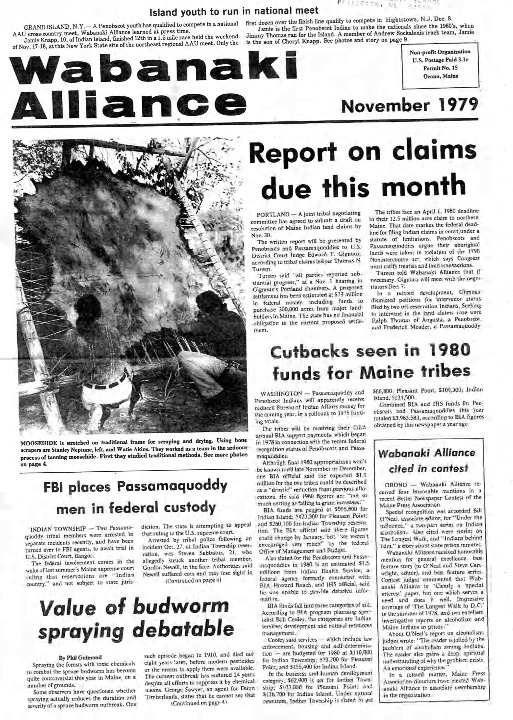
MOOSEHTOE is stretched on traditional frame for scraping and drying. Using bone
in 1978 in connection with the recent federal
recognition status o f Penobscots and Passa
scrapers are Stanley Neptune, left, and Watie Akins. They worked as a team in the arduous
process of in n in g moosehide. First they studied traditional methods. See m ore photos
maquoddies.
Although final 1980 appropriations won’
t
on page 4.
be known until late November or December,
one BIA official said the expected $1.1
million for the two tribes could be described
ORONO — Wabanaki Alliance re
as a "drastic” reduction from previous allo
ceived four honorable mentions in a
cations. He said 1980 figures are “not so
recent Better Newspaper Contest o f the
much cutting as failing to grant increases.”
Maine Press Association.
BIA funds are pegged at $508,800 for
Special recognition was accorded Bill
Indian Island; $423,300 for Pleasant Point;
O’
Neal, associate editor, for “Under the
influence,” a two-part series on Indian
diction. The state is attempting to appeal and $260,100 for Indian Township reserva
INDIAN TOWNSHIP — Two Passama
tion. The BIA official said these figures
alcoholism. Also cited were stories on
that ruling to the U.S. supreme court.
quoddy tribal members were arrested in
t
The Longest Walk, and “ Indians behind
Arrested by tribal police following an could change by January, but “we weren’
separate incidents recently, and have been
encouraged very much” by the federal
bars,” a story about state prison inmates.
incident Oct. 27, at Indian Township reser
turned over to FBI agents, to await trial in
Wabanaki Alliance received honorable
vation, was Steven Sabbatus, 21, who Office o f Management and Budget.
U.S. District Court, Bangor.
Also slated for the Penobscots and Passa
mention for general excellence, best
allegedly struck another tribal member,
The federal involvement comes in the
maquoddies in 1980 is an estimated $1.5
feature story (to O ’
Neal and Steve Cart
Gordon Newell, in the face. Authorities said
wake o f last summer’ Maine supreme court
s
wright, editor), and best feature series.
Newell suffered cuts and may lose sight in millioon from Indian Health Service, a
ruling that reservations are “ Indian
federal agency formerly connected with
Contest judges commented that Wab
(Continued on page 4)
country,” and not subject to state jurisBIA. Howard Roach, and IHS official, said
anaki Alliance is “ Clearly a 'special
he was unable to provide detailed infor
interest’ paper, but one which serves a
mation.
need and does it well. Impressive
BIA funds fall into three categories o f aid.
coverage o f ‘
The Longest Walk to D.C.
According to BIA program planning spec
in the summer o f 1978, and two excellent
ialist Bob Cooley, the categories are Indian
investigative reports oh alcoholism and
services, development and natural resources
Maine Indians in prison.”
management.
About O ’
Neal’ report on alcoholism,
s
Cooley said services — which include law
judges wrote: “The reader is jolted by the
enforcement, housing and self-determina
problem o f alcoholism among Indians.
tion — are budgeted for 1980 at $110,000
The reader also gains a deep, spiritual
such episode began in 1910, and died out
By Phil Guimond
for Indian Township; $79,200 for Pleasant
understanding of why the problem exists.
eight years later, before modem pesticides
Spraying the forests with toxic chemicals
Point; and $155,400 for Indian Island.
An emotional experience.”
or the means to apply them were available.
to combat the spruce budworm has become
In the business and human development
In a related matter, Maine Press
The current outbreak has endured 24 years
quite controversial this year in Maine, on a
category, $62,900 is set for Indian Town
Association directors have elected Wab
despite all efforts to suppress it by chemical
number of grounds.
ship; $103,000 for Pleasant Point; and
anaki Alliance to associate membership
means. George Sawyer, an agent for Dunn
Some observers have questioned whether
in the organization.
Timberlands, states that he cannot see that $126,700 for Indian Island. Under natural
spraying actually reduces the duration and
resources, Indian Township is slated to get
(Continued on page 4)
severity of a spruce budworm outbreak. One
Wabanaki Alliance
cited in contest
Passamaquoddy
in federal custody
FBI places
m en
Value of budworm
spraying debatable
Page 2
Wabanaki Alliance November 1979
editorials
Bad sm ok e signals
The visitor to our office puffed on her cigarette defiantly, ignoring
three signs asking people please not to smoke here. Well, we might
say, it's her funeral.
But it isn’ just a personal choice. Medical reports state
t
conclusively that other people’ smoking injures our own health. We
s
must realize as individuals that we are not alone, and our actions,
such as smoking a cancer-causing substance, affect our neighbors.
A recent Washington Post story states: “Tests are pointing up the
damage done to the lungs o f infants and children in homes where
there are smokers." A doctor estimates that the effect o f parental
smoking on children is equivalent to the child smoking three to five
cigarettes per day.
Smoking is the most comm on form o f indoor air pollution. Smoke
from cigarettes is loaded with carbon monoxide, a deadly gas.
Carbon monoxide displaces oxygen in the bloodstream, and this is
especially life-threatening to a person with heart disease — where the
heart is struggling to get enough oxygen.
Emphysema and asthma are conditions easily irritated by
smoking. Also frequent are eye problems for contact lens wearers,
aggravated hay fever and assorted allergic symptoms.
In view o f all this, it seems particularly reprehensible that many
employees o f the Penobscot Indian Health Center are heavy smokers.
Oftenone must walk through a haze o f cigarette smoke to enter the
clinic. The young children, the elderly, the sick — these people
deserve better than to be subjected to contaminated air.
WARRIORS - Proud of their Penobscot heritage are these Indian Island youngsters,
Keane Francis, left, and Jason Pardilla. They were dressed for ceremonial dancing at last
summer’ pageant, held annually at the reservation.
s
Nutrition Notes
— Provide eating untensils and dishes
that are easy for the child to hold and use.
(A young child is in the process of
Habits learned in the first few years o f life developing fine motor control) Serving
remain for the rest o f one’ life, and parents
s
“finger foods” will also help motor develop
must take the responsibility o f assisting in ment.
the development o f the child’ eating habits.
s
— Having the child come to the table
The developmental process o f the be- rested.
haviorial attitudes towards the formation of
— Serve foods in variety o f textures,
positive eating habits must be undertaken colors and flavors. Pre-schoolers and tod
with careful consideration. Children learn dlers prefer plain blandly flavored foods
from their environment. Every effort should that are lightly seasoned.
be made to influence the child to adopt a
— Serve snacks early enough, so they
healthy eating style, and to facilitate the won’ spoil the child’ appetite before the
t
s
nutritional needs during the critical periods meal; (two hours before).
o f physical growth and development.
— Remember, appetite decreases as rate
As a way o f providing the needed o f growth decreases. Foods may be refused.
nutrients for proper growth and the Don’ force the child to eat, keeping in mind
t
formation o f positive eating behavior, the his essential nutrients for the day.
planning o f nutritious meals and snacks in
— Serve meals in small amounts. The
the home is essential to accomplish these child may ask for seconds.
goals. The daily meals and snacks should be
— Encouraging the child to assist in the
served on a regular schedule. They should preparation for the meal (setting the table,
be appetizing, colorful, attractive, easy to pouring own drink, feeding himself, etc.)
manipulate, palatable, offered in varieties, serves as a positive reinforcement and an
and should come from each o f the four basic enjoyable time for the child.
food groups (Snacks should include two or
Remember the child is learning to
three of the four food groups). The following associate with his environment at this time.
suggestions will facilitate the formation of The child will mimic his peers. Association
healthy eating habits:
with a good healthy environment is a
— Serve meals in a pleasant place and a positive step to the formation o f good eating
calm atmosphere.
habits.
By Natalie S. Mitchell, LPN
Health Reporter
Associate Member —
Wabanaki Alliance
Maine Press Association
Vol. 3, No. 1
1
November1979
Published monthly by the Division of Indian Services [DIS] at the Indian Resource Center,
95 Main St., Orono, Me. 04473.
Steven Cartwright, Editor
William O ’
Neal, Ass’L Editor
V'KNOUJ I'M & E T T IN &
1 F I& P
ALL T H E S E
W
U//7H
EROM EUROPE.
Quotable
Get a few laughs, do the best you can, take nothing serious, for
nothing is certainly depending on this generation. Each one lives in
spite o f the previous one and not because o f it.
Will Rogers, humorist-philosopher
Cherokee Indian
DIS Board of Directors
Jean Chavaree [chairman]
John Bailey, Public Safety Coordinator
Albert Dana, Tribal Councilor
Timothy Love, Representative to State Legislature
Jeannette Neptune, Community Development Director
Jeannette LaPlante,Central Maine Indian Assoc.
Susan Desiderio, Assn, of Aroostook Indians
Maynard Polchies, President, Aroostook Indians
Melvin L. Vicaire, Central Maine Indian Assn.
David A. Francis
Indian Island
Pleasant Point
Indian Township
Indian Island
Indian Township
Orono
Houlton
Houlton
Mattawamkeag
Pleasant Point
DIS is an agency of Diocesan Human Relations Services, Inc. of Maine. Subscriptions to
this newspaper are available by writing to Wabanaki Alliance, 95 Main SL, Orono, Me.
r v ______ ti_______________ Carribu aniJ fllS a rp a nnn-nrflfit r n moration. Contn butions are deductible for income tax purposes.
Wabanaki Alliance November 1979
Page 3
letters
Wouldn't be without it
Most generous people
Hinckley
To the editor:
This is just a short letter to thank you for
continuing to send the Wabanaki Alliance
to me here at the Hinckley Home-SchoolFarm. It keeps me in touch with the
Penobscot community where I had the good
fortune to be at St. Ann’ Church for the
s
past year and a half before coming to
Hinckley.
I miss the Island and its people im
mensely. They are the kindest, friendliest,
and most generous people I have ever
known, and I treasure the privilege that was
mine in being able to live on the Island and
share in their community.
Keep up the good work!
Rev. David P. Cote, CSW
Program Director
Hinckley Home-School-Farm
Indians in history
Gardiner
To the editor:
Please send me any information you have.
I teach Maine history in Gardiner and we
need information on Maine’s natives. I am
interested in newspapers or any other
material.
Steve Swindells
Bass Harbor
To the editor:
Please renew my subscription to Wab
anaki Alliance. I would not want to be
without it.
Hollis Piatt
Personal interest
Poughkeepsie, N.Y.
To the editor:
I am in the process o f collecting as much
material available concerning the Indian
issues in Maine. I am attempting to write a
research paper on the Indian land claim
controversy, and I would like to investigate
many aspects related to the land case such
as: the Indian’ suit, and its merit; specific
s
Indian human affairs; the property rights o f
small landowners, and how they feel they are
being threatened; and the White House
negotiations for a compromise settlement. I
have a personal interest in the case, also, as I
am a resident of Kittery, Maine when not at
school. I have already received one issue of
the Wabanaki Alliance (April 1978), and I
have found it very helpful. I would
appreciate it if you would send me any
recent periodicals which are specifically
relevant to my topic. Please inform me o f the
cost.
Thank you so much for your time.
Catherine L. Robbins
Prejudice
Atlantic, N.C.
To the editor:
I received the last issue of your fine paper
today, and I was really enjoying reading it
until I came to the part about the racial
dispute at school.
I have two children in a all white school
here at Atlantic, N.C.^where we live. There
are no Indian schools around this area. We
are seeking Federal recognition from the
government, and the locals are envious and
hate the ground we walk on. They are under
the impression that we intend to take the
land from them. “It is a thought, after the
way we have been treated.” My two sons,
Jerry, Jr. and Jodie, are in grade school.
Every day each comes home with a black eye
or something. The children call them pigs,
chiefy, dogs, and many other names. The
boys fight back. I admire the spirit in them
that they have, true American Indian. Their
motto is, "The bigger they are, the harder
they fall,” which is really true.
We have been in this neck o f the woods
for some 34 years and still can’ get along
t
with the residents of this area. Every time I
pass someone, I get a war whoop, a how, or
some smart remark, my wife gets the same.
We cannot get credit anywhere; I cannot
get a job anywhere in this country. I have a
heart condition and a ruptured disc. The
Dr. told me that he knew I could not work,
but he wasn’ going to say so. All the Dr’
t
s,
here stick together. I have no income except
for a few dollars I make through my small
mail order business, TCS Enterprise, which
is not much. I cannot get welfare or SSI
simply because of the unfair treatment by
Dr’
s., hospitals, and the public affairs
workers here.
You think Indians have it tough; they
should live here where we do, then they
would realize how tough it is.
y V
I would like for you to publish this letter
so every true born American Indian that
reads this paper can see what we face every
day o f our lives.
May I add, every time I go to get food
from the store I am treated as if I am an
animal and get waited on last. I have had a
few run-ins with a few o f the locals here
because o f the smart remarks. One long
haired hippy got to me so bad one night at
the store, asking me nothing but how, I
pulled my knife, and grabbed him by the
hair, and pretended to cut it off. He soon
began to see the light. When he found that I
could show him how, he cooled off. I do not
like to fight, I’ a Christian and a minister,
m
but I believe I have to stand for the things I
believe in, am I not correct? Jesus Christ,
the Lord o f Lords, King of Kings had a
disciple Peter, his rock, the Comer Stone for
his church. Peter lost his temper; he cut off
the ear of the guard, remember the story in
the Bible? Well we have the right to stand
for what is right as well, I am sure.
I would really like for you to let the
Indians that read your paper know how it is
here in the eastern part of N.C.
Let me hear from you when you will. Here
is $2.00, all I have to help pay for some of
your mailing of your papers.
I would send more but I just don’ have
t
any more. We have plenty o f food, we burn
wood to keep warm, so you take this money
and pay postage for some papers, we don’
t
really need it. I’ll get some more soon. The
Lord God looks out for us very well. We are
in no need at the present time, and I’m sure
it will continue to be with His help.
Like 1 said, let me hear from you when
you will. Keep up the good reporting that
you are doing.
Jerry Lee Faircloth, Sr.
MOVIE STAR? — Someday, maybe. Peter Dana Point’ Joyce Tomah, pictured here, said
s
she would like to become a model. She’ off to a good start.
s
Remembrance
Impressed
Lansing, Mich.
To the editor:
Michigan Indian Manpower Consortium
has read your recent newsletter and are
impressed. We would like to be put on your
mailing list. Please bill us.
Florence Babcock
Compiling history
Thorndike
T o the editor:
I would like very much to subscribe to the
Wabanaki Alliance as soon as possible.
As I am in the process o f compiling a
history of Penobscot Indian Art styles, it will
be most helpful in my work. Also, if there
is any chance that I could obtain any back
issues of the paper it would be greatly
appreciated.
Pamela Lindsay
Building cabin
Portersville, Pa.
Dear Sir:
I’ writing to thank..you for sending my
m
sister her newsletter, she hasn’ mentioned it
t
to me, but I know you people are great, and
I know you won’ forget my sister. Also I
t
want to mention that my husband and I are
planning to build a log cabin home. If you
know of someone that knows how to build a
log cabin home, we would like to know as
soon as possible, we would give them a job
and try to find a place for them to live, we
own our own business. I’ give you one of
ll
our cards, also I raise and sell cairn terriers.
I’ also send my card up. If you can put it in
ll
the paper I’ sure would appreciate it.
d
I’ enclosing a check, hope you keep up
m
the good work, which I know you will.
Louise E. Kraly
Morning Star
Bangor
To the editor:
I would like to express my appreciation to
the Wabanaki Alliance for the September
issue o f the "Houlton Indians Remember
ed.” Most o f those people pictured are my
ancestors.
I would also like to thank Mr. James
Wherry for the ancestry chart he recently
had done for our family.
Waneta Deveau
New subscriber
Kennebunkport
To the editor:
I would like to subscribe to the Wabanaki
Alliance. I have heard good things about
your paper and have enjoyed the issues
which I have seen in my library. If there is a
subscription rate, please let me know.
Thank you.
Katherine Kubiak
Informative
Shaftsbury, Vt.
To the editor:
I am doing a unit on Native Americans
from the New England and eastern U.S.
I am looking for information to help show
third graders about Native Americans
today. Their view of Native Americans is
very limited.
I would appreicate it if you could send me
some copies o f your newspaper. I think
seeing the paper and reading some o f the
articles will give the kids a better idea about
Native Americans. If you have any other
information I would greatly appreciate it.
We are specifically studying the Abanaki of
Vermont from this area. Thank you.
Joanne Lukasiewicz
Page 4
Wabanaki Alliance November 1979
Budworm control: To spray or not to spray
(Continued from page 1
)
spraying has done anything to discourage
the budworm. On the other hand, he does
notice a marked reduction of small bird life,
and such birds are one o f the major natural
control agents. Is it possible that spraying
may actually prolong an outbreak by dis
rupting natural controls and cycles?
All parties agree that the pesticides being
used in the spray program are harmful to a
great many organisms besides the spruce
budworm. The law requires that they be
applied in strict conformity to label direc
tions approved by the Environmental Pro
tection Agency. All the pesticides being used
in Maine this year carry warnings against
contamination of streams and ponds, but
there are slight differences in label wording.
Dr. Harold E. Kazmaier, of the Regional
Pesticides Office, o f EPA, in Boston, met
with several staff members o f the Health
and Social Services Department, on June 18.
The question of which waters should be
protected by buffer zones, and how wide
such zones should be was confused by these
label differences, according to Dr. Kaz
maier. In written comment on the 1979
Enviro: mental Impact Statement, Dr. Kaz
maier criticized the adequacy o f the
provision for buffer zones. He also objected
to plans to continue spraying until wind
speeds reached 12 miles per hour, whereas
the 1978 limit was 6 M.P.H. During our
discussion, he also pointed out that due to
heavy rain before and during the spray
period, there was a great deal more water on
the ground than is usual at this time o f year.
Dr. Kazmaier was very open about sharing
documented information with us. As the
representative o f a regulatory agency, he
could not draw conclusions, but he left us in
no doubt that pesticides are, in fact, getting
in the water, in apparent violation o f the
law.
The most effective opposition to this
year’ spraying program has come from
s
residents of eastern Washington County.
This group, in addition to raising the issues
already mentioned, has charged that there
have been both accidentia! and deliberate
instances in which “no spray” areas received
substantial doses of insecticides; and that
these have included people, farm animals
and orgafric farms and gardens. Commer
cial organic farmers, who must guarantee
that the produce they sell is chemical-free,
stressed the dollar losses already experi
enced or threatened. One area with a sub
stantial number of organic farms was sub
sequently removed from the spray program.
The Washington County group and
others organized a protest rally in Augusta
on May 31. The main focus o f this protest
was the possible health effects of exposure to
pesticide sprays. Governor Brennan ex
pressed the opinion that the health risk was
not a major one compared to the need for
wood fiber. When asked how he would feel if
his own family lived in or near the spray
zones, the Governor became visibly angry,
and said, "D on’ get personal!” The direct
t
evidence that these insecticides cause cancer
is not conclusive, but Bo Yerxa, o f South
Princeton, writing in the Bangor Daily
News, on June 14, cites troubling evidence.
The most heavily sprayed counties in Maine,
he indicates, have a rate o f birth defects two
to four times that o f the southern part o f the
state.
Arguments against the spraying program
based on economic, environmental and
health considerations are strongly docu
mented in The Case Against Aerial Insecti
cide Forest Spraying, a position paper
developed by a consortium o f Canadian
environmental organizations. This study
demonstrates that the economic argument
for spraying is based on false premises. The
true cost of one proposed program in Cape
Breton, in 1977, is calculated as being 3.6
million dollars to protect an asset of
$500,000. Nova Scotia considered a spray
program for 1978, but decided against, with
the following statement by the Minister of
Lands and Forests: “We feel it is far better
from the forestry point o f view to suffer our
losses now rather than spray and prolong
the inevitable. . . . The forests o f New
Brunswick after twenty-five years o f spray
ing are not the envy o f anyone involved in
BONE scrapers made from the shank of a cow moose are displayed by Watie Akins, who
said he shot his moose at Debsconeag. The moose will provide dried and frozen meat for the
winter, as well as a handsome drumskin.
proper forest management.” The study goes
on to document the failure of spraying to
reduce budworm populations over a period
of years, the inaccuracy o f the spraying tech
niques available, and the very serious health
hazards represented by the chemicals
involved.
The evidence against the effectiveness of
spraying, and the environmental hazards,
are such that the U.S. Forest Service has
announced it will not support a spraying
program next year. The Maine Department
o f Conservation has opposed spraying after
1981. This would seem to amount to two
strikes against the program; and the serious
questions’ about health effects should,
despite Governor Brennan’ opinion, be
s
sufficient to rule pesticide spraying out
immediately. Whatever the reasons of the
Governor, the paper companies and the
pesticide industry may be for supporting the
present methods, there are other effective
means to reduce the harm done by the
spruce budworm.
The continuation o f spraying should be of
special concern to all the people o f the
Penobscot Nation for two reasons. First, the
rivers and lands o f the Penobscot watershed
have always been the base o f our food supply
and our economy. Many o f our people must
still turn to the forests, the rivers and the
islands to feed their families. Here also
many of our people return for spiritual ful
fillment and for recreation. Secondly, the
lands that are being sprayed are the very
lands over which we claim ownership. The
immediate and long-term damage being
done to this land and its resources is damage
directly to us!
Governor Pehrson has officially written to
the U.S. Bureau o f Indian Affairs, asking
assistance in measuring damages due to
spruce budworm spraying, and o f a spill of
TRIS (the fire-retardant for children’
s
clothing which was banned as a cancercausing agent) into the Piscataquis River. If
cause for action is found, the letter states,
“we expect litigation to be pursued for
damages to Penobscot property.”
Citizen activism this year has raised the
economic and political cost of the spray
program almost to the breaking point. The
danger is that with the end of spraying, on
June 20, citizen pressure will fall off, and the
decision whether to spray next year will be
left once again to people with a vested
interest in its continuation. If, on the other
hand, citizen groups stay involved and
prepare thoroughly for the hearing and
legislative process which will being in the
early fall, there need not be another year of
spraying in Maine.
EDITOR’ NOTE: Phil Guimond is
S
assistant health planner with the Penobscot
Indian Health and Social Services Depart
ment.
Two Passamaquoddies
arrested
(Continued from page 1
)
his right eye. As Wabanaki Alliance went to
press, the Sabbatus case was scheduled for a
probable cause hearing in federal district
court. He earlier had entered no plea, in
appearing before U.S. Magistrate Edward
H. Keith.
Federal Judge George Mitchell, newly
appointed to serve Maine’ northern region,
s
declined comment on the case. Also refusing
to comment was Lt. Norman Nicholson of
Indian Township police department. Sab
batus was reportedly remanded to federal
jail in lieu o f $5,000 bail.
In another jurisdiction-related case, Wil
liam Sockabasin o f Indian Township was
reported arrested recently for allegedly
attempting to bum a trailer owned by
Estelle Neptune o f the Township. Socka
basin was charged with malicious mischief,
according to Lee Lowery, FBI agent
stationed in Bangor. Sockabasin has been
released on personal recognizance.
Lowery said the FBI has jurisdiction over
14 major crimes. He said in reference to the
Sockabasin and Sabbatus cases, “The main
thing is to get them (tribes) authority to
handle this kind of thing.”
HOLLOW LOGS await moosehide drumskin. Stanley Neptune said the huge old tree was
already partly hollow, and enlarging the hole was not particularly difficult. When
completed, the big ceremonial drums may be used for powwows and other occasions.
Wabanaki Alliance November 1979
Page 5
Wabanaki Corp. m oves
toward local control
ORONO — Wabanaki Corporation, an
agency working to end alcoholism and drug
abuse among Maine Indians, appears to be
shifting control toward its reservation and
off-reservation constituents.
Following a series o f staff upheavals
earlier this year, National Institute of Alco
hol and Alcohol Abuse (NIAAA) suspended
funding of the agency, until such time as
paperwork, neglected during the agency’
s
troubles, was brought up to date.
Although program funds have been rein
stated, no money for indirect costs has been
allocated by NIAAA. Indirect costs consist
primarily of administrative expenses, in
cluding salaries of the executive director and
secretaries, and despite requests by NIAAA,
had never been determined.
An audit, begun in July, is still underway.
According to one source, it took' three
months “just to reconstruct the books. It
was much worse than anyone suspected.”
Upon completion of the audit, an indirect
cost figure will be reached and allocated to
the program by NIAAA.
Until that time office employees and
expenses are reportedly being payed from
the direct program costs, which one official
estimated could only last six more months at
the present rate of spending.
Sources within the agency predict that
when full funding is again achieved, the
reservation and off-reservation entities rep
resented will exercise more control over the
programs. Some of the tribal entities have
requested that alcoholism counselors work
ing for the agency, report regularly to the
various health and social services depart
ments on the reservations or at the
off-reservation offices. In the past coun
selors have worked at large within the
Indian communities, responsible only to the
central office in Orono.
Vice chairman o f Wabanaki Corporation
board Allen J. Sockabasin, who declined
comment on the agency’ future until after
s
the audit’ completion, confirmed that
s
currenty board members “don’ know where
t
we are financially.”
Wilderness Pursuits, a Wabanaki Corpor
ation confidence-building program for
youth, will reportedly be resurrected, but in
a very different form again reflecting a more
local approach. Instead o f organizing
camping trips from the central office, local
youth counselors will be hired to run more
general youth alcoholism programs, work
ing in cooperation with the respective tribal
recreation departments.
St. Regis Mohawk health director Richard Jock meets his Penobscot counterpart. Dr.
Eunice Baumann-Nelson, director of Indian Island clinic.
Mohawks visit Indian Island
to view health center
INDIAN ISLAND — St. Regis Mohawk
Richard Jock, a Mohawk who is health
tribal officials traveled to the Penobscot director for the St. Regis tribe, said he
Nation at Indian Island last month, amid wanted to “get an idea what the problems
joking about historical enmity between the are” in constructing and operating a health
center through IHS. He said he admired the
tribes. This time they came in peace.
s
Chief Leonard Garrow of the Mohawk’ Penobscot’ model clinic. For years, the
s
Mohawks have had a state-run health
Hogansburg, N.Y., reservation, told Penob
scot officials he was impressed with the center, but are now seeking federal support.
Indian Island clinic, administered through
Jock said 1981 is target date for com
federal Indian Health Service (IHS) by Dr. pletion o f a new health center, to serve an
Eunice Baumann-Nelson, a Penobscot.
estimated 3,400 o f the tribe’ 6,000 mem
s
Formal greetings were exchanged be bers. The Mohawk reservation straddles the
tween Penobscot tribal Gov. Wilfred Pehr- U.S.-Canadian border, with separate tribal
son, and Garrow. “We hope that you can governments. Jock holds a master’ degree
s
come up and visit,” Garrow said during a in English from St. Lawrence College, and is
banquet supervised by chef. Happy Hamil a graduate o f State University o f New York
at Plattsburg.
ton.
Philip Guimond, left, and Bruce Spang, health center staff.
Health center hires
educator, trainee
INDIAN ISLAND — Penobscot health
education and planning got a boost
recently with the hiring o f two staff
members for the tribal Department of
Health and Social Services.
hired as health educator was Bruce
Spang, 34, a veteran of three years with
the Counseling Center in Bangor, and
one year as a therapist in a Massa
chusetts methadone clinic. Spang hopes
to conduct educational workshops, form
self-help groups, and organize training
programs. He is currently trying to en
courage Indian parents to bring their
children to the center for immunization
against measles, mumps and other
diseases.
Spang, a native o f Chicago, graduated
from DePauw University with a degree in
history and philosophy. He received
master’ degrees in art and divinity from
s
Vanderbilt Divinity School, and a
master’ degree in counseling from Uni
s
versity of Maine at Orono. While
attending divinity school. Spang founded
a folk arts school in eastern Tennessee.
He is married and lives in Hampden.
Hired by the center as deputy health
planner and trainee was Philip Gui
mond, 33, a member of the Penobscot
tribe. He has studied environmental
sciences at Tunxis Community College in
Connecticut, where he lived for a number
o f years. Guimond wants to study the
“impact of the total environment” on
tribal health. He is interested in tradi
tional medicine, and a holistic approach
to health care.
Guimond hopes to start a program to
monitor Penobscot River water quality;
he said he was extremely concerned fol
lowing a spill o f the chemical TRIS, from
a Guilford mill into the Piscataquis
River. Guimond is also studying the
hazards o f nuclear power and radiation;
and the risks involved in spraying to
control spruce budworms.
Bailey on Wabanaki board
PLEASANT POINT — John L. Bailey,
public safety coordinator for the Passamaquoddy tribe here, has been appointed to
the Wabanaki Corporation board o f direc
tors.
Appointed by tribal Gov. Robert Newell,
Bailey will represent Pleasant Point on
the board of the alcoholism and drug
abuse prevention agency, based in Orono.
Bailey is a longtime member of the
Division of Indian Services board of
directors, which supervises publication of
Wabanaki Alliance.
Indian Island fire chief, Fred Becker, goes over operation of the Island’s new fire truck
for volunteers Philip Guimond [left] and Robert [Red] Bartlett.
Island gets fire truck
INDIAN ISLAND — With the acquisi
tion this month o f a Pierce Minipump by
.Indian Island, all three Maine reservations
are equipped with at least one fire truck.
Indian Island Fire Chief Fred Becker said
the new fire engine has a 400 gallon per
minute pumping capacity and can carry 250
gallons for backup. Becker, who also serves
on the Old Town Fire Dept., said the new
truck should be able to handle any
structural fire on the reservation. He added
that because it has four-wheel drive, it is
also ideally suited to fight grass fires where
access to a conventional fire truck would be
limited.
The Island fire crew is currently 10 people
strong, although few o f them have any
firefighting experience. Douglas Francis is
Asst. Chief, and Philip Guimond is Lieu
tenant, Becker said the firefighters would
receive training from a state instructor.
They also have the use o f the Old Town
training equipment, he said. He predicted.
the Island crew would be ready in two or
three months.
The Island fire team will respond to fires
off the Island, if requested, Becker said.
Page 6
Wabanaki Alliance November 1979
Uranium mining wreaks
destruction on Navajos
crops have died; the sheep that used to graze cried. Whenever we prayed, I would pray to lution on April 9, 1978, which said, in part:
by Loretta Schwartz
Fear of disease
CROWN POINT, N.M. — Huge red on the crops have died; many o f the horses myself silently in Navaho and promise
“As citizens o f the Navaho Nation we
s
rocks still rise out o f nowhere like giant have died; and the area’ water supply may myself that no one would ever take the place
be lost.
of my own mother and father. I decided that have become increasingly alarmed at pres
twisted sculptures. In some places you can
For the most part Crown Point is a when I became educated I would go home ent and planned uranium mining activity in
still find small everygreen pinon and juniper
community like Red Rock. Few o f the and help my people.”
our community and are most fearful o f its
trees growing near sand-colored mesas.
Native Americans read or write or speak
But once there were wild flowers bloom
After attending grammar school and high effect on our health, welfare, property, and
English. Few have ever left home. In many
ing in profusion and deer and rabbits
school and Brigham Young University, Elsie culture as well as the well-being o f future
darting between cactus plants. That was ways Crown Point is as vulnerable to abuse did return home to Dalton Pass (near Crown generations. We hereby state that we are
from the uranium corporations as was Red
before the uranium mining and the tailing
Point). When she got there the uranium totally and unalterably opposed to all
Rock. But one thing that is different is a 27piles, before the Navaho miners began to die
uranium exploration within our boundaries
year-old Navaho woman named Elsie miners had also arrived. They had already
from a strange, invincible small-cell car
made more than 3,000 drilling holes on the for the following reasons:
Peshlakai.
cinoma known for 50 years to be caused by
“The air we breathe will be poisoned by
reservation where her family lived, and a
When Elsie was seven. Mormon mission
chronic radiation exposure.
mine was planned 800 feet from their home. radioactive elements released into the
The full effect o f early mining in Red aries began to arrive at the reservation.
atmosphere during the course o f mining
People told Elsie that they had heard
“They told me about a grammar school 1
Rock, New Mexico, probably won’ be
t
activity.
rumors about a place called Red Rock
known for another decade, but according to could go to in Utah and they said I would
“ Present environmental standards are in
have ‘
parents’ there,” Elsie explained. where the drillers had come and gone and
Dr. Gerald Bunker, one of many physicians
adequate to prevent introduction o f these
studying the situation, the increase in the
cancer-causing agents into the air, and we
risk o f lung cancer among Navaho uranium
fear the disease which will result to ourselves
miner:, is at least 85 fold. This conclusion is
and our livestock ...
based on a study o f more than 700 Indian
“ Massive use o f groundwater during the
uranium miners.
course o f uranium mining will pollute our
Coughing attacks
present water supply and eventually cause it
One o f these miners, Clark Dick, worked
to become exhausted.
in the uranium mines for nearly 20 years.
“The pollution o f the air and water com
Shortly before he died of lung cancer at age
bined with the degradation o f our land by
40, he went to an English-speaking lawyer
the mining activity will destroy livestock
and prepared a typed statement that he
raising and result in great unemployment.
hoped would help his wife get compensation
“Already sacred and historical sites pre
after his death. It said in part:
“ About five years ago, I began to cough
cious to our culture have been willfully and
quite a bit. The coughing attacks usually
wantonly destroyed by those engaged in this
came while I was at work in the mine . . . I
uranium exploration and development. We
thought I was just getting a little dust or dirt
fear further and greater destruction o f such
in my throat and it was nothing to be
sites.
concerned about. Over a period o f time the
“ Now, therefore, be it resolved that the
coughing became gradually worse and ... it
Dalton Pass Chapter demands all uraniumgot to the point so that I felt my head
mining activity within our boundaries be
hurting and would have blurred vision . . .
halted immediately and premanently.
Then I noticed that I began to spit up blood
"Be it further resolved that we intend to
when I had these coughing attacks. I was
wage a determined struggle to halt all uran
having more attacks, and they were getting
ium-mining activity within the Dalton Pass
more severe . . . I also started feeling weak
Chapter.”
and was unable to do my work in the mines.
To held them in their battle the chapter
I quit my job . . . I told one foreman that I
retained Joseph Gmuca, a lawyer employed
was not going to be able to work any more,
by a low-income, legal service group called
but he didn’ say a lot about it ... I guess he
t
DNA, acronym for Dinebeiina Nahiilna Be
interpreted this as my resignation.”
Agaditahe, Navaho words that stand for
After his death in 1973, Clark Dick’
s
“economic revitalization o f the people.”
widow Fannie, like all the other Red Rock
On December 22, 1978, a suit was filed in
widows with husbands who had worked in
the U.S. District Court against the De
the mines, sought compensation. To date,
partment o f Energy, the Department o f the
25 deaths have been reported. Yet despite
Interior, the Department o f Agriculture, the
the fact that the occupational connection
Environmental Protection Agency, the
was.clear and a number o f politicians had
Tennessee Valley Authority, and the Nu
expressed interest in helping, only the late
Senator Joseph Montoya (D.-N. Mex.) and
clear Regulatory Commission.
Senator Pete Domenici (R.-N. Mex.) actual
The suit requires the defandants to
ly tried to push bills through Congress. The
“comply with the National Environmental
bills,- which were turned down, sought to
Policy Act by preparing national, regional,
provide money for victims and their sur
and site-specific environmental impact
vivors,. reduce delays in litigation, and
statements,” and it seeks to prevent all
provide funds for research into the cause of
involved government agencies and private
“white-lung” disease. Former Secretary of
corporations from taking further actions
the Interior Stewart Udall recently called
until they have complied. The suit would
the deaths a tragedy and is presently looking
also "require defendants to rescind and
into the situation.
reconsider” land leasing and other actions
The Red Rock mines, closed in 1968, were
already begun without compliance with
“When I was in third grade I filled out an where everyone who worked in the mines
most recently run by Kerr-McGee (the Okla
NEPA.
homa-based oil, gas, and uranium giant). application and signed my parents name. had died or was dying. Elsie, who had
studied chemistry and biology, read every
At the time this article went to press,
Kerr-McGee is the same company that But when the bus came, my own parents
Federal District Court Judge Harold Greene
t
recently lost a $10.5 million lawsuit that wouldn’ let me go. The next year I got thing she could find, talked to experts, and
centered around the case o f Karen Silk- smarter, I filled out the application, but I began to go from home to home, talking to had turned down a motion to dismiss the
t
case and a subsequent motion to change the
wood. a lab technician in a plant producing didn’ tell anyone. On the day the bus came, the Navahos about radiation.
As Elsie Peshlakai traveled and explained
site o f the suit from Washington, D.C., to
fuel rods for nuclear reactors. Silkwood my mother was away washing clothes. I told
mysteriously died while driving to meet a my sister-in-law that I was going away to what was happening, she also learned that New Mexico.
school. She supported me, saying. ‘
Yes. I many had never given permission for the
Water contaminated
New York Times reporter in an effort to
s
document her charges that officials at the think you should because that’ the only way drilling rigs and the miners.
Meanwhile. Crown Point is in danger of
ll
installation had knowingly exposed their you’ ever learn.’
"W e were told that Steven Morgan, the losing its only water supply. In a working
"W e packed a few clothes and I went out -medicine man. the oldest man in the com
employees to lethal doses o f cancer-causing
paper entitled “ Impacts o f the Uranium
on the dirt road and waited until the elders munity. gave his permission; but when we
plutonium.
Industry on Water Quality,” J. L. Kunkler
Kerr-McGee, along with some 15 other came. They put me on a chartered Grey
asked him he said he never had and never o f the United States Geological Survey put it
energy companies seeking uranium, have hound bus to Provo. We rode all night. The would,” Elsie said. “We began to hold this way: “Groundwater resources are being
now converged on Crown Point, a tiny next day I met my foster mother. I meetings. We would stay up nights and ask depleted by underground mining and, as a
community that is part of the Bureau of remember the first time that she gave me a each other what we are going to do. Many consequence, wells that yield water from the
I
Indian Affairs’ Eastern Navaho Agency in bath. She said, ‘ have never seen skin quite
aquifers (natural underground water reser
thought it was too late.”
northwestern New Mexico. The companies, this dark. I feel like 1 should keep
Finally, Elsie Peshlakai and the Dalton voirs) being mined will yield less water and
t
which have begun to drill test holes and scrubbing.’ I was scared, but I didn’ cry.
“Three and a half weeks later I went up to Pass chapter o f the Navaho Indians in may ultimately yield none.”
construct mines, claim that they have
Crown Point, New Mexico, drafted a reso
(Continued on page 7)
improved their techniques. But already the the top o f the lava rocks and I cried and
Wahanaki Alliance November 1979
Page 7
‘
Now there is not enough food for the family
because so many animals have died'
—
(Continued from page 6)
»
The Environmental Protection Agency, a
defendant in the suit, came to similar con
clusions in a recent draft environmental
impact statement.While there is water, there is significant
danger to those who drink it. According to
studies undertaken in the New Mexico En
vironmental Improvement Division, the
water that is pumped out o f the uranium
mines contains elevated concentrations of
radium, arsenic, and nitrate. The discharge
o f such highly contaminated mine effluents
into streams creates a long-lived source of
groundwater contamination. The studies
also indicate that industry-sponsored en
vironmental monitoring programs are in
adequately designed and implemented and
may not define the full long-term impacts o f
mining and million operations on the
groundwater quality.
Nevertheless, the United States Geologi
cal Survey claims that the Crown Point
mining plants do not constitute a “major
federal action significantly affecting the
quality o f human environment.”
And John Lobdell, a Tennessee Val
ley Authority official, told Crown Point resi
dents that proposed mining activities were
not anything to worry about, though he con
ceded that “the chemical reaction o f the
uranium is especially hard on the kidneys
while the radiation is hard on the rapidly
multiplying cells such as blood, genes, or
bone. I can’ guarantee there will be no
t
effect to you or your offspring, but then I
can’ one hundred percent guarantee you
t
won't fall down in your bathtub tonight
either.” (The Tennessee Valley Authority is
the producer o f phosphate slag used to
make concrete blocks that were discovered
to be radioactive, but only after they were
used in some 200,000 homes in the South
east.)
“ Nothing grows here”
It was 10 degrees below zero. I sat beside
Elsie Peshlakai in her blue, four-wheeldrive pickup truck. We were going to see an
old Navaho woman whose land had recently
been confiscated. The company had put up
a sign that read, “Private Road, Keep Out.”
We traveled up the long dirt road past
hundreds o f white stakes; each stake
marked the place where a hole had been
drilled. “As you can see, there is nothing
growing out here any more,” Elsie said as we
approached a tiny gray hut with a red roof.
Inside, I saw Hah-nah-bah Charley sitting
on the side o f her bed. She was wearing a
brightly colored yellow skirt and a blueflowered blouse. She greeted me softly in
Navaho. Then she said: “My sheep are
dead. There are three large mud pits, each
the side o f this house. Some sheep drowned
in the mud, others died — one right after
the other, like they were poisoned.
“How many animals have died alto
gether?” I asked.
“Three calves, sixteen sheep, eleven goats,
four horses,” came the reply. “Now there is
not enough food for the family because so
many animals have died. A white man from
the BIA (Bureau o f Indian Affairs) came out
to look at the dead sheep and said it’
s
probably the water since the wells they dug
have a runoff that goes right into the
animals' stock pond.
“ Why did you let them come here?” I
asked. When Elsie repeated the question,
the old woman began to speak rapidly.
Gesturing with her hands, she explained,
“One day a white man carrying papers came
with an Indian and said, ‘
Mother, because
all is well with you and you use your land
well, and you have no problems with your
neighbors or your allotment (160 acres), we
want you to put your thumbprint right here
on this piece o f papei.' ” Trusting them.
Hah-nah-bah agreed and pressed her thumb
on the paper, not realizing that it was
actually a contract givuig the oil company
access to 160 acres o f some o f the most
valuable land in America. Her land.
“Later, I went to the BIA office,” Hahnah-bah said, “and told them what had
happened. But they just said, ‘ is your
It
fault. You signed the paper.’”
“The Bureau o f Indian Affairs was set up
by the government to protect the Indian
people, yet they never told any of us what
they were going to do,” Elsie said angrily as
we climbed back into the truck. “They just
took what they wanted, even our grave sites,
even our sacred springs, and went over them
with a bulldozer.”
“We act on behalf o f the allottee,”
Edward Plummer, superintendent o f the
Eastern Agency in Crown Point told me.
“All the responsibilities we execute come
from Congress. Our duties are assigned to
us just like any other governmental organi
zation. We develop the forms for the appli
cant to sign. Then we make every effort to
locate the allottee. O f course, if we cannot
find the person, or if there are several
owners and they disagree, then we make a
judgment for them. We also make an esti
mate o f how much damage will be done. We
inform the allottee o f all this. Then the
allottee makes the decision. The allottees
have the legal right to the land, which is held
in trust for them by our organization. If the
allottees sign the contracts and change their
minds after construction has begun, they
would need a lawsuit to stop the companies.
After all, that’ why we have a Navaho staff
s
to make sure they understand.”
" I have heard stories from people that
contradict what you’ telling me,” I said. “I
re
have heard that people have been pressured
and forced into signing documents without
knowing what they were signing.”
“Well,” he answered, “we are under
staffed. We have four thousand allotments
out here and a Navaho staff o f four.”
“Do you personally own an allotment?" I
asked.
“ No, I don’ he said. “The way it works
t,”
is that the land usually belongs to the
women. The society has been set up so that
the land is passed from father to daughter
and uncle to niece. When a Navaho man
marries, he almost always, goes to live on the
woman’ land. Most o f these allotments
s
were distributed between 1910 and 1930. At
that time Indian-owned land was reduced
from twenty-four million acres to two and a
half million acres. Since the government
didn’ know about the uranium then, those
t
who were given land were given both the
surface and the subsurface rights to the
land.”
Spoiled land
“Don’ you feel that your people are being
t
cheated?”
“Well, the Navaho doesn’ care about
t
money. He has a different value system from
the white man. He values the land, not the
money. To the Navaho the land is Mother. It
brings him food.”
"Yes, but the land is being destroyed,” I
ventured.
“That is true,” he said sadly. “I feel with
them. I am a Navaho. I grew up with them.
The almighty dollars has come in here and
spoiled the land. We might do reclaiming of
the land, but what good is it if we have
ruined the water? Right now we have
contaminated water running down the
creek. We could move them to town bu
Navahos don’ live that way. The land is
t
where they have their ties.”
“Isn’ this a hard position for you
t
personally to be in?” I asked. Suddenly he
hardened. ‘Tve been here for eleven years.
I’ satisfied. I’ happy as hell. They have
m
m
all these options.” He looked at his watch,
“I have to be going,” he- said. “Please
remember I represent the Secretary o f the
Interior. I am charged by him with these
responsibilities.”
There are a lot o f people who feel that the
Bureau of Indian Affairs is not meeting its
responsibilities. Tom Barry, energy reporter
for the Navaho Times, in Albuquerque, is
one.' He conducted his own investigation
into the BIA and concluded, “Environ
mental assessments o f lease offerings and
approval o f mining plans have amounted to
no more than routine letters o f approval,
rarely extending to two pages, and at times
consisting o f only one sentence.”
When asked if the BIA was fulfilling its
true responsibility to the Navahos, regarding
the BIA mineral-leasing program, Thomas
Lynch, director o f the Minerals Division in
Window Rock, Arizona, who signed the
leases, replied: “Let’ put it this way, we are
s
taking care o f everything. We are following
the regulations.”
Some BIA administrators may be doing
that, but the damage to Navaho land
continues. Sarah McCray, a dark-eyed,
highly spirited middle-aged Navaho woman,
tells this story.
"Back in 1974 two people came to me
from what I thought was the Bureau of
Indian Affaris. They said they wanted to
lease one acre for a hundred dollars for one
year. I signed.
Trusted a Navaho
"They began to bring in equipment,
scattering it over my allotment. Then they
began to drill. Some time later they
returned. This time saying they wanted to
put in one little light bulb because they had
come across some bedrock and needed to
look into one o f the holes. ‘
Please, please
sign it,’ said one man, speaking in Navaho.
Because he was a Navaho I trusted him. I
signed. Then they put power lines on my
land.
“Two or three years later a white man
with a big beard came and said the men over
there saw uranium on your land and they
want you to sign your name. This time I
said, ‘
No. I am poor and I am humble, but I
too have needs. I want you to drill over here
for water so that we can have water to drink
and water for our livestock and then I want
you to make a road, a real good road, from
the highway straight to my house because
there is only one way out, over the
mountains o f bedrock and we have to haul
eight fifty-gallon barrels o f water over that
rock every day for our animals.
A Navajo elder
“ He said, ‘
We will do that for you if you
will sign your name.’ I said, ‘
No. I want it
done first then I will sign my name.’ He just
laughed then rolled up his maps and left.
"Two months later he returned again and
said, ‘
Have you thought about it?’ And I
said, ‘
Yes. Have you thought about making
me the well and the road?’ He said, ‘
No, we
won’ do that. That will cost a lot o f money.’
t
I said, ‘
Then I’ never sign my name.
ll
You’ lied to me again and again. I’
ve
m
going to find out what’ at the bottom of
s
this. I’ sure there’ a lawyer who will help
m
s
me. I hear there’s a meeting in Crown Point
and I’ going to go.’ ”
m
Sarah McCray did go to that meeting.
That was July 25, 1978. It was there that she
met Elsie Peshlakai and became an active
participant in the struggle against uranium
mining.
She also met Shirley Roper, a young
Navaho woman, who, like Elsie, left home as
a young child to live with the Mormons and
become educated. When Shirley returned
with a college degree and two years of post
graduate training in clinical psychology, she
found hundreds of holes drilled in her land.
“Talk about Indian givers. First they
throw us on this old barren desert, and then
they want to take it back. They gave it to us
because they thought it was no good. Now it
is their last resource for atomic energy, and
we still have no electricity. Talk about
defense. What are they going to defend? A
radioactive field where everyone has cancer?
It’ hard to know who’ more naive, the
s
s
Navahos who signed the papers or the
companies who rush blindly forward.”
For Shirley’ mother, Mae Roper, the
s
pain is greater. “I’m so timid in front of
white men,” she explains. “They said sign
it and I signed it. I am an old woman. Even
if I do not get cancer, I have only got a few
more years to live, but my children and
grandchildren will hold me responsible for
opening up the mine and killing them off.”
Then she turned to Elsie who was trans
lating this from Navaho and said, “No more
signatures, Elsie. You must go into the
homes and tell them. Our whole way of
dealing with life has been to accept and
accept.”
“Yes,” Elsie said “even now our own
people w'ho don’ look beyond today think
t
we are taking away jobs. They forget that
even with the mines on our land we Navahos
are the last to be hired, the first to be fired,
and the lowest paid. But we are starting to
ask questions.”
Then Elsie put her hand on Mae Roper’
s
shoulder and said in Navaho: “No more
signatures — it’ survival now.”
s
(Reprinted from the October 1979 issue of
Ms. magazine, with permission.)
PROTECTED — A new security alarm system has been installed at Indian Township ele
mentary school to protect the building from vandals. At left is nearly completed
kindergarten building.
Page 8
Wabanaki Alliance November 1979
Traffic ticket leads to fracas
Neighbors contacted Mrs. Neptune s
INDIAN ISLAND — An attempt to
deliver a traffic ticket late one night ended sons, who allegedly then went to Gali
peau's house and became involved in the
in the hospitalization of a 58-year-old Indian
melee.
Island woman and an FBI investigation.
Because o f recent court decisions denying
Police have declined comment on the
events of that recent night; however, state jurisdiction on Maine’s reservations
according to witnesses of the incident, the due to the tribes' federal status. Federal
disturbance began at 11:00 p.m. when tribal Bureau of Investigation (FBI) was called in
patrolman Darryl Massey presented Roger on the* case to consider assault charges
Galipeau with a ticket for driving an against some Island residents involved.
unregistered vehicle, a van belonging to
FBI agent Donald Cummings, assigned to
Galipeau’ brother-in-law, Stanley Neptune. the case, declined comment on the case,
s
According to witnesses Galipeau refused except to say that his involvement was in
to sign the ticket and tried to enter his response to a complaint from Indian Island
house. At this point witnesses say Massey police on an alleged assault of one of its
twisted Galipeau's arm behind his back. officers.
Following attempts by Galipeau’ wife,
s
According to Galipeau, the original
Janice, to intercede, Massey allegedly grab
charge of driving an unregistered vehicle
bed her. as well, and twisted her arm.
was dismissed by the court on technicalities.
Reportedly wakened by the shouts o f her
daughter Janice, Susan Neptune arrived and
tried to pull her daughter free. During
Obituary
efforts by Massey to resist Mrs. Neptune,
Roger broke free and entered the house,
MARIAN L. DENNIS
reportedly to change his shirt.
OLD TOWN — Mrs. Marian L. Dennis,
Meanwhile, witnesses say. Janice at
75, o f 66 Wilson Street died Oct. 14, 1979.
tempted to prevent Massey from entering
She was born Feb. 12, 1904, in Montville,
the house. During the ensuing scuffle, Mrs.
Neptune again attempted to separate her the daughter o f Mr. and Mrs. Fred Stewart.
She was the wife o f the late Joseph Dennis.
daughter and the policeman, and, according
to witnesses. Massey elbowed or pushed her, She is survived by four sons, Roy Dana Sr. of
STORY HOUR— Indian Township kids take advantage of the new Frances Xavier Day
Bangor, Joseph Dennis of Medford, Mass.,
causing her to fall.
Care Center at Peter Dana Point. |Kathy Tomah photo]
Witnesses say at this point, when Roger William Dennis o f Portland, Claude Dennis
Galipeau reemerged from his house, his wife of Old Town; three daughters, Clara Jen
again tried to come between Massey and nings, Evelyn McKenzie and Myrtle Baker,
him. Mrs. Neptune allegedly got up and all of Old Town; three sisters, Ruth St. John
again tried to pull Massey and her daughter o f Thorndike, Esther Stewart o f Linapart. It was during this second attempt, colnville, Mrs. Maynard Hall o f Lincolnville
Center; 13 grandchildren; 12 great-grand
according to witnesses, that she collapsed.
Again according to witnesses. Roger children; several nieces, nephews and
by Kathy Tomah
speaking, and also for them to learn to carried Mrs. Neptune into the house, while cousins.
Funeral services were held at St. Anne
Area reporter
interact with each other. It helps them to her daughter called for someone to call an
On Sept. 1 the Frances Xavier Day Care
9,
become more independent and to be able to ambulance. Massey, allegedly at this point Church on Indian Island. Burial was in the
tribal cemetery, Indian Island.
Center at Peter Dana Point opened its doors
do as much as they can for themselves. They called Old Town police for a backup.
to Indian youngsters.
sing songs together, have finger play, which
Presently there are fourteen children
helps them to become more coordinated,
going. The center can serve 22 children.
and learn to follow directions. They develop
Some children that go to Early Childhood in
their motor skills.
the morning go to the Day Care Center in
The center is an economic boost to the
They also visited the United Nations
the afternoon.
by Kathy Tomah
community. It provides excellent care for
headquarters in New York. The following
The children attending now are Jeremy
Area reporter
the children and permits their parents to
day involved a plenary session and workshop
Bryant, Rose' Ann Campbell, Archie Lawork and not have to worry, and also is con
Carl Nicholas Jr., son of the Lieutenant in the areas of health and welfare, education
Coote, Jeanne Lewey, Stephen Newell Jr.,
venient.
Governor o f Indian Township, was one of and child development, war, peace, racism
Blanche Sockabasin, Chad Sockabasin,
This is a state funded program, but is also
two high school seniors picked from the and sexism, child abuse and juvenile justice,
Sam Sockabasin, Raphael Sockabasin Jr.,
being supported by the Township ele
state o f Maine to attend a Youth Enrich
and human survival.
Maria Sockabasin, Julie Sockabasin, Tif
mentary school. Admittance fee for the
ment Symposium sponsored by the Sun
Each symposium participant was requir
fany Sacoby, Howard Stevens, Juanita
children is based on family income.
Company.
ed to make or have made a gift representa
Sopiel.
tive o f his or her state or country and to tell
The administrator is Sarah Miranov from
This is in observance o f the United
the significance of the item.
Grand Lake Stream. The teacher is Robin
Nations International Year of the Child.
Glassman, who has a Bachelor’ degree in
s
There were only two selected for this trip
ORONO — Small Business Administra
teaching and, prior to coming here, taught
from each o f the fifty states, plus District of
tion (SBA) officials held a one day seminar
for five years in New York. There are two
this month for Maine Indians interested in Columbia. Puerto Rico, and the Virgin
teacher’ aides who assist her, Linda Newell
s
Islands. In addition, there were two persons
starting their own businesses.
and Paula Bryant.
Sponsored by Maine’ Department of each from Europe, England. Africa, Asia,
s
The day care is open Monday through
Indian Affairs (DIA). the meeting attracted Latin America, and Canada, about 118
Friday, 7:30 a.m. to 4:15 p.m. The children
around eight participants. Despite the low participants in all.
are provided with breakfast and lunch. They
turnout, most people attending expressed
An excellent program was planned to
go out to play twice a day, weather
satisfaction with what they had learned, improve the perception o f youth leaders on
permitting. This is an excellent place for
according to DIA representative, Russell the "Rights of the Child.” The central
these children ages 3 to 5. educationally
theme o f the four days, which were October
Socoby.
Among those attending were Ann Par- 24 through the 27 will be on the quality of
dilla. who operates an Indian craft store at life for young people in our world com
Indian Island. Tina (Rhine) Coffman of munity. Participants stayed in Philadelphia, Indian Island, who with her husband, Pennsylvania near Independence Hall.
INDIAN ISLAND — A reservation resi
Ralph, plans to open an off-reservation beer
dent. and an off-reservation Penobscot, were
distributorship for Coors beer, and Edward
elected Nov. 7, to fill vacancies on the
Daigle, who said he was there to pick up
Penobscot tribal council.
some “general ideas," possibly for starting a
Joseph (Jo-Jo) Francis of Indian Island
grocery.
tallied the largest count, with 132 votes.
Next was Nicholas Dow, with 79 votes.
Chicago pow wow
Losers in the council elections were Violet
UNITY — A selection o f American
Carl Nicholas Jr.
[Photo by Kathy Tomah]
Francis. 60 votes, and Pat Almenas, who
Indian basketry and weaving will be
includes tribute
received 42 votes. Francis Mitchell and
Following these discussions, there was a
exhibited through Nov. 16, at Unity College
Theodore N. Mitchell each received one
panel consisting of their counterparts from
CHICAGO — First held 26 years ago, the Art Gallery.
write-in vote.
third world countries such as Africa, Asia
Part of the Terry Indian collection, the
Francis will serve the unexpired tour year American Indian Center here will hold its display features Passamaquoddy and Pen
and Latin America. The following day there
term of Pat Baer, who resigned from the annual powwow Nov. 23, 24 and 25, at obscot fancy and coarse basket weaving,
were workshops, and /participants had a
council when he and his family moved to Chicago Armory.
chance to develop resolutions and recom
Planned in conjunction with the event is a plus examples o f the art from elsewhere in
Massachusetts.
mendations regarding the rights o f young
the U.S. Peter Smith Terry, 1910-1976,
Erlene Paul' carried the school board memorial feast for David C. Fox, Nov. 24, at
people that can be widely shared in this
spent a dozen years assembling Indian arts
election, pulling 95 votes from a field o f six 5 p.m. Canadian quill weaving, Zuni inlay,
country and abroad.
and crafts for a tribal museum in Unity. The
candidates. She and Michael S. Ranco, with and Navajo jewelry making will be ex
There was also time for them to go on
museum, located on Quaker Hill in an old
66 votes, were the winners. Other candidates hibited, along with silversmithing. basketry
Meeting House, is open seasonally. A historical tours, entertainment was pro
were Merlene Couturier, 52 votes; Carol and beadwork. Indians from 17 states are
Waterville resident, Terry was widely known vided, and also time to relax. On the last
Dana, 49 votes; Cheryl Knapp, 42 votes and expected to attend, performing dances and
day, they visited Washington, D.C.
among Maine Indians.
songs, and competing for prizes.
write-in Theodore N. Mitchell, 36 votes.
Indian Township day care
more than babysitting
Picked for enrichment program
SBA holds seminar
Council, school
board slots filled
Terry collection
on display at Unity
Wabanaki Alliance November 1979
A HUG HELPS— Cheryl Knapp of Indian Island comforts a tired son, Joe, 12, who placed
17th in a 1.5 mile race at Readfield, where state track meet was held. At right is Penobscot
track team coach Mike Ranco, with Renee Knapp in foreground. The meet at Maranacook
school was something of a family affair, with two Knapp brothers in races, and Ranco’s son.
Coincidentally, Mike Ranco ran against Maranacook coach Stan Cowan— a race
organizer— back when Ranco was a student at Orono High School.
Page 9
SWIFT-FOOTED— Three members of Indian Island’ track club— named for famous
s
Penobscot Olympic runner Andrew Sockalexis— line up for a 1.5 mile run at Maranacook
Community School in Readfield. From left in the age nine-and-under race are Chris Ranco,
eighth over the finish line in 11.1 minutes; Kirk Francis, 16th in 12 minutes; and Jamie
Knapp, who placed second, in 10.3 minutes.
Island sports boast record participation
INDIAN ISLAND —
Enthusiasm is
running high this year for the Indian Island
hockey team, according to recreation direc
tor, Red Bartlett.
The 41 kids who turned out for the team
represent the largest number for any Island
sport to date. Bartlett said he has had a
larger than usual number o f parents show
an interest, as well.
Bartlett said 18 players had- gone to
hockey school at the Montreal Canadiens
training camp, which may have contributed
to this year’ turn out. The camp guarantees
s
participants will improve 50 per cent.
This is the first time the team will be
representing Indian Island in the statewide
Penobscot Valley Hockey League. There are
approximately 12 other teams in the league.
Bartlett said the Island is divided into three
age group teams, mites, peewees, and
squirts.
League competition will begin toward the
end o f this month, according to Bartlett,
who said he is also trying to organize a
program “for kids who have never been on
skates.”
Knapp, 17th. Ronnie Paul came in second
in the 16 and 17 age group, but will be too
old to enter the regionals.
The runners are part of the Andrew
Sockalexis track club are are coached by
Michael Ranco of Indian Island.
Indian Island also holds top honors with
its basketball team, which has won the
Orono-Old Town YMCA basketball confer
ence for the last two years, with a two-year
1
record o f 57 wins to only three losses.
According to Bartlett, gymnastics is also
gaining in popularity among Indian Island
kids. This year 27 children are enrolled in
the program.
Running program strong
ONLY SECONDS after the first place
winner crossed the finish line, Jamie Knapp
of Indian Island headed for the home
stretch at Maranacook school, site of this
month’s state track meet.
Although the hockey team is a recent
addition to the Island, the Penobscots
continue to excel in the more established
Island sports. Following in the footsteps of
Penobscot Olympian runner, Andrew Sock
alexis, Indian Island is sending five runners
to the junior Olympics cross-country regional
championships in New York.
These five recently qualified for the
regional competition at a meet held in Reidfield, Maine. In their respective age groups
Jamie Knapp and Greta Neptune took
second place honors, Chris Ranco finished
8th, Kirk Francis came in 16th, and Joe
RONNIE PAUL, 18, took second place’in
five mile race at state track meet, Readfield.
He ran the hilly, muddy course in 34.1
minutes. Paul is no novice, having complet
ed the 26-mile-plus Paul Bunyan marathon,
July 14.
GRETA NEPTUNE of Indian Island came
pounding in at the 1.5 mile finish line
without even looking winded, to take second
place at state track meet in Readfield. Her
time was 11.2 minutes, just one minute more
than teammate Jamie Knapp’s time in the
boy’ division of the age nine-and-under
s
race.
CMIA completes summer program
By Bernice Murphy
The Central Maine Indian Association
(CMIA) was able to offer Indian youths
between the ages o f 6 and 14 a summer
recreation program this year.
CMIA needed a recreational director and
found Steven Googoo, a Micmac entering
his senior year at University o f Maine at
Orono as a Physical Educational student.
Googoo taught the youths the importance
o f team effort, good sportsmanship, and
self-motivation in sports such as volleyball,
baseball, soccer, field hockey, and horse
shoes. He took them on field trips, camping,
and hiking at Villa-Vaughn Beach, Branch
Lake, Jenkins Beach, Cold Stream and
Mattakeuk Pond, where they learned the
importance o f protecting our woodlands and
waterways while enjoying the out-of-doors.
Steve taught them the importance o f a
healthier body through physical fitness and
nutritional habits and held a Junior Olym
pics for them. He told them Indian stories
and with the assistance of Bridget W ood
ward taught them beading. The children
were taught a part o f their native heritage by
taking them to the Indian museum at Unity
The youths had a very enjoyable summer
vacation, playing games and sports, while
becoming more aware o f the importance o f a
healthy body and a little more informed
about their world.
CMIA said Googoo and his aides —
Bridget Woodward, Susan LeClair, Lisa and
David Pardilla made the first summer rec
reation program “a tremendous success.”
Page 10
Wabanaki Alliance November 1979
A Thanksgiving prayer
ACCOMPLISHMENT — These three Indian Island residents recently completed require
ments for a diploma from Old Town High School. From left, the graduates are Ruby
Nicolar, Gary Neptune Sr., and Pauline Mitchell. Nicolar and Neptune are Penobscots,
Mitchell is a Navaho.
A roostook News
By Brenda Polchies
Area Correspondent
HOULTON —
Specialist 5th Class
Donald Levasseur. son o f Mrs. Shirley
Levasseur of the Ludlow Road in Houlton, is
currently home on leave after being honor
ably discharged from the U.S. Army. He re
enlisted Oct. 11th to serve another three
years with the 82nd Airborne Division at
Fort Bragg, North Carolina. In January
1980, he plans to enter Cambell College at
Fayetteville and pursue administrative
courses for an Associates Degree. He is
scheduled to return to Fort Bragg to receive
new orders on Nov. 16th. While in the Army,
he was awarded the Army Commendation
Medal. Good Conduct Medal, Parachutist
Badge, and Expert Badge M-16. Levasseur
initially enlisted Oct. 12, 1976. He is a
graduate o f Houlton High School.
MONTICELLO — Allen Jewell, 15-yearold son o f Mr. and Mrs. Michael Jewell of
the Station Road, was severely injured in a
fall from a bridge on U.S. Route 1 at Monticello, Oct. 23rd. He received massive bone
fractures and is now confined at the A.R.
Gould Memorial Hospital in Presque Isle.
He will be recoperating for a spell and cards
and letters would be greatly appreciated.
Allen is a student at Houlton Jr. High
School.
by Big White Owl
O, Thou Great and Good Spirit, Thou
Supreme and Infinite One, in whom the
earth and all things in it, may be seen and
heard. A Great and Mighty “ Kitche
Manitou” art thou, clothed with the day,
yea, with the brightest day, a day o f many
summers and winters long. Yea, a day of
everlasting continuance.
We give thanks to Thee on this day for all
nature, for its wonderful and mysterious way
o f life development.
We give thanks for being able to hear,
and to understand, the sweet music emanat
ing from the trees, swaying and singing, in
the gentle breeze.
We give thanks for being able to identify,
the medicinal roots and herbs, and for being
able to enjoy the beautiful flowers in gorge
ous bloom.
We give thanks for being able to see, the
fleecy clouds in the blue sky, and for being
able to feel the wind, the rain, the snow, in
our face, as we stand with uplifted arms
before the altar o f the Great Mystery!
We give thanks for being able to appre
ciate, the beauty o f the rippling streams,
leisurely flowing along winding trails, and
shady nooks.
We give thanks for having learned how to
stand, in silent salute, as “wild geese” pass
overhead in wondrous formation and ma
jestic flight.
We give thanks for the awe inspiring,
deep blue waters, the great lakes and the
seas, and all the life therein.
We give thanks to Kishalehmookquaing,
Our Creator, for abundantly supplying us
with com, beans, tobacco, pumpkins.
Omaha Indian to aid scouting
DAYTON, N.J. — Joseph T. Provost, an
enrolled Omaha tribal member, o f Albu.
querque, New Mexico, has became the first
of two project associates for the newly-an-
Educational meeting
WASHINGTON — National Advisory
Council on Indian Education (NACIE)
has scheduled a regular meeting Nov. 30Dec. 2, at Denver, Colorado.
On the agenda for the meeting is
election of officers, review o f NACIE’s
1980 budget, future activities, special
reports and other business. The meeting
is open to the public. Representing
Maine Indians on the council is Wayne
A. Newell. Passamaquoddy, o f Indian
Township.
nounced American Indian scouting out
reach program.
James Hess, project director said, “With
out question, we have an extremely wellqualified person to serve in this position.”
Provost, who is known as "Injun Joe,” has a
record o f professional experience with Boy
Scouts o f America, most recently as field
service director for BSA’s southwest area
council, headquartered in Albuquerque.
squashes, potatoes, tomatoes, nuts and
berries, for the beaver and fish in our rivers,
for the deer, elk and bear, in our forests.
We give thanks for our good health. We
are indeed happy to see the leaves on the
trees, red, gold, brown, purple, falling,
gliding, drifting, sailing, down to the
Mother Earth again.
We give thanks for having lived another
year, for having enjoyed the seasons of
winter, spring, summer, autumn.
We give thanks for “Gish’uch,” the great
shining sun, for the pale moon, for the
numberless stars, for our Mother, the Earth;
whom we claim as our mother because ‘
the
good earth’ carries all the people o f the
world, and everything they need. Indeed,
when we look around, we cannot help but
realize that “Kitche Manitou” — Great
Spirit provides all the important necessities
o f life for us.
We give thanks, for all o f these, and
countless other blessings. “O, Katanehtooweyun,” Almighty Spirit, Creator o f All
Things, Hear us, and help us!
I Have Spoken.
Turkeys and trimmings flown to Indians
VAN NUYS, Calif. — Litton Flying
Club, following the suggestion o f Indian
movie star “Iron Eyes” Cody, has chosen
to bring Thanksgiving dinners to Mojave
Indian reservation at Needles, California.
Club members are soliciting donations
o f cash, warm clothing and canned food
to add to their own purchases o f turkeys
and “the fixings,” said Glenn Thacker,
in a press release. Twenty-five private
aircraft are expected to take off Nov. 10
from Van Nuys airport.
The mojave tribe is comprised o f 145
families, and is situated on the Colorado
River.
The mojave Indian nation was visited
by Spanish explorers in 1604 at the
Colorado River, and the Rev. Francisco
AAI director on
leave of absence
HOULTON — Maynard Polchies, presi
dent of Association of Aroostook Indians
(AAI), has taken an indefinite leave of
absence, following orders from his doctor.
Acting director Terry Polchies said May
nard, his brother, was suffering from
nervous exhauston, complicated by arthritis.
Polchies’ wife said in recent months AAI
programs had gotten “too big, too fast,"
and that the pressure on Polchies had been
tremendous.
Staff at AAI said they are far behind in
the paper work. Polchies has been out for
most of this month, his staff said. He is
expected to continue convalescing for
another month at least.
de Escobar wrote, “ We found them very
friendly, and they gave us maize, frijoles
and calabashes which is the ordinary
food of all the people of the river.”
The U.S. Congress in 1865 established
the Colorado Indian Reservation where
the Mojave and other Colorado River
tribes lived. In 1911, the present Fort
Mojave Indian Reservation was set apart
for the tribe. In 1967 the Arizona Village
was developed when the Mojave tribe
received 100 homes from the U.S.
Marine base at Twenty-Nine Palms,
Calif.
Approximately 22 thousand acres of
the Mojave reservation have a high
potential for development as irrigated
cropland, and three thousand acres are
situated for rangeland use, with the
remainder composed of brush and wild
lands.
According to tribal chairman Llewel
lyn Barrackman, the Mojave tribe now is
making agricultural progress on the
reservation and has leased land to
various companies for that purpose, all
with the objective o f keeping native
members o f the tribe on the reservation
rather than forced to move to urban
areas to maintain a minimum standard
of living.
Litton Flying club has delivered
around 50,000 pounds of food and
clothing to the Manzanita, Jamal, Pala,
Havasupai, Paiute, Tule River, La Jolla
and Pauma tribes, since 1972.
SUBSCRIBE T O
WABANAKI
ALLIANCE
VISITORS FROM BOSTON - John [Sammy! Saplel and Duma MacDonald from the
Boston Indian Council [BIC] recently visited Indian Island. Sapiel is sitting on the
Penobscot Indian Nation Judicial Advisory Committee [PDUAC], which is charged with
developing laws for the Island’s new judicial system.
News of
Maine Indian Country
Wabanaki Alliance November 1979
advertisements
Blackfeet and Sioux men get BIA jobs
WASHINGTON — Three assistant area
directors for the Bureau o f Indian Affairs’
office in Aberdeen, South Dakota, have
been named.
Richard D. Drapeaux, formerly deputy
area director in Aberdeen will be the assist
The Housing Authority of the City o f Westbrook is accepting applications for the Section | ant area director for human resources. This
8 Rental Assistance Program. The program will financially assist 30 low and moderate:
office will supervise the office o f employ
income families in paying their rent. The income limits for applicants are as follows:
ment assistance, social services, tribal gov
Maximum
Persons in
ernment, law enforcement, housing and
Income
Family
Indian business development.
$ 9,800.
*1
Drapeaux, 50, a member o f the Yankton
11,200.
2
Sioux Tribe, is a graduate o f South Dakota
12,600.
3
State University and entered federal service
14,000.
4
in 1952 as a teacher on the Pine Ridge
14,850.
5
Indian Reservation. He subsequently served
16,600.
6
at the Turtle Mountain, Fort Totten, Fort
17,500.
7
*SingIe persons must be 62 years of age or declared disabled by the Social Security Act. j: Berthold agencies in education, employment
assistance and housing positions. In 1975,
Participating families will pay between 15 and 25 percent of their income for rent and the;:
he was appointed deputy area director, a
Housing Authority of the City o f Westbrook will pay the balance. Applicant preference!;
will be given to persons living in. employed or accepted for employment in the City o l : position he held until the reorganization of
Westbrook. Present applicants must re-apply for this Section VIII Rental Assistance; the Aberdeen area office in May which
established assistant area directors for ad
allocation.
ministration, education, human resources
TO APPLY/OR REQUEST INFORMATION
and natural resources in lieu o f the deputy
CALL 854-9779
and division chief s positions.
Between 9:00 a.m. and 4:30 p.tn.
Dennis L. Petersen, 53, enrolled member
Owners requesting information on participating in this rental assistance program are;
o f the Cheyenne River Sioux Tribe will be
also asked to contact the above number.
the assistant area director for natural
Minorities are encouraged to apply.
resources. His office will supervise the
overall responsibility for roads, rights pro
tection, real estate services, forestry, range
ANNOUNCEMENT
management, environmental quality and
POSITION AVAILABLE
The Penobscot Indian Tribal Court of
energy resources. Petersen is a graduate of
Unclassified State Service
offenses has an opening for a part-time
South Dakota State University and did post
Maine Human Rights Commission
position as judge.
graduate work at Colorado State and the
CLERK TYPIST III
Qualifications must be:
University o f Arizona. He served with the
For Portland, Maine field office.
1 Knowledge o f State o f Maine Laws.
.
U.S. Infantry in WWII and again during the
Minimum o f 2 years experience in an
2. Be willing to familiarize him/herself
Korean conflict. He was with the South
office providing service to the general
with Penobscot Tribal Ordinances
Dakota State University Extension Service.
public. Excellent typing and receptionist
and Laws.
skills required; ability to work with
3. Be o f high moral character and
minimum supervision and the ability to
JOB OPENING
physically sound.
accept varied job duties is a necessity.
Central Maine Indian Association has an
4. Not have been convicted or found
Submit resume to:
guilty o f a tribal felony or a felony
opening for Director o f Health and
Maine Human Rights Commission
elsewhere or within one year last past
Social Services. Applicants must have a
State House
o f a misdemeanor, excepting minor
B.S. degree in Social Welfare, or the
Augusta, Maine 04333
equivalent in work experience. They
traffic violations.
Salary Range: $181.60-$229.20
must have a driver’ license and be able
s
5. Not holding at the time o f appoint
to travel. Applicants must be able to
ment an elective office.
communicate well with both Indian and
Salary negotiable.
Non-Indian groups. Resumes will be
An equal opportunity employer.
UF0PI HEWS, has i brand new newspaper about
accepted until November 28,1979 at:
Please submit resume to:
UFO and the O ccu lt Packed with opportunities and
Central Maine Indian Association
Jerry Pardilla
fu n packed readini for everyone. A single copy of
95 Main Street
Community Building
UF0PI news sells for just $2.00. Send your money
for your first copy today: UF0PI HEWS, P.O.B. 161,
Orono, Maine 04473
Indian Island, Me. 04468
Atlantic, H. C. 28511.
ATTENTION: Personnel Committee
HOUSING ASSISTANCE
soosecoocc
VETERANS ADMINISTRATION
1=1
Equal Housing
OPPORTUNITY
Owned Homes For Sale
Throughout The State
Minimum Cash Down Payment
Financing Available Through V.A.
30 Year Loans — No Closing Costs
9Vi% Interest.
Anyone Can Buy
You Don't Have To Be A Veteran
See Your Local Real Estate Broker
Or Contact
VETERANS ADMINISTRATION
LOAN GUARANTY DIVISION
TOGUS, MAINE 04330
Tel. 207-623-8411 Ext. 433
^OOC>SOSOCOCO=OCOOOOOOOOOCCOCiOOOCOOOCOOOOOC>=OOCO©!>»
Page 11
FOR SALE
CONTENTS OF WORKSHOP:
Includes two power lathes, drill press,
other power tools. Buy all, or separate
machines.
Write or call —
Mrs. Edna Becker
Indian Island
Old Town, maine 04468
827-5467
Loren J. Farmer, 41, will be the assistant
area director for administration and will
supervise general areas of financial man
agement, budget, personnel services, real
property management, procurement and
contracting, and safety and planning.
Farmer, an enrolled member o f the
Blackfeet Tribe o f Montana, is a graduate of
Haskell Institute and joined the BIA in
1959. He has served in administrative and
management positions in western Washing
ton, Portland and Cheyenne River office and
was superintendent o f the Yankton and Fort
Belknap Agencies.
The Aberdeen area office administers
programs and services for 15 Indian tribes
with a population o f 61,300 in the states of
North Dakota, South Dakota and Nebraska.
JOB OPENING
Community Health Representative
The Community Health Services Pro
gram at Indian Township Reservation
will be providing services to Federally
recognized Passamaquoddies and Penobscots resident in Aroostook County.
This is part o f the Federally funded
Indian Health Service program being set
up at Indian Township.
A full time Community Health Repre
sentative is needed to work in Aroostook
County. This person will help to locate
eleigible people and develop a health
care program for them by working with
medical providers in the County.
The person hired will be under super
vision o f the Community Health Services
Program at Indian Township but would
spend most o f their time in Aroostook
County.
The person hired: 1 must have a
)
strong interest in health care and should
have some health care experience; 2
)
must be able to work well with the people
and the health care providers; 3) must be
able to work well on their own to carry
out their assignments; 4) must have a
drivers license and car; 5) must be willing
to attend training sessions in and out of
state to upgrade skills.
If you are interested, please contact
Wayne Newell, Director, Community
Health Services, Indian Township Tribal
Government, Box 301, Princeton, Maine
04668.
Attend The
Navajo College
Write or call:
Office of Admissions
Navajo Community C ollege
Psalie, Navajo Nation,
Arizona 86556
fully accredited
SELL THINGS
FAST
Wabanaki Alliance, Maine’ only
s
Indian newpaper, now offers advertising
at reasonable rates, with preference given
to Indian persons and Indian businesses.
Take advantage o f an opportunity to
reach about 3,000 readers — most of
them Indian persons — through a
display advertisement of your choice.
Call or write us for rates and other
information.
WABANAKI ALLIANCE
95 Main St.
Orono, Maine 04473
Tel. [207] 866-4903
Page 12
Wabanaki Alliance November 1979
Flashback photo
news notes
Documentary film
project underway
OLD DAYS IN AROOSTOOK — Levi Joseph, an Indian from “the County” and father of
Ramona Stackhouse of East Eddington, looks like he’s not going anywhere in a hurry, in his
handsome Oakland auto, deep in Houlton snows. [Photo courtesy of Ramona Stackhouse]
Workshop builds cultural bridge
by Brenda Polchies
Area Reporter
PRESQUE ISLE — A two day workshop,
sponsored by the Northeast Indian Cultural
Awareness Training (NICAT) program, of
the University of Maine at Orono, was held
at the University of Maine at Presque Isle
Oct. 22 and 23 with attendance o f human
service workers and representatives of
various agencies offering human services
from throughout Aroostook County. The
workshop was aimed specifically at human
service workers to inform them o f the
differences of Indians in terms o f culture
and heritage. It is hoped that this workshop
will enable human service workers and
agencies dealing with youth to better service
Indian- people-after listening to members of
the Indian community.
There was a problem in getting a good
dialogue going because of difficulty getting
appropriate questions and responses from
human service workers and agency repre
sentatives regarding Indian culture and
heritage, and especially about Indian child
ren. The big questions asked were, why are
Indian people different? Are Indian people
different? Do Indian children have to be
treated differently in order to accomplish
what is best for the Indian child? Towards
the conclusion o f the workshop, it became
evident and there was agreement among the
participants, both Indian and non-Indian,
that there were no significant differences
between non-Indians and Indians in north
ern Maine except for the fact that culture
and heritage is still a part o f life for the
majority o f Maliseets and Micmacs.
Among topics covered were concepts of
ownership possession and competition, his
torical perspective on present day Indian
organizations in Aroostook, economics in
the Aroostook Indian community, and
alcoholism. Films were shown and there
were small group disucssions with a special
emphasis on problem solving. An extensive
and in-depth discussion on alcoholism
among Indians was featured. On the first
day o f the workshop, initial results o f the
NICAT field surveys were presented to the
group. Statistics, comments, and recom
mendations were discussed.
Gail Dana is Project Coordinator and
trainer for NICAT and she conducted the
workshop along with Indian Presenters
Terry Polchies and Berek Dore. Other re
source people who participated in the work
shop were Professors Lloyd Brightman and
Stephen Marks o f the University of Maine at
Orono; state Commissioner o f Indian
Affairs Charles Rhynard; Gary Ennis,
director o f Aroostook Indian Education at
Caribou; and Louie Paul, alcoholism coun
selor for AAI. Staff from the Department of
Indian Affairs at Houlton and staff from the
offices o f the Association o f Aroostook
Indians at Caribou and Houlton were also
present.
Indian leader
se e s grim year
ORONO — A plan for a 60-minute
documentary film on Maine Indians is
moving ahead, according to producer Jay
Kent.
Funding is being channeled through
Tribal Governors, Inc., of Orono, and Kent
hopes to hire an Indian person to direct the
film, he told Wabanaki Alliance in an
interview. He said he wants to encourage
Indian participation in all facets o f the film.
“ I’ very serious about having people get
m
in touch with me. If people don’ get
t
involved this is just going to be another
honky movie,” Kent said, adding, “ I think
one of the failings o f all the other films I’
ve
seen is that it’ Indians or non-Indians
s
talking about Indians. I want to minimize
the talking and get into the showing.”
Asked about the purpose o f the film, Kent
said, “I know that saying ‘
trying to increase
cultural awareness' is getting to be a cliche,
but that’ what we’ trying to do.” The film
s
re
will portray Micmacs, Maliseets, Penobscots
and Passamaquoddies.
Serving on a film advisory committee are
Dr. Eunice Baumann-Nelson o f Penobscot
health center, Penobscot historian Glenn
Starbird, Joyce Tompkins o f Association of
Aroostook Indians, Central Maine Indian
Association director Tom Vicaire, former
Passamaquoddy bilingual program director
Robert Leavitt, Passamaquoddy official
Roger Gabriel, Indian Pride director Joseph
Nicholas, Penobscot official Jean Mitchell,
and Rick Cross, former head o f Aroostook
Indian Education.
MONTREAL — Canadian govern
ment was strongly criticized for cutbacks
in Indian services, at a recent annual
meeting o f National Indian Brotherhood
(NIB).
NIB President Noel Starblanket said
Canadian bureaucrats offer "nothing
new and exciting,” and that vital
programs may get the “axe.” Public
works projects on a number of Canadian
reservations have been cancelled.
However, Starblanket praised NIB’
s
efforts during the past year, citing in
particular a visit to London and the
Queen's representatives. The visit in
cluded 300 chiefs and elders, and was,
“ An irreversible step toward entrenching
Indian aboriginal and treaty rights,”
Starblanket said, in an article in Native
People, a Canadian weekly.
CLAREMORE, Oklahoma — Famed
humorist Will Rogers would have been a
century old Nov. 4, if he were living today.
He died in a plane crash Aug. 15, 1935.
A cowboy, wit, philosopher, vaudeville
star and newspaper columnist, Rogers had a
playfully ironic sense o f life’ foibles and
s
real possibilities. When introduced to
President Coolidge, he said, “ Pardon me, I
didn't get your name.” This was apparently
the only time anyone saw the President
laugh.
On the eve o f the Depression, Rogers said,
“ It just ain’ in the book for us to have the
t
best of everything all the time. If you got
more money, the other fellow maybe has
better health, and if another’s got some
thing, why, some other will have something
PLEASANT POINT — A fire caused by a else. But we got too big an overbalance o f
woodstove resulted in minor damage to a everything, and we better kinder start
looking ahead and sorter taking stock and
reservation home here.
An alarm was turned in at 9:30 a.m., Oct. seeing where we are headed for.”
15, for a fire that broke out at the home of
Rogers may have been at one time the
Donald Stanley o f Pleasant Point. Tribal most popular person in the U.S., but not
Public Safety Director John Bailey credited everyone knew he was part Cherokee. The
a speedy and efficient tribal fire department New York Times said, “Will was an Indian
with extinguishing the fire and saving the — only part Cherokee, but a full-blooded
house. The Pleasant Point Fire Department Indian nonetheless, in his and everyone
has undergone training and has acquired a else’ eyes at a time when Indians were not
s
particularly admired in the West.”
fire engine.
Damage to the Stanley house was
Known as a Claremore native, Rogers was
actually born in nearby Oologah. He used
estimated at $300.
the Claremore address, however, since
Two bonds
“nobody but an Indian could pronounce
Oologah.”
seek recognition
Fire causes
slight dam age
WASHINGTON — Department of the
Interior is putting a notice in the federal
register on its proposal to acknowledge the
Grand Traverse Band o f Ottawa and
Chippewa Indians of Northern Michigan as
an Indian tribe, Bureau of Indian Affairs
Forrest Gerard said.
Schaghticokes mark
tenth anniversary
AVON, Mass. — Chief Broken Arrow
(George Hopkins) and wife Necia, a
princess, presided at the 10th anniversary
dinner o f New England Coastal Schaghticoke Indian Association.
The recent powwow included Indian films
and a show, and awarding o f plaques to
invited guests. Several tribes were repre
This year CMIA is trying to obtain sented at the festivities. The first association
donations o f food, money and toys to be dis
meeting took place in October 1969, at
tributed to Indian families that need the Schaghticoke Indian reservation, Kent,
help for Christmas. It also has about 60 Conn.
Indian people in different institutions in
CMIA seek s n ew logo
Maine and would like to do something for
them, too.
Anyone wishing to make a donation is
ORONO — Central Maine Indian Asso
asked to indicate whether it is to go towards
ciation is looking for an artistic person to
the families or people in institutions or both.
design a new logo for the Orono-based
(Donations will go to both, if a preference
organization.
isn’ stated.) Donors are asked to contact
t
Anyone wishing to try their hand at a logo
either Marta Conlin or Tom Thurlow, Out
design should submit their work to CMIA,
reach Workers at CMIA, 866-5587 or 866- 95 Main Street, Orono, Maine 04473. The
5588. Any assistance will be greatly appre
logo should have an Indian motif and be
ciated by CMIA and the people it will be
suitable to represent all activities o f the offhelping.
reservation social service association.
CMIA to play
Santa Claus
HA’
^ING A CHAT at Central Maine Indian Association supper meeting are board
members Ramona Stackhouse, left, and Helen Devoe.
Will Rogers
was a Cherokee
GRAND ISLAND, N.Y. — A Penobscot youth has qualified to com pete m a national
AAU cross country m eet W abm aki Afimnce learned a tp r e s s time.
weekend
first
over
t0 m ake the jt fo n a ls since the 1960’ when
P
s,
Jimmy Thomas ran tor the Island. A member of Andrew Sockalexis track team, Jamie
0lyh *t esno 01 KapSepoo ad81o pgr
a t e h o f 17 np-e hts n 17n a
61
0
Wabanaki
A llia n ce
Non-profit Organization
U.S. Postage Paid 3.1c
Permit No. 15
Orono, Maine
N ovem ber 1979
Report on claims
due this month
PORTLAND — A joint tribal negotiating
committee has agreed to submit a draft on
resolution o f Maine Indian land claims by
Nov. 30.
The written report will be presented by
Penobscots and Passamaquoddies to U.S.
District Court Judge Edward T. Gignoux,
according to tribal claims lawyer Thomas N.
Tureen.
Tureen said “all parties reported sub
stantial progress,” at a Nov. 1 hearing in
Gignoux’ Portland chambers. A proposed
s
settlement has been estimated at $79 million
in federal money, including funds to
purchase 300,000 acres from major land
holders in Maine. The state has no financial
obligation in the current proposed settle
ment.
The tribes face an April 1 1980 deadline
,
in their 12.5 million acre claim to northern
Maine. That date markes the federal dead
line for filing Indian claims in court,under a
statute o f limitations. Penobscots and
Passamaquoddies argue their aboriginal
lands were taken in violation o f the 1790
Nonintercourse act, which says Congress
must ratify treaties and land transactions.
Tureen told Wabanaki Alliance that if
necessary, Gignoux will meet with the nego
tiators Dec. 7.
In a related development, Gignoux
dismissed petitions for intervenor status
filed by two off-reservation Indians. Seeking
to intervene in the land claims case were
Ralph Thomas o f Augusta, a Penobscot,
and Frederick Meader, a Passamaquoddy.
Cutbacks seen in 1980
funds for l\Aaine tribes
$66,800; Pleasant Point, $109,300; Indian
WASHINGTON — Passamaquoddy and
Island, $134,500.
Penobscot Indians will apparently receive
Combined BIA and IHS funds for Pen
reduced Bureau o f Indian Affairs money for
obscots and Passamaquoddies this year
the coming year, in a rollback to 1978 fund
totaled $3,983,583, according to BIA figures
ing totals.
obtained by this newspaper a year ago.
The tribes will be receiving their third
annual BIA support payments, which began
MOOSEHTOE is stretched on traditional frame for scraping and drying. Using bone
in 1978 in connection with the recent federal
recognition status o f Penobscots and Passa
scrapers are Stanley Neptune, left, and Watie Akins. They worked as a team in the arduous
process of in n in g moosehide. First they studied traditional methods. See m ore photos
maquoddies.
Although final 1980 appropriations won’
t
on page 4.
be known until late November or December,
one BIA official said the expected $1.1
million for the two tribes could be described
ORONO — Wabanaki Alliance re
as a "drastic” reduction from previous allo
ceived four honorable mentions in a
cations. He said 1980 figures are “not so
recent Better Newspaper Contest o f the
much cutting as failing to grant increases.”
Maine Press Association.
BIA funds are pegged at $508,800 for
Special recognition was accorded Bill
Indian Island; $423,300 for Pleasant Point;
O’
Neal, associate editor, for “Under the
influence,” a two-part series on Indian
diction. The state is attempting to appeal and $260,100 for Indian Township reserva
INDIAN TOWNSHIP — Two Passama
tion. The BIA official said these figures
alcoholism. Also cited were stories on
that ruling to the U.S. supreme court.
quoddy tribal members were arrested in
t
The Longest Walk, and “ Indians behind
Arrested by tribal police following an could change by January, but “we weren’
separate incidents recently, and have been
encouraged very much” by the federal
bars,” a story about state prison inmates.
incident Oct. 27, at Indian Township reser
turned over to FBI agents, to await trial in
Wabanaki Alliance received honorable
vation, was Steven Sabbatus, 21, who Office o f Management and Budget.
U.S. District Court, Bangor.
Also slated for the Penobscots and Passa
mention for general excellence, best
allegedly struck another tribal member,
The federal involvement comes in the
maquoddies in 1980 is an estimated $1.5
feature story (to O ’
Neal and Steve Cart
Gordon Newell, in the face. Authorities said
wake o f last summer’ Maine supreme court
s
wright, editor), and best feature series.
Newell suffered cuts and may lose sight in millioon from Indian Health Service, a
ruling that reservations are “ Indian
federal agency formerly connected with
Contest judges commented that Wab
(Continued on page 4)
country,” and not subject to state jurisBIA. Howard Roach, and IHS official, said
anaki Alliance is “ Clearly a 'special
he was unable to provide detailed infor
interest’ paper, but one which serves a
mation.
need and does it well. Impressive
BIA funds fall into three categories o f aid.
coverage o f ‘
The Longest Walk to D.C.
According to BIA program planning spec
in the summer o f 1978, and two excellent
ialist Bob Cooley, the categories are Indian
investigative reports oh alcoholism and
services, development and natural resources
Maine Indians in prison.”
management.
About O ’
Neal’ report on alcoholism,
s
Cooley said services — which include law
judges wrote: “The reader is jolted by the
enforcement, housing and self-determina
problem o f alcoholism among Indians.
tion — are budgeted for 1980 at $110,000
The reader also gains a deep, spiritual
such episode began in 1910, and died out
By Phil Guimond
for Indian Township; $79,200 for Pleasant
understanding of why the problem exists.
eight years later, before modem pesticides
Spraying the forests with toxic chemicals
Point; and $155,400 for Indian Island.
An emotional experience.”
or the means to apply them were available.
to combat the spruce budworm has become
In the business and human development
In a related matter, Maine Press
The current outbreak has endured 24 years
quite controversial this year in Maine, on a
category, $62,900 is set for Indian Town
Association directors have elected Wab
despite all efforts to suppress it by chemical
number of grounds.
ship; $103,000 for Pleasant Point; and
anaki Alliance to associate membership
means. George Sawyer, an agent for Dunn
Some observers have questioned whether
in the organization.
Timberlands, states that he cannot see that $126,700 for Indian Island. Under natural
spraying actually reduces the duration and
resources, Indian Township is slated to get
(Continued on page 4)
severity of a spruce budworm outbreak. One
Wabanaki Alliance
cited in contest
Passamaquoddy
in federal custody
FBI places
m en
Value of budworm
spraying debatable
Page 2
Wabanaki Alliance November 1979
editorials
Bad sm ok e signals
The visitor to our office puffed on her cigarette defiantly, ignoring
three signs asking people please not to smoke here. Well, we might
say, it's her funeral.
But it isn’ just a personal choice. Medical reports state
t
conclusively that other people’ smoking injures our own health. We
s
must realize as individuals that we are not alone, and our actions,
such as smoking a cancer-causing substance, affect our neighbors.
A recent Washington Post story states: “Tests are pointing up the
damage done to the lungs o f infants and children in homes where
there are smokers." A doctor estimates that the effect o f parental
smoking on children is equivalent to the child smoking three to five
cigarettes per day.
Smoking is the most comm on form o f indoor air pollution. Smoke
from cigarettes is loaded with carbon monoxide, a deadly gas.
Carbon monoxide displaces oxygen in the bloodstream, and this is
especially life-threatening to a person with heart disease — where the
heart is struggling to get enough oxygen.
Emphysema and asthma are conditions easily irritated by
smoking. Also frequent are eye problems for contact lens wearers,
aggravated hay fever and assorted allergic symptoms.
In view o f all this, it seems particularly reprehensible that many
employees o f the Penobscot Indian Health Center are heavy smokers.
Oftenone must walk through a haze o f cigarette smoke to enter the
clinic. The young children, the elderly, the sick — these people
deserve better than to be subjected to contaminated air.
WARRIORS - Proud of their Penobscot heritage are these Indian Island youngsters,
Keane Francis, left, and Jason Pardilla. They were dressed for ceremonial dancing at last
summer’ pageant, held annually at the reservation.
s
Nutrition Notes
— Provide eating untensils and dishes
that are easy for the child to hold and use.
(A young child is in the process of
Habits learned in the first few years o f life developing fine motor control) Serving
remain for the rest o f one’ life, and parents
s
“finger foods” will also help motor develop
must take the responsibility o f assisting in ment.
the development o f the child’ eating habits.
s
— Having the child come to the table
The developmental process o f the be- rested.
haviorial attitudes towards the formation of
— Serve foods in variety o f textures,
positive eating habits must be undertaken colors and flavors. Pre-schoolers and tod
with careful consideration. Children learn dlers prefer plain blandly flavored foods
from their environment. Every effort should that are lightly seasoned.
be made to influence the child to adopt a
— Serve snacks early enough, so they
healthy eating style, and to facilitate the won’ spoil the child’ appetite before the
t
s
nutritional needs during the critical periods meal; (two hours before).
o f physical growth and development.
— Remember, appetite decreases as rate
As a way o f providing the needed o f growth decreases. Foods may be refused.
nutrients for proper growth and the Don’ force the child to eat, keeping in mind
t
formation o f positive eating behavior, the his essential nutrients for the day.
planning o f nutritious meals and snacks in
— Serve meals in small amounts. The
the home is essential to accomplish these child may ask for seconds.
goals. The daily meals and snacks should be
— Encouraging the child to assist in the
served on a regular schedule. They should preparation for the meal (setting the table,
be appetizing, colorful, attractive, easy to pouring own drink, feeding himself, etc.)
manipulate, palatable, offered in varieties, serves as a positive reinforcement and an
and should come from each o f the four basic enjoyable time for the child.
food groups (Snacks should include two or
Remember the child is learning to
three of the four food groups). The following associate with his environment at this time.
suggestions will facilitate the formation of The child will mimic his peers. Association
healthy eating habits:
with a good healthy environment is a
— Serve meals in a pleasant place and a positive step to the formation o f good eating
calm atmosphere.
habits.
By Natalie S. Mitchell, LPN
Health Reporter
Associate Member —
Wabanaki Alliance
Maine Press Association
Vol. 3, No. 1
1
November1979
Published monthly by the Division of Indian Services [DIS] at the Indian Resource Center,
95 Main St., Orono, Me. 04473.
Steven Cartwright, Editor
William O ’
Neal, Ass’L Editor
V'KNOUJ I'M & E T T IN &
1 F I& P
ALL T H E S E
W
U//7H
EROM EUROPE.
Quotable
Get a few laughs, do the best you can, take nothing serious, for
nothing is certainly depending on this generation. Each one lives in
spite o f the previous one and not because o f it.
Will Rogers, humorist-philosopher
Cherokee Indian
DIS Board of Directors
Jean Chavaree [chairman]
John Bailey, Public Safety Coordinator
Albert Dana, Tribal Councilor
Timothy Love, Representative to State Legislature
Jeannette Neptune, Community Development Director
Jeannette LaPlante,Central Maine Indian Assoc.
Susan Desiderio, Assn, of Aroostook Indians
Maynard Polchies, President, Aroostook Indians
Melvin L. Vicaire, Central Maine Indian Assn.
David A. Francis
Indian Island
Pleasant Point
Indian Township
Indian Island
Indian Township
Orono
Houlton
Houlton
Mattawamkeag
Pleasant Point
DIS is an agency of Diocesan Human Relations Services, Inc. of Maine. Subscriptions to
this newspaper are available by writing to Wabanaki Alliance, 95 Main SL, Orono, Me.
r v ______ ti_______________ Carribu aniJ fllS a rp a nnn-nrflfit r n moration. Contn butions are deductible for income tax purposes.
Wabanaki Alliance November 1979
Page 3
letters
Wouldn't be without it
Most generous people
Hinckley
To the editor:
This is just a short letter to thank you for
continuing to send the Wabanaki Alliance
to me here at the Hinckley Home-SchoolFarm. It keeps me in touch with the
Penobscot community where I had the good
fortune to be at St. Ann’ Church for the
s
past year and a half before coming to
Hinckley.
I miss the Island and its people im
mensely. They are the kindest, friendliest,
and most generous people I have ever
known, and I treasure the privilege that was
mine in being able to live on the Island and
share in their community.
Keep up the good work!
Rev. David P. Cote, CSW
Program Director
Hinckley Home-School-Farm
Indians in history
Gardiner
To the editor:
Please send me any information you have.
I teach Maine history in Gardiner and we
need information on Maine’s natives. I am
interested in newspapers or any other
material.
Steve Swindells
Bass Harbor
To the editor:
Please renew my subscription to Wab
anaki Alliance. I would not want to be
without it.
Hollis Piatt
Personal interest
Poughkeepsie, N.Y.
To the editor:
I am in the process o f collecting as much
material available concerning the Indian
issues in Maine. I am attempting to write a
research paper on the Indian land claim
controversy, and I would like to investigate
many aspects related to the land case such
as: the Indian’ suit, and its merit; specific
s
Indian human affairs; the property rights o f
small landowners, and how they feel they are
being threatened; and the White House
negotiations for a compromise settlement. I
have a personal interest in the case, also, as I
am a resident of Kittery, Maine when not at
school. I have already received one issue of
the Wabanaki Alliance (April 1978), and I
have found it very helpful. I would
appreciate it if you would send me any
recent periodicals which are specifically
relevant to my topic. Please inform me o f the
cost.
Thank you so much for your time.
Catherine L. Robbins
Prejudice
Atlantic, N.C.
To the editor:
I received the last issue of your fine paper
today, and I was really enjoying reading it
until I came to the part about the racial
dispute at school.
I have two children in a all white school
here at Atlantic, N.C.^where we live. There
are no Indian schools around this area. We
are seeking Federal recognition from the
government, and the locals are envious and
hate the ground we walk on. They are under
the impression that we intend to take the
land from them. “It is a thought, after the
way we have been treated.” My two sons,
Jerry, Jr. and Jodie, are in grade school.
Every day each comes home with a black eye
or something. The children call them pigs,
chiefy, dogs, and many other names. The
boys fight back. I admire the spirit in them
that they have, true American Indian. Their
motto is, "The bigger they are, the harder
they fall,” which is really true.
We have been in this neck o f the woods
for some 34 years and still can’ get along
t
with the residents of this area. Every time I
pass someone, I get a war whoop, a how, or
some smart remark, my wife gets the same.
We cannot get credit anywhere; I cannot
get a job anywhere in this country. I have a
heart condition and a ruptured disc. The
Dr. told me that he knew I could not work,
but he wasn’ going to say so. All the Dr’
t
s,
here stick together. I have no income except
for a few dollars I make through my small
mail order business, TCS Enterprise, which
is not much. I cannot get welfare or SSI
simply because of the unfair treatment by
Dr’
s., hospitals, and the public affairs
workers here.
You think Indians have it tough; they
should live here where we do, then they
would realize how tough it is.
y V
I would like for you to publish this letter
so every true born American Indian that
reads this paper can see what we face every
day o f our lives.
May I add, every time I go to get food
from the store I am treated as if I am an
animal and get waited on last. I have had a
few run-ins with a few o f the locals here
because o f the smart remarks. One long
haired hippy got to me so bad one night at
the store, asking me nothing but how, I
pulled my knife, and grabbed him by the
hair, and pretended to cut it off. He soon
began to see the light. When he found that I
could show him how, he cooled off. I do not
like to fight, I’ a Christian and a minister,
m
but I believe I have to stand for the things I
believe in, am I not correct? Jesus Christ,
the Lord o f Lords, King of Kings had a
disciple Peter, his rock, the Comer Stone for
his church. Peter lost his temper; he cut off
the ear of the guard, remember the story in
the Bible? Well we have the right to stand
for what is right as well, I am sure.
I would really like for you to let the
Indians that read your paper know how it is
here in the eastern part of N.C.
Let me hear from you when you will. Here
is $2.00, all I have to help pay for some of
your mailing of your papers.
I would send more but I just don’ have
t
any more. We have plenty o f food, we burn
wood to keep warm, so you take this money
and pay postage for some papers, we don’
t
really need it. I’ll get some more soon. The
Lord God looks out for us very well. We are
in no need at the present time, and I’m sure
it will continue to be with His help.
Like 1 said, let me hear from you when
you will. Keep up the good reporting that
you are doing.
Jerry Lee Faircloth, Sr.
MOVIE STAR? — Someday, maybe. Peter Dana Point’ Joyce Tomah, pictured here, said
s
she would like to become a model. She’ off to a good start.
s
Remembrance
Impressed
Lansing, Mich.
To the editor:
Michigan Indian Manpower Consortium
has read your recent newsletter and are
impressed. We would like to be put on your
mailing list. Please bill us.
Florence Babcock
Compiling history
Thorndike
T o the editor:
I would like very much to subscribe to the
Wabanaki Alliance as soon as possible.
As I am in the process o f compiling a
history of Penobscot Indian Art styles, it will
be most helpful in my work. Also, if there
is any chance that I could obtain any back
issues of the paper it would be greatly
appreciated.
Pamela Lindsay
Building cabin
Portersville, Pa.
Dear Sir:
I’ writing to thank..you for sending my
m
sister her newsletter, she hasn’ mentioned it
t
to me, but I know you people are great, and
I know you won’ forget my sister. Also I
t
want to mention that my husband and I are
planning to build a log cabin home. If you
know of someone that knows how to build a
log cabin home, we would like to know as
soon as possible, we would give them a job
and try to find a place for them to live, we
own our own business. I’ give you one of
ll
our cards, also I raise and sell cairn terriers.
I’ also send my card up. If you can put it in
ll
the paper I’ sure would appreciate it.
d
I’ enclosing a check, hope you keep up
m
the good work, which I know you will.
Louise E. Kraly
Morning Star
Bangor
To the editor:
I would like to express my appreciation to
the Wabanaki Alliance for the September
issue o f the "Houlton Indians Remember
ed.” Most o f those people pictured are my
ancestors.
I would also like to thank Mr. James
Wherry for the ancestry chart he recently
had done for our family.
Waneta Deveau
New subscriber
Kennebunkport
To the editor:
I would like to subscribe to the Wabanaki
Alliance. I have heard good things about
your paper and have enjoyed the issues
which I have seen in my library. If there is a
subscription rate, please let me know.
Thank you.
Katherine Kubiak
Informative
Shaftsbury, Vt.
To the editor:
I am doing a unit on Native Americans
from the New England and eastern U.S.
I am looking for information to help show
third graders about Native Americans
today. Their view of Native Americans is
very limited.
I would appreicate it if you could send me
some copies o f your newspaper. I think
seeing the paper and reading some o f the
articles will give the kids a better idea about
Native Americans. If you have any other
information I would greatly appreciate it.
We are specifically studying the Abanaki of
Vermont from this area. Thank you.
Joanne Lukasiewicz
Page 4
Wabanaki Alliance November 1979
Budworm control: To spray or not to spray
(Continued from page 1
)
spraying has done anything to discourage
the budworm. On the other hand, he does
notice a marked reduction of small bird life,
and such birds are one o f the major natural
control agents. Is it possible that spraying
may actually prolong an outbreak by dis
rupting natural controls and cycles?
All parties agree that the pesticides being
used in the spray program are harmful to a
great many organisms besides the spruce
budworm. The law requires that they be
applied in strict conformity to label direc
tions approved by the Environmental Pro
tection Agency. All the pesticides being used
in Maine this year carry warnings against
contamination of streams and ponds, but
there are slight differences in label wording.
Dr. Harold E. Kazmaier, of the Regional
Pesticides Office, o f EPA, in Boston, met
with several staff members o f the Health
and Social Services Department, on June 18.
The question of which waters should be
protected by buffer zones, and how wide
such zones should be was confused by these
label differences, according to Dr. Kaz
maier. In written comment on the 1979
Enviro: mental Impact Statement, Dr. Kaz
maier criticized the adequacy o f the
provision for buffer zones. He also objected
to plans to continue spraying until wind
speeds reached 12 miles per hour, whereas
the 1978 limit was 6 M.P.H. During our
discussion, he also pointed out that due to
heavy rain before and during the spray
period, there was a great deal more water on
the ground than is usual at this time o f year.
Dr. Kazmaier was very open about sharing
documented information with us. As the
representative o f a regulatory agency, he
could not draw conclusions, but he left us in
no doubt that pesticides are, in fact, getting
in the water, in apparent violation o f the
law.
The most effective opposition to this
year’ spraying program has come from
s
residents of eastern Washington County.
This group, in addition to raising the issues
already mentioned, has charged that there
have been both accidentia! and deliberate
instances in which “no spray” areas received
substantial doses of insecticides; and that
these have included people, farm animals
and orgafric farms and gardens. Commer
cial organic farmers, who must guarantee
that the produce they sell is chemical-free,
stressed the dollar losses already experi
enced or threatened. One area with a sub
stantial number of organic farms was sub
sequently removed from the spray program.
The Washington County group and
others organized a protest rally in Augusta
on May 31. The main focus o f this protest
was the possible health effects of exposure to
pesticide sprays. Governor Brennan ex
pressed the opinion that the health risk was
not a major one compared to the need for
wood fiber. When asked how he would feel if
his own family lived in or near the spray
zones, the Governor became visibly angry,
and said, "D on’ get personal!” The direct
t
evidence that these insecticides cause cancer
is not conclusive, but Bo Yerxa, o f South
Princeton, writing in the Bangor Daily
News, on June 14, cites troubling evidence.
The most heavily sprayed counties in Maine,
he indicates, have a rate o f birth defects two
to four times that o f the southern part o f the
state.
Arguments against the spraying program
based on economic, environmental and
health considerations are strongly docu
mented in The Case Against Aerial Insecti
cide Forest Spraying, a position paper
developed by a consortium o f Canadian
environmental organizations. This study
demonstrates that the economic argument
for spraying is based on false premises. The
true cost of one proposed program in Cape
Breton, in 1977, is calculated as being 3.6
million dollars to protect an asset of
$500,000. Nova Scotia considered a spray
program for 1978, but decided against, with
the following statement by the Minister of
Lands and Forests: “We feel it is far better
from the forestry point o f view to suffer our
losses now rather than spray and prolong
the inevitable. . . . The forests o f New
Brunswick after twenty-five years o f spray
ing are not the envy o f anyone involved in
BONE scrapers made from the shank of a cow moose are displayed by Watie Akins, who
said he shot his moose at Debsconeag. The moose will provide dried and frozen meat for the
winter, as well as a handsome drumskin.
proper forest management.” The study goes
on to document the failure of spraying to
reduce budworm populations over a period
of years, the inaccuracy o f the spraying tech
niques available, and the very serious health
hazards represented by the chemicals
involved.
The evidence against the effectiveness of
spraying, and the environmental hazards,
are such that the U.S. Forest Service has
announced it will not support a spraying
program next year. The Maine Department
o f Conservation has opposed spraying after
1981. This would seem to amount to two
strikes against the program; and the serious
questions’ about health effects should,
despite Governor Brennan’ opinion, be
s
sufficient to rule pesticide spraying out
immediately. Whatever the reasons of the
Governor, the paper companies and the
pesticide industry may be for supporting the
present methods, there are other effective
means to reduce the harm done by the
spruce budworm.
The continuation o f spraying should be of
special concern to all the people o f the
Penobscot Nation for two reasons. First, the
rivers and lands o f the Penobscot watershed
have always been the base o f our food supply
and our economy. Many o f our people must
still turn to the forests, the rivers and the
islands to feed their families. Here also
many of our people return for spiritual ful
fillment and for recreation. Secondly, the
lands that are being sprayed are the very
lands over which we claim ownership. The
immediate and long-term damage being
done to this land and its resources is damage
directly to us!
Governor Pehrson has officially written to
the U.S. Bureau o f Indian Affairs, asking
assistance in measuring damages due to
spruce budworm spraying, and o f a spill of
TRIS (the fire-retardant for children’
s
clothing which was banned as a cancercausing agent) into the Piscataquis River. If
cause for action is found, the letter states,
“we expect litigation to be pursued for
damages to Penobscot property.”
Citizen activism this year has raised the
economic and political cost of the spray
program almost to the breaking point. The
danger is that with the end of spraying, on
June 20, citizen pressure will fall off, and the
decision whether to spray next year will be
left once again to people with a vested
interest in its continuation. If, on the other
hand, citizen groups stay involved and
prepare thoroughly for the hearing and
legislative process which will being in the
early fall, there need not be another year of
spraying in Maine.
EDITOR’ NOTE: Phil Guimond is
S
assistant health planner with the Penobscot
Indian Health and Social Services Depart
ment.
Two Passamaquoddies
arrested
(Continued from page 1
)
his right eye. As Wabanaki Alliance went to
press, the Sabbatus case was scheduled for a
probable cause hearing in federal district
court. He earlier had entered no plea, in
appearing before U.S. Magistrate Edward
H. Keith.
Federal Judge George Mitchell, newly
appointed to serve Maine’ northern region,
s
declined comment on the case. Also refusing
to comment was Lt. Norman Nicholson of
Indian Township police department. Sab
batus was reportedly remanded to federal
jail in lieu o f $5,000 bail.
In another jurisdiction-related case, Wil
liam Sockabasin o f Indian Township was
reported arrested recently for allegedly
attempting to bum a trailer owned by
Estelle Neptune o f the Township. Socka
basin was charged with malicious mischief,
according to Lee Lowery, FBI agent
stationed in Bangor. Sockabasin has been
released on personal recognizance.
Lowery said the FBI has jurisdiction over
14 major crimes. He said in reference to the
Sockabasin and Sabbatus cases, “The main
thing is to get them (tribes) authority to
handle this kind of thing.”
HOLLOW LOGS await moosehide drumskin. Stanley Neptune said the huge old tree was
already partly hollow, and enlarging the hole was not particularly difficult. When
completed, the big ceremonial drums may be used for powwows and other occasions.
Wabanaki Alliance November 1979
Page 5
Wabanaki Corp. m oves
toward local control
ORONO — Wabanaki Corporation, an
agency working to end alcoholism and drug
abuse among Maine Indians, appears to be
shifting control toward its reservation and
off-reservation constituents.
Following a series o f staff upheavals
earlier this year, National Institute of Alco
hol and Alcohol Abuse (NIAAA) suspended
funding of the agency, until such time as
paperwork, neglected during the agency’
s
troubles, was brought up to date.
Although program funds have been rein
stated, no money for indirect costs has been
allocated by NIAAA. Indirect costs consist
primarily of administrative expenses, in
cluding salaries of the executive director and
secretaries, and despite requests by NIAAA,
had never been determined.
An audit, begun in July, is still underway.
According to one source, it took' three
months “just to reconstruct the books. It
was much worse than anyone suspected.”
Upon completion of the audit, an indirect
cost figure will be reached and allocated to
the program by NIAAA.
Until that time office employees and
expenses are reportedly being payed from
the direct program costs, which one official
estimated could only last six more months at
the present rate of spending.
Sources within the agency predict that
when full funding is again achieved, the
reservation and off-reservation entities rep
resented will exercise more control over the
programs. Some of the tribal entities have
requested that alcoholism counselors work
ing for the agency, report regularly to the
various health and social services depart
ments on the reservations or at the
off-reservation offices. In the past coun
selors have worked at large within the
Indian communities, responsible only to the
central office in Orono.
Vice chairman o f Wabanaki Corporation
board Allen J. Sockabasin, who declined
comment on the agency’ future until after
s
the audit’ completion, confirmed that
s
currenty board members “don’ know where
t
we are financially.”
Wilderness Pursuits, a Wabanaki Corpor
ation confidence-building program for
youth, will reportedly be resurrected, but in
a very different form again reflecting a more
local approach. Instead o f organizing
camping trips from the central office, local
youth counselors will be hired to run more
general youth alcoholism programs, work
ing in cooperation with the respective tribal
recreation departments.
St. Regis Mohawk health director Richard Jock meets his Penobscot counterpart. Dr.
Eunice Baumann-Nelson, director of Indian Island clinic.
Mohawks visit Indian Island
to view health center
INDIAN ISLAND — St. Regis Mohawk
Richard Jock, a Mohawk who is health
tribal officials traveled to the Penobscot director for the St. Regis tribe, said he
Nation at Indian Island last month, amid wanted to “get an idea what the problems
joking about historical enmity between the are” in constructing and operating a health
center through IHS. He said he admired the
tribes. This time they came in peace.
s
Chief Leonard Garrow of the Mohawk’ Penobscot’ model clinic. For years, the
s
Mohawks have had a state-run health
Hogansburg, N.Y., reservation, told Penob
scot officials he was impressed with the center, but are now seeking federal support.
Indian Island clinic, administered through
Jock said 1981 is target date for com
federal Indian Health Service (IHS) by Dr. pletion o f a new health center, to serve an
Eunice Baumann-Nelson, a Penobscot.
estimated 3,400 o f the tribe’ 6,000 mem
s
Formal greetings were exchanged be bers. The Mohawk reservation straddles the
tween Penobscot tribal Gov. Wilfred Pehr- U.S.-Canadian border, with separate tribal
son, and Garrow. “We hope that you can governments. Jock holds a master’ degree
s
come up and visit,” Garrow said during a in English from St. Lawrence College, and is
banquet supervised by chef. Happy Hamil a graduate o f State University o f New York
at Plattsburg.
ton.
Philip Guimond, left, and Bruce Spang, health center staff.
Health center hires
educator, trainee
INDIAN ISLAND — Penobscot health
education and planning got a boost
recently with the hiring o f two staff
members for the tribal Department of
Health and Social Services.
hired as health educator was Bruce
Spang, 34, a veteran of three years with
the Counseling Center in Bangor, and
one year as a therapist in a Massa
chusetts methadone clinic. Spang hopes
to conduct educational workshops, form
self-help groups, and organize training
programs. He is currently trying to en
courage Indian parents to bring their
children to the center for immunization
against measles, mumps and other
diseases.
Spang, a native o f Chicago, graduated
from DePauw University with a degree in
history and philosophy. He received
master’ degrees in art and divinity from
s
Vanderbilt Divinity School, and a
master’ degree in counseling from Uni
s
versity of Maine at Orono. While
attending divinity school. Spang founded
a folk arts school in eastern Tennessee.
He is married and lives in Hampden.
Hired by the center as deputy health
planner and trainee was Philip Gui
mond, 33, a member of the Penobscot
tribe. He has studied environmental
sciences at Tunxis Community College in
Connecticut, where he lived for a number
o f years. Guimond wants to study the
“impact of the total environment” on
tribal health. He is interested in tradi
tional medicine, and a holistic approach
to health care.
Guimond hopes to start a program to
monitor Penobscot River water quality;
he said he was extremely concerned fol
lowing a spill o f the chemical TRIS, from
a Guilford mill into the Piscataquis
River. Guimond is also studying the
hazards o f nuclear power and radiation;
and the risks involved in spraying to
control spruce budworms.
Bailey on Wabanaki board
PLEASANT POINT — John L. Bailey,
public safety coordinator for the Passamaquoddy tribe here, has been appointed to
the Wabanaki Corporation board o f direc
tors.
Appointed by tribal Gov. Robert Newell,
Bailey will represent Pleasant Point on
the board of the alcoholism and drug
abuse prevention agency, based in Orono.
Bailey is a longtime member of the
Division of Indian Services board of
directors, which supervises publication of
Wabanaki Alliance.
Indian Island fire chief, Fred Becker, goes over operation of the Island’s new fire truck
for volunteers Philip Guimond [left] and Robert [Red] Bartlett.
Island gets fire truck
INDIAN ISLAND — With the acquisi
tion this month o f a Pierce Minipump by
.Indian Island, all three Maine reservations
are equipped with at least one fire truck.
Indian Island Fire Chief Fred Becker said
the new fire engine has a 400 gallon per
minute pumping capacity and can carry 250
gallons for backup. Becker, who also serves
on the Old Town Fire Dept., said the new
truck should be able to handle any
structural fire on the reservation. He added
that because it has four-wheel drive, it is
also ideally suited to fight grass fires where
access to a conventional fire truck would be
limited.
The Island fire crew is currently 10 people
strong, although few o f them have any
firefighting experience. Douglas Francis is
Asst. Chief, and Philip Guimond is Lieu
tenant, Becker said the firefighters would
receive training from a state instructor.
They also have the use o f the Old Town
training equipment, he said. He predicted.
the Island crew would be ready in two or
three months.
The Island fire team will respond to fires
off the Island, if requested, Becker said.
Page 6
Wabanaki Alliance November 1979
Uranium mining wreaks
destruction on Navajos
crops have died; the sheep that used to graze cried. Whenever we prayed, I would pray to lution on April 9, 1978, which said, in part:
by Loretta Schwartz
Fear of disease
CROWN POINT, N.M. — Huge red on the crops have died; many o f the horses myself silently in Navaho and promise
“As citizens o f the Navaho Nation we
s
rocks still rise out o f nowhere like giant have died; and the area’ water supply may myself that no one would ever take the place
be lost.
of my own mother and father. I decided that have become increasingly alarmed at pres
twisted sculptures. In some places you can
For the most part Crown Point is a when I became educated I would go home ent and planned uranium mining activity in
still find small everygreen pinon and juniper
community like Red Rock. Few o f the and help my people.”
our community and are most fearful o f its
trees growing near sand-colored mesas.
Native Americans read or write or speak
But once there were wild flowers bloom
After attending grammar school and high effect on our health, welfare, property, and
English. Few have ever left home. In many
ing in profusion and deer and rabbits
school and Brigham Young University, Elsie culture as well as the well-being o f future
darting between cactus plants. That was ways Crown Point is as vulnerable to abuse did return home to Dalton Pass (near Crown generations. We hereby state that we are
from the uranium corporations as was Red
before the uranium mining and the tailing
Point). When she got there the uranium totally and unalterably opposed to all
Rock. But one thing that is different is a 27piles, before the Navaho miners began to die
uranium exploration within our boundaries
year-old Navaho woman named Elsie miners had also arrived. They had already
from a strange, invincible small-cell car
made more than 3,000 drilling holes on the for the following reasons:
Peshlakai.
cinoma known for 50 years to be caused by
“The air we breathe will be poisoned by
reservation where her family lived, and a
When Elsie was seven. Mormon mission
chronic radiation exposure.
mine was planned 800 feet from their home. radioactive elements released into the
The full effect o f early mining in Red aries began to arrive at the reservation.
atmosphere during the course o f mining
People told Elsie that they had heard
“They told me about a grammar school 1
Rock, New Mexico, probably won’ be
t
activity.
rumors about a place called Red Rock
known for another decade, but according to could go to in Utah and they said I would
“ Present environmental standards are in
have ‘
parents’ there,” Elsie explained. where the drillers had come and gone and
Dr. Gerald Bunker, one of many physicians
adequate to prevent introduction o f these
studying the situation, the increase in the
cancer-causing agents into the air, and we
risk o f lung cancer among Navaho uranium
fear the disease which will result to ourselves
miner:, is at least 85 fold. This conclusion is
and our livestock ...
based on a study o f more than 700 Indian
“ Massive use o f groundwater during the
uranium miners.
course o f uranium mining will pollute our
Coughing attacks
present water supply and eventually cause it
One o f these miners, Clark Dick, worked
to become exhausted.
in the uranium mines for nearly 20 years.
“The pollution o f the air and water com
Shortly before he died of lung cancer at age
bined with the degradation o f our land by
40, he went to an English-speaking lawyer
the mining activity will destroy livestock
and prepared a typed statement that he
raising and result in great unemployment.
hoped would help his wife get compensation
“Already sacred and historical sites pre
after his death. It said in part:
“ About five years ago, I began to cough
cious to our culture have been willfully and
quite a bit. The coughing attacks usually
wantonly destroyed by those engaged in this
came while I was at work in the mine . . . I
uranium exploration and development. We
thought I was just getting a little dust or dirt
fear further and greater destruction o f such
in my throat and it was nothing to be
sites.
concerned about. Over a period o f time the
“ Now, therefore, be it resolved that the
coughing became gradually worse and ... it
Dalton Pass Chapter demands all uraniumgot to the point so that I felt my head
mining activity within our boundaries be
hurting and would have blurred vision . . .
halted immediately and premanently.
Then I noticed that I began to spit up blood
"Be it further resolved that we intend to
when I had these coughing attacks. I was
wage a determined struggle to halt all uran
having more attacks, and they were getting
ium-mining activity within the Dalton Pass
more severe . . . I also started feeling weak
Chapter.”
and was unable to do my work in the mines.
To held them in their battle the chapter
I quit my job . . . I told one foreman that I
retained Joseph Gmuca, a lawyer employed
was not going to be able to work any more,
by a low-income, legal service group called
but he didn’ say a lot about it ... I guess he
t
DNA, acronym for Dinebeiina Nahiilna Be
interpreted this as my resignation.”
Agaditahe, Navaho words that stand for
After his death in 1973, Clark Dick’
s
“economic revitalization o f the people.”
widow Fannie, like all the other Red Rock
On December 22, 1978, a suit was filed in
widows with husbands who had worked in
the U.S. District Court against the De
the mines, sought compensation. To date,
partment o f Energy, the Department o f the
25 deaths have been reported. Yet despite
Interior, the Department o f Agriculture, the
the fact that the occupational connection
Environmental Protection Agency, the
was.clear and a number o f politicians had
Tennessee Valley Authority, and the Nu
expressed interest in helping, only the late
Senator Joseph Montoya (D.-N. Mex.) and
clear Regulatory Commission.
Senator Pete Domenici (R.-N. Mex.) actual
The suit requires the defandants to
ly tried to push bills through Congress. The
“comply with the National Environmental
bills,- which were turned down, sought to
Policy Act by preparing national, regional,
provide money for victims and their sur
and site-specific environmental impact
vivors,. reduce delays in litigation, and
statements,” and it seeks to prevent all
provide funds for research into the cause of
involved government agencies and private
“white-lung” disease. Former Secretary of
corporations from taking further actions
the Interior Stewart Udall recently called
until they have complied. The suit would
the deaths a tragedy and is presently looking
also "require defendants to rescind and
into the situation.
reconsider” land leasing and other actions
The Red Rock mines, closed in 1968, were
already begun without compliance with
“When I was in third grade I filled out an where everyone who worked in the mines
most recently run by Kerr-McGee (the Okla
NEPA.
homa-based oil, gas, and uranium giant). application and signed my parents name. had died or was dying. Elsie, who had
studied chemistry and biology, read every
At the time this article went to press,
Kerr-McGee is the same company that But when the bus came, my own parents
Federal District Court Judge Harold Greene
t
recently lost a $10.5 million lawsuit that wouldn’ let me go. The next year I got thing she could find, talked to experts, and
centered around the case o f Karen Silk- smarter, I filled out the application, but I began to go from home to home, talking to had turned down a motion to dismiss the
t
case and a subsequent motion to change the
wood. a lab technician in a plant producing didn’ tell anyone. On the day the bus came, the Navahos about radiation.
As Elsie Peshlakai traveled and explained
site o f the suit from Washington, D.C., to
fuel rods for nuclear reactors. Silkwood my mother was away washing clothes. I told
mysteriously died while driving to meet a my sister-in-law that I was going away to what was happening, she also learned that New Mexico.
school. She supported me, saying. ‘
Yes. I many had never given permission for the
Water contaminated
New York Times reporter in an effort to
s
document her charges that officials at the think you should because that’ the only way drilling rigs and the miners.
Meanwhile. Crown Point is in danger of
ll
installation had knowingly exposed their you’ ever learn.’
"W e were told that Steven Morgan, the losing its only water supply. In a working
"W e packed a few clothes and I went out -medicine man. the oldest man in the com
employees to lethal doses o f cancer-causing
paper entitled “ Impacts o f the Uranium
on the dirt road and waited until the elders munity. gave his permission; but when we
plutonium.
Industry on Water Quality,” J. L. Kunkler
Kerr-McGee, along with some 15 other came. They put me on a chartered Grey
asked him he said he never had and never o f the United States Geological Survey put it
energy companies seeking uranium, have hound bus to Provo. We rode all night. The would,” Elsie said. “We began to hold this way: “Groundwater resources are being
now converged on Crown Point, a tiny next day I met my foster mother. I meetings. We would stay up nights and ask depleted by underground mining and, as a
community that is part of the Bureau of remember the first time that she gave me a each other what we are going to do. Many consequence, wells that yield water from the
I
Indian Affairs’ Eastern Navaho Agency in bath. She said, ‘ have never seen skin quite
aquifers (natural underground water reser
thought it was too late.”
northwestern New Mexico. The companies, this dark. I feel like 1 should keep
Finally, Elsie Peshlakai and the Dalton voirs) being mined will yield less water and
t
which have begun to drill test holes and scrubbing.’ I was scared, but I didn’ cry.
“Three and a half weeks later I went up to Pass chapter o f the Navaho Indians in may ultimately yield none.”
construct mines, claim that they have
Crown Point, New Mexico, drafted a reso
(Continued on page 7)
improved their techniques. But already the the top o f the lava rocks and I cried and
Wahanaki Alliance November 1979
Page 7
‘
Now there is not enough food for the family
because so many animals have died'
—
(Continued from page 6)
»
The Environmental Protection Agency, a
defendant in the suit, came to similar con
clusions in a recent draft environmental
impact statement.While there is water, there is significant
danger to those who drink it. According to
studies undertaken in the New Mexico En
vironmental Improvement Division, the
water that is pumped out o f the uranium
mines contains elevated concentrations of
radium, arsenic, and nitrate. The discharge
o f such highly contaminated mine effluents
into streams creates a long-lived source of
groundwater contamination. The studies
also indicate that industry-sponsored en
vironmental monitoring programs are in
adequately designed and implemented and
may not define the full long-term impacts o f
mining and million operations on the
groundwater quality.
Nevertheless, the United States Geologi
cal Survey claims that the Crown Point
mining plants do not constitute a “major
federal action significantly affecting the
quality o f human environment.”
And John Lobdell, a Tennessee Val
ley Authority official, told Crown Point resi
dents that proposed mining activities were
not anything to worry about, though he con
ceded that “the chemical reaction o f the
uranium is especially hard on the kidneys
while the radiation is hard on the rapidly
multiplying cells such as blood, genes, or
bone. I can’ guarantee there will be no
t
effect to you or your offspring, but then I
can’ one hundred percent guarantee you
t
won't fall down in your bathtub tonight
either.” (The Tennessee Valley Authority is
the producer o f phosphate slag used to
make concrete blocks that were discovered
to be radioactive, but only after they were
used in some 200,000 homes in the South
east.)
“ Nothing grows here”
It was 10 degrees below zero. I sat beside
Elsie Peshlakai in her blue, four-wheeldrive pickup truck. We were going to see an
old Navaho woman whose land had recently
been confiscated. The company had put up
a sign that read, “Private Road, Keep Out.”
We traveled up the long dirt road past
hundreds o f white stakes; each stake
marked the place where a hole had been
drilled. “As you can see, there is nothing
growing out here any more,” Elsie said as we
approached a tiny gray hut with a red roof.
Inside, I saw Hah-nah-bah Charley sitting
on the side o f her bed. She was wearing a
brightly colored yellow skirt and a blueflowered blouse. She greeted me softly in
Navaho. Then she said: “My sheep are
dead. There are three large mud pits, each
the side o f this house. Some sheep drowned
in the mud, others died — one right after
the other, like they were poisoned.
“How many animals have died alto
gether?” I asked.
“Three calves, sixteen sheep, eleven goats,
four horses,” came the reply. “Now there is
not enough food for the family because so
many animals have died. A white man from
the BIA (Bureau o f Indian Affairs) came out
to look at the dead sheep and said it’
s
probably the water since the wells they dug
have a runoff that goes right into the
animals' stock pond.
“ Why did you let them come here?” I
asked. When Elsie repeated the question,
the old woman began to speak rapidly.
Gesturing with her hands, she explained,
“One day a white man carrying papers came
with an Indian and said, ‘
Mother, because
all is well with you and you use your land
well, and you have no problems with your
neighbors or your allotment (160 acres), we
want you to put your thumbprint right here
on this piece o f papei.' ” Trusting them.
Hah-nah-bah agreed and pressed her thumb
on the paper, not realizing that it was
actually a contract givuig the oil company
access to 160 acres o f some o f the most
valuable land in America. Her land.
“Later, I went to the BIA office,” Hahnah-bah said, “and told them what had
happened. But they just said, ‘ is your
It
fault. You signed the paper.’”
“The Bureau o f Indian Affairs was set up
by the government to protect the Indian
people, yet they never told any of us what
they were going to do,” Elsie said angrily as
we climbed back into the truck. “They just
took what they wanted, even our grave sites,
even our sacred springs, and went over them
with a bulldozer.”
“We act on behalf o f the allottee,”
Edward Plummer, superintendent o f the
Eastern Agency in Crown Point told me.
“All the responsibilities we execute come
from Congress. Our duties are assigned to
us just like any other governmental organi
zation. We develop the forms for the appli
cant to sign. Then we make every effort to
locate the allottee. O f course, if we cannot
find the person, or if there are several
owners and they disagree, then we make a
judgment for them. We also make an esti
mate o f how much damage will be done. We
inform the allottee o f all this. Then the
allottee makes the decision. The allottees
have the legal right to the land, which is held
in trust for them by our organization. If the
allottees sign the contracts and change their
minds after construction has begun, they
would need a lawsuit to stop the companies.
After all, that’ why we have a Navaho staff
s
to make sure they understand.”
" I have heard stories from people that
contradict what you’ telling me,” I said. “I
re
have heard that people have been pressured
and forced into signing documents without
knowing what they were signing.”
“Well,” he answered, “we are under
staffed. We have four thousand allotments
out here and a Navaho staff o f four.”
“Do you personally own an allotment?" I
asked.
“ No, I don’ he said. “The way it works
t,”
is that the land usually belongs to the
women. The society has been set up so that
the land is passed from father to daughter
and uncle to niece. When a Navaho man
marries, he almost always, goes to live on the
woman’ land. Most o f these allotments
s
were distributed between 1910 and 1930. At
that time Indian-owned land was reduced
from twenty-four million acres to two and a
half million acres. Since the government
didn’ know about the uranium then, those
t
who were given land were given both the
surface and the subsurface rights to the
land.”
Spoiled land
“Don’ you feel that your people are being
t
cheated?”
“Well, the Navaho doesn’ care about
t
money. He has a different value system from
the white man. He values the land, not the
money. To the Navaho the land is Mother. It
brings him food.”
"Yes, but the land is being destroyed,” I
ventured.
“That is true,” he said sadly. “I feel with
them. I am a Navaho. I grew up with them.
The almighty dollars has come in here and
spoiled the land. We might do reclaiming of
the land, but what good is it if we have
ruined the water? Right now we have
contaminated water running down the
creek. We could move them to town bu
Navahos don’ live that way. The land is
t
where they have their ties.”
“Isn’ this a hard position for you
t
personally to be in?” I asked. Suddenly he
hardened. ‘Tve been here for eleven years.
I’ satisfied. I’ happy as hell. They have
m
m
all these options.” He looked at his watch,
“I have to be going,” he- said. “Please
remember I represent the Secretary o f the
Interior. I am charged by him with these
responsibilities.”
There are a lot o f people who feel that the
Bureau of Indian Affairs is not meeting its
responsibilities. Tom Barry, energy reporter
for the Navaho Times, in Albuquerque, is
one.' He conducted his own investigation
into the BIA and concluded, “Environ
mental assessments o f lease offerings and
approval o f mining plans have amounted to
no more than routine letters o f approval,
rarely extending to two pages, and at times
consisting o f only one sentence.”
When asked if the BIA was fulfilling its
true responsibility to the Navahos, regarding
the BIA mineral-leasing program, Thomas
Lynch, director o f the Minerals Division in
Window Rock, Arizona, who signed the
leases, replied: “Let’ put it this way, we are
s
taking care o f everything. We are following
the regulations.”
Some BIA administrators may be doing
that, but the damage to Navaho land
continues. Sarah McCray, a dark-eyed,
highly spirited middle-aged Navaho woman,
tells this story.
"Back in 1974 two people came to me
from what I thought was the Bureau of
Indian Affaris. They said they wanted to
lease one acre for a hundred dollars for one
year. I signed.
Trusted a Navaho
"They began to bring in equipment,
scattering it over my allotment. Then they
began to drill. Some time later they
returned. This time saying they wanted to
put in one little light bulb because they had
come across some bedrock and needed to
look into one o f the holes. ‘
Please, please
sign it,’ said one man, speaking in Navaho.
Because he was a Navaho I trusted him. I
signed. Then they put power lines on my
land.
“Two or three years later a white man
with a big beard came and said the men over
there saw uranium on your land and they
want you to sign your name. This time I
said, ‘
No. I am poor and I am humble, but I
too have needs. I want you to drill over here
for water so that we can have water to drink
and water for our livestock and then I want
you to make a road, a real good road, from
the highway straight to my house because
there is only one way out, over the
mountains o f bedrock and we have to haul
eight fifty-gallon barrels o f water over that
rock every day for our animals.
A Navajo elder
“ He said, ‘
We will do that for you if you
will sign your name.’ I said, ‘
No. I want it
done first then I will sign my name.’ He just
laughed then rolled up his maps and left.
"Two months later he returned again and
said, ‘
Have you thought about it?’ And I
said, ‘
Yes. Have you thought about making
me the well and the road?’ He said, ‘
No, we
won’ do that. That will cost a lot o f money.’
t
I said, ‘
Then I’ never sign my name.
ll
You’ lied to me again and again. I’
ve
m
going to find out what’ at the bottom of
s
this. I’ sure there’ a lawyer who will help
m
s
me. I hear there’s a meeting in Crown Point
and I’ going to go.’ ”
m
Sarah McCray did go to that meeting.
That was July 25, 1978. It was there that she
met Elsie Peshlakai and became an active
participant in the struggle against uranium
mining.
She also met Shirley Roper, a young
Navaho woman, who, like Elsie, left home as
a young child to live with the Mormons and
become educated. When Shirley returned
with a college degree and two years of post
graduate training in clinical psychology, she
found hundreds of holes drilled in her land.
“Talk about Indian givers. First they
throw us on this old barren desert, and then
they want to take it back. They gave it to us
because they thought it was no good. Now it
is their last resource for atomic energy, and
we still have no electricity. Talk about
defense. What are they going to defend? A
radioactive field where everyone has cancer?
It’ hard to know who’ more naive, the
s
s
Navahos who signed the papers or the
companies who rush blindly forward.”
For Shirley’ mother, Mae Roper, the
s
pain is greater. “I’m so timid in front of
white men,” she explains. “They said sign
it and I signed it. I am an old woman. Even
if I do not get cancer, I have only got a few
more years to live, but my children and
grandchildren will hold me responsible for
opening up the mine and killing them off.”
Then she turned to Elsie who was trans
lating this from Navaho and said, “No more
signatures, Elsie. You must go into the
homes and tell them. Our whole way of
dealing with life has been to accept and
accept.”
“Yes,” Elsie said “even now our own
people w'ho don’ look beyond today think
t
we are taking away jobs. They forget that
even with the mines on our land we Navahos
are the last to be hired, the first to be fired,
and the lowest paid. But we are starting to
ask questions.”
Then Elsie put her hand on Mae Roper’
s
shoulder and said in Navaho: “No more
signatures — it’ survival now.”
s
(Reprinted from the October 1979 issue of
Ms. magazine, with permission.)
PROTECTED — A new security alarm system has been installed at Indian Township ele
mentary school to protect the building from vandals. At left is nearly completed
kindergarten building.
Page 8
Wabanaki Alliance November 1979
Traffic ticket leads to fracas
Neighbors contacted Mrs. Neptune s
INDIAN ISLAND — An attempt to
deliver a traffic ticket late one night ended sons, who allegedly then went to Gali
peau's house and became involved in the
in the hospitalization of a 58-year-old Indian
melee.
Island woman and an FBI investigation.
Because o f recent court decisions denying
Police have declined comment on the
events of that recent night; however, state jurisdiction on Maine’s reservations
according to witnesses of the incident, the due to the tribes' federal status. Federal
disturbance began at 11:00 p.m. when tribal Bureau of Investigation (FBI) was called in
patrolman Darryl Massey presented Roger on the* case to consider assault charges
Galipeau with a ticket for driving an against some Island residents involved.
unregistered vehicle, a van belonging to
FBI agent Donald Cummings, assigned to
Galipeau’ brother-in-law, Stanley Neptune. the case, declined comment on the case,
s
According to witnesses Galipeau refused except to say that his involvement was in
to sign the ticket and tried to enter his response to a complaint from Indian Island
house. At this point witnesses say Massey police on an alleged assault of one of its
twisted Galipeau's arm behind his back. officers.
Following attempts by Galipeau’ wife,
s
According to Galipeau, the original
Janice, to intercede, Massey allegedly grab
charge of driving an unregistered vehicle
bed her. as well, and twisted her arm.
was dismissed by the court on technicalities.
Reportedly wakened by the shouts o f her
daughter Janice, Susan Neptune arrived and
tried to pull her daughter free. During
Obituary
efforts by Massey to resist Mrs. Neptune,
Roger broke free and entered the house,
MARIAN L. DENNIS
reportedly to change his shirt.
OLD TOWN — Mrs. Marian L. Dennis,
Meanwhile, witnesses say. Janice at
75, o f 66 Wilson Street died Oct. 14, 1979.
tempted to prevent Massey from entering
She was born Feb. 12, 1904, in Montville,
the house. During the ensuing scuffle, Mrs.
Neptune again attempted to separate her the daughter o f Mr. and Mrs. Fred Stewart.
She was the wife o f the late Joseph Dennis.
daughter and the policeman, and, according
to witnesses. Massey elbowed or pushed her, She is survived by four sons, Roy Dana Sr. of
STORY HOUR— Indian Township kids take advantage of the new Frances Xavier Day
Bangor, Joseph Dennis of Medford, Mass.,
causing her to fall.
Care Center at Peter Dana Point. |Kathy Tomah photo]
Witnesses say at this point, when Roger William Dennis o f Portland, Claude Dennis
Galipeau reemerged from his house, his wife of Old Town; three daughters, Clara Jen
again tried to come between Massey and nings, Evelyn McKenzie and Myrtle Baker,
him. Mrs. Neptune allegedly got up and all of Old Town; three sisters, Ruth St. John
again tried to pull Massey and her daughter o f Thorndike, Esther Stewart o f Linapart. It was during this second attempt, colnville, Mrs. Maynard Hall o f Lincolnville
Center; 13 grandchildren; 12 great-grand
according to witnesses, that she collapsed.
Again according to witnesses. Roger children; several nieces, nephews and
by Kathy Tomah
speaking, and also for them to learn to carried Mrs. Neptune into the house, while cousins.
Funeral services were held at St. Anne
Area reporter
interact with each other. It helps them to her daughter called for someone to call an
On Sept. 1 the Frances Xavier Day Care
9,
become more independent and to be able to ambulance. Massey, allegedly at this point Church on Indian Island. Burial was in the
tribal cemetery, Indian Island.
Center at Peter Dana Point opened its doors
do as much as they can for themselves. They called Old Town police for a backup.
to Indian youngsters.
sing songs together, have finger play, which
Presently there are fourteen children
helps them to become more coordinated,
going. The center can serve 22 children.
and learn to follow directions. They develop
Some children that go to Early Childhood in
their motor skills.
the morning go to the Day Care Center in
The center is an economic boost to the
They also visited the United Nations
the afternoon.
by Kathy Tomah
community. It provides excellent care for
headquarters in New York. The following
The children attending now are Jeremy
Area reporter
the children and permits their parents to
day involved a plenary session and workshop
Bryant, Rose' Ann Campbell, Archie Lawork and not have to worry, and also is con
Carl Nicholas Jr., son of the Lieutenant in the areas of health and welfare, education
Coote, Jeanne Lewey, Stephen Newell Jr.,
venient.
Governor o f Indian Township, was one of and child development, war, peace, racism
Blanche Sockabasin, Chad Sockabasin,
This is a state funded program, but is also
two high school seniors picked from the and sexism, child abuse and juvenile justice,
Sam Sockabasin, Raphael Sockabasin Jr.,
being supported by the Township ele
state o f Maine to attend a Youth Enrich
and human survival.
Maria Sockabasin, Julie Sockabasin, Tif
mentary school. Admittance fee for the
ment Symposium sponsored by the Sun
Each symposium participant was requir
fany Sacoby, Howard Stevens, Juanita
children is based on family income.
Company.
ed to make or have made a gift representa
Sopiel.
tive o f his or her state or country and to tell
The administrator is Sarah Miranov from
This is in observance o f the United
the significance of the item.
Grand Lake Stream. The teacher is Robin
Nations International Year of the Child.
Glassman, who has a Bachelor’ degree in
s
There were only two selected for this trip
ORONO — Small Business Administra
teaching and, prior to coming here, taught
from each o f the fifty states, plus District of
tion (SBA) officials held a one day seminar
for five years in New York. There are two
this month for Maine Indians interested in Columbia. Puerto Rico, and the Virgin
teacher’ aides who assist her, Linda Newell
s
Islands. In addition, there were two persons
starting their own businesses.
and Paula Bryant.
Sponsored by Maine’ Department of each from Europe, England. Africa, Asia,
s
The day care is open Monday through
Indian Affairs (DIA). the meeting attracted Latin America, and Canada, about 118
Friday, 7:30 a.m. to 4:15 p.m. The children
around eight participants. Despite the low participants in all.
are provided with breakfast and lunch. They
turnout, most people attending expressed
An excellent program was planned to
go out to play twice a day, weather
satisfaction with what they had learned, improve the perception o f youth leaders on
permitting. This is an excellent place for
according to DIA representative, Russell the "Rights of the Child.” The central
these children ages 3 to 5. educationally
theme o f the four days, which were October
Socoby.
Among those attending were Ann Par- 24 through the 27 will be on the quality of
dilla. who operates an Indian craft store at life for young people in our world com
Indian Island. Tina (Rhine) Coffman of munity. Participants stayed in Philadelphia, Indian Island, who with her husband, Pennsylvania near Independence Hall.
INDIAN ISLAND — A reservation resi
Ralph, plans to open an off-reservation beer
dent. and an off-reservation Penobscot, were
distributorship for Coors beer, and Edward
elected Nov. 7, to fill vacancies on the
Daigle, who said he was there to pick up
Penobscot tribal council.
some “general ideas," possibly for starting a
Joseph (Jo-Jo) Francis of Indian Island
grocery.
tallied the largest count, with 132 votes.
Next was Nicholas Dow, with 79 votes.
Chicago pow wow
Losers in the council elections were Violet
UNITY — A selection o f American
Carl Nicholas Jr.
[Photo by Kathy Tomah]
Francis. 60 votes, and Pat Almenas, who
Indian basketry and weaving will be
includes tribute
received 42 votes. Francis Mitchell and
Following these discussions, there was a
exhibited through Nov. 16, at Unity College
Theodore N. Mitchell each received one
panel consisting of their counterparts from
CHICAGO — First held 26 years ago, the Art Gallery.
write-in vote.
third world countries such as Africa, Asia
Part of the Terry Indian collection, the
Francis will serve the unexpired tour year American Indian Center here will hold its display features Passamaquoddy and Pen
and Latin America. The following day there
term of Pat Baer, who resigned from the annual powwow Nov. 23, 24 and 25, at obscot fancy and coarse basket weaving,
were workshops, and /participants had a
council when he and his family moved to Chicago Armory.
chance to develop resolutions and recom
Planned in conjunction with the event is a plus examples o f the art from elsewhere in
Massachusetts.
mendations regarding the rights o f young
the U.S. Peter Smith Terry, 1910-1976,
Erlene Paul' carried the school board memorial feast for David C. Fox, Nov. 24, at
people that can be widely shared in this
spent a dozen years assembling Indian arts
election, pulling 95 votes from a field o f six 5 p.m. Canadian quill weaving, Zuni inlay,
country and abroad.
and crafts for a tribal museum in Unity. The
candidates. She and Michael S. Ranco, with and Navajo jewelry making will be ex
There was also time for them to go on
museum, located on Quaker Hill in an old
66 votes, were the winners. Other candidates hibited, along with silversmithing. basketry
Meeting House, is open seasonally. A historical tours, entertainment was pro
were Merlene Couturier, 52 votes; Carol and beadwork. Indians from 17 states are
Waterville resident, Terry was widely known vided, and also time to relax. On the last
Dana, 49 votes; Cheryl Knapp, 42 votes and expected to attend, performing dances and
day, they visited Washington, D.C.
among Maine Indians.
songs, and competing for prizes.
write-in Theodore N. Mitchell, 36 votes.
Indian Township day care
more than babysitting
Picked for enrichment program
SBA holds seminar
Council, school
board slots filled
Terry collection
on display at Unity
Wabanaki Alliance November 1979
A HUG HELPS— Cheryl Knapp of Indian Island comforts a tired son, Joe, 12, who placed
17th in a 1.5 mile race at Readfield, where state track meet was held. At right is Penobscot
track team coach Mike Ranco, with Renee Knapp in foreground. The meet at Maranacook
school was something of a family affair, with two Knapp brothers in races, and Ranco’s son.
Coincidentally, Mike Ranco ran against Maranacook coach Stan Cowan— a race
organizer— back when Ranco was a student at Orono High School.
Page 9
SWIFT-FOOTED— Three members of Indian Island’ track club— named for famous
s
Penobscot Olympic runner Andrew Sockalexis— line up for a 1.5 mile run at Maranacook
Community School in Readfield. From left in the age nine-and-under race are Chris Ranco,
eighth over the finish line in 11.1 minutes; Kirk Francis, 16th in 12 minutes; and Jamie
Knapp, who placed second, in 10.3 minutes.
Island sports boast record participation
INDIAN ISLAND —
Enthusiasm is
running high this year for the Indian Island
hockey team, according to recreation direc
tor, Red Bartlett.
The 41 kids who turned out for the team
represent the largest number for any Island
sport to date. Bartlett said he has had a
larger than usual number o f parents show
an interest, as well.
Bartlett said 18 players had- gone to
hockey school at the Montreal Canadiens
training camp, which may have contributed
to this year’ turn out. The camp guarantees
s
participants will improve 50 per cent.
This is the first time the team will be
representing Indian Island in the statewide
Penobscot Valley Hockey League. There are
approximately 12 other teams in the league.
Bartlett said the Island is divided into three
age group teams, mites, peewees, and
squirts.
League competition will begin toward the
end o f this month, according to Bartlett,
who said he is also trying to organize a
program “for kids who have never been on
skates.”
Knapp, 17th. Ronnie Paul came in second
in the 16 and 17 age group, but will be too
old to enter the regionals.
The runners are part of the Andrew
Sockalexis track club are are coached by
Michael Ranco of Indian Island.
Indian Island also holds top honors with
its basketball team, which has won the
Orono-Old Town YMCA basketball confer
ence for the last two years, with a two-year
1
record o f 57 wins to only three losses.
According to Bartlett, gymnastics is also
gaining in popularity among Indian Island
kids. This year 27 children are enrolled in
the program.
Running program strong
ONLY SECONDS after the first place
winner crossed the finish line, Jamie Knapp
of Indian Island headed for the home
stretch at Maranacook school, site of this
month’s state track meet.
Although the hockey team is a recent
addition to the Island, the Penobscots
continue to excel in the more established
Island sports. Following in the footsteps of
Penobscot Olympian runner, Andrew Sock
alexis, Indian Island is sending five runners
to the junior Olympics cross-country regional
championships in New York.
These five recently qualified for the
regional competition at a meet held in Reidfield, Maine. In their respective age groups
Jamie Knapp and Greta Neptune took
second place honors, Chris Ranco finished
8th, Kirk Francis came in 16th, and Joe
RONNIE PAUL, 18, took second place’in
five mile race at state track meet, Readfield.
He ran the hilly, muddy course in 34.1
minutes. Paul is no novice, having complet
ed the 26-mile-plus Paul Bunyan marathon,
July 14.
GRETA NEPTUNE of Indian Island came
pounding in at the 1.5 mile finish line
without even looking winded, to take second
place at state track meet in Readfield. Her
time was 11.2 minutes, just one minute more
than teammate Jamie Knapp’s time in the
boy’ division of the age nine-and-under
s
race.
CMIA completes summer program
By Bernice Murphy
The Central Maine Indian Association
(CMIA) was able to offer Indian youths
between the ages o f 6 and 14 a summer
recreation program this year.
CMIA needed a recreational director and
found Steven Googoo, a Micmac entering
his senior year at University o f Maine at
Orono as a Physical Educational student.
Googoo taught the youths the importance
o f team effort, good sportsmanship, and
self-motivation in sports such as volleyball,
baseball, soccer, field hockey, and horse
shoes. He took them on field trips, camping,
and hiking at Villa-Vaughn Beach, Branch
Lake, Jenkins Beach, Cold Stream and
Mattakeuk Pond, where they learned the
importance o f protecting our woodlands and
waterways while enjoying the out-of-doors.
Steve taught them the importance o f a
healthier body through physical fitness and
nutritional habits and held a Junior Olym
pics for them. He told them Indian stories
and with the assistance of Bridget W ood
ward taught them beading. The children
were taught a part o f their native heritage by
taking them to the Indian museum at Unity
The youths had a very enjoyable summer
vacation, playing games and sports, while
becoming more aware o f the importance o f a
healthy body and a little more informed
about their world.
CMIA said Googoo and his aides —
Bridget Woodward, Susan LeClair, Lisa and
David Pardilla made the first summer rec
reation program “a tremendous success.”
Page 10
Wabanaki Alliance November 1979
A Thanksgiving prayer
ACCOMPLISHMENT — These three Indian Island residents recently completed require
ments for a diploma from Old Town High School. From left, the graduates are Ruby
Nicolar, Gary Neptune Sr., and Pauline Mitchell. Nicolar and Neptune are Penobscots,
Mitchell is a Navaho.
A roostook News
By Brenda Polchies
Area Correspondent
HOULTON —
Specialist 5th Class
Donald Levasseur. son o f Mrs. Shirley
Levasseur of the Ludlow Road in Houlton, is
currently home on leave after being honor
ably discharged from the U.S. Army. He re
enlisted Oct. 11th to serve another three
years with the 82nd Airborne Division at
Fort Bragg, North Carolina. In January
1980, he plans to enter Cambell College at
Fayetteville and pursue administrative
courses for an Associates Degree. He is
scheduled to return to Fort Bragg to receive
new orders on Nov. 16th. While in the Army,
he was awarded the Army Commendation
Medal. Good Conduct Medal, Parachutist
Badge, and Expert Badge M-16. Levasseur
initially enlisted Oct. 12, 1976. He is a
graduate o f Houlton High School.
MONTICELLO — Allen Jewell, 15-yearold son o f Mr. and Mrs. Michael Jewell of
the Station Road, was severely injured in a
fall from a bridge on U.S. Route 1 at Monticello, Oct. 23rd. He received massive bone
fractures and is now confined at the A.R.
Gould Memorial Hospital in Presque Isle.
He will be recoperating for a spell and cards
and letters would be greatly appreciated.
Allen is a student at Houlton Jr. High
School.
by Big White Owl
O, Thou Great and Good Spirit, Thou
Supreme and Infinite One, in whom the
earth and all things in it, may be seen and
heard. A Great and Mighty “ Kitche
Manitou” art thou, clothed with the day,
yea, with the brightest day, a day o f many
summers and winters long. Yea, a day of
everlasting continuance.
We give thanks to Thee on this day for all
nature, for its wonderful and mysterious way
o f life development.
We give thanks for being able to hear,
and to understand, the sweet music emanat
ing from the trees, swaying and singing, in
the gentle breeze.
We give thanks for being able to identify,
the medicinal roots and herbs, and for being
able to enjoy the beautiful flowers in gorge
ous bloom.
We give thanks for being able to see, the
fleecy clouds in the blue sky, and for being
able to feel the wind, the rain, the snow, in
our face, as we stand with uplifted arms
before the altar o f the Great Mystery!
We give thanks for being able to appre
ciate, the beauty o f the rippling streams,
leisurely flowing along winding trails, and
shady nooks.
We give thanks for having learned how to
stand, in silent salute, as “wild geese” pass
overhead in wondrous formation and ma
jestic flight.
We give thanks for the awe inspiring,
deep blue waters, the great lakes and the
seas, and all the life therein.
We give thanks to Kishalehmookquaing,
Our Creator, for abundantly supplying us
with com, beans, tobacco, pumpkins.
Omaha Indian to aid scouting
DAYTON, N.J. — Joseph T. Provost, an
enrolled Omaha tribal member, o f Albu.
querque, New Mexico, has became the first
of two project associates for the newly-an-
Educational meeting
WASHINGTON — National Advisory
Council on Indian Education (NACIE)
has scheduled a regular meeting Nov. 30Dec. 2, at Denver, Colorado.
On the agenda for the meeting is
election of officers, review o f NACIE’s
1980 budget, future activities, special
reports and other business. The meeting
is open to the public. Representing
Maine Indians on the council is Wayne
A. Newell. Passamaquoddy, o f Indian
Township.
nounced American Indian scouting out
reach program.
James Hess, project director said, “With
out question, we have an extremely wellqualified person to serve in this position.”
Provost, who is known as "Injun Joe,” has a
record o f professional experience with Boy
Scouts o f America, most recently as field
service director for BSA’s southwest area
council, headquartered in Albuquerque.
squashes, potatoes, tomatoes, nuts and
berries, for the beaver and fish in our rivers,
for the deer, elk and bear, in our forests.
We give thanks for our good health. We
are indeed happy to see the leaves on the
trees, red, gold, brown, purple, falling,
gliding, drifting, sailing, down to the
Mother Earth again.
We give thanks for having lived another
year, for having enjoyed the seasons of
winter, spring, summer, autumn.
We give thanks for “Gish’uch,” the great
shining sun, for the pale moon, for the
numberless stars, for our Mother, the Earth;
whom we claim as our mother because ‘
the
good earth’ carries all the people o f the
world, and everything they need. Indeed,
when we look around, we cannot help but
realize that “Kitche Manitou” — Great
Spirit provides all the important necessities
o f life for us.
We give thanks, for all o f these, and
countless other blessings. “O, Katanehtooweyun,” Almighty Spirit, Creator o f All
Things, Hear us, and help us!
I Have Spoken.
Turkeys and trimmings flown to Indians
VAN NUYS, Calif. — Litton Flying
Club, following the suggestion o f Indian
movie star “Iron Eyes” Cody, has chosen
to bring Thanksgiving dinners to Mojave
Indian reservation at Needles, California.
Club members are soliciting donations
o f cash, warm clothing and canned food
to add to their own purchases o f turkeys
and “the fixings,” said Glenn Thacker,
in a press release. Twenty-five private
aircraft are expected to take off Nov. 10
from Van Nuys airport.
The mojave tribe is comprised o f 145
families, and is situated on the Colorado
River.
The mojave Indian nation was visited
by Spanish explorers in 1604 at the
Colorado River, and the Rev. Francisco
AAI director on
leave of absence
HOULTON — Maynard Polchies, presi
dent of Association of Aroostook Indians
(AAI), has taken an indefinite leave of
absence, following orders from his doctor.
Acting director Terry Polchies said May
nard, his brother, was suffering from
nervous exhauston, complicated by arthritis.
Polchies’ wife said in recent months AAI
programs had gotten “too big, too fast,"
and that the pressure on Polchies had been
tremendous.
Staff at AAI said they are far behind in
the paper work. Polchies has been out for
most of this month, his staff said. He is
expected to continue convalescing for
another month at least.
de Escobar wrote, “ We found them very
friendly, and they gave us maize, frijoles
and calabashes which is the ordinary
food of all the people of the river.”
The U.S. Congress in 1865 established
the Colorado Indian Reservation where
the Mojave and other Colorado River
tribes lived. In 1911, the present Fort
Mojave Indian Reservation was set apart
for the tribe. In 1967 the Arizona Village
was developed when the Mojave tribe
received 100 homes from the U.S.
Marine base at Twenty-Nine Palms,
Calif.
Approximately 22 thousand acres of
the Mojave reservation have a high
potential for development as irrigated
cropland, and three thousand acres are
situated for rangeland use, with the
remainder composed of brush and wild
lands.
According to tribal chairman Llewel
lyn Barrackman, the Mojave tribe now is
making agricultural progress on the
reservation and has leased land to
various companies for that purpose, all
with the objective o f keeping native
members o f the tribe on the reservation
rather than forced to move to urban
areas to maintain a minimum standard
of living.
Litton Flying club has delivered
around 50,000 pounds of food and
clothing to the Manzanita, Jamal, Pala,
Havasupai, Paiute, Tule River, La Jolla
and Pauma tribes, since 1972.
SUBSCRIBE T O
WABANAKI
ALLIANCE
VISITORS FROM BOSTON - John [Sammy! Saplel and Duma MacDonald from the
Boston Indian Council [BIC] recently visited Indian Island. Sapiel is sitting on the
Penobscot Indian Nation Judicial Advisory Committee [PDUAC], which is charged with
developing laws for the Island’s new judicial system.
News of
Maine Indian Country
Wabanaki Alliance November 1979
advertisements
Blackfeet and Sioux men get BIA jobs
WASHINGTON — Three assistant area
directors for the Bureau o f Indian Affairs’
office in Aberdeen, South Dakota, have
been named.
Richard D. Drapeaux, formerly deputy
area director in Aberdeen will be the assist
The Housing Authority of the City o f Westbrook is accepting applications for the Section | ant area director for human resources. This
8 Rental Assistance Program. The program will financially assist 30 low and moderate:
office will supervise the office o f employ
income families in paying their rent. The income limits for applicants are as follows:
ment assistance, social services, tribal gov
Maximum
Persons in
ernment, law enforcement, housing and
Income
Family
Indian business development.
$ 9,800.
*1
Drapeaux, 50, a member o f the Yankton
11,200.
2
Sioux Tribe, is a graduate o f South Dakota
12,600.
3
State University and entered federal service
14,000.
4
in 1952 as a teacher on the Pine Ridge
14,850.
5
Indian Reservation. He subsequently served
16,600.
6
at the Turtle Mountain, Fort Totten, Fort
17,500.
7
*SingIe persons must be 62 years of age or declared disabled by the Social Security Act. j: Berthold agencies in education, employment
assistance and housing positions. In 1975,
Participating families will pay between 15 and 25 percent of their income for rent and the;:
he was appointed deputy area director, a
Housing Authority of the City o f Westbrook will pay the balance. Applicant preference!;
will be given to persons living in. employed or accepted for employment in the City o l : position he held until the reorganization of
Westbrook. Present applicants must re-apply for this Section VIII Rental Assistance; the Aberdeen area office in May which
established assistant area directors for ad
allocation.
ministration, education, human resources
TO APPLY/OR REQUEST INFORMATION
and natural resources in lieu o f the deputy
CALL 854-9779
and division chief s positions.
Between 9:00 a.m. and 4:30 p.tn.
Dennis L. Petersen, 53, enrolled member
Owners requesting information on participating in this rental assistance program are;
o f the Cheyenne River Sioux Tribe will be
also asked to contact the above number.
the assistant area director for natural
Minorities are encouraged to apply.
resources. His office will supervise the
overall responsibility for roads, rights pro
tection, real estate services, forestry, range
ANNOUNCEMENT
management, environmental quality and
POSITION AVAILABLE
The Penobscot Indian Tribal Court of
energy resources. Petersen is a graduate of
Unclassified State Service
offenses has an opening for a part-time
South Dakota State University and did post
Maine Human Rights Commission
position as judge.
graduate work at Colorado State and the
CLERK TYPIST III
Qualifications must be:
University o f Arizona. He served with the
For Portland, Maine field office.
1 Knowledge o f State o f Maine Laws.
.
U.S. Infantry in WWII and again during the
Minimum o f 2 years experience in an
2. Be willing to familiarize him/herself
Korean conflict. He was with the South
office providing service to the general
with Penobscot Tribal Ordinances
Dakota State University Extension Service.
public. Excellent typing and receptionist
and Laws.
skills required; ability to work with
3. Be o f high moral character and
minimum supervision and the ability to
JOB OPENING
physically sound.
accept varied job duties is a necessity.
Central Maine Indian Association has an
4. Not have been convicted or found
Submit resume to:
guilty o f a tribal felony or a felony
opening for Director o f Health and
Maine Human Rights Commission
elsewhere or within one year last past
Social Services. Applicants must have a
State House
o f a misdemeanor, excepting minor
B.S. degree in Social Welfare, or the
Augusta, Maine 04333
equivalent in work experience. They
traffic violations.
Salary Range: $181.60-$229.20
must have a driver’ license and be able
s
5. Not holding at the time o f appoint
to travel. Applicants must be able to
ment an elective office.
communicate well with both Indian and
Salary negotiable.
Non-Indian groups. Resumes will be
An equal opportunity employer.
UF0PI HEWS, has i brand new newspaper about
accepted until November 28,1979 at:
Please submit resume to:
UFO and the O ccu lt Packed with opportunities and
Central Maine Indian Association
Jerry Pardilla
fu n packed readini for everyone. A single copy of
95 Main Street
Community Building
UF0PI news sells for just $2.00. Send your money
for your first copy today: UF0PI HEWS, P.O.B. 161,
Orono, Maine 04473
Indian Island, Me. 04468
Atlantic, H. C. 28511.
ATTENTION: Personnel Committee
HOUSING ASSISTANCE
soosecoocc
VETERANS ADMINISTRATION
1=1
Equal Housing
OPPORTUNITY
Owned Homes For Sale
Throughout The State
Minimum Cash Down Payment
Financing Available Through V.A.
30 Year Loans — No Closing Costs
9Vi% Interest.
Anyone Can Buy
You Don't Have To Be A Veteran
See Your Local Real Estate Broker
Or Contact
VETERANS ADMINISTRATION
LOAN GUARANTY DIVISION
TOGUS, MAINE 04330
Tel. 207-623-8411 Ext. 433
^OOC>SOSOCOCO=OCOOOOOOOOOCCOCiOOOCOOOCOOOOOC>=OOCO©!>»
Page 11
FOR SALE
CONTENTS OF WORKSHOP:
Includes two power lathes, drill press,
other power tools. Buy all, or separate
machines.
Write or call —
Mrs. Edna Becker
Indian Island
Old Town, maine 04468
827-5467
Loren J. Farmer, 41, will be the assistant
area director for administration and will
supervise general areas of financial man
agement, budget, personnel services, real
property management, procurement and
contracting, and safety and planning.
Farmer, an enrolled member o f the
Blackfeet Tribe o f Montana, is a graduate of
Haskell Institute and joined the BIA in
1959. He has served in administrative and
management positions in western Washing
ton, Portland and Cheyenne River office and
was superintendent o f the Yankton and Fort
Belknap Agencies.
The Aberdeen area office administers
programs and services for 15 Indian tribes
with a population o f 61,300 in the states of
North Dakota, South Dakota and Nebraska.
JOB OPENING
Community Health Representative
The Community Health Services Pro
gram at Indian Township Reservation
will be providing services to Federally
recognized Passamaquoddies and Penobscots resident in Aroostook County.
This is part o f the Federally funded
Indian Health Service program being set
up at Indian Township.
A full time Community Health Repre
sentative is needed to work in Aroostook
County. This person will help to locate
eleigible people and develop a health
care program for them by working with
medical providers in the County.
The person hired will be under super
vision o f the Community Health Services
Program at Indian Township but would
spend most o f their time in Aroostook
County.
The person hired: 1 must have a
)
strong interest in health care and should
have some health care experience; 2
)
must be able to work well with the people
and the health care providers; 3) must be
able to work well on their own to carry
out their assignments; 4) must have a
drivers license and car; 5) must be willing
to attend training sessions in and out of
state to upgrade skills.
If you are interested, please contact
Wayne Newell, Director, Community
Health Services, Indian Township Tribal
Government, Box 301, Princeton, Maine
04668.
Attend The
Navajo College
Write or call:
Office of Admissions
Navajo Community C ollege
Psalie, Navajo Nation,
Arizona 86556
fully accredited
SELL THINGS
FAST
Wabanaki Alliance, Maine’ only
s
Indian newpaper, now offers advertising
at reasonable rates, with preference given
to Indian persons and Indian businesses.
Take advantage o f an opportunity to
reach about 3,000 readers — most of
them Indian persons — through a
display advertisement of your choice.
Call or write us for rates and other
information.
WABANAKI ALLIANCE
95 Main St.
Orono, Maine 04473
Tel. [207] 866-4903
Page 12
Wabanaki Alliance November 1979
Flashback photo
news notes
Documentary film
project underway
OLD DAYS IN AROOSTOOK — Levi Joseph, an Indian from “the County” and father of
Ramona Stackhouse of East Eddington, looks like he’s not going anywhere in a hurry, in his
handsome Oakland auto, deep in Houlton snows. [Photo courtesy of Ramona Stackhouse]
Workshop builds cultural bridge
by Brenda Polchies
Area Reporter
PRESQUE ISLE — A two day workshop,
sponsored by the Northeast Indian Cultural
Awareness Training (NICAT) program, of
the University of Maine at Orono, was held
at the University of Maine at Presque Isle
Oct. 22 and 23 with attendance o f human
service workers and representatives of
various agencies offering human services
from throughout Aroostook County. The
workshop was aimed specifically at human
service workers to inform them o f the
differences of Indians in terms o f culture
and heritage. It is hoped that this workshop
will enable human service workers and
agencies dealing with youth to better service
Indian- people-after listening to members of
the Indian community.
There was a problem in getting a good
dialogue going because of difficulty getting
appropriate questions and responses from
human service workers and agency repre
sentatives regarding Indian culture and
heritage, and especially about Indian child
ren. The big questions asked were, why are
Indian people different? Are Indian people
different? Do Indian children have to be
treated differently in order to accomplish
what is best for the Indian child? Towards
the conclusion o f the workshop, it became
evident and there was agreement among the
participants, both Indian and non-Indian,
that there were no significant differences
between non-Indians and Indians in north
ern Maine except for the fact that culture
and heritage is still a part o f life for the
majority o f Maliseets and Micmacs.
Among topics covered were concepts of
ownership possession and competition, his
torical perspective on present day Indian
organizations in Aroostook, economics in
the Aroostook Indian community, and
alcoholism. Films were shown and there
were small group disucssions with a special
emphasis on problem solving. An extensive
and in-depth discussion on alcoholism
among Indians was featured. On the first
day o f the workshop, initial results o f the
NICAT field surveys were presented to the
group. Statistics, comments, and recom
mendations were discussed.
Gail Dana is Project Coordinator and
trainer for NICAT and she conducted the
workshop along with Indian Presenters
Terry Polchies and Berek Dore. Other re
source people who participated in the work
shop were Professors Lloyd Brightman and
Stephen Marks o f the University of Maine at
Orono; state Commissioner o f Indian
Affairs Charles Rhynard; Gary Ennis,
director o f Aroostook Indian Education at
Caribou; and Louie Paul, alcoholism coun
selor for AAI. Staff from the Department of
Indian Affairs at Houlton and staff from the
offices o f the Association o f Aroostook
Indians at Caribou and Houlton were also
present.
Indian leader
se e s grim year
ORONO — A plan for a 60-minute
documentary film on Maine Indians is
moving ahead, according to producer Jay
Kent.
Funding is being channeled through
Tribal Governors, Inc., of Orono, and Kent
hopes to hire an Indian person to direct the
film, he told Wabanaki Alliance in an
interview. He said he wants to encourage
Indian participation in all facets o f the film.
“ I’ very serious about having people get
m
in touch with me. If people don’ get
t
involved this is just going to be another
honky movie,” Kent said, adding, “ I think
one of the failings o f all the other films I’
ve
seen is that it’ Indians or non-Indians
s
talking about Indians. I want to minimize
the talking and get into the showing.”
Asked about the purpose o f the film, Kent
said, “I know that saying ‘
trying to increase
cultural awareness' is getting to be a cliche,
but that’ what we’ trying to do.” The film
s
re
will portray Micmacs, Maliseets, Penobscots
and Passamaquoddies.
Serving on a film advisory committee are
Dr. Eunice Baumann-Nelson o f Penobscot
health center, Penobscot historian Glenn
Starbird, Joyce Tompkins o f Association of
Aroostook Indians, Central Maine Indian
Association director Tom Vicaire, former
Passamaquoddy bilingual program director
Robert Leavitt, Passamaquoddy official
Roger Gabriel, Indian Pride director Joseph
Nicholas, Penobscot official Jean Mitchell,
and Rick Cross, former head o f Aroostook
Indian Education.
MONTREAL — Canadian govern
ment was strongly criticized for cutbacks
in Indian services, at a recent annual
meeting o f National Indian Brotherhood
(NIB).
NIB President Noel Starblanket said
Canadian bureaucrats offer "nothing
new and exciting,” and that vital
programs may get the “axe.” Public
works projects on a number of Canadian
reservations have been cancelled.
However, Starblanket praised NIB’
s
efforts during the past year, citing in
particular a visit to London and the
Queen's representatives. The visit in
cluded 300 chiefs and elders, and was,
“ An irreversible step toward entrenching
Indian aboriginal and treaty rights,”
Starblanket said, in an article in Native
People, a Canadian weekly.
CLAREMORE, Oklahoma — Famed
humorist Will Rogers would have been a
century old Nov. 4, if he were living today.
He died in a plane crash Aug. 15, 1935.
A cowboy, wit, philosopher, vaudeville
star and newspaper columnist, Rogers had a
playfully ironic sense o f life’ foibles and
s
real possibilities. When introduced to
President Coolidge, he said, “ Pardon me, I
didn't get your name.” This was apparently
the only time anyone saw the President
laugh.
On the eve o f the Depression, Rogers said,
“ It just ain’ in the book for us to have the
t
best of everything all the time. If you got
more money, the other fellow maybe has
better health, and if another’s got some
thing, why, some other will have something
PLEASANT POINT — A fire caused by a else. But we got too big an overbalance o f
woodstove resulted in minor damage to a everything, and we better kinder start
looking ahead and sorter taking stock and
reservation home here.
An alarm was turned in at 9:30 a.m., Oct. seeing where we are headed for.”
15, for a fire that broke out at the home of
Rogers may have been at one time the
Donald Stanley o f Pleasant Point. Tribal most popular person in the U.S., but not
Public Safety Director John Bailey credited everyone knew he was part Cherokee. The
a speedy and efficient tribal fire department New York Times said, “Will was an Indian
with extinguishing the fire and saving the — only part Cherokee, but a full-blooded
house. The Pleasant Point Fire Department Indian nonetheless, in his and everyone
has undergone training and has acquired a else’ eyes at a time when Indians were not
s
particularly admired in the West.”
fire engine.
Damage to the Stanley house was
Known as a Claremore native, Rogers was
actually born in nearby Oologah. He used
estimated at $300.
the Claremore address, however, since
Two bonds
“nobody but an Indian could pronounce
Oologah.”
seek recognition
Fire causes
slight dam age
WASHINGTON — Department of the
Interior is putting a notice in the federal
register on its proposal to acknowledge the
Grand Traverse Band o f Ottawa and
Chippewa Indians of Northern Michigan as
an Indian tribe, Bureau of Indian Affairs
Forrest Gerard said.
Schaghticokes mark
tenth anniversary
AVON, Mass. — Chief Broken Arrow
(George Hopkins) and wife Necia, a
princess, presided at the 10th anniversary
dinner o f New England Coastal Schaghticoke Indian Association.
The recent powwow included Indian films
and a show, and awarding o f plaques to
invited guests. Several tribes were repre
This year CMIA is trying to obtain sented at the festivities. The first association
donations o f food, money and toys to be dis
meeting took place in October 1969, at
tributed to Indian families that need the Schaghticoke Indian reservation, Kent,
help for Christmas. It also has about 60 Conn.
Indian people in different institutions in
CMIA seek s n ew logo
Maine and would like to do something for
them, too.
Anyone wishing to make a donation is
ORONO — Central Maine Indian Asso
asked to indicate whether it is to go towards
ciation is looking for an artistic person to
the families or people in institutions or both.
design a new logo for the Orono-based
(Donations will go to both, if a preference
organization.
isn’ stated.) Donors are asked to contact
t
Anyone wishing to try their hand at a logo
either Marta Conlin or Tom Thurlow, Out
design should submit their work to CMIA,
reach Workers at CMIA, 866-5587 or 866- 95 Main Street, Orono, Maine 04473. The
5588. Any assistance will be greatly appre
logo should have an Indian motif and be
ciated by CMIA and the people it will be
suitable to represent all activities o f the offhelping.
reservation social service association.
CMIA to play
Santa Claus
HA’
^ING A CHAT at Central Maine Indian Association supper meeting are board
members Ramona Stackhouse, left, and Helen Devoe.
Will Rogers
was a Cherokee