
Text
W . A . ZI LESSK I
RFC 3
Bi.-TFORD*
ME .
Non-profit Organization
U.S. Postage Paid 3.1c
Permit No. 15
Orono, Maine
0 * 0 Os
W abanaki
A llia n ce
December 1979
Indian court holds first session
The Penobscot Nation held court for the
first time ever, in modern form, on Dec.
13, and with its 10-case initial docket,
quietly took a giant step toward asserting
tribal jurisdiction.
A committee of Penobscots headed by
paralegal Jerry Pardilla has .worked
painstakingly long hours in recent weeks
to draft and codify a working plan for a
court system and set of enforceable laws.
Their hard work follows the landmark
Sockabasin-Dana jurisdiction case last
summer involving two Passamaquoddy
men convicted of arson, in which a state
supreme court ruled that the offense on a
reservation was subject to federal, not
state authority.
Pardilla said the Holmes case —
involving a non-Indian who said the state
has no jurisdiction in a murder case last
summer on Indian Island — “forced our
hand,” and led to the hasty establishing of
a tribal court and criminal justice system
for minor offenses. Originally, the tribe
planned on a two-year study period.
Asked about the first session of
Penobscot court, Maine Indian land claims
lawyer vThomas N. Tureen, who has
consulted with tribes on jurisdictional
matters, told this newspaper, T in
pleased that it’ functioning.”
s
Pardilla commented, “I think it went
along well. I was just hoping that things
would run smoothly and that we'd have
respect, and we did.”
Essentially, the Penobscots are devel
oping a criminal justice system to handle
non-major crimes involving only Indian
persons. Crimes involving non-Indians
will —
if they occur on an Indian
reservation in Maine — be handled by
federal authorities. {Penobscots may
choose to challenge the non-Indian aspect
of jurisdiction at a later date.)
Passamaquoddies Take Action
Although Penobscots have taken the
lead in establishing their own court,
Passamaquoddies have not been idle. A s it
turns out, each of Maine’ three Indian
s
reservations (one Penobscot, two Passa
maquoddy) are going their separate ways
in establishing new jurisdiction. Each
reservation faces the challenge of filling
the void left by the removal of state
jurisdiction — a result of SockabasinDana.
At Pleasant Point, paralegal consultant
Valerie Em ery explained that a Code of
Federal Regulations (CFR) court will be
set up “in a month or so” through the U.S.
Bureau of Indian Affairs (BIA). Much
remains to be worked out, she said.
[Continued on page 14]
Ex-drug smuggling
yocht given to tribe
PLEASANT POINT — A 42-foot yacht
has been presented to th * Pacsam.anuoddy
»
tribe free o f charge, and is expected to « nve
this month at the reservation.
Declared surplus property by the General
Services Administration, the vessel was
seized near Miami because o f its use in
running illegal drugs. Three other boats
seized in drug raids are also scheduled to be
delivered to Pleasant Point, according to
tribal Lt. Gov. Gifford (Giv) Dore.
Dore, a sometime fisherman himself, said
the vessels will probably net groundfish, and
he hopes to see the as yet uncompleted fish
processing plant in operation. The proces
sing plant, built several years ago on reser
vation land, has been used for storing
housing materials.
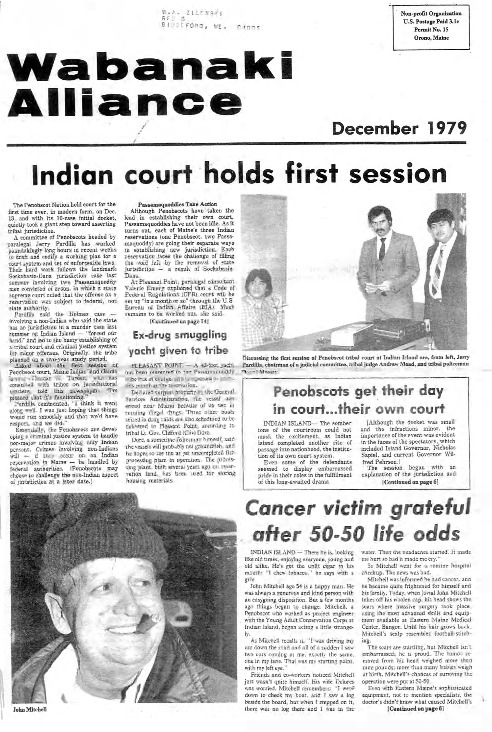
Discussing the first session of Penobscot tribal court at Indian Island are, from left, Jerry
Pardilla, chairman of a judicial committee, tribal judge Andrew Mead, and tribal policeman
TV??— ••I M v v ’y.
Penobscots get their day
in court...their o w n court
INDIAN ISLAND— The somber
tone of the courtroom couid not
mask the excitement, as Indian
Island completed another rite of
passage into nationhood, the institu
tion of its own court system.
Even some of the defendants
seemed to display embarrassed
pride in their roles in the fulfillment
of this long-awaited drama.
[Although the docket was small
and the infractions minor, the
importance of the event was evident
in the faces of the spectators, which
included Island Governor, Nicholas
Sapiel, and current Governor Wil
fred Pehrson.)
The session began with an
explanation of the jurisdiction and
[Continued on page 6]
Cancer victim grateful
after 50-50 life odds
John Mitchell
INDIAN ISLAND — There he is, looking
like old times, enjoying everyone, young and
old alike. He’ got the unlit cigar in his
s
mouth; “I chew tobacco,” he says with a
grin.
John Mitchell age 54 is a happy man. He
was always a generous and kind person with
an easygoing disposition. But a few months
ago things began to change. Mitchell, a
Penobscot who worked as project engineer
with the Young Adult Conservation Corps at
Indian Island, began acting a little strangelyAs Mitchell recalls it, “I was driving my
car down the road and all o f a sudden I saw
two cars coming at me, exactly the same,
one in my lane. That was my starting point,
with my left eye."
Friends and co-workers noticed Mitchell
just wasn’ quite himself. His wife Delores
t
was worried. Mitchell remembers: "I we:?f
down to check my boat, and I saw a log
beside the board, but when I stepped on it,
there was no log there and I was in the
water. Then the headaches started. It made
me hurt so bad it made me cry.”
So Mitchell went for a routine hospital
checkup. The news was bad.
Mitchell was informed he had cancer, and
he became quite frightened for himself and
his family. Today, when jovial John Mitchell
takes off his woolen cap, his head shows the
scars where massive surgery took place,
using the most advanced skills and equip
ment available at Eastern Maine Medical
Center, Bangor. Until his hair grows back,
Mitchell’ scalp resembles football-stitch
s
ing.
The scars are startling, but Mitchell isn’
t
embarrassed: he is proud. The tumor re
moved from his head weighed more than
nine pounds; more than many babies weigh
at birth. Mitchell’ chances of surviving the
s
operation were put at 50-50.
Even with Eastern Maine’s sophisticated
equipment, not to mention specialists, the
doctor’ didn’ know what caused Mitchell’
s
t
s
[Continued on page 6]
Page 2
Wabanaki Alliance December 1979
editorials
Set the record straight
The men and women involved in writing and editing a new Maine
history book, "D ingo,’’ are to be commended. It’ high time a book
s
was written which tries to correct some o f the many misconceptions
about Indian people and their culture. It gives substance to the belief
that Maine's tribes have endured a history o f injustices, not only at
the hands o f the state, but historians as well.
It should be noted, however, that in their zeal to shatter stereo
types found in earlier texts, the editors have occasionally strayed
from the role o f historians.
Toward the end o f a second chapter devoted to the tribes,
subjective statements take the place o f facts, with little or no
explanation. The opening o f a Department o f Indian Affairs office
for off-reservation Indians in Aroostook County is cited as evidence
"the state had finally accepted responsibility for the loss o f Indian
land and rights in Aroostook." The state might offer a different
opinion.
In another case, after an informative section on the Micmacs who
settled in Maine following the American Revolution, the unsubstan
tiated statement is made, “it is clear that the Americans have not
lived up to promises made to them." A few facts are needed here to
prove the point. Without the weight of evidence, such statements
become mere opinion, not history.
In striving the rectify wrongs o f past historians, the producers of
this book have suffered some o f the same pitfalls as their prede
cessors. In this case they have erred on the side o f a people abused
throughout history. It would be tempting to say this is all right; but
where a history book does not serve the truth, it loses strength.
Let the facts speak for themselves.
bv
dl
The April 1 deadline
The celebrated Maine Indian land claims case will most likely be
settled peaceably before April 1 1980.
,
That’ because a federal statute o f limitations takes effect on that
s
date. After April 1 no new Indian claims can be filed through the
,
federal government. This means that Penobscots and Passamaquoddies must settle their land and monetary claims prior to the
deadline, or their legal clout will be wiped out. True, as some Indians
argue, there is still the possibility o f World Court or other actions
“outside the system,” but this seems a long shot at best.
As w e’ said on this page before, a negotiated settlement appears
ve
to be the best o f all solutions to the valid claims o f the tribes. Right
now, Penobscots and Passamaquoddies face the prospect o f 300,000
acres in an estimated $79 million total settlement, with a variety of
special benefits in the form o f loans, grants and continuing support.
In the past, we’ made overly optimistic predictions on these pages
ve
about the settlement timetable, and so we are cautious in viewing the
latest proposal. But we can say without any doubt that as 1979 draws
to an end, so does the decade o f struggle by Penobscots and Passa
maquoddies to regain some o f what is rightfully theirs.
The tribes have done their homework, and the deadline is no major
threat to their long term efforts. They are ready to move. A dedicated
negotiating committee has worked very hard to secure a claims
settlement that is both realistic and beneficial to the Indian
community.
W INDIAN FRlENPsWE HAVE 50/V\E
FINE PROPERTY H E R E , FOR A M 0 P E 5 T PRICE.
Drugs an insidious force
by Brenda Polchies
I am an Indian person who is aware, is
conscious o f problems confronting the
Indian community today, and I am aware of
the pressures which are placed on our
Indian leaders. But I have come to realize
and fear that a sickness is infiltrating the
Indian community and the white com
munity through the guise o f legitimate
agencies employing certain Indian and nonIndian persons. The sickness I will name
specifically here is drugs. Illegal, immoral,
and hypocritical. These drugs are being
ingested by certain individuals o f the Indian
community and the white community in the
state and out o f state who are in decision
making capacities. Decisions are being
made for me and for you by Indians and
non-Indians whose minds and bodies are
saturated with these illegal drugs.
I do not want decisions being made for me
by these people. I do not want a drug-in
duced mind to determine my life, my future,
and my happiness. I do not want these druginduced individuals to determine the life of
my child. A thorough inner community and
inner agency house cleaning needs to take
place soon before it’ too late. These people
s
have to either butt out completely and crawl
around their own sick world, or they must
come forward and answer to someone. They
are kidding no-one but themselves. They are
the fools.
I know others are aware o f the problem,
and from the silence on this matter, I see
they choose to ignore it. Many times I have
broached this subject to key people I
thought were knowledgeable, intelligent,
and concerned, and many times an invisible
door was shut in my face. Why? What are
they afraid of? People with alcohol prob
lems, who are labeled as medically sick,
would soon enough find themselves kicked
out into the street if they showed up drunk
at their jobs. They would be arrested and
put in jail. Appropriate help is available to
them. Is it so different with this drug
situation? Just because the effect o f illegal
drugs is not obvious to an average
individual, does that make it more respect
able, more acceptable? Where is the
appropriate help for drug users and drug
addicts? I have heard a lot about public
awareness about drugs. Where is this public
awareness? I do not want to impede the
progress and great strides the Indian com
munity has made in the last few years, nor
do I want to just stand aside and allow this
problem to exist.
Once upon a time, I was very proud o f
these Indian leaders. I was proud to be a
part o f the Indian community. I felt safe and
secure in knowing the fact that my Indian
brothers were intelligent, sensitive, and very
capable in expressing my views, concerns,
and problems to the white community and
to political representatives. But I don’ feel
t
safe and secure anymore. I don’ feel
t
especially proud o f my Indian brothers
either. Many of my friends are into drugs;
they avoid me and they no longer look me
straight in the eye; they turn their heads
away. Obviously, they have a guilty con
science. Why did they succumb to this
insidious evil?
How does one stop this epidemic? I say
the word epidemic because it is touching on
all human aspects — Indian, white, youth,
and adult. And it isn’ just the kids and
t
adults on the street anymore who are
affected by this problem. Teachers, lawyers,
people in social agencies, health agencies,
federal agencies, state agencies, personnel in
jails and prisons, doctors and nurses;
counselors in hospitals — who purport to be
helping drug addicts and alcoholics — are
playing a hypocritical role because I have
come across an instance where a counselor
was into drugs himself; people with profes
sional backgrounds, people with advanced
university and college educations are all
included; are susceptible to this disease.
To me, the enemy is drugs. They have
become as easily available as aspirin, but the
damage they do in terms o f destroying
physical health, mental health, and family
relationships is paramount. I have not seen
legislation or laws which put legal restraints
on dealing specifically with drugs. Since it
seems virtually impossible to stop the source
o f illegal drugs, I would like to see
legislation enacted to some way, somehow,
make it mandatory for persons to submit to
a blood test, urine test, whichever way is
more feasible, to keep these people from
being employed in jobs which help pay for
these drugs. A system can be developed
which will make it mandatory for employees
to be accountable for their absences, where
abouts — their time on the job to their
superiors, their board o f directors, and their
executive staff. I know this sounds like a
naive way of solving a problem, but does
anyone else have a better solution?
Since this message is directed more
towards the Indian community, I offer this
last statement: Indian people today are as
vulnerable to society’ illicit, contemporary
s
temptations as they were many, many years
ago.
Is anyone out there listening? Does
anyone care?
Wabanaki Alliance December 1979
Page 3
letters to the
Bread and light
PRINCIPAL AND PUPIL — Sister Anselma Colford, Indian Township elementary
school, and student Jay Mazzadra, son of
Martha Malec, enjoy one another’ com
s
pany in this recent photo.
Great teaching
Indian Township
To the editor:
I sure enjoy your nice paper and am
sending a clipping o f my son Jay, age 9, with
Sister Ann Anselma o f Peter Dana Point.
She is out sick and 1 hope she feels much
better soon. She's been a very good principal
at the school. My son is learning Passamaquoddy and all the teachers have been very
great in teaching him. He loves the
reservation and hopes to live here. Merry
Christmas to all of you and keep up the good
work.
Martha Malec
Indian Township
To the editor:
People o f God . . . Peace and comfort be
with you.
My feelings for you are best expressed by
Paul and Timothy in the opening remarks of
the letter to the Prayer Community of
Philippi . . . Philippians 1 2-6, “Grace to
:
you and peace from God our Father and the
Lord Jesus Christ. I thank my God in all my
remembrance of you, always in every prayer
of mine for you all, making my prayer with
joy, thankful for your partnership in the
gospel from the first day until now. And, 1
am sure that he who began a good work in
you will bring it to completion at the day of
Jesus Christ."
As the Irish say, with a slight variation,
“Strangers are merely friends you have not
yet met." The few I have shared with in the
past, proved a grace in my life. I can only
look forward with anticipation to the joy of
meeting the rest of you in person. Mean
while, this letter will have to suffice to
express my thanks for your fellowship and
support.
Quincy, Boston, Plymouth, Brockton and
many places in between, have been a wall of
strength and disciple-ship for us Indians.
You cannot know here on earth just how
deeply your love has shaped us in the Lord
and our ministry o f sharing Bread and
Light.
Your love has allowed Jesus, as Lord of
Nations, to open up for us those “New
Horizons” we share as a common vision.
Again, our thanks in Him,
Partileas Susap
(The Rev. Joseph Laughlin)
Indian crossroads
Denver, Colo.
To the editor:
The Denver Native Americans United,
Inc., has been publishing a monthly news
letter for over two years. This newsletter
covers national as well as local news and is a
focus for the Native Americans in this
region.
Denver has been called the “Crossroads
of Indian Country," and rightfully so. There
are approximately 10,000 Indians living and
working here. They come from all over the
country representing all tribes. The DNAU
Center itself serves approximately 4,000
people, providing emergency assistance,
educational programs and employment
resources, as well as diverse social and
cultural programs.
Sam Gardipe, Jr., Editor
Reinforcing pride
Tucsen, Arizona
To the editor:
Your paper is like a letter from home. It
serves to reinforce m y pride of my
heritage. Congratulations on a well-edit
ed, illustrated, informative and pure
journalistic production.
I’ enclosed a small contribution.
ve
Merry Christmas to you and staff.
Normand T. Nelson
Dominica
To the editor:
My name is Hilary Frederick, Chief of
the Carib Reserve, on the island of
Dominica, in the West Indies; the last
remaining o f the Carib race.
This is the last reservation .. . the only
one in the Caribbean island. I am writing
to you because I received your news
paper, the Wabanaki Alliance, and I find
it very interesting. There is a lot of
history that has to be told about Caribs.
First, I will just give you some informa
tion. The Carib Reserve is situated on the
east side o f the Island o f Dominica; it
contained originally 7,760 acres of land,
but the government took some land and
there now remains 3.700 acres, which I
have a certificate o f title to.
At the age o f 22, I find the Caribs. the
minority on the island, we are left back,
as the majority are the black, and the
rulers are black also. And the problem
which- faces me now is that, there are
many black, or illegal residents on the
reserve. I would like to put them out, but
no help.
I am writing to link with my fellow
Indians overseas, to get acquainted with
their leaders. And the people too. The
Caribs number 500 pure caribs; 1,000
mixed; 500 black. Maybe you have heard
o f the hurricane that struck my island
very badly. In the Carib Reserve there
were about 125 homes damaged. We
have no materials to rebuild. We would
like galvanized board nails, chain saws
and other building materials. Along with
that 2,000 acres o f tree crops were
damaged and 1,100 acres o f forest land.
So I am asking my fellow brothers to
help me in my poor situation. The hur
ricane occurred on the 28th o f August,
1979. I would like to write news o f the
Carib for your newpaper in the near
future.
Ala-qua-bou-tauAla-cou-nar, maul Aquichah
Hilary Frederick
Seeking members
Leesburg, GA.
Imprisoned
Redding, Calif.
To the editor:
I am a sixteen-year-old Indian boy in a
correctional institution. I would like to
receive your newsletter soon.
Thank you.
Danny Black Hawk Worthen
Wabanaki Alliance
A Carib describes
his people
To the editor:
The Southeastern Cherokee Confederacy,
Inc. is a non-profit organization. We are
accepting members with 1/16 or more of
Indian heritage, but they can’ belong to two
t
tribes at one time. For more information
write to Principal Vice Chief Jim Little
Hawk Jackson, Southeastern Cherokee Con
federacy. Inc., Rt. 1 Box 112, Quitman, GA
,
31643.
Vol. 3, No. 12
December 1979
Published monthly by the Division of Indian Services [DIS] at the Indian Resource Center,
95 Main St., Orono, Maine 04473.
MEMBER — MAINE PRESS ASSOCIATION
Steven Cartwright, Editor
William O’Neal, Associate Editor
DIS Board of Directors
TROPHY ANGLER — Joe Lola, 12, of
Indian Township caught the biggest fish last
summer at Camp Roosevelt in East Edding
ton. The trophies were presented to Joe on
August 23rd by the Camp Director, Tom
Herbert. [Photo by Kathy Tomah]
Jean Chavaree [chairman]
John Bailey, Public Safety Coordinator
Albert Dana, Tribal Councilor
Timothy Love, Representative to State Legislature
Jeannette Neptune, Community Development Director
Jeannette LaPlante, Central Maine Indian Assoc.
Susan Desiderio, Assn, of Aroostook Indians
Maynard Polchies, President, Aroostook Indians
Melvin L. Vicaire, Central Maine Indian Assn.
David A. Francis, Public Safety Department
Indian Island
Pleasant Point
Indian Township
Indian Island
Indian Township
Orono
Houlton
Houlton
Mattawamkeag
Pleasant Point
DIS is an agency of Diocesan Human Relations Services, Inc. of Maine. Subscriptions to
this newspaper are available by writing to Wabanaki Alliance, 95 Main St., Orono, Me.
04473. Diocesan Human Relations Services and DIS are a non-profit corporation. Contri
butions are deductible for income tax purposes.
Picture raises questions
Iowa City, Iowa
To.the editor:
I’m writing in order to share a theory
about the enclosed picture and to ask
whether you have any information which
might correct or support it.
It is a portrait of “Joseph Porus, Pen
obscot Chief," painted in Washington.
D.C., 1842. by Charles Bird King. It belongs
to the Thomas Gilcrease Institute of
American History and Art, Tulsa, Okla
homa, where I took this photo o f it in June.
You can also find a black and white
reproduction o f it in THE INDIAN
LEGACY OF CHARLES BIRD KING, by
Herman J. Viola (Smithsonian Inst. Press,
1976), p . 111.
My theory is that “Porus” is the same
man who. 15 years later, was the “Joe Polis"
who guided Thoreau. (See the 3rd part of
THE MAINE WOODS.) T h o rea u sa y s that
Polis had represented his tribe in Washing
ton many years before and was age 48 in
1857, making him 33 in 1842. His descrip
tion o f Polis fits the man in this portrait, and
he also says that Polis had difficulty
pronouncing r’ and l’ sometimes using
s
s,
one for the other, which would explain the
two spellings and further support the
identity.
Is there somebody in the Penobscot tribe
or among the Abanakis (Wabanakis?) who
knows any more?
I learned about the existence o f the
portrait from a man in Schenectady, N.Y.,
Andrew Farry, who wrote after reading my
book THOREAU AND THE AMERICAN
INDIANS, to ask why I had used a picture
o f Joe Aitteon but none o f Polis. He’ never
d
seen the picture, but had seen a reference to
it in an article nearly 25 years before and
had always assumed that Porus and Polis
were the same man. What a memory!
1 have a little more information about
“Porus" and the painting if you are
interested. My home address is R.R. 1, Box
66, Oxford, Iowa 52232 (tel. 319/683-2692).
Robert F. Sayre
Native fashion show
Lincoln. Nebraska
To the editor:
The Native American Special Events
Committee o f the University Program
Council would like to do a Native American
fashion show with traditional and contemp
orary fashions. We are planning on doing
the show sometime between April 21 and 26,
1980, when we are also planning a traditional
program. 1 would like some information
concerning clothing designers in your area.
Please send names, addresses and telephone
numbers by December 14 if at all possible.
Send to: Kim Otto, 200 Nebraska Union,
University of Nebraska, Lincoln, NE 68588.
Thank you for your cooperation.
Kim Otto
Page 4
Wabanaki Alliance December 1979
Indian woman files complaints in job hassle
MILLINOCKET — Mary Francis Isaac
sits calmly in her Katahdin Avenue living
room and recounts a series o f events that
have escalated a personality conflict into a
human rights case.
A founding member of Central Maine
Indian Association (CMIA), Isaac, a Penob
scot, does not believe in being pushed
around. She maintains that her boss, Millinocket Town Manager William J. Ayoob,
has unfairly attacked her in her job as
bookkeeper/payroll clerk in the town office.
Isaac is currently vice president o f CMIA,
and a board member o f Tribal Governors,
Inc.
As Wabanaki Alliance went to press, a
hearing was scheduled to take place in
Bangor on an unfair labor practices charge,
presented by Isaac to the Maine Labor
Relations Board. Also, the Maine Human
Rights Commission was planning to file a
report if Ayoob and Isaac could not
negotiate a settlement by Dec. 1 .
7
All of this action began July 25, according
to Isaac, when she received a written repri
mand from Ayoob. The strongly worded
letter said in part: “You are spending too
much time at the counter and on the
telephone talking, much o f it about town
business not within your scope o f respon
sibility or authority; much of it that has
nothing to do with town business at all, and
offering information not within your auth
ority to do so.” Ayoob also said Isaac was
causing a morale problem.
The letter further stated that Isaac was
“hereby placed on notice that a continuance
Mary Francis Isaac
of said action may result in suspension or
termination.”
The next day, Isaac sent a brief letter
asking Ayoob to clarify the charges. On
Aug. 1 Isaac decided she had waited long
1,
enough for an explanation. She wrote Ayoob
that she had “no alternative but to request
your utmost cooperation in proceeding to
bring this grievance to the Personnel
Appeals Board. I believe I am being singled
out for reasons unknown to me and
apparently non-justifiable in writing.”
Oddly enough, although a fiery dispute
was carried on in the mails, Isaac and Ayoob
continued to work in the same offices, with
much daily contact. On Sept. 13, Ayoob
responded to the Aug. 1 letter from Isaac.
1
Ayoob defended his initial reprimand, but
said “no further action is contemplated if
the letter o f reprimand is taken seriously
and those types of actions mentioned are
corrected.”
Ayoob wrote: “ I have complimented your
neatness, cleanliness, and technical ability.
You were, however, reprimanded for poor
attitude, wasting time, unnecessary talking
at the counter, too much time on the
telephone on non-professional matters, and
involving yourself in dispensing information
not within your authority to do so.” Ayoob
concluded the letter with a warning to dis
continue “insubordination, disrespect, and
the attitude o f isolationism,” or be fired.
Asked if any o f Ayoob’ charges were
s
valid, Isaac said that she had occasionally
handled Central Maine Indian Association
business on the town office phone, but that
she had always made up the time, and had
not let it interfere with her usual duties.
Isaac said she is convinced Ayoob wants
to punish her for taking time to hear the
case o f distant relative Ronald (Sonahbeh)
Francis, charged with building an illegal fire
at Debsconeag Deadwater. On July 18, in
Millinocket, Judge Jessie H. Briggs ruled
that although Francis, a Penobscot, clearly
had built a fire without permission o f the
landowner. Great Northern Paper Co., the
state had not proved beyond reasonable
doubt that Great Northern’ title was
s
superior to the Penobscot Indians’ abor
iginal title. The finding: not guilty.
“If anything,” Isaac said, “ I’ guilty of
m
gloating over the opinion."
On Oct, 12, Ayoob ordered Isaac to report
to the public Works Director for work as a
secretary, on Monday, Oct. 15, at the same
rate o f pay as she received in the town office.
Supreme Court agrees
to government appeal
on Black Hills award
Penobscot tribal Gov. Wildred Pehrson chats with St. Regis Mohawk Chief Leonard
Garrow, at recent reception for Mohaws at Indian Island health center.
Elected Mohawk officials
oppose traditional movement
ST. REGIS (AKWESASNE) — Three
chiefs o f the Mohawk tribal council here
have accused a small group of Indians o f dis
rupting the reservation in the name of tradi
tional longhouse leadership. One of the
chiefs recently visited Indian Island Penob
scot reservation.
According to a New York State news
paper, the duly elected — and officially rec
ognized— government o f Mohawks opposes
the efforts of a radical group that has
barricaded itself in a reservation encamp
ment. The group had earlier seized a tribal
building, but later relinquished it.
The disputed leadership at the St. Regis
reservation began with an incident involving
the federally funded Young Adult Conser
vation Corps (YACC) and Loran Thompson,
a traditionalist chief. Thompson and Joseph
Swamp, another Mohawk, apparently
want to challenge state sovereignty on the
reservation, and they have refused to return
YACC equipment seized last May, in return
for dropping o f charges against them.
Chief Leonard Garrow of the Mohawk
tribe visited Penobscot Health and Social
Services recently, along with Mohawk health
service staff and council members. During
an informal conversation, Garrow told
Wabanaki Alliance that the traditionals
were trouble-makers, some of whom came
from elsewhere to join the rebellion.
Garrow and two other chiefs wrote, “If
the traditional Indian people at St. Regis
want to take over the government of the St.
Regis tribe and govern the affairs through
the historical form o f government, then they
must convince all the Indian people at St.
Regis to accept that type of government.
This does not seem probable,” they added.
Akwesasne Notes, an Indian newspaper
with national circulation, has become
spokesman for the insurgent Mohawks, and
a recent issue contains a long article in
defense of the traditionalist faction.
The Supreme Court agreed Dec. 10 to
hear the government’ challenge of the
s
$105 million award made to the Sioux
Indians for the taking of seven million
acres of land in the Black Hills area where
gold was found, after the land had been
set aside for the Indians.
The settlement is the largest court
judgment ever won by American Indians.
The U.S. Court of Appeals, in ordering
the settlement, ruled that the Govern
ment violated the Constitution in taking
the land without compensation.
Though the Government is appealing <
the award, many of the Sioux leaders have
argued that they do not want the money,
claiming they are entitled to the return of
the land.
Corrections
A sports photo caption in last month’
s
Wabanaki Alliance incorrectly identified a
young runner as Jamie Knapp. The boy
pictured is Kirk Francis o f Indian Island.
Both lads competed in the track meet at
Maranacook Community School.
In another sports photo, a caption incor
rectly stated coach Mike Ranco was an
Orono High School graduate. Ranco grad
uated from Old Town High School. Mar
anacook coach Stan Cowan attended Orono
High, and the two ran against each other in
their student days.
The editor apologizes for his errors.
The reassignment, he wrote, was caused by
Isaac’ “attitude” and relationship to
s
Ayoob, which had not improved satisfactori
ly, in the manager’ opinion.
s
The next day, town councilors Nathalie V.
McGibbon and John Pelkey wrote separate
letters to the Personnel Appeals Board in
support of Isaac's protest at her transfer.
Isaac herself filed a formal grievance with
the board Oct. 14.
Two days later the Personnel Appeals
Board responded to the councilors, saying
that Ayoob’ transfer of Isaac was legal,
s
and an appeal would not be considered
unless she was terminated.
Isaac will have worked three years for the
town this January. “Nowhere, as long as I
have worked, has anything like this been
done. I felt singled out,” she told this
newspaper.
Isaac said she decided to try to organize
town office employees as a union. “I felt the
non-union employees didn’ have any power.
t
The girls were actually being intimidated.
We figured we better protect ourselves,” she
said. Seeking union recognition did not
bring Isaac and Ayoob any closer to an
understanding.
On Oct. 23,_ a field representative of
American Federation of State, County and
Municipal Employees filed a complaint with
Maine Labor Relations Board. The com
plaint alleged "intimidation” o f those
persons wishing to unionize, and improper
transfer o f employees (such as Isaac) from
one job to another.
Results o f the hearing, slated Dec. 19,
were not known at press time.
The Maine Human Rights Commission
became involved in October when Isaac filed
a complaint alleging discrimination by the
town o f Millinocket. A closed-door hearing
was held by the commission in November, to
determine if an informal resolution of
differences was possible. Isaac declined to
discuss the hearing publicly.
Ayoob was hesitant to discuss the Isaac
case in a telephone interview. “I’ not going
m
to get into a debate,” he said. But he
commented that “some of her friends have
done her in,” in reference to a petition
reportedly bearing 400 signatures of support
for Isaac.
“ In all honesty I made some transfers,
and I did it for the good o f the service,”
Ayoob told Wabanaki. Alliance. “I’ not
m
going to go out and hurt anybody,” he said.
Would he fire anyone? “ God help us, ab
solutely not.” Ayoob said.
Isaac said 1 town employees have
1
resigned since last spring, and five depart
ment heads will have resigned by Christmas.
Do you have a
drinking problem?
Wabanaki Corporation offers an alco
holism program for Indian people who
need help because o f problems with
alcohol.
If you have such a problem- and need
help, or know o f someone in need, please
contact the Alcoholism Counselor in your
community or area.
Indian Island — Alcoholism Counselors
— Clarence Francis — Rosalie Murphy
— 207-866-5577.
Indian Township — Alcoholism Coun
selors — James Mitchell — Bernard
Stevens — 207-796-2321.
Association o f Aroostook Indians —
Alcoholism Counselors — Pious Perley
— Harriet Perley — 207-762-3571.
Pleasant Point — Alcoholism Counse
lors — Grace Roderick — Angelina
Robichaud — 207-853-2537.
Central Maine Indian Association —
Alcoholism Counselor — Alfred Dana —
207-269-2653 or 207-866-5577.
Wabanaki Alliance December 1979
Page 5
Textbok revises Indian history
“It was a struggle ... many years after the
coming o f the Europeans, we united into an
alliance called the Wabanaki Confederacy
... this idea of a confederacy set an example
for the bringing together many states under
one government. It served as a model for the
United States and the United Nations.”
That is an excerpt from the draft copy o f a
textbook which will take an unusual
approach toward Indians and their role in
the history o f the state.
Prepared for junior high school history
classes, “Dirigo: The Story o f Maine” is
intended by its compiler. Dean B. Bennett,
to present in a new light Indians, FrancoAmericans and other aspects o f state history
that have been avoided or misrepresented in
the past.
Operating under a grant through the state
Department of Education and Cultural
Services, Bennett has enlisted the aid of
American Friends Service Committee and a
panel of Indian volunteers who served as an
advisory committee on the chapters o f the
book dealing with Indians.
While the textbook had not been deliver
ed to the printers as o f press time, and
further revision was possible, a draft copy of
Dirigo was in nearly final form. The first
section of Dirigo dealing with Indians is told
in the first person, and describes encounters
with European explorers, settlers and
French priests.
“Many o f us felt that our own spiritual
leaders had failed us, so we turned more and
more to the Christian missionaries for
help,” the narration says. Told from a con
temporary Indian viewpoint, the text says,
"Alcohol was even more damaging to our
culture than all the epidemics."
“In our way o f life, we worked very hard
to settle disagreements peacefully. For
instance, every person’ opinion was listened
s
to with respect. No wonder we thought
Europeans w ere uncivilized,” the narrator
says.
A section on the “war years” tells o f the
European view o f Indians as "children of
the devil;” o f the quest for land, and a
divide and conquer approach. A particularly
vivid incident is recalled, when English
sailors took an Indian baby from a mother
to see if it could swim at birth, “like
animals.” The baby, son o f Abenaki Chief
Squando, drowned in the Saco River.
A section on “the spirit o f freedom” notes
the Maine Indians “had given many lives for
the Revolutionary cause, but when the war
was over, the Americans, it seemed, no
longer needed them.” Earlier, in 1775,
Joseph Orono (part white), said “Our white
brothers (Americans) tell us that they came
to our land to enjoy liberty and life. But
their King (of England) is coming to bind
them in chains and to kill them.”
A fateful treaty was signed in 1794, in
which the Passamaquoddies gave up most of
their lands, saving only six square miles near
Princeton, several islands in the St. Croix
River, plus 23.000 additional acres.
In 1796 and again in 1818, the
Penobscots are recorded as giving up
lands.
Knew not what they did
According to the Dirigo text, “ In spite of
the many deeds signed by the Abenakis, it is
clear they did not understand what they
were doing. To sell land was something
unheard of to the Indians. They did not
understand English law. And because they
could not read they never really knew what
was written into the land deeds.”
As early as 1698, Wabanaki Indians of
Maine agreed to be ruled by the English and
respect settlements. The agreement didn’
t
stick, with apparent violations on both sides.
Maine Indians generally sided with the
French, and the Wabanaki Confederacy, or
Great Council Fire, was an attempt to
present a united front. In 1724 Father Rasle
— a French Catholic priest who compiled a
Wabanaki dictionary now in Harvard’
s
library — was killed in the Norridgewock
Indian massacre.
The English attitude was further evidenc
ed by a bounty on Penobscot scalps, issued
in 1755 (1756, according to Dirigo). Such
attitude leaves suspect a later English proc
lamation that Penobscot “lands and prop
erty rights and liberty shall never be invaded
or distrubed.”
At the chapter’ conclusion, questions are
s
posed for the student, such as, "D o you
think the early history o f Maine could have
been different? Do you think the Europeans
and Wabanakis could have found a way to
live in peace? How do you think truth can
help people understand each other?"
The second chapter devoted to Indians
traces each o f the four Maine tribes from the
early 1800's to the present, beginning with
the Passamaquoddies.
The role o f the state Indian agents in
“leasing” tribal land and the influence these
people held is discussed. The setting up of a
trust fund by the state, using profits from
the sale of tribal timber is mentioned, and it
is stated that it is the money from the
Indian’ own trust fund which finances their
s
welfare program, not the generosity o f their
white neighbors, as is commonly believed.
The growing dependence o f the Passama
quoddies on welfare is chronicled, as they
shifted from hunting to guiding and craft
making.
01d~an3~5lew Parties which formed follow
ing introduction o f Protestant schools to the
reservation as well as the debate over
whether to keep the lifetime chiefs or hold
regular elections.
The book demonstrates the attitude o f the
By His H O N O U R
state toward the tribes in pointing out that
Maine did not grant the right to vote to
Maine tribes until 30 years after this right
had been recognized by the federal govern
Lieutenant-Govcrnour and Commander in Chief, in and over H is Majcfly’s Province o f the M affacbufeltsBay in N ew-England.
ment.
Dirigo outlines the struggle of the tribes
to get out from under the state’ influence,
s
beginning with formation o f the Depart
H E R E A S the Tribe o f Pem bfcot Indians have repeatedly in a perfidious Manner adted con
ment o f Indian Affairs (DIA) and cul
trary to their folcmn Submiflion unto H is Majefty long fince made and frequently renewed ;
minating in the Indian land claims. The
sab* thereto*, attheaNOKofthc^oufeofmeprefentatibes, totfl tljc 2Db(ceof Passamaquoddy section concludes by stat
SfS © attftp’ Council, thought fit to rffuc th(s proclamation, anb to Declare the ing that Indians are beginning to control
s
Penobfcot xribe of 3nDfans to be enemies, Rebels anD Xraitojs to $fs © ajeftp
iting G E O R G E the S econ d : 2lnD 3 Do Ijctcby require Sis fi@ajeftp’ Subjects of their own lives, although specific examples
s
this probmee to embrace all iOppojtunltfes of purfulng, captibating, Hilling anD D
e* are not given.
The section on the Penobscots traces a
Croplng all anD ebetp of the afojefalD JnDlans.
similar decline into dependence on the state
A N D W H E R E A S the General Court of this Province have voted that a Bounty or Incouas the tribe lost first its land and then its
ragement be granted and allowed to be paid out o f the Publick Treafury. to the marching Forces that Ihall
livelihood. Penobscot Lt. Gov. John Neptune
have been employed for the Defence ol the E oficrn and W eflern Frontiers, from the F ir jl to die Twentypermitted the state to remove timber from
fifth o f this Inftant November ;
tribal lands, but asked to be allowed to
§ abe thought fit to publitt) the fame; anD 3 Do hereby iDiomifc, -Chat there 0>nll continue hunting the game on the lands.
be paiD out of the ^roblnce-iCceafurp to all anD any of the faiD jfotets, ober anD However, the resulting heavy timbering
abobe their JBounty upon ^nliftmcnt, their (KUagcs anD SmbOfrcncc, tfje premiums oj
drove the animals away. In addition, it
$onnty following, viz.
greatly reduced the number o f birch, killing
For every Male Penobfcot Indian above the A ge o f Twelve Years, that fiiall be taken within the T im e
the canoe-making industry, according to the
aforefaid and brought to Bofion, F ifty Pounds.
book.
For every Scalp o f a Male Penobfcot Indian above the A ge aforcfiid,brought in as Evidence o f their being
The book again emphasizes that welfare
killed as aforefaid, Forty Pounds.
money received on the reservations comes
from tribal trust funds started long ago in
For every Female Penobfcot Indian taken and brought in as aforelaid.and for every Male Indian Prifoncr
under the A ge o f Twelve Years, taken and brought in as aforefaid, Twenty-fve Pounds.
exchange for use of the tribe’ lands.
s
Some of the questionable land deals the
For every Scalp o f luch Female Indian or Male Indian under the A ge o f T w elve Years, that fiiall be
state made with the Penobscots are high
killed and brought in as Evidence o f their being killed as aforefaid, Twenty Pounds.
lighted. For example, the book states that in
Given at the Council-Chamber in Bofion, this Third Day of November 1755, and in the Twenty-ninth Year of
1833 the state sent two men to the
the Reign of our Sovereign Lord G E O R G E the Second, by the Grace of GOD of Great-Britam,
Penobscots to purchase as much land as
France and Ireland, KING, Defender o!: the Faith, 6 -"
<possible, resulting in the sale o f four town
B j H I j Hononr'r Command,
ships. Only four tribal members signed the
3. C lU , Sect.
H acD
agreement, of which two of the signatures
are of doubtful validity, the book says. The
state then sold the land to one o f the two
negotiators.
The book mentions a decline o f the Pen
B 0 S T O N : Printed by John Draper, Printer to Mis Honour the Licutenam-Goveinour aud Council. 1755obscot culture, although this section ends
S P E N C E R
A
P H I P S,
Efq;
P R O C L A M A T I O N .
W
I
1
S. Phips.
GOD
Save the KI NG.
with the comment, “and there is a real
movement on the part o f many Penobscots
to live in keeping with their traditional
values.”
Next, the Maliseets are discussed. The
presence o f early Maliseet hunters in
Aroostook County is discussed, and the fact
that Maliseets were living in the Houlton ara
is noted. Stating, "Never once did the Mali
seets sign a treaty giving up their hunting
territory in Aroostook,” the book questions
the state’ failure to recognize the Maliseets
s
as a tribe.
The effects o f the state’ unwillingness to
s
recognize Maliseets are considered, and the
section concludes, “All in all, these Mali
seets have come to be treated as unwanted
strangers in their own land.”
The book turns to the role o f Micmacs in
the American Revolution and their settling
in Aroostook afterwards. The tribe’ plight
s
since that time is mentioned; the unem
ployment, poor housing, poor health, and
discrimination are all noted.
The text discusses the formation o f offreservation agencies, Association o f Aroos
took Indians (AAI), and Central Maine
Indian Association (CMIA).
The conclusion o f this final chapter on
Maine Indians deals with current develop
ments in tribal history, primarily through a
discussion o f issues such as sovereignty and
Maine Indian land claims.
Federal grants aid
Indian pupils
WASHINGTON — The Department of
Health. Education and Welfare has award
ed S43.6 million for projects in 42 states
which are designed to meet special educa
tion and culturally related academic needs
of American Indians, Eskimos, and Aleut
children.
1,148 public school districts during the
1979-80 school year.
On the Honor Roll
PLEASANT POINT— The following
students received 85 per cent or higher
grades in all subjects the first quarter of
this school year at the Beatrice Rafferty
School:
GRADE 1
Starr Nicholas, Rene Altvater, Tonia
Smith and Jonathan Homan.
GRADE 2
Timothy Newell, Adam Moore, James
Gibson, Steph an ie Francis, M elvin
Francis, Elizabeth Francis, Tekewitha
Doten, Nancy Clement, Victor Bassett
and Lisa Barnes.
GRADE 3
Percy Moore and Jacinta Altvater.
GRADE 4 .
Maria Bailey, Treena Graham. Sebas
tian Moore, Ernest Neptune, Hounie
Newell, R oger Newell, Joseph Nott and
Lisa Smith.
GRADE 5
Claire Francis, Sarah Dana, Rolfe
Richter, Venus Murphy, Theresa Farrell,
James Bailey, Lois Soctomah, Sebrena
Sockabasin, Patrick Newell and Lori
Cantara.
GRADE 6
Sam Newell, Kelly Emery, Joey
Barnes, Cheryl Paul, Evelyn Newell,
Peter Clement, Lisa Gardner, Darrell
Francis, Phillip Nicholas and Marie
Newell.
GRADE 7
Stella Dana, Mary M oore Robert
Newell, Evelyn Lewey, Mary Aubrey,
Denise Moore, Sandy Yarmal, Ralph
Dana, Rhonda Emery, Harvard Socto
mah, Esther Altvater, Rachael Nicholas,
John Stanley and Susan Francis.
GRADE 8
Rena Newell, Jodi Yarmal, Veronica
Newell, Gail Mitchell, Ruby Smith, Lynn
Bailey and Sheila Doyle.
Page 6
Wabanaki Alliance December 1979
Penobscots handle first docket
[Continued from page one]
procedures of the court by Judge
Andrew A. Mead, a Bangor attor
ney. In his opening statements,
Mead pointed out that the tribe had
adopted most of the criminal, motor
vehicle, and juvenile codes of
Maine, as well as Maine’ criminal
s
and civil procedures.
He said the maximum fine which
could currently be imposed was
$500 and maximum imprisonment,
six months, adding that, until the
court is more firmly established
sentences and fines would be lower
than in state courts.
The first case to appear before
the court was that of Eloise Francis,
charged with criminal mischief and
disorderly conduct. To the first
charge Francis pleaded guilty and
was fined $15. To the charge of
disorderly conduct she pleaded
not guilty and was scheduled a jury
trial.
In other cases James Paul,
Ronald Paul, and Richard Hamilton,
Jr. each pleaded nolo contendere to
charges of disorderly conduct and
were fined $15. Hamilton also
Cancer patient wins
pleaded guilty to possession of a
useable amount of marijuana after
first asking Mead what a useable
amount was and how the court was
sure the substance had been mari
juana. Mead declined comment,
saying as judge he was not
permitted to offer legal counsel.
Hamilton was charged $10.
In another disorderly conduct
case, Christine LaCasse pleaded
not guilty and was scheduled for a
jury trail.
[Continued from page one]
huge tumor. “They didn’ really know what
t
it was,” Mitchell said with a sense of
wonder. Doctors did diagnose cancer,
however, and Mitchell has undergone 40
cobalt radiation treatments.
When the choice had to be made,
Mitchell is happy to report that “the
decision to operate on me was made by the
entire family.” Not only that: “Both sides of
my family stood behind me,” he said. A
brother, Gary, traveled from Mississippi.
In three traffic related cases
The entire family, children included, fav
Kelvin M. Francis and Elizabeth
ored the operation.
Murphy pleaded guilty to operating
Brothers Matthew and Ted “Goodluck”
a motor vehicle without a license,
were close at hand, and sister-in-law Mary
and Calvin E. Tomah pleaded guilty
Isaac from Millinocket was helpful in the
to permitting an unlicensed driver
crisis.
to operate his car. All three were
“You know, you never know who your
fined $15.
friends are until you’ on your back . . .
re
The only scheduled case not
until a man lays $100 on your bed when you
processed was that of Stanley
haven’ worked three months and says
t
Neptune, who also had refused to
sign a summons to court according
Merry Christmas.” Tears welled in Mit
to Bailiff Darryl Massey. Mead
chell’s eyes and he had to stop talking
issued a bench warrant for N ep
awhile.
tune’ arrest.
s
Mitchell has unrestrained praise for
The next court session will be
Doctors Donald Stillwagon and Ernesto
held Jan. 9, 1980.
Ballesteros of Eastern Maine Medical
Center. He is grateful beyond words. “The
biggest thing that pulled me through was
the Lord God, and the surgeons,” he said,
adding, “They are the best team that there
is.”
Mitchell said that he wasn’ always the
t
Kenneth Black, executive director of the model patient in Bangor. “I had a hell o f a
National Tribal Chairman’ Association, time in the recovery unit. For two weeks I
s
sent a telegram to the Iranian Embassy gave them an awful hard time. They had to
asking for Kupke’ immediate release. strap me in,” he said.
s
Black said that “Indian tribes o f America
Now Mitchell must protect himself, so he
have extended hospitality and entertained wears a helmet when he is in a place where
Iranian students in this country . . . we
expect your country and officials would
reciprocate in a like manner.” Kiowa Chair
man Jacob Ahtone also sent a telegram
INDIAN ISLAND— A national confer
asking for Kupke’ release.
s
ence on Indian museums included some
very worthwhile workshops, according to
a Penobscot Indian representative who
attended the Washington D.C. meetings.
Pumpkin Soup
Francis C. Sapiel, president of the
1small pumpkin
newly formed Penobscot National Histor
V i cup butter, divided
ical Society, said “every one of the
1quart chicken or beef stock
workshops was very worthwhile.” Sapiel
1tablespoon sugar
and other active members of the society
Salt and pepper to taste
plan to establish a tribal museum in a new
Pinch of ground allspice
building at Indian Island. To join the
Milk or light cream
society or participate in regular meetings,
Peel, seed and cut pumpkin in small contact Sapiel or his wife Edwina, at Oak
chunks. There should be 1 quart of Hill, Indian Island.
The North American Indian Museums
pumpkin wedges or pieces. Place in a sauce
pan with half the butter, the stock, sugar Association regional training workshop
and 1 teaspoon salt. Bring to a boil, lower was held at the Smithsonian Institution.
heat and simmer 35 minutes, or until pump
kin is tender. Press through a sieve and
JOB OPENING
return pulp to saucepan. Season with
Sioux suggests Indians take
place of hostages in Iran
Caleb Shields, a tribal councilman with
the Assiniboine-Sioux tribes o f Fort Peck,
Montana, offered to call for 100 Indian
volunteers to exchange with the hostages
held at the U.S. Embassy in Tehran, Iran.
Shields said, “we will not stand by and let
the country o f Iran use the minority issue as
a weapon against this country o f ours.” He
said that if the offer was accepted they
would carry to Iran "a sacred pipe and
sacred colors o f the Indian people.” No
word from the Department o f State on the
possibility o f accepting the offer.
Fredrick Lee Kupke, 32, an employee of
the communications section o f the Embassy
in Tehran, Iran, is one of the Americans
held hostage by Khomeini supporters.
Film highlights
Indian gathering
CONCORD, Mass. — A celebration of
“native first people” was held Sunday, Dec.
1 , at Concord Academy, starting at 3 p.m.
6
Called Millennia Celebration, the event
included a film titled "more than Bows
and Arrows.” Also scheduled were work
shops on education, planning, a museum,
park and university. For further information
contact Fox Tree at Boston State College;
Slow Turtle, executive director o f Massa
chusetts Commission on Indian Affairs; Dr.
Helen Attaquin, Boston Children’ Mu
s
seum; Lenore Stiffarm, Harvard University.
A flyer for the event says: "The deep
spiritual message o f the millennia age is for
all .people who strive for unity to work to
achieve peace, goodwill, and understand
ing.”
AAillinocket students
on honor toll
MILLINOCKET— Two Indian pupils at
Steams High School have made the Honor
Roll for the current quarter.
They are Jackie Isaac, 16, and E. John
Isaac. 1 , the children o f John and Mary
8
Francis Isaac o f 70 Katahdin Ave. Jackie is
a junior, and John is a senior who plans to
attend EMVTI in Bangor. They have a
sister. Laura, 1 , also a student at Stearns.
4
Dean Anthony Francis, son o f Mary
Francis Isaac, and his wife Margaret are the
parents of a son, Nicholas Joseph, born Oct.
23. The family lives in Millinocket.
Sapiel offends meeting
he might bump his head. “ I’ regained my
ve
physical strength,” Mitchell says, but adds
that emotionally, “I’ still kind of choked
m
up.” He was especially moved by the fact
that masses were held on his behalf at both
Passamaquoddy and Penobscot Catholic
Churches.
By signing a release, Mitchell allowed a
special film crew from Walter Reed Army
Medical Center in Washington to film the
delicate operation to remove his tumor.
“They can use that.” Mitchell said, thinking
out loud . . . “if it’ an isolated case like up
s
in Alaska in the tundra, they can use it.”
Mitchell calls Eastern Maine “outstand
ing,” possessing in his opinion “one o f the
best cancer-fighting teams there is.” He
should know, and he’ willing to help,
s
through the film and in person.
“After what I’ gone through, I believe
ve
there’ no need o f getting scared o f cancer.
s
Learn to live with it. Talk with someone
that’ already had it. I’ willing to talk to
s
m
anybody,” Mitchell said.
Mitchell himself was helped a great deal
by counseling from fellow cancer patients.
Delores and John Mitchell have five sons:
Alan, Kirk, Keith, Keane and Andy Francis
from her first marriage; and two sons from
his first marriage: John Mitchell Jr. and
Randy Mitchell.
A former governor and lieutenant gover
nor o f the Penobscot tribe, Mitchell spent 19
years on the tribal council, and was elected
representative to the Legislature from
Indian Island. A graduate o f Old Town
High School, he worked many years in
construction, and as a shoeworker. He
earned several bronze and silver stars during
nine years serving in the Armed Forces, with
two hitches overseas.
The final radiation treatment took place
Dec. 13. Right now, the greatest joy is a
good cigar and just being alive.
Indian Cookery
pepper and allspice and additional salt if
necessary. Add remaining butter and
enough milk to make soup of the desired
consistency. Heat but do not boil. Serve with
fried bread if desired. Makes about 6
servings.
Navajos receive
808 acres
Outreach Worker Specialist
Must have valid Maine driver’
s
license and be able to travel around
the state, as well as attend
workshops and training sessions,
whenever deem ed necessary. Must
be able to communicate well with
off-reservation Indian people.
Anyone interested may apply in
person or submit resum es to
Central M aine Indian Association,
95 Main St., Orono, Maine 04473.
Deadline for applications is Dec. 28,
1979.
WASHINGTON — Secretary o f the
Interior Cecil D. Andrus has signed a
decision returning jurisdiction over 808
acres in Arizona to the Navajos.
The land, known as Antelope Creek
Recreation Development Area, in Conconino County, was held by Water and
Power Resources Service, formerly the I
Bureau o f Reclamation, o f the Department
I
of the Interior. The land will be held in trust
I
by the federal government.
INDIAN ISLAND
The lands were originally transferred I All auto repairs: foreign and domestic
from tribal jurisdiction to the Bureau o f I
CHRISTMAS SPECIALS
Reclamation on September 2, 1958, for use
Retread snow tires, mounted
I
in the development o f the Glen Canyon
and balanced — $24.50
I
Unit. Colorado River Storage Project.
Oil change (5 qts., oil filter, grease
The Antelope Creek Recreation Develop I
job, fluid level check) — $9.95
ment Area was not needed for Reclamation I
FREE ICE SCRAPERS
purposes, and was ordered restored to the
I
tribe.
LOVE'S AMOCO
I
I
•
J
I
1
I
g
!
HARDW ARE
& G U N SHOP
TOM VTCAIRE, Proprietor
The only Indian-owned hardware
business in the State o f Maine
“We’ eager to do business with people
re
in the Indian community,” says Tom.
The store carries a full line o f tools,
electrical and plumbing supplies, paint
and housewares. Also, a selection o f fine
new and used guns, plus high quality
woodstoves.
For all your hardware and
hunting needs, visit —
MATTAWAMKEAG HARDWARE &
GUN SHOP
and sample some good Indian hospitality
and service.
EXECUTIVE DIRECTOR
Central Maine Indian Association
Applicant must have food manage
ment and communication skill and be
able to deal with the public.
Must have understanding o f operation
o f Federal programs and be able to
understand the Federal and regulatory
process.
Must have complete understanding
and appreciation o f Indian needs and
culture and be able to gain the coopera
tion and confidence o f the constituency
represented.
Interested persons should submit letter
o f application and resume to Central
Maine Indian Association, Inc., 95 Main
Street, Orono, Maine 04473. Applica
tions will be accepted until December
28th, 1979.
Wabanaki Alliance December 1979
Page 7
Indians hear critics
of budworm policy
at hearing
BANGOR —
Two Penobscot tribal the state for refusal to pay my spruce
members attended what turned into a budworm tax. I keep much o f my land in a
polarized debate on Maine’ spruce bud- wild, natural state,” Fitzgerald said, ex
s
plaining that he prefers "natural cycles” to
worm control program.
Present at the Nov. 20 hearing were chemical control systems.
Fitzgerald said he paid his taxes under
Penobscot council member Joseph Francis,
and tribal health official, Philip Guimond. protest, with assurances he could press his
case in court later. He believes landowners
Chaired by state Conservation Commission
er Richard Barringer, the hearing dealt with should pay for spraying.
George C. (Pete) Sawyer, woodlands
findings and recommendations for a 1980
manager for the Timberland company in
budworm control policy.
Those who favored continued spraying northern Maine, remembers the "worst
from planes to kill off budworms appeared budworm blight” that occurred in 1917to represent pulp and paper interests, while 1918. He said the budworms left o f their
smaller landowners and individual citizens own accord, without chemical spraying.
seemed concerned about harmful effects of Sawyer says he keeps notes on winds,
spraying, and doubt about long term temperature and crops; after spraying last
summer, he did not get a buckwheat crop,
effectiveness o f the state policy.
Bo Yerxa of South Princeton, who won a for the first time in 60 years.
Sawyer said he requested his farm not be
lawsuit after his organic farm was sprayed
with chemicals, mentioned that spraying of sprayed, "but I looked out one day to see a
nearby Indian Township Passamaquoddy 'copter spraying the horse barn.” Sawyer
reservation threatened the Indians’ water would like to see long term funding of
supply. Big Lake was sprayed last summer, budword parasitism, or natural ways to
control the blight. “We certainly are short
he said.
Yerxa advocated an immediate halt to all sighted,” he said.
Doc Hodgins o f Eastport, an environ
aerial spraying operations. He pointed out
Newfoundland and Nova Scotia had stopped mentalist and activist, said paper companies
all spraying after researching effects. Yerxa unwisely cultivated softwood forests for high
said using tax money to pay for spraying is yield — susceptible to budworm infestation
— and are now facing their shortsighted
“a total misuse of public funds.”
Another outspoken critic o f spraying was ness. “The paper and pulp companies have
Charles Fitzgerald o f Atkinson, who flew his in the past few years had incredible profits,”
own plane behind, and above, spruce he said.
"The public issue in my mind is liability. I
budworm spray planes. He filmed the
spraying operation, including rescue of a would like to see the state out o f the position
o f being between the public and the com
downed plane at Eagle Lake, in the Allagash
panies,” Hodgins said. Ron Davis of
Wilderness.
The film, screened at the hearing, showed Natural Resources Council suggested an
28 violations o f spraying policy within a agency should be independent of the state
three-quarter hour period, including spray pesticide control board to honestly evaluate
that drifted onto lakes and rivers. “It makes policy. He said he is concerned about side
effect of spraying, such as higher accidental
the technology look pretty foolish,” Fitz
gerald said. Barringer at first objected to abortion rates, birth defects, contaminated
any discussion o f the film, but later allowed gardens and Christmas tree plantations.
Dick Jones, executive director o f Sports
comments when Fitzgerald protested that
men’ Alliance of Maine, urged industry
s
the film was part of his agreed-upon presen
and the state to seek alternatives to
tation.
“This year I nearly lost all o f my land to spraying.
Alice Conlin and Joyce Tomah of Indian Township share a joke during a recent visit to
Orono.
Heat, rent aid available
PRESQUE ISLE — Assistance aimed at
lessening the impact o f high energy costs —
including increased rent — for low-income
households is available, according to Nor
man Fournier, head of Aroostook County
Action Program, Inc.
Fournier said $300,000 is available in
Aroostook County to assist 7,000 poor
families. The funds are available as a result
o f the recent special session o f the Maine
Legislature, and action taken by Congress.
Fournier said additional energy assistance
funds are expected in January.
Paula Carter, ACAP staff member,
explained that eligibility guidelines are
different than previous programs. If a head
of household receives SSI (Supplemental
Security Income) the household automa
tically qualifies for assistance. If a head of
household received a 1979 Elderly House
holders Tax or Rent Refund or is eligible for
a 1979 or 1980 Tax or Rent Refund, then the
household qualifies. In all other cases, eli
gibility is based on income. To be eligible,
household income cannot exceed 125 per
cent of poverty guidelines. Fore a single
person, the annual income cannot exceed
$4,250; for a family o f four, $8,375. Carter
noted that applicants must provide proof of
all household income for at least the 90-day
period preceding application and no more
than twelve months preceding application.
Carter went on to explain that no funds
under this year’ program can be used to
s
pay outstanding fuel or energy bills. "This
year’ program is designed to provide fuel
s
through the winter in order to prevent
energy related crises. Assistance will be
provided in the form o f credits to energy
suppliers or direct payments to energy
suppliers for emergency fuel delivery,”
stated Carter. Maximum financial assist
ance for households paying their own heat is
$ 200.
Carter explained that applications will be
taken beginning Friday, December 7, 1979.
Beginning that date, persons wishing to
apply may do so at the ACAP Office at Sky
way Industrial Park, Presque Isle; 794 West
Main Street, Fort Kent; or 97'/i Military
Street, Houlton. Offices are open from 8:30
a.m. to 5 p.m. Monday through Friday,
except holidays. These three offices will also
be open Saturday morning from 9 a.m.-12
noon on December 8th and 15th; and open
Wednesday evening from 6 p.m.-8 p.m. on
December 19,1979.
Emergency Energy Assistance locations
HEAD OVER HEELS — Sherri Mitchell of Indian Island makes this tricky backwards
wheel on the balance beam look like child’s play. Sherri and fellow Island gymnast, Christa
King, practice over twenty hours a week at Vickie Daigle’ School of Dance in Bangor in
s
order to learn such feats.
ORONO — The following list of certifica
Addison. Piscataquis County — Penquis
tion sites for Emergency Fuel Assistance CAP, Brownville. Sagadahoc County —
Program (EFAP) to homes seeking assist
Coastal Economic Development Agency
ance with their fuel bills has been provided CAP.
by Central Maine Indian Association
Households meeting the requirements
(CMIA).
may apply for assistance directly for fuel
York County — Community Action Pro
bills, or for expenses related directly to fuel
gram Office (CAP), Elliot, Waterboro.
needs such as housing repairs, medical care,
Lincoln County — Coastal Economic De
food, and clothing.
velopment Agency (CAP), Jefferson, WisAll payment will be made to the vendors
casset. Somerville. Franklin County — CAP.
providing the needed services. No cash
Aroostook County — CAP, Allagash. Cum
payments will be made.
berland County — P.R.O.P.— Peoples Re
Maximum benefits available for federally
gional Opportunity Program CAP, Harpssubsidized tenants are $100 or 60 per cent of
well. Knox County — Mid Coast Human
,
Resources Council CAP. Kennebec County the monthly household rent as o f Oct. 1
1979, whichever is less. All other households
— Kennebec Valley CAP, Wayne, Windsor,
may receive up to $200.
Oakland. Penobscot County — Penquis
Deadline for applying is April 30, 1980.
CAP, Winn, East Millinocket, Eddington,
To monitor participation o f its members
Holden, Lee, Orono, Brewer, Orrington.
in EEAP, David Rudolph, CMIA adminis
Androscoggin County — Task Force on Hu
trative assitant, has requested that people
man Needs CAP, Wales. Waldo County —
served by CMIA contact the Orono or
CAP, Thorndike. Somerset County — Ken
nebec Valley CAP, Detroit, St. Albans. Portland CMIA office, if they plan to apply,
Oxford County — CAP, Porter, Mexico, or have had a problem in applying.
The Orono office is located at 95 Main
Rumford, Buckfield. Hancock County —
Street, Orono, Me. 04473, tel. 866-5587. In
Penquis CAP, Sorrento, Blue Hill. Wash
the Portland area contact CMIA at 615
ington County — Penquis CAP, Milbridge,
Steuben, Columbia Falls, Dennysville, Congress St., Portland, 04101, tel. 775-1872.
Page 8
Wabanaki Alliance December 1979
Claims negotiator rebuts
allegation of secrecy, stalling
Pleasant Point public safety director John Bailey [right] presents certificates of merit to
Maine Indian Transportation Association [MITA] drivers, Paul Richardson [left] and Peter
Neptune, for driving their MITA buses for over a year without an accident. Neptune has
been with MITA for two years and is now a supervisor. Richardson, a resident of Eastport, is
a volunteer for MITA and, as a licensed ambulance attendant, has offered his services for
the ambulance planned for the reservation.
Congress may see claim
legislation by January
PORTLAND— The lawyer for Penobs
cot and Passamaquoddy tribes says
legislation to resolve their 12.5 million
acre land claim could be brought to
Congress as early as next month.
Thomas N. Tureen— the tribal counsel
who has steered the claims through a
decade of negotiation and litigation— told
Wabanaki Alliance, “I think the major
obstacles have been cleared away. He said
legislation could be introduced by the
maine Congressional delegation sometime
after Jan. 1, 1980.
Tureen said the tribes are “prepared to
move,” and the April 1 deadline is no
threat to their case. Tribal representa
tives met Dec. 7, with US. District Court
Judge Edward T. Gignoux in Portland,
and a written report was presented.
Gignoux has been a pivotal figure in
several decisions establishing the Penobscot-Passamaquoddy case, and bringing
the tribes federal recognition and atten
dant benefits. Gignoux at first specified
monthly progress reports and meetings in
his chambers, but he is apparently pleased
with the progress of negotiations and that
requirement has been dropped.
In any case, Maine Indian claims will
likely be settled before April 1 1980, the
,
expiration date of a federal statute of
limitations on filing Indian claims. The
date represents the end of an extension to
the statute; currently there are several
thousand claims pending across the
nation. After that date Maine Indians
could no longer press their case in court.
The current settlement proposal in
volves a total of $79 million worth of
funds, benefits and land. The amount of
land to be purchased by the federal
government at fair market value is set at
Committee has held to review the entire
negotiation process taking place between
the “selected elite,” as Coulter states, and
federal/state officials.
For the past two and one half years we
have been negotiating with the federal and
state governments. During that time there
have been forty-seven (47) negotiating local
strategy sessions held alternatively at Pen
obscot Indian Nation, Passamaquoddy Na
tion at Indian Township, and Passama
quoddy Nation at Pleasant Point.”
Every session o f the negotiating team has
been public. Love asserted, adding that
three general voting meetings were also open
to all tribal members.
Love said the tribes desire land, not
dollars, and that contrary to Coulter’ view,
s
Maine Indians are not intimidated or
manipulated by Bureau o f Indian Affairs
officials and other federal bureaucrats. “We
do our own thinking,” he said.
Coulter wrote in the original story that
"negotiated settlements are especially dan
gerous,” because they may be unauthorized
or unwise agreements. Love disagreed,
stating that Coulter himself is “dangerous.”
The final decision. Love said “belongs to the
people.”
about 300,000 acres. That acreage will be
composed of various parcels in northeas
tern Maine now owned by major pulp and
paper companies. The firms’ lawyer,
Donald Perkins of Portland, has been
m eeting with a tribal negotiating commit
tee.
The state also has been meeting with
the tribes, although Maine has no financial
role in the proposed settlement. The
state’ participation is in regard to
s
criminal jurisdiction on reservations, an
issue that has not been entirely spelled
out. (See story this issue on tribal courts).
In a related action, the U.S. Supreme
Court has this month asked the Justice
Department for an opinion on whether the
authority to prosecute crimes committed
on reservations belong to federal or state
officials.
The opinion stems from a Maine
supreme court decision in SockabasinDana, a case involving two Passamaquoddies convicted of arson. The court said last
summer that federal, not state jurisdic
tion, applies on reservations when major
crimes are involved. The state wants to
appeal Sockabasin-Dana, but the U.S.
Supreme Court has not yet said whether it
will hear the appeal, Tureen said.
State Atty. Gen. Richard Cohen has
said the federal request for a criminal
jurisdiction opinion has “no impact” on
claims negotiations. Cohen said publicly
that officials are “very close” to an
agreement on resolving the entire claims
case, through out-of-court talks.
“I don’ disagree with Dick Cohen,” said
t
Tureen, after he was asked if a settlement
was near.
Oneidas file land claim
The Oneida Indians of Wisconsin and
Ontario, Canada have filed suit to claim
some five million acres of land stretching
in a strip from Ogdensburg near the
Canadian border to Binghampton near
Pennsylvania.
The suit seeks billions of dollars in
damages and eviction of landowners of
more than two-acre parcels in the claim
area. Attorneys for the Oneidas said the
suit exempted homeowners with two
acres or less because “W e don’ want to
t
evict people from their homes."
The Oneidas of New York, who have no
recognized governing body and are
Are Maine Indian land claims being
conducted in secret by an elite that has
delayed action? Not so, says Tim Love, a
Penobscot.
Love, member o f the Penobscot-Passama
quoddy land claims negotiating team says
there is no truth to publicized accusations
that the Maine tribes are negotiating in
secret, and delaying a settlement.
Timothy Love, a Penobscot tribal official,
responded in print to a story that appeared
recently in Wassaja. a California Indian
newspaper. In that story an Indian Law
Resource Center employee, Tim Coulter,
said various land claim cases are cloaked in
secrecy and indecision. “It is thus under
standable that the Indians in Maine had not
yet accepted or rejected the deal that was
announced last November (1978, by Sen.
William D. Hathaway o f Maine).''
In a later issue of Wassaja, Love count
ered that Coulter’ allegations were worth
s
“only the ink and paper it is written on.”
Love said Coulter chose “a very poor
example for negotiations of secrecy or in
decisiveness based on secrecy.”
Love continued, “obviously he knows not
the number o f public meetings that the joint
Penobscot and Passamaquoddy Negotiating
divided by internal factions, are not
represented in the suit.
The Oneidas asked for Department of
the Interior support for their claim but
were told in November that the Depart
ment would not support their claim.
Most of the eastern Indian land claims
have been based on violation of the Indian
Non-Intercourse Act of 1790. The Onei
das, however, lost most of their land
through treaties signed in 1785 and 1788.
The tribe contends that a 1783 proclama
tion by the Continental Congress, similar
to the Non-Intercourse Act, should have
the same effect.
NEW CLINIC
Pleasant Point Passamaquoddy Health and Social Services Department
will have new headquarters soon, in the large building behind brothers Jamie, left and Ray
Moore.
District courts neglect the poor
PORTLAND — A court monitoring study
recently done by Maine Civil Liberties
Union (MCLU) reports steps have been
taken by Maine courts during the past year
to protect the poor. The study also discloses
that serious violations o f the rights o f the
poor continue to occur.
The study reveals that in spite o f some
improvement, several district court judges
continue to violate the rights of defendants
by failing to inform them o f their right to
counsel and by failing to hold indigency
hearings in cases where such hearings are
required by the district court rules. Since
indigency hearings are not regularly held,
indigent defendants who are clearly eligible
for court-appointed attorneys do not receive
proper legal counsel.
These failings constitute serious infrac
tions o f the rights o f indigent persons.
Maine court rules clearly require judges to
conduct indigency hearings. The Maine law
court and the U.S. Supreme Court have
ruled that court-appointed counsel must be
provided for indigent defendants accused of
serious crimes.
The project focused on district courts in
Biddeford, Brunswick, Kittery, Lewiston,
Portland and Springvale. The monitors
found that some of the judges who were
monitored are doing an excellent job of
protecting uie rights o f accused persons and
are not violating any rules or court
decisions.
The MCLU has submitted its study on
court monitoring to Chief Justice Vincent
McKusick, who has been supportive o f the
MCLU’ efforts to improve the functioning
s
o f the district courts. The organization will
continue to monitor district courts in
various parts o f the state during the coming
year in order to bring to light any
inadequacies and injustices that continue to
exist.
Child welfare
grant available
WASHINGTON —
Applications for
grant funds for Indian tribes and organiza
tions to use in the establishment and
operation o f Indian child and family service
programs are now being accepted, Bureau
of Indian Affairs official Forrest Gerard
announced.
A notice published in the Federal Register
sets January 18, 1980, as the deadline for
this initial application period. The grants
are authorized under Title II of the Indian
Child Welfare Act o f 1978 (P.L. 95-608).
Additional periods for the receipt of grant
applications will be announced later if funds
remain available after the first grant
application period.
The Assistant Secretary said that the
grant fund distribution formula, designed to
provide a proportionately equitable share of
available funds to all approved applicants, is
also being published in the Federal Register.
Application materials and related infor
mation may be obtained from Bureau of
Indian Affairs Area Offices.
Wabanaki Alliance December 1979
Page 9
Priest finds Island
presents good challenge
INDIAN ISLAND— “The important
thing for a priest is you’ got to keep
ve
active,” said the Rev. John D. Civiello,
new priest at St. Ann’ Catholic Church on
s
the Penobscot reservation.
Father Civiello should have no problems
there. He can be seen running several
miles every morning on a regular circuit
around Indian Island, across the bridge,
and back to the rectory. He has arranged
with an old friend to take Penobscot
youngsters bowling at a Bangor alley — at
no cost.
was all-state in football and basketball.
"Basketball is still my first love,” he said.
What he lacks — if anything — in
physical exercise, Fr. Civiello makes up in
vigorous Church activities. He recently
visited 98 Penobscot families, in the first
Parish Visitation in 15 years at Indian
Island. He said it was a great opportunity
to get to know people, and he is glad he
took the initiative.
“I’ really delighted to be here. I've
m
enjoyed it, but it’ been hard work,” said
s
Fr. Civiello, a graduate of St. John’
s
Seminary in Brighton, Ma., and youngest
in an Italian immigrant family of 12
children. (He has various caps with
“Civiello” on the front, from family
reunion golf games.)
Although Fr. Civiello has been ordained
12 years, he said the Island post is “the
first real challenge I’ had.”
ve
Asked if he specialized in a particular
field or discipline, Fr. Civiello said, “I Representing Indian Island, Phyllis McGrane gives Tom Thurlow a $200 check lor the
want to work with all people...I like to Prisoner Program Christmas fund.
consider m yself just an all-around priest
available to the people. I think this
specializing is a cop out.
“I feel I have an acute responsibility to
witness the Gospel m essage to the people
I am serving," the Priest said.
Concerning a strong Charismatic move
ment among Maine Indians, Fr. Civiello
said he was tolerant but not one of the
Tom Thurlow, outreach worker at the homes and families over these coming
Charismatics. “You can’ let them come in
t
holidays.
and take over the Parish,” he said, adding Central Maine Indian Association (CMIA).
Thurlow suggested that Christmas
that he certainly was “not going to turn visited with Phyllis McGrane and Bruce
Spang at the Indian Health Services on baskets with gifts would be a tremendous
these people off.
“They (Charismatics) have done marv the Indian Island Reservation to speak lift in their spirits, but had not yet found
anyone interested in contributing their
elous work in keeping this Parish open with them about the “Prisoners Pro
time or money. McGrane spoke with
when (the Rev. David Cote, his immediate gram.”
the Governor of Indian Island, Wally
predecessor) was only here one day per
To date it is only the Penobscot Indian
Pehrson, and the Penobscot tribal council
week.
nation that recognizes the program and
“I’ not Charismatically inclined at all,” has been the only groiip wishing to help and was able to donate $200.00 for the
m
Prisoner Program Christmas fund.
Fr. Civiello said, “but I’ open to them.” the Prisoner Program.
m
The entire staff of Central Maine Indian
With the Christmas holidays approach
Association wishes to express their many
ing us again McGrane wanted to know thanks to the Penobscot Indian Nation for
how the Penobscot Indian Nation could their concern and help during these
help Christmas be a little brighter holiday months, making Christmas morn
for these persons separated from their ing that much brighter for all in spirit.
CAAIA, Island bring
Christmas to prisoners
The Rev. John Civiello
Because of serious medical difficulties,
Fr. Civiello, 40, cannot be quite as active
physically as he once was. At his
hometown high school, in Millinocket, he
Pleasant Point adds area
reporter to Alliance staff
Francis named to newspaper board
PLEASANT POINT— Pleasant Point
now has its own area reporter in the form
of Roberta (Ruby) Richter. With her
addition to the Wabanaki Alliance staff,
all five reservation and off-reservation
groups in Maine have local reporters.
The newest addition to the staff was
born in Calais and spent her grammar
school years at Pleasant Point. After
graduating from Portland High School,
Richter attended Northeastern Business
School in Portland, where she met her
husband, Karl. Following graduation the
couple spent several years in Illinois and
Massachusetts, finally moving back to the
reservation in 1968.
They have three children.
Richter has submitted articles to
Quoddy Tides in Eastport. She has served
on the Pleasant Point school board,
woman’ club, literacy volunteer group,
s
the bowling league, and is currently
employed as Pleasant Point tribal clerk.
Educating Indian children in hands of tribes
WASHINGTON — Assistant Secretary
for Indian Affairs Forrest J. Gerard says
educating Indian children is in the hands of
tribal governments.
Gerard, speaking to the eleventh annual
convention o f National Indian Education
Association in Denver, said tribes face a
challenge “to raise a whole child, to instruct
the intellect in the laws o f nature, to educate
a nation.” “ Children o f the 1980’ will
s
determine the future o f the Indian people,”
he said.
“The generation o f the 1980’ will receive
s
the benefits of the crucial federal Indian
policy changes of the 1970’s — just as the
legislation of the 1970’ resulted from the
s
unfinished agenda for racial and social
justice in the 1960’
s,” said Gerard. “The
coming generation may take passing aca
demic note o f many of the bold initiatives
achieved through great personal sacrifice by
many in this assembly.”
Gerard said another example o f the
Carter Administration’ support o f Indian
s
education was the last stages of the
implementation of public laws 95-651 and
95-471, Indian Education Amendments Act
and the Indian Controlled Community
College Act. He said that both of these acts
were “milestones in Indian education which
place authorities in the hands o f the tribes
and school boards unlike any o f the past.”
PLEASANT POINT— The Passamaquoddy tribe here has a new representa
tive on the Division of Indian Services
board of directors.
He is David A. (Martin) Francis Sr., 62,
a native of Pleasant Point and father of
ten children. Division of Indian Services,
an arm of Diocesan Human Relations
Services, Inc., is a non-profit agency that
sponsors publication of this newspaper.
Francis, a graduate of Shead Memorial
High School in Eastport, spent five years
in the U.S. Army as a staff sergeant in
radio communications. He is married to
the former Marion Neptune.
Francis has recently worked as a
bi-lingual language developer for Pleasant
Point and Indian Township Passamaquoddy children, in a program to teach the
native language. He is also a consultant to
the CETA supervisor at Pleasant Point.
In the past, Francis worked as grounds
keeper for Dr. James C. Bates of
Eastport.
David A. Francis
Passamaquoddy dictionary project needs funds
PLEASANT POINT — A beginning
Passamaquoddy Indian language dictionary
has been compiled with 5,000 word entries,
but a principal author says it should have
another 35,000 entries.
David A. Francis, Passamaquoddy lin
guist, said he has worked some ten years on
the project, primarily assisted by Philip
LeSourd, a non-Indian who studied linguis
tics at MIT. Now, Francis said, the project
needs funds. He said he is not sure where to
turn.
Francis said there is no lack of coopera
tion; the elders of the tribe have been
especially helpful supplying words and
meanings. Each entry in the new book
contains a definition, root word, singular
and plural usage, and how to write the word
using the 17 letter Passamaquoddy al
phabet.
LeSourd has not visited the reservation in
a number of months, and Francis said he
wished LeSourd would again work on the
project in Maine. Other persons who have
worked on the dictionary are Wayne Newell
o f Indian Township, founder of the Passa
maquoddy bi-lingual program, and Robert
Leavitt, former director of that program.
Page 10
Wabanaki Alliance December 1979
Book Nook
CEREMONY by Leslie Marmon Silko.
Viking Press, N.Y., 1977, 262 pages.
Ceremony is a story about the power of
stories. It is a story of a battle pitched
between the forces o f good and witchery,
with the stakes the sanity and soul o f an
Indian man.
Tayo, born of a white father and Laguna
Pueblo mother, returns to his reservation as
a veteran of World War II, shattered by
months of torture and the sight o f his
brother being killed in a ditch by enemy
soldiers.
Resented by the people of his village
because of his mixed blood and frequent
relapses into mental illness, he finds accept
ance only among the other Indian veterans •
of his reservation and comfort only in the
bottle.
Although his body begins to heal, his
mind continues to deteriorate until even his
family is considering sending him back to
the veteran’ hospital. As a last resort,.the
s
village sends a medicine man to see him.
Unable to help him, the old man directs him
to an ancient medicine man named Betonie,
living in a hovel in Gallup, New Mexico. At
first, Tayo thinks the old man is a fraud and
resigns himself to returning to the hospital.
However. Betonie tells him in white
hospitals he has no hope. “. .. you could go
back to that white place.... In that hospital
they don’ bury the dead, they keep them in
t
rooms and talk to them.”
Betonie begins telling Tayo the old stories
and performing ancient ceremonies. Re
peatedly Tayo becomes angry with himself
for believing the old man, but stays to hear
more. Gradually the power of the stories
begins to work on him, as Betonie gives him
the only weapon he has to fight for his
sanity.
As the days pass, Tayo is able to see,
through the stories, that he is not alone, but
part o f a continuing story; that he fits in.
Through the legends, Betonie enables him
to step outside himself to view his problem.
As with Betonie’ story o f the boy captured
s
by bears, “They couldn’ just grab the child.
t
They couldn’ simply take him back because
t
he would be in between forever, and
probably he would die. .. . Step by step the
medicine man brought the child back.”
Tayo is possessed by the white man, both
in his war experiences and in his blood.
Betonie exorcises the white man’ hold on
s
him. By enclosing the white man’ world
s
within the stories, Betonie makes it psycho
logically accessible and controllable, like a
voodoo doll.
Betonie warns Tayo that the white man is
merely a tool o f witches, and not the
ultimate source of evil. The witches use
hatred o f whites as a decoy to keep Indians
from seeing the true evil.
Armed with the new confidence that his
life has meaning as a part of a long
ceremony, generations long, designed to
fight witchery, Tayo returns to the reserva
tion. Upon his return, as he wanders the
hills, he meets and falls in love with a halfmagical woman, Ts’
eh, who deepens his
understanding of the workings of,the cere
monies and warns him that he soon must
test that understanding in battle with Emo,
another veteran, who is the embodiment of
witchery on the reservation.
That battle, which forms the climax of the
story, determines whether Tayo will survive
the struggle to give his people a new story for
fighting witchery, or be consumed by his
hatred of Emo, and, thus, hand victory to
the forces of evil.
Silko stays very close to the consciousness
o f her main character, Tayo. Often narra
tive, like Tayo’ initial delirum, swirls in and
s
out with few' reference points as to time or
place. Flashbacks appear inside of flash
backs only to be replaced without warning
with a dreamlike present.
As Tayo’ mind begins to heal, the
s
narrative begins to lose its undefined,
smoke-like quality. Instead of the parched
bleak world of before, the readers sees
through Tayo’ eyes more and more beauty,
s
and the dry, dusty tone o f the early part of
the novel is quenched.
Silko’ one departure from the conscious
s
ness of Tayo is a brief visit into the mind of
Helen Jean, a bar-hopping woman who left
her reservation "to find a good job.” This
departure from Tayo’ consciousness is
s
distracting and unnecessary, as though
Silko wanted to break away from the male
consciousness o f Tayo to show a female
view, one closer to her own and so
haphazardly threw this section in.
Despite Silko’ skill in showing Tayo’
s
s
feelings at each stage of his evolution, the
reasons for that evolution remain unclear.
This is largely because his relationship with
such pivotal characters as Betonie and Ts’
eh
seems only sketched in and" incomplete.
Betonie and Ts’
eh both catalyze great
changes in Tayo, but the process o f change
is not seen, making Tayo’ transformation
s
less believable.
Admittedly, describing anything as
esoteric as spiritual change is difficult, but
literature abounds with examples o f succes
sful attempts; e.g., Hesse's “Siddharthra.”
Despite these stylistic flaws, “Ceremony”
provides us with a well-written look into the
destruction of Indian culture and captures
the torment of a people so close to the earth
that its rending by great machines is like
cutting into their own flesh.
It shows well the strength o f the old
stories in getting people into harmony and
holding chaos at arms length.
— Bill O ’Neal
Basket weaver Jeannette Neptune, Passamaquoddy, fashions decorative split ash birds,
while tending her table of wares at recent University of Maine Christmas craft fair, in
Orono. She is a member of the board of this newspaper.
Poetry
For Richard Tompkins, My Cousin
LISTENING...
to what might have been
KNOW ING...
what has been
And still...
I wonder why.
^
C. M. Abumadi
Can’ seem to understand
t
or maybe I’ just closed my mind,
ve
Afraid I’ be hurt
ll
Because I’ had my share.
ve
I want more to look back upon
than tears or heartbreak,
pain and sorrow ...
A smile,
A love,
A happy tomorrow.
C. M. Abumadi
Maliseet
moonlight & frost
icy white dew
moonbeam snapped in two.
frozen people in time and space
there is not time but now and
no place but here.
flow, go on, ooze
thru eternity, at peace,
like the tide, wind.
Indian Island basket maker Eunice Crowley, Penobscot, at right, displays her work at recent
University of Maine at Orono crafts fair, assisted by Hilda Chow-Schlechter, left.
Passamaquoddy Bay
There’ a home for me
s
By the changing sea,
With its rising, falling way;
Where the current swirls,
Where old sow whirls
In Passamaquoddy Bay.
Where colors and hues
O f the changing views,
The slick-calm clearly mirrors;
Where reflected sky
May sparkle and die;
In windy, stormy terrors.
There’ a rushing tide
s
By the old sea-side,
’ an ever-changing view;
N
As the swell reflects
Some glimmering specks,
’ you hear the sea gulls’mew.
N
Yes, that’ home for me
s
Where I’ rather be.
d
Near the rising, falling way;
Where the current swirls
And old sow whirls
In Passamaquoddy Bay.
Charles A. Lewis
Pleasant Point
Your machinery shakes my core.
Bones jar in the earth.
We will rise
to chase the predators from
our land.
A band of skeletals, will haunt.
The spirits feel through the
bodies of our living,
that which you’ blown apart
ve
the soul o f our earth,
within each rock.
Red Hawk
Wabanaki Alliance December 1979
Page 11
Teacher Harriet Doherty assists student Lisa Nicholas.
BOXER — Gene Stevens, gets some coaching from tutor Monique Pratt. A Passamaquoddy
sophomore at Calais High School, Stevens is a welter weight fighter at 155 pounds. The
15-year-old boxer works out two hours per day, and is coached by fellow tribesman Frank
Newell, a former boxer. He is the son of Mr. and Mrs. Eugene Stevens, Indian Township.
Calais High helpful place
for Passamaquoddy pupils
Richard Stevens and Franny Neptune, outstanding Passamaquoddy students.
Christmas m e s s a g e from CMIA
With the Christmas holidays fast
approaching us for another year
wouldn’ it be great if all people
t
could join hands and contribute a
little of their time to help others less
fortunate than ourselves have a
better Christmas morning. How
much better we would feel on
Christmas day for knowing that we
helped som eone else that might not
have had a Christmas, if we hadn’
t
been there for them. Isn’ that what
t
Christmas is all about, “sharing”?
Any people wishing to help in any
way they can may contact the
Central Maine Indian Association in
Orono, Maine, Monday thru Friday
from 8:00 a.m. to 5:00 p.m. by
calling 866-5587 or 866-5588.
Indians bring culture to Paris
PARIS — Apache, Hopi, Yaqui and
Navajo Indians have visited France the past
two years, dancing for their foreign friends
and spectators, and showing that they are
not the stereotyped “savage.”
French people are reportedly fascinated
with Indian culture, and have invited their
visitors into their homes. Parisians were de
lighted when Hopis spilled into the aisles
and involved the audience in a circle dance.
The sponsoring Center for Relations with
Indians from America, three years old, has
among its sponsors American journalist
Pierre Salinger.
“ People move too fast here,” said a Hopi
from Arizona, who said he kept getting lost.
The center’ director, quoted in a New
s
York Times story, said, “The Indians have a
profound respect for everything that exists.
They are still very humanist. They are very
sincere, and know how to live in their
universe without anything. I think we should
read a message of existence through the
Indians.”
CALAIS — A few years ago Passama
quoddy Indian students did not attend
Calais High School. It’ a 45-minute drive
s
from Indian Township, and it's not the
nearest high school to the reservation.
But it's by far the best, say students and
education counselors alike. Indian students
at Woodland High School received little if
any academic or non-academic support. So,
even though Woodland is “next door” to the
reservation. Passamaquoddy pupils now get
up at 5 a.m.. and spend a lot of time riding
the bus to Calais and back. They miss many
sports and extracurricular activities after
school, but it's still a better deal than
Woodland, or for some, a boarding school
far from home.
Monique Pratt, federally funded migrant
tutor at Calais High, takes care of about 25
Passamaquoddy students as her special
charges. It has become her exclusive job.
and she loves it, she says. It’ her second
s
year tutoring, and she is aided by Harriet
Doherty, wife of Alan Doherty, migrant
tutor at Indian Township. Pratt is a
Lewiston native and graduated from Univer
sity of Maine at Portland-Gorham.
Both women, although non-Indian, have
an obvious understanding and rapport with
students. Still, the dropout rate is high.
Eight Passamaquoddies left Calais High in
recent months, two because of pregnancies.
The dropouts included three seniors, one
sophomore and four freshmen.
Typical of successful students in the
program are Frances Neptune, 16, and
Richard Stevens, 1 .
8
Fran Neptune, one of five daughters of
Jeannette Neptune, says Pratt works with
her “every day.” A shy sophomore — at
least when talking with a reporter — she
says she “wants to become a legal secre
tary.” Her “least favorite” subject is
English, while she enjoys biology, business
math, and geography. Her sister Janet
attends Calais High.
Neptune says the biggest problem at the
Township, for young people, is finding
"something to do." She said a lot of
destructive drinking goes on. She believes
the Indian Township elementary school gym
should be open at all times for community
use. She thinks she will move away, at least
for awhile. She attended Intermountain, a
Bureau of Indian Affairs boarding school in
Utah, but quit after a few weeks to come
home. (She was one o f seven Passama
quoddies at Intermountain this year, and
several others have also left the school, com
plaining of bullying by other students and
some homesickness.)
At lunch time, Neptune says, all the
Indian students sit together, but not because
of any discomfort with non-Indians. It’
s
simply that they all know each other. Asked
if she spoke Passamaquoddy, Neptune said
no, but she would like to. She said she w a
ras
little skeptical about traditional medicine,
but found a root that “tastes awful” cured a
toothache in short order.
Stevens is an Honor Roll student, looking
forward to joining the military. Like Nep
tune, he may move away from the reserva
tion — for awhile anyway. He too sees the
problem of what to do when home from
school. He says he would like to see
basketball courts and tennis courts opened
on The Strip, a portion of Indian Township
along Route 1 Princeton.
,
Stevens, son o f Mr. and Mrs. George
Stevens, is one of 16 children; a brother
Jerry attends Calais High, and sister Judy is
at Intermountain; she may quit at Christ
mastime.
Stevens thinks it's important to speak
Passamaqouddy. He spends about half his
time at Calais with Indian students. An avid
hunter, Stevens keeps in shape by running
four to six miles per day.
Enrolled students
Other Passamaquoddy students attending
Calais High and participating in the
migrant tutor program are Colleen Dana,
Dawn Fitch, Carla LaCoute, Linda Lank,
Dinah Levesque, Gerard Levesque, Matt
Lewey, Kathy Mitchell, Janet Neptune,
Donald Newell; Andrea, Carl, David, Leslie
and Lisa Nicholas; Karen Sabattus, Gene
Stevens, Gerry Stevens, Wanda Dana,
Daniel Lola and Alexander Nicholas.
y
Page 12
Wabanaki Alliance December 1979
Island readies 40 new homes
IN D IA N IS L A N D —
A fter sev en
months and 4.000 cubic yards of ledge,
Phase II of Indian Island Housing
Authority is nearing completion.
Richard Mitchell. Housing Authority
director, predicted the last house would
be finished by March, 1980, barring
particularly bad weather.
The housing project, which will cost
over tw o millin dollars when completed, is
funded by a Department of Housing and
Urban D ev elop m en t (HUD) grant.
Mitchell said a number of factors are
involved in deciding who will tenant the
houses, including age. steadiness and
amount of income, and number of
children. Rents will vary from a minimum
of $40 to a maximum of $175 per month,
although these figures are likely to
increase, Mitchell said.
Under HUD guidelines the Housing
Authority will own the houses and land for
25 years, at which time it is handed over
to the family living in it at the time. Under
the contract agreement each head of
household must stipulate a successor in
case of death. In this manner, the
property can stay with one family through
the 25 years. According to Mitchell this is
standard procedure in such HUD projects.
The only tenant obligation is to maintain
the house and submit to periodic property
inspections.
Rent payments go into two accounts,
one which is^ essentially a returnable
security deposit and the other, an earned
home payment account which is used to
for general maintenance and Housing
Authority expenses.
The former houses seem ed more suited to
the Southwest, he said, with no eaves to
shed snow. The new housing, he said, has
large eaves. Other improvements, he
noted, were greater room and storage
space, better insulation, and vented
attics. Also, future tenants were permit
ted to offer suggestions about how their
particular homes would be built.
Like the tw o Passamaquoddy reserva
tions, Indian Island Housing Authority is
involved in a law suit with a former
contractor.
The Passamaquoddies are negotiating
with IBEC, Inc., an Oklahoma firm, for
alleged defects in construction and design.
In the Island case the Housing Authority
is being sued by its general contractor for
withholding a portion of its fee.
Mitchell said the contractor allegedly
was failing to pass on tribal money to the
sub-contractors for whom it was intended
and did not seem willing to make
corrections to alleged construction errors
which resulted in water damage to some
of the Phase I houses. The tribe also has
claimed that the contractor completed
only 16 percent of the former project
during six months of prime weather,
resulting in repeated delays in the
completion date.
According to Mitchell, at one point the
company had set a day for occupancy, but,
when the day arrived, cancelled the
opening. Mitchell said moving vans and
U-Hauls were “lined up and down in front
of the housing office. W e stormed the
gates (of the general con tractor’ office,
s
and demanded the keys.” When the dust
settled, the tribe had the keys.
Partially as a result of this experience,
Mitchell said the present housing is being
conducted under a "modified force ac
count” system. With this method, al
though there is a “construction manage
ment team" similar in function to a
general contractor, all sub-contractors are
controlled and paid directly by the tribe.
With Phase Two winding down, the
tribe is beginning to consider the next lot
of houses. The proposed site on the
northeast side of the Island poses a
number of problems, Mitchell said. In
addition to being unsettled and mostly
swamp, it has even more ledge to
dynamite than the current site.
SCALE MODEL OR THE REAL THING? In this ease it is very real. This is part of the new
housing at Indian Island as seen from 300 feet up.
Tribes vote on
funding formula
WASHINGTON — American Indian
Tribes and Alaska Native Villages have
completed balloting on a distribution
formula as required by the 1978 Education
Amendments Act (P.L. 95-561). After a year
long effort, the Indians and Alaska Natives
voted to keep the Johnson-O’Malley Act
funding formula used by the Bureau ol
Indian Affairs during the last four years.
The Johnson-O'Malley Act provides fund
ing assistance for supplemental programs in
non-Federal schools serving Indian stu
dents. In fiscal year 1979 the appropriation
for this purpose, serving approximately
171,000 students, was $31,675,000.
Public Law 95-561 established that the
distribution formula should be chosen by a
Indian fishing
majority vote of the tribes and Alaska village
groups.
A task force appointed by the Interior
Assistant Secretary for Indian Affairs
published proposed formulas, received
numerous comments and held hearings
before submitting eight formulas to tribal
vote last spring. Since none received the
necessary' 51 percent, a run-off election
involving the two formulas receiving the
greatest number of votes was held this fall.
The winning formula, by a vote of 153 to
108, provides straight per capita payments
for all students, with increases allowed for
states which spend above the national
average for education.
The other formula was a straight per
capita plan which made no allowance for
cost of education in the state.
Forestry Department
budworm session
INDIAN TOW NSHIP— “W hat in the
world is a spruce budworm and why does
this character create so many problems?”
In an ironic twist, according to Mitchell,
That’ how an announcement of a
s
WASHINGTON — Regulations govern
because the tribe is federally recognized
ing the off-reservation treaty-rights fishing meeting Dec. 12, at Indian Township
now, a joint HUD-Bureau of Indian
Housing Director Richard Mitchell
community center, began. The meeting
of the Bay Mills Indian Community and the
Affairs (BIA) agreement may mean BIA
featured Gordon Mott, research scientist
Sault Ste. Marie Tribe of Chippewa Indians
In comparing the new housing with the has to build the roads for the next project.
with the U.S. F orest Service. Mott spoke
in Michigan were published in the Federal at the Passamaquoddy reservation at the
29 HUD units built several years ago, The Bureau is five years behind in its road
Register November 1 .
5
Mitchell sees great improvement, he said. projects, he said.
request of Bruce Francis, director of the
The Federal regulations were developed tribal forestry department. “Hopefully
pursuant to a Sept. 5 memorandum of everyone that attends will leave with a
understanding between the tribes and the better understanding” of the destructive
Interior Department concerning the regula
budworm blight in the Maine woods,
tion of treaty Indian fishing in the Great Francis said.
Lakes and connecting waters.
Under this agreement the tribes were to
Announcement of
develop one joint comprehensive set of
regulations governing the fishing of their
members. These regulations were to be
job openings
developed in consultation with, the U.S. Fish
During the fiscal year 1980. the
and Wildlife Service and the Michigan
Penobscot National Tribal Court System,
Department of Natural Resources. The
in operation of a contract & grant with
Interior Department was then to review the
the U.S. DOi. will require the following
joint tribal regulations to see that they met
conservation needs and to publish them as
court staff positions:
(1) ASSOCIATE JUDGE, (3 APPEL
)
Federal regulations if they did so.
LATE COURT JUSTICES. (2) PROSE
Several suggestions made by the State of
CU TO R S and (2) PUBLIC D E
Michigan have been incorporated into the
FENDERS with requisite backgrounds/
regulations, with the acquiescence of the
experience; AND (1 CLERK OF
)
tribes. The Secretary has also included in
COURTS with a related clerical back
the regulations a closure of the Lower St.
Mary’ River to net fishing as necessary for
s
ground.
All positions are part-time except
conservation purposes. This provision was
Clerk of Courts. Salaries are negotiable.
inserted, without the consent o f the tribes,
Please send resumes to: Jerry Pardilla,
under the Secretary's authority to act to
PINJAC Chairman, Community Build
protect the fishery resource.
ing. Indian Island, Maine 04468. or call
Because of the immediate need for regu
827-7776 Ext. 9 for further information.
latory protection of the resource, the
PHASE TW O STYLE — This house is typical of the style developed for the new Indian regulations became effective upon publica
Equal Opportunity Employer
tion as interim regulations.
Island HUD project.
laws published
Wabanaki Alliance December 1979
Page 13
A tribe finds itself
CARLA NICHOLAS, daughter of Lt- Gov.
Carl Nicholas of Indian Township, practices
her tennis swing, in gym class that started
this fall for first time.
Ju dge says act
null for states
WASHINGTON — An unofficial opinion
by U.S. Supreme Court Justice Byron White
states the Non-intercourse Act, basis of
Maine Indian land claims, applied to Indian
territory, and not to states.
White did not mention Maine Indians in
his statement, which concerned Blackbird
Bend land claims by the Omaha Indian
tribe. The supreme court justice said that
when Congress passed the law it “had in
mind only disputes arising in Indian
country, disputes that would not arise in, or
involve any of the states.’’
White dated the act 1834, although the
date used in Penobscot-Passamaquoddy
claims is 1790, when Congress first passed
the law to protect Indians from unauthoriz
ed and unfair land deals and treaties.
According to Vince Lovett of U.S. Bureau of
Indian Affairs, W hite’s reference is to a
renewal of the 1790 act.
Federal lawyer Wade McCree brushed
aside White's comments, stating “The
question was not explored in the courts . . .
nor was it briefed or argued (in the Supreme
Court).” McCree said W hite’s opinion
played no part in the Blackbird Bend
decision, which involved a claim to land
“lost” by a changing river course. Omaha
Indians were considered losers in the
decision.
Maine Atty. Gen. Richard Cohen has
requested the Supreme Court review the
meaning o f “Indian country,” and whether
the Non-intercourse Act applies to eastern
states.
The tribes have filed an opposing memor
andum through their lawyer, Thomas N.
Tureen.
INDIAN CRAFT
c q c c 148 Page
r n c c Catalog
_ .
4,
For free catalog,
write Dept.7 4
T lw world's largest
Indian Crafts Catalog.
Mora than 4,008 Items
tocfaoosa from!
Trade Beads. Tin Cones.
Brass Beads. Moire Taffeta
Ribbon. Ermine Skins,
Bone Elk Teeth, Shawl
Fringe and tarn.
GREY OW L
In d ian C ra ft M a n ufactu rin g Co.
.150-02 Beaver R d . Jam aica, N.Y. 212 5 2 6-3 6 6 0
by Paul A. Francis, Jr.
Lying pronely, face earthward, on a rich,
white cloud that is eternally drifting slowly
from north to south, I first came upon the
Penobscot Indian reservation in the winter
of 1948. My m ind’ eyes were yet too inex
s
perienced to comprehend, but yet I observ
ed. The Indian community below me
appears to be asleep with the winter,
paralyzed into dormancy by the cold and
snow o f February. Intermittently, however, I
see a stir o f activity as someone ventures
outside o f his house for an armload o f wood
or a bucket o f water. Then I see an
individual, no two, wending their way across
the frozen river, the one heading for town to
buy food at a store, the other aiming for
Orson Island to hunt deer or rabbit. And I
can see the Catholic church, an impressive
structure of stained-glass windows and
towering spire; and its bell, tolling sharply
in the air, beckons the people to celebrate
the mass o f ethereal salvation. And I can see
the houses o f these children of the universe
— deteriorating clapboard siding and tarpapered structures that can only whimper to
the wind. I note how ill-contrasted these
abodes are to the general picture of
sublimity my panoramic view extends over.
My nascent power of comprehension quickly
leaves me weary and saddened at the plight
of these people, my people, and so I accept
solace in sleep. I curl up in my blanket and
drift slumberously for ten years.
When I awaken it is the season of
summer, and the warmth o f the sun and the
gay chirpings of birds dispel the unpleasant
dreams that caused me to sleep a restless
sleep. Remembering the forlorn picture of
the Indian community that I previously
beheld, I reluctantly look down upon the
village to satisfy my curiosity of the present
status o f my people. My eyes immediately
notice that there is now a bridge spanning
the river. Technology, at last, has made its
advent! I scan the village for other signs of
technological salvation, and I am not dis
appointed. Television aerials stand atop
many o f the houses, their tentacles grasping
the invisible energy waves; electrical and
telephone wires are strung high on limbless
trees that line newly-tarred roads; motor
VIEWPOINT
lofty perch — nothing has changed! The
community has become abeyant, the people
are in a technological limbo, the fruits of
progressivism have wizened. The aspect of
this disheartening revelation virtually brings
vehicles, passenger and commercial, rove tears to my eyes, as I lament the vagarious
the streets like automated canines, sniffing nature of a people who had previously
for undiscovered recesses where they may displayed such noble promise.
mark their intrusion. But it is not an
In despair I allow my body to dissipate
unwelcome intrusion, for the people seem to into a mist, and this mist, heavy with sorrow,
rejoice in the abounding presence o f the rains down upon the community where it
white man’ technology, and these children materializes into the mundatie being of
s
o f the universe display a juvenile infatuation myself. I am ready to accept my lot amidst
with their newly-discovered toys.
this community that apparently, enigmati
Yes, the community is undergoing a cally has renounced its quest for a better
cultural transformation: it has bitten into existence. But, to my amazement and
the apple, the fruit of modem American gratification, I soon discover that there has
society, and has found it delectable. It has indeed been a change. That which I could
ravenously devoured the pulp of the techno
not perceive from my lofty perch has become
logical apple, exposing the core, and the evident now that I have commingled with
seeds have fallen to the virginal earth, where the people — a change has occurred in the
they have sprouted roots and begun to consciousness o f the people. For it has
flourish. Aloft, on my cumulus, I smile with become evident that the people are no
approbation to see that my people have longer fascinated and enchanted with pure
dissolved the rust o f tradition and have materialism; they have resuscitated a long
discovered and applied the pastels of pro
dormant spirit o f cultural traditionalism.
gressive Americanism. Who says assimila
Let progess make its inexorable intrusion,
tion is a debasing policy, who is to deny that the tribal consciousness seems to say, we will
acceptance o f the white man’ culture not repulse it. But heed this: we have, over
s
cannot but guarantee comfort and pros
the centuries, through deception or design,
perity? Does not the tolling o f the church been disrobed of our culture. We had
bell symbolize the celebration o f man’ become a tribe in name only, not in spirit.
s
conquest over all that is deplorable in this But at the crucial point at which the flame
world? I am satisfied, content with my o f ancestral pride was about to expire,
people’ progress, and the tranquillity perhaps forever, we realized our error. And
s
causes my mind to edge into the blissful now the flickering flame, fueled by the
repose of sleep. And so I sleep for not ten, desire of the people to regain their prideful
but fifteen years.
estate, has been revived, and day by day it
When I awaken my eyes are cast heaven
intensifies until one day it will consume the
ward, and I perceive that the sun is just universe. Yes, let our people partake of the
emerging from an eclipse. Notwithstanding fruits of materialism, but also let them
the ominous nature o f this celestial spec
relate to the cosmos that they are one in
tacle, I contentedly mull over the marvelous unison with all that is natural and sublime.
dream I have just awoken from. Oh, what a These children o f the universe are free to
splendid civilization must lie below me. play in the house of the Creator.
With heightening anticipation I roll over
Editor’ note: Paul A. Francis, Jr., a
s
and gaze downward. The shock at what I student at the University o f Maine at Orono,
saw nearly caused me to tumble out o f my is a member o f the Penobscot tribe.
Water rights cases
returned to state
Seven lawsuits filed by the Federal
Government to support Indian water
claims have been dismissed because two
Federal judges decided that state courts
are the proper forum for the controversy.
When five of the suits w ere filed last
April, Interior Secretary Cecil Andrus
said he had requested the action because
“any litigation of Indian claims should take
place in Federal courts.” The Montana
legislature was then in the process of
passing legislation to give the State courts
jurisdiction over Indian water rights.
Interior Solicitor Leo Krulitz expressed
surprise when informed of the dismissal.
He said the Justice Department “never
would have filed the suits in Federal Court
if they hadn’ felt that was the proper
t
forum."
Senator John Melcher of Montana said
the suits w ere “ill-conceived and ill tim ed”
and added that he had reason to believe
that the Justice Department would not
appeal the district court decision.
SUBSCRIBE T O
WABANAKI
ALLIANCE
News o f
Maine Indian Country
WILL ROGERS — Commemorated in a centennial stamp this year, humorist an
philosopher Will Rogers is best known for his comment: “I never met a man I didn’ like.
t
Not so well known is the fact he was part Cherokee Indian. This photo was lent to Wabanal
Alliance by Will Rogers Memorial in Claremore, Oklahoma.
Page 14
Wabanaki Alliance December 1979
Tribes assert jurisdiction
through Indian court
[Continued from page one]
Indian Civil Rights Act, as background for
According to Emery, Pleasant Point the committee he chairs — known as
Passamaquoddies plan to take advantage PINJAC, the Penobscot Indian Nation
of BIA help and training, and eventually Judicial Advisory Committee.
Established recently by tribal govern
employ tribal members as judges and
jury. Penobscots on the other hand have ment, PINJAC was reponsible for select
said they preferred to handle their own ing the tribe’ new judge, Andrew Mead.
s
jurisdictional affairs as much as possible, Mead, 28, is a Bangor lawyer experienced
without BIA intervention.
in trial law, who has also handled Indian
Em ery said Pleasant Point tribal cases. “W e’
re not now planning on
members have held three general m eet
processing any major crimes, w e’ leave
ll
ings on jurisdiction related issues.
that to the feds," Mead said.
The Indian Civil Rights Act specifies
At Indian Township, Passamaquoddy
Lt. Gov. Carl J. Nicholas said tribal that jail sentences can be no m ore than six
members voted in a referendum to retain months’ duration, and fines may not
state jurisdiction for a four-year transi
exceed $500. “I anticipate that the fines
tional period, after which a CFR court will will be less than state court, and as far as
probably be established. He said tribal I’ concerned, jail sentences will be a last
m
officials hope to m eet with a U.S. district resort,” said Mead, explaining that he
attorney and the state attorney general to favors alternative sentencing such as
work out how the state can retain — or alcoholism counseling, restitution and
regain —
interim juridiction on the work details.
Mead and Pardilla said PINJAC has for
reservation.
Spectators at Indian Island's first day of tribal court: At the center Penobscot governor
Nicholas said federal marshalls or the the time being adopted Maine Revised
Wilfred Pehrson confers with former governor Nicholas Sapiel [seated].
* FBI can be summoned to the reservation Statutes as their set of laws. Pardilla said,
at this time, but must travel from Bangor. “We envision this court to cover the whole
Shared Training
gamut of civil and criminal” jurisdiction.
“E xcept where Congress has expressly
Valerie Emery, 29, and Jerry Pardilla,
22, are both graduates of a now limited us, we retain our powers,”
discontinued Indian paralegal training Pardilla said.
Indian Legal View Sought
program sponsored in Washington, D.C.
In an action that could directly affect
by Antioch College. Em ery described the
nine month course as “a whole new tribal jurisdiction, the U.S. Supreme
Court this month asked the Justice
Mead said reciprocity would also mean outlook. I have to give all the teachers
INDIAN ISLAND— As the first tribal
credit,” she said. Em ery spent six years Department for an opinion on the
judge in Maine’ history, 28-year-old Island residents could lje sued in tribal
s
applicability of federal versus state
working for Tureen.
court by non-Indians, while tribal court
Andrew A. Mead breaks new legal ground
As an intern with the Quinault Indian jurisdiction over crimes committed on
suits brought by Penobscots against
with every decision he hands down.
Nation in Washington state, Pardilla got Indian reservations.
While attempting to apply laws which in non-Indians would be honored by state
Justices asked Wade McCree, solicitor
first hand experience with tribal courts. “I
many cases are still being written, Mead courts.
general, to submit a legal opinion in
did some prosecuting for some administra
Mead, a non-Indian, holds a B.A. in
said was aware of the precedent-setting
connection with the state of Maine’
s
tive departments,” he said.
Psychology from University of Maine at
possibilities of his job and the gray areas,
Pardilla has been studying things like intention to appeal the ruling in the
Orono and received his J.D. (Juris
but stated he would “extend the jurisdic
the Assimilated General Crimes Act, and Sockabasin-Dana case.
Doctor) from New York Law School in
tion (of the tribal court) as far as it will
1976. The New Jersey native has been a
go-”
Native American high school creative writing awards
summer intern with Pine Tree Legal
In comments following first m eeting of
Assistance, Inc. and has been in private
the Penobscot tribal court said he will be
Requirements for entering the Native
SANTA FE, N.M. — The Creative
practice for the last three and one-half
serving the dual functions of judge and
American High School Creative Writing
Writing Program of the Institute of Ameri
consultant in setting up the court. He said .years.
can Indian Arts announces its first annual Awards competition are: The contestant
He does not view his position as
the system is still unfinished and would
Native American High School Creative must be an Indian currently enrolled in a
require another six weeks to be fully permanent. “I think I will be replaced by
high school program. The student may
an Indian. I think it’ appropriate,” he Writing Awards.
s
operational. According to the new judge,
The Institute's Creative Writing Program submit up to three pieces o f creative writing
said.
numerous forms still have to b e composed
In light of the many unknowns involved. was founded in 1978 and offers in its two (poetry, fiction, plays), but all work must be
and printed and procedures developed.
He admitted that he was worried that in Mead said he was “very impressed with year program an Associate of Fine Arts typed, double spaced. No work submitted to
the first session a case would arise for the Penobscots’ ambition to set up a full degree in Creative Writing. In addition, it the competition will be returned, so students
produces “Spawning the Medicine River,” a are urged to retain copies.
which the court was not prepared, and court.”
magazine o f predominately student writing,
was pleased that everything had gone
Deadline for submission is February 1
,
but which also publishes authors.
smoothly. Despite the embryonic state of
1980.
the court and the questions of procedure
which still must be worked out, there was
no question of the courts authority, he
said. "W e have jurisdiction coming out of
our ears."
INDIAN ISLAND— A man who says he
He was less certain of the court’ future is part Micmac Indian may face extradi
s
if the U.S. Supreme Court finds in favor of tion, in connection with a fugitive charge
the state of Maine on its pending appeal to involving a manslaughter case in Califor
overturn a Maine supreme court ju dge
nia.
ment denying state jurisdiction on reser
The case of Michaelangelo Giovanni
vations.
Benete, a man described as in his early
Mead predicted that the Penobscot thirties, is pending in Superior Court in
court would be similar to other Maine Bangor. Benete, who has lived at Indian
courts. Although some minor differences Island for some time, prefers the name
exist, he said, such as placement of chairs
“Runningwolf,” and said he is of Micmacin circles in some cases, tribal courts have
Sicilian descent.
usually been fashioned after their Anglo
Benete claims in his defense that the
counterparts.
state has no jurisdiction over him,
During the court session Mead routine
following a state supreme court ruling last
ly asked defendants if they would need
summer that said federal jurisdiction
time to pay their fines. Although this
applies to “Indian country,” such as the
right exists in state courts, he said it is
Penobscot reservation.
seldom pointed out, adding that he had
seen welfare mothers use food or rent
money to pay fines, not realizing they
could delay payment.
ALBUQUERQUE, N.M. — Ed Driving
For Mead a major step in establishing
Hawk was elected president o f the National
the validity of the Penobscot court will be
Congress of American Indians at the annual
made if full reciprocity is established with
meeting held October 1 .
5
state courts. He said this would “elevate
Driving Hawk lost a different election,
the prestige of the tribal court.” Recipro
Oct. 25. He was defeated by 35 votes, 1,277
city is a mutual recognition of authority
to 1,242, in his reelection bid as president of
between court systems. It would mean
Rosebud Sioux Tribe in South Dakota. SWEETGRASS FOR TOP BRASS — Maine Gov. Joseph Brennan accepts Passama
court action against an individual in the
Norman Wilson is new tribal president.
state system such as speeding convictions
quoddy sweetgrass basket from Alberta Bailey of Pleasant Point, at last fall’ Eastern States
s
could be taken into consideration in the
NCAI, founded in the early 1950’ is the Exposition in Springfield, Mass. Alberta and husband John represented Maine Department
s,
Island court.
largest Indian organization in the US.
of Indian Affairs at the exhibit. Brennan toured the exposition.
New tribal judge sees
Indian law as challenging
Island resident
nabbed as fugitive
Win some , lose some
Wabanaki Alliance December 1979
Page 15
Penobscot injured
when auto swerves
OLD TOW N — A woman has been
charged with attempted homicide and
aggravated assault, following an incident
in which she.allegedly drove her car into
pedestrian D oug Francis of Indian Island,
a Penobscot.
Francis, 37, suffered severe injuries to
both legs, and was admitted to Eastern
Maine Medical Center, after the 10:30
p.m. occurrence on North Brunswick
Street. Old Town Police said Francis was
walking near Old Town Canoe Co., when
he was intentionally struck by a vehicle
operated by Sandra Williams, 25, of
Hampden.
Francis had apparently met Williams
earlier that evening, and a disagreement
ensued. Williams has been arraigned in
court, and her case continued for a
probable cause hearing next month.
Francis, a roofing and siding worker,
said he is worried about whether he will
ever work again in that business. He was
employed at Old Town Applicators,
owned by Miles Francis of Indian Island.
Francis, who has no family, says his
legs are in a bad way, but his “spirits are
up. Must pray for m e hope I get
better,” he said.
Indians featured in public TV films
LINCOLN, Neb. — Native American
Broadcasting Consortium has announced
expanded programming.
The NAPBC distributes programming
about Indians to PTV stations for broadcast
use and to schools and community groups
for non-broadcast use. The twenty-seven
total hours in the NAPBC library were
selected by a national screening committee
made up o f PTV program managers and
Indians employed in communications. All
programming selected must appeal to both
general audiences and to Native American
viewers, a press release said.
The “new additions” are from a variety of
sources and address diverse interests.
Included among the nine new titles is the
recently completed seven-part series about
New England Indians, “People o f the First
Light.” This complements the Northwest
Indian series, “The Real People” and the
Woods Indian series, “Forest Spirits” also
in the NAPBC library.
Another NAPBC addition — “American
Indian Artists” —
features Southwest
Indian artists.
Two programs by independent producers
were added. “Dineh: the People” in an indepth study o f the Navajo Indians, largest
Indian tribe in this country. The other pro
gram, “The Long Road Home," tells the
story o f the Creek Nation’ history.
s
“Miss Indian America Pageant” is a
special interest program showing young
Indian women in traditional costume. A
second special interest program is "The
Eagle and the Condor” which features a
group o f young Indian college student per
formers on tour in South America.
Over two years NAPBC has been opera
tional, its screening committee has pre
viewed some Indian programming and has
selected only the highest quality for distri
bution. However, a critical need still exists
for additional top-quality Native American
programming.
“The Omaha Tribe” — a three-program
series on the life-style of the Nebraska
Omaha Indians will be available in No
vember.
Productions “in the works” — but not yet
completed include “Wisdom o f the First
Americans,” a 13-part series which will
show Indian contributions to American
society.
Township boasts
seven GED graduates
INDIAN TOW NSHIP— Sherri Riggs, a
teacher who prepares students to take the
Graduate Equivalency Diploma test,
announced that seven of her students,
including 62-year-old David Soctomah,
received their diplomas this month.
The other six graduates w ere Gail
Stevens, Martha Ann Barstis, Dale
Newell, Dana Newell, Martina Stevens,
and Cathy Lank.
R iggs said she has been teaching the
course, which lasts up to ten weeks, if
needed, for three years at Indian
Township.
The diploma is generally recognized as
equivalent to a high school diploma, she
said.
m
VETERANS ADMINISTRATION
§
Owned Homes For Sale
Throughout The State
Equal Housing
OPPORTUNITY
Minimum Down Payment
Financing Available Through V.A.
30 Year Loan — No Closing Costs
11V2 % Interest.
Anyone Can Buy
8
You Don't Have To Be A Veteran
See Your Local Real Estate Broker
Or Contact
VETERANS ADMINISTRATION
LOAN GUARANTY DIVISION
TOGUS, MAINE 04330
Tel. 207-623-8411 Ext. 433
A word to the wise
Tapestry at S t Ann’ Catholic Church, Indian Township.
s
Indian leaders sign 'energy treaty'
Representatives of 10 western states
and m em bers of the Council of Energy
Resources Tribes (CERT) signed an
agreement in Phoenix this month to
attempt to insure that the goal of national
energy independence is not reached at
their expense.
Governor Bruce Babbitt of Arizona said
that the agreement showed “we have
common interests in developing the
mountain W est to make sure that our
energy resources are used wisely, utilized
for the benefit of the West, the people
DIRECTOR,
NATURAL RESOU RCES
The Director of Natural R e
sources is generally responsible for
the administrative and program
management duties of this newly
established Department. He/She
must process technical knowledge
and skills in the areas of forestry,
and administration. Must be con
cerned and be interested in the
protection of the environment.
SPECIFIC D/R
1. Implement, manage the Forest
Management Plan.
2. Responsible for Administrative
functions of the Department on a
day to day basis.
3. Responsible for the supervision
of staff within Department.
4. Must report monthly to Tribal
Governor and Council.
5. Must work closely with Wildlife
and Parks personnel to protect the
wildlife within tribal lands.
6. Responsible for the supervision
of all cutting and planting of trees
on all tribal lands and oversee the
continued tribal silvaculture p roj
ect.
7. Responsible for all the develop
ment coordination and maintenance
of a forest fire protection pian.
8. Responsible for coordinating all
efforts against forest diseases,
harmful insects and establish action
plans accordingly to protect the
total forest and environment.
9. Responsible for coordinating all
development of the watershed plan
within tribal lands.
EDU CATION/EXPERIENCE/
SKILLS REQUIRED
A Bachelor's D egree with a major
in forestry is essential, but equiva
lent education and experience can
be considered if candidate meets, all
general qualifications listed in P.E.
8 level.
P.E. Scale of P.E. 8 with starting
salary of $15,080.
who live here and future generations. He
said that the W est would not “b e overrun
by the overwhelming political pow er of
the Eastern states.”
The ten states are Alaska, Arizona,
C olorado, M ontana, N ebraska, N ew
Mexico, North Dakota, South Dakota,
Utah and Wyoming.
Department of Energy announced that
the U.S. w ill commit $24 million in the
next ten months to speed development of
Indian energy resources in the West. That
funding would continue in future years.
Peter MacDonald, CERT chairman, said
“Santa Claus has com e earlier than we
expected."
Santa won’t
skip Indian kids
Fear not, faithful children, Santa Claus
will not forget you. He plans to alight at
Pleasant Point to visit Passamaquoddy
children on Christmas eve. The tribal fire
department w ill help out by giving him a
ride on a nice red firetruck, about 6 p.m.,
Dec. 24.
At Indian Township, Passamaquoddy
youngsters will be treated to a party and
special film at the elementary school, on
Friday, Dec. 21, in the morning. Indivi
dual class parties will follow.
Not to be left out, Penobscot children
will have a school party Thursday, Dec.
20, at the Indian Island school, at a bright
and early 8:30 a.m. In the evening, at 7,
pre-schoolers are invited to the Commu
nity Building, where a party will be given
for them, sponsored by the Beano
Committee, tribal government and school,
and assisted by Island teenagers. It's
rumored Santa may show up, so get
ready.
At the Association of Aroostook Indi
ans. Micmac and Maliseet families will
benefit from an estimated 100 Christmas
baskets packed with good things, accord
ing to Betty Joseph in Houlton. Central
Maine Indian Association in Orono is
doing the same sort of thing, and is also
putting on a Christmas party for kids and
their parents, Saturday, Dec. 22, at 1
p.m. at 95 Main St., Orono. Their
announcement says: “Any people wishing
to bring a drum or to dance — come."
Court rejects water rights
The United States Supreme Court
refused to intervene in a dispute over the
proper forum for litigating Indian water
rights issues.
The Court rejected a Jicarilla Apache
request to rule on whether state or federal
courts should be used to litigate contro
versies over the water rights of tribes.
Page 16
Wabanaki Alliance December 1979
Christmas message
from this newspaper
Penobscot rendering of Crucifixion
This faded late 18th century painting of the Crucifixion was painted by a Penobscot, Joseph
Paul Orson, who had no formal training and was almost totally blind. Orson reportedly used
cranberry juice and other natural colorings for paint. The 50 by 90 inch work of art hangs at
St. Ann’ Church, Indian Island. In this photo, the Rev. John Civiello, center, looks on, as
s
Michael Gramlich, right, and Greg Hart, both Maine State Museum employees, point to
decayed areas of the painting. The museum staff plans to temporarily remove the work,
photograph and restore it. Note the Indian features the artist gave the figures.
news notes
Township principal
undergoes surgery
INDIAN TOWNSHIP — Sister Anselma
Colford, principal o f Indian Township ele
mentary school, is recovering from major
surgery, and is doing well, according to
reports at press time.
Sr. Anselma is residing at St. Joseph’
s
Convent. 605 Stevens Ave., Portland, 04103.
until she is strong enough to return to her
duties at the Passamaquoddy school. She is
up and walking, according to Joseph
Stewart, Township education counselor and
interim school principal.
Stewart suggested friends may wish to
send her a card or letter at the abovementioned address.
Wax up: slope
nearly ready
PLEASANT POINT — A small ski area
is about ready for use, at the coastal
Passamaquoddy reservation here.
Tribal officials say that $5,500, obtained
through then Sen. William D. Hathaway a
couple of years ago as a federal grant, has
been used for leveling and filling o f a slope
below the tribal water tower. Light poles
have been erected, and there is the
possibility of a tow, to take skiers to the top
of the hill, at a future date, according to
Passamaquoddy Lt. Gov. Gifford Dore.
Until then, there’ plenty o f good exercise
s
to be had by hiking uphill.
Supreme Court eyes
Indian construction firms
WASHINGTON — The U.S. Supreme
Court has announced it will review a ruling
that the federal Interior Department must
publicly advertise bids before signing con
tracts with Indian-owned construction com
panies in the West. Government officials
argue this policy could ruin some Indian
businesses. The court made its announce
ment Nov. 26.
ORONO — There is much over which
to rejoice, and much to be thankful for,
as this year and a decade called the
“70’ become history.
s”
It has been a decade of tremendous
forward strides for Indian people
throughout the U.S., but particularly in
Maine. Notably, the Penobscots and
Passamaquoddies have won federal rec
ognition as Indian tribes, making them
eligible for a host o f services and forti
fying their land claims. The claims, of
course, overshadow many smaller gains.
The settlement o f the claims — probably
very soon — may bring prosperity, pride
and new challenges to the tribes, but the
smaller steps are not insignificant.
Alcoholism and unemployment are
getting the attention they deserve on and
off the reservations. They are persistent
problems. Homeless Indian children are
now getting the chance to be placed in an
Indian foster family, so that their
heritage isn’ brushed aside at an early
t
age. Health clinics are operating, or are
being built, to serve Indian people. New'
reservation housing is booming, and
while the design could be more energy
efficient for this climate, the news is
nonetheless good.
Another thing that has happened is
this newspaper. Wabanaki Alliance be
gan monthly publication in August 1977.
We’ had our ups and downs, but we
ve
haven’ missed an issue, and we hope you
t
haven’ either. We have tried to be a
t
voice and medium of communication for
all Indians in Maine, and even those else
where with an interest in the goings-on of
Passamaquoddies, Penobscots, Micmacs
and Maliseets.
In some ways, we’ succeeded. We
ve
were complimented for our “general
excellence” by Maine Press Association.
But it’ the letters from readers that tell
s
us if we’ doing our job. They say we
re
are. We acknowledge some o f our faults,
and we hope you will help us correct
them.
We need you
We are proud o f our Indian reporters
and correspondents. We’ like in par
d
ticular to mention Brenda Polchies of
Association o f Aroostook Indians, Na
talie Mitchell of Penobscot Health and
Social Services, Mary T. Byers o f Indian
Island, Kathy Tomah of Indian Town
ship, Roberta Richter o f Pleasant Point,
and many others who have written
articles and contributed photographs to
make this an informative newspaper. We
cannot think o f a better way to serve and
reflect the Indian community than to
have Indians doing the reporting.
Now, if you are still with us, we come
to the money part. Operation o f this
newspaper, including office rental, type
setting, printing, staff salaries, postage
and materials, costs about $40,000 per
year. That’ a considerable amount of
s
money, but we believe the function o f the
newspaper makes it a good investment.
Wabanaki Alliance has had the bene
fit o f a start-up grant from Campaign for
Human Development. It has helped us
through two full years of successful
operation. But grants do not last forever,
and this one expires next fall. We hear
from our readers that they want the
paper to continue, so we are looking at
alternatives.
An obvious way to help pay the cost of
this non-profit operation is to charge a
subscription rate, and our board of
directors has considered $5 per year. We
think most people could afford that. If in
some cases a person could not afford it,
other arrangements could be made.
Another way to help finance the paper
is to request support from the tribes. We
are exploring this possibility as Wab
anaki Alliance goes to press. We will
report to our readers what happens.
Readers, let us hear from you. You are
the reason we exist as a newspaper. We
wish all of you the Merriest Christmas,
and a Joyous New Year.
— Steve Cartwright, editor.
CMIA hires new health director
ORONO— Marta Conlin, 21, has been
hired as director of health and social
services for Central Maine Indian Associa
tion.
Conlin, who learned of the CMIA
personnel committee decision at press
time, said she was delighted by the
appointment. She was chosen from a field
of several qualified applicants. Conlin, an
outreach worker for CMIA the past few
months, grew up at Pleasant Point and
Indian Township reservations. A gradu
ate of Hinckley School, 1974, she is
currently working toward a bachelor’
s
degree in philosophy at University of
Maine at Orono.
Conlin succeeds Linda Collinson as
health and social services director.
Collinson resigned for a job elsewhere.
Pleasant Point fills
school board slots
PLEASANT POINT — Three new mem
bers have been elected to the Pleasant Point
school board, according to chairman John
Nicholas.
Winners in a field o f several candidates in
the recent polling were Joseph Hartley
Nicholas, Shirley Bailey, and John Dana.
Nicholas will serve two years; Bailey and
Dana will serve three year terms.
Penobscot addresses
civil rights workers
PORTLAND — Dana Mitchell, a Pen
obscot tribal member from Indian Island,
spoke to an audience at a recent national
conference o f human rights workers, held
here in October. Mitchell said he discussed
emerging Indian civil rights. Mitchell has
himself won a job discrimination case
through the Maine Human Rights Commis
sion. -
TRADITIONAL D R ESS — These Passamaquoddies display Indian clothing, beads and
feathers, as well as young and old faces. Left to right are Lizzie Lola Stevens, Seraphine
Lola Stevens and Sabattus Lola. [Photo courtesy of Mildred Yatroussis, a Passama
quoddy tribal member who resides in Connecticut.]
RFC 3
Bi.-TFORD*
ME .
Non-profit Organization
U.S. Postage Paid 3.1c
Permit No. 15
Orono, Maine
0 * 0 Os
W abanaki
A llia n ce
December 1979
Indian court holds first session
The Penobscot Nation held court for the
first time ever, in modern form, on Dec.
13, and with its 10-case initial docket,
quietly took a giant step toward asserting
tribal jurisdiction.
A committee of Penobscots headed by
paralegal Jerry Pardilla has .worked
painstakingly long hours in recent weeks
to draft and codify a working plan for a
court system and set of enforceable laws.
Their hard work follows the landmark
Sockabasin-Dana jurisdiction case last
summer involving two Passamaquoddy
men convicted of arson, in which a state
supreme court ruled that the offense on a
reservation was subject to federal, not
state authority.
Pardilla said the Holmes case —
involving a non-Indian who said the state
has no jurisdiction in a murder case last
summer on Indian Island — “forced our
hand,” and led to the hasty establishing of
a tribal court and criminal justice system
for minor offenses. Originally, the tribe
planned on a two-year study period.
Asked about the first session of
Penobscot court, Maine Indian land claims
lawyer vThomas N. Tureen, who has
consulted with tribes on jurisdictional
matters, told this newspaper, T in
pleased that it’ functioning.”
s
Pardilla commented, “I think it went
along well. I was just hoping that things
would run smoothly and that we'd have
respect, and we did.”
Essentially, the Penobscots are devel
oping a criminal justice system to handle
non-major crimes involving only Indian
persons. Crimes involving non-Indians
will —
if they occur on an Indian
reservation in Maine — be handled by
federal authorities. {Penobscots may
choose to challenge the non-Indian aspect
of jurisdiction at a later date.)
Passamaquoddies Take Action
Although Penobscots have taken the
lead in establishing their own court,
Passamaquoddies have not been idle. A s it
turns out, each of Maine’ three Indian
s
reservations (one Penobscot, two Passa
maquoddy) are going their separate ways
in establishing new jurisdiction. Each
reservation faces the challenge of filling
the void left by the removal of state
jurisdiction — a result of SockabasinDana.
At Pleasant Point, paralegal consultant
Valerie Em ery explained that a Code of
Federal Regulations (CFR) court will be
set up “in a month or so” through the U.S.
Bureau of Indian Affairs (BIA). Much
remains to be worked out, she said.
[Continued on page 14]
Ex-drug smuggling
yocht given to tribe
PLEASANT POINT — A 42-foot yacht
has been presented to th * Pacsam.anuoddy
»
tribe free o f charge, and is expected to « nve
this month at the reservation.
Declared surplus property by the General
Services Administration, the vessel was
seized near Miami because o f its use in
running illegal drugs. Three other boats
seized in drug raids are also scheduled to be
delivered to Pleasant Point, according to
tribal Lt. Gov. Gifford (Giv) Dore.
Dore, a sometime fisherman himself, said
the vessels will probably net groundfish, and
he hopes to see the as yet uncompleted fish
processing plant in operation. The proces
sing plant, built several years ago on reser
vation land, has been used for storing
housing materials.
Discussing the first session of Penobscot tribal court at Indian Island are, from left, Jerry
Pardilla, chairman of a judicial committee, tribal judge Andrew Mead, and tribal policeman
TV??— ••I M v v ’y.
Penobscots get their day
in court...their o w n court
INDIAN ISLAND— The somber
tone of the courtroom couid not
mask the excitement, as Indian
Island completed another rite of
passage into nationhood, the institu
tion of its own court system.
Even some of the defendants
seemed to display embarrassed
pride in their roles in the fulfillment
of this long-awaited drama.
[Although the docket was small
and the infractions minor, the
importance of the event was evident
in the faces of the spectators, which
included Island Governor, Nicholas
Sapiel, and current Governor Wil
fred Pehrson.)
The session began with an
explanation of the jurisdiction and
[Continued on page 6]
Cancer victim grateful
after 50-50 life odds
John Mitchell
INDIAN ISLAND — There he is, looking
like old times, enjoying everyone, young and
old alike. He’ got the unlit cigar in his
s
mouth; “I chew tobacco,” he says with a
grin.
John Mitchell age 54 is a happy man. He
was always a generous and kind person with
an easygoing disposition. But a few months
ago things began to change. Mitchell, a
Penobscot who worked as project engineer
with the Young Adult Conservation Corps at
Indian Island, began acting a little strangelyAs Mitchell recalls it, “I was driving my
car down the road and all o f a sudden I saw
two cars coming at me, exactly the same,
one in my lane. That was my starting point,
with my left eye."
Friends and co-workers noticed Mitchell
just wasn’ quite himself. His wife Delores
t
was worried. Mitchell remembers: "I we:?f
down to check my boat, and I saw a log
beside the board, but when I stepped on it,
there was no log there and I was in the
water. Then the headaches started. It made
me hurt so bad it made me cry.”
So Mitchell went for a routine hospital
checkup. The news was bad.
Mitchell was informed he had cancer, and
he became quite frightened for himself and
his family. Today, when jovial John Mitchell
takes off his woolen cap, his head shows the
scars where massive surgery took place,
using the most advanced skills and equip
ment available at Eastern Maine Medical
Center, Bangor. Until his hair grows back,
Mitchell’ scalp resembles football-stitch
s
ing.
The scars are startling, but Mitchell isn’
t
embarrassed: he is proud. The tumor re
moved from his head weighed more than
nine pounds; more than many babies weigh
at birth. Mitchell’ chances of surviving the
s
operation were put at 50-50.
Even with Eastern Maine’s sophisticated
equipment, not to mention specialists, the
doctor’ didn’ know what caused Mitchell’
s
t
s
[Continued on page 6]
Page 2
Wabanaki Alliance December 1979
editorials
Set the record straight
The men and women involved in writing and editing a new Maine
history book, "D ingo,’’ are to be commended. It’ high time a book
s
was written which tries to correct some o f the many misconceptions
about Indian people and their culture. It gives substance to the belief
that Maine's tribes have endured a history o f injustices, not only at
the hands o f the state, but historians as well.
It should be noted, however, that in their zeal to shatter stereo
types found in earlier texts, the editors have occasionally strayed
from the role o f historians.
Toward the end o f a second chapter devoted to the tribes,
subjective statements take the place o f facts, with little or no
explanation. The opening o f a Department o f Indian Affairs office
for off-reservation Indians in Aroostook County is cited as evidence
"the state had finally accepted responsibility for the loss o f Indian
land and rights in Aroostook." The state might offer a different
opinion.
In another case, after an informative section on the Micmacs who
settled in Maine following the American Revolution, the unsubstan
tiated statement is made, “it is clear that the Americans have not
lived up to promises made to them." A few facts are needed here to
prove the point. Without the weight of evidence, such statements
become mere opinion, not history.
In striving the rectify wrongs o f past historians, the producers of
this book have suffered some o f the same pitfalls as their prede
cessors. In this case they have erred on the side o f a people abused
throughout history. It would be tempting to say this is all right; but
where a history book does not serve the truth, it loses strength.
Let the facts speak for themselves.
bv
dl
The April 1 deadline
The celebrated Maine Indian land claims case will most likely be
settled peaceably before April 1 1980.
,
That’ because a federal statute o f limitations takes effect on that
s
date. After April 1 no new Indian claims can be filed through the
,
federal government. This means that Penobscots and Passamaquoddies must settle their land and monetary claims prior to the
deadline, or their legal clout will be wiped out. True, as some Indians
argue, there is still the possibility o f World Court or other actions
“outside the system,” but this seems a long shot at best.
As w e’ said on this page before, a negotiated settlement appears
ve
to be the best o f all solutions to the valid claims o f the tribes. Right
now, Penobscots and Passamaquoddies face the prospect o f 300,000
acres in an estimated $79 million total settlement, with a variety of
special benefits in the form o f loans, grants and continuing support.
In the past, we’ made overly optimistic predictions on these pages
ve
about the settlement timetable, and so we are cautious in viewing the
latest proposal. But we can say without any doubt that as 1979 draws
to an end, so does the decade o f struggle by Penobscots and Passa
maquoddies to regain some o f what is rightfully theirs.
The tribes have done their homework, and the deadline is no major
threat to their long term efforts. They are ready to move. A dedicated
negotiating committee has worked very hard to secure a claims
settlement that is both realistic and beneficial to the Indian
community.
W INDIAN FRlENPsWE HAVE 50/V\E
FINE PROPERTY H E R E , FOR A M 0 P E 5 T PRICE.
Drugs an insidious force
by Brenda Polchies
I am an Indian person who is aware, is
conscious o f problems confronting the
Indian community today, and I am aware of
the pressures which are placed on our
Indian leaders. But I have come to realize
and fear that a sickness is infiltrating the
Indian community and the white com
munity through the guise o f legitimate
agencies employing certain Indian and nonIndian persons. The sickness I will name
specifically here is drugs. Illegal, immoral,
and hypocritical. These drugs are being
ingested by certain individuals o f the Indian
community and the white community in the
state and out o f state who are in decision
making capacities. Decisions are being
made for me and for you by Indians and
non-Indians whose minds and bodies are
saturated with these illegal drugs.
I do not want decisions being made for me
by these people. I do not want a drug-in
duced mind to determine my life, my future,
and my happiness. I do not want these druginduced individuals to determine the life of
my child. A thorough inner community and
inner agency house cleaning needs to take
place soon before it’ too late. These people
s
have to either butt out completely and crawl
around their own sick world, or they must
come forward and answer to someone. They
are kidding no-one but themselves. They are
the fools.
I know others are aware o f the problem,
and from the silence on this matter, I see
they choose to ignore it. Many times I have
broached this subject to key people I
thought were knowledgeable, intelligent,
and concerned, and many times an invisible
door was shut in my face. Why? What are
they afraid of? People with alcohol prob
lems, who are labeled as medically sick,
would soon enough find themselves kicked
out into the street if they showed up drunk
at their jobs. They would be arrested and
put in jail. Appropriate help is available to
them. Is it so different with this drug
situation? Just because the effect o f illegal
drugs is not obvious to an average
individual, does that make it more respect
able, more acceptable? Where is the
appropriate help for drug users and drug
addicts? I have heard a lot about public
awareness about drugs. Where is this public
awareness? I do not want to impede the
progress and great strides the Indian com
munity has made in the last few years, nor
do I want to just stand aside and allow this
problem to exist.
Once upon a time, I was very proud o f
these Indian leaders. I was proud to be a
part o f the Indian community. I felt safe and
secure in knowing the fact that my Indian
brothers were intelligent, sensitive, and very
capable in expressing my views, concerns,
and problems to the white community and
to political representatives. But I don’ feel
t
safe and secure anymore. I don’ feel
t
especially proud o f my Indian brothers
either. Many of my friends are into drugs;
they avoid me and they no longer look me
straight in the eye; they turn their heads
away. Obviously, they have a guilty con
science. Why did they succumb to this
insidious evil?
How does one stop this epidemic? I say
the word epidemic because it is touching on
all human aspects — Indian, white, youth,
and adult. And it isn’ just the kids and
t
adults on the street anymore who are
affected by this problem. Teachers, lawyers,
people in social agencies, health agencies,
federal agencies, state agencies, personnel in
jails and prisons, doctors and nurses;
counselors in hospitals — who purport to be
helping drug addicts and alcoholics — are
playing a hypocritical role because I have
come across an instance where a counselor
was into drugs himself; people with profes
sional backgrounds, people with advanced
university and college educations are all
included; are susceptible to this disease.
To me, the enemy is drugs. They have
become as easily available as aspirin, but the
damage they do in terms o f destroying
physical health, mental health, and family
relationships is paramount. I have not seen
legislation or laws which put legal restraints
on dealing specifically with drugs. Since it
seems virtually impossible to stop the source
o f illegal drugs, I would like to see
legislation enacted to some way, somehow,
make it mandatory for persons to submit to
a blood test, urine test, whichever way is
more feasible, to keep these people from
being employed in jobs which help pay for
these drugs. A system can be developed
which will make it mandatory for employees
to be accountable for their absences, where
abouts — their time on the job to their
superiors, their board o f directors, and their
executive staff. I know this sounds like a
naive way of solving a problem, but does
anyone else have a better solution?
Since this message is directed more
towards the Indian community, I offer this
last statement: Indian people today are as
vulnerable to society’ illicit, contemporary
s
temptations as they were many, many years
ago.
Is anyone out there listening? Does
anyone care?
Wabanaki Alliance December 1979
Page 3
letters to the
Bread and light
PRINCIPAL AND PUPIL — Sister Anselma Colford, Indian Township elementary
school, and student Jay Mazzadra, son of
Martha Malec, enjoy one another’ com
s
pany in this recent photo.
Great teaching
Indian Township
To the editor:
I sure enjoy your nice paper and am
sending a clipping o f my son Jay, age 9, with
Sister Ann Anselma o f Peter Dana Point.
She is out sick and 1 hope she feels much
better soon. She's been a very good principal
at the school. My son is learning Passamaquoddy and all the teachers have been very
great in teaching him. He loves the
reservation and hopes to live here. Merry
Christmas to all of you and keep up the good
work.
Martha Malec
Indian Township
To the editor:
People o f God . . . Peace and comfort be
with you.
My feelings for you are best expressed by
Paul and Timothy in the opening remarks of
the letter to the Prayer Community of
Philippi . . . Philippians 1 2-6, “Grace to
:
you and peace from God our Father and the
Lord Jesus Christ. I thank my God in all my
remembrance of you, always in every prayer
of mine for you all, making my prayer with
joy, thankful for your partnership in the
gospel from the first day until now. And, 1
am sure that he who began a good work in
you will bring it to completion at the day of
Jesus Christ."
As the Irish say, with a slight variation,
“Strangers are merely friends you have not
yet met." The few I have shared with in the
past, proved a grace in my life. I can only
look forward with anticipation to the joy of
meeting the rest of you in person. Mean
while, this letter will have to suffice to
express my thanks for your fellowship and
support.
Quincy, Boston, Plymouth, Brockton and
many places in between, have been a wall of
strength and disciple-ship for us Indians.
You cannot know here on earth just how
deeply your love has shaped us in the Lord
and our ministry o f sharing Bread and
Light.
Your love has allowed Jesus, as Lord of
Nations, to open up for us those “New
Horizons” we share as a common vision.
Again, our thanks in Him,
Partileas Susap
(The Rev. Joseph Laughlin)
Indian crossroads
Denver, Colo.
To the editor:
The Denver Native Americans United,
Inc., has been publishing a monthly news
letter for over two years. This newsletter
covers national as well as local news and is a
focus for the Native Americans in this
region.
Denver has been called the “Crossroads
of Indian Country," and rightfully so. There
are approximately 10,000 Indians living and
working here. They come from all over the
country representing all tribes. The DNAU
Center itself serves approximately 4,000
people, providing emergency assistance,
educational programs and employment
resources, as well as diverse social and
cultural programs.
Sam Gardipe, Jr., Editor
Reinforcing pride
Tucsen, Arizona
To the editor:
Your paper is like a letter from home. It
serves to reinforce m y pride of my
heritage. Congratulations on a well-edit
ed, illustrated, informative and pure
journalistic production.
I’ enclosed a small contribution.
ve
Merry Christmas to you and staff.
Normand T. Nelson
Dominica
To the editor:
My name is Hilary Frederick, Chief of
the Carib Reserve, on the island of
Dominica, in the West Indies; the last
remaining o f the Carib race.
This is the last reservation .. . the only
one in the Caribbean island. I am writing
to you because I received your news
paper, the Wabanaki Alliance, and I find
it very interesting. There is a lot of
history that has to be told about Caribs.
First, I will just give you some informa
tion. The Carib Reserve is situated on the
east side o f the Island o f Dominica; it
contained originally 7,760 acres of land,
but the government took some land and
there now remains 3.700 acres, which I
have a certificate o f title to.
At the age o f 22, I find the Caribs. the
minority on the island, we are left back,
as the majority are the black, and the
rulers are black also. And the problem
which- faces me now is that, there are
many black, or illegal residents on the
reserve. I would like to put them out, but
no help.
I am writing to link with my fellow
Indians overseas, to get acquainted with
their leaders. And the people too. The
Caribs number 500 pure caribs; 1,000
mixed; 500 black. Maybe you have heard
o f the hurricane that struck my island
very badly. In the Carib Reserve there
were about 125 homes damaged. We
have no materials to rebuild. We would
like galvanized board nails, chain saws
and other building materials. Along with
that 2,000 acres o f tree crops were
damaged and 1,100 acres o f forest land.
So I am asking my fellow brothers to
help me in my poor situation. The hur
ricane occurred on the 28th o f August,
1979. I would like to write news o f the
Carib for your newpaper in the near
future.
Ala-qua-bou-tauAla-cou-nar, maul Aquichah
Hilary Frederick
Seeking members
Leesburg, GA.
Imprisoned
Redding, Calif.
To the editor:
I am a sixteen-year-old Indian boy in a
correctional institution. I would like to
receive your newsletter soon.
Thank you.
Danny Black Hawk Worthen
Wabanaki Alliance
A Carib describes
his people
To the editor:
The Southeastern Cherokee Confederacy,
Inc. is a non-profit organization. We are
accepting members with 1/16 or more of
Indian heritage, but they can’ belong to two
t
tribes at one time. For more information
write to Principal Vice Chief Jim Little
Hawk Jackson, Southeastern Cherokee Con
federacy. Inc., Rt. 1 Box 112, Quitman, GA
,
31643.
Vol. 3, No. 12
December 1979
Published monthly by the Division of Indian Services [DIS] at the Indian Resource Center,
95 Main St., Orono, Maine 04473.
MEMBER — MAINE PRESS ASSOCIATION
Steven Cartwright, Editor
William O’Neal, Associate Editor
DIS Board of Directors
TROPHY ANGLER — Joe Lola, 12, of
Indian Township caught the biggest fish last
summer at Camp Roosevelt in East Edding
ton. The trophies were presented to Joe on
August 23rd by the Camp Director, Tom
Herbert. [Photo by Kathy Tomah]
Jean Chavaree [chairman]
John Bailey, Public Safety Coordinator
Albert Dana, Tribal Councilor
Timothy Love, Representative to State Legislature
Jeannette Neptune, Community Development Director
Jeannette LaPlante, Central Maine Indian Assoc.
Susan Desiderio, Assn, of Aroostook Indians
Maynard Polchies, President, Aroostook Indians
Melvin L. Vicaire, Central Maine Indian Assn.
David A. Francis, Public Safety Department
Indian Island
Pleasant Point
Indian Township
Indian Island
Indian Township
Orono
Houlton
Houlton
Mattawamkeag
Pleasant Point
DIS is an agency of Diocesan Human Relations Services, Inc. of Maine. Subscriptions to
this newspaper are available by writing to Wabanaki Alliance, 95 Main St., Orono, Me.
04473. Diocesan Human Relations Services and DIS are a non-profit corporation. Contri
butions are deductible for income tax purposes.
Picture raises questions
Iowa City, Iowa
To.the editor:
I’m writing in order to share a theory
about the enclosed picture and to ask
whether you have any information which
might correct or support it.
It is a portrait of “Joseph Porus, Pen
obscot Chief," painted in Washington.
D.C., 1842. by Charles Bird King. It belongs
to the Thomas Gilcrease Institute of
American History and Art, Tulsa, Okla
homa, where I took this photo o f it in June.
You can also find a black and white
reproduction o f it in THE INDIAN
LEGACY OF CHARLES BIRD KING, by
Herman J. Viola (Smithsonian Inst. Press,
1976), p . 111.
My theory is that “Porus” is the same
man who. 15 years later, was the “Joe Polis"
who guided Thoreau. (See the 3rd part of
THE MAINE WOODS.) T h o rea u sa y s that
Polis had represented his tribe in Washing
ton many years before and was age 48 in
1857, making him 33 in 1842. His descrip
tion o f Polis fits the man in this portrait, and
he also says that Polis had difficulty
pronouncing r’ and l’ sometimes using
s
s,
one for the other, which would explain the
two spellings and further support the
identity.
Is there somebody in the Penobscot tribe
or among the Abanakis (Wabanakis?) who
knows any more?
I learned about the existence o f the
portrait from a man in Schenectady, N.Y.,
Andrew Farry, who wrote after reading my
book THOREAU AND THE AMERICAN
INDIANS, to ask why I had used a picture
o f Joe Aitteon but none o f Polis. He’ never
d
seen the picture, but had seen a reference to
it in an article nearly 25 years before and
had always assumed that Porus and Polis
were the same man. What a memory!
1 have a little more information about
“Porus" and the painting if you are
interested. My home address is R.R. 1, Box
66, Oxford, Iowa 52232 (tel. 319/683-2692).
Robert F. Sayre
Native fashion show
Lincoln. Nebraska
To the editor:
The Native American Special Events
Committee o f the University Program
Council would like to do a Native American
fashion show with traditional and contemp
orary fashions. We are planning on doing
the show sometime between April 21 and 26,
1980, when we are also planning a traditional
program. 1 would like some information
concerning clothing designers in your area.
Please send names, addresses and telephone
numbers by December 14 if at all possible.
Send to: Kim Otto, 200 Nebraska Union,
University of Nebraska, Lincoln, NE 68588.
Thank you for your cooperation.
Kim Otto
Page 4
Wabanaki Alliance December 1979
Indian woman files complaints in job hassle
MILLINOCKET — Mary Francis Isaac
sits calmly in her Katahdin Avenue living
room and recounts a series o f events that
have escalated a personality conflict into a
human rights case.
A founding member of Central Maine
Indian Association (CMIA), Isaac, a Penob
scot, does not believe in being pushed
around. She maintains that her boss, Millinocket Town Manager William J. Ayoob,
has unfairly attacked her in her job as
bookkeeper/payroll clerk in the town office.
Isaac is currently vice president o f CMIA,
and a board member o f Tribal Governors,
Inc.
As Wabanaki Alliance went to press, a
hearing was scheduled to take place in
Bangor on an unfair labor practices charge,
presented by Isaac to the Maine Labor
Relations Board. Also, the Maine Human
Rights Commission was planning to file a
report if Ayoob and Isaac could not
negotiate a settlement by Dec. 1 .
7
All of this action began July 25, according
to Isaac, when she received a written repri
mand from Ayoob. The strongly worded
letter said in part: “You are spending too
much time at the counter and on the
telephone talking, much o f it about town
business not within your scope o f respon
sibility or authority; much of it that has
nothing to do with town business at all, and
offering information not within your auth
ority to do so.” Ayoob also said Isaac was
causing a morale problem.
The letter further stated that Isaac was
“hereby placed on notice that a continuance
Mary Francis Isaac
of said action may result in suspension or
termination.”
The next day, Isaac sent a brief letter
asking Ayoob to clarify the charges. On
Aug. 1 Isaac decided she had waited long
1,
enough for an explanation. She wrote Ayoob
that she had “no alternative but to request
your utmost cooperation in proceeding to
bring this grievance to the Personnel
Appeals Board. I believe I am being singled
out for reasons unknown to me and
apparently non-justifiable in writing.”
Oddly enough, although a fiery dispute
was carried on in the mails, Isaac and Ayoob
continued to work in the same offices, with
much daily contact. On Sept. 13, Ayoob
responded to the Aug. 1 letter from Isaac.
1
Ayoob defended his initial reprimand, but
said “no further action is contemplated if
the letter o f reprimand is taken seriously
and those types of actions mentioned are
corrected.”
Ayoob wrote: “ I have complimented your
neatness, cleanliness, and technical ability.
You were, however, reprimanded for poor
attitude, wasting time, unnecessary talking
at the counter, too much time on the
telephone on non-professional matters, and
involving yourself in dispensing information
not within your authority to do so.” Ayoob
concluded the letter with a warning to dis
continue “insubordination, disrespect, and
the attitude o f isolationism,” or be fired.
Asked if any o f Ayoob’ charges were
s
valid, Isaac said that she had occasionally
handled Central Maine Indian Association
business on the town office phone, but that
she had always made up the time, and had
not let it interfere with her usual duties.
Isaac said she is convinced Ayoob wants
to punish her for taking time to hear the
case o f distant relative Ronald (Sonahbeh)
Francis, charged with building an illegal fire
at Debsconeag Deadwater. On July 18, in
Millinocket, Judge Jessie H. Briggs ruled
that although Francis, a Penobscot, clearly
had built a fire without permission o f the
landowner. Great Northern Paper Co., the
state had not proved beyond reasonable
doubt that Great Northern’ title was
s
superior to the Penobscot Indians’ abor
iginal title. The finding: not guilty.
“If anything,” Isaac said, “ I’ guilty of
m
gloating over the opinion."
On Oct, 12, Ayoob ordered Isaac to report
to the public Works Director for work as a
secretary, on Monday, Oct. 15, at the same
rate o f pay as she received in the town office.
Supreme Court agrees
to government appeal
on Black Hills award
Penobscot tribal Gov. Wildred Pehrson chats with St. Regis Mohawk Chief Leonard
Garrow, at recent reception for Mohaws at Indian Island health center.
Elected Mohawk officials
oppose traditional movement
ST. REGIS (AKWESASNE) — Three
chiefs o f the Mohawk tribal council here
have accused a small group of Indians o f dis
rupting the reservation in the name of tradi
tional longhouse leadership. One of the
chiefs recently visited Indian Island Penob
scot reservation.
According to a New York State news
paper, the duly elected — and officially rec
ognized— government o f Mohawks opposes
the efforts of a radical group that has
barricaded itself in a reservation encamp
ment. The group had earlier seized a tribal
building, but later relinquished it.
The disputed leadership at the St. Regis
reservation began with an incident involving
the federally funded Young Adult Conser
vation Corps (YACC) and Loran Thompson,
a traditionalist chief. Thompson and Joseph
Swamp, another Mohawk, apparently
want to challenge state sovereignty on the
reservation, and they have refused to return
YACC equipment seized last May, in return
for dropping o f charges against them.
Chief Leonard Garrow of the Mohawk
tribe visited Penobscot Health and Social
Services recently, along with Mohawk health
service staff and council members. During
an informal conversation, Garrow told
Wabanaki Alliance that the traditionals
were trouble-makers, some of whom came
from elsewhere to join the rebellion.
Garrow and two other chiefs wrote, “If
the traditional Indian people at St. Regis
want to take over the government of the St.
Regis tribe and govern the affairs through
the historical form o f government, then they
must convince all the Indian people at St.
Regis to accept that type of government.
This does not seem probable,” they added.
Akwesasne Notes, an Indian newspaper
with national circulation, has become
spokesman for the insurgent Mohawks, and
a recent issue contains a long article in
defense of the traditionalist faction.
The Supreme Court agreed Dec. 10 to
hear the government’ challenge of the
s
$105 million award made to the Sioux
Indians for the taking of seven million
acres of land in the Black Hills area where
gold was found, after the land had been
set aside for the Indians.
The settlement is the largest court
judgment ever won by American Indians.
The U.S. Court of Appeals, in ordering
the settlement, ruled that the Govern
ment violated the Constitution in taking
the land without compensation.
Though the Government is appealing <
the award, many of the Sioux leaders have
argued that they do not want the money,
claiming they are entitled to the return of
the land.
Corrections
A sports photo caption in last month’
s
Wabanaki Alliance incorrectly identified a
young runner as Jamie Knapp. The boy
pictured is Kirk Francis o f Indian Island.
Both lads competed in the track meet at
Maranacook Community School.
In another sports photo, a caption incor
rectly stated coach Mike Ranco was an
Orono High School graduate. Ranco grad
uated from Old Town High School. Mar
anacook coach Stan Cowan attended Orono
High, and the two ran against each other in
their student days.
The editor apologizes for his errors.
The reassignment, he wrote, was caused by
Isaac’ “attitude” and relationship to
s
Ayoob, which had not improved satisfactori
ly, in the manager’ opinion.
s
The next day, town councilors Nathalie V.
McGibbon and John Pelkey wrote separate
letters to the Personnel Appeals Board in
support of Isaac's protest at her transfer.
Isaac herself filed a formal grievance with
the board Oct. 14.
Two days later the Personnel Appeals
Board responded to the councilors, saying
that Ayoob’ transfer of Isaac was legal,
s
and an appeal would not be considered
unless she was terminated.
Isaac will have worked three years for the
town this January. “Nowhere, as long as I
have worked, has anything like this been
done. I felt singled out,” she told this
newspaper.
Isaac said she decided to try to organize
town office employees as a union. “I felt the
non-union employees didn’ have any power.
t
The girls were actually being intimidated.
We figured we better protect ourselves,” she
said. Seeking union recognition did not
bring Isaac and Ayoob any closer to an
understanding.
On Oct. 23,_ a field representative of
American Federation of State, County and
Municipal Employees filed a complaint with
Maine Labor Relations Board. The com
plaint alleged "intimidation” o f those
persons wishing to unionize, and improper
transfer o f employees (such as Isaac) from
one job to another.
Results o f the hearing, slated Dec. 19,
were not known at press time.
The Maine Human Rights Commission
became involved in October when Isaac filed
a complaint alleging discrimination by the
town o f Millinocket. A closed-door hearing
was held by the commission in November, to
determine if an informal resolution of
differences was possible. Isaac declined to
discuss the hearing publicly.
Ayoob was hesitant to discuss the Isaac
case in a telephone interview. “I’ not going
m
to get into a debate,” he said. But he
commented that “some of her friends have
done her in,” in reference to a petition
reportedly bearing 400 signatures of support
for Isaac.
“ In all honesty I made some transfers,
and I did it for the good o f the service,”
Ayoob told Wabanaki. Alliance. “I’ not
m
going to go out and hurt anybody,” he said.
Would he fire anyone? “ God help us, ab
solutely not.” Ayoob said.
Isaac said 1 town employees have
1
resigned since last spring, and five depart
ment heads will have resigned by Christmas.
Do you have a
drinking problem?
Wabanaki Corporation offers an alco
holism program for Indian people who
need help because o f problems with
alcohol.
If you have such a problem- and need
help, or know o f someone in need, please
contact the Alcoholism Counselor in your
community or area.
Indian Island — Alcoholism Counselors
— Clarence Francis — Rosalie Murphy
— 207-866-5577.
Indian Township — Alcoholism Coun
selors — James Mitchell — Bernard
Stevens — 207-796-2321.
Association o f Aroostook Indians —
Alcoholism Counselors — Pious Perley
— Harriet Perley — 207-762-3571.
Pleasant Point — Alcoholism Counse
lors — Grace Roderick — Angelina
Robichaud — 207-853-2537.
Central Maine Indian Association —
Alcoholism Counselor — Alfred Dana —
207-269-2653 or 207-866-5577.
Wabanaki Alliance December 1979
Page 5
Textbok revises Indian history
“It was a struggle ... many years after the
coming o f the Europeans, we united into an
alliance called the Wabanaki Confederacy
... this idea of a confederacy set an example
for the bringing together many states under
one government. It served as a model for the
United States and the United Nations.”
That is an excerpt from the draft copy o f a
textbook which will take an unusual
approach toward Indians and their role in
the history o f the state.
Prepared for junior high school history
classes, “Dirigo: The Story o f Maine” is
intended by its compiler. Dean B. Bennett,
to present in a new light Indians, FrancoAmericans and other aspects o f state history
that have been avoided or misrepresented in
the past.
Operating under a grant through the state
Department of Education and Cultural
Services, Bennett has enlisted the aid of
American Friends Service Committee and a
panel of Indian volunteers who served as an
advisory committee on the chapters o f the
book dealing with Indians.
While the textbook had not been deliver
ed to the printers as o f press time, and
further revision was possible, a draft copy of
Dirigo was in nearly final form. The first
section of Dirigo dealing with Indians is told
in the first person, and describes encounters
with European explorers, settlers and
French priests.
“Many o f us felt that our own spiritual
leaders had failed us, so we turned more and
more to the Christian missionaries for
help,” the narration says. Told from a con
temporary Indian viewpoint, the text says,
"Alcohol was even more damaging to our
culture than all the epidemics."
“In our way o f life, we worked very hard
to settle disagreements peacefully. For
instance, every person’ opinion was listened
s
to with respect. No wonder we thought
Europeans w ere uncivilized,” the narrator
says.
A section on the “war years” tells o f the
European view o f Indians as "children of
the devil;” o f the quest for land, and a
divide and conquer approach. A particularly
vivid incident is recalled, when English
sailors took an Indian baby from a mother
to see if it could swim at birth, “like
animals.” The baby, son o f Abenaki Chief
Squando, drowned in the Saco River.
A section on “the spirit o f freedom” notes
the Maine Indians “had given many lives for
the Revolutionary cause, but when the war
was over, the Americans, it seemed, no
longer needed them.” Earlier, in 1775,
Joseph Orono (part white), said “Our white
brothers (Americans) tell us that they came
to our land to enjoy liberty and life. But
their King (of England) is coming to bind
them in chains and to kill them.”
A fateful treaty was signed in 1794, in
which the Passamaquoddies gave up most of
their lands, saving only six square miles near
Princeton, several islands in the St. Croix
River, plus 23.000 additional acres.
In 1796 and again in 1818, the
Penobscots are recorded as giving up
lands.
Knew not what they did
According to the Dirigo text, “ In spite of
the many deeds signed by the Abenakis, it is
clear they did not understand what they
were doing. To sell land was something
unheard of to the Indians. They did not
understand English law. And because they
could not read they never really knew what
was written into the land deeds.”
As early as 1698, Wabanaki Indians of
Maine agreed to be ruled by the English and
respect settlements. The agreement didn’
t
stick, with apparent violations on both sides.
Maine Indians generally sided with the
French, and the Wabanaki Confederacy, or
Great Council Fire, was an attempt to
present a united front. In 1724 Father Rasle
— a French Catholic priest who compiled a
Wabanaki dictionary now in Harvard’
s
library — was killed in the Norridgewock
Indian massacre.
The English attitude was further evidenc
ed by a bounty on Penobscot scalps, issued
in 1755 (1756, according to Dirigo). Such
attitude leaves suspect a later English proc
lamation that Penobscot “lands and prop
erty rights and liberty shall never be invaded
or distrubed.”
At the chapter’ conclusion, questions are
s
posed for the student, such as, "D o you
think the early history o f Maine could have
been different? Do you think the Europeans
and Wabanakis could have found a way to
live in peace? How do you think truth can
help people understand each other?"
The second chapter devoted to Indians
traces each o f the four Maine tribes from the
early 1800's to the present, beginning with
the Passamaquoddies.
The role o f the state Indian agents in
“leasing” tribal land and the influence these
people held is discussed. The setting up of a
trust fund by the state, using profits from
the sale of tribal timber is mentioned, and it
is stated that it is the money from the
Indian’ own trust fund which finances their
s
welfare program, not the generosity o f their
white neighbors, as is commonly believed.
The growing dependence o f the Passama
quoddies on welfare is chronicled, as they
shifted from hunting to guiding and craft
making.
01d~an3~5lew Parties which formed follow
ing introduction o f Protestant schools to the
reservation as well as the debate over
whether to keep the lifetime chiefs or hold
regular elections.
The book demonstrates the attitude o f the
By His H O N O U R
state toward the tribes in pointing out that
Maine did not grant the right to vote to
Maine tribes until 30 years after this right
had been recognized by the federal govern
Lieutenant-Govcrnour and Commander in Chief, in and over H is Majcfly’s Province o f the M affacbufeltsBay in N ew-England.
ment.
Dirigo outlines the struggle of the tribes
to get out from under the state’ influence,
s
beginning with formation o f the Depart
H E R E A S the Tribe o f Pem bfcot Indians have repeatedly in a perfidious Manner adted con
ment o f Indian Affairs (DIA) and cul
trary to their folcmn Submiflion unto H is Majefty long fince made and frequently renewed ;
minating in the Indian land claims. The
sab* thereto*, attheaNOKofthc^oufeofmeprefentatibes, totfl tljc 2Db(ceof Passamaquoddy section concludes by stat
SfS © attftp’ Council, thought fit to rffuc th(s proclamation, anb to Declare the ing that Indians are beginning to control
s
Penobfcot xribe of 3nDfans to be enemies, Rebels anD Xraitojs to $fs © ajeftp
iting G E O R G E the S econ d : 2lnD 3 Do Ijctcby require Sis fi@ajeftp’ Subjects of their own lives, although specific examples
s
this probmee to embrace all iOppojtunltfes of purfulng, captibating, Hilling anD D
e* are not given.
The section on the Penobscots traces a
Croplng all anD ebetp of the afojefalD JnDlans.
similar decline into dependence on the state
A N D W H E R E A S the General Court of this Province have voted that a Bounty or Incouas the tribe lost first its land and then its
ragement be granted and allowed to be paid out o f the Publick Treafury. to the marching Forces that Ihall
livelihood. Penobscot Lt. Gov. John Neptune
have been employed for the Defence ol the E oficrn and W eflern Frontiers, from the F ir jl to die Twentypermitted the state to remove timber from
fifth o f this Inftant November ;
tribal lands, but asked to be allowed to
§ abe thought fit to publitt) the fame; anD 3 Do hereby iDiomifc, -Chat there 0>nll continue hunting the game on the lands.
be paiD out of the ^roblnce-iCceafurp to all anD any of the faiD jfotets, ober anD However, the resulting heavy timbering
abobe their JBounty upon ^nliftmcnt, their (KUagcs anD SmbOfrcncc, tfje premiums oj
drove the animals away. In addition, it
$onnty following, viz.
greatly reduced the number o f birch, killing
For every Male Penobfcot Indian above the A ge o f Twelve Years, that fiiall be taken within the T im e
the canoe-making industry, according to the
aforefaid and brought to Bofion, F ifty Pounds.
book.
For every Scalp o f a Male Penobfcot Indian above the A ge aforcfiid,brought in as Evidence o f their being
The book again emphasizes that welfare
killed as aforefaid, Forty Pounds.
money received on the reservations comes
from tribal trust funds started long ago in
For every Female Penobfcot Indian taken and brought in as aforelaid.and for every Male Indian Prifoncr
under the A ge o f Twelve Years, taken and brought in as aforefaid, Twenty-fve Pounds.
exchange for use of the tribe’ lands.
s
Some of the questionable land deals the
For every Scalp o f luch Female Indian or Male Indian under the A ge o f T w elve Years, that fiiall be
state made with the Penobscots are high
killed and brought in as Evidence o f their being killed as aforefaid, Twenty Pounds.
lighted. For example, the book states that in
Given at the Council-Chamber in Bofion, this Third Day of November 1755, and in the Twenty-ninth Year of
1833 the state sent two men to the
the Reign of our Sovereign Lord G E O R G E the Second, by the Grace of GOD of Great-Britam,
Penobscots to purchase as much land as
France and Ireland, KING, Defender o!: the Faith, 6 -"
<possible, resulting in the sale o f four town
B j H I j Hononr'r Command,
ships. Only four tribal members signed the
3. C lU , Sect.
H acD
agreement, of which two of the signatures
are of doubtful validity, the book says. The
state then sold the land to one o f the two
negotiators.
The book mentions a decline o f the Pen
B 0 S T O N : Printed by John Draper, Printer to Mis Honour the Licutenam-Goveinour aud Council. 1755obscot culture, although this section ends
S P E N C E R
A
P H I P S,
Efq;
P R O C L A M A T I O N .
W
I
1
S. Phips.
GOD
Save the KI NG.
with the comment, “and there is a real
movement on the part o f many Penobscots
to live in keeping with their traditional
values.”
Next, the Maliseets are discussed. The
presence o f early Maliseet hunters in
Aroostook County is discussed, and the fact
that Maliseets were living in the Houlton ara
is noted. Stating, "Never once did the Mali
seets sign a treaty giving up their hunting
territory in Aroostook,” the book questions
the state’ failure to recognize the Maliseets
s
as a tribe.
The effects o f the state’ unwillingness to
s
recognize Maliseets are considered, and the
section concludes, “All in all, these Mali
seets have come to be treated as unwanted
strangers in their own land.”
The book turns to the role o f Micmacs in
the American Revolution and their settling
in Aroostook afterwards. The tribe’ plight
s
since that time is mentioned; the unem
ployment, poor housing, poor health, and
discrimination are all noted.
The text discusses the formation o f offreservation agencies, Association o f Aroos
took Indians (AAI), and Central Maine
Indian Association (CMIA).
The conclusion o f this final chapter on
Maine Indians deals with current develop
ments in tribal history, primarily through a
discussion o f issues such as sovereignty and
Maine Indian land claims.
Federal grants aid
Indian pupils
WASHINGTON — The Department of
Health. Education and Welfare has award
ed S43.6 million for projects in 42 states
which are designed to meet special educa
tion and culturally related academic needs
of American Indians, Eskimos, and Aleut
children.
1,148 public school districts during the
1979-80 school year.
On the Honor Roll
PLEASANT POINT— The following
students received 85 per cent or higher
grades in all subjects the first quarter of
this school year at the Beatrice Rafferty
School:
GRADE 1
Starr Nicholas, Rene Altvater, Tonia
Smith and Jonathan Homan.
GRADE 2
Timothy Newell, Adam Moore, James
Gibson, Steph an ie Francis, M elvin
Francis, Elizabeth Francis, Tekewitha
Doten, Nancy Clement, Victor Bassett
and Lisa Barnes.
GRADE 3
Percy Moore and Jacinta Altvater.
GRADE 4 .
Maria Bailey, Treena Graham. Sebas
tian Moore, Ernest Neptune, Hounie
Newell, R oger Newell, Joseph Nott and
Lisa Smith.
GRADE 5
Claire Francis, Sarah Dana, Rolfe
Richter, Venus Murphy, Theresa Farrell,
James Bailey, Lois Soctomah, Sebrena
Sockabasin, Patrick Newell and Lori
Cantara.
GRADE 6
Sam Newell, Kelly Emery, Joey
Barnes, Cheryl Paul, Evelyn Newell,
Peter Clement, Lisa Gardner, Darrell
Francis, Phillip Nicholas and Marie
Newell.
GRADE 7
Stella Dana, Mary M oore Robert
Newell, Evelyn Lewey, Mary Aubrey,
Denise Moore, Sandy Yarmal, Ralph
Dana, Rhonda Emery, Harvard Socto
mah, Esther Altvater, Rachael Nicholas,
John Stanley and Susan Francis.
GRADE 8
Rena Newell, Jodi Yarmal, Veronica
Newell, Gail Mitchell, Ruby Smith, Lynn
Bailey and Sheila Doyle.
Page 6
Wabanaki Alliance December 1979
Penobscots handle first docket
[Continued from page one]
procedures of the court by Judge
Andrew A. Mead, a Bangor attor
ney. In his opening statements,
Mead pointed out that the tribe had
adopted most of the criminal, motor
vehicle, and juvenile codes of
Maine, as well as Maine’ criminal
s
and civil procedures.
He said the maximum fine which
could currently be imposed was
$500 and maximum imprisonment,
six months, adding that, until the
court is more firmly established
sentences and fines would be lower
than in state courts.
The first case to appear before
the court was that of Eloise Francis,
charged with criminal mischief and
disorderly conduct. To the first
charge Francis pleaded guilty and
was fined $15. To the charge of
disorderly conduct she pleaded
not guilty and was scheduled a jury
trial.
In other cases James Paul,
Ronald Paul, and Richard Hamilton,
Jr. each pleaded nolo contendere to
charges of disorderly conduct and
were fined $15. Hamilton also
Cancer patient wins
pleaded guilty to possession of a
useable amount of marijuana after
first asking Mead what a useable
amount was and how the court was
sure the substance had been mari
juana. Mead declined comment,
saying as judge he was not
permitted to offer legal counsel.
Hamilton was charged $10.
In another disorderly conduct
case, Christine LaCasse pleaded
not guilty and was scheduled for a
jury trail.
[Continued from page one]
huge tumor. “They didn’ really know what
t
it was,” Mitchell said with a sense of
wonder. Doctors did diagnose cancer,
however, and Mitchell has undergone 40
cobalt radiation treatments.
When the choice had to be made,
Mitchell is happy to report that “the
decision to operate on me was made by the
entire family.” Not only that: “Both sides of
my family stood behind me,” he said. A
brother, Gary, traveled from Mississippi.
In three traffic related cases
The entire family, children included, fav
Kelvin M. Francis and Elizabeth
ored the operation.
Murphy pleaded guilty to operating
Brothers Matthew and Ted “Goodluck”
a motor vehicle without a license,
were close at hand, and sister-in-law Mary
and Calvin E. Tomah pleaded guilty
Isaac from Millinocket was helpful in the
to permitting an unlicensed driver
crisis.
to operate his car. All three were
“You know, you never know who your
fined $15.
friends are until you’ on your back . . .
re
The only scheduled case not
until a man lays $100 on your bed when you
processed was that of Stanley
haven’ worked three months and says
t
Neptune, who also had refused to
sign a summons to court according
Merry Christmas.” Tears welled in Mit
to Bailiff Darryl Massey. Mead
chell’s eyes and he had to stop talking
issued a bench warrant for N ep
awhile.
tune’ arrest.
s
Mitchell has unrestrained praise for
The next court session will be
Doctors Donald Stillwagon and Ernesto
held Jan. 9, 1980.
Ballesteros of Eastern Maine Medical
Center. He is grateful beyond words. “The
biggest thing that pulled me through was
the Lord God, and the surgeons,” he said,
adding, “They are the best team that there
is.”
Mitchell said that he wasn’ always the
t
Kenneth Black, executive director of the model patient in Bangor. “I had a hell o f a
National Tribal Chairman’ Association, time in the recovery unit. For two weeks I
s
sent a telegram to the Iranian Embassy gave them an awful hard time. They had to
asking for Kupke’ immediate release. strap me in,” he said.
s
Black said that “Indian tribes o f America
Now Mitchell must protect himself, so he
have extended hospitality and entertained wears a helmet when he is in a place where
Iranian students in this country . . . we
expect your country and officials would
reciprocate in a like manner.” Kiowa Chair
man Jacob Ahtone also sent a telegram
INDIAN ISLAND— A national confer
asking for Kupke’ release.
s
ence on Indian museums included some
very worthwhile workshops, according to
a Penobscot Indian representative who
attended the Washington D.C. meetings.
Pumpkin Soup
Francis C. Sapiel, president of the
1small pumpkin
newly formed Penobscot National Histor
V i cup butter, divided
ical Society, said “every one of the
1quart chicken or beef stock
workshops was very worthwhile.” Sapiel
1tablespoon sugar
and other active members of the society
Salt and pepper to taste
plan to establish a tribal museum in a new
Pinch of ground allspice
building at Indian Island. To join the
Milk or light cream
society or participate in regular meetings,
Peel, seed and cut pumpkin in small contact Sapiel or his wife Edwina, at Oak
chunks. There should be 1 quart of Hill, Indian Island.
The North American Indian Museums
pumpkin wedges or pieces. Place in a sauce
pan with half the butter, the stock, sugar Association regional training workshop
and 1 teaspoon salt. Bring to a boil, lower was held at the Smithsonian Institution.
heat and simmer 35 minutes, or until pump
kin is tender. Press through a sieve and
JOB OPENING
return pulp to saucepan. Season with
Sioux suggests Indians take
place of hostages in Iran
Caleb Shields, a tribal councilman with
the Assiniboine-Sioux tribes o f Fort Peck,
Montana, offered to call for 100 Indian
volunteers to exchange with the hostages
held at the U.S. Embassy in Tehran, Iran.
Shields said, “we will not stand by and let
the country o f Iran use the minority issue as
a weapon against this country o f ours.” He
said that if the offer was accepted they
would carry to Iran "a sacred pipe and
sacred colors o f the Indian people.” No
word from the Department o f State on the
possibility o f accepting the offer.
Fredrick Lee Kupke, 32, an employee of
the communications section o f the Embassy
in Tehran, Iran, is one of the Americans
held hostage by Khomeini supporters.
Film highlights
Indian gathering
CONCORD, Mass. — A celebration of
“native first people” was held Sunday, Dec.
1 , at Concord Academy, starting at 3 p.m.
6
Called Millennia Celebration, the event
included a film titled "more than Bows
and Arrows.” Also scheduled were work
shops on education, planning, a museum,
park and university. For further information
contact Fox Tree at Boston State College;
Slow Turtle, executive director o f Massa
chusetts Commission on Indian Affairs; Dr.
Helen Attaquin, Boston Children’ Mu
s
seum; Lenore Stiffarm, Harvard University.
A flyer for the event says: "The deep
spiritual message o f the millennia age is for
all .people who strive for unity to work to
achieve peace, goodwill, and understand
ing.”
AAillinocket students
on honor toll
MILLINOCKET— Two Indian pupils at
Steams High School have made the Honor
Roll for the current quarter.
They are Jackie Isaac, 16, and E. John
Isaac. 1 , the children o f John and Mary
8
Francis Isaac o f 70 Katahdin Ave. Jackie is
a junior, and John is a senior who plans to
attend EMVTI in Bangor. They have a
sister. Laura, 1 , also a student at Stearns.
4
Dean Anthony Francis, son o f Mary
Francis Isaac, and his wife Margaret are the
parents of a son, Nicholas Joseph, born Oct.
23. The family lives in Millinocket.
Sapiel offends meeting
he might bump his head. “ I’ regained my
ve
physical strength,” Mitchell says, but adds
that emotionally, “I’ still kind of choked
m
up.” He was especially moved by the fact
that masses were held on his behalf at both
Passamaquoddy and Penobscot Catholic
Churches.
By signing a release, Mitchell allowed a
special film crew from Walter Reed Army
Medical Center in Washington to film the
delicate operation to remove his tumor.
“They can use that.” Mitchell said, thinking
out loud . . . “if it’ an isolated case like up
s
in Alaska in the tundra, they can use it.”
Mitchell calls Eastern Maine “outstand
ing,” possessing in his opinion “one o f the
best cancer-fighting teams there is.” He
should know, and he’ willing to help,
s
through the film and in person.
“After what I’ gone through, I believe
ve
there’ no need o f getting scared o f cancer.
s
Learn to live with it. Talk with someone
that’ already had it. I’ willing to talk to
s
m
anybody,” Mitchell said.
Mitchell himself was helped a great deal
by counseling from fellow cancer patients.
Delores and John Mitchell have five sons:
Alan, Kirk, Keith, Keane and Andy Francis
from her first marriage; and two sons from
his first marriage: John Mitchell Jr. and
Randy Mitchell.
A former governor and lieutenant gover
nor o f the Penobscot tribe, Mitchell spent 19
years on the tribal council, and was elected
representative to the Legislature from
Indian Island. A graduate o f Old Town
High School, he worked many years in
construction, and as a shoeworker. He
earned several bronze and silver stars during
nine years serving in the Armed Forces, with
two hitches overseas.
The final radiation treatment took place
Dec. 13. Right now, the greatest joy is a
good cigar and just being alive.
Indian Cookery
pepper and allspice and additional salt if
necessary. Add remaining butter and
enough milk to make soup of the desired
consistency. Heat but do not boil. Serve with
fried bread if desired. Makes about 6
servings.
Navajos receive
808 acres
Outreach Worker Specialist
Must have valid Maine driver’
s
license and be able to travel around
the state, as well as attend
workshops and training sessions,
whenever deem ed necessary. Must
be able to communicate well with
off-reservation Indian people.
Anyone interested may apply in
person or submit resum es to
Central M aine Indian Association,
95 Main St., Orono, Maine 04473.
Deadline for applications is Dec. 28,
1979.
WASHINGTON — Secretary o f the
Interior Cecil D. Andrus has signed a
decision returning jurisdiction over 808
acres in Arizona to the Navajos.
The land, known as Antelope Creek
Recreation Development Area, in Conconino County, was held by Water and
Power Resources Service, formerly the I
Bureau o f Reclamation, o f the Department
I
of the Interior. The land will be held in trust
I
by the federal government.
INDIAN ISLAND
The lands were originally transferred I All auto repairs: foreign and domestic
from tribal jurisdiction to the Bureau o f I
CHRISTMAS SPECIALS
Reclamation on September 2, 1958, for use
Retread snow tires, mounted
I
in the development o f the Glen Canyon
and balanced — $24.50
I
Unit. Colorado River Storage Project.
Oil change (5 qts., oil filter, grease
The Antelope Creek Recreation Develop I
job, fluid level check) — $9.95
ment Area was not needed for Reclamation I
FREE ICE SCRAPERS
purposes, and was ordered restored to the
I
tribe.
LOVE'S AMOCO
I
I
•
J
I
1
I
g
!
HARDW ARE
& G U N SHOP
TOM VTCAIRE, Proprietor
The only Indian-owned hardware
business in the State o f Maine
“We’ eager to do business with people
re
in the Indian community,” says Tom.
The store carries a full line o f tools,
electrical and plumbing supplies, paint
and housewares. Also, a selection o f fine
new and used guns, plus high quality
woodstoves.
For all your hardware and
hunting needs, visit —
MATTAWAMKEAG HARDWARE &
GUN SHOP
and sample some good Indian hospitality
and service.
EXECUTIVE DIRECTOR
Central Maine Indian Association
Applicant must have food manage
ment and communication skill and be
able to deal with the public.
Must have understanding o f operation
o f Federal programs and be able to
understand the Federal and regulatory
process.
Must have complete understanding
and appreciation o f Indian needs and
culture and be able to gain the coopera
tion and confidence o f the constituency
represented.
Interested persons should submit letter
o f application and resume to Central
Maine Indian Association, Inc., 95 Main
Street, Orono, Maine 04473. Applica
tions will be accepted until December
28th, 1979.
Wabanaki Alliance December 1979
Page 7
Indians hear critics
of budworm policy
at hearing
BANGOR —
Two Penobscot tribal the state for refusal to pay my spruce
members attended what turned into a budworm tax. I keep much o f my land in a
polarized debate on Maine’ spruce bud- wild, natural state,” Fitzgerald said, ex
s
plaining that he prefers "natural cycles” to
worm control program.
Present at the Nov. 20 hearing were chemical control systems.
Fitzgerald said he paid his taxes under
Penobscot council member Joseph Francis,
and tribal health official, Philip Guimond. protest, with assurances he could press his
case in court later. He believes landowners
Chaired by state Conservation Commission
er Richard Barringer, the hearing dealt with should pay for spraying.
George C. (Pete) Sawyer, woodlands
findings and recommendations for a 1980
manager for the Timberland company in
budworm control policy.
Those who favored continued spraying northern Maine, remembers the "worst
from planes to kill off budworms appeared budworm blight” that occurred in 1917to represent pulp and paper interests, while 1918. He said the budworms left o f their
smaller landowners and individual citizens own accord, without chemical spraying.
seemed concerned about harmful effects of Sawyer says he keeps notes on winds,
spraying, and doubt about long term temperature and crops; after spraying last
summer, he did not get a buckwheat crop,
effectiveness o f the state policy.
Bo Yerxa of South Princeton, who won a for the first time in 60 years.
Sawyer said he requested his farm not be
lawsuit after his organic farm was sprayed
with chemicals, mentioned that spraying of sprayed, "but I looked out one day to see a
nearby Indian Township Passamaquoddy 'copter spraying the horse barn.” Sawyer
reservation threatened the Indians’ water would like to see long term funding of
supply. Big Lake was sprayed last summer, budword parasitism, or natural ways to
control the blight. “We certainly are short
he said.
Yerxa advocated an immediate halt to all sighted,” he said.
Doc Hodgins o f Eastport, an environ
aerial spraying operations. He pointed out
Newfoundland and Nova Scotia had stopped mentalist and activist, said paper companies
all spraying after researching effects. Yerxa unwisely cultivated softwood forests for high
said using tax money to pay for spraying is yield — susceptible to budworm infestation
— and are now facing their shortsighted
“a total misuse of public funds.”
Another outspoken critic o f spraying was ness. “The paper and pulp companies have
Charles Fitzgerald o f Atkinson, who flew his in the past few years had incredible profits,”
own plane behind, and above, spruce he said.
"The public issue in my mind is liability. I
budworm spray planes. He filmed the
spraying operation, including rescue of a would like to see the state out o f the position
o f being between the public and the com
downed plane at Eagle Lake, in the Allagash
panies,” Hodgins said. Ron Davis of
Wilderness.
The film, screened at the hearing, showed Natural Resources Council suggested an
28 violations o f spraying policy within a agency should be independent of the state
three-quarter hour period, including spray pesticide control board to honestly evaluate
that drifted onto lakes and rivers. “It makes policy. He said he is concerned about side
effect of spraying, such as higher accidental
the technology look pretty foolish,” Fitz
gerald said. Barringer at first objected to abortion rates, birth defects, contaminated
any discussion o f the film, but later allowed gardens and Christmas tree plantations.
Dick Jones, executive director o f Sports
comments when Fitzgerald protested that
men’ Alliance of Maine, urged industry
s
the film was part of his agreed-upon presen
and the state to seek alternatives to
tation.
“This year I nearly lost all o f my land to spraying.
Alice Conlin and Joyce Tomah of Indian Township share a joke during a recent visit to
Orono.
Heat, rent aid available
PRESQUE ISLE — Assistance aimed at
lessening the impact o f high energy costs —
including increased rent — for low-income
households is available, according to Nor
man Fournier, head of Aroostook County
Action Program, Inc.
Fournier said $300,000 is available in
Aroostook County to assist 7,000 poor
families. The funds are available as a result
o f the recent special session o f the Maine
Legislature, and action taken by Congress.
Fournier said additional energy assistance
funds are expected in January.
Paula Carter, ACAP staff member,
explained that eligibility guidelines are
different than previous programs. If a head
of household receives SSI (Supplemental
Security Income) the household automa
tically qualifies for assistance. If a head of
household received a 1979 Elderly House
holders Tax or Rent Refund or is eligible for
a 1979 or 1980 Tax or Rent Refund, then the
household qualifies. In all other cases, eli
gibility is based on income. To be eligible,
household income cannot exceed 125 per
cent of poverty guidelines. Fore a single
person, the annual income cannot exceed
$4,250; for a family o f four, $8,375. Carter
noted that applicants must provide proof of
all household income for at least the 90-day
period preceding application and no more
than twelve months preceding application.
Carter went on to explain that no funds
under this year’ program can be used to
s
pay outstanding fuel or energy bills. "This
year’ program is designed to provide fuel
s
through the winter in order to prevent
energy related crises. Assistance will be
provided in the form o f credits to energy
suppliers or direct payments to energy
suppliers for emergency fuel delivery,”
stated Carter. Maximum financial assist
ance for households paying their own heat is
$ 200.
Carter explained that applications will be
taken beginning Friday, December 7, 1979.
Beginning that date, persons wishing to
apply may do so at the ACAP Office at Sky
way Industrial Park, Presque Isle; 794 West
Main Street, Fort Kent; or 97'/i Military
Street, Houlton. Offices are open from 8:30
a.m. to 5 p.m. Monday through Friday,
except holidays. These three offices will also
be open Saturday morning from 9 a.m.-12
noon on December 8th and 15th; and open
Wednesday evening from 6 p.m.-8 p.m. on
December 19,1979.
Emergency Energy Assistance locations
HEAD OVER HEELS — Sherri Mitchell of Indian Island makes this tricky backwards
wheel on the balance beam look like child’s play. Sherri and fellow Island gymnast, Christa
King, practice over twenty hours a week at Vickie Daigle’ School of Dance in Bangor in
s
order to learn such feats.
ORONO — The following list of certifica
Addison. Piscataquis County — Penquis
tion sites for Emergency Fuel Assistance CAP, Brownville. Sagadahoc County —
Program (EFAP) to homes seeking assist
Coastal Economic Development Agency
ance with their fuel bills has been provided CAP.
by Central Maine Indian Association
Households meeting the requirements
(CMIA).
may apply for assistance directly for fuel
York County — Community Action Pro
bills, or for expenses related directly to fuel
gram Office (CAP), Elliot, Waterboro.
needs such as housing repairs, medical care,
Lincoln County — Coastal Economic De
food, and clothing.
velopment Agency (CAP), Jefferson, WisAll payment will be made to the vendors
casset. Somerville. Franklin County — CAP.
providing the needed services. No cash
Aroostook County — CAP, Allagash. Cum
payments will be made.
berland County — P.R.O.P.— Peoples Re
Maximum benefits available for federally
gional Opportunity Program CAP, Harpssubsidized tenants are $100 or 60 per cent of
well. Knox County — Mid Coast Human
,
Resources Council CAP. Kennebec County the monthly household rent as o f Oct. 1
1979, whichever is less. All other households
— Kennebec Valley CAP, Wayne, Windsor,
may receive up to $200.
Oakland. Penobscot County — Penquis
Deadline for applying is April 30, 1980.
CAP, Winn, East Millinocket, Eddington,
To monitor participation o f its members
Holden, Lee, Orono, Brewer, Orrington.
in EEAP, David Rudolph, CMIA adminis
Androscoggin County — Task Force on Hu
trative assitant, has requested that people
man Needs CAP, Wales. Waldo County —
served by CMIA contact the Orono or
CAP, Thorndike. Somerset County — Ken
nebec Valley CAP, Detroit, St. Albans. Portland CMIA office, if they plan to apply,
Oxford County — CAP, Porter, Mexico, or have had a problem in applying.
The Orono office is located at 95 Main
Rumford, Buckfield. Hancock County —
Street, Orono, Me. 04473, tel. 866-5587. In
Penquis CAP, Sorrento, Blue Hill. Wash
the Portland area contact CMIA at 615
ington County — Penquis CAP, Milbridge,
Steuben, Columbia Falls, Dennysville, Congress St., Portland, 04101, tel. 775-1872.
Page 8
Wabanaki Alliance December 1979
Claims negotiator rebuts
allegation of secrecy, stalling
Pleasant Point public safety director John Bailey [right] presents certificates of merit to
Maine Indian Transportation Association [MITA] drivers, Paul Richardson [left] and Peter
Neptune, for driving their MITA buses for over a year without an accident. Neptune has
been with MITA for two years and is now a supervisor. Richardson, a resident of Eastport, is
a volunteer for MITA and, as a licensed ambulance attendant, has offered his services for
the ambulance planned for the reservation.
Congress may see claim
legislation by January
PORTLAND— The lawyer for Penobs
cot and Passamaquoddy tribes says
legislation to resolve their 12.5 million
acre land claim could be brought to
Congress as early as next month.
Thomas N. Tureen— the tribal counsel
who has steered the claims through a
decade of negotiation and litigation— told
Wabanaki Alliance, “I think the major
obstacles have been cleared away. He said
legislation could be introduced by the
maine Congressional delegation sometime
after Jan. 1, 1980.
Tureen said the tribes are “prepared to
move,” and the April 1 deadline is no
threat to their case. Tribal representa
tives met Dec. 7, with US. District Court
Judge Edward T. Gignoux in Portland,
and a written report was presented.
Gignoux has been a pivotal figure in
several decisions establishing the Penobscot-Passamaquoddy case, and bringing
the tribes federal recognition and atten
dant benefits. Gignoux at first specified
monthly progress reports and meetings in
his chambers, but he is apparently pleased
with the progress of negotiations and that
requirement has been dropped.
In any case, Maine Indian claims will
likely be settled before April 1 1980, the
,
expiration date of a federal statute of
limitations on filing Indian claims. The
date represents the end of an extension to
the statute; currently there are several
thousand claims pending across the
nation. After that date Maine Indians
could no longer press their case in court.
The current settlement proposal in
volves a total of $79 million worth of
funds, benefits and land. The amount of
land to be purchased by the federal
government at fair market value is set at
Committee has held to review the entire
negotiation process taking place between
the “selected elite,” as Coulter states, and
federal/state officials.
For the past two and one half years we
have been negotiating with the federal and
state governments. During that time there
have been forty-seven (47) negotiating local
strategy sessions held alternatively at Pen
obscot Indian Nation, Passamaquoddy Na
tion at Indian Township, and Passama
quoddy Nation at Pleasant Point.”
Every session o f the negotiating team has
been public. Love asserted, adding that
three general voting meetings were also open
to all tribal members.
Love said the tribes desire land, not
dollars, and that contrary to Coulter’ view,
s
Maine Indians are not intimidated or
manipulated by Bureau o f Indian Affairs
officials and other federal bureaucrats. “We
do our own thinking,” he said.
Coulter wrote in the original story that
"negotiated settlements are especially dan
gerous,” because they may be unauthorized
or unwise agreements. Love disagreed,
stating that Coulter himself is “dangerous.”
The final decision. Love said “belongs to the
people.”
about 300,000 acres. That acreage will be
composed of various parcels in northeas
tern Maine now owned by major pulp and
paper companies. The firms’ lawyer,
Donald Perkins of Portland, has been
m eeting with a tribal negotiating commit
tee.
The state also has been meeting with
the tribes, although Maine has no financial
role in the proposed settlement. The
state’ participation is in regard to
s
criminal jurisdiction on reservations, an
issue that has not been entirely spelled
out. (See story this issue on tribal courts).
In a related action, the U.S. Supreme
Court has this month asked the Justice
Department for an opinion on whether the
authority to prosecute crimes committed
on reservations belong to federal or state
officials.
The opinion stems from a Maine
supreme court decision in SockabasinDana, a case involving two Passamaquoddies convicted of arson. The court said last
summer that federal, not state jurisdic
tion, applies on reservations when major
crimes are involved. The state wants to
appeal Sockabasin-Dana, but the U.S.
Supreme Court has not yet said whether it
will hear the appeal, Tureen said.
State Atty. Gen. Richard Cohen has
said the federal request for a criminal
jurisdiction opinion has “no impact” on
claims negotiations. Cohen said publicly
that officials are “very close” to an
agreement on resolving the entire claims
case, through out-of-court talks.
“I don’ disagree with Dick Cohen,” said
t
Tureen, after he was asked if a settlement
was near.
Oneidas file land claim
The Oneida Indians of Wisconsin and
Ontario, Canada have filed suit to claim
some five million acres of land stretching
in a strip from Ogdensburg near the
Canadian border to Binghampton near
Pennsylvania.
The suit seeks billions of dollars in
damages and eviction of landowners of
more than two-acre parcels in the claim
area. Attorneys for the Oneidas said the
suit exempted homeowners with two
acres or less because “W e don’ want to
t
evict people from their homes."
The Oneidas of New York, who have no
recognized governing body and are
Are Maine Indian land claims being
conducted in secret by an elite that has
delayed action? Not so, says Tim Love, a
Penobscot.
Love, member o f the Penobscot-Passama
quoddy land claims negotiating team says
there is no truth to publicized accusations
that the Maine tribes are negotiating in
secret, and delaying a settlement.
Timothy Love, a Penobscot tribal official,
responded in print to a story that appeared
recently in Wassaja. a California Indian
newspaper. In that story an Indian Law
Resource Center employee, Tim Coulter,
said various land claim cases are cloaked in
secrecy and indecision. “It is thus under
standable that the Indians in Maine had not
yet accepted or rejected the deal that was
announced last November (1978, by Sen.
William D. Hathaway o f Maine).''
In a later issue of Wassaja, Love count
ered that Coulter’ allegations were worth
s
“only the ink and paper it is written on.”
Love said Coulter chose “a very poor
example for negotiations of secrecy or in
decisiveness based on secrecy.”
Love continued, “obviously he knows not
the number o f public meetings that the joint
Penobscot and Passamaquoddy Negotiating
divided by internal factions, are not
represented in the suit.
The Oneidas asked for Department of
the Interior support for their claim but
were told in November that the Depart
ment would not support their claim.
Most of the eastern Indian land claims
have been based on violation of the Indian
Non-Intercourse Act of 1790. The Onei
das, however, lost most of their land
through treaties signed in 1785 and 1788.
The tribe contends that a 1783 proclama
tion by the Continental Congress, similar
to the Non-Intercourse Act, should have
the same effect.
NEW CLINIC
Pleasant Point Passamaquoddy Health and Social Services Department
will have new headquarters soon, in the large building behind brothers Jamie, left and Ray
Moore.
District courts neglect the poor
PORTLAND — A court monitoring study
recently done by Maine Civil Liberties
Union (MCLU) reports steps have been
taken by Maine courts during the past year
to protect the poor. The study also discloses
that serious violations o f the rights o f the
poor continue to occur.
The study reveals that in spite o f some
improvement, several district court judges
continue to violate the rights of defendants
by failing to inform them o f their right to
counsel and by failing to hold indigency
hearings in cases where such hearings are
required by the district court rules. Since
indigency hearings are not regularly held,
indigent defendants who are clearly eligible
for court-appointed attorneys do not receive
proper legal counsel.
These failings constitute serious infrac
tions o f the rights o f indigent persons.
Maine court rules clearly require judges to
conduct indigency hearings. The Maine law
court and the U.S. Supreme Court have
ruled that court-appointed counsel must be
provided for indigent defendants accused of
serious crimes.
The project focused on district courts in
Biddeford, Brunswick, Kittery, Lewiston,
Portland and Springvale. The monitors
found that some of the judges who were
monitored are doing an excellent job of
protecting uie rights o f accused persons and
are not violating any rules or court
decisions.
The MCLU has submitted its study on
court monitoring to Chief Justice Vincent
McKusick, who has been supportive o f the
MCLU’ efforts to improve the functioning
s
o f the district courts. The organization will
continue to monitor district courts in
various parts o f the state during the coming
year in order to bring to light any
inadequacies and injustices that continue to
exist.
Child welfare
grant available
WASHINGTON —
Applications for
grant funds for Indian tribes and organiza
tions to use in the establishment and
operation o f Indian child and family service
programs are now being accepted, Bureau
of Indian Affairs official Forrest Gerard
announced.
A notice published in the Federal Register
sets January 18, 1980, as the deadline for
this initial application period. The grants
are authorized under Title II of the Indian
Child Welfare Act o f 1978 (P.L. 95-608).
Additional periods for the receipt of grant
applications will be announced later if funds
remain available after the first grant
application period.
The Assistant Secretary said that the
grant fund distribution formula, designed to
provide a proportionately equitable share of
available funds to all approved applicants, is
also being published in the Federal Register.
Application materials and related infor
mation may be obtained from Bureau of
Indian Affairs Area Offices.
Wabanaki Alliance December 1979
Page 9
Priest finds Island
presents good challenge
INDIAN ISLAND— “The important
thing for a priest is you’ got to keep
ve
active,” said the Rev. John D. Civiello,
new priest at St. Ann’ Catholic Church on
s
the Penobscot reservation.
Father Civiello should have no problems
there. He can be seen running several
miles every morning on a regular circuit
around Indian Island, across the bridge,
and back to the rectory. He has arranged
with an old friend to take Penobscot
youngsters bowling at a Bangor alley — at
no cost.
was all-state in football and basketball.
"Basketball is still my first love,” he said.
What he lacks — if anything — in
physical exercise, Fr. Civiello makes up in
vigorous Church activities. He recently
visited 98 Penobscot families, in the first
Parish Visitation in 15 years at Indian
Island. He said it was a great opportunity
to get to know people, and he is glad he
took the initiative.
“I’ really delighted to be here. I've
m
enjoyed it, but it’ been hard work,” said
s
Fr. Civiello, a graduate of St. John’
s
Seminary in Brighton, Ma., and youngest
in an Italian immigrant family of 12
children. (He has various caps with
“Civiello” on the front, from family
reunion golf games.)
Although Fr. Civiello has been ordained
12 years, he said the Island post is “the
first real challenge I’ had.”
ve
Asked if he specialized in a particular
field or discipline, Fr. Civiello said, “I Representing Indian Island, Phyllis McGrane gives Tom Thurlow a $200 check lor the
want to work with all people...I like to Prisoner Program Christmas fund.
consider m yself just an all-around priest
available to the people. I think this
specializing is a cop out.
“I feel I have an acute responsibility to
witness the Gospel m essage to the people
I am serving," the Priest said.
Concerning a strong Charismatic move
ment among Maine Indians, Fr. Civiello
said he was tolerant but not one of the
Tom Thurlow, outreach worker at the homes and families over these coming
Charismatics. “You can’ let them come in
t
holidays.
and take over the Parish,” he said, adding Central Maine Indian Association (CMIA).
Thurlow suggested that Christmas
that he certainly was “not going to turn visited with Phyllis McGrane and Bruce
Spang at the Indian Health Services on baskets with gifts would be a tremendous
these people off.
“They (Charismatics) have done marv the Indian Island Reservation to speak lift in their spirits, but had not yet found
anyone interested in contributing their
elous work in keeping this Parish open with them about the “Prisoners Pro
time or money. McGrane spoke with
when (the Rev. David Cote, his immediate gram.”
the Governor of Indian Island, Wally
predecessor) was only here one day per
To date it is only the Penobscot Indian
Pehrson, and the Penobscot tribal council
week.
nation that recognizes the program and
“I’ not Charismatically inclined at all,” has been the only groiip wishing to help and was able to donate $200.00 for the
m
Prisoner Program Christmas fund.
Fr. Civiello said, “but I’ open to them.” the Prisoner Program.
m
The entire staff of Central Maine Indian
With the Christmas holidays approach
Association wishes to express their many
ing us again McGrane wanted to know thanks to the Penobscot Indian Nation for
how the Penobscot Indian Nation could their concern and help during these
help Christmas be a little brighter holiday months, making Christmas morn
for these persons separated from their ing that much brighter for all in spirit.
CAAIA, Island bring
Christmas to prisoners
The Rev. John Civiello
Because of serious medical difficulties,
Fr. Civiello, 40, cannot be quite as active
physically as he once was. At his
hometown high school, in Millinocket, he
Pleasant Point adds area
reporter to Alliance staff
Francis named to newspaper board
PLEASANT POINT— Pleasant Point
now has its own area reporter in the form
of Roberta (Ruby) Richter. With her
addition to the Wabanaki Alliance staff,
all five reservation and off-reservation
groups in Maine have local reporters.
The newest addition to the staff was
born in Calais and spent her grammar
school years at Pleasant Point. After
graduating from Portland High School,
Richter attended Northeastern Business
School in Portland, where she met her
husband, Karl. Following graduation the
couple spent several years in Illinois and
Massachusetts, finally moving back to the
reservation in 1968.
They have three children.
Richter has submitted articles to
Quoddy Tides in Eastport. She has served
on the Pleasant Point school board,
woman’ club, literacy volunteer group,
s
the bowling league, and is currently
employed as Pleasant Point tribal clerk.
Educating Indian children in hands of tribes
WASHINGTON — Assistant Secretary
for Indian Affairs Forrest J. Gerard says
educating Indian children is in the hands of
tribal governments.
Gerard, speaking to the eleventh annual
convention o f National Indian Education
Association in Denver, said tribes face a
challenge “to raise a whole child, to instruct
the intellect in the laws o f nature, to educate
a nation.” “ Children o f the 1980’ will
s
determine the future o f the Indian people,”
he said.
“The generation o f the 1980’ will receive
s
the benefits of the crucial federal Indian
policy changes of the 1970’s — just as the
legislation of the 1970’ resulted from the
s
unfinished agenda for racial and social
justice in the 1960’
s,” said Gerard. “The
coming generation may take passing aca
demic note o f many of the bold initiatives
achieved through great personal sacrifice by
many in this assembly.”
Gerard said another example o f the
Carter Administration’ support o f Indian
s
education was the last stages of the
implementation of public laws 95-651 and
95-471, Indian Education Amendments Act
and the Indian Controlled Community
College Act. He said that both of these acts
were “milestones in Indian education which
place authorities in the hands o f the tribes
and school boards unlike any o f the past.”
PLEASANT POINT— The Passamaquoddy tribe here has a new representa
tive on the Division of Indian Services
board of directors.
He is David A. (Martin) Francis Sr., 62,
a native of Pleasant Point and father of
ten children. Division of Indian Services,
an arm of Diocesan Human Relations
Services, Inc., is a non-profit agency that
sponsors publication of this newspaper.
Francis, a graduate of Shead Memorial
High School in Eastport, spent five years
in the U.S. Army as a staff sergeant in
radio communications. He is married to
the former Marion Neptune.
Francis has recently worked as a
bi-lingual language developer for Pleasant
Point and Indian Township Passamaquoddy children, in a program to teach the
native language. He is also a consultant to
the CETA supervisor at Pleasant Point.
In the past, Francis worked as grounds
keeper for Dr. James C. Bates of
Eastport.
David A. Francis
Passamaquoddy dictionary project needs funds
PLEASANT POINT — A beginning
Passamaquoddy Indian language dictionary
has been compiled with 5,000 word entries,
but a principal author says it should have
another 35,000 entries.
David A. Francis, Passamaquoddy lin
guist, said he has worked some ten years on
the project, primarily assisted by Philip
LeSourd, a non-Indian who studied linguis
tics at MIT. Now, Francis said, the project
needs funds. He said he is not sure where to
turn.
Francis said there is no lack of coopera
tion; the elders of the tribe have been
especially helpful supplying words and
meanings. Each entry in the new book
contains a definition, root word, singular
and plural usage, and how to write the word
using the 17 letter Passamaquoddy al
phabet.
LeSourd has not visited the reservation in
a number of months, and Francis said he
wished LeSourd would again work on the
project in Maine. Other persons who have
worked on the dictionary are Wayne Newell
o f Indian Township, founder of the Passa
maquoddy bi-lingual program, and Robert
Leavitt, former director of that program.
Page 10
Wabanaki Alliance December 1979
Book Nook
CEREMONY by Leslie Marmon Silko.
Viking Press, N.Y., 1977, 262 pages.
Ceremony is a story about the power of
stories. It is a story of a battle pitched
between the forces o f good and witchery,
with the stakes the sanity and soul o f an
Indian man.
Tayo, born of a white father and Laguna
Pueblo mother, returns to his reservation as
a veteran of World War II, shattered by
months of torture and the sight o f his
brother being killed in a ditch by enemy
soldiers.
Resented by the people of his village
because of his mixed blood and frequent
relapses into mental illness, he finds accept
ance only among the other Indian veterans •
of his reservation and comfort only in the
bottle.
Although his body begins to heal, his
mind continues to deteriorate until even his
family is considering sending him back to
the veteran’ hospital. As a last resort,.the
s
village sends a medicine man to see him.
Unable to help him, the old man directs him
to an ancient medicine man named Betonie,
living in a hovel in Gallup, New Mexico. At
first, Tayo thinks the old man is a fraud and
resigns himself to returning to the hospital.
However. Betonie tells him in white
hospitals he has no hope. “. .. you could go
back to that white place.... In that hospital
they don’ bury the dead, they keep them in
t
rooms and talk to them.”
Betonie begins telling Tayo the old stories
and performing ancient ceremonies. Re
peatedly Tayo becomes angry with himself
for believing the old man, but stays to hear
more. Gradually the power of the stories
begins to work on him, as Betonie gives him
the only weapon he has to fight for his
sanity.
As the days pass, Tayo is able to see,
through the stories, that he is not alone, but
part o f a continuing story; that he fits in.
Through the legends, Betonie enables him
to step outside himself to view his problem.
As with Betonie’ story o f the boy captured
s
by bears, “They couldn’ just grab the child.
t
They couldn’ simply take him back because
t
he would be in between forever, and
probably he would die. .. . Step by step the
medicine man brought the child back.”
Tayo is possessed by the white man, both
in his war experiences and in his blood.
Betonie exorcises the white man’ hold on
s
him. By enclosing the white man’ world
s
within the stories, Betonie makes it psycho
logically accessible and controllable, like a
voodoo doll.
Betonie warns Tayo that the white man is
merely a tool o f witches, and not the
ultimate source of evil. The witches use
hatred o f whites as a decoy to keep Indians
from seeing the true evil.
Armed with the new confidence that his
life has meaning as a part of a long
ceremony, generations long, designed to
fight witchery, Tayo returns to the reserva
tion. Upon his return, as he wanders the
hills, he meets and falls in love with a halfmagical woman, Ts’
eh, who deepens his
understanding of the workings of,the cere
monies and warns him that he soon must
test that understanding in battle with Emo,
another veteran, who is the embodiment of
witchery on the reservation.
That battle, which forms the climax of the
story, determines whether Tayo will survive
the struggle to give his people a new story for
fighting witchery, or be consumed by his
hatred of Emo, and, thus, hand victory to
the forces of evil.
Silko stays very close to the consciousness
o f her main character, Tayo. Often narra
tive, like Tayo’ initial delirum, swirls in and
s
out with few' reference points as to time or
place. Flashbacks appear inside of flash
backs only to be replaced without warning
with a dreamlike present.
As Tayo’ mind begins to heal, the
s
narrative begins to lose its undefined,
smoke-like quality. Instead of the parched
bleak world of before, the readers sees
through Tayo’ eyes more and more beauty,
s
and the dry, dusty tone o f the early part of
the novel is quenched.
Silko’ one departure from the conscious
s
ness of Tayo is a brief visit into the mind of
Helen Jean, a bar-hopping woman who left
her reservation "to find a good job.” This
departure from Tayo’ consciousness is
s
distracting and unnecessary, as though
Silko wanted to break away from the male
consciousness o f Tayo to show a female
view, one closer to her own and so
haphazardly threw this section in.
Despite Silko’ skill in showing Tayo’
s
s
feelings at each stage of his evolution, the
reasons for that evolution remain unclear.
This is largely because his relationship with
such pivotal characters as Betonie and Ts’
eh
seems only sketched in and" incomplete.
Betonie and Ts’
eh both catalyze great
changes in Tayo, but the process o f change
is not seen, making Tayo’ transformation
s
less believable.
Admittedly, describing anything as
esoteric as spiritual change is difficult, but
literature abounds with examples o f succes
sful attempts; e.g., Hesse's “Siddharthra.”
Despite these stylistic flaws, “Ceremony”
provides us with a well-written look into the
destruction of Indian culture and captures
the torment of a people so close to the earth
that its rending by great machines is like
cutting into their own flesh.
It shows well the strength o f the old
stories in getting people into harmony and
holding chaos at arms length.
— Bill O ’Neal
Basket weaver Jeannette Neptune, Passamaquoddy, fashions decorative split ash birds,
while tending her table of wares at recent University of Maine Christmas craft fair, in
Orono. She is a member of the board of this newspaper.
Poetry
For Richard Tompkins, My Cousin
LISTENING...
to what might have been
KNOW ING...
what has been
And still...
I wonder why.
^
C. M. Abumadi
Can’ seem to understand
t
or maybe I’ just closed my mind,
ve
Afraid I’ be hurt
ll
Because I’ had my share.
ve
I want more to look back upon
than tears or heartbreak,
pain and sorrow ...
A smile,
A love,
A happy tomorrow.
C. M. Abumadi
Maliseet
moonlight & frost
icy white dew
moonbeam snapped in two.
frozen people in time and space
there is not time but now and
no place but here.
flow, go on, ooze
thru eternity, at peace,
like the tide, wind.
Indian Island basket maker Eunice Crowley, Penobscot, at right, displays her work at recent
University of Maine at Orono crafts fair, assisted by Hilda Chow-Schlechter, left.
Passamaquoddy Bay
There’ a home for me
s
By the changing sea,
With its rising, falling way;
Where the current swirls,
Where old sow whirls
In Passamaquoddy Bay.
Where colors and hues
O f the changing views,
The slick-calm clearly mirrors;
Where reflected sky
May sparkle and die;
In windy, stormy terrors.
There’ a rushing tide
s
By the old sea-side,
’ an ever-changing view;
N
As the swell reflects
Some glimmering specks,
’ you hear the sea gulls’mew.
N
Yes, that’ home for me
s
Where I’ rather be.
d
Near the rising, falling way;
Where the current swirls
And old sow whirls
In Passamaquoddy Bay.
Charles A. Lewis
Pleasant Point
Your machinery shakes my core.
Bones jar in the earth.
We will rise
to chase the predators from
our land.
A band of skeletals, will haunt.
The spirits feel through the
bodies of our living,
that which you’ blown apart
ve
the soul o f our earth,
within each rock.
Red Hawk
Wabanaki Alliance December 1979
Page 11
Teacher Harriet Doherty assists student Lisa Nicholas.
BOXER — Gene Stevens, gets some coaching from tutor Monique Pratt. A Passamaquoddy
sophomore at Calais High School, Stevens is a welter weight fighter at 155 pounds. The
15-year-old boxer works out two hours per day, and is coached by fellow tribesman Frank
Newell, a former boxer. He is the son of Mr. and Mrs. Eugene Stevens, Indian Township.
Calais High helpful place
for Passamaquoddy pupils
Richard Stevens and Franny Neptune, outstanding Passamaquoddy students.
Christmas m e s s a g e from CMIA
With the Christmas holidays fast
approaching us for another year
wouldn’ it be great if all people
t
could join hands and contribute a
little of their time to help others less
fortunate than ourselves have a
better Christmas morning. How
much better we would feel on
Christmas day for knowing that we
helped som eone else that might not
have had a Christmas, if we hadn’
t
been there for them. Isn’ that what
t
Christmas is all about, “sharing”?
Any people wishing to help in any
way they can may contact the
Central Maine Indian Association in
Orono, Maine, Monday thru Friday
from 8:00 a.m. to 5:00 p.m. by
calling 866-5587 or 866-5588.
Indians bring culture to Paris
PARIS — Apache, Hopi, Yaqui and
Navajo Indians have visited France the past
two years, dancing for their foreign friends
and spectators, and showing that they are
not the stereotyped “savage.”
French people are reportedly fascinated
with Indian culture, and have invited their
visitors into their homes. Parisians were de
lighted when Hopis spilled into the aisles
and involved the audience in a circle dance.
The sponsoring Center for Relations with
Indians from America, three years old, has
among its sponsors American journalist
Pierre Salinger.
“ People move too fast here,” said a Hopi
from Arizona, who said he kept getting lost.
The center’ director, quoted in a New
s
York Times story, said, “The Indians have a
profound respect for everything that exists.
They are still very humanist. They are very
sincere, and know how to live in their
universe without anything. I think we should
read a message of existence through the
Indians.”
CALAIS — A few years ago Passama
quoddy Indian students did not attend
Calais High School. It’ a 45-minute drive
s
from Indian Township, and it's not the
nearest high school to the reservation.
But it's by far the best, say students and
education counselors alike. Indian students
at Woodland High School received little if
any academic or non-academic support. So,
even though Woodland is “next door” to the
reservation. Passamaquoddy pupils now get
up at 5 a.m.. and spend a lot of time riding
the bus to Calais and back. They miss many
sports and extracurricular activities after
school, but it's still a better deal than
Woodland, or for some, a boarding school
far from home.
Monique Pratt, federally funded migrant
tutor at Calais High, takes care of about 25
Passamaquoddy students as her special
charges. It has become her exclusive job.
and she loves it, she says. It’ her second
s
year tutoring, and she is aided by Harriet
Doherty, wife of Alan Doherty, migrant
tutor at Indian Township. Pratt is a
Lewiston native and graduated from Univer
sity of Maine at Portland-Gorham.
Both women, although non-Indian, have
an obvious understanding and rapport with
students. Still, the dropout rate is high.
Eight Passamaquoddies left Calais High in
recent months, two because of pregnancies.
The dropouts included three seniors, one
sophomore and four freshmen.
Typical of successful students in the
program are Frances Neptune, 16, and
Richard Stevens, 1 .
8
Fran Neptune, one of five daughters of
Jeannette Neptune, says Pratt works with
her “every day.” A shy sophomore — at
least when talking with a reporter — she
says she “wants to become a legal secre
tary.” Her “least favorite” subject is
English, while she enjoys biology, business
math, and geography. Her sister Janet
attends Calais High.
Neptune says the biggest problem at the
Township, for young people, is finding
"something to do." She said a lot of
destructive drinking goes on. She believes
the Indian Township elementary school gym
should be open at all times for community
use. She thinks she will move away, at least
for awhile. She attended Intermountain, a
Bureau of Indian Affairs boarding school in
Utah, but quit after a few weeks to come
home. (She was one o f seven Passama
quoddies at Intermountain this year, and
several others have also left the school, com
plaining of bullying by other students and
some homesickness.)
At lunch time, Neptune says, all the
Indian students sit together, but not because
of any discomfort with non-Indians. It’
s
simply that they all know each other. Asked
if she spoke Passamaquoddy, Neptune said
no, but she would like to. She said she w a
ras
little skeptical about traditional medicine,
but found a root that “tastes awful” cured a
toothache in short order.
Stevens is an Honor Roll student, looking
forward to joining the military. Like Nep
tune, he may move away from the reserva
tion — for awhile anyway. He too sees the
problem of what to do when home from
school. He says he would like to see
basketball courts and tennis courts opened
on The Strip, a portion of Indian Township
along Route 1 Princeton.
,
Stevens, son o f Mr. and Mrs. George
Stevens, is one of 16 children; a brother
Jerry attends Calais High, and sister Judy is
at Intermountain; she may quit at Christ
mastime.
Stevens thinks it's important to speak
Passamaqouddy. He spends about half his
time at Calais with Indian students. An avid
hunter, Stevens keeps in shape by running
four to six miles per day.
Enrolled students
Other Passamaquoddy students attending
Calais High and participating in the
migrant tutor program are Colleen Dana,
Dawn Fitch, Carla LaCoute, Linda Lank,
Dinah Levesque, Gerard Levesque, Matt
Lewey, Kathy Mitchell, Janet Neptune,
Donald Newell; Andrea, Carl, David, Leslie
and Lisa Nicholas; Karen Sabattus, Gene
Stevens, Gerry Stevens, Wanda Dana,
Daniel Lola and Alexander Nicholas.
y
Page 12
Wabanaki Alliance December 1979
Island readies 40 new homes
IN D IA N IS L A N D —
A fter sev en
months and 4.000 cubic yards of ledge,
Phase II of Indian Island Housing
Authority is nearing completion.
Richard Mitchell. Housing Authority
director, predicted the last house would
be finished by March, 1980, barring
particularly bad weather.
The housing project, which will cost
over tw o millin dollars when completed, is
funded by a Department of Housing and
Urban D ev elop m en t (HUD) grant.
Mitchell said a number of factors are
involved in deciding who will tenant the
houses, including age. steadiness and
amount of income, and number of
children. Rents will vary from a minimum
of $40 to a maximum of $175 per month,
although these figures are likely to
increase, Mitchell said.
Under HUD guidelines the Housing
Authority will own the houses and land for
25 years, at which time it is handed over
to the family living in it at the time. Under
the contract agreement each head of
household must stipulate a successor in
case of death. In this manner, the
property can stay with one family through
the 25 years. According to Mitchell this is
standard procedure in such HUD projects.
The only tenant obligation is to maintain
the house and submit to periodic property
inspections.
Rent payments go into two accounts,
one which is^ essentially a returnable
security deposit and the other, an earned
home payment account which is used to
for general maintenance and Housing
Authority expenses.
The former houses seem ed more suited to
the Southwest, he said, with no eaves to
shed snow. The new housing, he said, has
large eaves. Other improvements, he
noted, were greater room and storage
space, better insulation, and vented
attics. Also, future tenants were permit
ted to offer suggestions about how their
particular homes would be built.
Like the tw o Passamaquoddy reserva
tions, Indian Island Housing Authority is
involved in a law suit with a former
contractor.
The Passamaquoddies are negotiating
with IBEC, Inc., an Oklahoma firm, for
alleged defects in construction and design.
In the Island case the Housing Authority
is being sued by its general contractor for
withholding a portion of its fee.
Mitchell said the contractor allegedly
was failing to pass on tribal money to the
sub-contractors for whom it was intended
and did not seem willing to make
corrections to alleged construction errors
which resulted in water damage to some
of the Phase I houses. The tribe also has
claimed that the contractor completed
only 16 percent of the former project
during six months of prime weather,
resulting in repeated delays in the
completion date.
According to Mitchell, at one point the
company had set a day for occupancy, but,
when the day arrived, cancelled the
opening. Mitchell said moving vans and
U-Hauls were “lined up and down in front
of the housing office. W e stormed the
gates (of the general con tractor’ office,
s
and demanded the keys.” When the dust
settled, the tribe had the keys.
Partially as a result of this experience,
Mitchell said the present housing is being
conducted under a "modified force ac
count” system. With this method, al
though there is a “construction manage
ment team" similar in function to a
general contractor, all sub-contractors are
controlled and paid directly by the tribe.
With Phase Two winding down, the
tribe is beginning to consider the next lot
of houses. The proposed site on the
northeast side of the Island poses a
number of problems, Mitchell said. In
addition to being unsettled and mostly
swamp, it has even more ledge to
dynamite than the current site.
SCALE MODEL OR THE REAL THING? In this ease it is very real. This is part of the new
housing at Indian Island as seen from 300 feet up.
Tribes vote on
funding formula
WASHINGTON — American Indian
Tribes and Alaska Native Villages have
completed balloting on a distribution
formula as required by the 1978 Education
Amendments Act (P.L. 95-561). After a year
long effort, the Indians and Alaska Natives
voted to keep the Johnson-O’Malley Act
funding formula used by the Bureau ol
Indian Affairs during the last four years.
The Johnson-O'Malley Act provides fund
ing assistance for supplemental programs in
non-Federal schools serving Indian stu
dents. In fiscal year 1979 the appropriation
for this purpose, serving approximately
171,000 students, was $31,675,000.
Public Law 95-561 established that the
distribution formula should be chosen by a
Indian fishing
majority vote of the tribes and Alaska village
groups.
A task force appointed by the Interior
Assistant Secretary for Indian Affairs
published proposed formulas, received
numerous comments and held hearings
before submitting eight formulas to tribal
vote last spring. Since none received the
necessary' 51 percent, a run-off election
involving the two formulas receiving the
greatest number of votes was held this fall.
The winning formula, by a vote of 153 to
108, provides straight per capita payments
for all students, with increases allowed for
states which spend above the national
average for education.
The other formula was a straight per
capita plan which made no allowance for
cost of education in the state.
Forestry Department
budworm session
INDIAN TOW NSHIP— “W hat in the
world is a spruce budworm and why does
this character create so many problems?”
In an ironic twist, according to Mitchell,
That’ how an announcement of a
s
WASHINGTON — Regulations govern
because the tribe is federally recognized
ing the off-reservation treaty-rights fishing meeting Dec. 12, at Indian Township
now, a joint HUD-Bureau of Indian
Housing Director Richard Mitchell
community center, began. The meeting
of the Bay Mills Indian Community and the
Affairs (BIA) agreement may mean BIA
featured Gordon Mott, research scientist
Sault Ste. Marie Tribe of Chippewa Indians
In comparing the new housing with the has to build the roads for the next project.
with the U.S. F orest Service. Mott spoke
in Michigan were published in the Federal at the Passamaquoddy reservation at the
29 HUD units built several years ago, The Bureau is five years behind in its road
Register November 1 .
5
Mitchell sees great improvement, he said. projects, he said.
request of Bruce Francis, director of the
The Federal regulations were developed tribal forestry department. “Hopefully
pursuant to a Sept. 5 memorandum of everyone that attends will leave with a
understanding between the tribes and the better understanding” of the destructive
Interior Department concerning the regula
budworm blight in the Maine woods,
tion of treaty Indian fishing in the Great Francis said.
Lakes and connecting waters.
Under this agreement the tribes were to
Announcement of
develop one joint comprehensive set of
regulations governing the fishing of their
members. These regulations were to be
job openings
developed in consultation with, the U.S. Fish
During the fiscal year 1980. the
and Wildlife Service and the Michigan
Penobscot National Tribal Court System,
Department of Natural Resources. The
in operation of a contract & grant with
Interior Department was then to review the
the U.S. DOi. will require the following
joint tribal regulations to see that they met
conservation needs and to publish them as
court staff positions:
(1) ASSOCIATE JUDGE, (3 APPEL
)
Federal regulations if they did so.
LATE COURT JUSTICES. (2) PROSE
Several suggestions made by the State of
CU TO R S and (2) PUBLIC D E
Michigan have been incorporated into the
FENDERS with requisite backgrounds/
regulations, with the acquiescence of the
experience; AND (1 CLERK OF
)
tribes. The Secretary has also included in
COURTS with a related clerical back
the regulations a closure of the Lower St.
Mary’ River to net fishing as necessary for
s
ground.
All positions are part-time except
conservation purposes. This provision was
Clerk of Courts. Salaries are negotiable.
inserted, without the consent o f the tribes,
Please send resumes to: Jerry Pardilla,
under the Secretary's authority to act to
PINJAC Chairman, Community Build
protect the fishery resource.
ing. Indian Island, Maine 04468. or call
Because of the immediate need for regu
827-7776 Ext. 9 for further information.
latory protection of the resource, the
PHASE TW O STYLE — This house is typical of the style developed for the new Indian regulations became effective upon publica
Equal Opportunity Employer
tion as interim regulations.
Island HUD project.
laws published
Wabanaki Alliance December 1979
Page 13
A tribe finds itself
CARLA NICHOLAS, daughter of Lt- Gov.
Carl Nicholas of Indian Township, practices
her tennis swing, in gym class that started
this fall for first time.
Ju dge says act
null for states
WASHINGTON — An unofficial opinion
by U.S. Supreme Court Justice Byron White
states the Non-intercourse Act, basis of
Maine Indian land claims, applied to Indian
territory, and not to states.
White did not mention Maine Indians in
his statement, which concerned Blackbird
Bend land claims by the Omaha Indian
tribe. The supreme court justice said that
when Congress passed the law it “had in
mind only disputes arising in Indian
country, disputes that would not arise in, or
involve any of the states.’’
White dated the act 1834, although the
date used in Penobscot-Passamaquoddy
claims is 1790, when Congress first passed
the law to protect Indians from unauthoriz
ed and unfair land deals and treaties.
According to Vince Lovett of U.S. Bureau of
Indian Affairs, W hite’s reference is to a
renewal of the 1790 act.
Federal lawyer Wade McCree brushed
aside White's comments, stating “The
question was not explored in the courts . . .
nor was it briefed or argued (in the Supreme
Court).” McCree said W hite’s opinion
played no part in the Blackbird Bend
decision, which involved a claim to land
“lost” by a changing river course. Omaha
Indians were considered losers in the
decision.
Maine Atty. Gen. Richard Cohen has
requested the Supreme Court review the
meaning o f “Indian country,” and whether
the Non-intercourse Act applies to eastern
states.
The tribes have filed an opposing memor
andum through their lawyer, Thomas N.
Tureen.
INDIAN CRAFT
c q c c 148 Page
r n c c Catalog
_ .
4,
For free catalog,
write Dept.7 4
T lw world's largest
Indian Crafts Catalog.
Mora than 4,008 Items
tocfaoosa from!
Trade Beads. Tin Cones.
Brass Beads. Moire Taffeta
Ribbon. Ermine Skins,
Bone Elk Teeth, Shawl
Fringe and tarn.
GREY OW L
In d ian C ra ft M a n ufactu rin g Co.
.150-02 Beaver R d . Jam aica, N.Y. 212 5 2 6-3 6 6 0
by Paul A. Francis, Jr.
Lying pronely, face earthward, on a rich,
white cloud that is eternally drifting slowly
from north to south, I first came upon the
Penobscot Indian reservation in the winter
of 1948. My m ind’ eyes were yet too inex
s
perienced to comprehend, but yet I observ
ed. The Indian community below me
appears to be asleep with the winter,
paralyzed into dormancy by the cold and
snow o f February. Intermittently, however, I
see a stir o f activity as someone ventures
outside o f his house for an armload o f wood
or a bucket o f water. Then I see an
individual, no two, wending their way across
the frozen river, the one heading for town to
buy food at a store, the other aiming for
Orson Island to hunt deer or rabbit. And I
can see the Catholic church, an impressive
structure of stained-glass windows and
towering spire; and its bell, tolling sharply
in the air, beckons the people to celebrate
the mass o f ethereal salvation. And I can see
the houses o f these children of the universe
— deteriorating clapboard siding and tarpapered structures that can only whimper to
the wind. I note how ill-contrasted these
abodes are to the general picture of
sublimity my panoramic view extends over.
My nascent power of comprehension quickly
leaves me weary and saddened at the plight
of these people, my people, and so I accept
solace in sleep. I curl up in my blanket and
drift slumberously for ten years.
When I awaken it is the season of
summer, and the warmth o f the sun and the
gay chirpings of birds dispel the unpleasant
dreams that caused me to sleep a restless
sleep. Remembering the forlorn picture of
the Indian community that I previously
beheld, I reluctantly look down upon the
village to satisfy my curiosity of the present
status o f my people. My eyes immediately
notice that there is now a bridge spanning
the river. Technology, at last, has made its
advent! I scan the village for other signs of
technological salvation, and I am not dis
appointed. Television aerials stand atop
many o f the houses, their tentacles grasping
the invisible energy waves; electrical and
telephone wires are strung high on limbless
trees that line newly-tarred roads; motor
VIEWPOINT
lofty perch — nothing has changed! The
community has become abeyant, the people
are in a technological limbo, the fruits of
progressivism have wizened. The aspect of
this disheartening revelation virtually brings
vehicles, passenger and commercial, rove tears to my eyes, as I lament the vagarious
the streets like automated canines, sniffing nature of a people who had previously
for undiscovered recesses where they may displayed such noble promise.
mark their intrusion. But it is not an
In despair I allow my body to dissipate
unwelcome intrusion, for the people seem to into a mist, and this mist, heavy with sorrow,
rejoice in the abounding presence o f the rains down upon the community where it
white man’ technology, and these children materializes into the mundatie being of
s
o f the universe display a juvenile infatuation myself. I am ready to accept my lot amidst
with their newly-discovered toys.
this community that apparently, enigmati
Yes, the community is undergoing a cally has renounced its quest for a better
cultural transformation: it has bitten into existence. But, to my amazement and
the apple, the fruit of modem American gratification, I soon discover that there has
society, and has found it delectable. It has indeed been a change. That which I could
ravenously devoured the pulp of the techno
not perceive from my lofty perch has become
logical apple, exposing the core, and the evident now that I have commingled with
seeds have fallen to the virginal earth, where the people — a change has occurred in the
they have sprouted roots and begun to consciousness o f the people. For it has
flourish. Aloft, on my cumulus, I smile with become evident that the people are no
approbation to see that my people have longer fascinated and enchanted with pure
dissolved the rust o f tradition and have materialism; they have resuscitated a long
discovered and applied the pastels of pro
dormant spirit o f cultural traditionalism.
gressive Americanism. Who says assimila
Let progess make its inexorable intrusion,
tion is a debasing policy, who is to deny that the tribal consciousness seems to say, we will
acceptance o f the white man’ culture not repulse it. But heed this: we have, over
s
cannot but guarantee comfort and pros
the centuries, through deception or design,
perity? Does not the tolling o f the church been disrobed of our culture. We had
bell symbolize the celebration o f man’ become a tribe in name only, not in spirit.
s
conquest over all that is deplorable in this But at the crucial point at which the flame
world? I am satisfied, content with my o f ancestral pride was about to expire,
people’ progress, and the tranquillity perhaps forever, we realized our error. And
s
causes my mind to edge into the blissful now the flickering flame, fueled by the
repose of sleep. And so I sleep for not ten, desire of the people to regain their prideful
but fifteen years.
estate, has been revived, and day by day it
When I awaken my eyes are cast heaven
intensifies until one day it will consume the
ward, and I perceive that the sun is just universe. Yes, let our people partake of the
emerging from an eclipse. Notwithstanding fruits of materialism, but also let them
the ominous nature o f this celestial spec
relate to the cosmos that they are one in
tacle, I contentedly mull over the marvelous unison with all that is natural and sublime.
dream I have just awoken from. Oh, what a These children o f the universe are free to
splendid civilization must lie below me. play in the house of the Creator.
With heightening anticipation I roll over
Editor’ note: Paul A. Francis, Jr., a
s
and gaze downward. The shock at what I student at the University o f Maine at Orono,
saw nearly caused me to tumble out o f my is a member o f the Penobscot tribe.
Water rights cases
returned to state
Seven lawsuits filed by the Federal
Government to support Indian water
claims have been dismissed because two
Federal judges decided that state courts
are the proper forum for the controversy.
When five of the suits w ere filed last
April, Interior Secretary Cecil Andrus
said he had requested the action because
“any litigation of Indian claims should take
place in Federal courts.” The Montana
legislature was then in the process of
passing legislation to give the State courts
jurisdiction over Indian water rights.
Interior Solicitor Leo Krulitz expressed
surprise when informed of the dismissal.
He said the Justice Department “never
would have filed the suits in Federal Court
if they hadn’ felt that was the proper
t
forum."
Senator John Melcher of Montana said
the suits w ere “ill-conceived and ill tim ed”
and added that he had reason to believe
that the Justice Department would not
appeal the district court decision.
SUBSCRIBE T O
WABANAKI
ALLIANCE
News o f
Maine Indian Country
WILL ROGERS — Commemorated in a centennial stamp this year, humorist an
philosopher Will Rogers is best known for his comment: “I never met a man I didn’ like.
t
Not so well known is the fact he was part Cherokee Indian. This photo was lent to Wabanal
Alliance by Will Rogers Memorial in Claremore, Oklahoma.
Page 14
Wabanaki Alliance December 1979
Tribes assert jurisdiction
through Indian court
[Continued from page one]
Indian Civil Rights Act, as background for
According to Emery, Pleasant Point the committee he chairs — known as
Passamaquoddies plan to take advantage PINJAC, the Penobscot Indian Nation
of BIA help and training, and eventually Judicial Advisory Committee.
Established recently by tribal govern
employ tribal members as judges and
jury. Penobscots on the other hand have ment, PINJAC was reponsible for select
said they preferred to handle their own ing the tribe’ new judge, Andrew Mead.
s
jurisdictional affairs as much as possible, Mead, 28, is a Bangor lawyer experienced
without BIA intervention.
in trial law, who has also handled Indian
Em ery said Pleasant Point tribal cases. “W e’
re not now planning on
members have held three general m eet
processing any major crimes, w e’ leave
ll
ings on jurisdiction related issues.
that to the feds," Mead said.
The Indian Civil Rights Act specifies
At Indian Township, Passamaquoddy
Lt. Gov. Carl J. Nicholas said tribal that jail sentences can be no m ore than six
members voted in a referendum to retain months’ duration, and fines may not
state jurisdiction for a four-year transi
exceed $500. “I anticipate that the fines
tional period, after which a CFR court will will be less than state court, and as far as
probably be established. He said tribal I’ concerned, jail sentences will be a last
m
officials hope to m eet with a U.S. district resort,” said Mead, explaining that he
attorney and the state attorney general to favors alternative sentencing such as
work out how the state can retain — or alcoholism counseling, restitution and
regain —
interim juridiction on the work details.
Mead and Pardilla said PINJAC has for
reservation.
Spectators at Indian Island's first day of tribal court: At the center Penobscot governor
Nicholas said federal marshalls or the the time being adopted Maine Revised
Wilfred Pehrson confers with former governor Nicholas Sapiel [seated].
* FBI can be summoned to the reservation Statutes as their set of laws. Pardilla said,
at this time, but must travel from Bangor. “We envision this court to cover the whole
Shared Training
gamut of civil and criminal” jurisdiction.
“E xcept where Congress has expressly
Valerie Emery, 29, and Jerry Pardilla,
22, are both graduates of a now limited us, we retain our powers,”
discontinued Indian paralegal training Pardilla said.
Indian Legal View Sought
program sponsored in Washington, D.C.
In an action that could directly affect
by Antioch College. Em ery described the
nine month course as “a whole new tribal jurisdiction, the U.S. Supreme
Court this month asked the Justice
Mead said reciprocity would also mean outlook. I have to give all the teachers
INDIAN ISLAND— As the first tribal
credit,” she said. Em ery spent six years Department for an opinion on the
judge in Maine’ history, 28-year-old Island residents could lje sued in tribal
s
applicability of federal versus state
working for Tureen.
court by non-Indians, while tribal court
Andrew A. Mead breaks new legal ground
As an intern with the Quinault Indian jurisdiction over crimes committed on
suits brought by Penobscots against
with every decision he hands down.
Nation in Washington state, Pardilla got Indian reservations.
While attempting to apply laws which in non-Indians would be honored by state
Justices asked Wade McCree, solicitor
first hand experience with tribal courts. “I
many cases are still being written, Mead courts.
general, to submit a legal opinion in
did some prosecuting for some administra
Mead, a non-Indian, holds a B.A. in
said was aware of the precedent-setting
connection with the state of Maine’
s
tive departments,” he said.
Psychology from University of Maine at
possibilities of his job and the gray areas,
Pardilla has been studying things like intention to appeal the ruling in the
Orono and received his J.D. (Juris
but stated he would “extend the jurisdic
the Assimilated General Crimes Act, and Sockabasin-Dana case.
Doctor) from New York Law School in
tion (of the tribal court) as far as it will
1976. The New Jersey native has been a
go-”
Native American high school creative writing awards
summer intern with Pine Tree Legal
In comments following first m eeting of
Assistance, Inc. and has been in private
the Penobscot tribal court said he will be
Requirements for entering the Native
SANTA FE, N.M. — The Creative
practice for the last three and one-half
serving the dual functions of judge and
American High School Creative Writing
Writing Program of the Institute of Ameri
consultant in setting up the court. He said .years.
can Indian Arts announces its first annual Awards competition are: The contestant
He does not view his position as
the system is still unfinished and would
Native American High School Creative must be an Indian currently enrolled in a
require another six weeks to be fully permanent. “I think I will be replaced by
high school program. The student may
an Indian. I think it’ appropriate,” he Writing Awards.
s
operational. According to the new judge,
The Institute's Creative Writing Program submit up to three pieces o f creative writing
said.
numerous forms still have to b e composed
In light of the many unknowns involved. was founded in 1978 and offers in its two (poetry, fiction, plays), but all work must be
and printed and procedures developed.
He admitted that he was worried that in Mead said he was “very impressed with year program an Associate of Fine Arts typed, double spaced. No work submitted to
the first session a case would arise for the Penobscots’ ambition to set up a full degree in Creative Writing. In addition, it the competition will be returned, so students
produces “Spawning the Medicine River,” a are urged to retain copies.
which the court was not prepared, and court.”
magazine o f predominately student writing,
was pleased that everything had gone
Deadline for submission is February 1
,
but which also publishes authors.
smoothly. Despite the embryonic state of
1980.
the court and the questions of procedure
which still must be worked out, there was
no question of the courts authority, he
said. "W e have jurisdiction coming out of
our ears."
INDIAN ISLAND— A man who says he
He was less certain of the court’ future is part Micmac Indian may face extradi
s
if the U.S. Supreme Court finds in favor of tion, in connection with a fugitive charge
the state of Maine on its pending appeal to involving a manslaughter case in Califor
overturn a Maine supreme court ju dge
nia.
ment denying state jurisdiction on reser
The case of Michaelangelo Giovanni
vations.
Benete, a man described as in his early
Mead predicted that the Penobscot thirties, is pending in Superior Court in
court would be similar to other Maine Bangor. Benete, who has lived at Indian
courts. Although some minor differences Island for some time, prefers the name
exist, he said, such as placement of chairs
“Runningwolf,” and said he is of Micmacin circles in some cases, tribal courts have
Sicilian descent.
usually been fashioned after their Anglo
Benete claims in his defense that the
counterparts.
state has no jurisdiction over him,
During the court session Mead routine
following a state supreme court ruling last
ly asked defendants if they would need
summer that said federal jurisdiction
time to pay their fines. Although this
applies to “Indian country,” such as the
right exists in state courts, he said it is
Penobscot reservation.
seldom pointed out, adding that he had
seen welfare mothers use food or rent
money to pay fines, not realizing they
could delay payment.
ALBUQUERQUE, N.M. — Ed Driving
For Mead a major step in establishing
Hawk was elected president o f the National
the validity of the Penobscot court will be
Congress of American Indians at the annual
made if full reciprocity is established with
meeting held October 1 .
5
state courts. He said this would “elevate
Driving Hawk lost a different election,
the prestige of the tribal court.” Recipro
Oct. 25. He was defeated by 35 votes, 1,277
city is a mutual recognition of authority
to 1,242, in his reelection bid as president of
between court systems. It would mean
Rosebud Sioux Tribe in South Dakota. SWEETGRASS FOR TOP BRASS — Maine Gov. Joseph Brennan accepts Passama
court action against an individual in the
Norman Wilson is new tribal president.
state system such as speeding convictions
quoddy sweetgrass basket from Alberta Bailey of Pleasant Point, at last fall’ Eastern States
s
could be taken into consideration in the
NCAI, founded in the early 1950’ is the Exposition in Springfield, Mass. Alberta and husband John represented Maine Department
s,
Island court.
largest Indian organization in the US.
of Indian Affairs at the exhibit. Brennan toured the exposition.
New tribal judge sees
Indian law as challenging
Island resident
nabbed as fugitive
Win some , lose some
Wabanaki Alliance December 1979
Page 15
Penobscot injured
when auto swerves
OLD TOW N — A woman has been
charged with attempted homicide and
aggravated assault, following an incident
in which she.allegedly drove her car into
pedestrian D oug Francis of Indian Island,
a Penobscot.
Francis, 37, suffered severe injuries to
both legs, and was admitted to Eastern
Maine Medical Center, after the 10:30
p.m. occurrence on North Brunswick
Street. Old Town Police said Francis was
walking near Old Town Canoe Co., when
he was intentionally struck by a vehicle
operated by Sandra Williams, 25, of
Hampden.
Francis had apparently met Williams
earlier that evening, and a disagreement
ensued. Williams has been arraigned in
court, and her case continued for a
probable cause hearing next month.
Francis, a roofing and siding worker,
said he is worried about whether he will
ever work again in that business. He was
employed at Old Town Applicators,
owned by Miles Francis of Indian Island.
Francis, who has no family, says his
legs are in a bad way, but his “spirits are
up. Must pray for m e hope I get
better,” he said.
Indians featured in public TV films
LINCOLN, Neb. — Native American
Broadcasting Consortium has announced
expanded programming.
The NAPBC distributes programming
about Indians to PTV stations for broadcast
use and to schools and community groups
for non-broadcast use. The twenty-seven
total hours in the NAPBC library were
selected by a national screening committee
made up o f PTV program managers and
Indians employed in communications. All
programming selected must appeal to both
general audiences and to Native American
viewers, a press release said.
The “new additions” are from a variety of
sources and address diverse interests.
Included among the nine new titles is the
recently completed seven-part series about
New England Indians, “People o f the First
Light.” This complements the Northwest
Indian series, “The Real People” and the
Woods Indian series, “Forest Spirits” also
in the NAPBC library.
Another NAPBC addition — “American
Indian Artists” —
features Southwest
Indian artists.
Two programs by independent producers
were added. “Dineh: the People” in an indepth study o f the Navajo Indians, largest
Indian tribe in this country. The other pro
gram, “The Long Road Home," tells the
story o f the Creek Nation’ history.
s
“Miss Indian America Pageant” is a
special interest program showing young
Indian women in traditional costume. A
second special interest program is "The
Eagle and the Condor” which features a
group o f young Indian college student per
formers on tour in South America.
Over two years NAPBC has been opera
tional, its screening committee has pre
viewed some Indian programming and has
selected only the highest quality for distri
bution. However, a critical need still exists
for additional top-quality Native American
programming.
“The Omaha Tribe” — a three-program
series on the life-style of the Nebraska
Omaha Indians will be available in No
vember.
Productions “in the works” — but not yet
completed include “Wisdom o f the First
Americans,” a 13-part series which will
show Indian contributions to American
society.
Township boasts
seven GED graduates
INDIAN TOW NSHIP— Sherri Riggs, a
teacher who prepares students to take the
Graduate Equivalency Diploma test,
announced that seven of her students,
including 62-year-old David Soctomah,
received their diplomas this month.
The other six graduates w ere Gail
Stevens, Martha Ann Barstis, Dale
Newell, Dana Newell, Martina Stevens,
and Cathy Lank.
R iggs said she has been teaching the
course, which lasts up to ten weeks, if
needed, for three years at Indian
Township.
The diploma is generally recognized as
equivalent to a high school diploma, she
said.
m
VETERANS ADMINISTRATION
§
Owned Homes For Sale
Throughout The State
Equal Housing
OPPORTUNITY
Minimum Down Payment
Financing Available Through V.A.
30 Year Loan — No Closing Costs
11V2 % Interest.
Anyone Can Buy
8
You Don't Have To Be A Veteran
See Your Local Real Estate Broker
Or Contact
VETERANS ADMINISTRATION
LOAN GUARANTY DIVISION
TOGUS, MAINE 04330
Tel. 207-623-8411 Ext. 433
A word to the wise
Tapestry at S t Ann’ Catholic Church, Indian Township.
s
Indian leaders sign 'energy treaty'
Representatives of 10 western states
and m em bers of the Council of Energy
Resources Tribes (CERT) signed an
agreement in Phoenix this month to
attempt to insure that the goal of national
energy independence is not reached at
their expense.
Governor Bruce Babbitt of Arizona said
that the agreement showed “we have
common interests in developing the
mountain W est to make sure that our
energy resources are used wisely, utilized
for the benefit of the West, the people
DIRECTOR,
NATURAL RESOU RCES
The Director of Natural R e
sources is generally responsible for
the administrative and program
management duties of this newly
established Department. He/She
must process technical knowledge
and skills in the areas of forestry,
and administration. Must be con
cerned and be interested in the
protection of the environment.
SPECIFIC D/R
1. Implement, manage the Forest
Management Plan.
2. Responsible for Administrative
functions of the Department on a
day to day basis.
3. Responsible for the supervision
of staff within Department.
4. Must report monthly to Tribal
Governor and Council.
5. Must work closely with Wildlife
and Parks personnel to protect the
wildlife within tribal lands.
6. Responsible for the supervision
of all cutting and planting of trees
on all tribal lands and oversee the
continued tribal silvaculture p roj
ect.
7. Responsible for all the develop
ment coordination and maintenance
of a forest fire protection pian.
8. Responsible for coordinating all
efforts against forest diseases,
harmful insects and establish action
plans accordingly to protect the
total forest and environment.
9. Responsible for coordinating all
development of the watershed plan
within tribal lands.
EDU CATION/EXPERIENCE/
SKILLS REQUIRED
A Bachelor's D egree with a major
in forestry is essential, but equiva
lent education and experience can
be considered if candidate meets, all
general qualifications listed in P.E.
8 level.
P.E. Scale of P.E. 8 with starting
salary of $15,080.
who live here and future generations. He
said that the W est would not “b e overrun
by the overwhelming political pow er of
the Eastern states.”
The ten states are Alaska, Arizona,
C olorado, M ontana, N ebraska, N ew
Mexico, North Dakota, South Dakota,
Utah and Wyoming.
Department of Energy announced that
the U.S. w ill commit $24 million in the
next ten months to speed development of
Indian energy resources in the West. That
funding would continue in future years.
Peter MacDonald, CERT chairman, said
“Santa Claus has com e earlier than we
expected."
Santa won’t
skip Indian kids
Fear not, faithful children, Santa Claus
will not forget you. He plans to alight at
Pleasant Point to visit Passamaquoddy
children on Christmas eve. The tribal fire
department w ill help out by giving him a
ride on a nice red firetruck, about 6 p.m.,
Dec. 24.
At Indian Township, Passamaquoddy
youngsters will be treated to a party and
special film at the elementary school, on
Friday, Dec. 21, in the morning. Indivi
dual class parties will follow.
Not to be left out, Penobscot children
will have a school party Thursday, Dec.
20, at the Indian Island school, at a bright
and early 8:30 a.m. In the evening, at 7,
pre-schoolers are invited to the Commu
nity Building, where a party will be given
for them, sponsored by the Beano
Committee, tribal government and school,
and assisted by Island teenagers. It's
rumored Santa may show up, so get
ready.
At the Association of Aroostook Indi
ans. Micmac and Maliseet families will
benefit from an estimated 100 Christmas
baskets packed with good things, accord
ing to Betty Joseph in Houlton. Central
Maine Indian Association in Orono is
doing the same sort of thing, and is also
putting on a Christmas party for kids and
their parents, Saturday, Dec. 22, at 1
p.m. at 95 Main St., Orono. Their
announcement says: “Any people wishing
to bring a drum or to dance — come."
Court rejects water rights
The United States Supreme Court
refused to intervene in a dispute over the
proper forum for litigating Indian water
rights issues.
The Court rejected a Jicarilla Apache
request to rule on whether state or federal
courts should be used to litigate contro
versies over the water rights of tribes.
Page 16
Wabanaki Alliance December 1979
Christmas message
from this newspaper
Penobscot rendering of Crucifixion
This faded late 18th century painting of the Crucifixion was painted by a Penobscot, Joseph
Paul Orson, who had no formal training and was almost totally blind. Orson reportedly used
cranberry juice and other natural colorings for paint. The 50 by 90 inch work of art hangs at
St. Ann’ Church, Indian Island. In this photo, the Rev. John Civiello, center, looks on, as
s
Michael Gramlich, right, and Greg Hart, both Maine State Museum employees, point to
decayed areas of the painting. The museum staff plans to temporarily remove the work,
photograph and restore it. Note the Indian features the artist gave the figures.
news notes
Township principal
undergoes surgery
INDIAN TOWNSHIP — Sister Anselma
Colford, principal o f Indian Township ele
mentary school, is recovering from major
surgery, and is doing well, according to
reports at press time.
Sr. Anselma is residing at St. Joseph’
s
Convent. 605 Stevens Ave., Portland, 04103.
until she is strong enough to return to her
duties at the Passamaquoddy school. She is
up and walking, according to Joseph
Stewart, Township education counselor and
interim school principal.
Stewart suggested friends may wish to
send her a card or letter at the abovementioned address.
Wax up: slope
nearly ready
PLEASANT POINT — A small ski area
is about ready for use, at the coastal
Passamaquoddy reservation here.
Tribal officials say that $5,500, obtained
through then Sen. William D. Hathaway a
couple of years ago as a federal grant, has
been used for leveling and filling o f a slope
below the tribal water tower. Light poles
have been erected, and there is the
possibility of a tow, to take skiers to the top
of the hill, at a future date, according to
Passamaquoddy Lt. Gov. Gifford Dore.
Until then, there’ plenty o f good exercise
s
to be had by hiking uphill.
Supreme Court eyes
Indian construction firms
WASHINGTON — The U.S. Supreme
Court has announced it will review a ruling
that the federal Interior Department must
publicly advertise bids before signing con
tracts with Indian-owned construction com
panies in the West. Government officials
argue this policy could ruin some Indian
businesses. The court made its announce
ment Nov. 26.
ORONO — There is much over which
to rejoice, and much to be thankful for,
as this year and a decade called the
“70’ become history.
s”
It has been a decade of tremendous
forward strides for Indian people
throughout the U.S., but particularly in
Maine. Notably, the Penobscots and
Passamaquoddies have won federal rec
ognition as Indian tribes, making them
eligible for a host o f services and forti
fying their land claims. The claims, of
course, overshadow many smaller gains.
The settlement o f the claims — probably
very soon — may bring prosperity, pride
and new challenges to the tribes, but the
smaller steps are not insignificant.
Alcoholism and unemployment are
getting the attention they deserve on and
off the reservations. They are persistent
problems. Homeless Indian children are
now getting the chance to be placed in an
Indian foster family, so that their
heritage isn’ brushed aside at an early
t
age. Health clinics are operating, or are
being built, to serve Indian people. New'
reservation housing is booming, and
while the design could be more energy
efficient for this climate, the news is
nonetheless good.
Another thing that has happened is
this newspaper. Wabanaki Alliance be
gan monthly publication in August 1977.
We’ had our ups and downs, but we
ve
haven’ missed an issue, and we hope you
t
haven’ either. We have tried to be a
t
voice and medium of communication for
all Indians in Maine, and even those else
where with an interest in the goings-on of
Passamaquoddies, Penobscots, Micmacs
and Maliseets.
In some ways, we’ succeeded. We
ve
were complimented for our “general
excellence” by Maine Press Association.
But it’ the letters from readers that tell
s
us if we’ doing our job. They say we
re
are. We acknowledge some o f our faults,
and we hope you will help us correct
them.
We need you
We are proud o f our Indian reporters
and correspondents. We’ like in par
d
ticular to mention Brenda Polchies of
Association o f Aroostook Indians, Na
talie Mitchell of Penobscot Health and
Social Services, Mary T. Byers o f Indian
Island, Kathy Tomah of Indian Town
ship, Roberta Richter o f Pleasant Point,
and many others who have written
articles and contributed photographs to
make this an informative newspaper. We
cannot think o f a better way to serve and
reflect the Indian community than to
have Indians doing the reporting.
Now, if you are still with us, we come
to the money part. Operation o f this
newspaper, including office rental, type
setting, printing, staff salaries, postage
and materials, costs about $40,000 per
year. That’ a considerable amount of
s
money, but we believe the function o f the
newspaper makes it a good investment.
Wabanaki Alliance has had the bene
fit o f a start-up grant from Campaign for
Human Development. It has helped us
through two full years of successful
operation. But grants do not last forever,
and this one expires next fall. We hear
from our readers that they want the
paper to continue, so we are looking at
alternatives.
An obvious way to help pay the cost of
this non-profit operation is to charge a
subscription rate, and our board of
directors has considered $5 per year. We
think most people could afford that. If in
some cases a person could not afford it,
other arrangements could be made.
Another way to help finance the paper
is to request support from the tribes. We
are exploring this possibility as Wab
anaki Alliance goes to press. We will
report to our readers what happens.
Readers, let us hear from you. You are
the reason we exist as a newspaper. We
wish all of you the Merriest Christmas,
and a Joyous New Year.
— Steve Cartwright, editor.
CMIA hires new health director
ORONO— Marta Conlin, 21, has been
hired as director of health and social
services for Central Maine Indian Associa
tion.
Conlin, who learned of the CMIA
personnel committee decision at press
time, said she was delighted by the
appointment. She was chosen from a field
of several qualified applicants. Conlin, an
outreach worker for CMIA the past few
months, grew up at Pleasant Point and
Indian Township reservations. A gradu
ate of Hinckley School, 1974, she is
currently working toward a bachelor’
s
degree in philosophy at University of
Maine at Orono.
Conlin succeeds Linda Collinson as
health and social services director.
Collinson resigned for a job elsewhere.
Pleasant Point fills
school board slots
PLEASANT POINT — Three new mem
bers have been elected to the Pleasant Point
school board, according to chairman John
Nicholas.
Winners in a field o f several candidates in
the recent polling were Joseph Hartley
Nicholas, Shirley Bailey, and John Dana.
Nicholas will serve two years; Bailey and
Dana will serve three year terms.
Penobscot addresses
civil rights workers
PORTLAND — Dana Mitchell, a Pen
obscot tribal member from Indian Island,
spoke to an audience at a recent national
conference o f human rights workers, held
here in October. Mitchell said he discussed
emerging Indian civil rights. Mitchell has
himself won a job discrimination case
through the Maine Human Rights Commis
sion. -
TRADITIONAL D R ESS — These Passamaquoddies display Indian clothing, beads and
feathers, as well as young and old faces. Left to right are Lizzie Lola Stevens, Seraphine
Lola Stevens and Sabattus Lola. [Photo courtesy of Mildred Yatroussis, a Passama
quoddy tribal member who resides in Connecticut.]