
Text
Readershtfim & ffiFenefl your subscription?
W abanaki
All
U.S. Pottage Paid
January 1981
Tribes face decision
on settlement funds
Ihe Passamaquoddy and Penobscot,
in bes are grappling with the difficult.,
awesome task of deciding what to do with
proceeds «> last year’ $ 1 million
r
s
8 .5
federal settlement o f their long-loughl
land claims case.
At Pleasant Point and Indian Township,
the two eastern Passamaquoddy reserva
tions, some tribal m em bers have circulat
ed petitions asking that money be divided
on a per capita basis. The m oney involved
is i he interest front a $27 million trust
hind, to be split 50-50 between the tribes.
The remaining $54.5 million is for pur
chase ol 300,000 acres from large land
holders in Maine, using previously agreedupon opiions.
President Carter recently signed into
law an appropriations bill that funds the
settlement.
Votes will be taken on what to do with
shares ol the money. Those advocating a
per capita distribution of interest earned
are not. expected to prevail. At Indian
Island, a full tribal m eeting is scheduled
this month to decide how to spend or
invest funds.
In a related development, land claims
lawyer Thomas N. Tureen has reportedly
contracted with the Penobscots and
Passamaquoddys to continue serving as
legal counsel. Tureen will reportedly
receive a $50,000 annual fee from Pen
obscot Nation, and similar amounts from
the two Passamaquoddy reservations.
(Continued on page 4)
Cohen chairs Indian panel
W A S H IN G T O N —
U.S. S e n a to r W il
liam S. Cohen of Maine is the new
chairman o f the Senate Select Com m ittee
on Indian Affairs, an appointment that
was predicted last month by this new s
paper.
With the shift to a Republican admin
istration and the potential for power,
Cohen has altered his opinion of the panel.
H e had e a rlie r o p p o s e d e x te n d in g th e life
of the committee. Cohen as chairman
succeeds Senator John Melcher, a Mon
tana Democrat who will remain a com
mittee member.
Cohen was named to the top slot on the
com m ittee this month, along with fellow
Republican Senators Mark Andrews of
North Dakota, a freshman, and David
Durenberger of Minnesota, com pleting
the term of Hubert H. Humphrey.
Last month, C ongress voted to extend
the Senate Select Com m ittee on Indian
Affairs for three years. It was established
four years ago, and has dealt with such
legislation as the Maine Indian land claims
settlement, on which a hearing was held
last summer.
Fuel aid offered
INDIAN TOW NSHIP —
If you're
having trouble m eeting energy costs this
winter — and by golly, it’ a ru gged one —
s
you can contact HEAP. The HEAP pro
gram can help, according to Wanda Dana,
coordinator of HEAP (Home E nergy
Assistance Program). See Dana at the
tribal office, or call 796-2301, for informa
tion about this federal program.
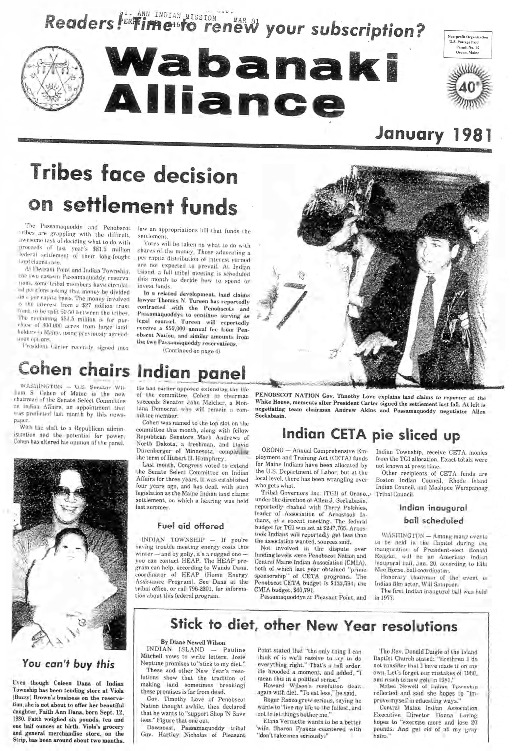
PENOBSCOT NATION Gov. Timothy Love explains land claims to reporter at the
White House, moments after President Ca
signed the settlement last fall. At left is
negotiating team chairman Andrew Ak
and Passamaquoddy negotiator Allen
Sockabasin.
Indian CETA pie sliced up
ORONO — Annual Com prehensive Em
ployment and Training Act (CETA) funds
for Maine Indians have been allocated by
the U.S. Department of Labor, but at the
local level, there has been wrangling over
who ge ts what.
Tribal Governors Inc. (TGI) of Orono,
under the direction of Allen J. Sockabasin,
reportedly clashed with Terry Polchies,
leader of Association of Aroostook In
dians, at a recent meeting. The federal
budget for TGI was set at $247,765. A roos
took Indians will reportedly get less than
the association wanted, sources said.
N ot involved in the dispute over
funding levels w ere Penobscot Nation and
Central Maine Indian Association (CMIA),
both of which last year obtained “prime
sponsorship” of CETA programs. The
Penobscot CETA budget is $133,594; the
CMIA budget, $60,791.
Passamaquoddys at Pleasant Point, and
Indian Township, receive CETA monies
from the TGI allocation. Exact totals were
not known at press time.
Other recipients of CETA funds are
Boston Indian Council, Rhode Island
Indian Council, and Mashpee Wampanoag
Tribal Council.
Indian inaugural
bail scheduled
WASHINGTON — Am ong many events
to be held in the Capitol during the
inauguration of President-elect Ronald
Reagan, will be an American Indian
inaugural ball, Jan. 20, according to Ella
Mae Horse, ball coordinator.
Honorary chairman of the event is
Indian film actor. Will Sampson.
The first Indian inaugural ball was held
in 1977.
Stick to diet, other New Year resolutions
You can't buy this
Even though Coleen Dana of Indian
Township has been tending store at Viola
[Buzzy] Brown's business on the reserva
tion, she is not about to offer her beautiful
daughter, Faith Ann Dana, born Sept. 12,
1980. Faith weighed six pounds, ten and
one half ounces at birth. Viola’ grocery
s
and general merchandise store, on the
Strip, has been around about two months.
By Diane Newell Wilson
IN D IA N IS L A N D —
Pau line
Mitchell vows to write letters. Josie
Neptune prom ises to “stick to my diet.”
These and other New Year’ reso
s
lutions show that the tradition of
making (and som etim es breaking)
these prom ises is far from dead.
Gov. Timothy Love o f Penobscot
Nation thought awhile, then declared
that he wants to "support Shop ’ Save
N
less.” Figure that one out.
Downeast, Passamaquoddy tribal
Gov. Hartley Nicholas o f Pleasant
Point stated, that “the only thing I can
think of is w e’ resolve to try to do
ll
everything right.” That’ a tall order.
s
He brooded a moment, and added, “I
mean this in a political sense."
Howard W ilson’ resolution dealt
s
again with diet. “T o eat less,” he said.
R oger Ranco grew serious, saying he
wants to “live my life to the fullest, and
not to let things bother me.”
Elana Vermette wants to be a better
wife. Sharon Francis countered with
"don’ take men seriously."
t
The Rev. Donald Daigle of the Island
Baptist Church stated: “Brethren I do
not consider that I have made it on my
own. L et’ forget our mistakes of 1980,
s
and reach to new gold in 1981."
M a b el N ew e ll o f Indian T ow n sh ip
reflected and said she hopes to “im
prove m yself in educating ways."
Central Maine Indian Association
Executive Director Donna Loring
hopes to "exercise m ore and lose 20
pounds. And ge t rid of all my gray
hairs."
Wabanaki Alliance January 1981
editorials
The Precedent
)ns to the contrary, we see the Maine Indian land claims
> setting a terrific precedent that forebodes a gathering
ial assertiveness in New England, and beyond.
lobscot-Passamaquoddy claims were pending, lawyers,
tors and like-minded spokesmen assured the State of
-ther worried parties that settling with the tribes would
:edent.
: Indian claims, they said,* were unique. This implied the
resolution ot the claims here could not be used elseno tear. The Maine claims are only Maine’ problem.
s
ntime, Indian claims are surfacing in many places, from
Indians in New York, to Schaghticoke Indians in
1 here are rumblings from Indians elsewhere on the
ard.
lese tribes have in common? Simple: they all base their
ie 1790 Trade and Nonintercourse Act, which said
st approve Indian treaties. Many tribes dealt with state
without that federal approval — Maine for instance —
ing old treaties long taken for granted,
ians may have unintentionally done a great service to
Who will be next? The Abenakis of V erm on t? The late
angley feared a precedent. Tribal spokesmen scoffed at
course, discounting the precedent concept may have
t strategy.
>e, we will watch with interest the progress o f our
erting their claims. If they need a reference, or advice
le Penobscot-Passamaquoddy negotiating team. Or ask
2en.
N ew s in
tuJ a ^ h e
.
,
”a T
T
ujem oers appeared in the Bangor Daily
8 0f the Navr lu« ' USS
(all Navy
n gh t’Barbara ttajgle, John Lonng, Barry Nelson, Rhonda Mitchell.
Constitution
A brief notice is due the Passamaquoddy Tribe at Pleasant Point
which has taken upon itself the task of drafting and ratifying a
constitution. Already a draft proposal has been circulated, and at
first glance it looks good.
iu e constitution sets forth the responsibilities,
procedures o f the tribe in a forthright manner.
laws
and
,, Per,^P S one of the more important elements of the new draft is
is: All members of the Passamaquoddy Tribe shall have equal
political rights and opportunities to participate in the economic
resources and tribal assets, and no member shall be denied freedom
o conscience, speech, religion, association or assembly, nor shall be
denied the right to petition the tribal council for the redress of
grievances against the tribe.”
46th Parallel
me somebody took Loomis Sappier to task. Not that he
it deal of space here.
:res of space in the Bangor Daily News in the past
s. Usually it’ a big headline about “Maliseet Nation
s
ing above 46th parallel,” or something like that,
a word, hogwash. And the Bangor Daily News has
en tor it. This guy Loomis is not, and never was, to
, leader of the Maliseets.
; article, he calls himself chairman o f Maliseet Land
ittee. That's the story in which he said he asked the
sy in Ottawa for money to pay legal fees. Iran? Take a
iself visited our office in Orono once. A likeable
-vith a ready smile, he claims 15 million acres of Maine
leople. Never mind that he is from Canada. Well, he
s that Maine Indian claims are settled, in a deal that
ither, or further claims, as we understand it. Maliseets
000 acres out o f the total 300,000 acres. Not a lot, but
•e than Loomis Sappier is likely to get.
Daily News has been fooled by Sappier. As for Sappier
ts the Ayatollah can advise him on how to fool the rest
Quotable
Every year our white intruders become more greedy, exacting,
oppressive, and overbearing , . . Wants and oppressions are our
lo t... Are we not being stripped day by day o f the little that remains
of our ancient liberty? . . . Unless every tribe unanimously combines
to give a check to the ambition and avarice of the whites, they will
soon conquer us apart and disunited, and we will be driven away
fiom our native country and scattered as autumnal leaves before the
wind.
— Tecumseh, Shawnee Chief 1812
Wabanaki Alliance January 1981
pj w
letters
Among the old on es
Middleburg, Fla.
To the editor:
Thank you for sending me a copy of the
paper, March issue. I found it very good
and worth while information. All Indian
peoples need to stand together, to win the
battles we face. 1 have lived in Maine and I
am Indian. My home is in Oklahoma, my
people are Chickasaw/Choctaw. I am
among the old ones, many winters has
taught many things.
Great Spirit bless all and keep up good
work.
R osie M. Brown
The goings-on
North Weymouth, Mass.
Tribe takes $1 bid for snack bar
PLEASANT POINT - The Passamaquoddy Snack Bar, located in the gymnasium of the community building, was
leased recently to the tribal Recreation
Department, for one dollar.
Linwood (Red) Sapiel made the bid for
the department... Mc0rdj„ ir_.t0J i i iB| .Dima
1
ol R'easant Point, a businessman.
bar concession, and Peter Bailey, $4,800.
Both bids w ere rejected in favor of the one
dollar offer, Dana said.
Dana himself has clashed with tribal
government over trucking jobs. Dana
Trucking Company is scheduled to work
o n l ounda.ti ons f° r 35 new houses at Indian
T o wn
Construction Company, Augusta.
In the meantime, Dana Trucking is in
volved in reconstruction work on the
Eastport breakwater.
To the editor:
I received the Wabanaki today and
think it is g r e a t ... a nice way to keep up
on what’ goin g on at home, on the island.
s
Keep up the good work.
Paul F. Hamilton
P lease continue
To the editor:
Sacramento, Calif
. Enclosed is a chock for five dollars
Please continue to send the Wabanaki tc
me. f enjoy the paper very much.
Mary R. Verdugo
l obiqu e requ est
1o the editor:
Tobiquc Indian Reserve
Our school would like to subscribe to
your Wabanaki Alliance magazine for a
two year period.
Would you please send the bill to the
above address as we do not know if there
has been a change in subscription rates.
Thank you very much and keep up the
good work. W e enjoy your paper.
Gertrude Nicholas
Resource Center
Mahsos School
Nations
Seattle, Wash.
To the editor:
Thanks for the information about your
newspaper. We are very interested in
is happening among the tribes in
affects other tribes in the United States
and Canada. I am also personally inter
ested, since the Penobscots are m y grand
father’ people.
s
In our midst
I would like to establish an exchange
with your publication and I have already
entered a complimentary subscription for
Indian Township
PLEASANT POINT — A referendum
Wabanaki Alliance. I would appreciate To the editor:
the postponem ent was announced in order
vote scheduled Jan. 5 at the reservation,
to provide voters with more information
receiving your publication. More than
The King has been in our midst for some
to see if the community wishes to apply to
about the project.
this, I would appreciate your input on two thousand years now. My prayer for
the Federal E nergy R egulatory Com m is
newsworthy events in your area. In order you is that He will be your personal Lord.
The project would be located at the site
sion for a license to build Half-Moon Cove
to establish an effective news network.
of the old Eastport-Perry toll bridge and
I pray that His word within you may
tidal project, has been postponed to Jan
would consist of a dam about 1,000 feet
Nations needs the cooperation of editors bear fruit daily in victory for you and your
19.
long and 75 feet high with pow er provided
and writers throughout Indian Country. family.
According to Dr. Normand LaBerge,
We will have bureau offices in key
by tidal w aters from Half-Moon Cove
In Jesus and Mary,
director of the Half-Moon C ove project.
em ptying through a tidal gate
locations around the U.S. and Canada, but
Fr. Joe Laughlin
we need local input to provide accurate
and thorough coverage of local events. I
Wabanaki Alliance
Vol. 5, No. 1
hope that you will be able to work with’us.
January 1981
M aking contact
In exchange, we will work with you as an
Published monthly by the Division of Indian Services |DIS] at the Indian
information source with excellent national
Resource Center, 95 Main St., Orono, Maine 04473. Telephone [207| 866-4903
and international contacts.
Keene, N.H.
3 the editor:
Typeset by Old Town/Oruno Times. Printed by Ellsworth American.
I will look forward to hearing from you
I am very interested in learning more
soon, and to working with you in the
about all our American Indian tribes, both
M ember — Maine P ress Association
future.
those federally recognized and those not. I
Duane F. Warren
have written to all 82 BIA agencies, am in
Steven Cartwright, Editor
Editor
process o f writing to the various tribal
councils, am sending for sample Nalive
C h eyen n e/A rapaho
American newspapers, and also trying to
develop correspondence with Native
Reporters
T o the editor:
peoples on and off reservations.
Diane Newell Wilson
I am the Executive Director of the Las
Phone 827-6219
I would appreciate receiving a sample of
Brenda Polchies
Casas/Drums, an organization named your paper, and if you would, I would
Phone 532-7317
Roberta Richter
after Bartolome Las Casas, a fifteenth appreciate your publishing this letter.
Phone 853-4654
Kathy Tomah
century Dominican who worked for the
Phone 796-2301
For the record, so your readers will
cause of the Native Americans. Currently
know a bit about me, I am a white woman,
DIS Board of Directors
our resource persons are working with
43 years o f age, divorced, m other of four
Jean Chavarcc fchairman |
India* ls|and
the Cheyenne and Arapaho people in daughters ages 16,17,19 and 21. I work to
Donna Lonng, Central Maine Indian Assoc.
Old Town
Northwest Oklahoma. Ours is a human su p p or t m y s e lf and tw o y o u n g e s t
Timothy Love, Governor
Indian Is|and
developm ent program where w e try to daughters.
Jeannette Neptune, Community Developm ent Director
Indian Township
work for enablement rather than de
My interest in Native Americans is
Jeanette LaPlante, Central Maine Indian Assoc.
Old Town
pendence, em powerm ent rather than sincere and I will gladly correspond with
Brenda Polchies, Assn, of Aroostook Indians
Houlton
manipulation, native cultural developm ent anyone who has same.
rather than exploitation. (Choose life)
The main questions I ask are. What is it
DIS is an agency of Diocesan Human Relations Services, Inc. of Maine. Sub
As we plan for future placem ents of new like to be a Native American today? And
scription to this newspaper are available by writing to Wabanaki Alliance, 95
resource persons based on their interests what do Native Americans hope for the
Main St.. Orono, Me. 04473. Diocesan Human Relations Services and DIS are a
and the needs of the Native Americans, I future?
non-profit corporation. Contributions are deductible for income tax purposes.
though I would contact you to see if you
Carolyn L. Cote .
Rates: $5 per year [12 issues]; $6 Canada and overseas; $10 for institutions
have any needs which might be considered
Maple Court Apts.
Ischools, government, business, etc.]
by us for future placements.
Bldg. 1, Apt. 1
Annette R. Roach, O.P.
Keene, N.H. 03431
Dana complained that tribal govern
ment is against private enterprise. He
said John Bailey bid $5,000 for the snack
Tidal pow er referendum slated
Page 4
Wahanaki Alliance January 1981
Decision
Virginia Tomah
Welfare director
likes job
PLEASANT POINT — Virginia Tomah,
30, laughingly called herself “liLtle brown
Vergie,” comparing herself to a non-Indian
woman who worked for Department of
Indian Affairs.
“I love my job and I do it well," Tomah
said, expressing her gratitude to then
Gov. Robert Newell. She is in charge of
welfare for the tribe, and assists members
with AFDC. social security, food stamps,
veterans benefits, Indian Health Service
and other referrals.
Tomah is also chairman o f the Pleasant
Point school board, and recently visited
South Dakota in that capacity.
She believes that the tribe's best
chances at self determination will be
through jobs.
On the job about one year, Tomah
formerly edited a tribal newsletter, and is
a former alcoholism counselor. She has
attended University of Maine at PortlandGorham, University of Maine at Orono,
and Tufts University. She is married and
the mother of three.
(Continued from page 1
)
Penobscots m et recently at Indian
Island with representatives of the invest
ment firm, Merrill, Lynch, which has an
office in Portland. While making no
commitments, the tribe showed interest in
options offered by Joseph Kenney, Merrill
Lynch senior manager in New York City.
Kenney told the tribe, “it's your money
and not ours and we just, want to do what
is mutually agreeable and obtainable . . .
i he sole thing we're getting paid for is our
advice," he said.
The Merrill Lynch fee, three eighths of
one per cent, would equal $46,875 based
on investments for the Penobscots of $12.5
million annually, Kenney explained. One
million dollars is earmarked to aid elderly
of the tribe.
Additionally, the Penobscot tribe will
get $96,000 from a state of Maine account
that belongs to Indians of Maine. The
.Passamaquoddy share is about $200,000,
and will also be returned.
Northeast Bank President G eorge Cattermann told the Penobscots “the primary
concern is to make sure nothing happens
to this money." He advised investing
funds in a variety of places to assure
security.
At the Penobscot meeting, 28 tribal
mem bers voted on how to invest the
Penobscot share of the trust fund. They
voted in favor of U.S. Treasury bills,
considered a very low risk investment.
Another motion was passed to reinvest
income from the trust fund, also in
treasury bills, in increments up to $2
Tribal leader
in Quoddy Tides
EASTPORT — A recent issue of the
bi-weekly Quoddy Tides featured a front,
page interview with Pleasant Point Gov. J.
Hartley Nicholas, commenting on the land
claims.
“There are some who see dollar signs
dancing in front of their eyes," Nicholas told
reporter Marie Jones. “Unless it is used
wisely (the income from a trust fund) we
will not be better off in a few years than we
are now," the governor said.
"Before any money is distributed to any
body, the tribe must pay its bills. I would
like to wipe the bills out before we give
money away," Nicholas said.
Also in The Quoddy Tides was a feature
article on Edward Bassett Jr. of Pleasant
Point, written by Susan Esposito. Bassett, is
builder of a birch bark canoe.
TOBIQUE RESERVE, Canada— Loomis
J. Sappier, self-proclaimed leader of the
Maliseet Nation and chairman of Maliseet land claims to 15 million acres in
northern Maine, has asked the Iranian
em bassy in Ottawa for financial aid.
Sappier wants help paying legal costs,
according to a story in the Bangor Daily
News. “W e’ not ju st maneuvering, we
re
really need money,” he told a reporter.
Tribal officials attend
Boston task force meeting
BOSTON — A number of tribal officials
from Maine attended a recent meeting
here of Federal Regional Council/Indian
Task Force.
The Department of Housing and Urban
Development, and other items relating to
Indians, w ere on the agenda. Barbara
Namias, a Mohawk, is task force coor
dinator.
R oger Ritter and Brian R. Bowden
represented Indian Township Passama
quoddy reservation; Gov. Timothy Love
attended for Penobscot Nation, accom
panied by Penobscot housing director
Rick Mitchell.
Also present was James McGrath,
representing the Schaghticoke Indians of
Connecticut. McGrath, a former journalist,
worked briefly for the Passam aquoddys at
Pleasant Point. Pequots and Narraganse e is also w ere represented.
Carla Francis, a Penobscot, attended for
Boston Indian Council, where she is
employed.
Shinnecock quiet
on land claim s
Penobscots to
mull investments
INDIAN ISLAND — Members of the
Penobscot Nation have been invited to
attend a general meeting, Saturday, Jan.
1 at 1 p.m., at the Community Building.
7,
The purpose of the meeting is to consider
options relative to the tribe's share of
income from the recent $81.5 million land
claims settlement. Half of a $27 million
trust fund administered by the federal
government belongs to Penobscots.
M aliseef asks Iran for funds
DONALD PERKINS, lawyer for major
landowners who have agreed to sell
acreage to the Penobscot and Passama
quoddy tribes under terms of land claims
settlement.
million. Penobscots will set up a trust fund
investment committee, with seven regular
mem bers and three alternates.
Joseph (Jo-Jo) Francis, tribal councilor,
observed humorously, “we talk here like
we read the Wall Street Journal, this talk
about C-D’ ’(certificate of deposits) and
s
T-bills (treasury bills).. . . next thing you
know we’ be Dunn <6 Bradstreet."
ll
A Mohegon claim
NEW YORK CITY - Mohcgan Indians
of Connecticut will continue their efforts
to recover 2,500 acres of land north of.
New London, after the state failed in a
preliminary m ove to have the Indians’
claims dismissed in court.
Using the 1790 Trade and Noninter
course Act — the same act as was basis for
Maine Indian claims — the Mohegans
appear to be making progress. Connecti
cut argued the act applied to Indians of
the w est only, but the court rejected that
interpretation.
HAMPTON BAYS, N.Y. — The Shinne
cock Hills w ere once part of the rolling
Indian reservation here — som e 3,600
acres — but since 1859 the tribe has lived
on a 400 acre parcel. The New York Tim es
reports.
T h ere are rumors of land claims based
on the 1790 Trade and Nonintercourse
Act, which protected tribes by requiring
Congressional approval o f transactions.
Often such approval was not undertaken
in dealings with Eastern Indians.
Twenty-year-old R ebecca Hill, Shinne
cock Native American Coalition director,
said "no comment.” So did Native Ameri
can Rights Fund (NARF) lawyer Law
rence Aschenbrenner, who has researched
the situation for the Shinnecocks.
About 200 tribal m em bers survive
today.
PENOBSCOT NATION
Department of Employment Train
ing & Youth P rojects is taking applica
tions for public service employment
under Comprehensive Employment
and Training Act Titles II-D and VI.
At present one PSE position is des
ignated within the Department for a
Management Information Specialist.
The individual selected for this position
should possess strong oral and written
communication skills, be willing to
learn CETA regulations and guidelines
concerning client eligibility and track
ing requirements, and be able to apply
these guidelines to individual client sit
uations. The MIS will be responsible
for participant records and reports.
PE 4 salary range is $170 to $240 per
week.
If interested, please contact —
L EE CAMERON
Telephone 827-6146
Applicants should m eet CETA eli
gibility requirements.
An Iranian official at the em bassy re
portedly declined comment on a letter
Sappier sent.
Sappier and his group maintain they
have New Brunswick tribal support
toward a claim to 15 million acres in
northern Maine and are acting on behalf of
all Maliseets in Canada and the United
States. The Maine territory the Maliseets
want takes in all land in the state north of
the 46th parallel, “which in the past has
been our hunting and fishing domain,"
according to Sappier.
Sappier w rote the Iranian embassy,
“back at the time your country was
striving and struggling in your endeavor
to develop natural resources, Canada and
the United States spent millions in your
hour of need to help you obtain your selfdetermination. The natural resources of
the North American continent are the
bona fide properties of the Indian nations.
It has now becom e absolutely necessary
for us to focus our full attention (for
financial aid) on the Third World coun
tries.”
Constitution drafted
at Pleasant Point
PLEASANT POINT — With the assist
ance of tribal planner Charles A. Lewis, a
constitution has been drafted for the
Passamaquoddy Tribe, with copies avail
able to interested persons.
The draft contains full definitions of
tribal status and membership, territory,
bill of rights, rights of members, govern
ment, legislative body, tribal council and
executive powers, the judicial branch, and
oaths of office.
Jurisdiction of the tribe, for example,
e x te n d s to lan ds a s m a y "h e re a fte r be
e sta b lish e d a s a r e se r v a tio n (settlem ent)
pursuant to authorization o f the Maine
Indian Land Claims Settlem ent Act.”
Such lands will be administered by a
commission set up pursuant to that Act.
Tribal membership is defined as “any
person who name appears on the official
census roll of the Passamaquoddy Tribe as
of 1980, provided that corrections may be
made in the said census roll by the tribal
council within five years of the adoption of
this constitution."
CAN’ FIND A JOB?
T
Try th e
JOB CORPS
Would you like to be trained as a ...
Bookkeeper
Secretary/Stenographer
Clerk Typist
Nursing Assistant
If you are 16 to 21 and not in school,
the Penobscot Job Corps Center has
training program s which may be of
interest to you.
The Penobscot Job Corps Center
provides all trainees with a place to
live, meals, health care and a cash
monthly stipend while you learn. And
when you finish, w e’ also help you
ll
find a job.
SOUND GOOD?
IT IS GOOD.
ASK FOR JOB CORPS
— in the Portland area— 775-7225
— in the Auburn area— 786-4190
— in the Bangor area— 947-0755
— or toll free anywhere in Maine
at 1-800-432-7307
ASK FOR
JOB CORPS RECRUITMENT
W&h&n&ki Alliance January 1981
Page 5
Stone age Indian
site studied
Under sail, Hurricane Islanders surge ahead in their two-masted, open vessel.
Facing the sea (and yourself)
By Brenda Polchics
HURRICANE ISLAND - These are a
few of my own thoughts describing a long
weekend trip I took recently. I was with a
group of 10 from Houlton who journeyed
181 miles to Rockland by bus plus the 12
m i ICS~'~by~'"bo'0.'trL
-[rom~'th e— m ainland— toHurricane Island. This gal learned a few
things while on this three day expedition to
Outward Bound on Hurricane Island. This
gal learned she had inner resources and
inner strengths in mind and body she never
knew before that she had. This gal seemed
to be in a state of uneventful limbo before
coming face to face with the forever moving
and powerful sea.
As I was rappelling down a 200 foot sheer
granite cliff, or vigorously sailing along
with my comrades in a 20 foot pulling boat
in stormy Penobscot Bay, the sails billowing
furiously in the wind; at one point, the port
side of the boat was being swamped by
huge waves so that the sails w ere practical
ly parallel to the foamy sea and those of us
who were on the port side of the boat w ere
staring wide-eyed straight down to star
board at our comrades, who in turn w ere
staring wide-eyed back at us, all the while
my stomach was heaving; the big questions
I repeatedly asked m yself was, “What in
hell was I doing here? What am I goin g to
learn from all this?” After throwing up into expedition. On the chance the opportunity
the sea just before getting to shore, I felt will arise again, I have every intention of
alright for the rest of the strenuous ordeal. heading back down to Hurricane Island.
I say strenuous ordeal more to apply to the
EDITO R ’ NOTE: Brenda Polchies, a
S
real feelings of fear, indecision, a sense of
Maliseet who is a reporter for this news
stupidity, and the “I Can’ syndrome.
t"
— ~ I- d o n ^ t t o w e n . k n o . w a J io m > 4 A . B , w in u a n a ^ e t » i. paper. has written numerous articles. She is
have “bravely,” “dangerously,” “foolishly,” employed by Association ot AroostcTolT
jumped into the ocean water via feet first Indians (AAI), Houlton.
Hurricane Island Outward Bound School
with assistance o f a lifejacket, encourage
ment, and enlightenment from my Watch is a nonprofit organization based in Rock
instructors, who are thoroughly trained, land and on the island itself, which is near
competent, and experts in their field of rock Vinalhaven in Penobscot Bay. It is a yearclimbing, sailing, navigating, rappelling, round operation, and various courses are
ropes course, food and nutrition, and they offered, along with financial aid, a spokes
presented sensitive and thought provoking woman said. The school can be reached by
philosophy. It is here, surrounded by cold, writing Box 429, Rockland, Maine 04841, or
salty seaw ater I experienced my first dip calling 207-594-5548.
into the ocean depths.
The experiences I shared with my com
rades, to me w ere not ordinary, everyday
experiences. For this reason, in my mind, I
will relive this brief, unique, first experi
ence over and over again. In the span of
three short days, friends w ere made, and
when it came Lime to bid farewell, I felt sad
because I knew I would never see their
faces again.
I have recovered fully from sore muscles,
bumps, and bruises, and I feel that I am
ready for a m ore heady and heavy
TV program revived
ORONO — A public television series
called Maine Indian Journal will be
started again next month.
The show w ent off the air in 1978, after
running for about one year under the
direction of Kim Mitchell, a Penobscot.
Mitchell will again direct, produce and
probably host the Maine Public Broad
casting N etwork program.
The first of a bi-monthly series is
scheduled Feb. 16 (Washington’ Birth
s
day), at 7:30 p.m., on stations of the Maine
public TV network.
M icm ac rem ov ed
from federal team
Putting to sea, a crew at Outward Bound school braves wind and wave.
WASHINGTON — Alexander (Sandy)
McNabb, a Micmac, has been replaced by
a non-Indian on a Bureau of Indian Affairs
(BIA) transition team.
Jim Hawkins, director of the Office of
Indian Education Program s under Com
missioner Louis Bruce in the early 1970’
s,
has replaced the previously announced
team of McNabb and Dallas Merrell on the
Reagan transition team for the Bureau of
Indian Affairs.
Hawkins, a non-Indian, had been a BIA
area director in Minneapolis and a teacher
and school official in Alaska. He has held
high positions in the Departm ent of
Commerce, the Peace Corps and Interior.
He has been in private business the past
few years.
AZISCOHOS LAKE - Som e 1,500 arti
facts have turned up over the past decade
at an archaeological site here, near the
Maine-New Hampshire border. The spear
heads and tool fragments may belong to
Indians that used the area 11,000 years ago.
Dr. Michael Gramly, a Harvard-trained
expert working for the Maine State
Museum, called the site “important because
of the total picture. It’ the highest altitude
s
Paleo-Indian site known in the eastern U.S.
It’ within a short distance of a lithic source
s
area where the people then got stone for
tools. There is a continuing pattern of
occupancy on this site, and there is a killing
ground in association with the habitation
site," he said.
Gramly led a group of college students
last summer in work at the Francis Vail
site, named after an East Stoneham
amateur who discovered it. National Geo
graphic Society contributed money to the
dig.
Two weeks before the students and
Gramly packed up, charcoal remains of a
hearth w ere uncovered. Samples of the
charcoal have been sent to the Smithsonian
Institution in Washington, D.C., for radio
carbon dating.
“These people w ere craftsmen of the first
rank. They only used finer grain, quality
materials," Gramly said.
Long Walk
arrives in D.G.
W ASHINGTON — A group of Indians
and others left Alcatraz Island, California,
June 1, and arrived in this city in time for
What made the 4,000 journey remark
able is that participants reportedly walk
ed the entire distance, a feat that had been
accomplished in a m ore widely publicized
march for Indian rights in 1978.
The walkers crossed a proposed MX
missile site on Shoshone land, and in New
Mexico, m et Hopi and Navajo people
protesting mining of Black Mesa by
Peabody Coal Co. The group held a vigil
for jailed Leonard Peltier in Illinois.
Peltier is a symbolic' leader of Indian
resistance to non-Indian courts and auth
ority.
Another stop on the journey was at
Three Mile Island in Pennsylvania, site of
a major nuclear accident in 1979.
In Washington, D.C., walkers prayed
and rallied at the White House, Washing
ton monument, Lincoln memorial and
other locations.
W omen, h eritage topics
TAHLEQUAH, Oklahoma - A sym
posium on the American Indian, and a
conference on Indian-Alaska native wo
men, are scheduled this April at North
eastern State University here.
The Indian symposium, with a theme of
“wind songs,” is slated April 2-3. The
women’ conference is set April 3-5.
s
Try on ad,..
INTRODUCTORY RATES
$5 for first column inch, $3 each
additional inch. Discounts available for
repeating ads.
Quarter page: $40
Half page: $80
Full page: $150
Classified ads: $1.50 up to 15 words:
10c each additional word.
G ET RESULTS!
Page 6
Wabanaki Alliance January 1981
Brings Indians, whites together
Youth corps has
INDIAN ISLAND and INDIAN TOW N
SHIP
This April the Young Adult
Conservation Corps (YACC) will cele
brate its third anniversary at the Penob
scot and Passamaquoddy reservations.
According to those in charge, the
program is a considerable success. There
have been problems, achievements, fail
ures, cutbacks and expansions. There are
critics o f a program that mixes Indian and
non-Indian young men and women . .. outof-work, out-of-school young men and
w’
omen who need help.
The director at Indian Island's Bur-nurwurb-skek (original word for Penobscot)
camp has taken flak for his decisions, but
has also reaped the reward of strong
leadership.
For openers, director Richard Ham
ilton, a Penobscot, has been selected
nationally to head a YACC emergency
assistance group. His camp will be “on
call, should special needs arise. Hamilton
recently underwent a week of special
training for the job, at Boise, Idaho.
Further, Hamilton is in process of
establishing a rem ote “satellite” camp for
30 enrollees, for Seminole Indians in the
Fort Lauderdale, Florida area. If all goes
through as planned, the Seminole camp
will increase his budget of $550,000 by an
additional $300,000.
Hamilton, hired by the Penobscot tribal
council Feb. 25,1978, to initiate the YACC
program, asserts proudly, “w e’ve com e a
long way.”
IT S A BIRD, IT'S A PLANE ... no, it's the LARC
an amphibious transporter owned
by Indian Island YACC.
You get a good cross section,
they learn from each other'
- Richard Hamilton
\ACC worker and Joseph Sapiel, staff.
According to Hamilton, “what makes
these programs work so well — and they
do work well — is they are non-targeted.
This way you get a mix. You ge t a good
cross section of the population, and they
learn from each other.”
A ges 16-23, YACC participants include
high school dropouts and college grad
uates, rich and poor, from nearby and
faraway. When the program started,
along with the summer Youth Conserva
tion Corps (YCC), there w ere 250 en
rollees.
Now, with government cutbacks,, there
are ju st 40 enrollees, a percentage of them
m em bers of the Penobscot tribe.
Various conservation projects; trails,
roads, footbridges, maps, timber stand
improvement, surveys, educational dis
plays and lectures; all of these tell a
success story for YACC.
Unfortunately, the slashing of tires on
YACC trucks, not necessarily by YACC
workers, tarnishes a good reputation.
Once, YACC workers held a rowdy party
in the woods, with reports of smoking
dope, when they should have been on the
job.
Hamilton is strict about such incidents.
Drugs and alcohol are absolutely pro
hibited, although cigarette sm oking is
permitted in safe areas. “If we see them
with a joint, it’ automatic termination. If
s
we see them with a beer, it's termination
on the spot,” Hamilton said.
W orkers interviewed on th e jo b claim it
is easy to sm uggle beer or marijuana onto
job sites, some of which are very isolated.
W hether ihese workers w ere bragging or
not was unclear.
There are usually four crew s of seven
YACC workers each, at Indian Island,
including one crew leader, and one assist
ant leader. Separate crew s maintain the
amphibious LARC vehicle, acquired as
government surplus, and handle other
maintenance and assorted chores.
Th e L A R C ’ d iese l e n gin e w as
s
thoroughly overhauled by young men of
Indian Island, and the monstrous “boat on
wheels” is used to ferry w orkers to places
like Orson Island, where crew s have
cleared old roads and property lines.
Orson was once inhabited by Penobscots,
and contained the tribal poor farm.
On Orson, during a recent visit to a
worksite, forester Betsy Bolt of Kennebunkport, age 22, served as safety officer.
A graduate of University o f Maine at
Orono, she said she enjoyed the woods
work, and was grateful to have a job for
one year
the maximum any person may
be enrolled in YACC.
Ray Smith, like Betsy a non-Indian, is a
graduate of Bangor High. Twenty years
old, he said YACC was his “second choice"
of a job, because he would prefer
something closer to home. “I was really
desperate for work. I’ been out o f work
d
ten months and I was living at home with
my mother,” he said.
Smith went to the Bangor unem
ployment office, where he learned about
\ ACC at Indian Island.
He complained that “Indian preference”
is used in promotions, and "there seem s to
be a lot of favoritism here. A lot of
relatives are employed.” Hamilton said
the charges are untrue.
David Ingraham, 23, ia a “white hat,”
meaning a crew leader. He see s YACC as
“an experience," but notes “you’ only
re
making minimum wage.” Actually, crew
leaders receive $4.65 per hour; assistants,
$3.55 per hour. “It gives you a place to
work; a lot of people here haven’ finished
t
high school,” said Ingraham, a non-Indian.
David Sapiel, 22, an Indian crew leader
and son of Lt. Gov. Nicholas Sapiel,
finished his year-old hitch at YACC last
month. He may enter the Coast Guard, he
said. He has been a crew leader since
June, assisted by another Penobscot, Sue
Priest. He has no regrets about working in
YACC.
One of the m ore helping projects YACC
has undertaken was the cutting of 200
cords of firewood, which will be moved
from Orson Island by sled and snowm obile
when the Penobscot R iver freezes solid.
The wood will assist Indian Island
residents with winter fuel.
Hamilton said TSI (timber stand im
provement) on Orson, and other places,
creates firebreaks, opens lots for campers,
helps control pests, and “in ten years
increases the value (of the timber) by 50
per cent."
In other work, YACC crew s camped at
Mattawamkeag W ilderness Park, set up a
recreation area for day care on Indian
Island, built fencing at the community
building, and recently finished building a
road that runs the perim eter of Indian
Island, on a form er trail.
Wabanaki Alliance January 1981
3ITI0 a long way
No longer with YACC, Kipp Kilpatrick
undertook many educational projects with
crews, and supervised digging and seed
ing of drainage ditches around new
housing on the island.
A devoted, long time supporter of
YACC's educational program s is Mary
Sherwood of Greenfield, who with a vast
horticultural knowledge helped establish a
botanical garden. A book on the subject
was produced.
The YACC now occupies a $93,000
building partially constructed with crew
labor. Last February, Indian Island YACC
underwent a federal review by the.Office
of Youth Programs. “The findings were
excellent," Hamilton said.
A report stated “satisfaction with chain
of command, and that “financial account
ability of this project is impressive.”
Deserving credit, along with director
Hamilton, are Frank Jennings, in charge
of supply, and Joseph Sapiel, work coor
dinator.
Indian Township YACC
The sister to Indian Island’ YACC is at
s
Indian Township, a base camp for opera
tions that covers Pleasant Point reserva
tion, and the town of Vanceboro. Passamaquoddys hold m ost of the top positions:
Dennis Tomah is director, Harry Stevens,
work coordinator, Jake Lola, safety
officer. Elmer Lank is administrative
,officer.
The camp recently underwent the same
three day review as took place at Indian
Island. The review team o f Jim G regg and
Deborah Harstedt, from R egion I federal
offices in Boston; w ere im pressed with
operations, they said informally.
One imbalance was that only three or
four females worked in YACC. Also,
Pleasant'Point has only a small contingent
of the YACC program.
Stevens said YACC projects include
favors for tribal governm ent because
they pay the salaries.” H e is wrong, at
least, about the salaries, which are paid by
the federal government.
Stevens said YACC crew s are working
closely with the Passamaquoddy tribal
forestry department.
“W ere trying to stay m ostly on the re s
ervation, but eventually w e’ be going
ll
into the surrounding areas,” Stevens said,
adding later, "if the tribe lets us alone
we’ do a hell of a lot better.”
ll
Township YACC crew s have acted to
prevent erosion on the reservation cam p
ground road, have supplied cedar poles for
Pleasant Point day care; built a play
ground swing set for Princeton headstart
program; and crews have learned first aid
and firefighting techniques.
Enrollment has declined due to budget
cutbacks, and is currently at about 60,
down from 110..The current year’ budget
s
is $123,000, down from last year’ total of
s
$190,000. The starting budget, including
the \ou lh Conservation Corps program,
was $322,000. There are four YACC-paid
staff and six CETA workers, in addition to
enrollees.
^ At Pleasant Point’ YACC branch, Dot
s
Francis is crew leader, Shirley Bailey is
head coordinator, and Barbara Dana is an
aide.
W orking on the LARC engine, Indian Island.
Richard Hamilton, YACC director.
V i r r ...
Page 7
Page 8
Wabanaki Alliance January 1981
Teaching teachers
about Indians
By Robert M. Leavitt
Imagine that you are a teacher. You are
about to present a series of lessons on a
topic about which you have no first-hand
knowledge. The sources and materials
available to you contain only out-of-date
and over-simplified information. Even
though the subject is of great importance
to the geography and history of your state
and to its culture and economy, the
materials say nothing of recent or current
events. They offer no insights into the
lives of the people you will be discussing.
Sound p r e p o ste r o u s? H u n d red s of
Maine teachers teach such a unit every
year — the subject: Maine Indians. But
most of the time these teachers are not illprepared through any failure on their
part. They simply have had no way to
become better-informed.
To help teachers learn about Maine’
s
Native peoples, the Maine Indian Prograpi
of the American Friends Service Com
mittee, under the direction of Mary
Griffith and a working com mittee of
native and non-native people, has held a
series of workshops. Learning and Teach
ing About Maine Indians. The m ost recent
workshop was held last fall.
About 25 classroom teachers from the
central Maine area met with representa
tives of Maliseet, Passamaquoddy a*nd
Penobscot peoples — both on — and offreservation. They had a chance to unlearn
the stereotypes so many Maine residents
grow up with, however close to reser
vations they may live, and to ge t a
personal point of view on native history
and contemporary culture. In addition,
they found out about materials, approved
by Native Americans, that are available
for teachers and students to use.
In many of the commonly available
books and audio-visual materials, teachers
find out, at best, that “northeast w ood
land" Indians used to live in Maine and
had the same culture as m ost Indians from
here to the Canadian Rockies. At worst,
they read of a warlike, poorly spoken
people who eventually saw the error of
their ways and disappeared into the
dominant society.
“I’ not an Indian, I’ a Maliseet.”
m
m
Darryl Nicholas, a conference speaker, did
not come to this statement of pride with
the help of those who “educated” him in
schools. Like many young Native Am eri
cans, he told his audience, he went
through a period of shame and confusion
about himself and his own people. As a
boy, he was taken away from home to a
residential school, where he did not learn
about being a Maliseet, but about being
another kind of person — a person whose
values and accomplishments w ere not
found among the people at home.
Deanna Francis, Eunice Baumann-Nelson, Wayne Newell, Julia Sockbeson,
Ralph Dana, Donna Loring, Peter Paul —
along with Darryl Nicholas, these confer
ence speakers told teachers about the
positive and optimistic contributions
Maine’ native people have made in the
s
past and continue to make to their state.
America was not a virgin land discovered
by Europeans. Native culture is not
quaint. It is m ore than artifacts, costumes,
stories or songs. The Passamaquoddy,
Maliseet and Penobscot cultures are ways
of life in the 1980’ “Language lives be
s.
cause it holds the soul of a person.” Yet,
says Wayne Newell, som e teachers, even
at the reservation school, think it is “cute”
that children learn their native language
in class.
At the conference in Bangor, Deanna
Francis and Eunice Baumann-Nelson
shared records of personal achievement;
Wayne Newell, Julia Sockbeson and P eter
Paul offered perspectives on ancient and
contemporary history; Ralph Dana and
Donna Loring gave information on growth
and progress, on and off the reservation;
Christina Neptune, and Veronica Atwin
talked about basket-making and other
crafts. These w ere real people sharing
first-hand experiences.
What are the implications of the
speakers’ m essages for teachers who
teach — not Maine Indians — but about
Maine Indians? With their newly-gained
knowledge they can present a fairer and
m ore accurate view of contemporary
Native Americans in Maine. Their stu
dents will have a truer understanding of
how the people who have lived in Maine
the longest continue to shape its history.
Non-Indians who live in Maine will realize
that they have much to learn from Maine’
s
Native Americans, who have adopted and
adapted, but who maintain a unique way
o f living.
ED ITO R ’S NOTE: Robert M. Leavitt is
the former director of Wabnaki Bilingual
Education Program, at Indian Township.
A Harvard graduate, he has taught school
at Pleasant Point, and currently heads a
gifted and talented student program in
Dover-Foxcroft, where he lives with his
family.
New baby girls outnumber the boys
By Diane Newell Wilson
Several new tribal m em bers have made
them selves known, small though they
are.
At Pleasant Point, Mr. and Mrs. Brian
Altvater are the parents of a baby girl,
born Dec. 22, 1980, at Calais Regional
Hospital.
At Porterville, California, a girl was
born to Mr. and Mrs. Jeffrey Dennis, Dec.
14, 1980. Grandmother is Alice R. Fowler
of Indian Island.
Maxine Judson of Indian Island wishes
to announce a daughter born to Carol and
Tom Mason of Bridgeport, Connecticut.
Apparently there is a run on daughters.
A baby girl was born Jan. 8, to Carol
Dana and Stanley Neptune of Indian
Island. She weighed a healthy eight
pounds, three and one half ounces.
A daughter was born Oct. 22, 1980, to
Howard and Celina Wilson of Tampa,
Florida. Grandparents are Howard and
Celina Wilson
Diane Wilson of Indian Island. The baby’
s
name is also Celina.
Finally, there is a report of one boy. A
son, Joseph Martin Dana, w as born to Sue
Priest and Roy Dana Jr., Penobscots. He
was born Nov. 29, 1980, and weighed
seven pounds, eight ounces.
Maine museum plans 1981 Indian exhibit
the spelling of his name from Gramlich)
said the museum has “an enorm ous room
w e’ going to fill, all with the pre-history
re
of Maine ... continuing to the modern day
with the native American.” A variety of
aspects, from music to basketry, will be on
display.
Planning got a boost from National En
dowment for the Humanities, Gramly
said.
Gramly said the exhibit can offer “a
little bit of something for everyone." It
will cost $100,000 to $150,000 to mount the
displays, he said. Another part of the job
is soliciting item s for exhibit. “W e need
decorative items. W e don’ even have a
t
pair of moccasins in this museum,” Gramly
BANGOR — Twenty Bangor Commun said. Games, pastim es and clothing are
ity College students, including a Maliseet
needed.
woman, set off for sub-Arctic Ontario New
Year’ Eve, to spend a fortnight studying
s
Cree Indians.
Among the group was Vinita Brown,
whose mother is a Maliseet from Kingsclear. New Brunswick.
W ASHINGTON — President Carter
The study trip was led by Stephen and last month approved bankrolling Indian
Elizabeth Hyatt, and Ray Gemmel, all Health Service (IHS) for four m ore years.
faculty members. Stephen Hyatt took a
The funds okayed total $495.8 million, of
similar trip several years ago, to the which $99 million is authorized for the
isolated town of Moosonee, m ore than current fiscal year. In Maine, IHS funds
1,000 miles north of Bangor.
are allocated to the Penobscot National at
After driving two days, the study group
Indian Island, Passamaquoddy Tribe at
planned to board the Polar Bear Express, Pleasant Point and Indian Township, and
the unofficial, affectionate name for the Association of Aroostook Indians in Houltrain that travels the roadless, final 186 ton.
miles to the Cree village.
The Indian Health Care Im provement
After World War II, Hyatt reports, the Act, passed in 1976, provided funds
Cree people lost their traditional trapping through 1980.
skills, through white influence. For
awhile, Crees worked building a radar
com plex for Canadian government, but
that operation has been shut down
PROGRAM DIRECTO R
permanently.
For Division of Health Services
Students paid $200 each for the trip. At
within Penobscot Nation, Department
one point, Theodore N. Mitchell, assistant
of Health and Human Services. Health
dean of student affairs for Indian pro
Program D irector will be responsible
gram s and services at University of Maine
to Departmental Director and to the
at Orono. had planned to join the journey
Board o f Directors. R esponsibilities
north.
include the administration and super
vision of health programs, preparation
and maintenance of grants and con
tracts and program budget. Health
Director will recruit and em ploy staff,
prepare reports and program evalua
tions, serve as a departmental liaison
to Tribal Governor and other depart
PORTLAND— M embers of the Stevens
ments. Qualifications: training in public
Avenue Congregational Church continued
health planning and administration or
a tradition begun several years ago, and
related field, four years experience,
sent Christmas gifts to reservation
BA/BS recommended, Indian preleryoungsters.
ence. Salary $9,880 to $14,040 annually.
As in years past, the Chureh sent boxes
Contact:
of gifts by bus to Wabanaki Alliance in
PEN OBSCOT NATION
Orono, and the newspaper then sent the
Indian Island
gifts to appropriate points. For Christmas
Old Town, Maine 04468
1980, presents w ere delivered to children
207-827-7776
of Indian Township, through the courtesy
A U G U STA T h e M aine State
Museum is gearing for a major exhibit
this year on the state’ pre-history, in
s
cluding Indian culture — “from the time ol
man’ first entry into Maine to the modern
s
day,” according to Dr. Michael Gramly,
consultant to the museum.
Holder of a PhD in anthropology from
Harvard, Gramly (who recently changed
Students visit
remote Cree village
Carter okays 1H
S
Church donates gifts
for Indian youngsters
PASSAMAQUODDY LUMBER COMPANY - A non-Indian business in Princeton on
which the Passamaquoddy tribe has a purchase option. [Bill O’
Neal photo].
of Allen J. Sockabasin. Last year, gifts
went to Indian Island kids.
Wabanaki Alliance January 1981
Page 9
Tobique woman takes
discrimination case to UN
TOBIQUE RESERVE, Canada— Thirlytwo-year-old Sandra Lovelace is the
granddaughter of a M aliseet chief who
served 22 years. She is unquestionably
Maliseet, but since 1970 has been treated
white. Why?
Because she a Canadian Indian woman,
and under laws there, if you marry a nonIndian man, you lose your Indian status.
Even her fellow tribesmen treat her as
non-Indian.
For Lovelace, it meant leaving the
reserve. She is far from alone in this
predicament, but she is different in that
she is fighting all the way up to the United
Nations, where a committee recently
ruled in her favor.
That’ not enough, she told a Canadian
s
news magazine. She wants the Indian Act
changed to put an end to discrimination on
the basis of race and sex.
A setback occurred when the UN
Human Rights Committee in Geneva
(Switzerland) put off a decision on her
case until, probably, this March.
Lovelace married a non-Indian at Fort
Fairfield, Maine, and later m oved to
Anaheim, California. The marriage broke
up, and Lovelace moved home with a son.
However, the Tobique Reserve chief said
she could not live there.
She m oved into a tent until cold
weather. They she stayed in the jail
awhile, finally m oving in with a sister.
She explained to a reporter, “Even if
the U.N. decides in my favor, it’ still up to
s
the government. All along they’ been
ve
saying they don’ want to impose their will
t
on the Indian people. But that’ been their
s
excuse not to do anything. They told the
brotherhood to rewrite the act, but they
can't agree on anything. I don’ blame the
t
chiefs. I blame the government for every
thing. They made the act. Let them
change it.
“And even if they do change the act,
maybe it won't be retroactive. It won’t
affect me. Younger women, yes, but not
me," she said.
JOLLY TIM ES and delicious food w ere had by all at the Central Maine Indian
Association annual Christmas party, held last month at Bangor YWCA. Volunteer fundraising and generous friends helped foot the bill. (Photo by Richard Torierl
CMIA brings tidings of comfort, joy
BANGOR — More than 200 people —
100 of them between the ages of seven
w eeks and 17 — attended a gala Christmas
party, Dec. 13, held at Bangor YWCA.
The party for Indian youngsters was
reservation populations in statistics used sponsored by Central Maine Indian A sso
to establish need for various grants and ciation of Orono, relying on many in
contracts.
dividual donations of funds, time and
Francis said she has contacted about 20 energy. Bridget Woodward, CMIA secretribal m em bers who share her concern, tary-treasurer and principal organizer of
and she hopes to bring the matter up at a the event, said special thanks are due “the
regular tribal council m eeting at Pleasant many people who donated and made our
parly a success."
Point, Jan. 26.
^T h ere w ere gifts for each child, includ
‘ h ere’ a few that really need help.
T
s
They save up their bottles to g e t their ing hand beaded necklaces. There was
Indian dancing, with drumming provided
bread," Francis commented.
by Delores Mitchell. Carroll Stevens led
the dancing in full Indian dress.
A raffle for the party raised som e $200,
and prizes awarded included a rifle,
blender and $50 food certificate.. Ramona
Kent. “Many people have heard the words Stackhouse, CMIA board member, won a
‘Passamaquoddy’ and ‘
Penobscot,’ but
they don’ know the people and lives
t
behind the words. Nor are they aware
that Maine is the home of the Micmac and
Maliseet people as well.”
Besides portraying the human side of
Indian life, the film gives an under
standing of events that lead to the largest
MONTREAL — Indians here — and
Indian land claim in U.S. history. Laws,
elsewhere in Canada — feel left out of
treaties, and traditions from the earliest
efforts to draft a new Canadian constitu
years o f our country enabled the Penob
tion in Ottawa.
scot and Passamaquoddy tribes to lay
The Confedration of Indians of Quebec
claim to 12.5 million acres.
declared recently that it will bring its
TGI envisions distribution across the
grievances to British courts if necessary.
state. Anyone wishing information on the
Indians allege Canadian governm ent is
film should contact Kent: 207-866-5526.
leaving them out, both in planning, and in
terms o f legal rights and privileges.
The Quebec Indian group said it
planned to take the case to United Nations
General Assembly, an action endorsed by
a tribal member) and currently- enrolled in National Indian Brotherhood.
an undergraduate pre-professional educa
Caughnawaga Mohawk Chief Andrew
tional course that will take you into one of Deslisle and Huron Chief Max Gros-Louis
the following fields: medicine, osteopathy, have made contact with UN officials in
dentistry, veterinary medicine, optom
Switzerland, according to Indian News, a
etry, podiatry, or pharmacy. Also, please government publication in Canada.
include a copy o f your m ost current tran
script.
If selected, you will receive round-trip
air fare plus $20. per day to cover room
LIBRARY RESEARCHER
and board, plus a wealth of information
Library Researcher, full time six
from the workshop. (13 of 60 participants
months, to work for American Friends
are currently in a health professional
Service Committee on Bibliography
school with others scheduled to enter a
about Maine Indians. Applicant must
professional school at a later date.)
be fast and accurate reader, willing to
travel to libraries around State, famil
If interested in attending the AAIP
iar with culture of Maine Indians, able
workshop, please com plete this applica
to qualify for C E TA position.
tion and return to: Association of Am eri
can Indian Physicians, 6801 S. Western,
Send resum e to Central Maine
Suite 206, Oklahoma City, Oklahoma
Indian Assoc., 95 Main St., Orono, Me.
73139.
04473. Attn.: Donna Loring Executive
If you have further questions, you may
Director. Submit by January 30, 1981.
call collect, station call, (405) 631-0447.
Off reservation Indian protests benefits
PLEASANT POINT - Linda Francis is
i member of the Passamaquoddy tribe
lere, but she does not live on the
• eservation.
Instead, she lives a few miles away, in
iastport. Because of this, she says, she
md o th er o ff - re se rv a tion Passam ajuoddys are denied welfare benefits given
m-rescrvation Indians. Francis said she is
.old to go to city officials in Eastport, even
• hough tribal governm ent includes off-
Indian film nearing release
ORONO — A 60-minute documentary
film on Maine Indians, under the working
title of “We Are Still Here,” is moving
steadily toward completion. Aided by
granls from the Maine Council for the
Humanities and Public Policy, and the
U.S. Office of Education, the film depicts
the history, culture and traditional/contemporary life of the Maine Indian. It is
due for release early in 1981.
The film is being produced by Tribal
Governors Inc. (TGI), and is under the
direction of Jay Kent and Wayne Mitchell.
It will be available to schools, church
groups and civic organizations.
“It is apparent there’ a lot of misin
s
formation about Maine Indians,” said
Canadians not
happy with reforms
special citation for selling the most raffle
tickets.
Other board m em bers who pitched in to
work on Lhe party preparations, operation
and clean-up w ere Tom Vicaire, Mary
Isaac, Denise Mitchell, Jeannette LaPlante. Also, staff of CMIA, Donna
Loring, Irene Augustine and Marta Conlin, and Debbie Bouchard of Old Town,
assisted in many ways.
Guests came from as far away as Millinockel, Gardiner and Franklin.
Last but not least, Santa himself
delighted the guests, with his-usual hoAioho humor.
returns to region
ROQUE BLUFFS - Jeff Hill, 38, a
former planner with Passamaquoddy Gov.
Francis J. Nicholas at Pleasant Point, has
returned to downeast Maine.
After several jobs out of state. Hill is
staying with Sheila Talbot of Roque
Bluffs, a rock musician and maker of
Indian crafts.
Hill formerly lived in Robbinston, and
worked several years for the tribe. He
studied social welfare at State University
o f New York, Stony Brook, and attended
Rhode Island School of Design, Boston
University, and E cole des Beaux-Arts,
Paris.
At this time he has no plans to seek
work with the tribes, he said.
Want to train to be a health worker?
Many Indian students have expressed
n interest in the health career pathway,
’
hey want to know and understand the
system" of becoming a health profesional. The Association of American
idian Physicians (AAIP) will be holding a
re-admission workshop answering the
uestions: How to select a professional
:hool; what tests you will be required to
ike; when to take the tests and test
iking tips; how and when to com plete a
rofessional school application and make it
.rong for consideration; the admissions
rocess, including the professional school
dmissions interview (including a mock
tterview for each participant); common
roblems faced by Indian students; finncial aids; and other such topics that
idian students should know when puruing a health profession.
To qualify, you must be Indian (submit a
crtificate degree of Indian blood, and/or
itter from your tribe certifying you to be
HARDWARE
& GUN SHOP
TOM VICAIRE, Proprietor
The only Indian-owned hardware
business in the State o f Maine
“ W c’ eager to do business with people
rc
in the Indian community." says Tom.
The store carries a full line o f tools,
electrical and plumbing supplies, paint
and housewares. Also, a selection of fine
new and used guns.
See Our Garden Supplies and Tools
For all your hardware and
hunting needs, visit —
MATTAWAMKEAG HARDWARE &
GUN SHOP
and sample some good Indian hospitality
and service.
age 10
Wabanaki Alliance January 1981
(
—
Commentary
Job motivation
By Dean Chavers
l or years, no one in the nation seemed
o know the extent of unemployment on
ndian reservations or among Indian
teople. After some effort by many
ndividuals and organizations, the Federal
government, through the Bureau of Labor
'latistics. has recently reported that the
ndian unemployment for the nation is 40
torrent.
lust looking at this single statistic, it is
ihv ious that there is a need for jobs in
ndian country. Many of the other
>roblems of Indian people — poor health
are. low educational levels, poor housing
would be largely solved if Indian adults
lad meaningful work to do.
In a reeeni conversation with Ron
\ndrade. the Executive Director of the
'iational Congress of American Indians
NCAI), he expressed his concern and that
I the National C ongress for the develop^
'
ncnl of jobs in Indian country. But he
eported that a different approach was
ceded than that taken in the past.
There are various Federal programs
.'ft over from the Great Society which are
imed at lessening the extent of Indian
nemployment. The largest of these are
he Comprehensive Employment and
'raining Act (CETA) programs, the
arious Jobs Corps programs, and the
Economic Development Administration
EDA).in the Department of Commerce.
-DA provides funds for public works, for
ilanning grants, for business loans, and
r>r technical assistance.
All these types of programs, and others
vhich could be named, have had a limited
mpact on lowering unemployment, and
i'hen they have had an impact, it has been
bandage approach: the bandage is
.pplied to the sore, but when it is taken
iff. the sore is still there. What is needed
s a way lo cure the sore, not to cover it
ip.
The bandage for CETA has been that
oo often the em ployers who want the
’ETA workers do not provide any meanngful training or education for them,
vhich is supposed to be part of the
hligation. Cities and counties have used
’ ETA workers to take the place of
workers they had to lay off from positions
laid for from their own funds. Without
ny commitment from the employers.
• ETA workers lose their jobs as soon as
he CETA funds run out.
And in the Bureau of Indian Affairs
BIA) itself, there is a great emphasis on
roviding social welfare services of vard u s kinds rather than on creating solid,
jng lasting jobs. The BIA and Indian
lealth Service (IHS) mentality seem s to
—
—
‘
—
P oetry
\
The men in my community helped each
other
without a price or political view
A political view different from each other
did not breed resentm ent only that he was
dancing to a different drummer, but
would and
did have the challenge to try to think and
talk for himself
call for keeping Indians on welfare
Community
forever, rather than creating jobs to take
people off welfare.
What is needed in Indian country,
My community was a “Rose Garden,"
My Community was once a happy
according to Andrade, is small businesses
beauty with the
Community
and cottage industries which would be
thorns, a balance of good and bad, but
You could tell
compatible with Indian cultures and at the
one never
The children filled the air with laughter
same time provide worthwhile work to
overruling the other.
Happy children meant happy families
Indian people. With the 10 percent set
The children w ere protected by all the
Sky Owl
aside in Federal contract program s for
parents who watched and supervised
minority contractors, thousands o f Indian
W hose authority was respected as it
people could be employed in this sector
came by love
alone, whether it is building construction,
providing uniforms to the military, or
manufacturing ball point pens for the
Federal bureaucracy.
The women in my Community met, visited
Fortunately, there are som e examples
I Speak to Sky Owl:
and
of programs that work. The United Indian
As the little w hisper of a brook
borrowed from one another giving them
Developm ent Association (UIDA) in Cali
W hispers along the way to join a stream
the
fornia, started by David Lester, now the
And the whispers of many brooks
break of their day to stop and chat
Commissioner of the Administration for
Join the stream, to make a mighty river
aware of
Native Americans, at last count had
And the river roars and is heard.
the feeling of each other, not afraid
assisted about 500 Indian people to start
So may the voices of all our people
of what
and operate small businesses, from barber
Be heard across the land.
the thought of them may be, because of
shops to logging operations. UIDA pro
And may the Great Spirit listen
friendship
vides technical assistance from the incor
And give us peace and our heritage back,
To a friend’ house the way is never long
s
poration o f the business to the time the
and
business is on its feet, and continues to be
A curse on the white man.
successful under the leadership of Steve
Shonebeki
Stallings.
V
In Oklahoma, Oklahomans for Indian
Opportunity (010), under the leadership
of Iola Hayden, has taken a similar
approach to the creation of jobs. 010 has
helped many Indian people becom e estab
lished in small businesses.
UIDA and OIO should be used as ex
By William B. Newell
amples by the Federal bureaucrats who
The Indians always called the white ways of preparing corn for eating.
are ostensibly assisting econom ic develop
man brother” in all his dealings with him.
The following are only a few such
ment in Indian country. A ssisting econo -„ He never called him “master," “your articles which involved hundreds of minor
mic growth (the declared purpose o f EDA)
majesty," or any other title which in any cultural traits:
will be done not through the creation of way would indicate that he considered him
P ota toes,
T om atoes,
P um pkin s.
large enterprises which require huge
a superior or lesser being. E very man was Squashes. Lima Beans. Kidney Beans,
amounts of capital to launch and operate,
trusted and deceit was never looked for in P ep p ers, C oca (Cacao), P in ea p p les,
but through the creation of small busi
a fellow man. White people first com ing to N ispero, B a rb a d o es C herry, S t r a w
nesses which can be managed by Indian
American were given a place to build their berries, Persimmons, Papaws, Guava.
people themselves.
lodge but never under any circumstances Oca, Cashew Nut, Pacay, Jocote, Star
Too often, the large enterprises have to did the Indian give or sell outright to him Apples, Mate Tea, Alligator Pear, Sour
call on non-Indians from the outside to land which was supposed to be free to all Sop, Sw eet Sop, Custard Apple. Cassava,
provide the accounting, bookkeeping, and human beings.
vCucumber, Peanuts, Maple Sugar.
managerial skills necessary to a multi
Not only did the American Indian teach
Tobacco (a culture taken up by nearly
million dollar operation. And too often, the us all our ideas of social democracy but everybody). Quinine (important medicinal
local Indian people end up with the least also he contributed vastly to our econo
contribution), Casa Sagrade (most im
meaningful and poorest paying job in the mics.
portant laxative used today); Cocaine (im
large enterprise, from sw eeping floors to
The following list of food plants, and portant drug used extensively by Indians
driving the trucks to waiting on tables. economic contributions are only a few of in pre-Columbian days). Cotton (Indians
It is no wonder that these low-paid em
the many that exist. There are hundreds w ore first cotton clothing in the world),
ployees are not highly motivated and have of others not mentioned here. The fact to Henequen (hemp). Rubber (Indians first
chronic absenteeism, and so on. They have bear in mind is that these w ere known to invented rubber). Copal (an important
no reason to work for an organization in the Indian, and used by the Indian, long varnish), Peruvian Balm, Sunflower, Parwhich they have no vested interest. What before the Europeans discovered America ica (in South America only). (No intoxi
they need is a job in which they have a and eventually taken over by the white eating beverages or drugs w ere used in
vested interest, and they will be mo
man.
North America).
tivated, and will produce.
Corn is a culture as well as every
Flavors: vanilla, chocolate, pineapple,
other economic product or plant taken up maple and strawberry.
by the white man. When Indian corn was
EDITO R’ NOTE: William B. Newell, aS
accepted it meant taking the whole Penobscot, resides at Indian Island-. A
culture: husking pins, corn cribs, husking retired professor, he is contributing a
bees, “barn dances,” and the forty or fifty column on Indian ways.
Indian Way
Hints for Health
By Dr. Fenn Welch, DO S
Indian Island
The impacted tooth can becom e de
lved. whether it can be seen in the mouth
r not. and if left untreated can cause
everetoothache.
II the lower third molar is impacted, the
pper third molar may continue to erupt
ownward. It presses against the gum
issue Hap covering the crown of the
npacicd tooth, resulting in an acute
ifection which can be very uncomfortable
nd may extend to the cheek.
It may affect throat, or neck (causing
eadaehe). jaw stiffness, and may cause
eneral sick feeling. Bacteria and food can
et under the tissue flap and can cause an
ifection of the area.
An impacted tooth can also cause harm
y pressing against another tooth. The
tooth under pressure may be injured and
may be pushed out of position.
An impacted tooth may encourage the
developm ent of a cyst or other pathology,
causing destruction and injury to adjacent
structures.
Your dentist can answer your questions
about teeth.
Trust land rules updated
WASHINGTON — Regulations govern
ing acquisition o f trust land for Indians
w ere published in the Federal Register.
Commissioner of Indian Affairs William E.
Hallett said. The regulations w ere effec
tive Oct. 18.
These regulations followed a four-year,
study by the Bureau of Indian Affairs.!
M A IL T O W A B A N A K I ALLIANCE, 95 M AIN ST R E E T, O R O N O , M A IN E 04475
W A B A N A K I A L L IA N C E S U B S C R I P T I O N F O R M
(Make checks payable to Wabanaki Alliance)
Name
Street
[
I EN CLOSE:
I$5 for one year
1 1 for one year
$6
1___1
_
(Canada)
1 1
$10 for one year
1
____1
(Institutional rate)
City/Town and State . ..........................................
Donation (Amount)
Zip Code
----
Wabanaki Alliance January 1981
Page 1
1
Tribal tour package could lure Europeans
INDIAN ISLAND — After attending
the 1980 Maine Governor's Conference on
Tourism, Penobscot tribal planner Michael
Ranco is convinced there's good potential
Indian tourism.
The tribe would go after the foreign
tourist
Europeans, especially Germans,
have for years demonstrated a special
interest in American Indians.
Ranco said developing packaged tours
could spur a rebirth of traditional crafts,
dress and customs. Indian meals could be
served, and all lodgings confirmed in
advance. Tour guides would be available.
Mike Ranco
Special points of interest on a projected
Lour, according to a draft proposal
prepared by Ranco, would include St.
Ann’ Church, oldest Catholic mission on
s
the east coast; Robert Abbe museum at
Acadia National Park, containing Indian
artifacts; Pcmaquid Point, site of early
settlement and battle with Indians; Maine
State Museum, Augusta; Norridgewock,
site of Indian massacre where Father
Sebastian Rasle was killed by British; and
legendary Mt. Katahdin.
“Finally," Ranco says, "the Penobscot
Indian Nation Tours will allow the tour
groups to see the extent of land in miles
Christa King attends
gymnastic m eet
BANGOR — Ten girls from the Vickie
Daigle Gymnastics Team, including
Christa King, a Penobscot from Indian
Island, attended a Kurt Thomas clinic in
Wilton. Connecticut at the U.S. Academy
of Gymnastics. Thanksgiving weekend.
Many of the coaches and gymnasts were
impressed with the team as a whole,
especially with Melinda Parent, a six year
old member of the team. The girls were
excited about meeting and working with
Kurt Thomas, and other leading national
and elite coaches from the east coast.
Mrs. Daigle, herself a former Radio City
Music Hall Rockette, has to her credit
former students that include one Rockette, a Florida Mermaid (underwater
shows), one National Junior Olympics
competitor, and now a pre-elite gymnast.
“Never before in Maine’ Gymnastic
s
history has a gymnast been selected for
such a prestigious training,” she said.
that was once the territory of the Penobscots. The Penobscot/ Passamaquoddv
land claims case was won on the validity of
historical data and documents. The magni
tude of this case was that Maine Indians
had claim to approximately 12 million
acres of Maine lands."
Ranco and tribal Gov. Timothy Love,
who also attended the recent tourism con
ference held in Rockport, have discussed
their ideas with Gordon Clapp, Bangor
travel agent. Ranco said Clapp “is now
working with two foreign travel agencies "
to generate interest and trade, par
ticularly the European nations (German,
Netherlands).”
According to Ranco, “the thing that
makes the economic venture exciting is
that the whole community will be par
ticipating and benefiting."
As a result of successful marketing of
the tours, Ranco and Clapp envision:
-Growth in individuals and family arts
and crafts business. The package tours
will enhance the family income.
— Will re-kindle creativity of Penobscot
arts and crafts skills which most tribal
members have not utilized for sometime.
-Establishing the beginnings of an econo
mic base within the tribe and awaken the
entrepreneurial skills of the tribe to turn
over the tourism dollars.
— The tourism dollar will turnover in
community through demand "economy
between individuals and families for the
purchase of raw products like sweetgrass,
ash, fiddlcheads.
—
U
' (
/
>i
j
.
-
• Jt.s--
''o
MT
KATAHDIN
V
. " C
V.
VL
X
v
r -
\{
n d ia K 1
ISLAND
NO R R I DGE WOC K
\
o=
(X
K
C .W
W
*
i
r_
—
MAINE-
"STATE
v T
» N. ^
/
o
v;
*r •'
i* .
>
•
3\0.
v
/
i
^
a
T.
‘ v -___ ____
_o
r
>
•
. v A B B l
MUSEUM
MUSEUM
-
-
DAM ARI SCO T T A
PEMAQUID
‘ POINT
LO C A TIO N M A P
G ov ern or says
slash ed tires
p rop er e x p e n se
PLEASANT POINT - The tribal
governor here recently used funds from a
siumpage account (money received lor
woodcutting rights) to buy a set of tires
for his daughter's auto.
Gov. J. Hartley Nicholas defended this
action, stating that the tires had been
slashed, he believes, as criticism of his
administration. Therefore, he said, he was
justified in using tribal funds to purchase
a now set of tires. “I'd do it again." the
Governor said in a telephone conversa
lion.
Some Passamaquoddv tribal members,
including Ralph Dana and Deanna Francis,
accuse Nicholas of mishandling funds in
the matter. Francis was a candidate for
governor in a recent election, losing by a
small margin to Nicholas.
Dana charged that tribal government
has not paid its bills. He cited the example
of Ellsworth Builders Supply, which suc
cessfully brought suit in Maine District
Court to recover $7,535.
Also, Dana cited a letter from a U.S.
Bureau of Indian Affairs (B1A) ofticial to
Governor Nicholas, regarding a $225,000
loan to the tribe for construction of the
tribal health clinic. Interest of $5,831 had
not been paid as of December 1980,
although it was due several months
earlier.
The BIA bill has since been paid, accordintr to Lt. Gov. Cliv Dorc.
\ .
INDIAN ISLAND
Projected tour sites
VETERANS ADMINISTRATION
O w n e d Hom es For Sale
in W ashington County
Equal Housing
OPPORTUNITY
ANYONE CAN BUY
YOU DON’ HAVE TO
T
BE A VETERAN
See Your Local Real
Estate Broker Or
Contact
Main Street, Baring, Maine
3 bedroom, 2-car garage — $28,500.00 —
$500.00 D.P.
9 Academy Street, Calais, Maine
4 bedroom, ready to move into. Reduced to
$28,500.00 — $500.00 D.P.
Summer Street, Calais, Maine
4 bedroom, new heating system —
$22,900.00 — $500.00 D.P.
Main Street, Princeton, Maine
4 bedroom — attached garage. Reduce to
$27,500.00 — no D.P.
All VA financed
A t p re v a ilin g in te re s t ra te s
VETERANS ADMINISTRATION
LOAN GUARANTY DIVISION
TOGUS, MAINE 04330
Tel. 207-623-8411 Ext. 433
• • • • •
Page 12
Wabanaki Alliance January 1981
Flashback photo
1
news notes
M a rin e rep ort due
on Passam aquoddy
‘ ° ™ ERN PORTRAIT - These Maliseets, some in traditional garb, appear in a
photo that appears to be at least 100 years old. Anyone know who’ who? James Wherry
s
° iiS*° r° V f ^ rOOSto° £ ^ d ia n ^ lender of the photo, said left to right begins:
th T J T
• U ^ OWn' T ° m&h 5 wife’ Dr- Peter Richies. Close examination shows
D
f
the padcLe bearing the name [we think] “Frank Polchies.”
Paper aid i orphans
OKONO - This newspaper, with
permission ol ihe family, has appealed
inr donations io help the four children
«> ihe hue John and Ann Socobasin.
i
he parents died in a murder-suicide at
i heir Indian Township home, a few
days he Iore Christmas.
Koger, Madeline, John and Joe
Socobasin lost their parents in a tragic
shooting incident at their home, recent
ly. In a dispute. John Socobasin Sr.. 40,
shot hiswile. Ann. 28, and then turned
the gun on himself.
Their maternal grandmother, Joan
M. Dana, has taken the lour Socobasin
children into her own home, joining her
own family. AH the relatives favor
keeping the children together. But the
strain has been too much for Mrs.
Dana, and she has twice been hospitali
zed in Calais for rest.
Mrs. Dana has given permission for
Wabanaki Alliance, an Indian news
paper, to channel donations to the
family. The address is 95 Main Street.
Orono, Maine 04473.
So far. Central Maine Indian Asso
ciation, Jay Kent, and this newspaper,
are among contributors.
Murder-suicide orphans four
INDIAN TOWNSHIP - A reported
murder-suicide left the four children of
John and Ann Socobasin orphaned here,
Dec. 1 , 1980.
6
1welve-year-old Roger Socobasin re
portedly discovered his parents in their
bedroom that day, moments after John
Socobasin, 40, shot himself. He had ap
parently shot his wife, Ann. 28, im
mediately before taking his own life, at
the Peter Dana Point home.
The father reportedly used a hunting
rifle that belonged to his son. Besides
Roger, the children are Madeline, 11; John
Jr., 1 ; and Joseph, eight years old. The
0
children were staying with their maternal
.grandmother Joan M. Dana of Indian
Township.
Indian Township Police, headed by
Chief Norman Nicholson, cooperated with
two FBI agents in an investigation. There
was reportedly some confusion over
precisely who has jurisdiction on the
reservation, pending implementation of
the land claims act.
A large group gathered for the Catholic
funeral at St. Ann’ Church, Dec. 1 ,
s
9
Peter Dana Point, and burial followed in
the tribal cemetery.
John Socobasin was born Sept. 25, 1940,
and was a communicant of St. Ann’
s
Church. He is survived by his children;
many aunts, uncles, nieces, and nephews.
Ann Socobasin was born March 9, 1952,
at Indian Township. A communicant of St.
Ann’ she is survived by her children;
s,
mother, Joan Dana; paternal grand
mother, Lena Brooks; maternal grand
father,- Fred Tomah; sisters Brenda and
Regina Dana; brothers Matthew, Andrew,
Martin, Nicholas, Louis and Dale Dana;
and many aunts, uncles, nieces, nephews.
A happy ending for Micmac
INDIAN ISLAND — Isabelle Toney
Shay and her son Karl got a Christmas
present of a place to live.
Recently widowed, Shay was ordered to
leave the house of the late Patrick Shay,
because of a dispute involving-heirs to the
property.
She refused to leave, saying it was the
custom of the tribe to take care of widows.
Also, she wanted Karl to remain at Indian
Island elementary school without inter
ruption. But Gov. Timothy Love reluctant
ly gave the order, and Penobscot Tribal
Judge Andrew Mead set a date by which
she must vacate.
Still refusing to go, Isabelle Shay was
arrested by Indian Island Police, and later
bailed. Love directed the tribe to rent her
a cabin in Milford as temporary shelter.
Apparently, intentions were good on
both sides, but there were misunder
standings.
The happy solution is that mother and
son have moved into an old but well built
Indian Island home owned by Jean A.
Moore of Murfreesboro, Tennessee. Shay
said she is very comfortable, and the tribe
is arranging for necessary repairs. The
house is close to school.
Governor Love said he is pleased the
situation could be resolved peacefully,
without, hard feelings. He said Shay, a
Micmac from Nova Scotia, has applied for
adoption into the Penobscot. Nation.
BOSTON — A report is being prepared
on the hunting of dolphin, seal and other
marine life, at Pleasant Point Passama
quoddy reservation.
An employee of the New England
Aquarium here, Patricia Fiorelli, spent
three weeks at Passamaquoddy and Cobscook Bays last summer, meeting and
talking with Indian people.
One Passamaquoddy man, not identified
by name, continues to hunt dolphin at
Pleasant Point, and Fiorelli spent con
siderable time with him. She also was
associated with the marine lab of Boston's
Suffok University, located at Cobscook
Bay.
Fiorelli said she grew very fond of
Pleasant Point and the surrounding
countryside, and she hopes to return next
summer.
She is a dolphin trainer at the aquarium.
Carter for b roadca stin g
LINCOLN, Neb. - Frank Blythe,
r director of Native American Public Broad
casting Consortium, participated in a
White House conference and Presidential
reception, Sept. 11,that recognized Carter
administration efforts to promote min
ority ownership of broadcast facilities.
On his return, Blythe, a CherokeeSioux Indian, stated that while the
number of minority-owned broadcasl ,a
cilities (including both radio and televi
sion) has doubled since 1978 from 64 to
128, “the fact remains, this total is less
than 2% of all broadcast facilities in the
United States.”
Ex-editor joins B1A office
WASHINGTON — Susan Drake has
joined Public Information staff in the U.S.
Bureau of Indian Affairs.
Drake, who will head publications for
BIA, will be responsible for an annual
report, fact sheets, newsletters, brochures
and BIA publications distributed to the
general public.
She was a reporter with The Sun
Bulletin in Binghamton, New York, in
1975 and interned with Newsday in Long
Island, New York, in 1976 before joining
Newsweek as Assistant Editor in 1977.
Ms. Drake was Associate Editor for
Newsweek from 1978-1980.
Drake was born on a farm near Louis
ville. Kentucky, and grew up in a suburb
of St. Louis.
LEWEYJ. BAILEY
PLEASANT POINT — Lewey Joseph
Bailey, 78, died Nov. 1 , 1980 at the East8
port Memorial Hospital following a long
illness. He was born at Pleasant Point,
Sept. 28, 1902, son of Joseph and Julianna
(Dana) Bailey.
He was employed in his younger years
at the Riviera Packing Co. in Eastporl and
during World War II he worked at
a Portland shipyard.
Survivors include his wife, Josephine
(Gabriel) Bailey; three sons, Stanley
Bailey, John Bailey and Joseph Bailey>
one daughter, Martha Nicholas; two
brothers, Peter Bailey and George Bailey;
three sisters, Helen Stanley, Ada Francis
and Grace Dana, all of Pleasant Point;
several grandchildren and great-grand
children.
A mass of Christian burial was celebiated at St. Anns Catholic Church with
Rev. Joseph E. Mullen, celebrant. Inter
ment was in the tribal cemetery, Pleasant
Point.
N e w teach er
Diane Brissette, 27, a native of Fort Fairfield, has been hired to teach a portion of
the third grade at Indian Island ele
mentary school. She is a graduate of
University of Maine at Presque Isle in
elementary education, with a concentra
tion in special education and learning dis
abilities. She has taught school four years.
A mother of four, she and her husband live
in Bangor. The third graders’ room has
been partitioned to add classroom space.
HAND CRAFTED BEADWORK
*
or that special touch of color and
design, in wrist and watchbands;
earrings, and other fine jewelry.
WRITE OR PIIONE:
S. C. FRANCIS
Box 387
Old Town, Maine 04468
[207)827-7435
Between 1 and 8 p.m., Monday-Friday
(5M
Specialists in wilderness travel.
IN IA C A T
D N RF
SU P PL IE S
*» « £ **•
For free catalog,
w nte Dept. 7 .
r p r r 148 Page
r n c c Catalog
Tha world's lanjast
Indian Crafts Citaloo.
Mora than 4,000 Itanu
lo choose from!
Trade Beads, Tin Cones,
Brass Beads, M oire Taffeta
R ibbon, Ermine Skins,
Bone Elk Teeth, Shawl
Fringe and Yarn.
ftREY OWL
113-15 Springfield Blvd.
Queens Village, N.Y. 11429
Sales - Rentals - Guide Service
20% OFF
SHERPA SNOWSHOES
O ffe r lim ited
ends Full M o o n , F e b ru a ry
H om e of Igas Island custom-made
packs and equipment
38 Main St.
O ron o
866-4878
W abanaki
All
U.S. Pottage Paid
January 1981
Tribes face decision
on settlement funds
Ihe Passamaquoddy and Penobscot,
in bes are grappling with the difficult.,
awesome task of deciding what to do with
proceeds «> last year’ $ 1 million
r
s
8 .5
federal settlement o f their long-loughl
land claims case.
At Pleasant Point and Indian Township,
the two eastern Passamaquoddy reserva
tions, some tribal m em bers have circulat
ed petitions asking that money be divided
on a per capita basis. The m oney involved
is i he interest front a $27 million trust
hind, to be split 50-50 between the tribes.
The remaining $54.5 million is for pur
chase ol 300,000 acres from large land
holders in Maine, using previously agreedupon opiions.
President Carter recently signed into
law an appropriations bill that funds the
settlement.
Votes will be taken on what to do with
shares ol the money. Those advocating a
per capita distribution of interest earned
are not. expected to prevail. At Indian
Island, a full tribal m eeting is scheduled
this month to decide how to spend or
invest funds.
In a related development, land claims
lawyer Thomas N. Tureen has reportedly
contracted with the Penobscots and
Passamaquoddys to continue serving as
legal counsel. Tureen will reportedly
receive a $50,000 annual fee from Pen
obscot Nation, and similar amounts from
the two Passamaquoddy reservations.
(Continued on page 4)
Cohen chairs Indian panel
W A S H IN G T O N —
U.S. S e n a to r W il
liam S. Cohen of Maine is the new
chairman o f the Senate Select Com m ittee
on Indian Affairs, an appointment that
was predicted last month by this new s
paper.
With the shift to a Republican admin
istration and the potential for power,
Cohen has altered his opinion of the panel.
H e had e a rlie r o p p o s e d e x te n d in g th e life
of the committee. Cohen as chairman
succeeds Senator John Melcher, a Mon
tana Democrat who will remain a com
mittee member.
Cohen was named to the top slot on the
com m ittee this month, along with fellow
Republican Senators Mark Andrews of
North Dakota, a freshman, and David
Durenberger of Minnesota, com pleting
the term of Hubert H. Humphrey.
Last month, C ongress voted to extend
the Senate Select Com m ittee on Indian
Affairs for three years. It was established
four years ago, and has dealt with such
legislation as the Maine Indian land claims
settlement, on which a hearing was held
last summer.
Fuel aid offered
INDIAN TOW NSHIP —
If you're
having trouble m eeting energy costs this
winter — and by golly, it’ a ru gged one —
s
you can contact HEAP. The HEAP pro
gram can help, according to Wanda Dana,
coordinator of HEAP (Home E nergy
Assistance Program). See Dana at the
tribal office, or call 796-2301, for informa
tion about this federal program.
PENOBSCOT NATION Gov. Timothy Love explains land claims to reporter at the
White House, moments after President Ca
signed the settlement last fall. At left is
negotiating team chairman Andrew Ak
and Passamaquoddy negotiator Allen
Sockabasin.
Indian CETA pie sliced up
ORONO — Annual Com prehensive Em
ployment and Training Act (CETA) funds
for Maine Indians have been allocated by
the U.S. Department of Labor, but at the
local level, there has been wrangling over
who ge ts what.
Tribal Governors Inc. (TGI) of Orono,
under the direction of Allen J. Sockabasin,
reportedly clashed with Terry Polchies,
leader of Association of Aroostook In
dians, at a recent meeting. The federal
budget for TGI was set at $247,765. A roos
took Indians will reportedly get less than
the association wanted, sources said.
N ot involved in the dispute over
funding levels w ere Penobscot Nation and
Central Maine Indian Association (CMIA),
both of which last year obtained “prime
sponsorship” of CETA programs. The
Penobscot CETA budget is $133,594; the
CMIA budget, $60,791.
Passamaquoddys at Pleasant Point, and
Indian Township, receive CETA monies
from the TGI allocation. Exact totals were
not known at press time.
Other recipients of CETA funds are
Boston Indian Council, Rhode Island
Indian Council, and Mashpee Wampanoag
Tribal Council.
Indian inaugural
bail scheduled
WASHINGTON — Am ong many events
to be held in the Capitol during the
inauguration of President-elect Ronald
Reagan, will be an American Indian
inaugural ball, Jan. 20, according to Ella
Mae Horse, ball coordinator.
Honorary chairman of the event is
Indian film actor. Will Sampson.
The first Indian inaugural ball was held
in 1977.
Stick to diet, other New Year resolutions
You can't buy this
Even though Coleen Dana of Indian
Township has been tending store at Viola
[Buzzy] Brown's business on the reserva
tion, she is not about to offer her beautiful
daughter, Faith Ann Dana, born Sept. 12,
1980. Faith weighed six pounds, ten and
one half ounces at birth. Viola’ grocery
s
and general merchandise store, on the
Strip, has been around about two months.
By Diane Newell Wilson
IN D IA N IS L A N D —
Pau line
Mitchell vows to write letters. Josie
Neptune prom ises to “stick to my diet.”
These and other New Year’ reso
s
lutions show that the tradition of
making (and som etim es breaking)
these prom ises is far from dead.
Gov. Timothy Love o f Penobscot
Nation thought awhile, then declared
that he wants to "support Shop ’ Save
N
less.” Figure that one out.
Downeast, Passamaquoddy tribal
Gov. Hartley Nicholas o f Pleasant
Point stated, that “the only thing I can
think of is w e’ resolve to try to do
ll
everything right.” That’ a tall order.
s
He brooded a moment, and added, “I
mean this in a political sense."
Howard W ilson’ resolution dealt
s
again with diet. “T o eat less,” he said.
R oger Ranco grew serious, saying he
wants to “live my life to the fullest, and
not to let things bother me.”
Elana Vermette wants to be a better
wife. Sharon Francis countered with
"don’ take men seriously."
t
The Rev. Donald Daigle of the Island
Baptist Church stated: “Brethren I do
not consider that I have made it on my
own. L et’ forget our mistakes of 1980,
s
and reach to new gold in 1981."
M a b el N ew e ll o f Indian T ow n sh ip
reflected and said she hopes to “im
prove m yself in educating ways."
Central Maine Indian Association
Executive Director Donna Loring
hopes to "exercise m ore and lose 20
pounds. And ge t rid of all my gray
hairs."
Wabanaki Alliance January 1981
editorials
The Precedent
)ns to the contrary, we see the Maine Indian land claims
> setting a terrific precedent that forebodes a gathering
ial assertiveness in New England, and beyond.
lobscot-Passamaquoddy claims were pending, lawyers,
tors and like-minded spokesmen assured the State of
-ther worried parties that settling with the tribes would
:edent.
: Indian claims, they said,* were unique. This implied the
resolution ot the claims here could not be used elseno tear. The Maine claims are only Maine’ problem.
s
ntime, Indian claims are surfacing in many places, from
Indians in New York, to Schaghticoke Indians in
1 here are rumblings from Indians elsewhere on the
ard.
lese tribes have in common? Simple: they all base their
ie 1790 Trade and Nonintercourse Act, which said
st approve Indian treaties. Many tribes dealt with state
without that federal approval — Maine for instance —
ing old treaties long taken for granted,
ians may have unintentionally done a great service to
Who will be next? The Abenakis of V erm on t? The late
angley feared a precedent. Tribal spokesmen scoffed at
course, discounting the precedent concept may have
t strategy.
>e, we will watch with interest the progress o f our
erting their claims. If they need a reference, or advice
le Penobscot-Passamaquoddy negotiating team. Or ask
2en.
N ew s in
tuJ a ^ h e
.
,
”a T
T
ujem oers appeared in the Bangor Daily
8 0f the Navr lu« ' USS
(all Navy
n gh t’Barbara ttajgle, John Lonng, Barry Nelson, Rhonda Mitchell.
Constitution
A brief notice is due the Passamaquoddy Tribe at Pleasant Point
which has taken upon itself the task of drafting and ratifying a
constitution. Already a draft proposal has been circulated, and at
first glance it looks good.
iu e constitution sets forth the responsibilities,
procedures o f the tribe in a forthright manner.
laws
and
,, Per,^P S one of the more important elements of the new draft is
is: All members of the Passamaquoddy Tribe shall have equal
political rights and opportunities to participate in the economic
resources and tribal assets, and no member shall be denied freedom
o conscience, speech, religion, association or assembly, nor shall be
denied the right to petition the tribal council for the redress of
grievances against the tribe.”
46th Parallel
me somebody took Loomis Sappier to task. Not that he
it deal of space here.
:res of space in the Bangor Daily News in the past
s. Usually it’ a big headline about “Maliseet Nation
s
ing above 46th parallel,” or something like that,
a word, hogwash. And the Bangor Daily News has
en tor it. This guy Loomis is not, and never was, to
, leader of the Maliseets.
; article, he calls himself chairman o f Maliseet Land
ittee. That's the story in which he said he asked the
sy in Ottawa for money to pay legal fees. Iran? Take a
iself visited our office in Orono once. A likeable
-vith a ready smile, he claims 15 million acres of Maine
leople. Never mind that he is from Canada. Well, he
s that Maine Indian claims are settled, in a deal that
ither, or further claims, as we understand it. Maliseets
000 acres out o f the total 300,000 acres. Not a lot, but
•e than Loomis Sappier is likely to get.
Daily News has been fooled by Sappier. As for Sappier
ts the Ayatollah can advise him on how to fool the rest
Quotable
Every year our white intruders become more greedy, exacting,
oppressive, and overbearing , . . Wants and oppressions are our
lo t... Are we not being stripped day by day o f the little that remains
of our ancient liberty? . . . Unless every tribe unanimously combines
to give a check to the ambition and avarice of the whites, they will
soon conquer us apart and disunited, and we will be driven away
fiom our native country and scattered as autumnal leaves before the
wind.
— Tecumseh, Shawnee Chief 1812
Wabanaki Alliance January 1981
pj w
letters
Among the old on es
Middleburg, Fla.
To the editor:
Thank you for sending me a copy of the
paper, March issue. I found it very good
and worth while information. All Indian
peoples need to stand together, to win the
battles we face. 1 have lived in Maine and I
am Indian. My home is in Oklahoma, my
people are Chickasaw/Choctaw. I am
among the old ones, many winters has
taught many things.
Great Spirit bless all and keep up good
work.
R osie M. Brown
The goings-on
North Weymouth, Mass.
Tribe takes $1 bid for snack bar
PLEASANT POINT - The Passamaquoddy Snack Bar, located in the gymnasium of the community building, was
leased recently to the tribal Recreation
Department, for one dollar.
Linwood (Red) Sapiel made the bid for
the department... Mc0rdj„ ir_.t0J i i iB| .Dima
1
ol R'easant Point, a businessman.
bar concession, and Peter Bailey, $4,800.
Both bids w ere rejected in favor of the one
dollar offer, Dana said.
Dana himself has clashed with tribal
government over trucking jobs. Dana
Trucking Company is scheduled to work
o n l ounda.ti ons f° r 35 new houses at Indian
T o wn
Construction Company, Augusta.
In the meantime, Dana Trucking is in
volved in reconstruction work on the
Eastport breakwater.
To the editor:
I received the Wabanaki today and
think it is g r e a t ... a nice way to keep up
on what’ goin g on at home, on the island.
s
Keep up the good work.
Paul F. Hamilton
P lease continue
To the editor:
Sacramento, Calif
. Enclosed is a chock for five dollars
Please continue to send the Wabanaki tc
me. f enjoy the paper very much.
Mary R. Verdugo
l obiqu e requ est
1o the editor:
Tobiquc Indian Reserve
Our school would like to subscribe to
your Wabanaki Alliance magazine for a
two year period.
Would you please send the bill to the
above address as we do not know if there
has been a change in subscription rates.
Thank you very much and keep up the
good work. W e enjoy your paper.
Gertrude Nicholas
Resource Center
Mahsos School
Nations
Seattle, Wash.
To the editor:
Thanks for the information about your
newspaper. We are very interested in
is happening among the tribes in
affects other tribes in the United States
and Canada. I am also personally inter
ested, since the Penobscots are m y grand
father’ people.
s
In our midst
I would like to establish an exchange
with your publication and I have already
entered a complimentary subscription for
Indian Township
PLEASANT POINT — A referendum
Wabanaki Alliance. I would appreciate To the editor:
the postponem ent was announced in order
vote scheduled Jan. 5 at the reservation,
to provide voters with more information
receiving your publication. More than
The King has been in our midst for some
to see if the community wishes to apply to
about the project.
this, I would appreciate your input on two thousand years now. My prayer for
the Federal E nergy R egulatory Com m is
newsworthy events in your area. In order you is that He will be your personal Lord.
The project would be located at the site
sion for a license to build Half-Moon Cove
to establish an effective news network.
of the old Eastport-Perry toll bridge and
I pray that His word within you may
tidal project, has been postponed to Jan
would consist of a dam about 1,000 feet
Nations needs the cooperation of editors bear fruit daily in victory for you and your
19.
long and 75 feet high with pow er provided
and writers throughout Indian Country. family.
According to Dr. Normand LaBerge,
We will have bureau offices in key
by tidal w aters from Half-Moon Cove
In Jesus and Mary,
director of the Half-Moon C ove project.
em ptying through a tidal gate
locations around the U.S. and Canada, but
Fr. Joe Laughlin
we need local input to provide accurate
and thorough coverage of local events. I
Wabanaki Alliance
Vol. 5, No. 1
hope that you will be able to work with’us.
January 1981
M aking contact
In exchange, we will work with you as an
Published monthly by the Division of Indian Services |DIS] at the Indian
information source with excellent national
Resource Center, 95 Main St., Orono, Maine 04473. Telephone [207| 866-4903
and international contacts.
Keene, N.H.
3 the editor:
Typeset by Old Town/Oruno Times. Printed by Ellsworth American.
I will look forward to hearing from you
I am very interested in learning more
soon, and to working with you in the
about all our American Indian tribes, both
M ember — Maine P ress Association
future.
those federally recognized and those not. I
Duane F. Warren
have written to all 82 BIA agencies, am in
Steven Cartwright, Editor
Editor
process o f writing to the various tribal
councils, am sending for sample Nalive
C h eyen n e/A rapaho
American newspapers, and also trying to
develop correspondence with Native
Reporters
T o the editor:
peoples on and off reservations.
Diane Newell Wilson
I am the Executive Director of the Las
Phone 827-6219
I would appreciate receiving a sample of
Brenda Polchies
Casas/Drums, an organization named your paper, and if you would, I would
Phone 532-7317
Roberta Richter
after Bartolome Las Casas, a fifteenth appreciate your publishing this letter.
Phone 853-4654
Kathy Tomah
century Dominican who worked for the
Phone 796-2301
For the record, so your readers will
cause of the Native Americans. Currently
know a bit about me, I am a white woman,
DIS Board of Directors
our resource persons are working with
43 years o f age, divorced, m other of four
Jean Chavarcc fchairman |
India* ls|and
the Cheyenne and Arapaho people in daughters ages 16,17,19 and 21. I work to
Donna Lonng, Central Maine Indian Assoc.
Old Town
Northwest Oklahoma. Ours is a human su p p or t m y s e lf and tw o y o u n g e s t
Timothy Love, Governor
Indian Is|and
developm ent program where w e try to daughters.
Jeannette Neptune, Community Developm ent Director
Indian Township
work for enablement rather than de
My interest in Native Americans is
Jeanette LaPlante, Central Maine Indian Assoc.
Old Town
pendence, em powerm ent rather than sincere and I will gladly correspond with
Brenda Polchies, Assn, of Aroostook Indians
Houlton
manipulation, native cultural developm ent anyone who has same.
rather than exploitation. (Choose life)
The main questions I ask are. What is it
DIS is an agency of Diocesan Human Relations Services, Inc. of Maine. Sub
As we plan for future placem ents of new like to be a Native American today? And
scription to this newspaper are available by writing to Wabanaki Alliance, 95
resource persons based on their interests what do Native Americans hope for the
Main St.. Orono, Me. 04473. Diocesan Human Relations Services and DIS are a
and the needs of the Native Americans, I future?
non-profit corporation. Contributions are deductible for income tax purposes.
though I would contact you to see if you
Carolyn L. Cote .
Rates: $5 per year [12 issues]; $6 Canada and overseas; $10 for institutions
have any needs which might be considered
Maple Court Apts.
Ischools, government, business, etc.]
by us for future placements.
Bldg. 1, Apt. 1
Annette R. Roach, O.P.
Keene, N.H. 03431
Dana complained that tribal govern
ment is against private enterprise. He
said John Bailey bid $5,000 for the snack
Tidal pow er referendum slated
Page 4
Wahanaki Alliance January 1981
Decision
Virginia Tomah
Welfare director
likes job
PLEASANT POINT — Virginia Tomah,
30, laughingly called herself “liLtle brown
Vergie,” comparing herself to a non-Indian
woman who worked for Department of
Indian Affairs.
“I love my job and I do it well," Tomah
said, expressing her gratitude to then
Gov. Robert Newell. She is in charge of
welfare for the tribe, and assists members
with AFDC. social security, food stamps,
veterans benefits, Indian Health Service
and other referrals.
Tomah is also chairman o f the Pleasant
Point school board, and recently visited
South Dakota in that capacity.
She believes that the tribe's best
chances at self determination will be
through jobs.
On the job about one year, Tomah
formerly edited a tribal newsletter, and is
a former alcoholism counselor. She has
attended University of Maine at PortlandGorham, University of Maine at Orono,
and Tufts University. She is married and
the mother of three.
(Continued from page 1
)
Penobscots m et recently at Indian
Island with representatives of the invest
ment firm, Merrill, Lynch, which has an
office in Portland. While making no
commitments, the tribe showed interest in
options offered by Joseph Kenney, Merrill
Lynch senior manager in New York City.
Kenney told the tribe, “it's your money
and not ours and we just, want to do what
is mutually agreeable and obtainable . . .
i he sole thing we're getting paid for is our
advice," he said.
The Merrill Lynch fee, three eighths of
one per cent, would equal $46,875 based
on investments for the Penobscots of $12.5
million annually, Kenney explained. One
million dollars is earmarked to aid elderly
of the tribe.
Additionally, the Penobscot tribe will
get $96,000 from a state of Maine account
that belongs to Indians of Maine. The
.Passamaquoddy share is about $200,000,
and will also be returned.
Northeast Bank President G eorge Cattermann told the Penobscots “the primary
concern is to make sure nothing happens
to this money." He advised investing
funds in a variety of places to assure
security.
At the Penobscot meeting, 28 tribal
mem bers voted on how to invest the
Penobscot share of the trust fund. They
voted in favor of U.S. Treasury bills,
considered a very low risk investment.
Another motion was passed to reinvest
income from the trust fund, also in
treasury bills, in increments up to $2
Tribal leader
in Quoddy Tides
EASTPORT — A recent issue of the
bi-weekly Quoddy Tides featured a front,
page interview with Pleasant Point Gov. J.
Hartley Nicholas, commenting on the land
claims.
“There are some who see dollar signs
dancing in front of their eyes," Nicholas told
reporter Marie Jones. “Unless it is used
wisely (the income from a trust fund) we
will not be better off in a few years than we
are now," the governor said.
"Before any money is distributed to any
body, the tribe must pay its bills. I would
like to wipe the bills out before we give
money away," Nicholas said.
Also in The Quoddy Tides was a feature
article on Edward Bassett Jr. of Pleasant
Point, written by Susan Esposito. Bassett, is
builder of a birch bark canoe.
TOBIQUE RESERVE, Canada— Loomis
J. Sappier, self-proclaimed leader of the
Maliseet Nation and chairman of Maliseet land claims to 15 million acres in
northern Maine, has asked the Iranian
em bassy in Ottawa for financial aid.
Sappier wants help paying legal costs,
according to a story in the Bangor Daily
News. “W e’ not ju st maneuvering, we
re
really need money,” he told a reporter.
Tribal officials attend
Boston task force meeting
BOSTON — A number of tribal officials
from Maine attended a recent meeting
here of Federal Regional Council/Indian
Task Force.
The Department of Housing and Urban
Development, and other items relating to
Indians, w ere on the agenda. Barbara
Namias, a Mohawk, is task force coor
dinator.
R oger Ritter and Brian R. Bowden
represented Indian Township Passama
quoddy reservation; Gov. Timothy Love
attended for Penobscot Nation, accom
panied by Penobscot housing director
Rick Mitchell.
Also present was James McGrath,
representing the Schaghticoke Indians of
Connecticut. McGrath, a former journalist,
worked briefly for the Passam aquoddys at
Pleasant Point. Pequots and Narraganse e is also w ere represented.
Carla Francis, a Penobscot, attended for
Boston Indian Council, where she is
employed.
Shinnecock quiet
on land claim s
Penobscots to
mull investments
INDIAN ISLAND — Members of the
Penobscot Nation have been invited to
attend a general meeting, Saturday, Jan.
1 at 1 p.m., at the Community Building.
7,
The purpose of the meeting is to consider
options relative to the tribe's share of
income from the recent $81.5 million land
claims settlement. Half of a $27 million
trust fund administered by the federal
government belongs to Penobscots.
M aliseef asks Iran for funds
DONALD PERKINS, lawyer for major
landowners who have agreed to sell
acreage to the Penobscot and Passama
quoddy tribes under terms of land claims
settlement.
million. Penobscots will set up a trust fund
investment committee, with seven regular
mem bers and three alternates.
Joseph (Jo-Jo) Francis, tribal councilor,
observed humorously, “we talk here like
we read the Wall Street Journal, this talk
about C-D’ ’(certificate of deposits) and
s
T-bills (treasury bills).. . . next thing you
know we’ be Dunn <6 Bradstreet."
ll
A Mohegon claim
NEW YORK CITY - Mohcgan Indians
of Connecticut will continue their efforts
to recover 2,500 acres of land north of.
New London, after the state failed in a
preliminary m ove to have the Indians’
claims dismissed in court.
Using the 1790 Trade and Noninter
course Act — the same act as was basis for
Maine Indian claims — the Mohegans
appear to be making progress. Connecti
cut argued the act applied to Indians of
the w est only, but the court rejected that
interpretation.
HAMPTON BAYS, N.Y. — The Shinne
cock Hills w ere once part of the rolling
Indian reservation here — som e 3,600
acres — but since 1859 the tribe has lived
on a 400 acre parcel. The New York Tim es
reports.
T h ere are rumors of land claims based
on the 1790 Trade and Nonintercourse
Act, which protected tribes by requiring
Congressional approval o f transactions.
Often such approval was not undertaken
in dealings with Eastern Indians.
Twenty-year-old R ebecca Hill, Shinne
cock Native American Coalition director,
said "no comment.” So did Native Ameri
can Rights Fund (NARF) lawyer Law
rence Aschenbrenner, who has researched
the situation for the Shinnecocks.
About 200 tribal m em bers survive
today.
PENOBSCOT NATION
Department of Employment Train
ing & Youth P rojects is taking applica
tions for public service employment
under Comprehensive Employment
and Training Act Titles II-D and VI.
At present one PSE position is des
ignated within the Department for a
Management Information Specialist.
The individual selected for this position
should possess strong oral and written
communication skills, be willing to
learn CETA regulations and guidelines
concerning client eligibility and track
ing requirements, and be able to apply
these guidelines to individual client sit
uations. The MIS will be responsible
for participant records and reports.
PE 4 salary range is $170 to $240 per
week.
If interested, please contact —
L EE CAMERON
Telephone 827-6146
Applicants should m eet CETA eli
gibility requirements.
An Iranian official at the em bassy re
portedly declined comment on a letter
Sappier sent.
Sappier and his group maintain they
have New Brunswick tribal support
toward a claim to 15 million acres in
northern Maine and are acting on behalf of
all Maliseets in Canada and the United
States. The Maine territory the Maliseets
want takes in all land in the state north of
the 46th parallel, “which in the past has
been our hunting and fishing domain,"
according to Sappier.
Sappier w rote the Iranian embassy,
“back at the time your country was
striving and struggling in your endeavor
to develop natural resources, Canada and
the United States spent millions in your
hour of need to help you obtain your selfdetermination. The natural resources of
the North American continent are the
bona fide properties of the Indian nations.
It has now becom e absolutely necessary
for us to focus our full attention (for
financial aid) on the Third World coun
tries.”
Constitution drafted
at Pleasant Point
PLEASANT POINT — With the assist
ance of tribal planner Charles A. Lewis, a
constitution has been drafted for the
Passamaquoddy Tribe, with copies avail
able to interested persons.
The draft contains full definitions of
tribal status and membership, territory,
bill of rights, rights of members, govern
ment, legislative body, tribal council and
executive powers, the judicial branch, and
oaths of office.
Jurisdiction of the tribe, for example,
e x te n d s to lan ds a s m a y "h e re a fte r be
e sta b lish e d a s a r e se r v a tio n (settlem ent)
pursuant to authorization o f the Maine
Indian Land Claims Settlem ent Act.”
Such lands will be administered by a
commission set up pursuant to that Act.
Tribal membership is defined as “any
person who name appears on the official
census roll of the Passamaquoddy Tribe as
of 1980, provided that corrections may be
made in the said census roll by the tribal
council within five years of the adoption of
this constitution."
CAN’ FIND A JOB?
T
Try th e
JOB CORPS
Would you like to be trained as a ...
Bookkeeper
Secretary/Stenographer
Clerk Typist
Nursing Assistant
If you are 16 to 21 and not in school,
the Penobscot Job Corps Center has
training program s which may be of
interest to you.
The Penobscot Job Corps Center
provides all trainees with a place to
live, meals, health care and a cash
monthly stipend while you learn. And
when you finish, w e’ also help you
ll
find a job.
SOUND GOOD?
IT IS GOOD.
ASK FOR JOB CORPS
— in the Portland area— 775-7225
— in the Auburn area— 786-4190
— in the Bangor area— 947-0755
— or toll free anywhere in Maine
at 1-800-432-7307
ASK FOR
JOB CORPS RECRUITMENT
W&h&n&ki Alliance January 1981
Page 5
Stone age Indian
site studied
Under sail, Hurricane Islanders surge ahead in their two-masted, open vessel.
Facing the sea (and yourself)
By Brenda Polchics
HURRICANE ISLAND - These are a
few of my own thoughts describing a long
weekend trip I took recently. I was with a
group of 10 from Houlton who journeyed
181 miles to Rockland by bus plus the 12
m i ICS~'~by~'"bo'0.'trL
-[rom~'th e— m ainland— toHurricane Island. This gal learned a few
things while on this three day expedition to
Outward Bound on Hurricane Island. This
gal learned she had inner resources and
inner strengths in mind and body she never
knew before that she had. This gal seemed
to be in a state of uneventful limbo before
coming face to face with the forever moving
and powerful sea.
As I was rappelling down a 200 foot sheer
granite cliff, or vigorously sailing along
with my comrades in a 20 foot pulling boat
in stormy Penobscot Bay, the sails billowing
furiously in the wind; at one point, the port
side of the boat was being swamped by
huge waves so that the sails w ere practical
ly parallel to the foamy sea and those of us
who were on the port side of the boat w ere
staring wide-eyed straight down to star
board at our comrades, who in turn w ere
staring wide-eyed back at us, all the while
my stomach was heaving; the big questions
I repeatedly asked m yself was, “What in
hell was I doing here? What am I goin g to
learn from all this?” After throwing up into expedition. On the chance the opportunity
the sea just before getting to shore, I felt will arise again, I have every intention of
alright for the rest of the strenuous ordeal. heading back down to Hurricane Island.
I say strenuous ordeal more to apply to the
EDITO R ’ NOTE: Brenda Polchies, a
S
real feelings of fear, indecision, a sense of
Maliseet who is a reporter for this news
stupidity, and the “I Can’ syndrome.
t"
— ~ I- d o n ^ t t o w e n . k n o . w a J io m > 4 A . B , w in u a n a ^ e t » i. paper. has written numerous articles. She is
have “bravely,” “dangerously,” “foolishly,” employed by Association ot AroostcTolT
jumped into the ocean water via feet first Indians (AAI), Houlton.
Hurricane Island Outward Bound School
with assistance o f a lifejacket, encourage
ment, and enlightenment from my Watch is a nonprofit organization based in Rock
instructors, who are thoroughly trained, land and on the island itself, which is near
competent, and experts in their field of rock Vinalhaven in Penobscot Bay. It is a yearclimbing, sailing, navigating, rappelling, round operation, and various courses are
ropes course, food and nutrition, and they offered, along with financial aid, a spokes
presented sensitive and thought provoking woman said. The school can be reached by
philosophy. It is here, surrounded by cold, writing Box 429, Rockland, Maine 04841, or
salty seaw ater I experienced my first dip calling 207-594-5548.
into the ocean depths.
The experiences I shared with my com
rades, to me w ere not ordinary, everyday
experiences. For this reason, in my mind, I
will relive this brief, unique, first experi
ence over and over again. In the span of
three short days, friends w ere made, and
when it came Lime to bid farewell, I felt sad
because I knew I would never see their
faces again.
I have recovered fully from sore muscles,
bumps, and bruises, and I feel that I am
ready for a m ore heady and heavy
TV program revived
ORONO — A public television series
called Maine Indian Journal will be
started again next month.
The show w ent off the air in 1978, after
running for about one year under the
direction of Kim Mitchell, a Penobscot.
Mitchell will again direct, produce and
probably host the Maine Public Broad
casting N etwork program.
The first of a bi-monthly series is
scheduled Feb. 16 (Washington’ Birth
s
day), at 7:30 p.m., on stations of the Maine
public TV network.
M icm ac rem ov ed
from federal team
Putting to sea, a crew at Outward Bound school braves wind and wave.
WASHINGTON — Alexander (Sandy)
McNabb, a Micmac, has been replaced by
a non-Indian on a Bureau of Indian Affairs
(BIA) transition team.
Jim Hawkins, director of the Office of
Indian Education Program s under Com
missioner Louis Bruce in the early 1970’
s,
has replaced the previously announced
team of McNabb and Dallas Merrell on the
Reagan transition team for the Bureau of
Indian Affairs.
Hawkins, a non-Indian, had been a BIA
area director in Minneapolis and a teacher
and school official in Alaska. He has held
high positions in the Departm ent of
Commerce, the Peace Corps and Interior.
He has been in private business the past
few years.
AZISCOHOS LAKE - Som e 1,500 arti
facts have turned up over the past decade
at an archaeological site here, near the
Maine-New Hampshire border. The spear
heads and tool fragments may belong to
Indians that used the area 11,000 years ago.
Dr. Michael Gramly, a Harvard-trained
expert working for the Maine State
Museum, called the site “important because
of the total picture. It’ the highest altitude
s
Paleo-Indian site known in the eastern U.S.
It’ within a short distance of a lithic source
s
area where the people then got stone for
tools. There is a continuing pattern of
occupancy on this site, and there is a killing
ground in association with the habitation
site," he said.
Gramly led a group of college students
last summer in work at the Francis Vail
site, named after an East Stoneham
amateur who discovered it. National Geo
graphic Society contributed money to the
dig.
Two weeks before the students and
Gramly packed up, charcoal remains of a
hearth w ere uncovered. Samples of the
charcoal have been sent to the Smithsonian
Institution in Washington, D.C., for radio
carbon dating.
“These people w ere craftsmen of the first
rank. They only used finer grain, quality
materials," Gramly said.
Long Walk
arrives in D.G.
W ASHINGTON — A group of Indians
and others left Alcatraz Island, California,
June 1, and arrived in this city in time for
What made the 4,000 journey remark
able is that participants reportedly walk
ed the entire distance, a feat that had been
accomplished in a m ore widely publicized
march for Indian rights in 1978.
The walkers crossed a proposed MX
missile site on Shoshone land, and in New
Mexico, m et Hopi and Navajo people
protesting mining of Black Mesa by
Peabody Coal Co. The group held a vigil
for jailed Leonard Peltier in Illinois.
Peltier is a symbolic' leader of Indian
resistance to non-Indian courts and auth
ority.
Another stop on the journey was at
Three Mile Island in Pennsylvania, site of
a major nuclear accident in 1979.
In Washington, D.C., walkers prayed
and rallied at the White House, Washing
ton monument, Lincoln memorial and
other locations.
W omen, h eritage topics
TAHLEQUAH, Oklahoma - A sym
posium on the American Indian, and a
conference on Indian-Alaska native wo
men, are scheduled this April at North
eastern State University here.
The Indian symposium, with a theme of
“wind songs,” is slated April 2-3. The
women’ conference is set April 3-5.
s
Try on ad,..
INTRODUCTORY RATES
$5 for first column inch, $3 each
additional inch. Discounts available for
repeating ads.
Quarter page: $40
Half page: $80
Full page: $150
Classified ads: $1.50 up to 15 words:
10c each additional word.
G ET RESULTS!
Page 6
Wabanaki Alliance January 1981
Brings Indians, whites together
Youth corps has
INDIAN ISLAND and INDIAN TOW N
SHIP
This April the Young Adult
Conservation Corps (YACC) will cele
brate its third anniversary at the Penob
scot and Passamaquoddy reservations.
According to those in charge, the
program is a considerable success. There
have been problems, achievements, fail
ures, cutbacks and expansions. There are
critics o f a program that mixes Indian and
non-Indian young men and women . .. outof-work, out-of-school young men and
w’
omen who need help.
The director at Indian Island's Bur-nurwurb-skek (original word for Penobscot)
camp has taken flak for his decisions, but
has also reaped the reward of strong
leadership.
For openers, director Richard Ham
ilton, a Penobscot, has been selected
nationally to head a YACC emergency
assistance group. His camp will be “on
call, should special needs arise. Hamilton
recently underwent a week of special
training for the job, at Boise, Idaho.
Further, Hamilton is in process of
establishing a rem ote “satellite” camp for
30 enrollees, for Seminole Indians in the
Fort Lauderdale, Florida area. If all goes
through as planned, the Seminole camp
will increase his budget of $550,000 by an
additional $300,000.
Hamilton, hired by the Penobscot tribal
council Feb. 25,1978, to initiate the YACC
program, asserts proudly, “w e’ve com e a
long way.”
IT S A BIRD, IT'S A PLANE ... no, it's the LARC
an amphibious transporter owned
by Indian Island YACC.
You get a good cross section,
they learn from each other'
- Richard Hamilton
\ACC worker and Joseph Sapiel, staff.
According to Hamilton, “what makes
these programs work so well — and they
do work well — is they are non-targeted.
This way you get a mix. You ge t a good
cross section of the population, and they
learn from each other.”
A ges 16-23, YACC participants include
high school dropouts and college grad
uates, rich and poor, from nearby and
faraway. When the program started,
along with the summer Youth Conserva
tion Corps (YCC), there w ere 250 en
rollees.
Now, with government cutbacks,, there
are ju st 40 enrollees, a percentage of them
m em bers of the Penobscot tribe.
Various conservation projects; trails,
roads, footbridges, maps, timber stand
improvement, surveys, educational dis
plays and lectures; all of these tell a
success story for YACC.
Unfortunately, the slashing of tires on
YACC trucks, not necessarily by YACC
workers, tarnishes a good reputation.
Once, YACC workers held a rowdy party
in the woods, with reports of smoking
dope, when they should have been on the
job.
Hamilton is strict about such incidents.
Drugs and alcohol are absolutely pro
hibited, although cigarette sm oking is
permitted in safe areas. “If we see them
with a joint, it’ automatic termination. If
s
we see them with a beer, it's termination
on the spot,” Hamilton said.
W orkers interviewed on th e jo b claim it
is easy to sm uggle beer or marijuana onto
job sites, some of which are very isolated.
W hether ihese workers w ere bragging or
not was unclear.
There are usually four crew s of seven
YACC workers each, at Indian Island,
including one crew leader, and one assist
ant leader. Separate crew s maintain the
amphibious LARC vehicle, acquired as
government surplus, and handle other
maintenance and assorted chores.
Th e L A R C ’ d iese l e n gin e w as
s
thoroughly overhauled by young men of
Indian Island, and the monstrous “boat on
wheels” is used to ferry w orkers to places
like Orson Island, where crew s have
cleared old roads and property lines.
Orson was once inhabited by Penobscots,
and contained the tribal poor farm.
On Orson, during a recent visit to a
worksite, forester Betsy Bolt of Kennebunkport, age 22, served as safety officer.
A graduate of University o f Maine at
Orono, she said she enjoyed the woods
work, and was grateful to have a job for
one year
the maximum any person may
be enrolled in YACC.
Ray Smith, like Betsy a non-Indian, is a
graduate of Bangor High. Twenty years
old, he said YACC was his “second choice"
of a job, because he would prefer
something closer to home. “I was really
desperate for work. I’ been out o f work
d
ten months and I was living at home with
my mother,” he said.
Smith went to the Bangor unem
ployment office, where he learned about
\ ACC at Indian Island.
He complained that “Indian preference”
is used in promotions, and "there seem s to
be a lot of favoritism here. A lot of
relatives are employed.” Hamilton said
the charges are untrue.
David Ingraham, 23, ia a “white hat,”
meaning a crew leader. He see s YACC as
“an experience," but notes “you’ only
re
making minimum wage.” Actually, crew
leaders receive $4.65 per hour; assistants,
$3.55 per hour. “It gives you a place to
work; a lot of people here haven’ finished
t
high school,” said Ingraham, a non-Indian.
David Sapiel, 22, an Indian crew leader
and son of Lt. Gov. Nicholas Sapiel,
finished his year-old hitch at YACC last
month. He may enter the Coast Guard, he
said. He has been a crew leader since
June, assisted by another Penobscot, Sue
Priest. He has no regrets about working in
YACC.
One of the m ore helping projects YACC
has undertaken was the cutting of 200
cords of firewood, which will be moved
from Orson Island by sled and snowm obile
when the Penobscot R iver freezes solid.
The wood will assist Indian Island
residents with winter fuel.
Hamilton said TSI (timber stand im
provement) on Orson, and other places,
creates firebreaks, opens lots for campers,
helps control pests, and “in ten years
increases the value (of the timber) by 50
per cent."
In other work, YACC crew s camped at
Mattawamkeag W ilderness Park, set up a
recreation area for day care on Indian
Island, built fencing at the community
building, and recently finished building a
road that runs the perim eter of Indian
Island, on a form er trail.
Wabanaki Alliance January 1981
3ITI0 a long way
No longer with YACC, Kipp Kilpatrick
undertook many educational projects with
crews, and supervised digging and seed
ing of drainage ditches around new
housing on the island.
A devoted, long time supporter of
YACC's educational program s is Mary
Sherwood of Greenfield, who with a vast
horticultural knowledge helped establish a
botanical garden. A book on the subject
was produced.
The YACC now occupies a $93,000
building partially constructed with crew
labor. Last February, Indian Island YACC
underwent a federal review by the.Office
of Youth Programs. “The findings were
excellent," Hamilton said.
A report stated “satisfaction with chain
of command, and that “financial account
ability of this project is impressive.”
Deserving credit, along with director
Hamilton, are Frank Jennings, in charge
of supply, and Joseph Sapiel, work coor
dinator.
Indian Township YACC
The sister to Indian Island’ YACC is at
s
Indian Township, a base camp for opera
tions that covers Pleasant Point reserva
tion, and the town of Vanceboro. Passamaquoddys hold m ost of the top positions:
Dennis Tomah is director, Harry Stevens,
work coordinator, Jake Lola, safety
officer. Elmer Lank is administrative
,officer.
The camp recently underwent the same
three day review as took place at Indian
Island. The review team o f Jim G regg and
Deborah Harstedt, from R egion I federal
offices in Boston; w ere im pressed with
operations, they said informally.
One imbalance was that only three or
four females worked in YACC. Also,
Pleasant'Point has only a small contingent
of the YACC program.
Stevens said YACC projects include
favors for tribal governm ent because
they pay the salaries.” H e is wrong, at
least, about the salaries, which are paid by
the federal government.
Stevens said YACC crew s are working
closely with the Passamaquoddy tribal
forestry department.
“W ere trying to stay m ostly on the re s
ervation, but eventually w e’ be going
ll
into the surrounding areas,” Stevens said,
adding later, "if the tribe lets us alone
we’ do a hell of a lot better.”
ll
Township YACC crew s have acted to
prevent erosion on the reservation cam p
ground road, have supplied cedar poles for
Pleasant Point day care; built a play
ground swing set for Princeton headstart
program; and crews have learned first aid
and firefighting techniques.
Enrollment has declined due to budget
cutbacks, and is currently at about 60,
down from 110..The current year’ budget
s
is $123,000, down from last year’ total of
s
$190,000. The starting budget, including
the \ou lh Conservation Corps program,
was $322,000. There are four YACC-paid
staff and six CETA workers, in addition to
enrollees.
^ At Pleasant Point’ YACC branch, Dot
s
Francis is crew leader, Shirley Bailey is
head coordinator, and Barbara Dana is an
aide.
W orking on the LARC engine, Indian Island.
Richard Hamilton, YACC director.
V i r r ...
Page 7
Page 8
Wabanaki Alliance January 1981
Teaching teachers
about Indians
By Robert M. Leavitt
Imagine that you are a teacher. You are
about to present a series of lessons on a
topic about which you have no first-hand
knowledge. The sources and materials
available to you contain only out-of-date
and over-simplified information. Even
though the subject is of great importance
to the geography and history of your state
and to its culture and economy, the
materials say nothing of recent or current
events. They offer no insights into the
lives of the people you will be discussing.
Sound p r e p o ste r o u s? H u n d red s of
Maine teachers teach such a unit every
year — the subject: Maine Indians. But
most of the time these teachers are not illprepared through any failure on their
part. They simply have had no way to
become better-informed.
To help teachers learn about Maine’
s
Native peoples, the Maine Indian Prograpi
of the American Friends Service Com
mittee, under the direction of Mary
Griffith and a working com mittee of
native and non-native people, has held a
series of workshops. Learning and Teach
ing About Maine Indians. The m ost recent
workshop was held last fall.
About 25 classroom teachers from the
central Maine area met with representa
tives of Maliseet, Passamaquoddy a*nd
Penobscot peoples — both on — and offreservation. They had a chance to unlearn
the stereotypes so many Maine residents
grow up with, however close to reser
vations they may live, and to ge t a
personal point of view on native history
and contemporary culture. In addition,
they found out about materials, approved
by Native Americans, that are available
for teachers and students to use.
In many of the commonly available
books and audio-visual materials, teachers
find out, at best, that “northeast w ood
land" Indians used to live in Maine and
had the same culture as m ost Indians from
here to the Canadian Rockies. At worst,
they read of a warlike, poorly spoken
people who eventually saw the error of
their ways and disappeared into the
dominant society.
“I’ not an Indian, I’ a Maliseet.”
m
m
Darryl Nicholas, a conference speaker, did
not come to this statement of pride with
the help of those who “educated” him in
schools. Like many young Native Am eri
cans, he told his audience, he went
through a period of shame and confusion
about himself and his own people. As a
boy, he was taken away from home to a
residential school, where he did not learn
about being a Maliseet, but about being
another kind of person — a person whose
values and accomplishments w ere not
found among the people at home.
Deanna Francis, Eunice Baumann-Nelson, Wayne Newell, Julia Sockbeson,
Ralph Dana, Donna Loring, Peter Paul —
along with Darryl Nicholas, these confer
ence speakers told teachers about the
positive and optimistic contributions
Maine’ native people have made in the
s
past and continue to make to their state.
America was not a virgin land discovered
by Europeans. Native culture is not
quaint. It is m ore than artifacts, costumes,
stories or songs. The Passamaquoddy,
Maliseet and Penobscot cultures are ways
of life in the 1980’ “Language lives be
s.
cause it holds the soul of a person.” Yet,
says Wayne Newell, som e teachers, even
at the reservation school, think it is “cute”
that children learn their native language
in class.
At the conference in Bangor, Deanna
Francis and Eunice Baumann-Nelson
shared records of personal achievement;
Wayne Newell, Julia Sockbeson and P eter
Paul offered perspectives on ancient and
contemporary history; Ralph Dana and
Donna Loring gave information on growth
and progress, on and off the reservation;
Christina Neptune, and Veronica Atwin
talked about basket-making and other
crafts. These w ere real people sharing
first-hand experiences.
What are the implications of the
speakers’ m essages for teachers who
teach — not Maine Indians — but about
Maine Indians? With their newly-gained
knowledge they can present a fairer and
m ore accurate view of contemporary
Native Americans in Maine. Their stu
dents will have a truer understanding of
how the people who have lived in Maine
the longest continue to shape its history.
Non-Indians who live in Maine will realize
that they have much to learn from Maine’
s
Native Americans, who have adopted and
adapted, but who maintain a unique way
o f living.
ED ITO R ’S NOTE: Robert M. Leavitt is
the former director of Wabnaki Bilingual
Education Program, at Indian Township.
A Harvard graduate, he has taught school
at Pleasant Point, and currently heads a
gifted and talented student program in
Dover-Foxcroft, where he lives with his
family.
New baby girls outnumber the boys
By Diane Newell Wilson
Several new tribal m em bers have made
them selves known, small though they
are.
At Pleasant Point, Mr. and Mrs. Brian
Altvater are the parents of a baby girl,
born Dec. 22, 1980, at Calais Regional
Hospital.
At Porterville, California, a girl was
born to Mr. and Mrs. Jeffrey Dennis, Dec.
14, 1980. Grandmother is Alice R. Fowler
of Indian Island.
Maxine Judson of Indian Island wishes
to announce a daughter born to Carol and
Tom Mason of Bridgeport, Connecticut.
Apparently there is a run on daughters.
A baby girl was born Jan. 8, to Carol
Dana and Stanley Neptune of Indian
Island. She weighed a healthy eight
pounds, three and one half ounces.
A daughter was born Oct. 22, 1980, to
Howard and Celina Wilson of Tampa,
Florida. Grandparents are Howard and
Celina Wilson
Diane Wilson of Indian Island. The baby’
s
name is also Celina.
Finally, there is a report of one boy. A
son, Joseph Martin Dana, w as born to Sue
Priest and Roy Dana Jr., Penobscots. He
was born Nov. 29, 1980, and weighed
seven pounds, eight ounces.
Maine museum plans 1981 Indian exhibit
the spelling of his name from Gramlich)
said the museum has “an enorm ous room
w e’ going to fill, all with the pre-history
re
of Maine ... continuing to the modern day
with the native American.” A variety of
aspects, from music to basketry, will be on
display.
Planning got a boost from National En
dowment for the Humanities, Gramly
said.
Gramly said the exhibit can offer “a
little bit of something for everyone." It
will cost $100,000 to $150,000 to mount the
displays, he said. Another part of the job
is soliciting item s for exhibit. “W e need
decorative items. W e don’ even have a
t
pair of moccasins in this museum,” Gramly
BANGOR — Twenty Bangor Commun said. Games, pastim es and clothing are
ity College students, including a Maliseet
needed.
woman, set off for sub-Arctic Ontario New
Year’ Eve, to spend a fortnight studying
s
Cree Indians.
Among the group was Vinita Brown,
whose mother is a Maliseet from Kingsclear. New Brunswick.
W ASHINGTON — President Carter
The study trip was led by Stephen and last month approved bankrolling Indian
Elizabeth Hyatt, and Ray Gemmel, all Health Service (IHS) for four m ore years.
faculty members. Stephen Hyatt took a
The funds okayed total $495.8 million, of
similar trip several years ago, to the which $99 million is authorized for the
isolated town of Moosonee, m ore than current fiscal year. In Maine, IHS funds
1,000 miles north of Bangor.
are allocated to the Penobscot National at
After driving two days, the study group
Indian Island, Passamaquoddy Tribe at
planned to board the Polar Bear Express, Pleasant Point and Indian Township, and
the unofficial, affectionate name for the Association of Aroostook Indians in Houltrain that travels the roadless, final 186 ton.
miles to the Cree village.
The Indian Health Care Im provement
After World War II, Hyatt reports, the Act, passed in 1976, provided funds
Cree people lost their traditional trapping through 1980.
skills, through white influence. For
awhile, Crees worked building a radar
com plex for Canadian government, but
that operation has been shut down
PROGRAM DIRECTO R
permanently.
For Division of Health Services
Students paid $200 each for the trip. At
within Penobscot Nation, Department
one point, Theodore N. Mitchell, assistant
of Health and Human Services. Health
dean of student affairs for Indian pro
Program D irector will be responsible
gram s and services at University of Maine
to Departmental Director and to the
at Orono. had planned to join the journey
Board o f Directors. R esponsibilities
north.
include the administration and super
vision of health programs, preparation
and maintenance of grants and con
tracts and program budget. Health
Director will recruit and em ploy staff,
prepare reports and program evalua
tions, serve as a departmental liaison
to Tribal Governor and other depart
PORTLAND— M embers of the Stevens
ments. Qualifications: training in public
Avenue Congregational Church continued
health planning and administration or
a tradition begun several years ago, and
related field, four years experience,
sent Christmas gifts to reservation
BA/BS recommended, Indian preleryoungsters.
ence. Salary $9,880 to $14,040 annually.
As in years past, the Chureh sent boxes
Contact:
of gifts by bus to Wabanaki Alliance in
PEN OBSCOT NATION
Orono, and the newspaper then sent the
Indian Island
gifts to appropriate points. For Christmas
Old Town, Maine 04468
1980, presents w ere delivered to children
207-827-7776
of Indian Township, through the courtesy
A U G U STA T h e M aine State
Museum is gearing for a major exhibit
this year on the state’ pre-history, in
s
cluding Indian culture — “from the time ol
man’ first entry into Maine to the modern
s
day,” according to Dr. Michael Gramly,
consultant to the museum.
Holder of a PhD in anthropology from
Harvard, Gramly (who recently changed
Students visit
remote Cree village
Carter okays 1H
S
Church donates gifts
for Indian youngsters
PASSAMAQUODDY LUMBER COMPANY - A non-Indian business in Princeton on
which the Passamaquoddy tribe has a purchase option. [Bill O’
Neal photo].
of Allen J. Sockabasin. Last year, gifts
went to Indian Island kids.
Wabanaki Alliance January 1981
Page 9
Tobique woman takes
discrimination case to UN
TOBIQUE RESERVE, Canada— Thirlytwo-year-old Sandra Lovelace is the
granddaughter of a M aliseet chief who
served 22 years. She is unquestionably
Maliseet, but since 1970 has been treated
white. Why?
Because she a Canadian Indian woman,
and under laws there, if you marry a nonIndian man, you lose your Indian status.
Even her fellow tribesmen treat her as
non-Indian.
For Lovelace, it meant leaving the
reserve. She is far from alone in this
predicament, but she is different in that
she is fighting all the way up to the United
Nations, where a committee recently
ruled in her favor.
That’ not enough, she told a Canadian
s
news magazine. She wants the Indian Act
changed to put an end to discrimination on
the basis of race and sex.
A setback occurred when the UN
Human Rights Committee in Geneva
(Switzerland) put off a decision on her
case until, probably, this March.
Lovelace married a non-Indian at Fort
Fairfield, Maine, and later m oved to
Anaheim, California. The marriage broke
up, and Lovelace moved home with a son.
However, the Tobique Reserve chief said
she could not live there.
She m oved into a tent until cold
weather. They she stayed in the jail
awhile, finally m oving in with a sister.
She explained to a reporter, “Even if
the U.N. decides in my favor, it’ still up to
s
the government. All along they’ been
ve
saying they don’ want to impose their will
t
on the Indian people. But that’ been their
s
excuse not to do anything. They told the
brotherhood to rewrite the act, but they
can't agree on anything. I don’ blame the
t
chiefs. I blame the government for every
thing. They made the act. Let them
change it.
“And even if they do change the act,
maybe it won't be retroactive. It won’t
affect me. Younger women, yes, but not
me," she said.
JOLLY TIM ES and delicious food w ere had by all at the Central Maine Indian
Association annual Christmas party, held last month at Bangor YWCA. Volunteer fundraising and generous friends helped foot the bill. (Photo by Richard Torierl
CMIA brings tidings of comfort, joy
BANGOR — More than 200 people —
100 of them between the ages of seven
w eeks and 17 — attended a gala Christmas
party, Dec. 13, held at Bangor YWCA.
The party for Indian youngsters was
reservation populations in statistics used sponsored by Central Maine Indian A sso
to establish need for various grants and ciation of Orono, relying on many in
contracts.
dividual donations of funds, time and
Francis said she has contacted about 20 energy. Bridget Woodward, CMIA secretribal m em bers who share her concern, tary-treasurer and principal organizer of
and she hopes to bring the matter up at a the event, said special thanks are due “the
regular tribal council m eeting at Pleasant many people who donated and made our
parly a success."
Point, Jan. 26.
^T h ere w ere gifts for each child, includ
‘ h ere’ a few that really need help.
T
s
They save up their bottles to g e t their ing hand beaded necklaces. There was
Indian dancing, with drumming provided
bread," Francis commented.
by Delores Mitchell. Carroll Stevens led
the dancing in full Indian dress.
A raffle for the party raised som e $200,
and prizes awarded included a rifle,
blender and $50 food certificate.. Ramona
Kent. “Many people have heard the words Stackhouse, CMIA board member, won a
‘Passamaquoddy’ and ‘
Penobscot,’ but
they don’ know the people and lives
t
behind the words. Nor are they aware
that Maine is the home of the Micmac and
Maliseet people as well.”
Besides portraying the human side of
Indian life, the film gives an under
standing of events that lead to the largest
MONTREAL — Indians here — and
Indian land claim in U.S. history. Laws,
elsewhere in Canada — feel left out of
treaties, and traditions from the earliest
efforts to draft a new Canadian constitu
years o f our country enabled the Penob
tion in Ottawa.
scot and Passamaquoddy tribes to lay
The Confedration of Indians of Quebec
claim to 12.5 million acres.
declared recently that it will bring its
TGI envisions distribution across the
grievances to British courts if necessary.
state. Anyone wishing information on the
Indians allege Canadian governm ent is
film should contact Kent: 207-866-5526.
leaving them out, both in planning, and in
terms o f legal rights and privileges.
The Quebec Indian group said it
planned to take the case to United Nations
General Assembly, an action endorsed by
a tribal member) and currently- enrolled in National Indian Brotherhood.
an undergraduate pre-professional educa
Caughnawaga Mohawk Chief Andrew
tional course that will take you into one of Deslisle and Huron Chief Max Gros-Louis
the following fields: medicine, osteopathy, have made contact with UN officials in
dentistry, veterinary medicine, optom
Switzerland, according to Indian News, a
etry, podiatry, or pharmacy. Also, please government publication in Canada.
include a copy o f your m ost current tran
script.
If selected, you will receive round-trip
air fare plus $20. per day to cover room
LIBRARY RESEARCHER
and board, plus a wealth of information
Library Researcher, full time six
from the workshop. (13 of 60 participants
months, to work for American Friends
are currently in a health professional
Service Committee on Bibliography
school with others scheduled to enter a
about Maine Indians. Applicant must
professional school at a later date.)
be fast and accurate reader, willing to
travel to libraries around State, famil
If interested in attending the AAIP
iar with culture of Maine Indians, able
workshop, please com plete this applica
to qualify for C E TA position.
tion and return to: Association of Am eri
can Indian Physicians, 6801 S. Western,
Send resum e to Central Maine
Suite 206, Oklahoma City, Oklahoma
Indian Assoc., 95 Main St., Orono, Me.
73139.
04473. Attn.: Donna Loring Executive
If you have further questions, you may
Director. Submit by January 30, 1981.
call collect, station call, (405) 631-0447.
Off reservation Indian protests benefits
PLEASANT POINT - Linda Francis is
i member of the Passamaquoddy tribe
lere, but she does not live on the
• eservation.
Instead, she lives a few miles away, in
iastport. Because of this, she says, she
md o th er o ff - re se rv a tion Passam ajuoddys are denied welfare benefits given
m-rescrvation Indians. Francis said she is
.old to go to city officials in Eastport, even
• hough tribal governm ent includes off-
Indian film nearing release
ORONO — A 60-minute documentary
film on Maine Indians, under the working
title of “We Are Still Here,” is moving
steadily toward completion. Aided by
granls from the Maine Council for the
Humanities and Public Policy, and the
U.S. Office of Education, the film depicts
the history, culture and traditional/contemporary life of the Maine Indian. It is
due for release early in 1981.
The film is being produced by Tribal
Governors Inc. (TGI), and is under the
direction of Jay Kent and Wayne Mitchell.
It will be available to schools, church
groups and civic organizations.
“It is apparent there’ a lot of misin
s
formation about Maine Indians,” said
Canadians not
happy with reforms
special citation for selling the most raffle
tickets.
Other board m em bers who pitched in to
work on Lhe party preparations, operation
and clean-up w ere Tom Vicaire, Mary
Isaac, Denise Mitchell, Jeannette LaPlante. Also, staff of CMIA, Donna
Loring, Irene Augustine and Marta Conlin, and Debbie Bouchard of Old Town,
assisted in many ways.
Guests came from as far away as Millinockel, Gardiner and Franklin.
Last but not least, Santa himself
delighted the guests, with his-usual hoAioho humor.
returns to region
ROQUE BLUFFS - Jeff Hill, 38, a
former planner with Passamaquoddy Gov.
Francis J. Nicholas at Pleasant Point, has
returned to downeast Maine.
After several jobs out of state. Hill is
staying with Sheila Talbot of Roque
Bluffs, a rock musician and maker of
Indian crafts.
Hill formerly lived in Robbinston, and
worked several years for the tribe. He
studied social welfare at State University
o f New York, Stony Brook, and attended
Rhode Island School of Design, Boston
University, and E cole des Beaux-Arts,
Paris.
At this time he has no plans to seek
work with the tribes, he said.
Want to train to be a health worker?
Many Indian students have expressed
n interest in the health career pathway,
’
hey want to know and understand the
system" of becoming a health profesional. The Association of American
idian Physicians (AAIP) will be holding a
re-admission workshop answering the
uestions: How to select a professional
:hool; what tests you will be required to
ike; when to take the tests and test
iking tips; how and when to com plete a
rofessional school application and make it
.rong for consideration; the admissions
rocess, including the professional school
dmissions interview (including a mock
tterview for each participant); common
roblems faced by Indian students; finncial aids; and other such topics that
idian students should know when puruing a health profession.
To qualify, you must be Indian (submit a
crtificate degree of Indian blood, and/or
itter from your tribe certifying you to be
HARDWARE
& GUN SHOP
TOM VICAIRE, Proprietor
The only Indian-owned hardware
business in the State o f Maine
“ W c’ eager to do business with people
rc
in the Indian community." says Tom.
The store carries a full line o f tools,
electrical and plumbing supplies, paint
and housewares. Also, a selection of fine
new and used guns.
See Our Garden Supplies and Tools
For all your hardware and
hunting needs, visit —
MATTAWAMKEAG HARDWARE &
GUN SHOP
and sample some good Indian hospitality
and service.
age 10
Wabanaki Alliance January 1981
(
—
Commentary
Job motivation
By Dean Chavers
l or years, no one in the nation seemed
o know the extent of unemployment on
ndian reservations or among Indian
teople. After some effort by many
ndividuals and organizations, the Federal
government, through the Bureau of Labor
'latistics. has recently reported that the
ndian unemployment for the nation is 40
torrent.
lust looking at this single statistic, it is
ihv ious that there is a need for jobs in
ndian country. Many of the other
>roblems of Indian people — poor health
are. low educational levels, poor housing
would be largely solved if Indian adults
lad meaningful work to do.
In a reeeni conversation with Ron
\ndrade. the Executive Director of the
'iational Congress of American Indians
NCAI), he expressed his concern and that
I the National C ongress for the develop^
'
ncnl of jobs in Indian country. But he
eported that a different approach was
ceded than that taken in the past.
There are various Federal programs
.'ft over from the Great Society which are
imed at lessening the extent of Indian
nemployment. The largest of these are
he Comprehensive Employment and
'raining Act (CETA) programs, the
arious Jobs Corps programs, and the
Economic Development Administration
EDA).in the Department of Commerce.
-DA provides funds for public works, for
ilanning grants, for business loans, and
r>r technical assistance.
All these types of programs, and others
vhich could be named, have had a limited
mpact on lowering unemployment, and
i'hen they have had an impact, it has been
bandage approach: the bandage is
.pplied to the sore, but when it is taken
iff. the sore is still there. What is needed
s a way lo cure the sore, not to cover it
ip.
The bandage for CETA has been that
oo often the em ployers who want the
’ETA workers do not provide any meanngful training or education for them,
vhich is supposed to be part of the
hligation. Cities and counties have used
’ ETA workers to take the place of
workers they had to lay off from positions
laid for from their own funds. Without
ny commitment from the employers.
• ETA workers lose their jobs as soon as
he CETA funds run out.
And in the Bureau of Indian Affairs
BIA) itself, there is a great emphasis on
roviding social welfare services of vard u s kinds rather than on creating solid,
jng lasting jobs. The BIA and Indian
lealth Service (IHS) mentality seem s to
—
—
‘
—
P oetry
\
The men in my community helped each
other
without a price or political view
A political view different from each other
did not breed resentm ent only that he was
dancing to a different drummer, but
would and
did have the challenge to try to think and
talk for himself
call for keeping Indians on welfare
Community
forever, rather than creating jobs to take
people off welfare.
What is needed in Indian country,
My community was a “Rose Garden,"
My Community was once a happy
according to Andrade, is small businesses
beauty with the
Community
and cottage industries which would be
thorns, a balance of good and bad, but
You could tell
compatible with Indian cultures and at the
one never
The children filled the air with laughter
same time provide worthwhile work to
overruling the other.
Happy children meant happy families
Indian people. With the 10 percent set
The children w ere protected by all the
Sky Owl
aside in Federal contract program s for
parents who watched and supervised
minority contractors, thousands o f Indian
W hose authority was respected as it
people could be employed in this sector
came by love
alone, whether it is building construction,
providing uniforms to the military, or
manufacturing ball point pens for the
Federal bureaucracy.
The women in my Community met, visited
Fortunately, there are som e examples
I Speak to Sky Owl:
and
of programs that work. The United Indian
As the little w hisper of a brook
borrowed from one another giving them
Developm ent Association (UIDA) in Cali
W hispers along the way to join a stream
the
fornia, started by David Lester, now the
And the whispers of many brooks
break of their day to stop and chat
Commissioner of the Administration for
Join the stream, to make a mighty river
aware of
Native Americans, at last count had
And the river roars and is heard.
the feeling of each other, not afraid
assisted about 500 Indian people to start
So may the voices of all our people
of what
and operate small businesses, from barber
Be heard across the land.
the thought of them may be, because of
shops to logging operations. UIDA pro
And may the Great Spirit listen
friendship
vides technical assistance from the incor
And give us peace and our heritage back,
To a friend’ house the way is never long
s
poration o f the business to the time the
and
business is on its feet, and continues to be
A curse on the white man.
successful under the leadership of Steve
Shonebeki
Stallings.
V
In Oklahoma, Oklahomans for Indian
Opportunity (010), under the leadership
of Iola Hayden, has taken a similar
approach to the creation of jobs. 010 has
helped many Indian people becom e estab
lished in small businesses.
UIDA and OIO should be used as ex
By William B. Newell
amples by the Federal bureaucrats who
The Indians always called the white ways of preparing corn for eating.
are ostensibly assisting econom ic develop
man brother” in all his dealings with him.
The following are only a few such
ment in Indian country. A ssisting econo -„ He never called him “master," “your articles which involved hundreds of minor
mic growth (the declared purpose o f EDA)
majesty," or any other title which in any cultural traits:
will be done not through the creation of way would indicate that he considered him
P ota toes,
T om atoes,
P um pkin s.
large enterprises which require huge
a superior or lesser being. E very man was Squashes. Lima Beans. Kidney Beans,
amounts of capital to launch and operate,
trusted and deceit was never looked for in P ep p ers, C oca (Cacao), P in ea p p les,
but through the creation of small busi
a fellow man. White people first com ing to N ispero, B a rb a d o es C herry, S t r a w
nesses which can be managed by Indian
American were given a place to build their berries, Persimmons, Papaws, Guava.
people themselves.
lodge but never under any circumstances Oca, Cashew Nut, Pacay, Jocote, Star
Too often, the large enterprises have to did the Indian give or sell outright to him Apples, Mate Tea, Alligator Pear, Sour
call on non-Indians from the outside to land which was supposed to be free to all Sop, Sw eet Sop, Custard Apple. Cassava,
provide the accounting, bookkeeping, and human beings.
vCucumber, Peanuts, Maple Sugar.
managerial skills necessary to a multi
Not only did the American Indian teach
Tobacco (a culture taken up by nearly
million dollar operation. And too often, the us all our ideas of social democracy but everybody). Quinine (important medicinal
local Indian people end up with the least also he contributed vastly to our econo
contribution), Casa Sagrade (most im
meaningful and poorest paying job in the mics.
portant laxative used today); Cocaine (im
large enterprise, from sw eeping floors to
The following list of food plants, and portant drug used extensively by Indians
driving the trucks to waiting on tables. economic contributions are only a few of in pre-Columbian days). Cotton (Indians
It is no wonder that these low-paid em
the many that exist. There are hundreds w ore first cotton clothing in the world),
ployees are not highly motivated and have of others not mentioned here. The fact to Henequen (hemp). Rubber (Indians first
chronic absenteeism, and so on. They have bear in mind is that these w ere known to invented rubber). Copal (an important
no reason to work for an organization in the Indian, and used by the Indian, long varnish), Peruvian Balm, Sunflower, Parwhich they have no vested interest. What before the Europeans discovered America ica (in South America only). (No intoxi
they need is a job in which they have a and eventually taken over by the white eating beverages or drugs w ere used in
vested interest, and they will be mo
man.
North America).
tivated, and will produce.
Corn is a culture as well as every
Flavors: vanilla, chocolate, pineapple,
other economic product or plant taken up maple and strawberry.
by the white man. When Indian corn was
EDITO R’ NOTE: William B. Newell, aS
accepted it meant taking the whole Penobscot, resides at Indian Island-. A
culture: husking pins, corn cribs, husking retired professor, he is contributing a
bees, “barn dances,” and the forty or fifty column on Indian ways.
Indian Way
Hints for Health
By Dr. Fenn Welch, DO S
Indian Island
The impacted tooth can becom e de
lved. whether it can be seen in the mouth
r not. and if left untreated can cause
everetoothache.
II the lower third molar is impacted, the
pper third molar may continue to erupt
ownward. It presses against the gum
issue Hap covering the crown of the
npacicd tooth, resulting in an acute
ifection which can be very uncomfortable
nd may extend to the cheek.
It may affect throat, or neck (causing
eadaehe). jaw stiffness, and may cause
eneral sick feeling. Bacteria and food can
et under the tissue flap and can cause an
ifection of the area.
An impacted tooth can also cause harm
y pressing against another tooth. The
tooth under pressure may be injured and
may be pushed out of position.
An impacted tooth may encourage the
developm ent of a cyst or other pathology,
causing destruction and injury to adjacent
structures.
Your dentist can answer your questions
about teeth.
Trust land rules updated
WASHINGTON — Regulations govern
ing acquisition o f trust land for Indians
w ere published in the Federal Register.
Commissioner of Indian Affairs William E.
Hallett said. The regulations w ere effec
tive Oct. 18.
These regulations followed a four-year,
study by the Bureau of Indian Affairs.!
M A IL T O W A B A N A K I ALLIANCE, 95 M AIN ST R E E T, O R O N O , M A IN E 04475
W A B A N A K I A L L IA N C E S U B S C R I P T I O N F O R M
(Make checks payable to Wabanaki Alliance)
Name
Street
[
I EN CLOSE:
I$5 for one year
1 1 for one year
$6
1___1
_
(Canada)
1 1
$10 for one year
1
____1
(Institutional rate)
City/Town and State . ..........................................
Donation (Amount)
Zip Code
----
Wabanaki Alliance January 1981
Page 1
1
Tribal tour package could lure Europeans
INDIAN ISLAND — After attending
the 1980 Maine Governor's Conference on
Tourism, Penobscot tribal planner Michael
Ranco is convinced there's good potential
Indian tourism.
The tribe would go after the foreign
tourist
Europeans, especially Germans,
have for years demonstrated a special
interest in American Indians.
Ranco said developing packaged tours
could spur a rebirth of traditional crafts,
dress and customs. Indian meals could be
served, and all lodgings confirmed in
advance. Tour guides would be available.
Mike Ranco
Special points of interest on a projected
Lour, according to a draft proposal
prepared by Ranco, would include St.
Ann’ Church, oldest Catholic mission on
s
the east coast; Robert Abbe museum at
Acadia National Park, containing Indian
artifacts; Pcmaquid Point, site of early
settlement and battle with Indians; Maine
State Museum, Augusta; Norridgewock,
site of Indian massacre where Father
Sebastian Rasle was killed by British; and
legendary Mt. Katahdin.
“Finally," Ranco says, "the Penobscot
Indian Nation Tours will allow the tour
groups to see the extent of land in miles
Christa King attends
gymnastic m eet
BANGOR — Ten girls from the Vickie
Daigle Gymnastics Team, including
Christa King, a Penobscot from Indian
Island, attended a Kurt Thomas clinic in
Wilton. Connecticut at the U.S. Academy
of Gymnastics. Thanksgiving weekend.
Many of the coaches and gymnasts were
impressed with the team as a whole,
especially with Melinda Parent, a six year
old member of the team. The girls were
excited about meeting and working with
Kurt Thomas, and other leading national
and elite coaches from the east coast.
Mrs. Daigle, herself a former Radio City
Music Hall Rockette, has to her credit
former students that include one Rockette, a Florida Mermaid (underwater
shows), one National Junior Olympics
competitor, and now a pre-elite gymnast.
“Never before in Maine’ Gymnastic
s
history has a gymnast been selected for
such a prestigious training,” she said.
that was once the territory of the Penobscots. The Penobscot/ Passamaquoddv
land claims case was won on the validity of
historical data and documents. The magni
tude of this case was that Maine Indians
had claim to approximately 12 million
acres of Maine lands."
Ranco and tribal Gov. Timothy Love,
who also attended the recent tourism con
ference held in Rockport, have discussed
their ideas with Gordon Clapp, Bangor
travel agent. Ranco said Clapp “is now
working with two foreign travel agencies "
to generate interest and trade, par
ticularly the European nations (German,
Netherlands).”
According to Ranco, “the thing that
makes the economic venture exciting is
that the whole community will be par
ticipating and benefiting."
As a result of successful marketing of
the tours, Ranco and Clapp envision:
-Growth in individuals and family arts
and crafts business. The package tours
will enhance the family income.
— Will re-kindle creativity of Penobscot
arts and crafts skills which most tribal
members have not utilized for sometime.
-Establishing the beginnings of an econo
mic base within the tribe and awaken the
entrepreneurial skills of the tribe to turn
over the tourism dollars.
— The tourism dollar will turnover in
community through demand "economy
between individuals and families for the
purchase of raw products like sweetgrass,
ash, fiddlcheads.
—
U
' (
/
>i
j
.
-
• Jt.s--
''o
MT
KATAHDIN
V
. " C
V.
VL
X
v
r -
\{
n d ia K 1
ISLAND
NO R R I DGE WOC K
\
o=
(X
K
C .W
W
*
i
r_
—
MAINE-
"STATE
v T
» N. ^
/
o
v;
*r •'
i* .
>
•
3\0.
v
/
i
^
a
T.
‘ v -___ ____
_o
r
>
•
. v A B B l
MUSEUM
MUSEUM
-
-
DAM ARI SCO T T A
PEMAQUID
‘ POINT
LO C A TIO N M A P
G ov ern or says
slash ed tires
p rop er e x p e n se
PLEASANT POINT - The tribal
governor here recently used funds from a
siumpage account (money received lor
woodcutting rights) to buy a set of tires
for his daughter's auto.
Gov. J. Hartley Nicholas defended this
action, stating that the tires had been
slashed, he believes, as criticism of his
administration. Therefore, he said, he was
justified in using tribal funds to purchase
a now set of tires. “I'd do it again." the
Governor said in a telephone conversa
lion.
Some Passamaquoddv tribal members,
including Ralph Dana and Deanna Francis,
accuse Nicholas of mishandling funds in
the matter. Francis was a candidate for
governor in a recent election, losing by a
small margin to Nicholas.
Dana charged that tribal government
has not paid its bills. He cited the example
of Ellsworth Builders Supply, which suc
cessfully brought suit in Maine District
Court to recover $7,535.
Also, Dana cited a letter from a U.S.
Bureau of Indian Affairs (B1A) ofticial to
Governor Nicholas, regarding a $225,000
loan to the tribe for construction of the
tribal health clinic. Interest of $5,831 had
not been paid as of December 1980,
although it was due several months
earlier.
The BIA bill has since been paid, accordintr to Lt. Gov. Cliv Dorc.
\ .
INDIAN ISLAND
Projected tour sites
VETERANS ADMINISTRATION
O w n e d Hom es For Sale
in W ashington County
Equal Housing
OPPORTUNITY
ANYONE CAN BUY
YOU DON’ HAVE TO
T
BE A VETERAN
See Your Local Real
Estate Broker Or
Contact
Main Street, Baring, Maine
3 bedroom, 2-car garage — $28,500.00 —
$500.00 D.P.
9 Academy Street, Calais, Maine
4 bedroom, ready to move into. Reduced to
$28,500.00 — $500.00 D.P.
Summer Street, Calais, Maine
4 bedroom, new heating system —
$22,900.00 — $500.00 D.P.
Main Street, Princeton, Maine
4 bedroom — attached garage. Reduce to
$27,500.00 — no D.P.
All VA financed
A t p re v a ilin g in te re s t ra te s
VETERANS ADMINISTRATION
LOAN GUARANTY DIVISION
TOGUS, MAINE 04330
Tel. 207-623-8411 Ext. 433
• • • • •
Page 12
Wabanaki Alliance January 1981
Flashback photo
1
news notes
M a rin e rep ort due
on Passam aquoddy
‘ ° ™ ERN PORTRAIT - These Maliseets, some in traditional garb, appear in a
photo that appears to be at least 100 years old. Anyone know who’ who? James Wherry
s
° iiS*° r° V f ^ rOOSto° £ ^ d ia n ^ lender of the photo, said left to right begins:
th T J T
• U ^ OWn' T ° m&h 5 wife’ Dr- Peter Richies. Close examination shows
D
f
the padcLe bearing the name [we think] “Frank Polchies.”
Paper aid i orphans
OKONO - This newspaper, with
permission ol ihe family, has appealed
inr donations io help the four children
«> ihe hue John and Ann Socobasin.
i
he parents died in a murder-suicide at
i heir Indian Township home, a few
days he Iore Christmas.
Koger, Madeline, John and Joe
Socobasin lost their parents in a tragic
shooting incident at their home, recent
ly. In a dispute. John Socobasin Sr.. 40,
shot hiswile. Ann. 28, and then turned
the gun on himself.
Their maternal grandmother, Joan
M. Dana, has taken the lour Socobasin
children into her own home, joining her
own family. AH the relatives favor
keeping the children together. But the
strain has been too much for Mrs.
Dana, and she has twice been hospitali
zed in Calais for rest.
Mrs. Dana has given permission for
Wabanaki Alliance, an Indian news
paper, to channel donations to the
family. The address is 95 Main Street.
Orono, Maine 04473.
So far. Central Maine Indian Asso
ciation, Jay Kent, and this newspaper,
are among contributors.
Murder-suicide orphans four
INDIAN TOWNSHIP - A reported
murder-suicide left the four children of
John and Ann Socobasin orphaned here,
Dec. 1 , 1980.
6
1welve-year-old Roger Socobasin re
portedly discovered his parents in their
bedroom that day, moments after John
Socobasin, 40, shot himself. He had ap
parently shot his wife, Ann. 28, im
mediately before taking his own life, at
the Peter Dana Point home.
The father reportedly used a hunting
rifle that belonged to his son. Besides
Roger, the children are Madeline, 11; John
Jr., 1 ; and Joseph, eight years old. The
0
children were staying with their maternal
.grandmother Joan M. Dana of Indian
Township.
Indian Township Police, headed by
Chief Norman Nicholson, cooperated with
two FBI agents in an investigation. There
was reportedly some confusion over
precisely who has jurisdiction on the
reservation, pending implementation of
the land claims act.
A large group gathered for the Catholic
funeral at St. Ann’ Church, Dec. 1 ,
s
9
Peter Dana Point, and burial followed in
the tribal cemetery.
John Socobasin was born Sept. 25, 1940,
and was a communicant of St. Ann’
s
Church. He is survived by his children;
many aunts, uncles, nieces, and nephews.
Ann Socobasin was born March 9, 1952,
at Indian Township. A communicant of St.
Ann’ she is survived by her children;
s,
mother, Joan Dana; paternal grand
mother, Lena Brooks; maternal grand
father,- Fred Tomah; sisters Brenda and
Regina Dana; brothers Matthew, Andrew,
Martin, Nicholas, Louis and Dale Dana;
and many aunts, uncles, nieces, nephews.
A happy ending for Micmac
INDIAN ISLAND — Isabelle Toney
Shay and her son Karl got a Christmas
present of a place to live.
Recently widowed, Shay was ordered to
leave the house of the late Patrick Shay,
because of a dispute involving-heirs to the
property.
She refused to leave, saying it was the
custom of the tribe to take care of widows.
Also, she wanted Karl to remain at Indian
Island elementary school without inter
ruption. But Gov. Timothy Love reluctant
ly gave the order, and Penobscot Tribal
Judge Andrew Mead set a date by which
she must vacate.
Still refusing to go, Isabelle Shay was
arrested by Indian Island Police, and later
bailed. Love directed the tribe to rent her
a cabin in Milford as temporary shelter.
Apparently, intentions were good on
both sides, but there were misunder
standings.
The happy solution is that mother and
son have moved into an old but well built
Indian Island home owned by Jean A.
Moore of Murfreesboro, Tennessee. Shay
said she is very comfortable, and the tribe
is arranging for necessary repairs. The
house is close to school.
Governor Love said he is pleased the
situation could be resolved peacefully,
without, hard feelings. He said Shay, a
Micmac from Nova Scotia, has applied for
adoption into the Penobscot. Nation.
BOSTON — A report is being prepared
on the hunting of dolphin, seal and other
marine life, at Pleasant Point Passama
quoddy reservation.
An employee of the New England
Aquarium here, Patricia Fiorelli, spent
three weeks at Passamaquoddy and Cobscook Bays last summer, meeting and
talking with Indian people.
One Passamaquoddy man, not identified
by name, continues to hunt dolphin at
Pleasant Point, and Fiorelli spent con
siderable time with him. She also was
associated with the marine lab of Boston's
Suffok University, located at Cobscook
Bay.
Fiorelli said she grew very fond of
Pleasant Point and the surrounding
countryside, and she hopes to return next
summer.
She is a dolphin trainer at the aquarium.
Carter for b roadca stin g
LINCOLN, Neb. - Frank Blythe,
r director of Native American Public Broad
casting Consortium, participated in a
White House conference and Presidential
reception, Sept. 11,that recognized Carter
administration efforts to promote min
ority ownership of broadcast facilities.
On his return, Blythe, a CherokeeSioux Indian, stated that while the
number of minority-owned broadcasl ,a
cilities (including both radio and televi
sion) has doubled since 1978 from 64 to
128, “the fact remains, this total is less
than 2% of all broadcast facilities in the
United States.”
Ex-editor joins B1A office
WASHINGTON — Susan Drake has
joined Public Information staff in the U.S.
Bureau of Indian Affairs.
Drake, who will head publications for
BIA, will be responsible for an annual
report, fact sheets, newsletters, brochures
and BIA publications distributed to the
general public.
She was a reporter with The Sun
Bulletin in Binghamton, New York, in
1975 and interned with Newsday in Long
Island, New York, in 1976 before joining
Newsweek as Assistant Editor in 1977.
Ms. Drake was Associate Editor for
Newsweek from 1978-1980.
Drake was born on a farm near Louis
ville. Kentucky, and grew up in a suburb
of St. Louis.
LEWEYJ. BAILEY
PLEASANT POINT — Lewey Joseph
Bailey, 78, died Nov. 1 , 1980 at the East8
port Memorial Hospital following a long
illness. He was born at Pleasant Point,
Sept. 28, 1902, son of Joseph and Julianna
(Dana) Bailey.
He was employed in his younger years
at the Riviera Packing Co. in Eastporl and
during World War II he worked at
a Portland shipyard.
Survivors include his wife, Josephine
(Gabriel) Bailey; three sons, Stanley
Bailey, John Bailey and Joseph Bailey>
one daughter, Martha Nicholas; two
brothers, Peter Bailey and George Bailey;
three sisters, Helen Stanley, Ada Francis
and Grace Dana, all of Pleasant Point;
several grandchildren and great-grand
children.
A mass of Christian burial was celebiated at St. Anns Catholic Church with
Rev. Joseph E. Mullen, celebrant. Inter
ment was in the tribal cemetery, Pleasant
Point.
N e w teach er
Diane Brissette, 27, a native of Fort Fairfield, has been hired to teach a portion of
the third grade at Indian Island ele
mentary school. She is a graduate of
University of Maine at Presque Isle in
elementary education, with a concentra
tion in special education and learning dis
abilities. She has taught school four years.
A mother of four, she and her husband live
in Bangor. The third graders’ room has
been partitioned to add classroom space.
HAND CRAFTED BEADWORK
*
or that special touch of color and
design, in wrist and watchbands;
earrings, and other fine jewelry.
WRITE OR PIIONE:
S. C. FRANCIS
Box 387
Old Town, Maine 04468
[207)827-7435
Between 1 and 8 p.m., Monday-Friday
(5M
Specialists in wilderness travel.
IN IA C A T
D N RF
SU P PL IE S
*» « £ **•
For free catalog,
w nte Dept. 7 .
r p r r 148 Page
r n c c Catalog
Tha world's lanjast
Indian Crafts Citaloo.
Mora than 4,000 Itanu
lo choose from!
Trade Beads, Tin Cones,
Brass Beads, M oire Taffeta
R ibbon, Ermine Skins,
Bone Elk Teeth, Shawl
Fringe and Yarn.
ftREY OWL
113-15 Springfield Blvd.
Queens Village, N.Y. 11429
Sales - Rentals - Guide Service
20% OFF
SHERPA SNOWSHOES
O ffe r lim ited
ends Full M o o n , F e b ru a ry
H om e of Igas Island custom-made
packs and equipment
38 Main St.
O ron o
866-4878