Text
THE DOUBLE CURVE MOTIVE
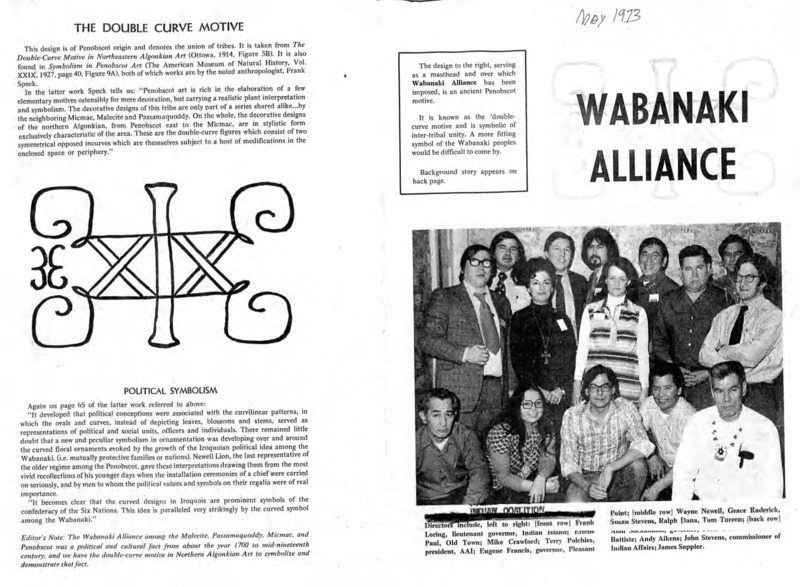
This design is of Penobscot origin and denotes the union of tribes. It is taken from The
Double-Curve Motive in Northeastern Algonkian A rt (Ottowa, 1914, Figure 5B). It is also
found in Symbolism in Penobscot Art (The American Museum of Natural History, Vol.
XXIX, 1927, page 40, Figure 9A), both of which works are by the noted anthropologist, Frank
Soeck
In the latter work Speck tells us: ‘‘Penobscot art is rich in the elaboration of a tew
elementary motives ostensibly for mere decoration, but carrying a realistic plant interpretation
and symbolism. The decorative designs of this tribe are only part oi a series shared alike...by
the neighboring Micmac, Malecite and Passamaquoddy. On the whole, the decorative designs
of the northern Algonkian, from Penobscot east to the Micmac, are in stylistic form
exclusively characteristic of the area. These are the double-curve figures which consist of two
symmetrical opposed incurves which are themselves subject to a host of modifications in the
enclosed space or periphery.”
/
The design to the right, serving
as a masthead and over which
Wabanaki Alliance has been
imposed, is an ancient Penobscot
motive.
It is known as the ‘double
curve motive and is symbolic of
inter-tribal unity. A more fitting
symbol of the Wabanaki peoples
would be difficult to come by.
Background story appears on
back page.
% .I ,* - ! S m BS
POLITICAL SYMBOLISM
Again on page 65 of the latter work referred to above:
‘‘It developed that political conceptions were associated with the curvilinear patterns, in
which the ovals and curves, instead of depicting leaves, blossoms and stems, served as
representations of political and social units, officers and individuals. There remained little
doubt that a new and peculiar symbolism in ornamentation was developing over and around
the curved floral ornaments evoked by the growth of the Iroquoian political idea among the
Wabanaki. (i.e. mutually protective families or nations). Newell Lion, the last representative of
the older regime among the Penobscot, gave these interpretations drawing them from the most
vivid recollections of his younger days when the installation ceremonies of a chief were carried
on seriously, and by men to whom the political values and symbols on their regalia were of real
importance.
,
‘‘It becomes clear that the curved designs in Iroquois are prominent symbols of the
confederacy of the Six Nations. This idea is paralleled very strikingly by the curved symbol
among the Wabanaki.”
Editor's Note: The Wabanaki Alliance among the Malecite, Passamaquoddy, Micmac. and
Penobscot was a political and cultural fact from about the year 1700 to mid-nineteenth
century\ and we have the double-curve motive in Northern Algonkian Art to symbolize and
demonstrate that fact.
•
DfrecIorS'Tnc!udc, left to right: [front row] Frank
Loring, lieutenant governor, Indian Island; Erlenc
Paul, Old Town; Mike Crawford; Terry Polchies,
president, AAI; Eugene Francis, governor, Pleasani
Point; [middle row] Wayne Newell, Grace Roderick,
Susan Stevens, Ralph Dana, Tom Tureen; [back row]
Alan Sockabasin, governor, Peter Dana Point; Tom
Battiste; Andy Aikcns; John Stevens, commissioner of
Indian Affairs; James Sappier.
W abanaki Alliance
Page 1
Catholic Laymen Fund Statewide Indian Center
The Division of Indian Services (DIS) of the
Catholic Diocese of Portland has received funds from
the DeRance Foundation of Milwaukee, Wisconsin, to
set up an Indian Resource Center and a Youth
Organization Program for Maine's Indians. The
Division of Indian Services is one branch of the
Diocesan Human Relations Services.
MS
Last fall DIS reached out to DeRance, Inc. and
requested in a formal proposal that they sponsor a
self-help program for the various tribes of Maine. In
the past years their efforts had been directed to Indian
peoples south of the border in Mexico and Central
America.
Their broad purposes involve charitable and
religious giving with emphasis on Roman Catholic
Church support for higher education and welfare
programs in America and abroad, and for educational
and social development in Latin America. The
foundation was established in 1946 in Wisconsin.
This funding represents their first effort to assist
Indians of North America and is divided into two
separate grants. The first of these is for $30,000 to
establish an Indian Resource Center or, for a more
descriptive title, a state-wide communications center
to serve all of Maine’s Indians.
The second grant is for $37,800 to implement a
Youth Organization Program to come under the
directorship of the Resource Center. This phase of the
grants is well under way with the hiring of TribalCouncil-approved Indian Youth Co-ordinators. A
search is being made at the moment for a professional
person to serve as a consultant on a part-time basis to
integrate educational, social and recreational projects
throughout the State.
The Youth Program is meant to enrich the
experience of Indian young people during their
growing years and leisure time and help them develop
spiritual and other personal strengths so that they can
more effectively meet the challenges encountered in
their various communities in a period of rapid change
in society in general.
Rev. Joseph F. Mahoney, a Jesuit Priest, who has a
Masters Degree in Communication Arts, has been
hired by the all-Indian DIS Board of Advisors as
Director of the Resource Center. He is also
responsible for fleshing out the Youth Organization
Program and for ensuring its refunding next year.
The Division of Indian Services is a unit of the
Catholic Diocese’s Human Relations Services and
enjoys the services of the only all-Indian Board of
Advisors which represents all the Indian Tribal
groups in Maine. This Board meets on a monthly
basis and discusses a wide range of issues affecting the
welfare of Maine’s Indian communities.
The DeRance grant will hopefully serve as a means
of enhancing the growth of further inter-tribal union
as a result of which a more effective voice can be heard
for the benefit of all.
The Indian Resource Center in Orono will try to
bridge the communication gaps between Indian and
non-Indian peoples by pursuing six major objectives:
1. Inter-Indian Communications
2. Religious Education
3. Leadership Development
4. Mobilization of Resources
5. Interpretation to the non-Indian community
6. Advocacy
Members of the DIS Board of Directors
pictured elsewhere in these pages. With
remuneration, they have served their people well
continue to do so. They deserve our gratitude
support.
are
no
and
and
JOHN L. STEVENS, COMMISSIONER OF INDIAN AFFAIRS,
AND KENNETH M. CURTIS, GOVERNOR OF THE STATE OF MAINE
Eastern Indians Form New Alliance
M aine In d ian lead ership la st D ecem ber
participated in an unprecedented meeting of Indian
peoples east of the Mississippi River. Over 125 people
from some 65 eastern Indian tribes, communities, and
organizations came together for the first time in this
century in Washington, D.C., the nation’s capital.
The Eastern Indian Conference, sponsored by the
Native American Rights Fund of Boulder, Colorado,
was made possible by a grant from the Edna
McConnell Clark Foundation of New York City.
It was the desire of the Clark Foundation to support
this effort to bring together Eastern Indian leaders in
an atmosphere of communication, cooperation and
new public awareness. Eastern Indians are the
descendants of Indian tribes living in the eastern part
of the United States prior to the American Revolution.
The Passamaquoddies, Penobscots, Micmacs, and
Malecites of Maine, the Senecas, Cayugas, Oneidas,
Shinnecocks and Poopatucks of New York, the
Manticokes of Delaware, the Miamis of Indiana, the
Mattaponi and Pamunky of Virginia, the Coharie and
Maccamau Siouans of North Carolina, the Catawbas,
Creeks, Coushattas, Cherokees and Seminoles are
some of the names of over 60 tribes, not to mention
the second largest Indian tribe in the country, the
Lumbees of North Carolina, with a population of
40,000.
Some eastern Indians live on State reservations, a
very few on Federal reservations, and some in cities.
But most live in isolated rural areas to which they
retreated from the advancing settlers. There they have
remained and endured without knowing their rights
or the availability of federal and state program funds,
attempting to retain their cultural values.
Even though the problems of Eastern Indians are
similar to those of western Indians, eastern Indians do
not receive the same kind of federal support and,
indeed, most of them do not come under the
Government’s OWN special agency for Indians, the
Bureau of Indian Affairs.
The Eastern Indian Conference attempted fo fill
some of the informational gaps shared by eastern
Indian groups. During the meeting, representatives of
government agencies like Health, Education, and
Welfare, U.S. Office of Education, The Office of
Economic Opportunity, U.S. Commission on Civil
Rights, the Departments of Commerce, Labor and
Agriculture, were on hand to discuss services offered
by their respective agencies for which eastern Indians
would be eligible.
Also present were lawyers and consultants who are
working with eastern Indians to discuss the historical
limitations as well as the current attempts being made
by eastern tribes in gaining federal recognition and
services. Representatives of the Clark, the Ford, the
Rockefeller Brothers, and the Donner Foundations
were also present to talk to conference delegates about
their needs and aspirations.
A keynote address was given by noted Indian
author and lawyer. Vine Deloria, Jr., on the last day.
In his talk, Mr. Deloria said that eastern Indians have
come together at a very important point in history, for
they are the Indian people who can help all Indian
people redefine the Government’s obligation to Indian
people based on the Constitution of the United States
and numerous treaties and executive decisions.
“ W hat Indian people must remember,” said Mr.
Deloria, “ is that the trustee relationship of the
Federal Government to Indian people is the respon
sibility of all Government agencies and not just of the
Department of Interior and the Bureau of Indian
Affairs.”
The enthusiasm of the group was marked by their
continuous meetings which were not on the agenda.
Out of these meetings, some of which remained in
session until the early morning hours, came a new
alliance called the Coalition of Eastern Native
Americans (CENA). By a unanimous approval of the
entire assembly, the new organization was founded
and an eleven-member steering committee, of which
Mr. Thomas Battiste and Mr. Andrew Aikens of.
Maine are members, was chosen by popular vote to
head CENA in its initial development. W. J.
Strickland, a thirty-year old Lumbee from Pembroke,
North Carolina, was elected chairman of the steering
committee. Regarding the goals of the new eastern
Coalition, Mr. Strickland said: “ We pledge to help all
Indian people in the East to move toward self-deter
mination, both community by community and state by
state. Each of these communities has its own
leadership, and its own needs. Our work will be to
remove road blocks and to deliver services so that
these needs can be met.” Mr. Strickland added: “ I am
pleased with the responsiveness of the people at this
conference, their dedication and their willingness to
cross community and state lines to resolve their
problems.”
The steering committee plans on incorporating as a
non-profit private organization to serve as a technical
assistance agency for eastern Indian groups. Funds
will be sought from private and public sources for
setting up an office in Washington, D.C. and for
programs to assist individual Indian communities and
tribes in their quest for self-determination. A long
range goal of CENA will be to work toward a single
Federal Government Indian policy whereby all
Indians are treated alike for delivery of services and
protection of resources, whether they be eastern,
western, urban or rural.
Page 2
Wabanaki Alliance
E D IT O R IA L S
WABANAKI ALLIANCE
It is appropriate that the first issue of WABANAKI ALLIANCE
appear in this season of Easter, of rebirth and new growth. This paper
is itself symbolic of a rebirth represented by our mast-head, of an
ancient alliance among the Indian people of Maine dating back to
1700. The term Wabanaki itself means, “The Daybreak People” or
“ People of the Eastern Lands” and embraced the very same tribes
identifiable today within the State of Maine: The Penobscot,
Passamaquoddy, Mic Mac and Malecite.
The very reason for existence of this paper is to improve
communications amongst all Maine’s Indian peoples. Our philosophy
will be to emphasize those areas of concern which unite the various
tribes and to minimize those areas which historically have been the
causes for disunion and dissension.
We are most grateful to the DeRance Foundation of Milwaukee,
Wisconsin, for enabling us to set up the Resource Center in Orono and
to work out a well-coordinated Youth Organization Program now in the
planning stage. We will work for more effective Christian witness to
Maine’s Indian people in the name of these committed Catholic
laymen.
CONGRATULATIONS!
The D.I.S. Board of Advisors, serving as the ex-officio Editorial
Board of this paper, wishes to congratulate the Indian leadership of the
various tribal units for the initiative they have taken in recent months to
improve the lot of Maine’s Indian people. The various Governors and
A.A.I. President, representing their various Tribal Councils, have been
on the road a good bit of the time since last Fall meeting with Maine’s
Congressional Delegation and various Federal agency representatives
in Washington, D.C., Boston, Augusta and Bangor. Along with their
dedicated professional advisors they have been working behind the
scenes to improve the Indian’s social lot and to redress ancient
injustices. One of the most hopeful developments has been the
formation of a new alliance called the Coalition of Eastern Native
Americans (C.E.N.A.) an organization badly needed to focus attention
on the eastern and northeastern Indians’ situations.
CONGRATULATIONS!
INVITATION
This first issue of WABANAKI ALLIANCE has been prepared
chiefly by Fr. Joseph Mahoney, S.J., Director of the Resource Center
acting in the name of and with the approval of his all-Indian Board of
Directors.
Following issues will, hopefully, be written and edited by volunteer
Indian people from all levels of society, including and especially, the
young both on reservation and from the university and high school
communities. Articles, artwork, poetry, letters to the editor, are needed
and wanted. From this reservoir of talent will come our all-Indian
editorial board of future issues.
Any person wishing to become involved should write to Fr. Joseph
Mahoney, S.J. at 89 Main Street, Orono, Maine.
WABANAKI ALLIANCE'
Vol. 1, No. 1
May1973
Managing Editor: Joseph F. Mahoney, S. J.
Editorial Board:
DIS Board of Directors: Thomas Battiste, Chairman;
Jean Chevaree, Alan Sockabasin, Nicholas Dow,
Terry Polchies, John Bailey
Published by Indian Resource Center, 93 Main St., Orono, Me.
A LONG DEEP SHAME
[The following are excerpts from a
recent syndicated newspaper column by
the outstanding black journalist, Carl
T. Rowan. His appraisal of the
significance of “Wounded Knee” is one
of the best I have seen. J.F.M.]
WASHINGTON—As a newsman, I
have spent weeks among the Sioux. I
have heard white Americans point to
Indian bellies, bloated or tumefied by
horrible diets, and exclaim: “You see,
they can’t be hungry.”
I have seen mothers shiver on the dirt
floors of tarpaper shacks on the
Standing Rock reservation in North
Dakota, massaging their babies to try to
keep them warm.
I have talked to hundreds of whites
on the periphery of Indian reservations
who produce a litany of stereotypes:
“ Indians are lazy, Indians are dirty,
Indians are drunkards” . . . a litany so
painfully similar to what I heard about
“niggers” during my young days in the
Deep South.
I have w alked enough dusty
reservation roads to know that for all
the ugly discriminations against, and
oppressions of, black people, or Puerto
Ricans, or Mexican Americans, it is the
American Indian who is most ne
glected, most brutalized, most de
graded.
And the pity is that those millions of
Americans who do care somewhat for
justice give a thought to these Indians
only when an angry protest erupts at the
Bureau of Indian Affairs here, or when
a crisis is at hand at some place like
Wounded Knee. The shame is that
Indians must resort to force and
law-breaking just to get the country to
consider their grievances.
We have “buried” the American
Indian alive in the backwoods of
American life. And because he is out of
sight, he is out of our minds.
It would be untrue in the physical
sense to say that we have given ourselves
peace of mind by keeping Indians in
rural concentration camps. Because the
Indian is now free to leave any
reservation.
But the prison shackles are in his
mind. All but a few have been denied
the education and training which would
enable them to cope in the highly
technological society at large. And
however good the training of a few,
isolation has made the American
mainstream a strange, hostile world
that some are loath to enter.
Many Indians truly put priority on
retaining their Indian heritage and
culture, so assimilation is not their goal.
Others are tied to their bleak, largely
barren reserves by dreamy notions that
someday, somehow the white man’s
government is going to hand over the
billions of dollars they say the white
man owes them for their land. They
want to be around to claim their share.
So it is not just rage that dis
tinguishes those Indian militants at
Wounded Knee. It is also confusion,
hopelessness, despair, these being the
most plentiful commodities among
American minorities these days.
W hat I am saying, then, is that there
is no way this government is going to
satisfy the myriad age-old grievances of
the American Indian movement in
general or the W ounded Knee
insurgents in particular. Only a genuine
transformation of heart and spirit by
the mass of Americans can produce
that.
—Carl T. Rowan.
Wabanaki Alliance
Page 3
An Appeal
INDIAN JUSTICE THROUGH MAINE S 106TH LEGISLATURE
“The White Men made us many promises, more than I can remember, but they never
kept but one; they promised to take our land, and they took it.”
Indian Quote from:
“Bury My Heart at Wounded Knee”
Our Indian countrymen have been
subjected to persecution and discrimi
nation since the 16th Century. Yet,
many Mainers still look with aloof
curiosity or d isin terest a t the
descendants of Sitting Bull, Geronimo,
Crazy Horse, Chief Joseph, Cochise, etc.
as they peacefully demonstrate or
violently protest their grievances at
historical sites such as Wounded Knee.
Most of us realize that there is a small
but significant part of the Indian
Nation living in Maine; but few of us
are aware that they have suffered and
continue to countenance many of the
same injustices perpetrated on their
western Brothers from the Dakotas.
The Penobscot, P assam aquoddy,
Micmac and Maliseet Tribes comprise
the estimated 2,500 Indians living in
Maine. Although most of them live on
the reservations at Indian Island-Old
Town, Pleasant Point-Perry, and Indian
Township-Princeton, many live off
reservation in the north east section of
the State.
The Passamaquoddy settlements are
State reservations with treaties dating
back to 1794 and 1795 - 26 years before
Maine became a State in 1820. Many
Maine Indians feel that the State of
Massachusetts and the State of Maine
have violated their treaties with the
Maine Tribes. One can only speculate
on the outcome of litigations in Federal
and State Courts over their suits, but
one need not sp eculate on the
conditions of poverty, alienation, and
despair in our Indian community today.
Economic depression with unem
ployment rates between 50 percent and
80 percent; educational deprivation
with nearly an 80 percent high school
dropout rate on some reservations;
substandard living conditions with no
plum bing and often d ilap id ated
housing; inadequate social, medical
and dental services highlight this
deplorable list of neglect and
discrim ination. The m ost telling
statistic is that of life expectancy - an
Indian’s average life is approximately
44. a white American’s is 72.
Maine Indians are not recognized by
the Federal Government and, therefore,
they are not eligible for federal
assistance services from the Bureau of
Indian Affairs in Washington. It’s true
the Oglala Sioux may have justified
grievances against the Federal Gov
ernment for breach of treaty and
corrupt m anagem ent o f Indian
programs in South Dakota - but Maine
Indians are not even eligible for
millions of dollars worth of services
afforded other American Tribes.
Federal, State and local officials have
admitted that the citizens of Maine
have discriminated against and ignored
the Indian people for too long. In order
to provide better lives and a brighter
future for our Maine Indians, we should
seriously consider favorable action on
the following legislative documents
before the 106th Maine Legislature:
LD 343 - PART H BUDGET
Sponsor: Senator Sewall of Penobscot
Purpose: This bill would provide a
clerk -ty p ist, In d ia n developm ent
specialist, typist, Accountant-clerk,
full-time chaplain, fees for tribal gov
ernments and increased support of
Indian Housing Authorities.
Referred to: Appropriations Committee
Allocation: $183,928 for the biennium
(1973-75)
LD 284— AN ACT Relating to Actions
for Money Due Indian Tribes and for
Injury Done to Tribal Lands.
Sponsor: Mr. Mills of Eastport
Referred to: Judiciary Committee
Purpose: This bill would allow the
Commissioner of Indian Affairs upon
his own initiative, or at the request of
the governing body of any of the
tribes, legal actions for money due
any such tribe and for injuries done
to tribal lands. The present law
would be amended to allow suits or
be filed for damages prior to Sep
tember 16, 1971. This date, accord
ing to the Indians, is unconstitu
tional and creates a possible conflict
of interest for the Attorney General
who is authorized to protect both
State and Indian interests.
LD 287—Resolution, Proposing an
Amendment to the Constitution to
Provide for Indian Representatives
to the Legislature.
Sponsor: Mr. Mills of Eastport
Referred to: Government Committee
Purpose: This resolution would allow
the Penobscot and Passamaquoddy
Tribes to elect one non-voting repre
sentative (from each tribe) to the leg
islature. For the first 120 years of
Maine’s history as a State, Indians
sat and spoke on the floor of the
House. In the early 1940’s this prac
tice was terminated. This amend
ment would establish privileges and
duties of Indian Representatives by
constitutional law as other represen
tatives.
LD 278 — AN ACT Relating to Lands
on Indian Township, Washington
County, acquired by the State.
Sponsor: Mr. Mills of Eastport
Referred to: Judiciary Committee
Purpose: This bill would allow the
conveyance of State acquired lands
on Indian Township in Washing
ton County to the Passamaquoddy
Tribe. (These lands would have to be
assessed for State, County or forestry
District taxes.) The intent is to elim
inate confusion as to the status of
lands acquired by the Passama
quoddy Tribe through purchase.
LD 1290 — AN ACT to Appropriate
Funds for the Purpose of Creating
an Off-Reservation Indian Develop
ment Office within the Department
of Indian Affairs.
Sponsor: Mr. Haskell of Houlton
Referred to: Appropriations Committee
Purpose: This Act would appropriate
$59,845 for the biennium to estab
lish an off-reservation office in order
to provide a voice for off-reservation
Indians and to insure that they re
ceive much needed social services.
LD 813 — RESOLVE, Appropriating
Funds for Construction of Early
Childhood Facility for the Passa
DELIA AND NICK RANCO, who just celebrated their sixtieth wedding anniversary
Easter Sunday, are a delightful example of the inner beauty that comes with the
passage of time. But time is by no means the only thing which has wrought that quiet
joy so obvious in this gracious couple. (Photo courtesy of Bangor Publishing Co.)
THE BEAUTY OF O LD AGE
The thought o f old age sends a shudder through many hearts. But
like most fears that beset us, this one is a lamentable delusion, and
needless.
I looked long at the loveliness o f a young cherry tree, a p ink bouquet
offered to the spirit o f springtime. I thought no tree could be fairer, and
sighed to think o f the wanton breeze that would soon scatter the bloom
and the beauty and leave to the tree but the dull duty o f fruitbearing.
Around the bend o f the road there towered a noble tree, fu ll two
centuries old. It bore its majestic crown on a stem that rose like a
bronze column reaching jrom earth to sky. I t breathed o f serenity,
power, and understanding, and shed a great peace.
The dainty pink tree was a poem, a lilting lyric poem; but this was an
epic, a classic o f majesty and music. Suddenly age meant something
beyond all losing. I t meant the gain o f all that was good in life, kneaded
into a soul that transcended all littleness, all trifling— a spirit aglow
with an inner glory. Men are as trees walking.
“How beautiful you are!" exclaimed a young enthusiast to an old
woman philosopher.
“M y child, I ought to be beautiful. I have lived eighty years," she
replied.
Youth is a time o f fleeting beauty, a passage o f storm and stress. We
regret it, but we would not have it again i f we might. Age brings peace:
and it will, i f we desire it, bring to us a beauty beyond the touch o f the
earth.
— Unknown
maquoddy Tribe at Pleasant Point.
Sponsor: Mr. Mills at Eastport
Referred to: Committee on Human
Resources
Purpose: To appropriate $83,500 to
construct an early childhood facility
for the Passamaquoddy Tribe at
Pleasant Point, Washington County.
The facility would provide Head
Start, Educational, Vocational li
brary and career development pro
grams.
LD 465 — AN ACT Relating to Leg
islation Affecting Penobscot Tribe
of Indians.
Sponsor: Mrs. Murchison of Mattawamkeag.
Referred to: Committee on Human
Resources
Purpose: No legislation directly affect
ing the Penobscot Tribe shall be in
troduced into the legislature without
first being submitted to the governor
and council of the Penobscot Tribe
of Indians for their approval.
—John Kerry, H RS
[Adaptedfrom the Church World, 4/23/73]
Page 4
Wabanaki Alliance
Dental Clinic Services
Opportunities At Hand
Human Relations Services, Inc.
(HRS), District IV, has been operating,
in one manner or another, dental clinic
programs since the summer of 1968.
Perhaps a brief history of the dental
clinics operated by HRS, District IV,
would be of some benefit to the Indian
reader.
AAI LEGAL HELP — The Association of Aroostook Indians, Inc., received a grant
from the Campaign For Homan Development, of the United States Catholic
Conference, for the purpose of establishing an Indian legal services program in
Aroostook County. Operations under the grant began last fall with the h i r i n g of an
attorney. The person hired is Robert Moore and the office is located in the building
owned by the A.A.I. at Bowdoin Street in Houlton.
The program will provide legal counsel to Indian people in Aroostook County. This
will include both civil and criminal matters. By providing a lawyer for Indians accused
of crimes, the A.A J. project is broader than Pine Tree Legal Assistance, Inc., which is
limited to civil matters.
The attorney is not yet admitted to practice in the state courts of Maine. However,
the results of the bar examination will be out in early April. After that time the
Aroostook Indian Legal Service will be in full operation. At present, the Indian Unit
of Pine Tree Legal Assistance, Inc., is cooperating with A.A.I. to provide necessary
representation in court.
Normally, the A.A.I. attorney is in the Caribou area one day a week. With no office
in that area, it has been Helen Ciganik, A.A.I.’s VISTA worker in Caribou, who has
put the people in contact with the attorney if needed.
Left to right in photo: Tom Battiste, Bishop Peter L.-Gerety, Terry Polchies,
Brenda Polchies, Gloria Tomah. [Church World Photo]
TONY KALISS REPORT
In the summer of 1972 a survey was commissioned by the Board of Directors of the
Division of Indian Services. Recently, the results of that broad and challenging work
was published by Mr. Tony Kaliss. It is a most valuable fact sheet and resource.
Following is the formal title of the work embracing 174 pages followed by the intro
duction to the report as written by Mr. Kaliss:
An inventory and evaluation of the programs serving the Indians of Maine
and
Recommendations for the future work of the Division of Indian Services—
Diocesan Human Relations Services of the Catholic Diocese of Portland, Maine.
This inventory and evaluation of the
programs serving the Indian population
of Maine was undertaken at the request
of the Board of Directors of the
Catholic Diocese of Portland’s Division
of Indian Services. The DIS was
established in the Spring of 1968 as part
of the Diocese’s Bureau of Human
Relations Services. Both the DIS and
the Bureau of Human Relations
Services, which was set up in 1966,
represent the belief of the Diocese in
Portland that a true Christian concern
must extend beyond the spiritual needs
of a man to deal with the social and
economic conditions in which he lives.
It represents, as well, the pressure
placed on all churches in the 1960’s to
respond to the day to day problems of
living faced by the poor and non-white
minorities in our country and around
the world, as well.
The DIS first consisted of a Director,
then responsible to the Director of the
Bureau of Human Relations Services.
Next, an Advisory Board of Indians and
non-Indians was set up and, finally, in
June of 1971 the Advisory Board was
changed into an all-Indian Board, with
two representatives from each Reserva
tion and two from the Association of
Aroostook Indians, which represents
the large Indian community in Aroos
took County. This Board was also given
increased powers and is now basically a
Board of Directors rather than an
Advisory Board.
The first Director of DIS was Louis
Doyle, who served from 1968 to 1972
when he resigned. His place was taken
by Father Richard Rokos, who accepted
the job temporarily to help the new
Board get on its feet. Feeling that he
has done what he intended, and after
discussion with the Board, Father
Rokos resigned as of June 30, 1972 to
return full time to his duties as Pastor
of the St. Anne’s Mission on the
Penobscot Reservation. He is now
pastor in Bucksport, Maine.
Because the DIS Board is still new
and because many things have changed
since DIS was set up in 1968, the Board
decided to take the opportunity of
getting a new Director to make some
decisions about where DIS should go in
the future. But to know where to go
from here, one has to know where
“here” is, and so the DIS Board
decided to have someone do an
inventory and evaluation o f the
programs now serving the Indians of
In the summer of 1968, a dental
clinic was established in the Calais
Regional Hospital in Calais, Maine.
The clinic was intended to be operated
only during the summer months and
originally only for the benefit of the
Indian population residing on the two
reservations located in Washington
County.
In August 1971, this summer clinic
was reorganized so that a full-time
dentist could be hired and dental
services provided to all low-income
children living in Washington County.
While the summer clinic program in
Washington County was being carried
on, a year-round clinic was established,
initially, in Lee, Maine. The Lee Dental
Clinic began tre a tin g low-income
children within a 35 mile radius of Lee
on July 1,1970. Subsequently, the clinic
was moved to its present location in the
Marianne School in Chester, Maine.
This clinic is now known as the Chester
Dental Clinic.
As the two dental clinics began
full-tim e operations, geographical
guidelines, eligibility criteria, and clinic
procedural policies were drafted and
put into effect. Basically, in order to
qualify for the clinic’s services, a child
Maine and make some recommenda
tions to the Board about future work.
This survey, then, is the result. It is
divided into three parts. Part One is an
inventory of programs serving the
Indians of Maine. It contains just the
facts; opinions have been left for Part
Two, which is an evaluation of the
programs. Part Three is based on Parts
One and Two, and contains recommen
dations to DIS about possible future
work of DIS.
The facts in this survey are based on
ten weeks of field work. The opinions
are based on many conversations with
some 70 Indians and a good few nonIndians during the ten weeks and on six
years of work and contact with the
Indians in Maine. Every person has his
own way of looking at things, and the
author of this survey certainly has his
own, but he has tried, as much as
possible, to learn from the people on the
receiving end what they think and
where they want to go in the future.
Any resemblance that the opinions in
this study have to the opinions of other
people is not at all coincidental since
the author thinks that many other
people besides himself have a lot of
good common sense. However, the
opinions expressed here in writing are
those of the author and he alone is
responsible for them.
Corrections and additions to the
factual material in this survey, as well
as any comments on the evaluations,
are very welcome. They should be
addressed to the Division of Indian
Service, 53 Illinois Ave., Bangor, Maine
04401.
must meet the following criteria:
1. The child must be 18 years of age
or younger.
2. The child’s family or guardian
must be receiving State public
assistance, i.e. A .F.D .C . or
A.A.B.D., State general assist
ance, Municipal or County Public
Assistance, or be eligible for or
receiving donated com m odity
foods.
3. The child must reside within the
geographical area served by each
clinic.
The clinic located in the Calais
Regional Hospital is staffed by Dr.
William Baker, D.M.D., and he is open
five days a week, generally Monday
through Friday, from eight in the
morning until five in the afternoon.
Referrals can be made either by the
person seeking dental health directly or
by another person acting on behalf of a
family and the family’s child or
children. The telephone number to call
is 454-7521. No fees are charged for the
general procedures offered a t the clinic,
except that laboratory fees must be
paid for, either by the family or some
other party, and fees are charged for
services for adults on an emergency
basis. Generally, adults are treated on
an emergency basis only for the
alleviation of pain, and thus usually
means a simple extraction of a tooth or
teeth.
The Chester Dental Clinic has the
same general operating guidelines,
services provided, eligibility criteria,
and other limitations which apply to the
Calais Clinic. The Chester Clinic is
staffed by Dr. David Levy, D.M.D. and
is generally open from eight in the
morning until five in the afternoon. The
phone number to call is 794-8185.
Again, referrals can be made by
individuals on their own behalf or by
some other party acting for a family and
a family’s child or children. The area
served by the Chester Clinic essentially
extends from just north of Old Town
(including In d ian Island) to the
northern most boundary of Penobscot
County and also includes a small part of
southern Aroostook County.
The two clinics are prevention
oriented and children are treated with
the expectation in mind th at the clinic
directors may terminate services to a
patient if that patient refuses to comply
with those instructions given to him or
to his family. The clinics cannot afford
to pay for transportation to or from the
clinics, so this must be worked out by
the individual families and their
children who want to receive dental
services from the clinics.
As of the date of this article, the
patient load in the Chester Clinic is
such that there is a ten month waiting
list; in Calais, the patient load is rapidly
expanding. However, it is the intent of
each clinic to try to serve as many
low-income c h ildren as possible
consistent with limited personnel and
quality dental care.
For additional information regarding
the clinics Program in general or any
specific aspect of it, please contact the
Human Relations Services—District IV
office, 53 Illinois Avenue, Bangor,
Maine, 04401. Telephone 947-8664.
Jon McNulty, HRS., Disk IV
Wabanaki Alliance
Page 5
MERCY' AND THE MAINE INDIAN
In the year 1878 a request for assistance in missionary and educational work among
the Penobscot Indians of Old Town came to the Motherhouse of the Sisters of Mercy
in Manchester, New Hampshire. In response to this request from Rt. Rev. James
Augustine Healy, Bishop of Portland, four Sisters left Manchester on August 25,
1878.
They arrived at Indian Island accompanied by Rev. Michael O’Brien, pastor of the
Old Town Church and Mother Francis Xavier Warde, foundress of the Sisters of
Mercy in the United States. Mother Warde came to officially open the Convent and
School that were to be established there.
During these ninety-some years the
The Sisters were met by the Chief of
Sisters of Mercy have continued
the Tribe, Sockabeson Swassin, who
uninterruptedly their work as educa
along with many others brought the
tors; provided health service for most of
those years through Sister Nurses at
Sisters in canoes to the other side of the
river. There they were welcomed with
Pleasant Point, and nursing care in the
warmth and genuine sincerity by large
early years wherever the need; and were
ever ready to respond to any need, be it
numbers gathered on the bank. Tribal
spiritual or physical.
Chief Sockabeson had given up his own
home in order that the Sisters would
The general feeling of good will that
have a place in which to live.
exists between the Reservation com
munities and the Sisters of Mercy is a
In 1880 the Penobscot Indians built a
living tribute to the ninety-some years
new Convent for the Sisters, assisted
of service that the Sisters have given to
financially in its erection by Bishop
the Passamaquoddy and Penobscot
Healy and priests of neighboring
Tribes in Maine.
parishes. A schoolhouse was built by
the State in the early 1880’s. Prior to
The “warmth and the genuine
that, classes for the children were held
sincerity” of the welcome that the
in a private home.
Sisters experienced on their arrival in
1879—has been handed down like a
A nother b an d of Sisters left
burning torch to successive generations
Manchester and arrived at Pleasant
. . . and for the warmth of that “light”
Point on Passamaquoddy Bay on June
the Sisters of Mercy are eternally
21, 1879. They, too, were received with
grateful.
great enthusiasm and the people
formed a guard of honor as the Sisters
—Sister Doris Kirby, R.C.M.
were escorted by the Tribal Chief to
their Convent, a finely constructed log
cabin adjoining the Church.
The Sisters from Pleasant Point spent
four months out of every year at Dana
Point. This arrangement continued for
a few years until more Sisters arrived to
As reported In the Bangor Daily
maintain' a separate residence and to
News of April 9, 1973, the Economic
continue the school at Dana Point
Development Administration has made
which was established in 1879.
a $50,000 grant to Maine’s Passama
Early in 1927 fire destroyed the
quoddy Indians.
Church and Convent on the Pleasant
Sen. Edmund S. Muskie said that the
Point Reservation. For a time the
money will be used to set up a
Sisters lived in Eastport continuing all
marketing system for the sale of baskets
the while the education of the children
made by Indians on the tribe’s Indian
and the care of the sick. The
Township and Pleasant Point reser
cornerstone for the present Church and
vations. Sen. Muskie said that the
Convent structure was laid in the latter
E.D. A. will pay for the entire cost of the
part of 1928.
project.
In 1955 Sister Beatrice Rafferty died
Representative leaders of the tribe
and was buried, at her request, in the
were in Washington in pursuit of the
cemetery at Pleasant Point. The Indian
idea. Muskie said they discussed the
people there, in recognition of her thirty
marketing grant application and other
years of service on that Reservation
applications for Federal help with the
named the present new school—the
Maine Congressional Delegation and
Beatrice Rafferty School.
other Federal officials.
E.D.A. And The
Passam aquoddy
B asket Co-op
MR. JOHN BAILEY
MRS. FRANCIS C. CHAVAREE
INDIANS SERVING INDIANS
Pictured in this issue of WABA
NAKI ALLIANCE are two members of
the DIS Board of Directors, Mrs.
Francis C. Chavaree, R.N., a Penobscot
of Indian Island and Mr. John Bailey, a
Passamaquoddy of Pleasant Point.
Other members of the Board are Mr.
Thomas Battiste, a MicMac of Houlton
and Chairman of the DIS Board; Mr.
Alan Sockabasin, a Passamaquoddy
and Governor of Peter Dana Point; Mr.
N icholas Dow, a Penobscot and
President of the Tribal Council at
Indian Island; Mr. Terry Polchies, a
M aliseet and P resid en t of the
Aroostook Association of Indians. Mr.
Polchies is filling out the term of Mrs.
Helen Ciganik, of Caribou.
We wish to extend our appreciation
to all of the members of the Board of
DIS who have served their Indian
people well at considerable expenditure
of time and energy and with no remun
eration. Especially do we wish to thank
Mrs. Helen Ciganik, a dedicated
servant of her Aroostook people, who
has recently finished service with the
DIS Board.
Also we express gratitude to Mr. Tom
Battiste, who has served the Board well
as its Chairman and who will be
resigning in July of this year. Tom has
recently received a Ford Foundation
Grant for private research in the
development of Indian leadership.
Congratulations to our Chairman!
Y outh O rganization Program
There was a Grant of $30,000 made
by DeRance, Inc. for the establishment
of an Indian Resource Center. Most
people concerned are aware of this fact.
But what is probably less well known
is the fact that a second grant for
$37,800 was given to set up and imple
ment a Youth Organization Program
for the benefit of all Maine’s Indian'
people. This second grant operates out
of the office of the Director of the
Indian Resource Center. Approxi
mately two thirds of the allotment for
the Youth Program is committed to
salaries.
Each reservation and the A.A.I. were
to hire a youth co-ordinator to be
approved by the respective tribal
councils. The three reservations have so
chosen and in each instance the person
chosen was already serving as Recrea
tion Director under an existing pro
gram . The present recreational
program will be expanded to include
formal instruction in Indian arts and
crafts, tutorial work, domestic sciences
and intercultural seminars and field
trips. To oversee this broadening of the
youth effort the Board of Directors is
currently searching for a part-time
professional person who can bring
know-how plus experience and
dedication to the job.
The Youth Coordinators approved by
the various Tribal Councils are:
Penobscot:
Orland “ Sparky” Clark
Pleasant Point: Francis “ Red” Sapiel
Peter Dana Point: Justin “Jake” Lola
O rono S ite For C enter
After considering the advantages of various
locations around northern Maine, a firm
decision was made last month to establish the
Indian Resource Center in Orono. The Resource
Center will share facilities, office personnel and
equipment with District IV of the Diocese of
Portland’s Human Relations Services in the
former Grammar School of St. Mary’s Parish.
Renovations are beginning on the first floor of
the well-preserved building and should be
completed by the end of May.
According to present plans, the large
classroom on the south-east comer of the
building will be divided into two offices with the
classroom on the south-west comer being
prepared as an all-purpose area with plans to
use it as a seminar room. This room will also
serve as an Indian Museum Library and arts and
crafts display center.
The Division of Indian Services has been
warmly welcomed by the pastor, Rev. John
Crozier, and by the Parish Council of St. Mary’s,
all of whom have generously given of their time
in working out financial and other
arrangements. In the name of the DIS Board of
Directors, Fr. Mahoney expresses appreciation
and gratitude.
Page 6
Wabanaki Alliance
Latest CENA Word From Washington
The eleven-member Steering Com
mittee of the Coalition of Eastern
Native Americans met in Washington,
D.C. on March 23, 24, 1973 for its
second meeting since its inception at
the Eastern Indian Conference in
Washington, D.C. on December 7-9,
1972. Also present were representatives
of Native American Rights Fund (L.
Graeme Bell, III) and the Institute for
the Development of Indian Law (Kirke,
Kickingbird and Lynn Shelby). In
addition, John Stevens (Chairman,
Planning C om m ittee) and M ike
Crawford (Resource planner) and other
interested persons in the .area were
present.
The session opened w ith Mr.
Strickland bringing the Committee
up-to-date on activities since the last
Steering Committee meeting. These
activities consisted of meeting with
officials of the Office of Economic
Opportunity and Health, Education
and Welfare.
As well as the discussion of funding
possibilities with foundation program
people, Mr. Strickland announced that
funding had been received from the
Rockefeller Brothers Fund in the
amount of $5,000 and from the Clark
Foundation for $3,000, for a total of
$8,000 for the operation of C.E.N.A.
activities.
L. Graeme Bell, III, of the Native
American Rights Fund’s Washington
office, reported on the . progress of
Public Law 92-318, regarding $18
million for Indian education.
Another purpose of the meeting was
to finalize the incorporation of CENA.
Mr. Kirke Kickingbird announced that
incorporation papers were filed March
23, 1973 in Washington, D.C.
Mr. Dale Wing, Assistant Executive
Director, National Council Indian
O p p o rtu n ity , suggested, and the
Committee concurred, that the Revenue
Sharing Act be studied by attorneys to
Penobscot Y ouths W in O ld Town
YMCA Basketball Tournam ent
TOURNAMENT WINNERS — The Indian Island Basketball Team,
winners of the Old Town YMCA Tournament, included: Steve Hamilton,
Dave Almenas, Rick Love, Mike Paul, Ray Chavaree, Junior Pehrson,
Mark Mitchell and Burnell Mitchell.
The 7th and 8th grade boys repre
senting In d ian Islan d won the
basketball tournament sponsored by
the Old Town YMCA, held Wednesday,
April 11,1973.
The Indian Island team, lead by
Ricky Love, who was high scorer of the
year averaging about 22 points per
game, compiled a 10-3 record for the
season.
Entering the tournament seeded in
first place, the Indian Island team won
three games to clinch the double elim
ination championship, defeating Mil
ford 7th and 8th grade team in over
time by the score of 40-38.
Ricky Love led all scores for the
tournament averaging about 20 points
per game.
For their efforts, in addition to the
first place team trophy, each boy
received an individual trophy. Ricky
Love received an additional trophy for
being the highest scorer for the year in
the league.
Team members are: Ricky Love,
Wilfred Pehrson, Jr., Mark Mitchell,
Dave Almenas, Ray Chavaree, Michael
Paul, Steve Hamilton, Burnell Mitchell.
The YMCA is sponsoring a banquet
for the league winners to be held on
May 9, 1973 at the K of C Hall in Old
Town.
The Penobscot Tribe will honor the
team ’s efforts with a community
banquet. The date is to be announced
later.
work with CENA in developing strategy
for landless and rural and state reser
vations in their quest for a share of the
money that is going to be distributed to
local and state officials.
Trudy K. Hypes, Contract Officer,
International Association of Official
Human Rights Agencies, suggested,
and the Committee concurred, that the
Coalition be used as a clearinghouse to
work with IAOHRA in developing
strategy for all official human rights
agencies in discrimination in employ
ment practices in their relationships
with Eastern Native Americans. Mrs.
Helen Attaquin was chosen to represent
the Coalition at the planning meeting in
Albuquerque, New Mexico, on March
28-31,1973.
Mr. Andy Akins, Treasurer, Lucille
Dawson, Secretary, and Helen Attaquin
suggested and the Committee concur
red that the Coalition support the
formation of the Commission of Indian
Affairs in the State of Connecticut. The
above represented the Coalition at the
March 26, 1973 hearing at the State
Capitol Building in Hartford, Connec
ticut, at the request of the Indians of
the State of Connecticut.
The next meeting of the Board of
Directors will be in Buffalo, New York,
June 1, 2,1973.
For further information, please contact:
Mr. W. J. Strickland, President
Coalition of Eastern Native
Americans
927 15th Street, N.W., Suite 612
Washington, D.C. 20005
(202) 638-2287
Jesuit Attacks McGovern's
Stand On Custer Violence
[Ed. Note: The following is a letter to
Sen. George S. McGovern o f South
Dakota written by Fr. Richard G.
Pates, SJ., director o f the M other
Butler Center, Rapid City, S.D., and
formerly o f St. Francis mission on the
Rosebud Sioux reservation in South
Dakota where he had served fo r many
years.}
This is a letter concerning your recent
statements on the incidents at Custer,
S.D. It is distressing, to say the least, to
hear your comments suddenly become
so one-sided. It would be well for you to
let the white community of the Black
Hills area know that you don’t so much
deplore the violence of AIM last
Tuesday, Feb. 6, but rather deplore the
need for such violence. This need grows
out of violence. The need grows out of
the long-standing, insensitive attitude
of most of the non-Indian people in this
area with regard to the injustices done
to the Indian people.
Somehow, some way, the whites do
not consider their routine violations—
both individually and institutionally—
of Indian civil rights as violence or a
breach of good law and order. It’s true
that there is usually little blood or fire
connected with it, but it is a low-profile
type of violence that does its deadly,
violent work in producing untold
suffering, and agony—physical and
mental— on the Indian people, young
and old, good and bad.
Attempts to gain a hearing and
redress to mitigate this violence usually
W arren M itchell
New A ssistant
Mr. W arren Mitchell has been
selected by the DIS Board as the new
assistant to the Director of the Indian
Resource Center, Orono. He is a
Penobscot and lives at Peter Dana
Point. The screening of applicants was
held April 17 at the Newman Center in
Orono.
Mr. Mitchell comes to the DIS after a
distinguished career as Sergeant-Major
in the U.S. Air Force Military Police.
His military career spanned 22 years
and involved leadership training of
close to 1,000 Air Force personnel. He
will be a welcome and valuable addition
to our staff.
and routinely end in lots of
bureaucratic talk and paper shuffling,
but with no appreciable results. The
agony just silently goes on and on and
on.
B ut eventually violence begets
violence, and violence' on the Indian
side finally erupted at Custer. It may
still happen elsewhere if nothing is
done. As a responsible representative
of the U.S. government, it should be
your job to seek remedies and
alleviation for the violence on both
sides. You shduld try to eliihitiate the
need for any violence.
I really can’t understand your sudden
blindness in this matter. Indians have
pretty well given you their support.
They were one of the few groups who
supported you at the ballot box in
South Dakota in the recent presidential
election. They thought that your
campaign speeches showed an under
standing of how the violence of oppres
sion and injustice works. Violence to
the Indian people exists daily here in
your state of South Dakota. And it is
just as real in its results as were the
bombings of Hanoi.
Now when the Indians make a thrust
for justice in apparently the only way
left to them — returning evil for
evil—you show complete lack of
understanding and empathy. I never
found you that way before.
I ask you please to reconsider and see
if you cannot find a better way and
better words to show your impartial
concern for all the citizens of South
Dakota, and particularly for those who
share your former convictions for the
help needed by the oppressed of the
world. Could it now be th at you realize
Nixon was right?
Richard G. Pates, SJ.
P.S. And in case someone advises the
answer that you do have concern for the
Indian people, but not for AIM, hear
the quote of an elderly Indian woman
when she was asked the identity of
AIM. She said, “They are the Indians
who speak up for the Indians who can’t
speak up, or are afraid.” Many can’t
and won’t follow the way of AIM, but
their silent sympathy and hope is that
the way of AIM gets something done no
one else seems to have been able to do.
[This appeared in the A pril '73 issue o f
National Jesuit News].
Wabanaki Alliance
Civil Rights For Indians
The following report was written by
Harriet Price, a member o f Maine's
Advisory Committee to the United
States Commission on Civil Rights, nnd
a loyal supporter and friend o f Maine's
Indian people:
“Fedeial and State Services and The
Maine Irdian” was the subject of an
investigaion of the Maine Advisory
Committee to the U.S. Commission on
Civil Rights. The t\vo day hearings vere
held in the Federal Courtroom in
Bangor, February 7-8,1973.
Harve} Johnson, chairman of the
Advisory Committee, led a panel lhat
questioned oyer 70 witnesses in 22
hours of sitting to hear testimony.
The people? questioned were repre
sentatives of Ffderal and State agencies
which should }iave a special relation
ship to Maine, Indians. The agencies
called to testify were in the areas of
liuuMiig, licdteli, education, law en
forcement, welfare, community ind
economic deve|opment.
Elected Indian leaders and represen
tatives of Indi^i agencies testified as to
their relationship to the Federal and
State agencie|7
T- ’- ‘'"evens,
Maine’s Department of Indian Affairs,
said he vouldjlike to see direct grants
given to the tnEes rather than serving as
a welfare a g e i^ .
A lan'
Passam aqucddy
governor of Indian Township, said lhat
with Federal cutbacks, unemployment
on his reservation would be almost 95
percent.
Matthew. Sappier, Penobscot gover
nor of Indian Islan d , told the
committee that the agencies should be
held accountable to the Indian com
munities, even before they plar a
program.
Passamaquoddy governor Eugene
Francis, Pleasant Point, described the
health problems, specifically citing the
new Lubec Family Health Clinic.
Terry Polchies, president of the
Association of Aroostook Indians, said
he thougit very little good would come
out of the hearings for the M ane
Indians.
Hon. Kenneth M. Curtis, Governor
of the State of Maine, spoke of his
concern for the State’s service of
off-reservation Indians. He felt the
Passamaquoddy and Penobscot tribes
should have “their day in court” in
regards to the Treaties.
R epresentatives o f th e M aine
Attorney General’s office, Indian Legal
Unit of Pine Tree Legal, and Associa
tion of AroostooK Indians spoke about
the legal obstacles to services for
Maine’s Indians.
Representatives o: the Bureau of
Indian Affairs (U.S. Dept, of Interior)
and the Indian Hedth Service (U.S.
Health, Education Sc Welfare) were
invited to the hearings but refused to
appear. Maine Indians are not served
by either of these agencies.
The Committee was concerned about
all the Federal cutbacks and how they
would affect Maine’s Indian commun
ity. It has therefore met with authorities
in Maine including the Governor,
Attorney General and two legislative
comnittees (Appropriations & Human
Resoirces). The Committee will send a
delegation to Washington, D.C. to talk
with the Congressional delegation and
Federal authorities.
A preliminary rppnrt will be released
shortly with findings and recommenda
tions. L ater a full report with
documentation will be released with
specific recom m endations :o the
agencies affected.
A staff report given at the hearings
said that health and unemployment
were the two greatest problerr.s con
fronting the Indians. Employment will
be the subject of another hearing by the
Main; Committee this year.
IN DEBT TO THE INDIANS
Half of all the names of this nation’s states are Indian
n origin. Here are some examples:
Alabama—Creek Indian word meaning “Here we rest.”
Arizona—Indian word meaning “Plac; of small springs.”
Arkansas—Quapaw Indian Tribe.
Connecticut—Indian word meaning beside or on the long river.
Dakota—Indian name for “ allies.”
Id ah o
Sh>sshon© Indian word E Dali Ho, m eaning “ Behold!
The sun coming down the mountain.”
Illinois—Irdian word “Illini” meaning “A great man.”
Iowa—Indian name meaning “ Sleepy waters.”
Kansas— Kaw Indian tribe meaning “Wind people.”
Kentucky—Indian name “ Kentake” neaning “ Prairie.”
Massachusetts—Indian word meaning “ Great Hills.”
Michigan—Indian name for “ Great Like.”
Minnesota—Indian name meaning “ Goud-tinted waters.”
Mississippi—Indian words meaning “ Treat river.”
Missouri—Missouri tribe meaning “Town of the large canoes.”
Nebraska—Otoe Indian name meaning “Fat water.”
Ohio—Indian name for “ Beautiful river.”
Oklahoma—Choctaw Indian word meaning “ Red people.”
Texas— Indian word “Tejas” meaning “ Friends or Allies.”
Wisconsin—Indian name meaning “Meeting of the rivers.”
NATIVE ART
Page 7
This design is of Penobscot origin and denotes the union of tribes. It is taken from The
Double-Curve Motive in Northeastern Algonkian A rt (Ottowa, 1914, Figure 5B). It is also
found in Symbolism in Penobscot Art (The American Museum of Natural History, Vol.
XXIX, 1927, page 40, Figure 9A), both of which works are by the noted anthropologist, Frank
Soeck
In the latter work Speck tells us: ‘‘Penobscot art is rich in the elaboration of a tew
elementary motives ostensibly for mere decoration, but carrying a realistic plant interpretation
and symbolism. The decorative designs of this tribe are only part oi a series shared alike...by
the neighboring Micmac, Malecite and Passamaquoddy. On the whole, the decorative designs
of the northern Algonkian, from Penobscot east to the Micmac, are in stylistic form
exclusively characteristic of the area. These are the double-curve figures which consist of two
symmetrical opposed incurves which are themselves subject to a host of modifications in the
enclosed space or periphery.”
/
The design to the right, serving
as a masthead and over which
Wabanaki Alliance has been
imposed, is an ancient Penobscot
motive.
It is known as the ‘double
curve motive and is symbolic of
inter-tribal unity. A more fitting
symbol of the Wabanaki peoples
would be difficult to come by.
Background story appears on
back page.
% .I ,* - ! S m BS
POLITICAL SYMBOLISM
Again on page 65 of the latter work referred to above:
‘‘It developed that political conceptions were associated with the curvilinear patterns, in
which the ovals and curves, instead of depicting leaves, blossoms and stems, served as
representations of political and social units, officers and individuals. There remained little
doubt that a new and peculiar symbolism in ornamentation was developing over and around
the curved floral ornaments evoked by the growth of the Iroquoian political idea among the
Wabanaki. (i.e. mutually protective families or nations). Newell Lion, the last representative of
the older regime among the Penobscot, gave these interpretations drawing them from the most
vivid recollections of his younger days when the installation ceremonies of a chief were carried
on seriously, and by men to whom the political values and symbols on their regalia were of real
importance.
,
‘‘It becomes clear that the curved designs in Iroquois are prominent symbols of the
confederacy of the Six Nations. This idea is paralleled very strikingly by the curved symbol
among the Wabanaki.”
Editor's Note: The Wabanaki Alliance among the Malecite, Passamaquoddy, Micmac. and
Penobscot was a political and cultural fact from about the year 1700 to mid-nineteenth
century\ and we have the double-curve motive in Northern Algonkian Art to symbolize and
demonstrate that fact.
•
DfrecIorS'Tnc!udc, left to right: [front row] Frank
Loring, lieutenant governor, Indian Island; Erlenc
Paul, Old Town; Mike Crawford; Terry Polchies,
president, AAI; Eugene Francis, governor, Pleasani
Point; [middle row] Wayne Newell, Grace Roderick,
Susan Stevens, Ralph Dana, Tom Tureen; [back row]
Alan Sockabasin, governor, Peter Dana Point; Tom
Battiste; Andy Aikcns; John Stevens, commissioner of
Indian Affairs; James Sappier.
W abanaki Alliance
Page 1
Catholic Laymen Fund Statewide Indian Center
The Division of Indian Services (DIS) of the
Catholic Diocese of Portland has received funds from
the DeRance Foundation of Milwaukee, Wisconsin, to
set up an Indian Resource Center and a Youth
Organization Program for Maine's Indians. The
Division of Indian Services is one branch of the
Diocesan Human Relations Services.
MS
Last fall DIS reached out to DeRance, Inc. and
requested in a formal proposal that they sponsor a
self-help program for the various tribes of Maine. In
the past years their efforts had been directed to Indian
peoples south of the border in Mexico and Central
America.
Their broad purposes involve charitable and
religious giving with emphasis on Roman Catholic
Church support for higher education and welfare
programs in America and abroad, and for educational
and social development in Latin America. The
foundation was established in 1946 in Wisconsin.
This funding represents their first effort to assist
Indians of North America and is divided into two
separate grants. The first of these is for $30,000 to
establish an Indian Resource Center or, for a more
descriptive title, a state-wide communications center
to serve all of Maine’s Indians.
The second grant is for $37,800 to implement a
Youth Organization Program to come under the
directorship of the Resource Center. This phase of the
grants is well under way with the hiring of TribalCouncil-approved Indian Youth Co-ordinators. A
search is being made at the moment for a professional
person to serve as a consultant on a part-time basis to
integrate educational, social and recreational projects
throughout the State.
The Youth Program is meant to enrich the
experience of Indian young people during their
growing years and leisure time and help them develop
spiritual and other personal strengths so that they can
more effectively meet the challenges encountered in
their various communities in a period of rapid change
in society in general.
Rev. Joseph F. Mahoney, a Jesuit Priest, who has a
Masters Degree in Communication Arts, has been
hired by the all-Indian DIS Board of Advisors as
Director of the Resource Center. He is also
responsible for fleshing out the Youth Organization
Program and for ensuring its refunding next year.
The Division of Indian Services is a unit of the
Catholic Diocese’s Human Relations Services and
enjoys the services of the only all-Indian Board of
Advisors which represents all the Indian Tribal
groups in Maine. This Board meets on a monthly
basis and discusses a wide range of issues affecting the
welfare of Maine’s Indian communities.
The DeRance grant will hopefully serve as a means
of enhancing the growth of further inter-tribal union
as a result of which a more effective voice can be heard
for the benefit of all.
The Indian Resource Center in Orono will try to
bridge the communication gaps between Indian and
non-Indian peoples by pursuing six major objectives:
1. Inter-Indian Communications
2. Religious Education
3. Leadership Development
4. Mobilization of Resources
5. Interpretation to the non-Indian community
6. Advocacy
Members of the DIS Board of Directors
pictured elsewhere in these pages. With
remuneration, they have served their people well
continue to do so. They deserve our gratitude
support.
are
no
and
and
JOHN L. STEVENS, COMMISSIONER OF INDIAN AFFAIRS,
AND KENNETH M. CURTIS, GOVERNOR OF THE STATE OF MAINE
Eastern Indians Form New Alliance
M aine In d ian lead ership la st D ecem ber
participated in an unprecedented meeting of Indian
peoples east of the Mississippi River. Over 125 people
from some 65 eastern Indian tribes, communities, and
organizations came together for the first time in this
century in Washington, D.C., the nation’s capital.
The Eastern Indian Conference, sponsored by the
Native American Rights Fund of Boulder, Colorado,
was made possible by a grant from the Edna
McConnell Clark Foundation of New York City.
It was the desire of the Clark Foundation to support
this effort to bring together Eastern Indian leaders in
an atmosphere of communication, cooperation and
new public awareness. Eastern Indians are the
descendants of Indian tribes living in the eastern part
of the United States prior to the American Revolution.
The Passamaquoddies, Penobscots, Micmacs, and
Malecites of Maine, the Senecas, Cayugas, Oneidas,
Shinnecocks and Poopatucks of New York, the
Manticokes of Delaware, the Miamis of Indiana, the
Mattaponi and Pamunky of Virginia, the Coharie and
Maccamau Siouans of North Carolina, the Catawbas,
Creeks, Coushattas, Cherokees and Seminoles are
some of the names of over 60 tribes, not to mention
the second largest Indian tribe in the country, the
Lumbees of North Carolina, with a population of
40,000.
Some eastern Indians live on State reservations, a
very few on Federal reservations, and some in cities.
But most live in isolated rural areas to which they
retreated from the advancing settlers. There they have
remained and endured without knowing their rights
or the availability of federal and state program funds,
attempting to retain their cultural values.
Even though the problems of Eastern Indians are
similar to those of western Indians, eastern Indians do
not receive the same kind of federal support and,
indeed, most of them do not come under the
Government’s OWN special agency for Indians, the
Bureau of Indian Affairs.
The Eastern Indian Conference attempted fo fill
some of the informational gaps shared by eastern
Indian groups. During the meeting, representatives of
government agencies like Health, Education, and
Welfare, U.S. Office of Education, The Office of
Economic Opportunity, U.S. Commission on Civil
Rights, the Departments of Commerce, Labor and
Agriculture, were on hand to discuss services offered
by their respective agencies for which eastern Indians
would be eligible.
Also present were lawyers and consultants who are
working with eastern Indians to discuss the historical
limitations as well as the current attempts being made
by eastern tribes in gaining federal recognition and
services. Representatives of the Clark, the Ford, the
Rockefeller Brothers, and the Donner Foundations
were also present to talk to conference delegates about
their needs and aspirations.
A keynote address was given by noted Indian
author and lawyer. Vine Deloria, Jr., on the last day.
In his talk, Mr. Deloria said that eastern Indians have
come together at a very important point in history, for
they are the Indian people who can help all Indian
people redefine the Government’s obligation to Indian
people based on the Constitution of the United States
and numerous treaties and executive decisions.
“ W hat Indian people must remember,” said Mr.
Deloria, “ is that the trustee relationship of the
Federal Government to Indian people is the respon
sibility of all Government agencies and not just of the
Department of Interior and the Bureau of Indian
Affairs.”
The enthusiasm of the group was marked by their
continuous meetings which were not on the agenda.
Out of these meetings, some of which remained in
session until the early morning hours, came a new
alliance called the Coalition of Eastern Native
Americans (CENA). By a unanimous approval of the
entire assembly, the new organization was founded
and an eleven-member steering committee, of which
Mr. Thomas Battiste and Mr. Andrew Aikens of.
Maine are members, was chosen by popular vote to
head CENA in its initial development. W. J.
Strickland, a thirty-year old Lumbee from Pembroke,
North Carolina, was elected chairman of the steering
committee. Regarding the goals of the new eastern
Coalition, Mr. Strickland said: “ We pledge to help all
Indian people in the East to move toward self-deter
mination, both community by community and state by
state. Each of these communities has its own
leadership, and its own needs. Our work will be to
remove road blocks and to deliver services so that
these needs can be met.” Mr. Strickland added: “ I am
pleased with the responsiveness of the people at this
conference, their dedication and their willingness to
cross community and state lines to resolve their
problems.”
The steering committee plans on incorporating as a
non-profit private organization to serve as a technical
assistance agency for eastern Indian groups. Funds
will be sought from private and public sources for
setting up an office in Washington, D.C. and for
programs to assist individual Indian communities and
tribes in their quest for self-determination. A long
range goal of CENA will be to work toward a single
Federal Government Indian policy whereby all
Indians are treated alike for delivery of services and
protection of resources, whether they be eastern,
western, urban or rural.
Page 2
Wabanaki Alliance
E D IT O R IA L S
WABANAKI ALLIANCE
It is appropriate that the first issue of WABANAKI ALLIANCE
appear in this season of Easter, of rebirth and new growth. This paper
is itself symbolic of a rebirth represented by our mast-head, of an
ancient alliance among the Indian people of Maine dating back to
1700. The term Wabanaki itself means, “The Daybreak People” or
“ People of the Eastern Lands” and embraced the very same tribes
identifiable today within the State of Maine: The Penobscot,
Passamaquoddy, Mic Mac and Malecite.
The very reason for existence of this paper is to improve
communications amongst all Maine’s Indian peoples. Our philosophy
will be to emphasize those areas of concern which unite the various
tribes and to minimize those areas which historically have been the
causes for disunion and dissension.
We are most grateful to the DeRance Foundation of Milwaukee,
Wisconsin, for enabling us to set up the Resource Center in Orono and
to work out a well-coordinated Youth Organization Program now in the
planning stage. We will work for more effective Christian witness to
Maine’s Indian people in the name of these committed Catholic
laymen.
CONGRATULATIONS!
The D.I.S. Board of Advisors, serving as the ex-officio Editorial
Board of this paper, wishes to congratulate the Indian leadership of the
various tribal units for the initiative they have taken in recent months to
improve the lot of Maine’s Indian people. The various Governors and
A.A.I. President, representing their various Tribal Councils, have been
on the road a good bit of the time since last Fall meeting with Maine’s
Congressional Delegation and various Federal agency representatives
in Washington, D.C., Boston, Augusta and Bangor. Along with their
dedicated professional advisors they have been working behind the
scenes to improve the Indian’s social lot and to redress ancient
injustices. One of the most hopeful developments has been the
formation of a new alliance called the Coalition of Eastern Native
Americans (C.E.N.A.) an organization badly needed to focus attention
on the eastern and northeastern Indians’ situations.
CONGRATULATIONS!
INVITATION
This first issue of WABANAKI ALLIANCE has been prepared
chiefly by Fr. Joseph Mahoney, S.J., Director of the Resource Center
acting in the name of and with the approval of his all-Indian Board of
Directors.
Following issues will, hopefully, be written and edited by volunteer
Indian people from all levels of society, including and especially, the
young both on reservation and from the university and high school
communities. Articles, artwork, poetry, letters to the editor, are needed
and wanted. From this reservoir of talent will come our all-Indian
editorial board of future issues.
Any person wishing to become involved should write to Fr. Joseph
Mahoney, S.J. at 89 Main Street, Orono, Maine.
WABANAKI ALLIANCE'
Vol. 1, No. 1
May1973
Managing Editor: Joseph F. Mahoney, S. J.
Editorial Board:
DIS Board of Directors: Thomas Battiste, Chairman;
Jean Chevaree, Alan Sockabasin, Nicholas Dow,
Terry Polchies, John Bailey
Published by Indian Resource Center, 93 Main St., Orono, Me.
A LONG DEEP SHAME
[The following are excerpts from a
recent syndicated newspaper column by
the outstanding black journalist, Carl
T. Rowan. His appraisal of the
significance of “Wounded Knee” is one
of the best I have seen. J.F.M.]
WASHINGTON—As a newsman, I
have spent weeks among the Sioux. I
have heard white Americans point to
Indian bellies, bloated or tumefied by
horrible diets, and exclaim: “You see,
they can’t be hungry.”
I have seen mothers shiver on the dirt
floors of tarpaper shacks on the
Standing Rock reservation in North
Dakota, massaging their babies to try to
keep them warm.
I have talked to hundreds of whites
on the periphery of Indian reservations
who produce a litany of stereotypes:
“ Indians are lazy, Indians are dirty,
Indians are drunkards” . . . a litany so
painfully similar to what I heard about
“niggers” during my young days in the
Deep South.
I have w alked enough dusty
reservation roads to know that for all
the ugly discriminations against, and
oppressions of, black people, or Puerto
Ricans, or Mexican Americans, it is the
American Indian who is most ne
glected, most brutalized, most de
graded.
And the pity is that those millions of
Americans who do care somewhat for
justice give a thought to these Indians
only when an angry protest erupts at the
Bureau of Indian Affairs here, or when
a crisis is at hand at some place like
Wounded Knee. The shame is that
Indians must resort to force and
law-breaking just to get the country to
consider their grievances.
We have “buried” the American
Indian alive in the backwoods of
American life. And because he is out of
sight, he is out of our minds.
It would be untrue in the physical
sense to say that we have given ourselves
peace of mind by keeping Indians in
rural concentration camps. Because the
Indian is now free to leave any
reservation.
But the prison shackles are in his
mind. All but a few have been denied
the education and training which would
enable them to cope in the highly
technological society at large. And
however good the training of a few,
isolation has made the American
mainstream a strange, hostile world
that some are loath to enter.
Many Indians truly put priority on
retaining their Indian heritage and
culture, so assimilation is not their goal.
Others are tied to their bleak, largely
barren reserves by dreamy notions that
someday, somehow the white man’s
government is going to hand over the
billions of dollars they say the white
man owes them for their land. They
want to be around to claim their share.
So it is not just rage that dis
tinguishes those Indian militants at
Wounded Knee. It is also confusion,
hopelessness, despair, these being the
most plentiful commodities among
American minorities these days.
W hat I am saying, then, is that there
is no way this government is going to
satisfy the myriad age-old grievances of
the American Indian movement in
general or the W ounded Knee
insurgents in particular. Only a genuine
transformation of heart and spirit by
the mass of Americans can produce
that.
—Carl T. Rowan.
Wabanaki Alliance
Page 3
An Appeal
INDIAN JUSTICE THROUGH MAINE S 106TH LEGISLATURE
“The White Men made us many promises, more than I can remember, but they never
kept but one; they promised to take our land, and they took it.”
Indian Quote from:
“Bury My Heart at Wounded Knee”
Our Indian countrymen have been
subjected to persecution and discrimi
nation since the 16th Century. Yet,
many Mainers still look with aloof
curiosity or d isin terest a t the
descendants of Sitting Bull, Geronimo,
Crazy Horse, Chief Joseph, Cochise, etc.
as they peacefully demonstrate or
violently protest their grievances at
historical sites such as Wounded Knee.
Most of us realize that there is a small
but significant part of the Indian
Nation living in Maine; but few of us
are aware that they have suffered and
continue to countenance many of the
same injustices perpetrated on their
western Brothers from the Dakotas.
The Penobscot, P assam aquoddy,
Micmac and Maliseet Tribes comprise
the estimated 2,500 Indians living in
Maine. Although most of them live on
the reservations at Indian Island-Old
Town, Pleasant Point-Perry, and Indian
Township-Princeton, many live off
reservation in the north east section of
the State.
The Passamaquoddy settlements are
State reservations with treaties dating
back to 1794 and 1795 - 26 years before
Maine became a State in 1820. Many
Maine Indians feel that the State of
Massachusetts and the State of Maine
have violated their treaties with the
Maine Tribes. One can only speculate
on the outcome of litigations in Federal
and State Courts over their suits, but
one need not sp eculate on the
conditions of poverty, alienation, and
despair in our Indian community today.
Economic depression with unem
ployment rates between 50 percent and
80 percent; educational deprivation
with nearly an 80 percent high school
dropout rate on some reservations;
substandard living conditions with no
plum bing and often d ilap id ated
housing; inadequate social, medical
and dental services highlight this
deplorable list of neglect and
discrim ination. The m ost telling
statistic is that of life expectancy - an
Indian’s average life is approximately
44. a white American’s is 72.
Maine Indians are not recognized by
the Federal Government and, therefore,
they are not eligible for federal
assistance services from the Bureau of
Indian Affairs in Washington. It’s true
the Oglala Sioux may have justified
grievances against the Federal Gov
ernment for breach of treaty and
corrupt m anagem ent o f Indian
programs in South Dakota - but Maine
Indians are not even eligible for
millions of dollars worth of services
afforded other American Tribes.
Federal, State and local officials have
admitted that the citizens of Maine
have discriminated against and ignored
the Indian people for too long. In order
to provide better lives and a brighter
future for our Maine Indians, we should
seriously consider favorable action on
the following legislative documents
before the 106th Maine Legislature:
LD 343 - PART H BUDGET
Sponsor: Senator Sewall of Penobscot
Purpose: This bill would provide a
clerk -ty p ist, In d ia n developm ent
specialist, typist, Accountant-clerk,
full-time chaplain, fees for tribal gov
ernments and increased support of
Indian Housing Authorities.
Referred to: Appropriations Committee
Allocation: $183,928 for the biennium
(1973-75)
LD 284— AN ACT Relating to Actions
for Money Due Indian Tribes and for
Injury Done to Tribal Lands.
Sponsor: Mr. Mills of Eastport
Referred to: Judiciary Committee
Purpose: This bill would allow the
Commissioner of Indian Affairs upon
his own initiative, or at the request of
the governing body of any of the
tribes, legal actions for money due
any such tribe and for injuries done
to tribal lands. The present law
would be amended to allow suits or
be filed for damages prior to Sep
tember 16, 1971. This date, accord
ing to the Indians, is unconstitu
tional and creates a possible conflict
of interest for the Attorney General
who is authorized to protect both
State and Indian interests.
LD 287—Resolution, Proposing an
Amendment to the Constitution to
Provide for Indian Representatives
to the Legislature.
Sponsor: Mr. Mills of Eastport
Referred to: Government Committee
Purpose: This resolution would allow
the Penobscot and Passamaquoddy
Tribes to elect one non-voting repre
sentative (from each tribe) to the leg
islature. For the first 120 years of
Maine’s history as a State, Indians
sat and spoke on the floor of the
House. In the early 1940’s this prac
tice was terminated. This amend
ment would establish privileges and
duties of Indian Representatives by
constitutional law as other represen
tatives.
LD 278 — AN ACT Relating to Lands
on Indian Township, Washington
County, acquired by the State.
Sponsor: Mr. Mills of Eastport
Referred to: Judiciary Committee
Purpose: This bill would allow the
conveyance of State acquired lands
on Indian Township in Washing
ton County to the Passamaquoddy
Tribe. (These lands would have to be
assessed for State, County or forestry
District taxes.) The intent is to elim
inate confusion as to the status of
lands acquired by the Passama
quoddy Tribe through purchase.
LD 1290 — AN ACT to Appropriate
Funds for the Purpose of Creating
an Off-Reservation Indian Develop
ment Office within the Department
of Indian Affairs.
Sponsor: Mr. Haskell of Houlton
Referred to: Appropriations Committee
Purpose: This Act would appropriate
$59,845 for the biennium to estab
lish an off-reservation office in order
to provide a voice for off-reservation
Indians and to insure that they re
ceive much needed social services.
LD 813 — RESOLVE, Appropriating
Funds for Construction of Early
Childhood Facility for the Passa
DELIA AND NICK RANCO, who just celebrated their sixtieth wedding anniversary
Easter Sunday, are a delightful example of the inner beauty that comes with the
passage of time. But time is by no means the only thing which has wrought that quiet
joy so obvious in this gracious couple. (Photo courtesy of Bangor Publishing Co.)
THE BEAUTY OF O LD AGE
The thought o f old age sends a shudder through many hearts. But
like most fears that beset us, this one is a lamentable delusion, and
needless.
I looked long at the loveliness o f a young cherry tree, a p ink bouquet
offered to the spirit o f springtime. I thought no tree could be fairer, and
sighed to think o f the wanton breeze that would soon scatter the bloom
and the beauty and leave to the tree but the dull duty o f fruitbearing.
Around the bend o f the road there towered a noble tree, fu ll two
centuries old. It bore its majestic crown on a stem that rose like a
bronze column reaching jrom earth to sky. I t breathed o f serenity,
power, and understanding, and shed a great peace.
The dainty pink tree was a poem, a lilting lyric poem; but this was an
epic, a classic o f majesty and music. Suddenly age meant something
beyond all losing. I t meant the gain o f all that was good in life, kneaded
into a soul that transcended all littleness, all trifling— a spirit aglow
with an inner glory. Men are as trees walking.
“How beautiful you are!" exclaimed a young enthusiast to an old
woman philosopher.
“M y child, I ought to be beautiful. I have lived eighty years," she
replied.
Youth is a time o f fleeting beauty, a passage o f storm and stress. We
regret it, but we would not have it again i f we might. Age brings peace:
and it will, i f we desire it, bring to us a beauty beyond the touch o f the
earth.
— Unknown
maquoddy Tribe at Pleasant Point.
Sponsor: Mr. Mills at Eastport
Referred to: Committee on Human
Resources
Purpose: To appropriate $83,500 to
construct an early childhood facility
for the Passamaquoddy Tribe at
Pleasant Point, Washington County.
The facility would provide Head
Start, Educational, Vocational li
brary and career development pro
grams.
LD 465 — AN ACT Relating to Leg
islation Affecting Penobscot Tribe
of Indians.
Sponsor: Mrs. Murchison of Mattawamkeag.
Referred to: Committee on Human
Resources
Purpose: No legislation directly affect
ing the Penobscot Tribe shall be in
troduced into the legislature without
first being submitted to the governor
and council of the Penobscot Tribe
of Indians for their approval.
—John Kerry, H RS
[Adaptedfrom the Church World, 4/23/73]
Page 4
Wabanaki Alliance
Dental Clinic Services
Opportunities At Hand
Human Relations Services, Inc.
(HRS), District IV, has been operating,
in one manner or another, dental clinic
programs since the summer of 1968.
Perhaps a brief history of the dental
clinics operated by HRS, District IV,
would be of some benefit to the Indian
reader.
AAI LEGAL HELP — The Association of Aroostook Indians, Inc., received a grant
from the Campaign For Homan Development, of the United States Catholic
Conference, for the purpose of establishing an Indian legal services program in
Aroostook County. Operations under the grant began last fall with the h i r i n g of an
attorney. The person hired is Robert Moore and the office is located in the building
owned by the A.A.I. at Bowdoin Street in Houlton.
The program will provide legal counsel to Indian people in Aroostook County. This
will include both civil and criminal matters. By providing a lawyer for Indians accused
of crimes, the A.A J. project is broader than Pine Tree Legal Assistance, Inc., which is
limited to civil matters.
The attorney is not yet admitted to practice in the state courts of Maine. However,
the results of the bar examination will be out in early April. After that time the
Aroostook Indian Legal Service will be in full operation. At present, the Indian Unit
of Pine Tree Legal Assistance, Inc., is cooperating with A.A.I. to provide necessary
representation in court.
Normally, the A.A.I. attorney is in the Caribou area one day a week. With no office
in that area, it has been Helen Ciganik, A.A.I.’s VISTA worker in Caribou, who has
put the people in contact with the attorney if needed.
Left to right in photo: Tom Battiste, Bishop Peter L.-Gerety, Terry Polchies,
Brenda Polchies, Gloria Tomah. [Church World Photo]
TONY KALISS REPORT
In the summer of 1972 a survey was commissioned by the Board of Directors of the
Division of Indian Services. Recently, the results of that broad and challenging work
was published by Mr. Tony Kaliss. It is a most valuable fact sheet and resource.
Following is the formal title of the work embracing 174 pages followed by the intro
duction to the report as written by Mr. Kaliss:
An inventory and evaluation of the programs serving the Indians of Maine
and
Recommendations for the future work of the Division of Indian Services—
Diocesan Human Relations Services of the Catholic Diocese of Portland, Maine.
This inventory and evaluation of the
programs serving the Indian population
of Maine was undertaken at the request
of the Board of Directors of the
Catholic Diocese of Portland’s Division
of Indian Services. The DIS was
established in the Spring of 1968 as part
of the Diocese’s Bureau of Human
Relations Services. Both the DIS and
the Bureau of Human Relations
Services, which was set up in 1966,
represent the belief of the Diocese in
Portland that a true Christian concern
must extend beyond the spiritual needs
of a man to deal with the social and
economic conditions in which he lives.
It represents, as well, the pressure
placed on all churches in the 1960’s to
respond to the day to day problems of
living faced by the poor and non-white
minorities in our country and around
the world, as well.
The DIS first consisted of a Director,
then responsible to the Director of the
Bureau of Human Relations Services.
Next, an Advisory Board of Indians and
non-Indians was set up and, finally, in
June of 1971 the Advisory Board was
changed into an all-Indian Board, with
two representatives from each Reserva
tion and two from the Association of
Aroostook Indians, which represents
the large Indian community in Aroos
took County. This Board was also given
increased powers and is now basically a
Board of Directors rather than an
Advisory Board.
The first Director of DIS was Louis
Doyle, who served from 1968 to 1972
when he resigned. His place was taken
by Father Richard Rokos, who accepted
the job temporarily to help the new
Board get on its feet. Feeling that he
has done what he intended, and after
discussion with the Board, Father
Rokos resigned as of June 30, 1972 to
return full time to his duties as Pastor
of the St. Anne’s Mission on the
Penobscot Reservation. He is now
pastor in Bucksport, Maine.
Because the DIS Board is still new
and because many things have changed
since DIS was set up in 1968, the Board
decided to take the opportunity of
getting a new Director to make some
decisions about where DIS should go in
the future. But to know where to go
from here, one has to know where
“here” is, and so the DIS Board
decided to have someone do an
inventory and evaluation o f the
programs now serving the Indians of
In the summer of 1968, a dental
clinic was established in the Calais
Regional Hospital in Calais, Maine.
The clinic was intended to be operated
only during the summer months and
originally only for the benefit of the
Indian population residing on the two
reservations located in Washington
County.
In August 1971, this summer clinic
was reorganized so that a full-time
dentist could be hired and dental
services provided to all low-income
children living in Washington County.
While the summer clinic program in
Washington County was being carried
on, a year-round clinic was established,
initially, in Lee, Maine. The Lee Dental
Clinic began tre a tin g low-income
children within a 35 mile radius of Lee
on July 1,1970. Subsequently, the clinic
was moved to its present location in the
Marianne School in Chester, Maine.
This clinic is now known as the Chester
Dental Clinic.
As the two dental clinics began
full-tim e operations, geographical
guidelines, eligibility criteria, and clinic
procedural policies were drafted and
put into effect. Basically, in order to
qualify for the clinic’s services, a child
Maine and make some recommenda
tions to the Board about future work.
This survey, then, is the result. It is
divided into three parts. Part One is an
inventory of programs serving the
Indians of Maine. It contains just the
facts; opinions have been left for Part
Two, which is an evaluation of the
programs. Part Three is based on Parts
One and Two, and contains recommen
dations to DIS about possible future
work of DIS.
The facts in this survey are based on
ten weeks of field work. The opinions
are based on many conversations with
some 70 Indians and a good few nonIndians during the ten weeks and on six
years of work and contact with the
Indians in Maine. Every person has his
own way of looking at things, and the
author of this survey certainly has his
own, but he has tried, as much as
possible, to learn from the people on the
receiving end what they think and
where they want to go in the future.
Any resemblance that the opinions in
this study have to the opinions of other
people is not at all coincidental since
the author thinks that many other
people besides himself have a lot of
good common sense. However, the
opinions expressed here in writing are
those of the author and he alone is
responsible for them.
Corrections and additions to the
factual material in this survey, as well
as any comments on the evaluations,
are very welcome. They should be
addressed to the Division of Indian
Service, 53 Illinois Ave., Bangor, Maine
04401.
must meet the following criteria:
1. The child must be 18 years of age
or younger.
2. The child’s family or guardian
must be receiving State public
assistance, i.e. A .F.D .C . or
A.A.B.D., State general assist
ance, Municipal or County Public
Assistance, or be eligible for or
receiving donated com m odity
foods.
3. The child must reside within the
geographical area served by each
clinic.
The clinic located in the Calais
Regional Hospital is staffed by Dr.
William Baker, D.M.D., and he is open
five days a week, generally Monday
through Friday, from eight in the
morning until five in the afternoon.
Referrals can be made either by the
person seeking dental health directly or
by another person acting on behalf of a
family and the family’s child or
children. The telephone number to call
is 454-7521. No fees are charged for the
general procedures offered a t the clinic,
except that laboratory fees must be
paid for, either by the family or some
other party, and fees are charged for
services for adults on an emergency
basis. Generally, adults are treated on
an emergency basis only for the
alleviation of pain, and thus usually
means a simple extraction of a tooth or
teeth.
The Chester Dental Clinic has the
same general operating guidelines,
services provided, eligibility criteria,
and other limitations which apply to the
Calais Clinic. The Chester Clinic is
staffed by Dr. David Levy, D.M.D. and
is generally open from eight in the
morning until five in the afternoon. The
phone number to call is 794-8185.
Again, referrals can be made by
individuals on their own behalf or by
some other party acting for a family and
a family’s child or children. The area
served by the Chester Clinic essentially
extends from just north of Old Town
(including In d ian Island) to the
northern most boundary of Penobscot
County and also includes a small part of
southern Aroostook County.
The two clinics are prevention
oriented and children are treated with
the expectation in mind th at the clinic
directors may terminate services to a
patient if that patient refuses to comply
with those instructions given to him or
to his family. The clinics cannot afford
to pay for transportation to or from the
clinics, so this must be worked out by
the individual families and their
children who want to receive dental
services from the clinics.
As of the date of this article, the
patient load in the Chester Clinic is
such that there is a ten month waiting
list; in Calais, the patient load is rapidly
expanding. However, it is the intent of
each clinic to try to serve as many
low-income c h ildren as possible
consistent with limited personnel and
quality dental care.
For additional information regarding
the clinics Program in general or any
specific aspect of it, please contact the
Human Relations Services—District IV
office, 53 Illinois Avenue, Bangor,
Maine, 04401. Telephone 947-8664.
Jon McNulty, HRS., Disk IV
Wabanaki Alliance
Page 5
MERCY' AND THE MAINE INDIAN
In the year 1878 a request for assistance in missionary and educational work among
the Penobscot Indians of Old Town came to the Motherhouse of the Sisters of Mercy
in Manchester, New Hampshire. In response to this request from Rt. Rev. James
Augustine Healy, Bishop of Portland, four Sisters left Manchester on August 25,
1878.
They arrived at Indian Island accompanied by Rev. Michael O’Brien, pastor of the
Old Town Church and Mother Francis Xavier Warde, foundress of the Sisters of
Mercy in the United States. Mother Warde came to officially open the Convent and
School that were to be established there.
During these ninety-some years the
The Sisters were met by the Chief of
Sisters of Mercy have continued
the Tribe, Sockabeson Swassin, who
uninterruptedly their work as educa
along with many others brought the
tors; provided health service for most of
those years through Sister Nurses at
Sisters in canoes to the other side of the
river. There they were welcomed with
Pleasant Point, and nursing care in the
warmth and genuine sincerity by large
early years wherever the need; and were
ever ready to respond to any need, be it
numbers gathered on the bank. Tribal
spiritual or physical.
Chief Sockabeson had given up his own
home in order that the Sisters would
The general feeling of good will that
have a place in which to live.
exists between the Reservation com
munities and the Sisters of Mercy is a
In 1880 the Penobscot Indians built a
living tribute to the ninety-some years
new Convent for the Sisters, assisted
of service that the Sisters have given to
financially in its erection by Bishop
the Passamaquoddy and Penobscot
Healy and priests of neighboring
Tribes in Maine.
parishes. A schoolhouse was built by
the State in the early 1880’s. Prior to
The “warmth and the genuine
that, classes for the children were held
sincerity” of the welcome that the
in a private home.
Sisters experienced on their arrival in
1879—has been handed down like a
A nother b an d of Sisters left
burning torch to successive generations
Manchester and arrived at Pleasant
. . . and for the warmth of that “light”
Point on Passamaquoddy Bay on June
the Sisters of Mercy are eternally
21, 1879. They, too, were received with
grateful.
great enthusiasm and the people
formed a guard of honor as the Sisters
—Sister Doris Kirby, R.C.M.
were escorted by the Tribal Chief to
their Convent, a finely constructed log
cabin adjoining the Church.
The Sisters from Pleasant Point spent
four months out of every year at Dana
Point. This arrangement continued for
a few years until more Sisters arrived to
As reported In the Bangor Daily
maintain' a separate residence and to
News of April 9, 1973, the Economic
continue the school at Dana Point
Development Administration has made
which was established in 1879.
a $50,000 grant to Maine’s Passama
Early in 1927 fire destroyed the
quoddy Indians.
Church and Convent on the Pleasant
Sen. Edmund S. Muskie said that the
Point Reservation. For a time the
money will be used to set up a
Sisters lived in Eastport continuing all
marketing system for the sale of baskets
the while the education of the children
made by Indians on the tribe’s Indian
and the care of the sick. The
Township and Pleasant Point reser
cornerstone for the present Church and
vations. Sen. Muskie said that the
Convent structure was laid in the latter
E.D. A. will pay for the entire cost of the
part of 1928.
project.
In 1955 Sister Beatrice Rafferty died
Representative leaders of the tribe
and was buried, at her request, in the
were in Washington in pursuit of the
cemetery at Pleasant Point. The Indian
idea. Muskie said they discussed the
people there, in recognition of her thirty
marketing grant application and other
years of service on that Reservation
applications for Federal help with the
named the present new school—the
Maine Congressional Delegation and
Beatrice Rafferty School.
other Federal officials.
E.D.A. And The
Passam aquoddy
B asket Co-op
MR. JOHN BAILEY
MRS. FRANCIS C. CHAVAREE
INDIANS SERVING INDIANS
Pictured in this issue of WABA
NAKI ALLIANCE are two members of
the DIS Board of Directors, Mrs.
Francis C. Chavaree, R.N., a Penobscot
of Indian Island and Mr. John Bailey, a
Passamaquoddy of Pleasant Point.
Other members of the Board are Mr.
Thomas Battiste, a MicMac of Houlton
and Chairman of the DIS Board; Mr.
Alan Sockabasin, a Passamaquoddy
and Governor of Peter Dana Point; Mr.
N icholas Dow, a Penobscot and
President of the Tribal Council at
Indian Island; Mr. Terry Polchies, a
M aliseet and P resid en t of the
Aroostook Association of Indians. Mr.
Polchies is filling out the term of Mrs.
Helen Ciganik, of Caribou.
We wish to extend our appreciation
to all of the members of the Board of
DIS who have served their Indian
people well at considerable expenditure
of time and energy and with no remun
eration. Especially do we wish to thank
Mrs. Helen Ciganik, a dedicated
servant of her Aroostook people, who
has recently finished service with the
DIS Board.
Also we express gratitude to Mr. Tom
Battiste, who has served the Board well
as its Chairman and who will be
resigning in July of this year. Tom has
recently received a Ford Foundation
Grant for private research in the
development of Indian leadership.
Congratulations to our Chairman!
Y outh O rganization Program
There was a Grant of $30,000 made
by DeRance, Inc. for the establishment
of an Indian Resource Center. Most
people concerned are aware of this fact.
But what is probably less well known
is the fact that a second grant for
$37,800 was given to set up and imple
ment a Youth Organization Program
for the benefit of all Maine’s Indian'
people. This second grant operates out
of the office of the Director of the
Indian Resource Center. Approxi
mately two thirds of the allotment for
the Youth Program is committed to
salaries.
Each reservation and the A.A.I. were
to hire a youth co-ordinator to be
approved by the respective tribal
councils. The three reservations have so
chosen and in each instance the person
chosen was already serving as Recrea
tion Director under an existing pro
gram . The present recreational
program will be expanded to include
formal instruction in Indian arts and
crafts, tutorial work, domestic sciences
and intercultural seminars and field
trips. To oversee this broadening of the
youth effort the Board of Directors is
currently searching for a part-time
professional person who can bring
know-how plus experience and
dedication to the job.
The Youth Coordinators approved by
the various Tribal Councils are:
Penobscot:
Orland “ Sparky” Clark
Pleasant Point: Francis “ Red” Sapiel
Peter Dana Point: Justin “Jake” Lola
O rono S ite For C enter
After considering the advantages of various
locations around northern Maine, a firm
decision was made last month to establish the
Indian Resource Center in Orono. The Resource
Center will share facilities, office personnel and
equipment with District IV of the Diocese of
Portland’s Human Relations Services in the
former Grammar School of St. Mary’s Parish.
Renovations are beginning on the first floor of
the well-preserved building and should be
completed by the end of May.
According to present plans, the large
classroom on the south-east comer of the
building will be divided into two offices with the
classroom on the south-west comer being
prepared as an all-purpose area with plans to
use it as a seminar room. This room will also
serve as an Indian Museum Library and arts and
crafts display center.
The Division of Indian Services has been
warmly welcomed by the pastor, Rev. John
Crozier, and by the Parish Council of St. Mary’s,
all of whom have generously given of their time
in working out financial and other
arrangements. In the name of the DIS Board of
Directors, Fr. Mahoney expresses appreciation
and gratitude.
Page 6
Wabanaki Alliance
Latest CENA Word From Washington
The eleven-member Steering Com
mittee of the Coalition of Eastern
Native Americans met in Washington,
D.C. on March 23, 24, 1973 for its
second meeting since its inception at
the Eastern Indian Conference in
Washington, D.C. on December 7-9,
1972. Also present were representatives
of Native American Rights Fund (L.
Graeme Bell, III) and the Institute for
the Development of Indian Law (Kirke,
Kickingbird and Lynn Shelby). In
addition, John Stevens (Chairman,
Planning C om m ittee) and M ike
Crawford (Resource planner) and other
interested persons in the .area were
present.
The session opened w ith Mr.
Strickland bringing the Committee
up-to-date on activities since the last
Steering Committee meeting. These
activities consisted of meeting with
officials of the Office of Economic
Opportunity and Health, Education
and Welfare.
As well as the discussion of funding
possibilities with foundation program
people, Mr. Strickland announced that
funding had been received from the
Rockefeller Brothers Fund in the
amount of $5,000 and from the Clark
Foundation for $3,000, for a total of
$8,000 for the operation of C.E.N.A.
activities.
L. Graeme Bell, III, of the Native
American Rights Fund’s Washington
office, reported on the . progress of
Public Law 92-318, regarding $18
million for Indian education.
Another purpose of the meeting was
to finalize the incorporation of CENA.
Mr. Kirke Kickingbird announced that
incorporation papers were filed March
23, 1973 in Washington, D.C.
Mr. Dale Wing, Assistant Executive
Director, National Council Indian
O p p o rtu n ity , suggested, and the
Committee concurred, that the Revenue
Sharing Act be studied by attorneys to
Penobscot Y ouths W in O ld Town
YMCA Basketball Tournam ent
TOURNAMENT WINNERS — The Indian Island Basketball Team,
winners of the Old Town YMCA Tournament, included: Steve Hamilton,
Dave Almenas, Rick Love, Mike Paul, Ray Chavaree, Junior Pehrson,
Mark Mitchell and Burnell Mitchell.
The 7th and 8th grade boys repre
senting In d ian Islan d won the
basketball tournament sponsored by
the Old Town YMCA, held Wednesday,
April 11,1973.
The Indian Island team, lead by
Ricky Love, who was high scorer of the
year averaging about 22 points per
game, compiled a 10-3 record for the
season.
Entering the tournament seeded in
first place, the Indian Island team won
three games to clinch the double elim
ination championship, defeating Mil
ford 7th and 8th grade team in over
time by the score of 40-38.
Ricky Love led all scores for the
tournament averaging about 20 points
per game.
For their efforts, in addition to the
first place team trophy, each boy
received an individual trophy. Ricky
Love received an additional trophy for
being the highest scorer for the year in
the league.
Team members are: Ricky Love,
Wilfred Pehrson, Jr., Mark Mitchell,
Dave Almenas, Ray Chavaree, Michael
Paul, Steve Hamilton, Burnell Mitchell.
The YMCA is sponsoring a banquet
for the league winners to be held on
May 9, 1973 at the K of C Hall in Old
Town.
The Penobscot Tribe will honor the
team ’s efforts with a community
banquet. The date is to be announced
later.
work with CENA in developing strategy
for landless and rural and state reser
vations in their quest for a share of the
money that is going to be distributed to
local and state officials.
Trudy K. Hypes, Contract Officer,
International Association of Official
Human Rights Agencies, suggested,
and the Committee concurred, that the
Coalition be used as a clearinghouse to
work with IAOHRA in developing
strategy for all official human rights
agencies in discrimination in employ
ment practices in their relationships
with Eastern Native Americans. Mrs.
Helen Attaquin was chosen to represent
the Coalition at the planning meeting in
Albuquerque, New Mexico, on March
28-31,1973.
Mr. Andy Akins, Treasurer, Lucille
Dawson, Secretary, and Helen Attaquin
suggested and the Committee concur
red that the Coalition support the
formation of the Commission of Indian
Affairs in the State of Connecticut. The
above represented the Coalition at the
March 26, 1973 hearing at the State
Capitol Building in Hartford, Connec
ticut, at the request of the Indians of
the State of Connecticut.
The next meeting of the Board of
Directors will be in Buffalo, New York,
June 1, 2,1973.
For further information, please contact:
Mr. W. J. Strickland, President
Coalition of Eastern Native
Americans
927 15th Street, N.W., Suite 612
Washington, D.C. 20005
(202) 638-2287
Jesuit Attacks McGovern's
Stand On Custer Violence
[Ed. Note: The following is a letter to
Sen. George S. McGovern o f South
Dakota written by Fr. Richard G.
Pates, SJ., director o f the M other
Butler Center, Rapid City, S.D., and
formerly o f St. Francis mission on the
Rosebud Sioux reservation in South
Dakota where he had served fo r many
years.}
This is a letter concerning your recent
statements on the incidents at Custer,
S.D. It is distressing, to say the least, to
hear your comments suddenly become
so one-sided. It would be well for you to
let the white community of the Black
Hills area know that you don’t so much
deplore the violence of AIM last
Tuesday, Feb. 6, but rather deplore the
need for such violence. This need grows
out of violence. The need grows out of
the long-standing, insensitive attitude
of most of the non-Indian people in this
area with regard to the injustices done
to the Indian people.
Somehow, some way, the whites do
not consider their routine violations—
both individually and institutionally—
of Indian civil rights as violence or a
breach of good law and order. It’s true
that there is usually little blood or fire
connected with it, but it is a low-profile
type of violence that does its deadly,
violent work in producing untold
suffering, and agony—physical and
mental— on the Indian people, young
and old, good and bad.
Attempts to gain a hearing and
redress to mitigate this violence usually
W arren M itchell
New A ssistant
Mr. W arren Mitchell has been
selected by the DIS Board as the new
assistant to the Director of the Indian
Resource Center, Orono. He is a
Penobscot and lives at Peter Dana
Point. The screening of applicants was
held April 17 at the Newman Center in
Orono.
Mr. Mitchell comes to the DIS after a
distinguished career as Sergeant-Major
in the U.S. Air Force Military Police.
His military career spanned 22 years
and involved leadership training of
close to 1,000 Air Force personnel. He
will be a welcome and valuable addition
to our staff.
and routinely end in lots of
bureaucratic talk and paper shuffling,
but with no appreciable results. The
agony just silently goes on and on and
on.
B ut eventually violence begets
violence, and violence' on the Indian
side finally erupted at Custer. It may
still happen elsewhere if nothing is
done. As a responsible representative
of the U.S. government, it should be
your job to seek remedies and
alleviation for the violence on both
sides. You shduld try to eliihitiate the
need for any violence.
I really can’t understand your sudden
blindness in this matter. Indians have
pretty well given you their support.
They were one of the few groups who
supported you at the ballot box in
South Dakota in the recent presidential
election. They thought that your
campaign speeches showed an under
standing of how the violence of oppres
sion and injustice works. Violence to
the Indian people exists daily here in
your state of South Dakota. And it is
just as real in its results as were the
bombings of Hanoi.
Now when the Indians make a thrust
for justice in apparently the only way
left to them — returning evil for
evil—you show complete lack of
understanding and empathy. I never
found you that way before.
I ask you please to reconsider and see
if you cannot find a better way and
better words to show your impartial
concern for all the citizens of South
Dakota, and particularly for those who
share your former convictions for the
help needed by the oppressed of the
world. Could it now be th at you realize
Nixon was right?
Richard G. Pates, SJ.
P.S. And in case someone advises the
answer that you do have concern for the
Indian people, but not for AIM, hear
the quote of an elderly Indian woman
when she was asked the identity of
AIM. She said, “They are the Indians
who speak up for the Indians who can’t
speak up, or are afraid.” Many can’t
and won’t follow the way of AIM, but
their silent sympathy and hope is that
the way of AIM gets something done no
one else seems to have been able to do.
[This appeared in the A pril '73 issue o f
National Jesuit News].
Wabanaki Alliance
Civil Rights For Indians
The following report was written by
Harriet Price, a member o f Maine's
Advisory Committee to the United
States Commission on Civil Rights, nnd
a loyal supporter and friend o f Maine's
Indian people:
“Fedeial and State Services and The
Maine Irdian” was the subject of an
investigaion of the Maine Advisory
Committee to the U.S. Commission on
Civil Rights. The t\vo day hearings vere
held in the Federal Courtroom in
Bangor, February 7-8,1973.
Harve} Johnson, chairman of the
Advisory Committee, led a panel lhat
questioned oyer 70 witnesses in 22
hours of sitting to hear testimony.
The people? questioned were repre
sentatives of Ffderal and State agencies
which should }iave a special relation
ship to Maine, Indians. The agencies
called to testify were in the areas of
liuuMiig, licdteli, education, law en
forcement, welfare, community ind
economic deve|opment.
Elected Indian leaders and represen
tatives of Indi^i agencies testified as to
their relationship to the Federal and
State agencie|7
T- ’- ‘'"evens,
Maine’s Department of Indian Affairs,
said he vouldjlike to see direct grants
given to the tnEes rather than serving as
a welfare a g e i^ .
A lan'
Passam aqucddy
governor of Indian Township, said lhat
with Federal cutbacks, unemployment
on his reservation would be almost 95
percent.
Matthew. Sappier, Penobscot gover
nor of Indian Islan d , told the
committee that the agencies should be
held accountable to the Indian com
munities, even before they plar a
program.
Passamaquoddy governor Eugene
Francis, Pleasant Point, described the
health problems, specifically citing the
new Lubec Family Health Clinic.
Terry Polchies, president of the
Association of Aroostook Indians, said
he thougit very little good would come
out of the hearings for the M ane
Indians.
Hon. Kenneth M. Curtis, Governor
of the State of Maine, spoke of his
concern for the State’s service of
off-reservation Indians. He felt the
Passamaquoddy and Penobscot tribes
should have “their day in court” in
regards to the Treaties.
R epresentatives o f th e M aine
Attorney General’s office, Indian Legal
Unit of Pine Tree Legal, and Associa
tion of AroostooK Indians spoke about
the legal obstacles to services for
Maine’s Indians.
Representatives o: the Bureau of
Indian Affairs (U.S. Dept, of Interior)
and the Indian Hedth Service (U.S.
Health, Education Sc Welfare) were
invited to the hearings but refused to
appear. Maine Indians are not served
by either of these agencies.
The Committee was concerned about
all the Federal cutbacks and how they
would affect Maine’s Indian commun
ity. It has therefore met with authorities
in Maine including the Governor,
Attorney General and two legislative
comnittees (Appropriations & Human
Resoirces). The Committee will send a
delegation to Washington, D.C. to talk
with the Congressional delegation and
Federal authorities.
A preliminary rppnrt will be released
shortly with findings and recommenda
tions. L ater a full report with
documentation will be released with
specific recom m endations :o the
agencies affected.
A staff report given at the hearings
said that health and unemployment
were the two greatest problerr.s con
fronting the Indians. Employment will
be the subject of another hearing by the
Main; Committee this year.
IN DEBT TO THE INDIANS
Half of all the names of this nation’s states are Indian
n origin. Here are some examples:
Alabama—Creek Indian word meaning “Here we rest.”
Arizona—Indian word meaning “Plac; of small springs.”
Arkansas—Quapaw Indian Tribe.
Connecticut—Indian word meaning beside or on the long river.
Dakota—Indian name for “ allies.”
Id ah o
Sh>sshon© Indian word E Dali Ho, m eaning “ Behold!
The sun coming down the mountain.”
Illinois—Irdian word “Illini” meaning “A great man.”
Iowa—Indian name meaning “ Sleepy waters.”
Kansas— Kaw Indian tribe meaning “Wind people.”
Kentucky—Indian name “ Kentake” neaning “ Prairie.”
Massachusetts—Indian word meaning “ Great Hills.”
Michigan—Indian name for “ Great Like.”
Minnesota—Indian name meaning “ Goud-tinted waters.”
Mississippi—Indian words meaning “ Treat river.”
Missouri—Missouri tribe meaning “Town of the large canoes.”
Nebraska—Otoe Indian name meaning “Fat water.”
Ohio—Indian name for “ Beautiful river.”
Oklahoma—Choctaw Indian word meaning “ Red people.”
Texas— Indian word “Tejas” meaning “ Friends or Allies.”
Wisconsin—Indian name meaning “Meeting of the rivers.”
NATIVE ART
Page 7