
Text
Non-profit org.
U Postage
.S.
Paid 2.1‘
Orono, Maine
Permit No. 14
Wabanakl
Alliance
January 1978
Indian parent w ages custody fight
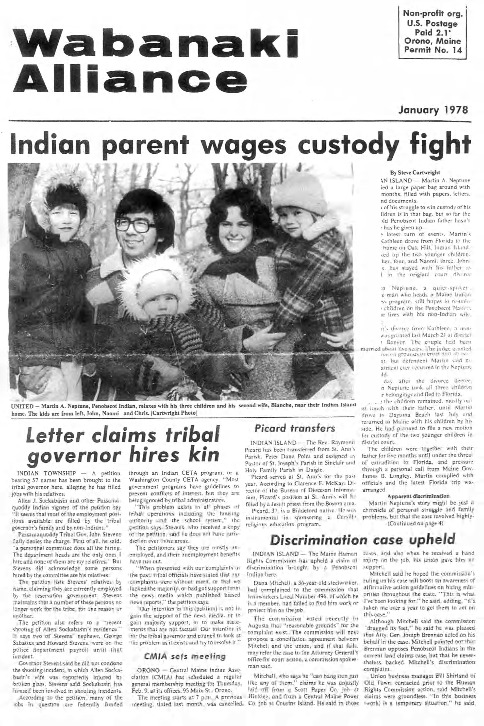
UNITED — Martin A. Neptune, Penobscot Indian, relaxes with his three children and his second wife, Blanche, near their Indian Island
home. The kids are from left, John, Naomi and Chris. [Cartwright Photo]
Letter claims tribal
governor hires kin
INDIAN TOWNSHIP — A petition
bearing 57 names has been brought to the
tribal governor here, alleging he has filled
jobs with his relatives.
Allen J. Sockabasin and other Passamaquoddy Indian signers o f the petition say
"It seems that most of the employment posi
tions available are filled by the tribal
governor's family and by non-Indians.”
Passamaquoddy Tribal Gov. John Stevens
flatly denies the charge. First of all. he said,
"a personnel committee does all the hiring.
The department heads are the only ones 1
hire and none of them are my relatives.”But
Stevens did acknowledge some persons
hired by the committee are his relatives.
The petition lists Stevens’relatives by
name, claiming they are currently employed
by the reservation government. Stevens
maintains that a number o f these persons no
longer work for the tribe, for one reason or
another.
The petition also refers to a "recent
shooting of Allen Sockabasin’ residence.”
s
It says two of Stevens’nephews. George
Sabattus and Howard Stevens, were on the
police departm ent payroll until that
incident.
Governor Stevens said he did not condone
the shooting incident, in which Allen Sockabasin's wife was reportedly injured by
broken glass. Stevens said Sockabasin has
himself been involved in shooting incidents.
According to the petition, many of the
jobs in question are federally funded
through an Indian CETA program, or a
Washington County CETA agency. "Most
government programs have guidelines to
prevent conflicts of interest, but they are
being ignored by tribal administrators.
"This problem exists in all phases of
tribal operations including the housing
authority and the school system,” the
petition says. Stevens, who received a copy
o f the petition, said he does not have juris
diction over those areas.
The petitioners say they are mostly un
employed, and their unemployment benefits
have run out.
“
When presented with our complaints in
the past, tribal officials have stated that our
complaints were without merit, or that we
lacked the majority, or had got support from
the news media which published biased
news reports,”the petition says.
"O ur intention in this (petition) is not to
gain the support o f the news media, or to
gain majority support, or to make state
ments that are not factual. Our intention is
for the tribal governor and council to look at
the problem as it exists and try to resolve it.”
CMIA sets m e etin g
ORONO — Central Maine Indian Asso
ciation (CMIA) has scheduled a regular
general membership meeting for Thursday,
Feb. 9, at its offices, 95 Main St., Orono.
The meeting starts at 7 p.m. A previous
meeting, slated last month, v/as cancelled.
Picard transfers
INDIAN ISLAND — The Rev. Raymond
Picard has been transferred from St. Ann's
Parish. Peter Dana Point and assigned as
Pastor of St. Joseph’ Parish in Sinclair and
s
Holy Family Parish in Daigle.
Picard served at St. Ann’ lor the past
s
year. According to Clarence F. McKay. Di
rector of the Bureau o f Diocesan Informa
tion. Picard’ position at St. Ann’ will be
s
s
filled by a Jesuit priest from the Boston area.
Picard. 37. is a Biddeford native. He was
instrumental in sponsoring a Cursillo
religious education program.
By Steve Cartwright
INDIAN ISLAND — Martin A. Neptune
has carried a large paper bag around with
him for months, filled with papers, letters,
photos and documents.
A saga o f his struggle to win custody of his
three children is in that bag. but so far the
26-year-old Penobscot Indian father hasn’
t
won. Nor has he given up.
In the latest turn of events. Martin’
s
ex-wife Kathleen drove from Florida to the
Neptune home on Oak Hill. Indian Island,
and picked up the two younger children.
Christopher, four, and Naomi, three. JohnJohn. six. has stayed with his father as
specified in the origian! court divorce
decree.
Martin Neptune, a quiet-spoken,
articulate man who heads a Maine Indian
wilderness program, still hopes to re-unite
his three children on the Penobscot Nation,
where he lives with his non-Indian wife.
Blanche.
Martin's divorce from Kathleen, a nonIndian, was granted last March 2 at district
1
court in Bangor. The couple had been
about five years. The judge granted
me divorce on grounus m cruet and abase,
treatment, but defendent Martin said no
such treatment ever occurred in the Neptune
household.
One day after the divorce decree.
Kathleen Neptune took all three children
and their belongings and tied to Florida.
There the children remained, mostly out
o f touch with their father, until Martin
drove to Daytona Beach last July and
returned to Maine with his children by his
side. He had planned to file a new motion
for custody o f the two younger children in
district court.
The children were together with their
father for five months until under the threat
of extradition to Florida, and pressure
through a personal call from Maine Gov.
James B. Longley, Martin complied with
officials and the latest Florida trip was
arranged.
Apparent discrimination
Martin Neptune’ story might be just a
s
chronicle o f personal struggle and family
problems, but that the case involved highly(Continued on page 4)
Discrimination case upheld
INDIAN ISLAND — The Maine Human
Rights Commission has upheld a claim of
discrimination brought by a Penobscot
Indian here.
Dana Mitchell, a 36-year-old steelworker,
had complained to the commission that
Ironworkers Local Number 496, o f which he
is a member, had failed to find him work or
protect him on the job.
The com m ission voted recently in
Augusta that “
reasonable grounds”for the
complaint exist. The commission will next
propose a conciliation agreement between
Mitchell and the union, and if that fails,
may refer the case to the Attorney General’
s
office for court action, a commission spokes
man said.
Mitchell, who says he "can hang iron just
like any o f them,” claims he was unjustly
laid off from a Scott Paper Co. job at
Hinkley, and from a Central Maine Power
Co. job at Cousins Island. He said in those
cases, and also when he received a hand
injury on the job, his union gave him no
support.
Mitchell said he hoped the commission’
s
ruling on his case will boost an awareness of
affirmative action guidelines on hiring min
orities throughout the state. "This is what
I’ been looking for.”he said, adding, "it’
ve
s
taken me over a year to get them to act on
this case.”
Although Mitchell said the commission
"dragged its feet,”he said he was pleased
that Atty. Gen. Joseph Brennan acted on his
behalf in the case. Mitchell pointed out that
Brennan opposes Penobscot Indians in the
current land claims case, but that he never
theless backed Mitchell’ discrimination
s
complaint.
Union business manager Bill Shirland of
Old Town, contacted prior to the Human
Rights Commission action, said Mitchell’
s
claims were groundless. “ this business
In
(work) is a temporary situation,” he said.
Page 2
Wabanaki Alliance January 1978
editorials
The commissioner
Housing Indians
A great deal is going on in the Indian housing business. New pro
jects are springing up on Maine’ three reservations every year, and
s
the whole appearance o f communities is in flux.
That appearance is more than cosmetic. New housing can change
the whole quality o f home life, and that, after all, is where life is
based. The benefits are obvious: safe, warm, spacious, attractive
houses mean healthier, happier families. Or that should be the case,
anyway.
Perhaps all this new construction is indeed a blessing, but we
wonder if its longer range effects are under scrutiny. Certainly the
new housing projects are a blessing for contractors, most o f whom
are non-Indian.
But what o f the Indians who live in these 550,000 houses? First of
all, if a family moves from a cramped, drafty dwelling to a spanking
new conventional suburban type home, the mere physical comforts
spell improvement.
But taking a closer look, we see these expensive new homes are not
in the least bit Indian in character, and reflect nothing o f native
American heritage. Further, many of the houses built to date are not
environmentally or aesthetically adapted to Maine.
An exception is Pleasant Point Passamaquoddy reservation with
its demonstration project for solar heated homes. But what about
woodstoves, roofs pitched to handle a snow load, and a home that
somehow harmonizes with the rugged weather and natural habitat o f
the northeast?
Many new Indian homes lack these things, and we don’know who
t
is responsible, who calls the shots. If tribal housing authorities have
surveyed Indians and learned that the kind o f houses being built are
exactly what Indians want, well and good.
But we doubt Indians are completely satisfied with what’ going
s
on.
We doubt Maine Indians want to sit back and watch the Indianness o f their communities obliterated by outside forces, however wellintentioned these forces may be. (We’ not so sure about good
re
intentions; there’a lot o f money to be made in the housing industry,
s
and more than one reservation job shows shoddy workmanship.)
Housing is more than four walls and a roof. Think for a moment
how much one can learn about someone by visiting that person’
s
home. When federal grant money becomes available to meet housing
shortages, the pressure is on to build, build, build. But is this
construction in the best interests o f Indians? Should Indians worry
about how new houses affect their lives and the character o f the
community?
Shelter is a necessity o f life, but it is much more than that. A home
is a spiritual center, a base for learning and growth. There is a
difference between a house and a home, and perhaps still another
difference between a home and an Indian home.
These things are subtle and less tangible than bricks and mortar,
but are the foundation o f Indian society.
WABANAKI ALLIANCE
Vol/l, N o . l
Januaiy 1978
Published monthly by the Division of Indian Services [DIS] at the Indian Resource Center,
95 Main St., Orono, Me. 04473.
Steven Cartwright, Editor
William O ’
Neal, Ass’ Editor
t.
DIS Board of Directors
Jean Chavaree [chairman]
John Bailey, CAP coordinator
Albert Dana
Timothy Love, CAP director
Jeannette Neptune, Tribal Clerk
Erlene Paul, Central Maine Indian Assn.
Roy Paul, Assn, of Aroostook Indians
Maynard Polchies, president, Aroostook Indians
Michael Ranco, Central Maine Indian Assn.
Indian Island
Pleasant Point
Indian Township
Indian Island
Indian Township
Indian Island
Houlton
Houlton
Orono
DIS is an agency ol Diocesan Human Relations Services, Inc. of Maine. Subscriptions to
this newspaper are available by writing to Wabanaki Alliance, 95 Main St., Orono, Me.
04473. Diocesan Human Relations Services and DIS are a non-profit corporation. Contri
butions are deductible for income tax purposes.
Whatever happened to the Commissioner o f the Maine Depart
ment o f Indian Affairs, one might ask.
Many, but not all Maine Indians are now federally recognized and
eligible for Bureau o f Indian Affairs (BIA) funds and services. That
may or may not alter the status o f Maine’ Indian commissioner.
s
What may have had more affect recently is the Indian land claims
issue, in which the State unilaterally opposes the Passamaquoddies
and Penobscots.
The State, briefly, is not on the best o f terms wr Indians. Also,
ith
the State is a political body and Gov. James B. Longley doesn’want
t
any clouds in his political future. He seems to be sitting tight on the
question o f a commissioner.
There hasn’ been a permanent commissioner since George M.
t
Mitchell, the second Indian to hold the post, quit over a dispute with
the Governor. The controversy arose from the land claims issue —
Mitchell said he couldn’ be neutral.
t
After Mitchell resigned, Longley named political consultant
Charles W. Rhynard as interim commissioner. Chuck Rhynard was
dubbed the “ day wonder” by some Indians, although he has
90
overstayed his original tenure.
Rhynard said Longley asked him to stay longer than the mutually
agreed upon 90 day term, and Rhynard accepted on condition he be
part time. He was to work part time until a replacement was named,
but there aren’ any successors on the horizon.
t
Perhaps Longley and other officials are hoping the problem will
just go away. Apparently, a number o f candidates for the job were
interviewed, but that’ the last we heard of it.
s
In fairness to Rhynard, he could have resigned and left the depart
ment in the lurch. He hasn’ But the Department o f Indian Affairs is
t.
on a skeleton crew, and wading in paperwork.
Set up in 1965 by then Gov. John Reed, the department was for a
time headed by John Stevens, a Passamaquoddy Indian and new
governor o f Indian Township reservation.
The department and the com m issioner’role can be a great plus to
s
Maine Indians, both as an official voice and as a contact with Statelevel politics and policies.
If the Governor and the Legislature, when they convene, d o not do
something about appointing a commissioner and maintaining the
Department of Indian Affairs, they should have to answer for it.
Wampanoag claims
There is no direct link between the Mashpee, Mass. Indian claims
and those o f the Penobscot and Passamaquoddy tribes in Maine, but
there are actual as well as important symbolic similarities.
In both states, native Americans are seeking some redress for
lands illegally taken from them, and ultimately, they are trying to
preserve their battered cultural customs and traditions.
Ironically, it is the very abuse o f Indian ways and the break-up of
Indian community that formed the basis o f the recent verdict in U.S.
District Court, Boston. The all-white jury said the Wampanoags do
not constitute a tribe.
Why aren’ the W ampanoags a tribe? Because whites took over
t
their lands, intermarried, and because Indians were assimilated into
the white culture. That's what former Nixon lawyer James St. Clair
argues, adding that W ampanoags have no unifying culture.
St. Clair represents the town and non-Indian landowners, a town
built on former Indian land. St. Clair says he sees no tribe, even
though Indians stand before him.
How would St. Clair know what a tribe is? The W ampanoag
Indians are a tribe that has survived as best they could in a system
that usually wants them extinct, or at least wants their culture
exterminated. No matter how few Indians there are, or how many
white ways they have adopted, the have a right to their cultural
identity.
In Maine, the Penobscots and Passamaquoddies won federal rec
ognition as a tribe. But obviously they are tribes with or without that
federal stamp o f approval.
Thank God, or the Great Spirit, that the W ampanoags have
persevered through wars, discrimination and white assimilation
tactics to stand tall in 1978 — two centuries o f survival — and call
themselves a tribe.
letters
Really proud
Alliance criticized
Bangor
To the editor:
As one who believes that unremitting
praise tends to make one overly confident in
performance, I wish to offer some questions
and criticisms to obviate such an occurance.
Firstly, I wonder why the editor began
anew with “
Vol. 1” since there have been
other editions of the Wabanaki Alliance?
Secondly, though not questioning his
enthusiasm and interest in the Indian com
munity, and realizing that he was perhaps
approved by the all-Indian DIS Board, I
wonder how effective the non-Indian
assistant editor will be in relating to the
Indian community?
Thirdly, the omission of the colorful logo
that introduced previous volumes is blind
ingly evident. Just how “
brightly colored”is
the mural pictured in black and white on
page 3 of the Dec. issue? Is the cost of color
prohibitive, especially where the paper
issues monthly?
Fourthly, though I realize that news about
Indians outside of Maine may be interest
ing, I yet question its inclusion to such an
extent in a paper geared toward Maine In
dians. Perhaps as much as one-half of
December's issue relates in content or
authorship to non-Maine Indians. And I
question the policy o f publishing articles
submitted by those who wish to remain
anonymous.
Paul A. Francis, Jr.
Return collar, cuff
Boston
To the editor:
I would like to receive the Wabanaki
Paper. I am Penobscot and Maliseet from
Indian Island. I’ read the paper and I'm
ve
really proud that they got people together
and published a fine paper.
Also, could you please say hello to my
aunt Vivian Massey for me.
Carla Francis
Sadly needed
Bass Harbor
To the editor:
Thank you for putting me on your mailing
list. You do not mention a subscription
price, but I enclose my check for five dollars,
as I do not think I should receive it for
nothing.
Such a publication is sadly needed in
Maine, and I hope it continues to reach a
wider and wider audience. I have great
admiration for what you are trying to do, to
establish the Indian identity and way o f life
which has been so cruelly denied for so long.
I think there is more o f an audience now
for the Indian ethic than in the past, if it
could just be reached. I hope the Wabanaki
Alliance can contribute to that outreach, as
this country has much to learn for its benefit
from the “
Indian way.”
Right on!
Hollis Piatt
Solar panels at Pleasant Point
These solar panels are in use at the Pleasant Point Passamaquoddy Reservation, as an
experimental project of the tribal housing authority. Results won’ be known until spring,
t
according to housing officials.
____________________ ____ _____
Commentary:
Prison life for an
Apache-AAicmac
By Bill O ’
Neal
NORFOLK PRISON. Mass. — A letter to
the editor in the December issue of
Wabanaki Alliance concerning prisoner
To the editor:
David Brady, a Micmac-Apache. prompted
In the November 1977 issue o f your paper,
us to write to him about his experiences in
there was another letter to the editor con
prison. His reply detailed some o f the
cerning a picture. In the letter, Eunice
tensions and even horrors which befall
Baumann made inquiries concerning the
Indians entering prison and provides a tragic
collar and cuff set belonging to the Pen
reminder o f what society is like when a
obscot Indian Nation.
Mattawamkeag person, in prison or not, has surrendered or
1have heard from several people that the
To the editor:
lost control o f his rights and is subject to the
last Governor to wear the collar and cuff set
Thank you very much for sending me will of others.
at inauguration was Francis Ranco and the
Wabanaki Alliance. I am more than a little
It was not necessary to open Brady’letter
s
last person to wear the medallion was John
distressed by many o f the articles, but to see the first signs of the pressures under
Mitchell.
These are Tribal belongings and a part of realize the truth must be faced and which he lives. He had taped all the sealed
accepted. Please continue to send me the parts o f the envelope to ensure that its
our lost traditions. They should be turned
paper as there are also many brighter sides contents could not be tampered with
over to some caretaker for future governors.
in the picture o f Indian affairs.
without being noticed.
They were never meant for an individual.
Shirley Potter Hanscom
In addition to having to tolerate the con
Karen Rhine
tempt of some of the prisoners, he has
charged that he receives little better treat
ment from some o f the guards. He states
that he has received Disciplinary Reports for
alleged infractions ranging from “
putting
too much butter on my bread to being a sus
picious person in my sleep. I guess the guard
thought in my dreams 1was plotting against
him. I have had verbal abuse thrown at me
from guards as well as cons, but this is to be
expected from an ignorant civilization.”
For these same Indians chose legend as
It’true that at your peak I mostly felt
s
When his daughter was murdered in 1975,
I'd done it then at last — I'd conquered you: the way to meet on truthful terms with you,
he received such remarks as, “
The only good
the fact that twice I’ nearly turned back
d
and even as I made my slow descent
Indian is a dead Indian.” Brady stated, "1
the reason for this started coming clear
down,
have to keep reminding myself I’ in a
m
in that I knew your reach down into me
that my whole body seethed with ache and
civilized society."
strain —
was no whit less than mine upwards to you.
Harrassment of Brady has gone beyond
these things were lost beneath the spread
verbal abuse and threats. He alleges that in
of joy
August of last year two individuals jammed
that came like spreading rain across
As mists swirled by across the tableland
the door of his cell while he was sleeping and
parched earth.
I realized suddenly the white-blazed trail
hurled a blazing jar o f gasoline onto the
was now a lifeline o f the frailest kind;
I revelled in the thought that everything
floor near him. Fortunately, he was able to
as thunder snarled and boomed I tried to
to see necessitated looking down —
get himself and two kittens which he was
hear
far down the northern steeps to Chimneykeeping to safety. This safety was short
just vacuum-filling air, but knew as well
Pond,
lived, however. Several weeks later he was
I somehow heard Pamola voicing ire.
or just down to the Knife Edge running
called out o f his cell on what he considers to
east —
have been a “
wild-goose chase.”While there
but even as I did so I began
So I know now that I will always think
(in the office of the officer in charge), one of
to feel my burgeoned sense o f triumph wane. o f you whenever I shall take stock of
the civilized convicts in my block went into
the scope o f my own dreams, the limits of
my cell, picked up my kitten, and proceeded
And what this had to do with was your vast
my strength, the kind o f life in legend I
to strangle her . . . then this individual put
indifference to terms like this o f mine —
and my own people have, or do not have —
her in a paper bag and left her outside my
that I and others reached your highest point
and thus our conversation, endless into time. cell door . . . I found her as she was left.”
was even less the point than was the fear
Although Brady feels that harrassment
that kept the Abenaki Indians
from the guards and inmates is in part due
Richard Aldridge
in olden days from climbing you at all.
to the fact that he is an Indian, his opinion
o f the prison superintendent is slightly dif
Old Town
Distressed
Poetry
Conversing with Katahdin
ferent. “
The superintendent discriminates
against everybody here, guards as well as
cons. He has the viewpoint o f he doesn't care
if you’ white, black, yellow, or red; you’
re
re
below his standpoint whether you be con or
guard ... I am not sticking up for him. I am
just facing reality in the whole situation.”
Though plagued with enemies, Brady is
not without some friends and support. “
A
lot o f white cons in my block and in the
prison are behind me all the way, as well as
white administration workers, so any dis
crimination is coming from a small group.”
Still, there seems to be little he can do
within the prison environment, where people
with authority over him are free to make and
break rules as they see fit. He stated that the
prison infirmary recently denied him
medication, which a doctor had told him he
had to take on a regular basis. Fortunately,
help from the outside in the form o f his
lawyer convinced the officials to reconsider.
Within prison there is little Brady can do
to defend himself. He refuses to name the
people who are persecuting him. “ won’
I
t
and can’ as this type of thing is against all
t,
the principles I have been taught in life.”He
also could take a protective custody, which
would remove him from most o f the people
harrassing him, an alternative he refuses to
accept. “ will not let a person who hasn’
I
t
the guts to come to my face and fight like a
man . . . make me run to a cell where I’ be
ll
locked up 23 hours a day. He also pointed
out that o f 26 prisoners killed in Walpole,
Norfolk, and Bridgewater Prisons in Massa
chusetts in the last three years, 22 have died
in protective custody. He stated that the only
way his situation can improve is if he is
moved to a minimum security institution.
With few places to turn within the prison,
Brady has had to rely on his own resources
and his culture to face the forces which are
against him in the prison. He said he has
done this by “
being myself, as I was raised;
by being proud of who I am and being proud
o f my people.”In 1971 during the unrest in
the Massachusetts prisons he along with
three other Indian prisoners started the
Indian Rights Group. Presently this group’
s
outside sponsor is the Native American
Indian Association, Worcester, Mass.
Last June, Brady’ case was accepted in
s
the Massachusetts State Supreme Court,
and it is here that he has pinned his greatest
hopes. “
When out, I will go to South
Dakota, pick up my wife and return to
Canada, where I’ from,” he said.
m
Page 4
Wabanaki Alliance January 1978
Indian custody fight
Jury rejects Mashpee status
By Bill O’
Neal
BOSTON — After a ten week trial, an all
As Martin sees it, Maine was all too ready
white jury has decided that the Wampanoag
to bring a case against him through extra
dition to Florida, but when the tables were Indians o f the town o f Mashpee, Massa
reversed, and Kathleen had broken the law, chusetts did not constitute a tribe, when the
Maine officials refused to lift a finger for Massachusetts Legislature in 1870 voted to
change Mashpee from an Indian land
him.
“
They’ going all out to put me in jail, district to a town, nor are they a tribe today.
re
The jury returned the decision in response
but they wouldn’ do a thing to help me
t
when I needed help,” Martin said, adding to three questions delivered by Judge Walter
that he believes his custody fight has taken J. Skinner during his instructions to the
on political dimensions and is not being jury. The jury concluded that the Indians
were a tribe in 1834 and 1842, but not in
considered on its own merits.
1790, the date of the U.S. Non-intercourse
Martin goes further than his personal
Act, and 1870. when the land was converted
case to say that it’ about time officials
s
into the town o f Mashpee. Without tribal
recognized there is a need for a national
custody law, to prevent the chain o f events status there is little chance that the Mashpee
Wampanoags can press their claim that
he has undergone.
Martin’ paper bag, which he finally forming the township was in violation o f the
s
1790 Non-intercourse Act, which prohibited
replaced with a new one after the other gave
all land transactions with tribes without the
out. contains considerable correspondence
sanction of the U.S. Congress.
with parents undergoing similar custody
Selectman George Benway o f Mashpee.
hardships. He has also located organizations
contacted by Wabanaki Alliance, said that
concerned with custody problems.
the jury had been instructed by Judge
Martin Neptune has learned he is far
Skinner that the burden o f proof rested with
from alone in his struggle.
the plaintiffs (the Indians) and that, if they
But Martin is also Indian and male. He
felt there was insufficient evidence, they
considers those facts two strikes against him
were to decide on the tribal issue in the
in the custody fight.
negative. Benway said he felt the jury could
‘
Screwed by system’
not determine the tribal status of the Wam
One Maine official agreed to comment
panoags around 1790 and, so, tendered a
publicly on Martin’ case, and admitted
s
negative decision for that date. He further
Martin Neptune received poor treatment.
surmised that the jury had decided against
"There is no question he wasn’ helped.
t
the Indians for the 1869-1870 date, based on
He was screwed by the system." said Charles
defense arguments that the tribe had re
W. Rhynard. commissioner o f the Maine
linquished its tribal status at that time,
Department o f Indian Affairs.
when it requested the rights of town mem
"The system did not provide good or
bership. He said that, "relinquishment has
adequate service to Martin, and I think he’
s
continued up to the time the suit was filed.”
justified in his feelings.”Rhynard said in a
In an interview with Wabanaki Alliance,
telephone conversation from his Augusta
Russell Peters, president of the Mashpee
office. "The legal system didn't do anything
Wampanoag Tribal Council. Inc., objected
to help him when he needed help." Rhynard
to Judge Skinner’ instructions to the jury
s
continued.
that the burden of proof rested with the
But when asked if Maine officials could
Indians. He stated that this ran counter to
be blamed for the situation. Rhynard said
all precedent in suits o f this nature.
that no. the Attorney General's office, and
Peters characterized the jury's decision as
Governor Longley. "went the extra mile" on
“
inconsistent” and "illogical.” He stated
Martin Neptune's behalf.
that the jurors “
didn’ understand the
t
Martin Neptune fights on. As o f press
issues”
and that making such a decision was
Kathleen’ lawyer. Donald C. Jacobson, time. He said he planned to visit the Maine
s
difficult for them after only "a crash course
also said that "during the proceedings o f the Human Rights Commission, and possibly
to learn Indian history and culture.”
divorce. (Martin) screamed and shouted also an office o f the U.S. Civil Rights Com
Peters also felt that the expert witnesses
‘
discrimination.’
”
mission. He said he would continue to wage
called by the defense were not well qualified
A denial from judge
his battle with letters to officials and others.
to give testimony in the case. He stated that
The judge who awarded the divorce And a motion seeking custody o f Chris and
Dr. Jane Guilliman. a sociologist at Boston
settlement at Maine District Court in Naomi has been scheduled for a hearing in
College, "just didn’ know much about
t
Bangor did not let the lawyer's allegations March, at district court. Bangor.
Wampanoag history.” He added that she
go unanswered.
What Martin really wants is to know that
"drew her conclusions after three interviews
Judge F. Davis Clark wrote in an open his children can grow to maturity in a stable,
down in Mashpee.” Referring to a second
letter that “
The allegations that Mr. loving home, not separated from one
defense witness. Dr. Frank Hutchins, he
Neptune was given custody because he is an another.
said, "Until the last six months he was
Indian is unfounded. It was based upon the
Martin ended a letter to Ass’ Maine
t.
ignorant of eastern Indians.”
evidence. The allegation that (Neptune) Atty. Gen. Richard S. Cohen with the state
The composition o f the jury, all white, was
screamed and shouted ‘
discrimination’ ment: “
When each o f my children were
also disturbing to Peters. O f the potential
during the proceedings is ... unfounded. He born. I committed my life to seeing that
jurors, only one was black and only one
did not.”
their happiness, well-being and potential
claimed Indian heritage. Both were rejected.
Martin says Davis has been fair, and not were realized. This is o f the utmost im
Peters stated, "Regardless o f how wellunsympathetic to his case. He cannot say the portance to me.
meaning the jury was ... a vote for us would
"N o one will break that commitment.”
same for other authorities.
mean white settlers would lose land in
Mashpee.”
He noted that the Indians had gone to
Washington to try to negotiate a settlement
WASHINGTON — Under Secretary of ship on B1A employees and upon estab
which would remove the cloud from the
the U.S. Department o f Interior James A. lished relationships between tbe tribes ana
property o f homeowners and businessmen,
Joseph announced today the appointment of BIA offices.
"but the selectmen refused to go along.”In
a task force to develop recommendations for
The 11-member task force includes
his opinion real estate interests among
the Secretary on the reorganization o f the representatives o f the National Congress of
certain o f the town’ selectmen influenced
s
Bureau o f Indian Affairs.
American Indians and the National Tribal
their decision to reject efforts to settle with
“
Secretary Andrus wants to insure that Chairmen’Association; two representatives
s
private landowners. According to Peters
the trust responsibilities o f the Federal Gov o f the BIA named by Assistant Secretary for
these interests feared that “ a partial
if
ernment are carried out effectively, that Indian Affairs Forrest Gerard; Acting
settlement let the homeowners o ff the
services to Native American people are Assistant Secretary for Policy, Budget and
hook.” they would no longer continue to
provided efficiently and that tribal govern Administration Larry Meierotto; and six
back the developers in the law suit. 80% of
ments are strengthened,”
Joseph said.
public members. The public members
the land involved in the suit is undeveloped
“ part o f a continuing effort to meet include Stewart L. Udall, former Secretary
As
land.
this objective a Task Force on the reorgani o f the Interior.
zation o f the Bureau o f Indian Affairs has
R ecom m endations o f the American
It has been estimated that approximately
been established to formulate and present Indian Policy Review Commission and other
$600,000 has already been spent in the
recommendations to the Secretary for im studies o f the Bureau and its responsibilities
town's defense, approximately half o f this
mediately improving the management, will be considered.
bein g provided by “
titled insurance
organization and practices o f the Bureau.”
Among the areas for improving the per
companies with a national interest in
Under Secretary Joseph said the study is to formance o f BIA which will be studied are:
defeating land claims.”
be comprehensive and the changes will be planning, advocacy, trust protection
Benway claimed that the Indians had
fundamental — not just cosmetic. He em services, human resource development,
stated from the outset that they were not
phasized that the changes will be instituted natural resource development, social service
interested in reimbursement for privately
in an orderly fashion to minimize any hard- delivery, personneL
owned land, but that when U.S. Sen.
(Continued from page 1
)
placed officials in Maine and Florida, and in
Martin’ opinion, involved substantial dis
s
crimination.
To Martin the discrimination is obvious:
when Kathleen took the children to Florida,
including John who was awarded to his
father, the judicial system did nothing. But
when he returned the children to Maine,
authorities seemed to pounce on Martin
with a new-found zeal.
When Longley received a request for
Martin's extradition from Florida officials,
he called Neptune and said he would wait
ten days before signing them. He told
Martin to return the two younger children to
their mother within that time, and Martin
did so.
Martin said he did everything he could to
set matters straight, talking to district
attorneys, his lawyers, the Maine Attorney
General’ office and the State Department
s
of Indian Affairs. But it all appears to have
been to no avail.
"Probably if I were white, middle or
upper class, it would be a different story.”
said Martin.
“ started with the judge in Florida, who
It
took a personal offense to me when he
ordered me to stay in the State and I left.
From there it went up to (Florida Gov.)
Rubin Askew (who contacted Longley).”he
said.
Martin began to feel the Florida courts
would not give him a fair hearing, and
would favor Kathleen in deciding the
custody case brought by the mother in that
state. Martin was not encouraged when he
learned the judge’name was Robert E. Lee.
s
Jr.
When Kathleen brought her action in
Florida court, her lawyer notified Martin of
a hearing and said. "Your petitioner feels
that the only reason the court in Maine
would have awarded custody o f the parties’
minor child (John, to father) was because of
the fact that (Martin) is an Indian, and there
are discrimination problems with the Indian
in Bangor, Maine.”
Task force to study B1A
Edward Kennedy, D-Mass., proposed legis
lation to uncloud the land, “
suddenly it had
a price tag” o f $20 million dollars.
According to Benway, this figure was
“
quickly changed to $4 million,”to be paid
by the Federal government. He said Ken
nedy’ attitude was one of, "What are you
s
worried about? It’ not your money.”
s
Benway stated that the selectmen w-ere
not willing to accept the proposed package
which would have unclouded private homeowners’land, if it did not include 1,500
acres o f property which have been
developed, but not acutally built upon yet.
He said this was necessary to restore the
market value of the homes in Mashpee and
to "bring the economy back." "W e would
have been run out of town, if we had
accepted the offer,”he added.
Charges of “
racial tactics” were levelled
by Peters at the methods used by the
defense. He stated, "The defense was trying
to say we weren’Indians; we were blacks.”
t
He added that the defense "didn’bring out
t
that most intermarriage was to whites.”
Benway called the allegations o f racism “
a
smokescreen.”
Lawrence Shubow, an attorney for the
Mashpee Indians, elaborated on this aspect
of the trial in a conversation with Wabanaki
Alliance. He stated that false racial im
pressions were generated in part by an 1870
U.S. Census, introduced by the defense in
evidence and describing the Indians as
being largely Negro. Shubow termed this
"historical nonsense.” He continued that
the Indians at one time had been referred to
and had sometimes referred to themselves as
"colored.”but that the connotation bore no
relationship to the Negro race, as it has in
more recent times. He suggested that the
defense was implying the Mashpee Indians
were "black, so you can forget about them.”
Shubow reiterated his definition o f a
tribe, given in a recent United Press Inter
national release. "A body of Indians, (of)
common ancestory. united under a com
munity bond, under a government leader
ship, and common territory — that’ what
s
we think a tribe is.”Shubow told Wabanaki
Alliance the issue was not so much over the
definition o f a tribe, but over what con
stitutes leadership. He said the white con
cept o f leadership "does not fit with the
Indian’forms o f decisions.”He pointed out
s
that leadership in Indian society is much
more "democratic,”with less emphasis on
one person telling the rest what to do. He
said that the improper definition o f lead
ership “
gave the jury the out they needed.”
Buoyed by the results o f the trial, Benway
plans to urge U.S. Rep. Gerald Studs, DMass., and U.S. Sen. Edward W. Brooke. RMass., to introduce legislation exempting all
private property from the Indian claim.
Benway said he hopes this will “
short-cir
cuit”an appeal by the Indians. This would
leave all but 1,500 acres of the disputed
13.000 acres with unclouded titles.
The jury's decision will only be viewed as
a recommendation by Judge Skinner, who
will reserve final judgement until both sides
have subm itted briefs this month,
commenting on the verdict. According to
Peters, "This trial is a long way from being
over.” He said that if the court decides
against the Indians, an appeal will be made.
Shubow also mentioned the possibility of
seeking to have a mistrial declared, if the
jury’ verdict is upheld. He stated that the
s
jury, considering whether the Indians con
stituted a tribe on two different dates, using
the same evidence for both dates, reached
different conclusions. He stated, “
There
are elements o f absurdity which the courts
will have to straighten out."
When asked if he thought the results of
the Mashpee trial would have any bearing
on the land claims suits in Maine, he
replied, “
Absolutely not,” although he
added that there may be some psychological
effects on both sides o f the issue.
On the day the jury reached its verdict in
the Mashpee case. Maine Attorney General
Joseph Brennan’ office announced that
s
Brennan’request to reopen the question of
s
the tribal status o f Maine Indians had been
denied by the U.S. Justice Department.
Nutrition
Notes
By Natalie S. Mitchell
Everybody knows that food is vital to sus
tain life. However, what about food? What
is it that makes it so important?
We’ start with the word, "vitamin.”This
ll
means, “
Vital to Life.” There are various
vitamins contained in food and each has a
function when consumed. Vitamin A. for
instance is important for the formation of
the mucous membranes (the lips, nasal
mucosa, which also is the lining o f organs,
and digestive system), it is also necessary' for
the visual purple that prevents night blind
ness and increases resistance to infections.
Food sources that contain vitamin A are
usually dark green and deep yellowvegetables. The dark green vegetables
include kale, mustard greens, broccoli,
spinach, turnip greens, and collards. The
deep yellow vegetables include carrots,
pumpkin, sweet potatoes, yellow squash,
and some red peppers. Other excellent food
sources for vitamin A are liver, milk, cheese,
eggs, butter, cantaloupe, apricots and
fortified margarine.
Your body does not get rid o f vitamin A
when ingested. It is stored in the liver. If you
overload on this vitamin, the results can be
toxic. By eating regular foods that contain
vitamin A this will not happen.
The point is, don’ take vitamin tablets
t
unless your doctor prescribes them for you.
Natalie Mitchell
NOTE: Natalie Mitchell, a Penobscot, is
food and nutrition coordinator for the
Indian Island Health and Social Services
Department. With this issue, she begins a
monthly nutritional information column for
this newspaper. Reader com m ent is
welcome.
Wheel deals
By Kathy Porter
Tim Love, a Penobscot from Indian
Island, purchased a 1976 Volare station
wagon from a Brewer auto dealer.
After buying the car in May o f 1977 he
suspected that the car had been in an
accident and had had some repairs, but was
not com pletely repaired. He noticed
structural damage which he was unable to
get repaired. Also the windshield leaks and
the car shakes when driven.
Tim will be going to Northeast Combat, a
consumer action group, for assistance to
rectify legally what can be done. Tim feels
that the dealer knowingly sold him a
defective car.
These kinds o f situations can be avoided.
Northeast Combat is an agency that helps to
educate the consumer in all areas o f buying.
They also deal directly with consumer
problems. They are located on Idaho
Avenue in Bangor.
They have just put out a booklet called,
‘
Wheels, Deals and Lemon Peels’ The
.
booklet is designed to help the consumer
become aware of his or her rights, avoid a
bad purchase, and to get through the maze
o f slick sales people, confusing credit rates
and flashy advertising.
The booklet is available for $1.50 from
Combat.
Dispute ended
on water rights
WASHINGTON — Secretary of the In
terior Cecil D. Andrus announced today
approval o f an agreement between the Gila
River Pima-Maricopa Indian Community
and the Kennecott Copper Corp. to settle a
long-standing dispute over w'ater rights in
Arizona’Gila River watershed.
s
Under the agreement, the Indians consent
to Kennecott’ continued use of water from
s
Mineral Creek, a tributary of the Gila River,
in its mining operation upstream from the
Indian Reservation.
In return, Kennecott agrees to pay the
Indians $1.5 million for past use of the water
and to replace or pay for water it uses from
that source in the future. The mining firm
has committed itself to seeking an allocation
of Central Arizona Project (CAP) water to
exchange with the tribe for Gila River water.
Until that is available. Kennecott will pay
the Indians $70 per acre foot of water used.
The provision for payment for Mineral
Creek water expires when the CAP is com
pleted or in 1990 with the possibility of a 1
0year extension. K ennecott agrees to
relinquish its claim to Mineral Creek water
in 1990. The settlement also resolves a
dispute over water Kennecott pumps from
four deep wells in the area and the effect of
that pumping on Gila River flows. Under
the agreement, the Indians consent to the
pumping until the year 2075; Kennecott
agrees to pay $70 an acre foot for a portion
of the water it pumps.
"Anyone who has followed Western water
disputes — particularly in the desert south
west — can only view this agreement as a
major achievement,” said Andrus. “
I
certainly commend both parties for reaching
a sensible, mutually beneficial resolution
without costly, time-consuming court suits
which might also have seriously disrupted
the state’economy.
s
"While both sides were willing to litigate
their claims if necessary, they agreed that
would work to everyone’disadvantage. The
s
Indians’
prime concern is water, but they
were reluctant to disrupt Kennecott’
s
mining operations, a major force in
Arizona’ economy. Under the agreement,
s
Kennecott will have the water so critical to
its mining operations. The Indians have
taken steps to ensure future water supplies
to the reservation."
Although the parties pledge in the agree
ment not to sue each other over the disputed
water rights, neither party abandons its
claims, Andrus said.
Kennecott claims it is using water it is
entitled to under the 1935 Gila Decree or
water from its tributaries which were
expressly excluded from the scope o f that
decree. The Indians counter that they were
not a party to the decree, that it is not
binding upon them and that, in any case, it
does not settle the water rights to which they
are entitled under the Winters Doctrine.
The doctrine, developed by the courts over
the years, holds that Indians are entitled to
enough water to serve the purposes for
which their reservations were created. The
doctrine establishes a priority water right
dated no later than the creation of the
reservation.
The Gila River Indians have the longest
history o f irrigated farming in the nation
through their Hohokam ancestors who used
an extensive system o f canals to irrigate the
Gila River Valley lands. The reservation was
established in 1859 and has been expanded
since to its present 372,000 acres.
While Kennecott and the Indian Com
munity are considered to be the major
claimants in the watershed, they are not the
only ones. Andrus said his approval o f the
agreement as trustee for Indian water rights
implies no position on any water rights
within the Gila River drainage, including
those of the San Carlos Irrigation and
Drainage Dist., a major agricultural user
downstream o f the water sources involved in
the agreement.
In a letter to the Secretary, Alexander
Lewis, Sr., Governor o f the Indian Com
munity, termed the approval of the agree
ment “ historic occasion.”
a
“
The agreement recognizes that we have
always befriended non-Indians.’
Wabanaki Alliance January 1978
Page 5
VISTA worker joins Alliance
Kathy A. Porter
ORONO — Wabanaki Alliance plans to
publish a monthly column o f consumer
information, written by a new member of
the staff who is a VISTA volunteer.
Kathy Porter, on a one year program with
VISTA (Volunteers In Service to America),
may carry out other assignments at the
newspaper, in addition to the consumer
column. For her consumer research, she will
use the resources o f Northeast COMBAT,
Inc., a Bangor non-profit consumer action
group.
The consumer column will probably deal
with a range o f subjects such as shopping for
used cars, homes, insurance and other issues
of interest to Maine Indians and others.
Questions and suggestions from readers will
be most welcome as a guide to the column’
s
content.
What the column does, and whether it’
s
useful, will depend in part on reader
response.
Kathy Porter will work under the
direction o f Wabanaki Alliance and Vivian
Massey, supervisor of the Maine Indian
section o f the national VISTA program.
A native o f Old Town where she currently
resides. Kathy Porter, 20. graduated from
Old Town High School and has worked with
racing horses at Bass Park. Bangor, and
with riding horses at Orono. She is
interested in consumer affairs, and news
paper work in general.
Cote succeeds Daigle at island
INDIAN ISLAND — After two-and-onehalf years o f service at St. Ann's Mission.
Indian Island. Old Town, the Rev. Donald
R. J. Daigle has been appointed temporary
administrator o f St. Joseph's Parish at
Wallagrass. in Aroostook County.
Wabanaki Alliance talked with Father
Daigle as he was preparing his papers for
transfer to St. Joseph's. When asked what
he felt his major emphasis had been, while
on the reservation here, he said he had
worked primarily with the youth. He said he
felt that he had turned St. Ann's into more
o f an "open house.” and that it was "no
longer a sanctuary." inaccessible to the
people it was designed to serve.
He said the Penobscot Indian people
whom he served were "sincere and wise.”
but stressed the need for self-determination,
saying they are "imprisoned, unable to fly
toward freedom o f spirit . . . locked bv
dependency."
A native of Aroostook County and having
been associate pastor at St. Thomas in Madawaska, Daigle will be working among
family and friends. He is bilingual in
English and French, which will be
invaluable in reaching the French speaking
community in Northern Maine.
The Rev. David P. Cote will be replacing
Father Daigle at St. Ann’ Father Cote
s.
holds a Masters Degree in Social Work from
Boston College School o f Social Work and
Rev. David P. Cote
has used his training in social programs
throughout the stale.
In 1975. he was appointed Director of the
Diocesan Resettlement Program, in charge
o f placement o f Vietnamese refugees. Since
1976. he has been the associate pastor of the
Cathedral o f the Immaculate Conception in
Portland.
Wayne Walker, regional director o f the
Diocesan Human Relations Services in
Orono described Cote as "very energetic”
and said he would be a dynamic force in the
Indian Island community.
Tribal status affirmed
AUGUSTA — The U.S. Justice Depart
ment has denied a bid by the State o f Maine
to reopen the question o f the status o f Passamaquoddy Indians.
Maine Atty. Gen. Joseph Brennan was
quick to criticize the Justice Department
decision. He is quoted by the Associated
Press as saying, “
Although the government
had not expressly so stated, I gather that the
Justice Department is o f the view that they
are obligated to argue the Indians’claim,
even if they do not believe that it will
necessarily be successful. I think it is un
fortunate that the department has such a
narrow perspective of its responsibilities.”
He further stated, “ would like to give
I
(Assistant U.S. Attorney General James
Moorman) some advice. I think the federal
government ought to ask itself whether it is
doing justice by pursuing a 200-year old
claim against the innocent citizens of
Maine."
“ think the federal government ought to
I
ask itself whether it is pursuing a case which
flies in the face o f 200 years o f history. I
think the federal government ought to stop
pretending they have done as much research
as we have and take a good hard look at the
historic facts. I think the United States
government is wrong.”
Moorman denied Brennan’ request
s
saying that the historical and legal evidence
submitted by the Maine Attorney General’
s
office was not adequate to merit reopening
the case.
In a UPI story Moorman stated, “ the
On
basis o f this material, as well as additional
legal and historical research, we have con
cluded that the prohibition against Indian
land transactions applied throughout the
United States. At this time, therefore, the
Department o f Justice cannot agree to your
(Brennan’ request.”
s)
The determination both that the Passamaquoddy and Penobscots do constitute
tribes and were covered by the Non-intercourse Act o f 1790 has been a keystone in
the development o f the land claims case, in
which the tribes charge that lands
comprising two-thirds o f the state were
taken from them in violation o f the Non
intercourse Act.
Page 6
Wabanaki Alliance January 1978
Indian legends
The Story of the Big Dipper
(Penobscot)
In the old day o f the ancients there lived a
poor family o f seven brothers and two sisters
on the edge of a large village. Their parents
had been killed and the care o f the family
had been left to the oldest brother and his
sister, Mooin.
They were strong and brave and soon took
part in the tribal festivals and won great re
known for their devotion to each other.
Each one worked hard and long except
P’
ses-muk, the youngest brother and Alakus, the youngest sister, for they were frail
and small. And they both loved their
brothers. But they helped in their own way
by sewing and decorating the skin garments
with dyed porcupine quills. And when their
relatives came to feast they would clean the
wigwam and decorate it with sweet smelling
maiden-fern and spruce boughs.
One day while the brothers and Mooin
were planting the corn in a large field, an
old warrior crept into their wigwam. He told
them he had escaped from an enemy camp
where he had been tortured and held
prisoner for years. There he had heard the
enemy planning to attack his people soon, so
he managed to flee in order to warn them.
The brother called the Chief and all the
people. He sent four large scouting parties
in the direction o f the four winds. The six
brothers pleaded with the Chief not to
separate them. So he sent them toward the
east.
While they were preparing for the war
path, the youngest brother, P'ses-muk
begged them to take him along. He was
strong enough, he reminded them, to carry
their quiver o f arrows and to cook for them.
But they would not listen to him.
“
Little brother, next time thee will be as
tall as we. And someone must care well for
Al-akus with kindness. We dearly love you.
also Mooin. But she who is strange, is unlike
us. Badly we regret leaving you," the older
brother said.
After the brothers had gone, Mooin made
P’
ses-muk and Al-akus work very hard. She
was not kind to them. She would eat the best
pieces o f meat and fish and leave them what
was left. They did not complain to anyone
for they had begun to be afraid o f their
oldest sister. So instead o f getting stronger
they grew frailer and frailer.
In the evening when they had finished
their day’work they would wander hand in
s
hand to the edge of the forest or to the top of
the high hill to see if they could catch a
glimpse of their brothers returning to them.
One day Mooin disappeared and did not
return that night. They hurried to their
unde and told them what had happened.
When she did not come home for many days
the old uncle decided that she must have
been killed or carried o ff by the enemy.
One day when the uncle was hunting he
thought he saw Mooin disappear in a cave
which was in the side of a mountain.
Soon the crops began to be eaten by bugs.
Many o f the old people died from strange
diseases. And children disappeared and
were never heard o f again.
The people called their Medicine Man.
He warned them that someone was making
magic on the tribe and that his power was
not strong enough to learn who the Evil One
was among them.
The uncle hoping to help his people said
that Mooin might be the cause of the great
Evil. He led them to the cave on the side of
the mountain. There they waited until
Mooin left her cave.
They waited until they saw her disappear
in the woods beyond and then they rushed
into the darkness. In the distance they could
hear the growl of a bear.
So they built a fire at the entrance o f the
cave. And when the darkness became filled
with strong smoke, the bear rushed out and
they fell on him and killed him.
When Mooin returned from the woods
where she had been hunting she found the
Great Magician dead and she wept for him.
For in killing the bear the people had killed
her husband. Angrily she swore vengence on
her people.
The next night she cut a piece o f bear
skin and made it into a bag for it contained
magical power. When she wore it around
her neck she instantly became a large, fierce
bear.
She ran down to the village where it was
dark and still. Swiftly she destroyed all of
her people and the entire village. But she
saved her youngest sister and brother
because she still loved them in her way and
she did not want harm to come to them.
Then she took P’
ses-muk and Al-akus to
the cave with her.
For a long time they lived peacefully to
gether. But the youngest brother and sister
never ceased to fear their sister, Mooin.
They held their tongues, not daring to speak
to each other for fear Mooin might hear
them.
One night when they were pretending to
sleep they saw her take out the magic-bear
skin bag from her bosom and sing over it.
This frightened them very much.
She was still very cruel to them. She would
send them out to gather firewood and hunt
and fish while she stayed at home and sang
over the bear skin bag.
One day P’
ses-muk stayed away longer
than she thought necessary so when he came
back she beat him severely.
That night as he and Al-akus lay on the
fur bed he whispered to his sister.
“
Little sister, today, I found Med-oulin,
the greatest Magician o f them all. He is
traveling and his camp lies far over to the
other side o f the mountain. He gave to me, a
powerful charm — a little moose-hide bag.
It is here inside my clothes. Have no fear of
Mooin, now. She can not harm us.”
The next day Mooin was in a bad temper.
As she built her fire and shook her magic
bag over it the flames went lower and lower.
Usually when she did this the fire would get
brighter and brighter and the flames would
snap and crack on the hearth. But she knew
that her magic had been broken. So she
planned to weave her magic over P’
ses-muk
and Al-akus and make them into little
worms that she could tread on.
So the next day she said sweetly to them.
"Today there must be much fire-wood.
Many rogans (birch-bark pails) o f water
must I have. Do not delay, my little sister
and brother.”
And when they were at the river filling up
the rogans with water, P’
ses-muk told
Al-akus to beware o f Mooin. They carried
much firewood and water for Mooin.
That day while the sun was still high in
the sky Al-akus spied her brothers and her
heart sang with joy. As they rushed across
the shallow water she motioned them to be
quiet for fear Mooin would hear their
return.
Happily they embraced Al-akus and
P’
ses-muk but it made them sad to see how
thin and frail their brother and sister were.
When they heard from the people how cruel
Mooin had been they shook their heads.
"She possesses great magic, my dear
brothers. I fear she will kill us this night.”
said P’
ses-muk.
The brothers who had traveled far and
had encountered many strange and magical
things told P’
ses-muk what to do that night.
“
Gather all the pricky burdocks. And at
midnight pile them around the wigwam. At
the entrance pile them very high but leave a
small passage so that escape is easy. We will
wait here for you.”
Just then they heard the sharp voice o f
Mooin calling them. So P’
ses-muk and
Al-akus left their brothers and hurried back
to the wigwam.
When they returned Mooin scolded them
and sent them to pick berries.
“
Hurry back for the fine feast we must
have this night,”she added:
They returned to the river and there with
the help of their brothers they picked many
baskets o f berries and large bunches o f bur
Molly Spotted Elk: Folklorist
INDIAN ISLAND — Mary Archam- motion pictures, and kept diaries from
beau died Feb. 21 last year at the age of the time she was a teenager.
Fluent in English, French, Spanish
73. Known also by her Penobscot Indian
name of Molly Spotted Elk, she and Penobscot, Molly attended Swarthcollected, transcribed and authored a more. University o f Pennsylvania and the
great many native American legends and Sorbonne, Paris. She studied geology and
anthropology, and was interested in
stories.
As a child, Molly preferred storytelling Tibetan, Mayan and Aztec culture. She
to playing with her peers. She would later worked with the Indian collections
s
listen to her elders as they retold legends at New York’ Museum of Natural
passed along through an oral tradition. History.
The accompanying reprinted texts are
Molly Spotted Elk showed an early
interest in accurate reporting based on from Molly Spotted Elk's works, some of
facts. Once someone cautioned her that which are preserved at Northeast
curiosity killed the cat. “
Whose cat, and Archives, University o f Maine. At the
s
whose curiosity,” she wanted to know. request of Molly’ daughter, Jean A.
Married to French journalist Jean Moore o f Murfreesboro, Tenn.
Mrs. Moore specifies that these
Archambeau, Molly had a career as a
professional dancer that led her to a writings are not to be reproduced without
Paris exposition. She acted in several her written permission.
docks. When the sun disappeared behind
the mountains they hurried home to help
Mooin prepare the fine feast o f fish, meat
and acom-meal bread.
Mooin ate so much she became sleepy and
decided to take a little nap.
When the brother and sister were sure
that Mooin was fast asleep they crept out of
the lodge and piled the burdock high
around the wigwam. When they had
finished they stole back into the wigwam
and pretended to fall asleep on the bed of
furs.
When the moon was high in the sky P’
sesmuk was awakened by the lonely call o f the
Whip-poor-will outside in tfre pine-tree.
Quickly he aroused his sister and silently
they stole out of the wigwam while Mooin
slept on. Not far from the pine-tree the
brothers were waiting for them and they all
set out at a quick pace for Katah-din, the
copper mountains and the dwelling place of
the Gods.
They had gone far when they realized that
a big bear was chasing them.
It was Mooin, their older sister, who by
the magic o f her bear-skin bag had been
able to change herself into a bear.
Q u ickly P ’
ses-muk rem em bered his
moose-hide bag and taking it out o f his shirt
he waved it in the air.
Looking back over his shoulder he saw the
bear limp. The prickly burdocks stuck
deeply into her feet and she had to stop and
pick them out o f her claws.
The brothers and their little sister ran as
fast as they could but the bear managed to
stay very close to them. Again P’
ses-muk
shook the bag and wished that something
big would come between them and the bear.
Immediately a big lake appeared.
On they traveled while the bear had to
swim across the lake.
Soon the bear was behind them, growling
and gnashing his teeth. Again P'ses-muk
shook his bag and a forest appeared. But
this time the bear made better headway and
P’
ses-muk had to order his brothers to climb
the tallest tree. This they did dragging their
little sister with them. P’
ses-muk was the
last to climb, and he no sooner had left the
ground than Mooin appeared beneath them,
showing her teeth. With her big paws she
shook the tree and four brothers fell to the
ground. She snatched at them and would
have tom them to pieces if P’
ses-muk had
not thrown each o f them a piece o f skin from
his moose-hide bag.
Swiftly the four brothers left the earth and
rose in the clear, silvery sky. P’
ses-muk
hastily gave his other brothers a piece of his
moose-skin bag and they too rose to the sky.
In his haste he had tom his bag into
pieces. With only two bits left he handed one
to Al-akus and the other he kept for himself.
At once they floated up into the sky to join
their brothers.
The power o f his magic bag was greater
than the power o f Mooin. She could do
nothing but watch them disappear from her
evil sight.
Today the brothers and their little sister
are still together. On clear nights they may
be seen as stars in the shape o f the Great
Dipper. You can see, too, the four brothers
who floated first to their home in the sky, for
they form the lower part of the Dipper. And
Al-akus and P'ses-muk who had the
smallest pieces o f the magic moose-hide bag
can be seen on the handle o f the dipper as
the faintest stars.
Turtle marries, cools off
Glus-kabe meets turtle whom he loves,
and wishes his uncle to marry. Turtle gets
married and he gets lazy. And he begins to
enjoy games. Game o f jumping over the
wigwams. Turtle gets stuck in the tent poles.
While dangling there and yelling, the
smoke makes him become hard and soon a
shell is formed on him, and the smoke
marked his back.
Turtle tries it again, when Glus-kabe tells
him he has become a great chief. But the
smoke became flames and he got burned so
had to rush to the river to cool off. And there
he lives today.
Adventures of Rabbit:
The Duck Hunt
Rabbit had heard that there were many
ducks in the neighborhood and without
much ado he had hurried o ff to shoot one or
two before any o f the other hunters would
awake. So noiselessly he crept out of the
wigwam one early morning and with his fine
bow and a few arrows he set off toward the
pond that was some distance away.
But he soon reached there and when he
arrived, he hid himself in the rushes and
waited. For the ducks were many and they
were floating around and playing in the
water. He tried to shoot but his aim was not
so good. His arrows scared many o f the
ducks away so that soon there were only a
few left. He had only one arrow left and he
did not know what to do.
Suddenly an idea came to him. He soaked
his arrow in the water and cured it on his
knee. And when it was properly shaped and
curved he took careful aim and let it sing
through the air. The ducks which were
floating around in a circle dropped one at a
time as the arrow passed through their
bodies. All were shot with his one last arrow.
He stuck out his chest, so delighted he
was with himself. And when he picked them
up he sang to himself. He tied them together
and carried them on his back and made sure
that he would pass in the center o f the
village where everyone would see him.
But when he reached the village there
were only a few people moving about their
campfires. But at least there were enough,
so that when the day was over everyone
would know that Rabbit had brought home
a fine bunch of wild ducks.
SUBSCRIBE TO
WABANAKI
ALLIANCE
Wabanaki Alliance January 1978
Page 7
The role of the totem
By Isabelle Knockwood Toney
The most universally accepted and there
fore most practiced tradition among native
North Americans today is the handcraft.
Specifically, it is the carving and sculpting
o f wood and rock that is gaining popularity.
Non-native interests have also changed from
starry-eyed curiosity and bewilderment to
acceptance and understanding of the
concepts of primitive symbolism.
Within the last decade attention has
expanded to every nook and corner until we
have among us professional craftsmen and
women who have mastered the skills and
techniques of their trade so that they are
able to earn a living wage or supplement an
income through the sale of their arts.
Sculptured works are being sought after
to match the interior decor and furnishing
o f homes and offices. Small pieces o f rock
and wood are being used as conversation
pieces on bureaus and desks or as wall
plaques to match Indian rugs, drapes and
spreads. The geometrical designs and
panorama of contrasting colors that are
unique to the native American reality are
popping up everywhere from theatrical
scenery to church altars.
The tales o f the totem pole are more
complete and fascinating than any you’
ll
find anywhere, in any book because they are
free from racism and sexism and also from
moral and value judgments. They date as far
back as the pre-literate era when people
hadn’ yet discovered reading and writing
t
and native people were communicating with
each other through the use o f symbols and
emblems. Like other forms o f artistic native
expression, their scope is prolific in that
every available space is utilized and every
phase o f living experience is weighed and
balanced. Out o f this process comes the
symmetry and planning.
In interpreting meanings it might be
helpful to understand some basic features.
For instance, height denotes prestige. Top
man on the totem is head o f the family, clan
or tribe. Focus and attention is mainly on
position and power in the community which
commensurates with personal or public
achievements and contributions to society.
The bottom section is considered least
important which is not meant to imply that
it holds no importance. To have been
deem ed worthy o f consideration is
honorable.
Among the woodland tribes, clans have
been lost and although there is some revival
and adoption o f clans today, generally the
Thunderbird is most commonly found
perching on peaks scanning the landscape.
Like the Phoenix, the Thunderbird sym
bolizes re-birth. At the time o f the ‘
Flood’
it
was the Thunderbird that brought messages
o f hope from the Creator to the survivors
who had landed on Mount Katahdin.
Mount Katahdin is to the Wabanaki as Mt.
Ararat is to Christians.
Wood sculpture originated along the
West Coast o f North America, in, and near
British Columbia where some of the largest
trees o f the world are found. Carving of
stone started with the Eskimos and Inuits.
Today the woodland tribes are looking to
these cultures as starting-off points in
raising their own consciousness about the
symbolic meaning o f totems.
In recent times, the use of totem poles has
been commercial, in promoting sales in
handicraft shops and trading posts. Along
with the wooden Indian, some totem poles
can still be found in museums and second
hand stores.
Because o f the social mobility guaranteed
by the Jay Treaty and enjoyed by native
people the exchange o f ideas among clans
and tribes is gaining momentum. Bit by bit,
section by section our story is being re
written in the language o f totems, talking
sticks and medicine canes. Emphasis will
again be placed on the achievements of the
race, its contribution to humanity, and its
potential.
quality tools and materials is basic in the
produ ction o f professional sculptured
works. A jackknife made out o f good quality
steel easily honed to a sharpness that will
maintain its edge fairly well is fundamental.
Besides a sharp blade, carving tools
should have a handle that fits easily inside
the palm. A handle too large can slip from
one's grip, while too small a handle can
cause cramping o f hand muscles.
Woods easiest to whittle include soft
woods, poplar, elm. cedar and pine. Roots of
gray birch are used for heads of war clubs.
For the ecology-minded, it’ helpful to
s
know that poplar is not popular for building
or firewood so can be found along
riverbanks, having been already cut down by
beavers and seasoned.
Excellent carving techniques can be
ruined by a botched-up application of poor
quality or water base paints. Sufficient
timing between coats should be permitted to
avoid smearing and smudging.
Soap and clay carving is ideal for the
beginner to practice basic shapes and geo
metrical designs. Emphasis is always on
proper handling and care of tools with safety
features in mind.
Artistic abilities will develop in propor
tion to any conscious growth and sensitivity
in the various aspects of native culture.
Along with one’ need to express thoughts
s
and feelings, numerous mediums and modes
will emerge.
Shapes, sizes, contours and lines will take
on forms that will tell the world “
The true
people o f the land have survived.”
Today’ native artists have added to the
s
color scheme o f things by using colors of the
20th century that were not available in the
14th and have added a permanence to their
works by using fixatives and lacquers that
have a shine and glass that is both attractive
and weatherproof.
O f the primary colors, red is most
commonly used as it represents our blood
lines. Another common color is brown, the
color o f Mother Earth.
Their style can be described as a merging
o f two cultures, involving both traditional
and contemporary perception.
Some carvers have developed styles and
markings that are their own trademark and
can be deciphered as readily and clearly as
signatures.
Cultural changes always follow thinking
patterns and socially acceptable behavior.
By asserting our sovereignty we have opened
up new ways o f thinking and communicat
ing that lead us where our ancestors left
their footprints and impressions eons ago.
Directions for national unity were marked
out for us in symbols and designs in the
eloquent language o f the totems.
WINTER WILDERNESS — Rick Love, instructor with Wilderness Pursuits, an Orono
based Indian youth program, shoulders a pack along with Everett Sapiel, at the outset of i
recent cross-country ski and camping trip.
Wilderness courses scheduled
O R O N O — W abanaki W ilderness
Pursuits has scheduled a number o f outings
for Maine Indian youth, from now through
March 1978.
The Wilderness organization is a non
profit program that offers young persons the
experience o f living and working together in
natural surroundings for several days. The
basic needs of survival are appreciated, and
participants share in joys and sorrows, as
well as struggle, hardship and a deep sense
of reward, according to Wilderness Pursuits
leaders.
Self-confidence grows, as does an under
standing c f cooperation and love, says
Martin A. Neptune, program director.
Wilderness Pursuits is staffed by Indians,
and serves the M icmacs, Maliseet.
Penobscot and Passamaquoddy communi
ties.
A description o f wilderness courses says,
"you’ discover that you can do things you
ll
never thought possible; overcome fears, find
out new things about yourself.” Winter
courses take place either on weekends, or
during school vacations.
Complete schedules, equipment lists and
other information is available from Wilder
ness Pursuits offices at 93 Main St., Orono.
Telephone 866-5577.
Two trips are slated Jan. 28 and 29, one
involving snowshoeing, the other cross
country skiing. Snowshoeing is set for the
Indian Island area; skiing for the Associa
tion o f Aroostook Indians area.
An instructor training course is set Feb. 2
to Feb. 6. A skiing trip for Central Maine
Indian Association youth is scheduled Feb.
11-12; a snowshoeing outing is set those
dates for Pleasant Point.
An all-area trip using cross-country skis is
slated Feb. 18-21; an all-area snowshoe trip.
Feb. 23-26. Instructor training will take
place Mar. 2-6.
On Mar. 11-12 there will be both a snow
shoeing trip for Indian Township, and a
skiing trip for Indian Island. On Mar.
18-19, snowshoeing courses for Aroostook
County and for Central Maine Indians have
been scheduled.
Cross-country ski trips for Indian Town
ship and for Pleasant Point are set Mar.
25-26. On Apr. 1 a snowshoeing outing is
-2,
set for Indian Island, and a skiing trip for
Aroostook County.
Students will be accepted on a first come,
first serve basis. Registration forms are
available at the Orono offices, or from Joe
Stewart at Indian Township school; Shirley
Mitchell at Pleasant Point school, Ken
Putnam at Indian Island school; Dick
Felker at Association of Aroostook Indians,
Houlton; Debbie Deveau at Central Maine
Indian Association, Orono.
Mobile clinic
visits island
]
j
<
j
INDIAN ISLAND — Medical services are
available to Penobscot Indians here at
monthly visits from a mobile health clinic.
Sponsored by Eastern Maine Medical
Center of Bangor, the van travels to a
number o f rural areas in Penobscot and
Piscataquis Counties on a regular basis. The
unit specializes in child care, offering
physical check-ups, immunization shots,
counseling, urine and blood testing and
referral to other agencies where needed.
Nurse Practitioner Nicci Kobritz said
EMMC’ Rural Pediatric Health Services
s
provides 24-hour coverage. Any child from
birth to age 21 is eligible, she said, adding
that there is sometimes no charge unless
patients are referred to the hospital at
Bangor, or elsewhere. Fees for services are
based on a sliding scale depending on in
come, and number o f children in the family.
The rural service unit can be reached
Page 8
Wabanaki Alliance January 1978
A flashback to the past
Joe Attean: More than Thoreau 's guide
By S. Glenn Starbird, Jr.
INDIAN ISLAND — One hundred years
after the death o f Joseph Attean, it is diffi
cult for the historian to understand why his
only claim to fame in the eyes o f the public is
that for a short time he was Henry David
Thoreau’personal guide.
s
Attean was far more than Indian guide.
He was the son o f a chief, descended from a
long line o f chiefs. He had the character,
qualities and ability needed for the station
into which he was born in 1829. The meager
records o f Penobscot Tribal History which
tell us o f the troubled times through which
he lived give us brief snatches of his life story
but more than that, they tell us of the
political factionalism that nearly tore the
tribe to pieces. It was finally settled, largely
through the efforts and abilities of Attean.
A winning team
He worked, as did his fellow tribesmen, in
the woods and on the river drives to earn his
living, for this was a time when the lives of
most Maine men were spent in the woods
and on the rivers.
Attean and his nephew Stephen Stanis
laus soon gained a reputation for being two
of the best river drivers and boatmen on the
Penobscot. They normally worked in the
same boat, one at the bow and one at the
stern and so well did they work together,
(they were nearly twins in their height,
weight, general looks, manners and mental
outlook) that they operated their boat
almost as a single man. The fact that
Stanislaus was not in the boat the day
Joseph Attean died was the one factor
perhaps more than any other that sealed his
l ate and that o f two others.
Joseph Attean was born Christmas Day.
1829 and grew up during the 1830's and
1840’ when strong resistance was growing
s
'.o many o f his father’ policies, and those
s
policies o f his father's Lieutenant Governor.
John Neptune.
This resistance and political unrest
eventually came to a head in 1838 when the
group opposed to Attean and Neptune, after
consulting with the heads o f the Passamaquoddy and Maliseet tribes, (always up to
ihis time federated with the Penobscots)
attempted to depose Attean and Neptune
ind choose new chiefs. Therefore a
convention of the three tribes was called to
meet at Indian Island Old Town in August
1838 for an election according to ancient
custom.
The group opposed to the old chiefs ac
complished their purpose and chose new
ones but the trouble did not end there for
ihe old leaders refused to step down and
■ supporters continued to regard them
heir
is the true Heads o f the Tribe.
Neither party would back down, even
rejecting the State’ well-meaning effort at
s
settlement the next year. From that time on
those who followed Attean and Neptune
were called the Old Party and those favoring
the newly-elected leaders Tomer Sockalexis
and Attean Orson, the New Party.
This state of affairs continued through
out the I840’ causing much discord and
s
disruption in tribal life. Because of this
more and more authority of the chiefs was
taken over by the State and in several
instances political differences resulted in
actual bloodshed. When John Hubbard
became Governor o f Maine he immediately
tried to find a way to bring some order out of
the chaos that was developing rapidly in
both tribes, for a similar situation existed
among the Passamaquoddies. In the case of
the Passamaquoddies he was successful,
with the Penobscots he was not.
Political system shifts
The agreement entered into about 1850
between the officers and principal members
o f both parties at the urging o f the Governor
of Maine provided that: "as John Attean
and John Neptune were chosen according to
the ancient usages o f the tribe into their
respective offices, that they should remain in
said offices during the remainder o f their
lives, and on the decease o f one or both, the
vacancy should be filled by majority vote of
the male members of the tribe o f twenty-one
years o f age and upwards, in a meeting duly
called by the Agent. Said officers to
continue for two years, and that an election
should be held every year to choose one
member o f the tribe to represent the tribe
before the Legislature and the Governor and
Council.”
Sections were then held annually for
choice o f representative and although the
State now recognized Attean and Neptune
as the legal chiefs there still existed much ill
feelings often resulting in near riot condi
tions at many elections.
Governor John Attean died in 1858 and
after the usual period o f mourning the Old
willing to submit himself to the elective
process for possession o f an office that was
already his by hereditary right.
Exactly how the firebrands o f the two
parties were persuaded to submit themselves
to the ballot is not known but quite likely
Attean’patience and forbearance played a
s
large part in it. Only one change seems to
have been made in the 1850 agreement, that
the elections should be annual instead of
biennial beginning in 1862. Eckstorm says
in 'The Penobscot Man,’"Joseph Attean
won his election by popular vote against
great opposition, and carried seven out of
the eight elections held up to the time o f his
death. The eighth, by the intervention o f the
so-called ‘
Special Law' passed by the state to
reduce the friction between the parties, was
JOSEPH ATTEAN — A celebrated Penobscot Indian who was Thoreau’ guide and an
s
expert on the Penobscot River log drives. This portrait will be exhibited at the tribal
governor's office at Indian Island.
s
Party declared his son Joseph his successor, the New Party’first election, none o f Joseph
and he was duly inaugurated by them Attean's party, the Old Party, or Con
according to ancient Indian custom, for life. servatives. voting that year.”
Attean's popularity even among New
The succession to the offices o f governor
.land lieutenant governor was still a hotly Party members did not set too well with Newdisputed issue between the two parties but Party leaders, with the result that the
now a generation had passed since the Special Law o f 1866, (mentioned above) was
original rupture and it seems apparent that passed giving the two parties exclusive
Joseph Attean had decided in his own mind election rights in alternate years beginning
that the time was ripe to settle the chaotic in 1867 with the Old Party.
political situation once and for all.
The agreement shows how far Attean was
“
Good and open-hearted”
willing to go to settle the party animosity
s
Fannie Hardy Eckstorm’The Penobscot that had almost destroyed his tribe’
s
Man describes Joseph Attean as “ only political existance. Attean and his new
not
brave but good, an open-hearted, patient, Lieutenant-Governor Saul Neptune (who
forbearing sort o f man ... loved for his mild was chosen by the Old Party to succeed his
justness.”These were exactly the qualities father John upon the latter’ death in 1865)
s
needed in a leader, especially at that had little to fear in an open election.
particular period.
The new law had the desired effect, and
In addition to his leadership abilities from that time on. for the most part,
Attean had the prestige o f his background elections were conducted in an orderly
and ancestry, an ancestry that traditionally manner, everyone abiding by the results
traced to Chief Madockawando and perhaps until the law was again changed about 1930.
even further to the half-legendary Bashaba.
Drowned on river drive
With these assets Attean commanded re
Unfortunately. Attean was not to live to
spect from even his New Party political op see the long term results o f his efforts.
Holding political office in the Penobscot
ponents. As soon as Attean was firmly in
control of his own party he seems to have Tribe at that period was not the best place to
made enforcement o f the agreement o f 1850 earn a living. Although there was a small
one o f the first issues ,to be settled.
stipend, the holder o f any office in the tribe
Attean felt sure of his position and so could not support a family on it.
earnestly did he desire a solution to the
In Attean’ case his livlihood involved
s
tribe’ leadership question that he was working in the woods in the winter and on
s
the river drives in the spring and summt
was while on one o f these drives in 1
near what is now Millinocket, that At
was drowned in the West Branch of
Penobscot, trying to save the lives of t
fellow drivers who could not swim.
Eckstorm has told the story as culled
the memories of the men who were there
saw it happen in her book ‘ Penol
The
Man.’ said the logs were "ricked up
She
jackstraws on both sides o f the falls.”Ir
boat was Attean, but on this day his ne]
Stanislaus was not with him and this ii
end made the difference. In Stanis
place was Charles Prouty, young and
perienced.
John Ross, the River Boss, later
Eckstorm the responsibility was real!’
for putting Prouty in the bow positic
that boat in the first place.
The boat veered, shot across
thundering current among the jagged i
on the opposite shore close above the st:
of water known as Blue Rock Pitch
those who could swim jumped e:
Attean. Attean dropped his useless pol<
grabbed his paddle but the boat woul<
respond.
Attean stayed with boat
Three non-swimmers clung to the
Eckstorm says, "And Joe Attean stayed
them, not clinging as they did, burii
water; not crouching and abject, waitir
the death that faced him, not a coward
never, but paddle in hand, because
water ran too deep for a pole-hold, star
astride his sunken boat, a big caulked
upon either gunwhale, working with th
ounce that was in him to drive the su
wreck and the men clinging to it into
eddy or cleft of the log-jams before they
carried down over the thundering fal
Attean’ death closed a turbulent e
s
Penobscot history. His life had been :
But by the time he died in 1870, the poi
life of the tribe had been given a new
largely through his efforts. It had turn
a new direction now and was held some
in check by the paternalistic power c
state. And it enabled new generatio:
Penobscots to develop the political
that would give them an ever-increa
control over their own destiny in the rr
half o f the coming century.
Pearson to push
Indian programs
AUGUSTA — Rep. Michael D. Pe
(D-Old Town) said he will be involv
funding of Indian programs during
second session o f the 108th Maine Le
ture.
A press release from Pearson sail
District 79 legislator will serve on th<
propriations Committee.
Do you have a
drinking problem
Wabanaki Corporation offers an a
holism program for Indian people
need help because o f problems
alcohol.
If you have such a problem and i
help, or know of someone in need, pi
contact the Alcoholism Counselor in
community or area.
Indian Island — Alcoholism G
selor — Clarence Francis — 2075577.
Indian Township — Alcoholism C
selor — Martha Barstis — 207-796-2
Pleasant Point — Alcoholism C
selor — Grace Roderick — 2072537.
Association o f Aroostook Indian
Alcoholism Counselor — Pious Peril
207-762-3751.
Central Maine Indian Associatio
Alcoholism Counselor — Alfred Dar
207-269-2653 or 207-866-5577.
U Postage
.S.
Paid 2.1‘
Orono, Maine
Permit No. 14
Wabanakl
Alliance
January 1978
Indian parent w ages custody fight
UNITED — Martin A. Neptune, Penobscot Indian, relaxes with his three children and his second wife, Blanche, near their Indian Island
home. The kids are from left, John, Naomi and Chris. [Cartwright Photo]
Letter claims tribal
governor hires kin
INDIAN TOWNSHIP — A petition
bearing 57 names has been brought to the
tribal governor here, alleging he has filled
jobs with his relatives.
Allen J. Sockabasin and other Passamaquoddy Indian signers o f the petition say
"It seems that most of the employment posi
tions available are filled by the tribal
governor's family and by non-Indians.”
Passamaquoddy Tribal Gov. John Stevens
flatly denies the charge. First of all. he said,
"a personnel committee does all the hiring.
The department heads are the only ones 1
hire and none of them are my relatives.”But
Stevens did acknowledge some persons
hired by the committee are his relatives.
The petition lists Stevens’relatives by
name, claiming they are currently employed
by the reservation government. Stevens
maintains that a number o f these persons no
longer work for the tribe, for one reason or
another.
The petition also refers to a "recent
shooting of Allen Sockabasin’ residence.”
s
It says two of Stevens’nephews. George
Sabattus and Howard Stevens, were on the
police departm ent payroll until that
incident.
Governor Stevens said he did not condone
the shooting incident, in which Allen Sockabasin's wife was reportedly injured by
broken glass. Stevens said Sockabasin has
himself been involved in shooting incidents.
According to the petition, many of the
jobs in question are federally funded
through an Indian CETA program, or a
Washington County CETA agency. "Most
government programs have guidelines to
prevent conflicts of interest, but they are
being ignored by tribal administrators.
"This problem exists in all phases of
tribal operations including the housing
authority and the school system,” the
petition says. Stevens, who received a copy
o f the petition, said he does not have juris
diction over those areas.
The petitioners say they are mostly un
employed, and their unemployment benefits
have run out.
“
When presented with our complaints in
the past, tribal officials have stated that our
complaints were without merit, or that we
lacked the majority, or had got support from
the news media which published biased
news reports,”the petition says.
"O ur intention in this (petition) is not to
gain the support o f the news media, or to
gain majority support, or to make state
ments that are not factual. Our intention is
for the tribal governor and council to look at
the problem as it exists and try to resolve it.”
CMIA sets m e etin g
ORONO — Central Maine Indian Asso
ciation (CMIA) has scheduled a regular
general membership meeting for Thursday,
Feb. 9, at its offices, 95 Main St., Orono.
The meeting starts at 7 p.m. A previous
meeting, slated last month, v/as cancelled.
Picard transfers
INDIAN ISLAND — The Rev. Raymond
Picard has been transferred from St. Ann's
Parish. Peter Dana Point and assigned as
Pastor of St. Joseph’ Parish in Sinclair and
s
Holy Family Parish in Daigle.
Picard served at St. Ann’ lor the past
s
year. According to Clarence F. McKay. Di
rector of the Bureau o f Diocesan Informa
tion. Picard’ position at St. Ann’ will be
s
s
filled by a Jesuit priest from the Boston area.
Picard. 37. is a Biddeford native. He was
instrumental in sponsoring a Cursillo
religious education program.
By Steve Cartwright
INDIAN ISLAND — Martin A. Neptune
has carried a large paper bag around with
him for months, filled with papers, letters,
photos and documents.
A saga o f his struggle to win custody of his
three children is in that bag. but so far the
26-year-old Penobscot Indian father hasn’
t
won. Nor has he given up.
In the latest turn of events. Martin’
s
ex-wife Kathleen drove from Florida to the
Neptune home on Oak Hill. Indian Island,
and picked up the two younger children.
Christopher, four, and Naomi, three. JohnJohn. six. has stayed with his father as
specified in the origian! court divorce
decree.
Martin Neptune, a quiet-spoken,
articulate man who heads a Maine Indian
wilderness program, still hopes to re-unite
his three children on the Penobscot Nation,
where he lives with his non-Indian wife.
Blanche.
Martin's divorce from Kathleen, a nonIndian, was granted last March 2 at district
1
court in Bangor. The couple had been
about five years. The judge granted
me divorce on grounus m cruet and abase,
treatment, but defendent Martin said no
such treatment ever occurred in the Neptune
household.
One day after the divorce decree.
Kathleen Neptune took all three children
and their belongings and tied to Florida.
There the children remained, mostly out
o f touch with their father, until Martin
drove to Daytona Beach last July and
returned to Maine with his children by his
side. He had planned to file a new motion
for custody o f the two younger children in
district court.
The children were together with their
father for five months until under the threat
of extradition to Florida, and pressure
through a personal call from Maine Gov.
James B. Longley, Martin complied with
officials and the latest Florida trip was
arranged.
Apparent discrimination
Martin Neptune’ story might be just a
s
chronicle o f personal struggle and family
problems, but that the case involved highly(Continued on page 4)
Discrimination case upheld
INDIAN ISLAND — The Maine Human
Rights Commission has upheld a claim of
discrimination brought by a Penobscot
Indian here.
Dana Mitchell, a 36-year-old steelworker,
had complained to the commission that
Ironworkers Local Number 496, o f which he
is a member, had failed to find him work or
protect him on the job.
The com m ission voted recently in
Augusta that “
reasonable grounds”for the
complaint exist. The commission will next
propose a conciliation agreement between
Mitchell and the union, and if that fails,
may refer the case to the Attorney General’
s
office for court action, a commission spokes
man said.
Mitchell, who says he "can hang iron just
like any o f them,” claims he was unjustly
laid off from a Scott Paper Co. job at
Hinkley, and from a Central Maine Power
Co. job at Cousins Island. He said in those
cases, and also when he received a hand
injury on the job, his union gave him no
support.
Mitchell said he hoped the commission’
s
ruling on his case will boost an awareness of
affirmative action guidelines on hiring min
orities throughout the state. "This is what
I’ been looking for.”he said, adding, "it’
ve
s
taken me over a year to get them to act on
this case.”
Although Mitchell said the commission
"dragged its feet,”he said he was pleased
that Atty. Gen. Joseph Brennan acted on his
behalf in the case. Mitchell pointed out that
Brennan opposes Penobscot Indians in the
current land claims case, but that he never
theless backed Mitchell’ discrimination
s
complaint.
Union business manager Bill Shirland of
Old Town, contacted prior to the Human
Rights Commission action, said Mitchell’
s
claims were groundless. “ this business
In
(work) is a temporary situation,” he said.
Page 2
Wabanaki Alliance January 1978
editorials
The commissioner
Housing Indians
A great deal is going on in the Indian housing business. New pro
jects are springing up on Maine’ three reservations every year, and
s
the whole appearance o f communities is in flux.
That appearance is more than cosmetic. New housing can change
the whole quality o f home life, and that, after all, is where life is
based. The benefits are obvious: safe, warm, spacious, attractive
houses mean healthier, happier families. Or that should be the case,
anyway.
Perhaps all this new construction is indeed a blessing, but we
wonder if its longer range effects are under scrutiny. Certainly the
new housing projects are a blessing for contractors, most o f whom
are non-Indian.
But what o f the Indians who live in these 550,000 houses? First of
all, if a family moves from a cramped, drafty dwelling to a spanking
new conventional suburban type home, the mere physical comforts
spell improvement.
But taking a closer look, we see these expensive new homes are not
in the least bit Indian in character, and reflect nothing o f native
American heritage. Further, many of the houses built to date are not
environmentally or aesthetically adapted to Maine.
An exception is Pleasant Point Passamaquoddy reservation with
its demonstration project for solar heated homes. But what about
woodstoves, roofs pitched to handle a snow load, and a home that
somehow harmonizes with the rugged weather and natural habitat o f
the northeast?
Many new Indian homes lack these things, and we don’know who
t
is responsible, who calls the shots. If tribal housing authorities have
surveyed Indians and learned that the kind o f houses being built are
exactly what Indians want, well and good.
But we doubt Indians are completely satisfied with what’ going
s
on.
We doubt Maine Indians want to sit back and watch the Indianness o f their communities obliterated by outside forces, however wellintentioned these forces may be. (We’ not so sure about good
re
intentions; there’a lot o f money to be made in the housing industry,
s
and more than one reservation job shows shoddy workmanship.)
Housing is more than four walls and a roof. Think for a moment
how much one can learn about someone by visiting that person’
s
home. When federal grant money becomes available to meet housing
shortages, the pressure is on to build, build, build. But is this
construction in the best interests o f Indians? Should Indians worry
about how new houses affect their lives and the character o f the
community?
Shelter is a necessity o f life, but it is much more than that. A home
is a spiritual center, a base for learning and growth. There is a
difference between a house and a home, and perhaps still another
difference between a home and an Indian home.
These things are subtle and less tangible than bricks and mortar,
but are the foundation o f Indian society.
WABANAKI ALLIANCE
Vol/l, N o . l
Januaiy 1978
Published monthly by the Division of Indian Services [DIS] at the Indian Resource Center,
95 Main St., Orono, Me. 04473.
Steven Cartwright, Editor
William O ’
Neal, Ass’ Editor
t.
DIS Board of Directors
Jean Chavaree [chairman]
John Bailey, CAP coordinator
Albert Dana
Timothy Love, CAP director
Jeannette Neptune, Tribal Clerk
Erlene Paul, Central Maine Indian Assn.
Roy Paul, Assn, of Aroostook Indians
Maynard Polchies, president, Aroostook Indians
Michael Ranco, Central Maine Indian Assn.
Indian Island
Pleasant Point
Indian Township
Indian Island
Indian Township
Indian Island
Houlton
Houlton
Orono
DIS is an agency ol Diocesan Human Relations Services, Inc. of Maine. Subscriptions to
this newspaper are available by writing to Wabanaki Alliance, 95 Main St., Orono, Me.
04473. Diocesan Human Relations Services and DIS are a non-profit corporation. Contri
butions are deductible for income tax purposes.
Whatever happened to the Commissioner o f the Maine Depart
ment o f Indian Affairs, one might ask.
Many, but not all Maine Indians are now federally recognized and
eligible for Bureau o f Indian Affairs (BIA) funds and services. That
may or may not alter the status o f Maine’ Indian commissioner.
s
What may have had more affect recently is the Indian land claims
issue, in which the State unilaterally opposes the Passamaquoddies
and Penobscots.
The State, briefly, is not on the best o f terms wr Indians. Also,
ith
the State is a political body and Gov. James B. Longley doesn’want
t
any clouds in his political future. He seems to be sitting tight on the
question o f a commissioner.
There hasn’ been a permanent commissioner since George M.
t
Mitchell, the second Indian to hold the post, quit over a dispute with
the Governor. The controversy arose from the land claims issue —
Mitchell said he couldn’ be neutral.
t
After Mitchell resigned, Longley named political consultant
Charles W. Rhynard as interim commissioner. Chuck Rhynard was
dubbed the “ day wonder” by some Indians, although he has
90
overstayed his original tenure.
Rhynard said Longley asked him to stay longer than the mutually
agreed upon 90 day term, and Rhynard accepted on condition he be
part time. He was to work part time until a replacement was named,
but there aren’ any successors on the horizon.
t
Perhaps Longley and other officials are hoping the problem will
just go away. Apparently, a number o f candidates for the job were
interviewed, but that’ the last we heard of it.
s
In fairness to Rhynard, he could have resigned and left the depart
ment in the lurch. He hasn’ But the Department o f Indian Affairs is
t.
on a skeleton crew, and wading in paperwork.
Set up in 1965 by then Gov. John Reed, the department was for a
time headed by John Stevens, a Passamaquoddy Indian and new
governor o f Indian Township reservation.
The department and the com m issioner’role can be a great plus to
s
Maine Indians, both as an official voice and as a contact with Statelevel politics and policies.
If the Governor and the Legislature, when they convene, d o not do
something about appointing a commissioner and maintaining the
Department of Indian Affairs, they should have to answer for it.
Wampanoag claims
There is no direct link between the Mashpee, Mass. Indian claims
and those o f the Penobscot and Passamaquoddy tribes in Maine, but
there are actual as well as important symbolic similarities.
In both states, native Americans are seeking some redress for
lands illegally taken from them, and ultimately, they are trying to
preserve their battered cultural customs and traditions.
Ironically, it is the very abuse o f Indian ways and the break-up of
Indian community that formed the basis o f the recent verdict in U.S.
District Court, Boston. The all-white jury said the Wampanoags do
not constitute a tribe.
Why aren’ the W ampanoags a tribe? Because whites took over
t
their lands, intermarried, and because Indians were assimilated into
the white culture. That's what former Nixon lawyer James St. Clair
argues, adding that W ampanoags have no unifying culture.
St. Clair represents the town and non-Indian landowners, a town
built on former Indian land. St. Clair says he sees no tribe, even
though Indians stand before him.
How would St. Clair know what a tribe is? The W ampanoag
Indians are a tribe that has survived as best they could in a system
that usually wants them extinct, or at least wants their culture
exterminated. No matter how few Indians there are, or how many
white ways they have adopted, the have a right to their cultural
identity.
In Maine, the Penobscots and Passamaquoddies won federal rec
ognition as a tribe. But obviously they are tribes with or without that
federal stamp o f approval.
Thank God, or the Great Spirit, that the W ampanoags have
persevered through wars, discrimination and white assimilation
tactics to stand tall in 1978 — two centuries o f survival — and call
themselves a tribe.
letters
Really proud
Alliance criticized
Bangor
To the editor:
As one who believes that unremitting
praise tends to make one overly confident in
performance, I wish to offer some questions
and criticisms to obviate such an occurance.
Firstly, I wonder why the editor began
anew with “
Vol. 1” since there have been
other editions of the Wabanaki Alliance?
Secondly, though not questioning his
enthusiasm and interest in the Indian com
munity, and realizing that he was perhaps
approved by the all-Indian DIS Board, I
wonder how effective the non-Indian
assistant editor will be in relating to the
Indian community?
Thirdly, the omission of the colorful logo
that introduced previous volumes is blind
ingly evident. Just how “
brightly colored”is
the mural pictured in black and white on
page 3 of the Dec. issue? Is the cost of color
prohibitive, especially where the paper
issues monthly?
Fourthly, though I realize that news about
Indians outside of Maine may be interest
ing, I yet question its inclusion to such an
extent in a paper geared toward Maine In
dians. Perhaps as much as one-half of
December's issue relates in content or
authorship to non-Maine Indians. And I
question the policy o f publishing articles
submitted by those who wish to remain
anonymous.
Paul A. Francis, Jr.
Return collar, cuff
Boston
To the editor:
I would like to receive the Wabanaki
Paper. I am Penobscot and Maliseet from
Indian Island. I’ read the paper and I'm
ve
really proud that they got people together
and published a fine paper.
Also, could you please say hello to my
aunt Vivian Massey for me.
Carla Francis
Sadly needed
Bass Harbor
To the editor:
Thank you for putting me on your mailing
list. You do not mention a subscription
price, but I enclose my check for five dollars,
as I do not think I should receive it for
nothing.
Such a publication is sadly needed in
Maine, and I hope it continues to reach a
wider and wider audience. I have great
admiration for what you are trying to do, to
establish the Indian identity and way o f life
which has been so cruelly denied for so long.
I think there is more o f an audience now
for the Indian ethic than in the past, if it
could just be reached. I hope the Wabanaki
Alliance can contribute to that outreach, as
this country has much to learn for its benefit
from the “
Indian way.”
Right on!
Hollis Piatt
Solar panels at Pleasant Point
These solar panels are in use at the Pleasant Point Passamaquoddy Reservation, as an
experimental project of the tribal housing authority. Results won’ be known until spring,
t
according to housing officials.
____________________ ____ _____
Commentary:
Prison life for an
Apache-AAicmac
By Bill O ’
Neal
NORFOLK PRISON. Mass. — A letter to
the editor in the December issue of
Wabanaki Alliance concerning prisoner
To the editor:
David Brady, a Micmac-Apache. prompted
In the November 1977 issue o f your paper,
us to write to him about his experiences in
there was another letter to the editor con
prison. His reply detailed some o f the
cerning a picture. In the letter, Eunice
tensions and even horrors which befall
Baumann made inquiries concerning the
Indians entering prison and provides a tragic
collar and cuff set belonging to the Pen
reminder o f what society is like when a
obscot Indian Nation.
Mattawamkeag person, in prison or not, has surrendered or
1have heard from several people that the
To the editor:
lost control o f his rights and is subject to the
last Governor to wear the collar and cuff set
Thank you very much for sending me will of others.
at inauguration was Francis Ranco and the
Wabanaki Alliance. I am more than a little
It was not necessary to open Brady’letter
s
last person to wear the medallion was John
distressed by many o f the articles, but to see the first signs of the pressures under
Mitchell.
These are Tribal belongings and a part of realize the truth must be faced and which he lives. He had taped all the sealed
accepted. Please continue to send me the parts o f the envelope to ensure that its
our lost traditions. They should be turned
paper as there are also many brighter sides contents could not be tampered with
over to some caretaker for future governors.
in the picture o f Indian affairs.
without being noticed.
They were never meant for an individual.
Shirley Potter Hanscom
In addition to having to tolerate the con
Karen Rhine
tempt of some of the prisoners, he has
charged that he receives little better treat
ment from some o f the guards. He states
that he has received Disciplinary Reports for
alleged infractions ranging from “
putting
too much butter on my bread to being a sus
picious person in my sleep. I guess the guard
thought in my dreams 1was plotting against
him. I have had verbal abuse thrown at me
from guards as well as cons, but this is to be
expected from an ignorant civilization.”
For these same Indians chose legend as
It’true that at your peak I mostly felt
s
When his daughter was murdered in 1975,
I'd done it then at last — I'd conquered you: the way to meet on truthful terms with you,
he received such remarks as, “
The only good
the fact that twice I’ nearly turned back
d
and even as I made my slow descent
Indian is a dead Indian.” Brady stated, "1
the reason for this started coming clear
down,
have to keep reminding myself I’ in a
m
in that I knew your reach down into me
that my whole body seethed with ache and
civilized society."
strain —
was no whit less than mine upwards to you.
Harrassment of Brady has gone beyond
these things were lost beneath the spread
verbal abuse and threats. He alleges that in
of joy
August of last year two individuals jammed
that came like spreading rain across
As mists swirled by across the tableland
the door of his cell while he was sleeping and
parched earth.
I realized suddenly the white-blazed trail
hurled a blazing jar o f gasoline onto the
was now a lifeline o f the frailest kind;
I revelled in the thought that everything
floor near him. Fortunately, he was able to
as thunder snarled and boomed I tried to
to see necessitated looking down —
get himself and two kittens which he was
hear
far down the northern steeps to Chimneykeeping to safety. This safety was short
just vacuum-filling air, but knew as well
Pond,
lived, however. Several weeks later he was
I somehow heard Pamola voicing ire.
or just down to the Knife Edge running
called out o f his cell on what he considers to
east —
have been a “
wild-goose chase.”While there
but even as I did so I began
So I know now that I will always think
(in the office of the officer in charge), one of
to feel my burgeoned sense o f triumph wane. o f you whenever I shall take stock of
the civilized convicts in my block went into
the scope o f my own dreams, the limits of
my cell, picked up my kitten, and proceeded
And what this had to do with was your vast
my strength, the kind o f life in legend I
to strangle her . . . then this individual put
indifference to terms like this o f mine —
and my own people have, or do not have —
her in a paper bag and left her outside my
that I and others reached your highest point
and thus our conversation, endless into time. cell door . . . I found her as she was left.”
was even less the point than was the fear
Although Brady feels that harrassment
that kept the Abenaki Indians
from the guards and inmates is in part due
Richard Aldridge
in olden days from climbing you at all.
to the fact that he is an Indian, his opinion
o f the prison superintendent is slightly dif
Old Town
Distressed
Poetry
Conversing with Katahdin
ferent. “
The superintendent discriminates
against everybody here, guards as well as
cons. He has the viewpoint o f he doesn't care
if you’ white, black, yellow, or red; you’
re
re
below his standpoint whether you be con or
guard ... I am not sticking up for him. I am
just facing reality in the whole situation.”
Though plagued with enemies, Brady is
not without some friends and support. “
A
lot o f white cons in my block and in the
prison are behind me all the way, as well as
white administration workers, so any dis
crimination is coming from a small group.”
Still, there seems to be little he can do
within the prison environment, where people
with authority over him are free to make and
break rules as they see fit. He stated that the
prison infirmary recently denied him
medication, which a doctor had told him he
had to take on a regular basis. Fortunately,
help from the outside in the form o f his
lawyer convinced the officials to reconsider.
Within prison there is little Brady can do
to defend himself. He refuses to name the
people who are persecuting him. “ won’
I
t
and can’ as this type of thing is against all
t,
the principles I have been taught in life.”He
also could take a protective custody, which
would remove him from most o f the people
harrassing him, an alternative he refuses to
accept. “ will not let a person who hasn’
I
t
the guts to come to my face and fight like a
man . . . make me run to a cell where I’ be
ll
locked up 23 hours a day. He also pointed
out that o f 26 prisoners killed in Walpole,
Norfolk, and Bridgewater Prisons in Massa
chusetts in the last three years, 22 have died
in protective custody. He stated that the only
way his situation can improve is if he is
moved to a minimum security institution.
With few places to turn within the prison,
Brady has had to rely on his own resources
and his culture to face the forces which are
against him in the prison. He said he has
done this by “
being myself, as I was raised;
by being proud of who I am and being proud
o f my people.”In 1971 during the unrest in
the Massachusetts prisons he along with
three other Indian prisoners started the
Indian Rights Group. Presently this group’
s
outside sponsor is the Native American
Indian Association, Worcester, Mass.
Last June, Brady’ case was accepted in
s
the Massachusetts State Supreme Court,
and it is here that he has pinned his greatest
hopes. “
When out, I will go to South
Dakota, pick up my wife and return to
Canada, where I’ from,” he said.
m
Page 4
Wabanaki Alliance January 1978
Indian custody fight
Jury rejects Mashpee status
By Bill O’
Neal
BOSTON — After a ten week trial, an all
As Martin sees it, Maine was all too ready
white jury has decided that the Wampanoag
to bring a case against him through extra
dition to Florida, but when the tables were Indians o f the town o f Mashpee, Massa
reversed, and Kathleen had broken the law, chusetts did not constitute a tribe, when the
Maine officials refused to lift a finger for Massachusetts Legislature in 1870 voted to
change Mashpee from an Indian land
him.
“
They’ going all out to put me in jail, district to a town, nor are they a tribe today.
re
The jury returned the decision in response
but they wouldn’ do a thing to help me
t
when I needed help,” Martin said, adding to three questions delivered by Judge Walter
that he believes his custody fight has taken J. Skinner during his instructions to the
on political dimensions and is not being jury. The jury concluded that the Indians
were a tribe in 1834 and 1842, but not in
considered on its own merits.
1790, the date of the U.S. Non-intercourse
Martin goes further than his personal
Act, and 1870. when the land was converted
case to say that it’ about time officials
s
into the town o f Mashpee. Without tribal
recognized there is a need for a national
custody law, to prevent the chain o f events status there is little chance that the Mashpee
Wampanoags can press their claim that
he has undergone.
Martin’ paper bag, which he finally forming the township was in violation o f the
s
1790 Non-intercourse Act, which prohibited
replaced with a new one after the other gave
all land transactions with tribes without the
out. contains considerable correspondence
sanction of the U.S. Congress.
with parents undergoing similar custody
Selectman George Benway o f Mashpee.
hardships. He has also located organizations
contacted by Wabanaki Alliance, said that
concerned with custody problems.
the jury had been instructed by Judge
Martin Neptune has learned he is far
Skinner that the burden o f proof rested with
from alone in his struggle.
the plaintiffs (the Indians) and that, if they
But Martin is also Indian and male. He
felt there was insufficient evidence, they
considers those facts two strikes against him
were to decide on the tribal issue in the
in the custody fight.
negative. Benway said he felt the jury could
‘
Screwed by system’
not determine the tribal status of the Wam
One Maine official agreed to comment
panoags around 1790 and, so, tendered a
publicly on Martin’ case, and admitted
s
negative decision for that date. He further
Martin Neptune received poor treatment.
surmised that the jury had decided against
"There is no question he wasn’ helped.
t
the Indians for the 1869-1870 date, based on
He was screwed by the system." said Charles
defense arguments that the tribe had re
W. Rhynard. commissioner o f the Maine
linquished its tribal status at that time,
Department o f Indian Affairs.
when it requested the rights of town mem
"The system did not provide good or
bership. He said that, "relinquishment has
adequate service to Martin, and I think he’
s
continued up to the time the suit was filed.”
justified in his feelings.”Rhynard said in a
In an interview with Wabanaki Alliance,
telephone conversation from his Augusta
Russell Peters, president of the Mashpee
office. "The legal system didn't do anything
Wampanoag Tribal Council. Inc., objected
to help him when he needed help." Rhynard
to Judge Skinner’ instructions to the jury
s
continued.
that the burden of proof rested with the
But when asked if Maine officials could
Indians. He stated that this ran counter to
be blamed for the situation. Rhynard said
all precedent in suits o f this nature.
that no. the Attorney General's office, and
Peters characterized the jury's decision as
Governor Longley. "went the extra mile" on
“
inconsistent” and "illogical.” He stated
Martin Neptune's behalf.
that the jurors “
didn’ understand the
t
Martin Neptune fights on. As o f press
issues”
and that making such a decision was
Kathleen’ lawyer. Donald C. Jacobson, time. He said he planned to visit the Maine
s
difficult for them after only "a crash course
also said that "during the proceedings o f the Human Rights Commission, and possibly
to learn Indian history and culture.”
divorce. (Martin) screamed and shouted also an office o f the U.S. Civil Rights Com
Peters also felt that the expert witnesses
‘
discrimination.’
”
mission. He said he would continue to wage
called by the defense were not well qualified
A denial from judge
his battle with letters to officials and others.
to give testimony in the case. He stated that
The judge who awarded the divorce And a motion seeking custody o f Chris and
Dr. Jane Guilliman. a sociologist at Boston
settlement at Maine District Court in Naomi has been scheduled for a hearing in
College, "just didn’ know much about
t
Bangor did not let the lawyer's allegations March, at district court. Bangor.
Wampanoag history.” He added that she
go unanswered.
What Martin really wants is to know that
"drew her conclusions after three interviews
Judge F. Davis Clark wrote in an open his children can grow to maturity in a stable,
down in Mashpee.” Referring to a second
letter that “
The allegations that Mr. loving home, not separated from one
defense witness. Dr. Frank Hutchins, he
Neptune was given custody because he is an another.
said, "Until the last six months he was
Indian is unfounded. It was based upon the
Martin ended a letter to Ass’ Maine
t.
ignorant of eastern Indians.”
evidence. The allegation that (Neptune) Atty. Gen. Richard S. Cohen with the state
The composition o f the jury, all white, was
screamed and shouted ‘
discrimination’ ment: “
When each o f my children were
also disturbing to Peters. O f the potential
during the proceedings is ... unfounded. He born. I committed my life to seeing that
jurors, only one was black and only one
did not.”
their happiness, well-being and potential
claimed Indian heritage. Both were rejected.
Martin says Davis has been fair, and not were realized. This is o f the utmost im
Peters stated, "Regardless o f how wellunsympathetic to his case. He cannot say the portance to me.
meaning the jury was ... a vote for us would
"N o one will break that commitment.”
same for other authorities.
mean white settlers would lose land in
Mashpee.”
He noted that the Indians had gone to
Washington to try to negotiate a settlement
WASHINGTON — Under Secretary of ship on B1A employees and upon estab
which would remove the cloud from the
the U.S. Department o f Interior James A. lished relationships between tbe tribes ana
property o f homeowners and businessmen,
Joseph announced today the appointment of BIA offices.
"but the selectmen refused to go along.”In
a task force to develop recommendations for
The 11-member task force includes
his opinion real estate interests among
the Secretary on the reorganization o f the representatives o f the National Congress of
certain o f the town’ selectmen influenced
s
Bureau o f Indian Affairs.
American Indians and the National Tribal
their decision to reject efforts to settle with
“
Secretary Andrus wants to insure that Chairmen’Association; two representatives
s
private landowners. According to Peters
the trust responsibilities o f the Federal Gov o f the BIA named by Assistant Secretary for
these interests feared that “ a partial
if
ernment are carried out effectively, that Indian Affairs Forrest Gerard; Acting
settlement let the homeowners o ff the
services to Native American people are Assistant Secretary for Policy, Budget and
hook.” they would no longer continue to
provided efficiently and that tribal govern Administration Larry Meierotto; and six
back the developers in the law suit. 80% of
ments are strengthened,”
Joseph said.
public members. The public members
the land involved in the suit is undeveloped
“ part o f a continuing effort to meet include Stewart L. Udall, former Secretary
As
land.
this objective a Task Force on the reorgani o f the Interior.
zation o f the Bureau o f Indian Affairs has
R ecom m endations o f the American
It has been estimated that approximately
been established to formulate and present Indian Policy Review Commission and other
$600,000 has already been spent in the
recommendations to the Secretary for im studies o f the Bureau and its responsibilities
town's defense, approximately half o f this
mediately improving the management, will be considered.
bein g provided by “
titled insurance
organization and practices o f the Bureau.”
Among the areas for improving the per
companies with a national interest in
Under Secretary Joseph said the study is to formance o f BIA which will be studied are:
defeating land claims.”
be comprehensive and the changes will be planning, advocacy, trust protection
Benway claimed that the Indians had
fundamental — not just cosmetic. He em services, human resource development,
stated from the outset that they were not
phasized that the changes will be instituted natural resource development, social service
interested in reimbursement for privately
in an orderly fashion to minimize any hard- delivery, personneL
owned land, but that when U.S. Sen.
(Continued from page 1
)
placed officials in Maine and Florida, and in
Martin’ opinion, involved substantial dis
s
crimination.
To Martin the discrimination is obvious:
when Kathleen took the children to Florida,
including John who was awarded to his
father, the judicial system did nothing. But
when he returned the children to Maine,
authorities seemed to pounce on Martin
with a new-found zeal.
When Longley received a request for
Martin's extradition from Florida officials,
he called Neptune and said he would wait
ten days before signing them. He told
Martin to return the two younger children to
their mother within that time, and Martin
did so.
Martin said he did everything he could to
set matters straight, talking to district
attorneys, his lawyers, the Maine Attorney
General’ office and the State Department
s
of Indian Affairs. But it all appears to have
been to no avail.
"Probably if I were white, middle or
upper class, it would be a different story.”
said Martin.
“ started with the judge in Florida, who
It
took a personal offense to me when he
ordered me to stay in the State and I left.
From there it went up to (Florida Gov.)
Rubin Askew (who contacted Longley).”he
said.
Martin began to feel the Florida courts
would not give him a fair hearing, and
would favor Kathleen in deciding the
custody case brought by the mother in that
state. Martin was not encouraged when he
learned the judge’name was Robert E. Lee.
s
Jr.
When Kathleen brought her action in
Florida court, her lawyer notified Martin of
a hearing and said. "Your petitioner feels
that the only reason the court in Maine
would have awarded custody o f the parties’
minor child (John, to father) was because of
the fact that (Martin) is an Indian, and there
are discrimination problems with the Indian
in Bangor, Maine.”
Task force to study B1A
Edward Kennedy, D-Mass., proposed legis
lation to uncloud the land, “
suddenly it had
a price tag” o f $20 million dollars.
According to Benway, this figure was
“
quickly changed to $4 million,”to be paid
by the Federal government. He said Ken
nedy’ attitude was one of, "What are you
s
worried about? It’ not your money.”
s
Benway stated that the selectmen w-ere
not willing to accept the proposed package
which would have unclouded private homeowners’land, if it did not include 1,500
acres o f property which have been
developed, but not acutally built upon yet.
He said this was necessary to restore the
market value of the homes in Mashpee and
to "bring the economy back." "W e would
have been run out of town, if we had
accepted the offer,”he added.
Charges of “
racial tactics” were levelled
by Peters at the methods used by the
defense. He stated, "The defense was trying
to say we weren’Indians; we were blacks.”
t
He added that the defense "didn’bring out
t
that most intermarriage was to whites.”
Benway called the allegations o f racism “
a
smokescreen.”
Lawrence Shubow, an attorney for the
Mashpee Indians, elaborated on this aspect
of the trial in a conversation with Wabanaki
Alliance. He stated that false racial im
pressions were generated in part by an 1870
U.S. Census, introduced by the defense in
evidence and describing the Indians as
being largely Negro. Shubow termed this
"historical nonsense.” He continued that
the Indians at one time had been referred to
and had sometimes referred to themselves as
"colored.”but that the connotation bore no
relationship to the Negro race, as it has in
more recent times. He suggested that the
defense was implying the Mashpee Indians
were "black, so you can forget about them.”
Shubow reiterated his definition o f a
tribe, given in a recent United Press Inter
national release. "A body of Indians, (of)
common ancestory. united under a com
munity bond, under a government leader
ship, and common territory — that’ what
s
we think a tribe is.”Shubow told Wabanaki
Alliance the issue was not so much over the
definition o f a tribe, but over what con
stitutes leadership. He said the white con
cept o f leadership "does not fit with the
Indian’forms o f decisions.”He pointed out
s
that leadership in Indian society is much
more "democratic,”with less emphasis on
one person telling the rest what to do. He
said that the improper definition o f lead
ership “
gave the jury the out they needed.”
Buoyed by the results o f the trial, Benway
plans to urge U.S. Rep. Gerald Studs, DMass., and U.S. Sen. Edward W. Brooke. RMass., to introduce legislation exempting all
private property from the Indian claim.
Benway said he hopes this will “
short-cir
cuit”an appeal by the Indians. This would
leave all but 1,500 acres of the disputed
13.000 acres with unclouded titles.
The jury's decision will only be viewed as
a recommendation by Judge Skinner, who
will reserve final judgement until both sides
have subm itted briefs this month,
commenting on the verdict. According to
Peters, "This trial is a long way from being
over.” He said that if the court decides
against the Indians, an appeal will be made.
Shubow also mentioned the possibility of
seeking to have a mistrial declared, if the
jury’ verdict is upheld. He stated that the
s
jury, considering whether the Indians con
stituted a tribe on two different dates, using
the same evidence for both dates, reached
different conclusions. He stated, “
There
are elements o f absurdity which the courts
will have to straighten out."
When asked if he thought the results of
the Mashpee trial would have any bearing
on the land claims suits in Maine, he
replied, “
Absolutely not,” although he
added that there may be some psychological
effects on both sides o f the issue.
On the day the jury reached its verdict in
the Mashpee case. Maine Attorney General
Joseph Brennan’ office announced that
s
Brennan’request to reopen the question of
s
the tribal status o f Maine Indians had been
denied by the U.S. Justice Department.
Nutrition
Notes
By Natalie S. Mitchell
Everybody knows that food is vital to sus
tain life. However, what about food? What
is it that makes it so important?
We’ start with the word, "vitamin.”This
ll
means, “
Vital to Life.” There are various
vitamins contained in food and each has a
function when consumed. Vitamin A. for
instance is important for the formation of
the mucous membranes (the lips, nasal
mucosa, which also is the lining o f organs,
and digestive system), it is also necessary' for
the visual purple that prevents night blind
ness and increases resistance to infections.
Food sources that contain vitamin A are
usually dark green and deep yellowvegetables. The dark green vegetables
include kale, mustard greens, broccoli,
spinach, turnip greens, and collards. The
deep yellow vegetables include carrots,
pumpkin, sweet potatoes, yellow squash,
and some red peppers. Other excellent food
sources for vitamin A are liver, milk, cheese,
eggs, butter, cantaloupe, apricots and
fortified margarine.
Your body does not get rid o f vitamin A
when ingested. It is stored in the liver. If you
overload on this vitamin, the results can be
toxic. By eating regular foods that contain
vitamin A this will not happen.
The point is, don’ take vitamin tablets
t
unless your doctor prescribes them for you.
Natalie Mitchell
NOTE: Natalie Mitchell, a Penobscot, is
food and nutrition coordinator for the
Indian Island Health and Social Services
Department. With this issue, she begins a
monthly nutritional information column for
this newspaper. Reader com m ent is
welcome.
Wheel deals
By Kathy Porter
Tim Love, a Penobscot from Indian
Island, purchased a 1976 Volare station
wagon from a Brewer auto dealer.
After buying the car in May o f 1977 he
suspected that the car had been in an
accident and had had some repairs, but was
not com pletely repaired. He noticed
structural damage which he was unable to
get repaired. Also the windshield leaks and
the car shakes when driven.
Tim will be going to Northeast Combat, a
consumer action group, for assistance to
rectify legally what can be done. Tim feels
that the dealer knowingly sold him a
defective car.
These kinds o f situations can be avoided.
Northeast Combat is an agency that helps to
educate the consumer in all areas o f buying.
They also deal directly with consumer
problems. They are located on Idaho
Avenue in Bangor.
They have just put out a booklet called,
‘
Wheels, Deals and Lemon Peels’ The
.
booklet is designed to help the consumer
become aware of his or her rights, avoid a
bad purchase, and to get through the maze
o f slick sales people, confusing credit rates
and flashy advertising.
The booklet is available for $1.50 from
Combat.
Dispute ended
on water rights
WASHINGTON — Secretary of the In
terior Cecil D. Andrus announced today
approval o f an agreement between the Gila
River Pima-Maricopa Indian Community
and the Kennecott Copper Corp. to settle a
long-standing dispute over w'ater rights in
Arizona’Gila River watershed.
s
Under the agreement, the Indians consent
to Kennecott’ continued use of water from
s
Mineral Creek, a tributary of the Gila River,
in its mining operation upstream from the
Indian Reservation.
In return, Kennecott agrees to pay the
Indians $1.5 million for past use of the water
and to replace or pay for water it uses from
that source in the future. The mining firm
has committed itself to seeking an allocation
of Central Arizona Project (CAP) water to
exchange with the tribe for Gila River water.
Until that is available. Kennecott will pay
the Indians $70 per acre foot of water used.
The provision for payment for Mineral
Creek water expires when the CAP is com
pleted or in 1990 with the possibility of a 1
0year extension. K ennecott agrees to
relinquish its claim to Mineral Creek water
in 1990. The settlement also resolves a
dispute over water Kennecott pumps from
four deep wells in the area and the effect of
that pumping on Gila River flows. Under
the agreement, the Indians consent to the
pumping until the year 2075; Kennecott
agrees to pay $70 an acre foot for a portion
of the water it pumps.
"Anyone who has followed Western water
disputes — particularly in the desert south
west — can only view this agreement as a
major achievement,” said Andrus. “
I
certainly commend both parties for reaching
a sensible, mutually beneficial resolution
without costly, time-consuming court suits
which might also have seriously disrupted
the state’economy.
s
"While both sides were willing to litigate
their claims if necessary, they agreed that
would work to everyone’disadvantage. The
s
Indians’
prime concern is water, but they
were reluctant to disrupt Kennecott’
s
mining operations, a major force in
Arizona’ economy. Under the agreement,
s
Kennecott will have the water so critical to
its mining operations. The Indians have
taken steps to ensure future water supplies
to the reservation."
Although the parties pledge in the agree
ment not to sue each other over the disputed
water rights, neither party abandons its
claims, Andrus said.
Kennecott claims it is using water it is
entitled to under the 1935 Gila Decree or
water from its tributaries which were
expressly excluded from the scope o f that
decree. The Indians counter that they were
not a party to the decree, that it is not
binding upon them and that, in any case, it
does not settle the water rights to which they
are entitled under the Winters Doctrine.
The doctrine, developed by the courts over
the years, holds that Indians are entitled to
enough water to serve the purposes for
which their reservations were created. The
doctrine establishes a priority water right
dated no later than the creation of the
reservation.
The Gila River Indians have the longest
history o f irrigated farming in the nation
through their Hohokam ancestors who used
an extensive system o f canals to irrigate the
Gila River Valley lands. The reservation was
established in 1859 and has been expanded
since to its present 372,000 acres.
While Kennecott and the Indian Com
munity are considered to be the major
claimants in the watershed, they are not the
only ones. Andrus said his approval o f the
agreement as trustee for Indian water rights
implies no position on any water rights
within the Gila River drainage, including
those of the San Carlos Irrigation and
Drainage Dist., a major agricultural user
downstream o f the water sources involved in
the agreement.
In a letter to the Secretary, Alexander
Lewis, Sr., Governor o f the Indian Com
munity, termed the approval of the agree
ment “ historic occasion.”
a
“
The agreement recognizes that we have
always befriended non-Indians.’
Wabanaki Alliance January 1978
Page 5
VISTA worker joins Alliance
Kathy A. Porter
ORONO — Wabanaki Alliance plans to
publish a monthly column o f consumer
information, written by a new member of
the staff who is a VISTA volunteer.
Kathy Porter, on a one year program with
VISTA (Volunteers In Service to America),
may carry out other assignments at the
newspaper, in addition to the consumer
column. For her consumer research, she will
use the resources o f Northeast COMBAT,
Inc., a Bangor non-profit consumer action
group.
The consumer column will probably deal
with a range o f subjects such as shopping for
used cars, homes, insurance and other issues
of interest to Maine Indians and others.
Questions and suggestions from readers will
be most welcome as a guide to the column’
s
content.
What the column does, and whether it’
s
useful, will depend in part on reader
response.
Kathy Porter will work under the
direction o f Wabanaki Alliance and Vivian
Massey, supervisor of the Maine Indian
section o f the national VISTA program.
A native o f Old Town where she currently
resides. Kathy Porter, 20. graduated from
Old Town High School and has worked with
racing horses at Bass Park. Bangor, and
with riding horses at Orono. She is
interested in consumer affairs, and news
paper work in general.
Cote succeeds Daigle at island
INDIAN ISLAND — After two-and-onehalf years o f service at St. Ann's Mission.
Indian Island. Old Town, the Rev. Donald
R. J. Daigle has been appointed temporary
administrator o f St. Joseph's Parish at
Wallagrass. in Aroostook County.
Wabanaki Alliance talked with Father
Daigle as he was preparing his papers for
transfer to St. Joseph's. When asked what
he felt his major emphasis had been, while
on the reservation here, he said he had
worked primarily with the youth. He said he
felt that he had turned St. Ann's into more
o f an "open house.” and that it was "no
longer a sanctuary." inaccessible to the
people it was designed to serve.
He said the Penobscot Indian people
whom he served were "sincere and wise.”
but stressed the need for self-determination,
saying they are "imprisoned, unable to fly
toward freedom o f spirit . . . locked bv
dependency."
A native of Aroostook County and having
been associate pastor at St. Thomas in Madawaska, Daigle will be working among
family and friends. He is bilingual in
English and French, which will be
invaluable in reaching the French speaking
community in Northern Maine.
The Rev. David P. Cote will be replacing
Father Daigle at St. Ann’ Father Cote
s.
holds a Masters Degree in Social Work from
Boston College School o f Social Work and
Rev. David P. Cote
has used his training in social programs
throughout the stale.
In 1975. he was appointed Director of the
Diocesan Resettlement Program, in charge
o f placement o f Vietnamese refugees. Since
1976. he has been the associate pastor of the
Cathedral o f the Immaculate Conception in
Portland.
Wayne Walker, regional director o f the
Diocesan Human Relations Services in
Orono described Cote as "very energetic”
and said he would be a dynamic force in the
Indian Island community.
Tribal status affirmed
AUGUSTA — The U.S. Justice Depart
ment has denied a bid by the State o f Maine
to reopen the question o f the status o f Passamaquoddy Indians.
Maine Atty. Gen. Joseph Brennan was
quick to criticize the Justice Department
decision. He is quoted by the Associated
Press as saying, “
Although the government
had not expressly so stated, I gather that the
Justice Department is o f the view that they
are obligated to argue the Indians’claim,
even if they do not believe that it will
necessarily be successful. I think it is un
fortunate that the department has such a
narrow perspective of its responsibilities.”
He further stated, “ would like to give
I
(Assistant U.S. Attorney General James
Moorman) some advice. I think the federal
government ought to ask itself whether it is
doing justice by pursuing a 200-year old
claim against the innocent citizens of
Maine."
“ think the federal government ought to
I
ask itself whether it is pursuing a case which
flies in the face o f 200 years o f history. I
think the federal government ought to stop
pretending they have done as much research
as we have and take a good hard look at the
historic facts. I think the United States
government is wrong.”
Moorman denied Brennan’ request
s
saying that the historical and legal evidence
submitted by the Maine Attorney General’
s
office was not adequate to merit reopening
the case.
In a UPI story Moorman stated, “ the
On
basis o f this material, as well as additional
legal and historical research, we have con
cluded that the prohibition against Indian
land transactions applied throughout the
United States. At this time, therefore, the
Department o f Justice cannot agree to your
(Brennan’ request.”
s)
The determination both that the Passamaquoddy and Penobscots do constitute
tribes and were covered by the Non-intercourse Act o f 1790 has been a keystone in
the development o f the land claims case, in
which the tribes charge that lands
comprising two-thirds o f the state were
taken from them in violation o f the Non
intercourse Act.
Page 6
Wabanaki Alliance January 1978
Indian legends
The Story of the Big Dipper
(Penobscot)
In the old day o f the ancients there lived a
poor family o f seven brothers and two sisters
on the edge of a large village. Their parents
had been killed and the care o f the family
had been left to the oldest brother and his
sister, Mooin.
They were strong and brave and soon took
part in the tribal festivals and won great re
known for their devotion to each other.
Each one worked hard and long except
P’
ses-muk, the youngest brother and Alakus, the youngest sister, for they were frail
and small. And they both loved their
brothers. But they helped in their own way
by sewing and decorating the skin garments
with dyed porcupine quills. And when their
relatives came to feast they would clean the
wigwam and decorate it with sweet smelling
maiden-fern and spruce boughs.
One day while the brothers and Mooin
were planting the corn in a large field, an
old warrior crept into their wigwam. He told
them he had escaped from an enemy camp
where he had been tortured and held
prisoner for years. There he had heard the
enemy planning to attack his people soon, so
he managed to flee in order to warn them.
The brother called the Chief and all the
people. He sent four large scouting parties
in the direction o f the four winds. The six
brothers pleaded with the Chief not to
separate them. So he sent them toward the
east.
While they were preparing for the war
path, the youngest brother, P'ses-muk
begged them to take him along. He was
strong enough, he reminded them, to carry
their quiver o f arrows and to cook for them.
But they would not listen to him.
“
Little brother, next time thee will be as
tall as we. And someone must care well for
Al-akus with kindness. We dearly love you.
also Mooin. But she who is strange, is unlike
us. Badly we regret leaving you," the older
brother said.
After the brothers had gone, Mooin made
P’
ses-muk and Al-akus work very hard. She
was not kind to them. She would eat the best
pieces o f meat and fish and leave them what
was left. They did not complain to anyone
for they had begun to be afraid o f their
oldest sister. So instead o f getting stronger
they grew frailer and frailer.
In the evening when they had finished
their day’work they would wander hand in
s
hand to the edge of the forest or to the top of
the high hill to see if they could catch a
glimpse of their brothers returning to them.
One day Mooin disappeared and did not
return that night. They hurried to their
unde and told them what had happened.
When she did not come home for many days
the old uncle decided that she must have
been killed or carried o ff by the enemy.
One day when the uncle was hunting he
thought he saw Mooin disappear in a cave
which was in the side of a mountain.
Soon the crops began to be eaten by bugs.
Many o f the old people died from strange
diseases. And children disappeared and
were never heard o f again.
The people called their Medicine Man.
He warned them that someone was making
magic on the tribe and that his power was
not strong enough to learn who the Evil One
was among them.
The uncle hoping to help his people said
that Mooin might be the cause of the great
Evil. He led them to the cave on the side of
the mountain. There they waited until
Mooin left her cave.
They waited until they saw her disappear
in the woods beyond and then they rushed
into the darkness. In the distance they could
hear the growl of a bear.
So they built a fire at the entrance o f the
cave. And when the darkness became filled
with strong smoke, the bear rushed out and
they fell on him and killed him.
When Mooin returned from the woods
where she had been hunting she found the
Great Magician dead and she wept for him.
For in killing the bear the people had killed
her husband. Angrily she swore vengence on
her people.
The next night she cut a piece o f bear
skin and made it into a bag for it contained
magical power. When she wore it around
her neck she instantly became a large, fierce
bear.
She ran down to the village where it was
dark and still. Swiftly she destroyed all of
her people and the entire village. But she
saved her youngest sister and brother
because she still loved them in her way and
she did not want harm to come to them.
Then she took P’
ses-muk and Al-akus to
the cave with her.
For a long time they lived peacefully to
gether. But the youngest brother and sister
never ceased to fear their sister, Mooin.
They held their tongues, not daring to speak
to each other for fear Mooin might hear
them.
One night when they were pretending to
sleep they saw her take out the magic-bear
skin bag from her bosom and sing over it.
This frightened them very much.
She was still very cruel to them. She would
send them out to gather firewood and hunt
and fish while she stayed at home and sang
over the bear skin bag.
One day P’
ses-muk stayed away longer
than she thought necessary so when he came
back she beat him severely.
That night as he and Al-akus lay on the
fur bed he whispered to his sister.
“
Little sister, today, I found Med-oulin,
the greatest Magician o f them all. He is
traveling and his camp lies far over to the
other side o f the mountain. He gave to me, a
powerful charm — a little moose-hide bag.
It is here inside my clothes. Have no fear of
Mooin, now. She can not harm us.”
The next day Mooin was in a bad temper.
As she built her fire and shook her magic
bag over it the flames went lower and lower.
Usually when she did this the fire would get
brighter and brighter and the flames would
snap and crack on the hearth. But she knew
that her magic had been broken. So she
planned to weave her magic over P’
ses-muk
and Al-akus and make them into little
worms that she could tread on.
So the next day she said sweetly to them.
"Today there must be much fire-wood.
Many rogans (birch-bark pails) o f water
must I have. Do not delay, my little sister
and brother.”
And when they were at the river filling up
the rogans with water, P’
ses-muk told
Al-akus to beware o f Mooin. They carried
much firewood and water for Mooin.
That day while the sun was still high in
the sky Al-akus spied her brothers and her
heart sang with joy. As they rushed across
the shallow water she motioned them to be
quiet for fear Mooin would hear their
return.
Happily they embraced Al-akus and
P’
ses-muk but it made them sad to see how
thin and frail their brother and sister were.
When they heard from the people how cruel
Mooin had been they shook their heads.
"She possesses great magic, my dear
brothers. I fear she will kill us this night.”
said P’
ses-muk.
The brothers who had traveled far and
had encountered many strange and magical
things told P’
ses-muk what to do that night.
“
Gather all the pricky burdocks. And at
midnight pile them around the wigwam. At
the entrance pile them very high but leave a
small passage so that escape is easy. We will
wait here for you.”
Just then they heard the sharp voice o f
Mooin calling them. So P’
ses-muk and
Al-akus left their brothers and hurried back
to the wigwam.
When they returned Mooin scolded them
and sent them to pick berries.
“
Hurry back for the fine feast we must
have this night,”she added:
They returned to the river and there with
the help of their brothers they picked many
baskets o f berries and large bunches o f bur
Molly Spotted Elk: Folklorist
INDIAN ISLAND — Mary Archam- motion pictures, and kept diaries from
beau died Feb. 21 last year at the age of the time she was a teenager.
Fluent in English, French, Spanish
73. Known also by her Penobscot Indian
name of Molly Spotted Elk, she and Penobscot, Molly attended Swarthcollected, transcribed and authored a more. University o f Pennsylvania and the
great many native American legends and Sorbonne, Paris. She studied geology and
anthropology, and was interested in
stories.
As a child, Molly preferred storytelling Tibetan, Mayan and Aztec culture. She
to playing with her peers. She would later worked with the Indian collections
s
listen to her elders as they retold legends at New York’ Museum of Natural
passed along through an oral tradition. History.
The accompanying reprinted texts are
Molly Spotted Elk showed an early
interest in accurate reporting based on from Molly Spotted Elk's works, some of
facts. Once someone cautioned her that which are preserved at Northeast
curiosity killed the cat. “
Whose cat, and Archives, University o f Maine. At the
s
whose curiosity,” she wanted to know. request of Molly’ daughter, Jean A.
Married to French journalist Jean Moore o f Murfreesboro, Tenn.
Mrs. Moore specifies that these
Archambeau, Molly had a career as a
professional dancer that led her to a writings are not to be reproduced without
Paris exposition. She acted in several her written permission.
docks. When the sun disappeared behind
the mountains they hurried home to help
Mooin prepare the fine feast o f fish, meat
and acom-meal bread.
Mooin ate so much she became sleepy and
decided to take a little nap.
When the brother and sister were sure
that Mooin was fast asleep they crept out of
the lodge and piled the burdock high
around the wigwam. When they had
finished they stole back into the wigwam
and pretended to fall asleep on the bed of
furs.
When the moon was high in the sky P’
sesmuk was awakened by the lonely call o f the
Whip-poor-will outside in tfre pine-tree.
Quickly he aroused his sister and silently
they stole out of the wigwam while Mooin
slept on. Not far from the pine-tree the
brothers were waiting for them and they all
set out at a quick pace for Katah-din, the
copper mountains and the dwelling place of
the Gods.
They had gone far when they realized that
a big bear was chasing them.
It was Mooin, their older sister, who by
the magic o f her bear-skin bag had been
able to change herself into a bear.
Q u ickly P ’
ses-muk rem em bered his
moose-hide bag and taking it out o f his shirt
he waved it in the air.
Looking back over his shoulder he saw the
bear limp. The prickly burdocks stuck
deeply into her feet and she had to stop and
pick them out o f her claws.
The brothers and their little sister ran as
fast as they could but the bear managed to
stay very close to them. Again P’
ses-muk
shook the bag and wished that something
big would come between them and the bear.
Immediately a big lake appeared.
On they traveled while the bear had to
swim across the lake.
Soon the bear was behind them, growling
and gnashing his teeth. Again P'ses-muk
shook his bag and a forest appeared. But
this time the bear made better headway and
P’
ses-muk had to order his brothers to climb
the tallest tree. This they did dragging their
little sister with them. P’
ses-muk was the
last to climb, and he no sooner had left the
ground than Mooin appeared beneath them,
showing her teeth. With her big paws she
shook the tree and four brothers fell to the
ground. She snatched at them and would
have tom them to pieces if P’
ses-muk had
not thrown each o f them a piece o f skin from
his moose-hide bag.
Swiftly the four brothers left the earth and
rose in the clear, silvery sky. P’
ses-muk
hastily gave his other brothers a piece of his
moose-skin bag and they too rose to the sky.
In his haste he had tom his bag into
pieces. With only two bits left he handed one
to Al-akus and the other he kept for himself.
At once they floated up into the sky to join
their brothers.
The power o f his magic bag was greater
than the power o f Mooin. She could do
nothing but watch them disappear from her
evil sight.
Today the brothers and their little sister
are still together. On clear nights they may
be seen as stars in the shape o f the Great
Dipper. You can see, too, the four brothers
who floated first to their home in the sky, for
they form the lower part of the Dipper. And
Al-akus and P'ses-muk who had the
smallest pieces o f the magic moose-hide bag
can be seen on the handle o f the dipper as
the faintest stars.
Turtle marries, cools off
Glus-kabe meets turtle whom he loves,
and wishes his uncle to marry. Turtle gets
married and he gets lazy. And he begins to
enjoy games. Game o f jumping over the
wigwams. Turtle gets stuck in the tent poles.
While dangling there and yelling, the
smoke makes him become hard and soon a
shell is formed on him, and the smoke
marked his back.
Turtle tries it again, when Glus-kabe tells
him he has become a great chief. But the
smoke became flames and he got burned so
had to rush to the river to cool off. And there
he lives today.
Adventures of Rabbit:
The Duck Hunt
Rabbit had heard that there were many
ducks in the neighborhood and without
much ado he had hurried o ff to shoot one or
two before any o f the other hunters would
awake. So noiselessly he crept out of the
wigwam one early morning and with his fine
bow and a few arrows he set off toward the
pond that was some distance away.
But he soon reached there and when he
arrived, he hid himself in the rushes and
waited. For the ducks were many and they
were floating around and playing in the
water. He tried to shoot but his aim was not
so good. His arrows scared many o f the
ducks away so that soon there were only a
few left. He had only one arrow left and he
did not know what to do.
Suddenly an idea came to him. He soaked
his arrow in the water and cured it on his
knee. And when it was properly shaped and
curved he took careful aim and let it sing
through the air. The ducks which were
floating around in a circle dropped one at a
time as the arrow passed through their
bodies. All were shot with his one last arrow.
He stuck out his chest, so delighted he
was with himself. And when he picked them
up he sang to himself. He tied them together
and carried them on his back and made sure
that he would pass in the center o f the
village where everyone would see him.
But when he reached the village there
were only a few people moving about their
campfires. But at least there were enough,
so that when the day was over everyone
would know that Rabbit had brought home
a fine bunch of wild ducks.
SUBSCRIBE TO
WABANAKI
ALLIANCE
Wabanaki Alliance January 1978
Page 7
The role of the totem
By Isabelle Knockwood Toney
The most universally accepted and there
fore most practiced tradition among native
North Americans today is the handcraft.
Specifically, it is the carving and sculpting
o f wood and rock that is gaining popularity.
Non-native interests have also changed from
starry-eyed curiosity and bewilderment to
acceptance and understanding of the
concepts of primitive symbolism.
Within the last decade attention has
expanded to every nook and corner until we
have among us professional craftsmen and
women who have mastered the skills and
techniques of their trade so that they are
able to earn a living wage or supplement an
income through the sale of their arts.
Sculptured works are being sought after
to match the interior decor and furnishing
o f homes and offices. Small pieces o f rock
and wood are being used as conversation
pieces on bureaus and desks or as wall
plaques to match Indian rugs, drapes and
spreads. The geometrical designs and
panorama of contrasting colors that are
unique to the native American reality are
popping up everywhere from theatrical
scenery to church altars.
The tales o f the totem pole are more
complete and fascinating than any you’
ll
find anywhere, in any book because they are
free from racism and sexism and also from
moral and value judgments. They date as far
back as the pre-literate era when people
hadn’ yet discovered reading and writing
t
and native people were communicating with
each other through the use o f symbols and
emblems. Like other forms o f artistic native
expression, their scope is prolific in that
every available space is utilized and every
phase o f living experience is weighed and
balanced. Out o f this process comes the
symmetry and planning.
In interpreting meanings it might be
helpful to understand some basic features.
For instance, height denotes prestige. Top
man on the totem is head o f the family, clan
or tribe. Focus and attention is mainly on
position and power in the community which
commensurates with personal or public
achievements and contributions to society.
The bottom section is considered least
important which is not meant to imply that
it holds no importance. To have been
deem ed worthy o f consideration is
honorable.
Among the woodland tribes, clans have
been lost and although there is some revival
and adoption o f clans today, generally the
Thunderbird is most commonly found
perching on peaks scanning the landscape.
Like the Phoenix, the Thunderbird sym
bolizes re-birth. At the time o f the ‘
Flood’
it
was the Thunderbird that brought messages
o f hope from the Creator to the survivors
who had landed on Mount Katahdin.
Mount Katahdin is to the Wabanaki as Mt.
Ararat is to Christians.
Wood sculpture originated along the
West Coast o f North America, in, and near
British Columbia where some of the largest
trees o f the world are found. Carving of
stone started with the Eskimos and Inuits.
Today the woodland tribes are looking to
these cultures as starting-off points in
raising their own consciousness about the
symbolic meaning o f totems.
In recent times, the use of totem poles has
been commercial, in promoting sales in
handicraft shops and trading posts. Along
with the wooden Indian, some totem poles
can still be found in museums and second
hand stores.
Because o f the social mobility guaranteed
by the Jay Treaty and enjoyed by native
people the exchange o f ideas among clans
and tribes is gaining momentum. Bit by bit,
section by section our story is being re
written in the language o f totems, talking
sticks and medicine canes. Emphasis will
again be placed on the achievements of the
race, its contribution to humanity, and its
potential.
quality tools and materials is basic in the
produ ction o f professional sculptured
works. A jackknife made out o f good quality
steel easily honed to a sharpness that will
maintain its edge fairly well is fundamental.
Besides a sharp blade, carving tools
should have a handle that fits easily inside
the palm. A handle too large can slip from
one's grip, while too small a handle can
cause cramping o f hand muscles.
Woods easiest to whittle include soft
woods, poplar, elm. cedar and pine. Roots of
gray birch are used for heads of war clubs.
For the ecology-minded, it’ helpful to
s
know that poplar is not popular for building
or firewood so can be found along
riverbanks, having been already cut down by
beavers and seasoned.
Excellent carving techniques can be
ruined by a botched-up application of poor
quality or water base paints. Sufficient
timing between coats should be permitted to
avoid smearing and smudging.
Soap and clay carving is ideal for the
beginner to practice basic shapes and geo
metrical designs. Emphasis is always on
proper handling and care of tools with safety
features in mind.
Artistic abilities will develop in propor
tion to any conscious growth and sensitivity
in the various aspects of native culture.
Along with one’ need to express thoughts
s
and feelings, numerous mediums and modes
will emerge.
Shapes, sizes, contours and lines will take
on forms that will tell the world “
The true
people o f the land have survived.”
Today’ native artists have added to the
s
color scheme o f things by using colors of the
20th century that were not available in the
14th and have added a permanence to their
works by using fixatives and lacquers that
have a shine and glass that is both attractive
and weatherproof.
O f the primary colors, red is most
commonly used as it represents our blood
lines. Another common color is brown, the
color o f Mother Earth.
Their style can be described as a merging
o f two cultures, involving both traditional
and contemporary perception.
Some carvers have developed styles and
markings that are their own trademark and
can be deciphered as readily and clearly as
signatures.
Cultural changes always follow thinking
patterns and socially acceptable behavior.
By asserting our sovereignty we have opened
up new ways o f thinking and communicat
ing that lead us where our ancestors left
their footprints and impressions eons ago.
Directions for national unity were marked
out for us in symbols and designs in the
eloquent language o f the totems.
WINTER WILDERNESS — Rick Love, instructor with Wilderness Pursuits, an Orono
based Indian youth program, shoulders a pack along with Everett Sapiel, at the outset of i
recent cross-country ski and camping trip.
Wilderness courses scheduled
O R O N O — W abanaki W ilderness
Pursuits has scheduled a number o f outings
for Maine Indian youth, from now through
March 1978.
The Wilderness organization is a non
profit program that offers young persons the
experience o f living and working together in
natural surroundings for several days. The
basic needs of survival are appreciated, and
participants share in joys and sorrows, as
well as struggle, hardship and a deep sense
of reward, according to Wilderness Pursuits
leaders.
Self-confidence grows, as does an under
standing c f cooperation and love, says
Martin A. Neptune, program director.
Wilderness Pursuits is staffed by Indians,
and serves the M icmacs, Maliseet.
Penobscot and Passamaquoddy communi
ties.
A description o f wilderness courses says,
"you’ discover that you can do things you
ll
never thought possible; overcome fears, find
out new things about yourself.” Winter
courses take place either on weekends, or
during school vacations.
Complete schedules, equipment lists and
other information is available from Wilder
ness Pursuits offices at 93 Main St., Orono.
Telephone 866-5577.
Two trips are slated Jan. 28 and 29, one
involving snowshoeing, the other cross
country skiing. Snowshoeing is set for the
Indian Island area; skiing for the Associa
tion o f Aroostook Indians area.
An instructor training course is set Feb. 2
to Feb. 6. A skiing trip for Central Maine
Indian Association youth is scheduled Feb.
11-12; a snowshoeing outing is set those
dates for Pleasant Point.
An all-area trip using cross-country skis is
slated Feb. 18-21; an all-area snowshoe trip.
Feb. 23-26. Instructor training will take
place Mar. 2-6.
On Mar. 11-12 there will be both a snow
shoeing trip for Indian Township, and a
skiing trip for Indian Island. On Mar.
18-19, snowshoeing courses for Aroostook
County and for Central Maine Indians have
been scheduled.
Cross-country ski trips for Indian Town
ship and for Pleasant Point are set Mar.
25-26. On Apr. 1 a snowshoeing outing is
-2,
set for Indian Island, and a skiing trip for
Aroostook County.
Students will be accepted on a first come,
first serve basis. Registration forms are
available at the Orono offices, or from Joe
Stewart at Indian Township school; Shirley
Mitchell at Pleasant Point school, Ken
Putnam at Indian Island school; Dick
Felker at Association of Aroostook Indians,
Houlton; Debbie Deveau at Central Maine
Indian Association, Orono.
Mobile clinic
visits island
]
j
<
j
INDIAN ISLAND — Medical services are
available to Penobscot Indians here at
monthly visits from a mobile health clinic.
Sponsored by Eastern Maine Medical
Center of Bangor, the van travels to a
number o f rural areas in Penobscot and
Piscataquis Counties on a regular basis. The
unit specializes in child care, offering
physical check-ups, immunization shots,
counseling, urine and blood testing and
referral to other agencies where needed.
Nurse Practitioner Nicci Kobritz said
EMMC’ Rural Pediatric Health Services
s
provides 24-hour coverage. Any child from
birth to age 21 is eligible, she said, adding
that there is sometimes no charge unless
patients are referred to the hospital at
Bangor, or elsewhere. Fees for services are
based on a sliding scale depending on in
come, and number o f children in the family.
The rural service unit can be reached
Page 8
Wabanaki Alliance January 1978
A flashback to the past
Joe Attean: More than Thoreau 's guide
By S. Glenn Starbird, Jr.
INDIAN ISLAND — One hundred years
after the death o f Joseph Attean, it is diffi
cult for the historian to understand why his
only claim to fame in the eyes o f the public is
that for a short time he was Henry David
Thoreau’personal guide.
s
Attean was far more than Indian guide.
He was the son o f a chief, descended from a
long line o f chiefs. He had the character,
qualities and ability needed for the station
into which he was born in 1829. The meager
records o f Penobscot Tribal History which
tell us o f the troubled times through which
he lived give us brief snatches of his life story
but more than that, they tell us of the
political factionalism that nearly tore the
tribe to pieces. It was finally settled, largely
through the efforts and abilities of Attean.
A winning team
He worked, as did his fellow tribesmen, in
the woods and on the river drives to earn his
living, for this was a time when the lives of
most Maine men were spent in the woods
and on the rivers.
Attean and his nephew Stephen Stanis
laus soon gained a reputation for being two
of the best river drivers and boatmen on the
Penobscot. They normally worked in the
same boat, one at the bow and one at the
stern and so well did they work together,
(they were nearly twins in their height,
weight, general looks, manners and mental
outlook) that they operated their boat
almost as a single man. The fact that
Stanislaus was not in the boat the day
Joseph Attean died was the one factor
perhaps more than any other that sealed his
l ate and that o f two others.
Joseph Attean was born Christmas Day.
1829 and grew up during the 1830's and
1840’ when strong resistance was growing
s
'.o many o f his father’ policies, and those
s
policies o f his father's Lieutenant Governor.
John Neptune.
This resistance and political unrest
eventually came to a head in 1838 when the
group opposed to Attean and Neptune, after
consulting with the heads o f the Passamaquoddy and Maliseet tribes, (always up to
ihis time federated with the Penobscots)
attempted to depose Attean and Neptune
ind choose new chiefs. Therefore a
convention of the three tribes was called to
meet at Indian Island Old Town in August
1838 for an election according to ancient
custom.
The group opposed to the old chiefs ac
complished their purpose and chose new
ones but the trouble did not end there for
ihe old leaders refused to step down and
■ supporters continued to regard them
heir
is the true Heads o f the Tribe.
Neither party would back down, even
rejecting the State’ well-meaning effort at
s
settlement the next year. From that time on
those who followed Attean and Neptune
were called the Old Party and those favoring
the newly-elected leaders Tomer Sockalexis
and Attean Orson, the New Party.
This state of affairs continued through
out the I840’ causing much discord and
s
disruption in tribal life. Because of this
more and more authority of the chiefs was
taken over by the State and in several
instances political differences resulted in
actual bloodshed. When John Hubbard
became Governor o f Maine he immediately
tried to find a way to bring some order out of
the chaos that was developing rapidly in
both tribes, for a similar situation existed
among the Passamaquoddies. In the case of
the Passamaquoddies he was successful,
with the Penobscots he was not.
Political system shifts
The agreement entered into about 1850
between the officers and principal members
o f both parties at the urging o f the Governor
of Maine provided that: "as John Attean
and John Neptune were chosen according to
the ancient usages o f the tribe into their
respective offices, that they should remain in
said offices during the remainder o f their
lives, and on the decease o f one or both, the
vacancy should be filled by majority vote of
the male members of the tribe o f twenty-one
years o f age and upwards, in a meeting duly
called by the Agent. Said officers to
continue for two years, and that an election
should be held every year to choose one
member o f the tribe to represent the tribe
before the Legislature and the Governor and
Council.”
Sections were then held annually for
choice o f representative and although the
State now recognized Attean and Neptune
as the legal chiefs there still existed much ill
feelings often resulting in near riot condi
tions at many elections.
Governor John Attean died in 1858 and
after the usual period o f mourning the Old
willing to submit himself to the elective
process for possession o f an office that was
already his by hereditary right.
Exactly how the firebrands o f the two
parties were persuaded to submit themselves
to the ballot is not known but quite likely
Attean’patience and forbearance played a
s
large part in it. Only one change seems to
have been made in the 1850 agreement, that
the elections should be annual instead of
biennial beginning in 1862. Eckstorm says
in 'The Penobscot Man,’"Joseph Attean
won his election by popular vote against
great opposition, and carried seven out of
the eight elections held up to the time o f his
death. The eighth, by the intervention o f the
so-called ‘
Special Law' passed by the state to
reduce the friction between the parties, was
JOSEPH ATTEAN — A celebrated Penobscot Indian who was Thoreau’ guide and an
s
expert on the Penobscot River log drives. This portrait will be exhibited at the tribal
governor's office at Indian Island.
s
Party declared his son Joseph his successor, the New Party’first election, none o f Joseph
and he was duly inaugurated by them Attean's party, the Old Party, or Con
according to ancient Indian custom, for life. servatives. voting that year.”
Attean's popularity even among New
The succession to the offices o f governor
.land lieutenant governor was still a hotly Party members did not set too well with Newdisputed issue between the two parties but Party leaders, with the result that the
now a generation had passed since the Special Law o f 1866, (mentioned above) was
original rupture and it seems apparent that passed giving the two parties exclusive
Joseph Attean had decided in his own mind election rights in alternate years beginning
that the time was ripe to settle the chaotic in 1867 with the Old Party.
political situation once and for all.
The agreement shows how far Attean was
“
Good and open-hearted”
willing to go to settle the party animosity
s
Fannie Hardy Eckstorm’The Penobscot that had almost destroyed his tribe’
s
Man describes Joseph Attean as “ only political existance. Attean and his new
not
brave but good, an open-hearted, patient, Lieutenant-Governor Saul Neptune (who
forbearing sort o f man ... loved for his mild was chosen by the Old Party to succeed his
justness.”These were exactly the qualities father John upon the latter’ death in 1865)
s
needed in a leader, especially at that had little to fear in an open election.
particular period.
The new law had the desired effect, and
In addition to his leadership abilities from that time on. for the most part,
Attean had the prestige o f his background elections were conducted in an orderly
and ancestry, an ancestry that traditionally manner, everyone abiding by the results
traced to Chief Madockawando and perhaps until the law was again changed about 1930.
even further to the half-legendary Bashaba.
Drowned on river drive
With these assets Attean commanded re
Unfortunately. Attean was not to live to
spect from even his New Party political op see the long term results o f his efforts.
Holding political office in the Penobscot
ponents. As soon as Attean was firmly in
control of his own party he seems to have Tribe at that period was not the best place to
made enforcement o f the agreement o f 1850 earn a living. Although there was a small
one o f the first issues ,to be settled.
stipend, the holder o f any office in the tribe
Attean felt sure of his position and so could not support a family on it.
earnestly did he desire a solution to the
In Attean’ case his livlihood involved
s
tribe’ leadership question that he was working in the woods in the winter and on
s
the river drives in the spring and summt
was while on one o f these drives in 1
near what is now Millinocket, that At
was drowned in the West Branch of
Penobscot, trying to save the lives of t
fellow drivers who could not swim.
Eckstorm has told the story as culled
the memories of the men who were there
saw it happen in her book ‘ Penol
The
Man.’ said the logs were "ricked up
She
jackstraws on both sides o f the falls.”Ir
boat was Attean, but on this day his ne]
Stanislaus was not with him and this ii
end made the difference. In Stanis
place was Charles Prouty, young and
perienced.
John Ross, the River Boss, later
Eckstorm the responsibility was real!’
for putting Prouty in the bow positic
that boat in the first place.
The boat veered, shot across
thundering current among the jagged i
on the opposite shore close above the st:
of water known as Blue Rock Pitch
those who could swim jumped e:
Attean. Attean dropped his useless pol<
grabbed his paddle but the boat woul<
respond.
Attean stayed with boat
Three non-swimmers clung to the
Eckstorm says, "And Joe Attean stayed
them, not clinging as they did, burii
water; not crouching and abject, waitir
the death that faced him, not a coward
never, but paddle in hand, because
water ran too deep for a pole-hold, star
astride his sunken boat, a big caulked
upon either gunwhale, working with th
ounce that was in him to drive the su
wreck and the men clinging to it into
eddy or cleft of the log-jams before they
carried down over the thundering fal
Attean’ death closed a turbulent e
s
Penobscot history. His life had been :
But by the time he died in 1870, the poi
life of the tribe had been given a new
largely through his efforts. It had turn
a new direction now and was held some
in check by the paternalistic power c
state. And it enabled new generatio:
Penobscots to develop the political
that would give them an ever-increa
control over their own destiny in the rr
half o f the coming century.
Pearson to push
Indian programs
AUGUSTA — Rep. Michael D. Pe
(D-Old Town) said he will be involv
funding of Indian programs during
second session o f the 108th Maine Le
ture.
A press release from Pearson sail
District 79 legislator will serve on th<
propriations Committee.
Do you have a
drinking problem
Wabanaki Corporation offers an a
holism program for Indian people
need help because o f problems
alcohol.
If you have such a problem and i
help, or know of someone in need, pi
contact the Alcoholism Counselor in
community or area.
Indian Island — Alcoholism G
selor — Clarence Francis — 2075577.
Indian Township — Alcoholism C
selor — Martha Barstis — 207-796-2
Pleasant Point — Alcoholism C
selor — Grace Roderick — 2072537.
Association o f Aroostook Indian
Alcoholism Counselor — Pious Peril
207-762-3751.
Central Maine Indian Associatio
Alcoholism Counselor — Alfred Dar
207-269-2653 or 207-866-5577.