
Text
Wabanaki
Alliance
Non-profit org.
U.S. Postage
Paid 2.1*
Orono, Maine
Permit No. 14
February 1978
Half million acres, $40 million proposed
Indians, White House
agree on settlement
A proposed settlement of nationally publicized Penobscot and
Passamaquoddy land claims was reportedly on the verge of being
announced at press time.
Although Indian representatives and members of a White House
claims task force refused comment on the joint federal-tribal agree
ment, Wabanaki Alliance learned from a reliable source that the
negotiated proposal calls for giving the two Maine tribes a $40
million dollar cash settlement, plus 500,000 acres of land.
Each tribe would receive half the award.
Thomas Tureen, lawyer for the tribes,
would not confirm any specific figures, but
said no settlement would be acceptable
without a “
substantial”amount of land. It
could not immediately be learned if the land
portion of the settlement would involve
Maine’ public lots, but it appeared such
s
land, including Baxter State Park, would
not be part of the deal.
Maine Atty. Gen. Joseph Brennan said at
press time that he was expecting to meet
with Eliot Cutler, a member of the Presi
dent’three man task force, to review the
s
negotiated settlement proposal. “ m going
I’
to listen to the proposal and then evaluate
it,”
Brennan said.
Brennan declined to say if the State would
change its steadfast position that Maine
could overturn the land claims case in court.
Brennan and Gov. James B. Longley have
repeatedly said the claims are without merit.
Maine officials have not been party to
several recent negotiating sessions between
Indians and the task force.
Those sessions, held since appointment of
the special task force last fall, have resulted
in the current settlement proposal. Tureen
and tribal officials have consistently sought
an out-of-court, negotiated end to the land
case, which was said to involve an initial
claim to two-thirds o f the State.
What land would be involved in an award
to the tribes has not been spelled out. but
major paper companies have reportedly
been approached concerning the proposed
settlement.
Indians and non-Indian negotiators have
not said what the next step will be, should
the tribes ratify the proposed settlement.
An approved settlement would likely be sent
to Congress before any land or monies were
awarded.
The President last spring named a retired
Georgia judge, William B. Gunter, to
recommend a settlement. Gunter proposed
giving the tribes $25 million and 100,000
acres o f land, plus options on 400,000 more
acres. But his porposal would have extin
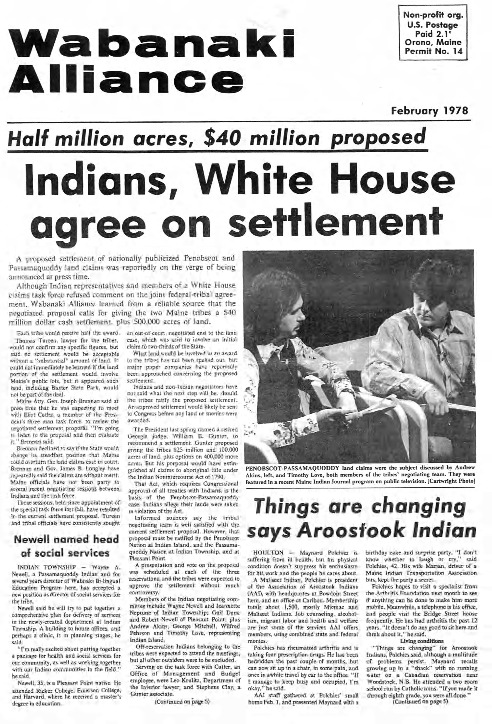
guished all claims to aboriginal title under PENOBSCOT-PASSAMAQUODDY land claims were the subject discussed by Andrew
Akins, left, and Timothy Love, both members of the tribes’
negotiating team. They were
the Indian Nonintercourse Act o f 1790.
That Act, which requires Congressional featured in a recent Maine Indian Journal program on public television. [Cartwright Photo]
approval o f all treaties with Indians, is the
basis o f the Penobscot-Passamaquoddy
case. Indians allege their lands were taken
in violation of the Act.
Inform ed sources say the tribal
negotiating team is well satisfied with the
current settlement proposal. However, that
proposal must be ratified by the Penobscot
Nation at Indian Island, and the Passama
quoddy Nation at Indian Township, and at
I
t
HOULTON — Maynard Polchies is birthday cake and surprise party. “ don’
Pleasant Point.
know whether to laugh or cry,” said
suffering from ill health, but his physical
A presentation and vote on the proposal
Polchies, 42. His wife Marian, driver o f a
condition doesn’ suppress his enthusiasm
t
INDIAN TOWNSHIP — Wayne A.
was scheduled at each of the three for his work and the people he cares about.
Maine Indian Transportation Association
Newell, a Passamaquoddy Indian and for
reservations, and the tribes were expected to
bus, kept the party a secret.
A Maliseet Indian, Polchies is president
several years director o f Wabnaki Bi-lingual
approve the settlement without much
Polchies hopes to visit a specialist from
of the Association of Aroostook Indians
Education Program here, has accepted a
controversy.
the Arthritis Foundation next month to see
(AAI), with headquartes at Bowdoin Street
new position as director o f social services for
Members of the Indian negotiating com here, and an office at Caribou. Membership
if anything can be done to make him more
the tribe.
mittee include Wayne Newell and Jeannette totals about 1,500, mostly Micmac and
mobile. Meanwhile, a telephone is his office,
Newell said he will try to put together a
Neptune o f Indian Township; Gail Dana
Maliseet Indians. Job counseling, alcohol and people visit the Bridge Street house
comprehensive plan for delivery of services
and Robert Newell of Pleasant Point; plus
frequently. He has had arthritis the past 12
ism, migrant labor and health and welfare
in the newly-created department at Indian
Andrew Akins, George Mitchell, Wilfred
years. “ doesn’do any good to sit here and
It
t
are just some of the services AAI offers
Township. A building to house offices, and
Pehrson and Timothy Love, representing members, using combined state and federal
think about it,” said.
he
perhaps a clinic, is in planning stages, he
Indian Island.
monies.
Living conditions
said.
Off-reservation Indians belonging to the
Polchies has rheumatoid arthritis and is
“
Things are changing” for Aroostook
“ m really excited about putting together
I’
tribes were expected to attend the meetings, taking four prescription drugs. He has been
Indians, Polchies said, although a multitude
a package for health and social services for
but all other outsiders were to be excluded.
bedridden the past couple o f months, but
o f problems persist. Maynard recalls
our community, as well as working together
Serving on the task force with Cutler, an can now sit up in a chair, in some pain, and
growing up in a “
shack” with no running
with our Indian communities in the field,”
O ffice o f M anagem ent and Budget once in awhile travel by car to the office. “
If
water on a Canadian reservation near
he said.
employee, were Leo Krulitz, Department of I manage to keep busy and occupied, I’
m
Woodstock, N.B. He attended a two room
Newell, 35, is a Pleasant Point native. He
the Interior lawyer, and Stephens Clay, a okay," he said.
school run by Catholic nuns. “ you made it
If
attended Ricker College, Emerson College,
through eighth grade, you were all done.”
AAI staff gathered at Polchies’small
and Harvard, where he received a master’ Gunter associate.
s
(Continued on page 5)
(Continued on page 5)
home Feb. 1 and presented Maynard with a
,
degree in education.
Newell named head
of social services
Things are changing
says Aroostook Indian
Page 2
Wabanaki Alliance February 1978
This past year, those who laughed at the land claims stopped
laughing. Perhaps they were only jeering at the claims so as not to
face the issues raised by Indians. Now, however, those issues — the
rights, of Indians to justice, equality and self-determination — can no
longer be ignored.
When the Bureau of Indian Affairs (BIA) recognized the
Penobscots and Passamaquoddies as federal Indians, eligible for
federal aid and services, that was merely a sign of the times, a sign
that things are changing for native Americans.
Another sign is Vice President Walter Mondale's pro-Indian
The Penobscot-Passamaquoddy land claims appear to be almost comments appearing in recent press reports. We figure Mondale is
settled, in a manner that will greatly benefit the two tribes.
speaking for the President, and his stance on native Americans may
Credit for a favorable resolution of the Indian land claims in be a genuine application of his stated aim to champion human rights
Maine can be spread over many individuals and even over society everywhere.
itself. We live in a cultural climate that has allowed a couple of
We have a lot to learn, all of us. There is much to do, much to write
almost forgotten Indian groups to involve the President and federal about, ahead of us. This is a new beginning for the Penobscot and
government in negotiations over the return of illegally taken lands. Passamaquoddy Nations. We use that word "nation" in the sense of
The claims have included monetary damages, but we hope that Indian identity and community.
actual land — a priceless resource in our eyes — is a major part of
The tribes’
time has come, and now we must make use of it in ways
any settlement. With a land base, Penobscots and Passamaquoddies that uphold the common good.
may eventually develop a viable economic base. Economic self-deter
mination can in turn lead to social and cultural reinforcement. We
see that “
land claims”
could signify a new era for the two tribes, and
might be the very thing that ensures tribal survival.
We don’know exactly what effect the transfer of land and money
t
will have on Indians, and we doubt anybody could predict what
With all the fanfare over Penobscot-Passamaquoddy Indian land
would happen with certainty. The fact that Indians and non-Indians
have kept secret almost all information regarding land claims has claims, little or nothing has been said or done for Micmac and
Maliseet Indians.
kept most of us in the dark.
They are also Maine Indians, as much as are the Penobscots and
Announcement o f a settlement is going to catch thousands of
people by surprise, and shock waves will doubtless be felt for a long Passamaquoddies, and they number in the hundreds, mostly residing
in Aroostook County. This newspaper is as guilty as others for not
time afterward.
The secrecy of negotiations and other work on the land claims case publicizing the plight of these northern Maine native Americans.
W e’ talked with a number of Micmac and Maliseet persons, and
ve
may have been justified, although it left many persons ignorant.
Probably the intent was to leave certain persons ignorant. In any some of them are bitter about the claims. Some of them feel left out,
event, that numerous Indians knew about the land case through and some o f them are worried they may lose benefits from the State
meetings, and that none o f them squealed, is positively remarkable. and federal government.
Micmacs and Maliseets are unlikely to lose benefits, but on the
That loyalty to the tribe and the cause of the claims is both a
tribute to, and a reflection o f Indian values. Those traditional values other hand they are not about to gain any major ones in the
have survived despite the encroachment of non-Indian ways, and the foreseeable future. Unlike the Penobscots and Passamaquoddies,
Micmacs and Maliseets are not recognized by the federal government
tribes’
lack of money and a land base.
We have observed the progress of the land claims over the past as eligible for BIA (Bureau of Indian Affairs) services, nor have they
year, sometimes at close range, sometimes from afar. We are one of any known documentation on which to base a land claim similar to
the few newspapers in the nation that has supported Penobscot- the now famous one that alleged two thirds of Maine belonged to the
Passamaquoddy land claims. And we clearly remember that a few Penobscots and Passamaquoddies.
editorials
The time has come
Micmacs and Maliseets
years ago, nobody outside the Indian community took the claims very
seriously.
Katahdin sunrise
Last month we printed a poem about Katahdin, but now we feel
moved to add our own comment.
Driving Interstate 95 to Houlton, and then on the return trip to
Orono, we gazed at Katahdin's formidable, snowbound peak.
The sloping ridges, white snow, gray rock and blue sky, created a
shock of pleasure to the senses, and stirred one’ thoughts in the
s
fresh morning sunlight. This is not a poem, only a tribute a
mysterious, glorious summit that is somehow larger than all of
Maine, and greater than all o f us who walk in the mountain’
s
shadow.
WABANAKI ALLIANCE
Vol. 2, No. 2
Februaty1978
This is a reminder, because we ourselves were reminded, that
s
Published monthly by the Division of Indian Services [DIS] at the Indian Resource Center, peace, beauty and the natural environment are Katahdin’ gifts to
95 Main St., Orono, Me. 04473.
us. We find it so easy to abuse and forget the physical and spiritual
harmony that nature has created around us.
Steven Cartwright, Editor
Not to see Katahdin, even from the vantage point o f an ugly,
William O’
Neal, Ass’ Editor
t.
speeding automobile, is to miss a penetrating reminder of the earth,
DIS Board of Directors
sun, sky and life itself. Not to notice this is tragic. We stopped the car
Jean Chavaree [chairman]
Indian Island
s
John Bailey, CAP coordinator
Pleasant Point for a m om ent’ silent appreciation. Even that recognition is better
Albert Dana
Indian Township than nothing, and that moment has already left its mark on us.
Timothy Love, CAP director
Indian Island
Those Indians who see Katahdin as a source of spiritual energy
Jeannette Neptune, Tribal Clerk
Indian Township
have something special. Those of us without that attachment are still
Eriene Paul, Central Maine Indian Assn.
Indian Island
Roy Paul, Assn, of Aroostook Indians
Houlton
able to feel the mountain's pull, and respond.
Maynard Polchies, president, Aroostook Indians
Houlton
Birds sang when we shut the motor off. We grew unaware o f the
Michael Ranco, Central Maine Indian Assn.
Orono
biting cold. We drank in the mountain with our eyes, but without
DIS is an agency of Diocesan Human Relations Services, Inc. of Maine. Subscriptions to moving it overwhelmed us with its simple, profound grace.
this newspaper are available by writing to Wabanaki Alliance, 95 Main St, Orono, Me.
It’ enough to say we were privileged to see something priceless,
s
04473. Diocesan Human Relations Services and DIS are a non-profit corporation. Contri
free, yet with a beauty so inscrutable as to defy even poets.
butions are deductible for income tax purposes.
Wabanaki Alliance February 1978
Page 3
letters
To the editor:
My name is Reginald Acquin, and I am a
Malecite Indian from Fredericton, N.B.,
Canada. Also at this time I am an inmate
here at the Washington State Penitentiary in
Walla Walla, Washington.
I was reading the Indian Life newspaper
the other day and came across your notice,
stating that you are or have already printed
a newspaper called, Wabanaki Alliance. I
would like to have a copy if I could. My pay
from my job here at prison is very small,
perhaps as time goes by I can save enough
money to pay for a years' subscription.
I remember a paper from Maine a few
years back, and I wrote to inquire about it,
but I guess it went out o f circulation. The
name o f it was, Wig-Wam-us.
Prestly I am involved in a school program
and plan to continue my studies upon my
release. Any educational information from
your area would be greatly appreciated.
I close with the though of our People’
s
way o f life, that the essence o f life is to live in
harmony with all things.
An Indian brother,
Reggie “
Zeke”Acquin #360407
Akwesasne sets
speaking four
MOHAWK NATION, N.Y. — Voices
from the Earth, a native American group
that tries to spread Indian ways and under
standing through a variety o f presentations,
is planning a March tour o f the Maine area.
According to Yonahwaylut, a member of
the group, the purpose o f the tour is to raise
money for Akwesasne Notes, a national
circulation Indian newspaper published
here.
Yonahwaylut said that an Akwesasne
Notes speaker’ bureau can offer presenta
s
tions on topics such as native land claims,
water rights, treaties, Indian law, and the
need for an international native people’
s
movement. “ in all, we feel very confident
All
that we can provide an exciting and infor
mative presentation for your group,” he
said.
Indians seek
status ruling
BOSTON — Wampanoag Indians of
Mashpee, Ma., were planning last month to
ask that the U.S. Interior Department de
termine their status as a tribe.
A wire service story reported that lawyers
for the Indians are making the request,
directed to a Federal Judge, to avoid a final
judgment against the Wampanoags in the
court battle involving Indian land claims in
the Town o f Mashpee.
On Jan. 6, a U.S. District Court jury
agreed that Mashpee Indians did not com
prise a tribe on four different historic oc
casions. That finding, after a 10-week trial,
said Wampanoags were a tribe at various
times in the 1800’ but were not a tribe in
s,
1790 when Congress passed the Non-inter
course Act. Mashpee Indian claims are
based on that act, which says Congress must
ratify all treaties.
The Indians say Mashpee lands were
illegally taken from them in 1870, when the
town was incorporated by the State of
Massachusetts. The Town o f Mashpee,
arguing against the Indians, says Wampan
oags no longer exist as a tribe or as recog
nizable Indians, partly because o f inter
marriage with non-Indians. M ashpee
Indians have not been recognized by the
federal government, as have other groups of
Indians such as the Penobscots and Passamaquoddies o f Maine.
The Mashpee land claims involve an esti
mated 13,000 acres, compared to at least
eight to ten million acres claimed by the two
Maine tribes.
Pen pals sought by Canadian students
FREDERICTON, N.B. — Are you a
young person who would like to make some
new friends in Canada? A group of Indians
aged seven to 17 have contacted this news
paper saying they would like to correspnd
with their Maine counterparts.
The group is “
most enthusiastic,” ac
cording to Stephanie Strilchuk, o f the New
Brunswick Association of Metis and NonStatus Indians in Fredericton, N.B. Names
of Canadian young people, their ages and
interests, are as follows. Please feel free to
write to them directly at the addresses given.
Heather Angela Brigley, Colton Brook
Rd„ R.R. #501-2, Rothesay, N.B. EOG
2WO, 10 years old.
Interests: Skating, baseball, child games.
Heather Ann Westhaver, Moores Mills,
St. Stephen, N.B. EOG 2LO, 17 years old.
Interests: Sports, reading, writing,
working with people, understanding my
culture, studying false advertising.
Kim Wheatley, 2247 Hurontario St., Apt.
814, Mississauga, Ontario, 14 years old.
Interests: Sports, disco music, dancing,
and I like meeting people and making new
friends.
Marie Saunders, 2247 Hurontario St.,
Apt. #528, Mississauga, Ontario L5A 2G2,
14 years old.
Interests: My hobbies are sports, I like to
play the clarinet, my favorite subjects in
Poetry
school are gym and art. I also like to meet
people and I like dancing.
Charlette Anne Brigley, Colton Brook
Rd.. R.R. #501-2, Rothesay, N.B., 9 years
old.
Interests: Playing dolls, playing games,
skating, sliding, baseball.
Helen Saunders. 2247 Hurontario St.
#628, Mississauga. Ontario L5A 2G2, 15
years old.
Interests: Collecting certain pennies, I
play the recorder, a bit o f guitar, I paint a
lot, sports (hockey) tennis, and I like to meet
new friends. I like to write letters.
Gary LeBouthillier, R.R. #1 Site 10 Box 5,
Bas Caraquet, N.B. EOB IEO, 9 years old.
Interests: Reading, karate, skating, base
ball, skiing, swimming, fishing.
Brian LeBouthillier, R.R. #1 Site 10 Box
5, Bas Caraquet, N.B. EOB IEO, 12 years
old.
Interests: Skating, skiing, swimming,
fishing, hunting, karate, badminton, volley
ball, football, baseball.
Douglas Diotte. 431 Goderich St., Dalhousie, N.B., 13 years old.
Interests: Playing sports, hunting, hiking.
Perry Harquail, 431 Goderich St.. Dalhousie. N.B., 13 years old.
Interests: Baseball, football,
swimming, hiking, soccer.
hockey,
WALK BESIDE ME
Junk yards, cigars, freeze dried food.
I’ caught in a prairie fire.
m
Magazines and limousines.
— unwanted children —
I could just sit and cry.
Smoke stacks, jet planes
and evil eyes,
streets full o f lies.
Come, walk along beside me.
We will go away
to a place where there
is life.
Billy Pryor
ANOTHER DAWN
On a warm August dusk
I walked quietly to the
east end o f the pond
to watch the sunset
in the still water,
picking blueberries on the way
as the night began to show
its life.
Like music to my heart
the deer came to drink on
the far bank.
A raccoon raised its head from
a sleeping log, rubbing the
daylight from his eyes.
Across the sun’fading image
s
rode a beaver heading home
to its lodge.
So too, I must head home.
For the night is only for
the keenest o f eyes,
and like the creatures
o f the light,
I must sleep till
another dawn.
Hart Lapointe, 431 Goderich St., Dalhousie, N.B., 10 years old.
Interests: Soccer, football, hiking,
swimming.
Kathy Mary Nash, 248 St. Mary’ St.,
s
Fredericton, N.B., 13 years old.
Interests: Swimming, beadwork, leatherwork, biking, cooking and housework.
Letha Brooks, 30 Maliseet Dr., Frederic
ton, N.B., 15 years old.
Interests: Horseback riding, baseball,
volleyball, beadwork, needlepoint, dancing
(Indian) and cheerleading.
John Brooks, 30 Maliseet Dr., Frederic
ton. N.B.. 10 years old.
Interests: Hockey, baseball, horseback
riding, football, biking. Indian dancing.
Leonard Brooks. 30 Maliseet Dr., Fred
ericton. N.B.. 7 years old.
Interests: Playing cars, cards (fish or
snap), running, swimming, Indian dancing,
skating.
Dana Brooks, 30 Maliseet Dr., Frederic
ton, N.B,, 7 years old.
Interests: Dolls, baseball, skipping,
swimming, skating, cards (fish or snap).
Tara Helena Brooks, 30 Maliseet Dr.,
Fredericton, N.B., 13 years old.
Interests: Horseback riding, swimming,
volleyball, baseball, leatherwork, beadwork,
cards, skating.
SUCH A THING
Love...
Is there such a thing
as love ... anymore ...
In this day o f one night
stands and rock and roll bands,
Lustful looks and how-to books.
Is there a woman left
Whose eyes can see
through all this chaos
to a lonely heart
in search o f a sharing
love away from this
empty cold world.
Billy Pryor
THE CHANGING SEASON
Tree tops bend gently in the wind
leaves float softly to the earth.
The feeling o f changing season all around.
Overhead the hawk glides, seemingly
effortless upon the currents.
Below, animals fast at work
storing for a winter’feast.
s
Billy Pryor
I ponder the thought — the miracles
before me
Behold the Beauty o f Life — the
meaning —
Do not be diverted
For it is here
Within the changing season
That I belong.
Billy Pryor
ED ITO R ’ NOTE: Poet Billy Pryor, an
S
Osage Metis Indian, has purchased an old
farm near Smyrna, N.Y., where he and his
wife Heidi have built a log cabin. The couple
hope to do subsistence farming, and event
ually form a metis (part Indian blood) com
munity in the area. These poems were sub
mitted for publication by Pryor’ friend
s
Charles E. Colcord o f New York City, a Pen
obscot Metis.
Page 4
Wabanaki Alliance February 1978
Passing on Indian traditions
By Isabelle Knockwood Toney
Traditions are unwritten moral codes and
customs which were passed down to us, one
generation to the next.
Not only do they serve as vital links with
our ancestors but they contain within them
vital information regarding our identity
which cannot be found in any text version,
geological dig or museum display.
Securely embedded within our traditions
are the analytic tools and resources with
which to rebuild our Wabanaki Nation of
which the Micmacs are a part along with the
Maliseets, Penobscots, Passamaquoddy and
the almost extinct Abenaki.
Their purpose is to unite people and to
keep them united. Their principles remain
constant even though lifestyles may change.
Freedom violated
Many small farmers who have found it
impossible to make a decent living on the
farm have migrated to the city. They choose
to change their lifestyle and to keep their
religious beliefs and ancient traditions.
Native people no longer depend entirely
on natural resources for food, shelter and
clothing but unlike the farmer their freedom
to choose where and how to live was not rec
ognized but ignored and often violated.
It is generally believed that traditions are
regressive, hindering progress and even
setting us back to the 14th century.
Don t look back advise the progres
sives.
“
Look to your traditional counsel, the
Medicine people. But where can native
people search for answers to their innumer
able and overwhelming problems? Tradi
tions were never written down; one can’
t
take a course on them.
For those “
close encounters”o f the best
kind we could start with the family unit
because it is the smallest nuclear unit in
society. Sadly, it seems that the only thing
that brings families together today is a
crisis, like the death o f one o f its members.
That’not how it was meant to be.
s
Awareness o f ourselves as true people of
the land will lead us to accept our indi
viduality and joint responsibility to ensure
the survival o f our race. Only through
working together will we learn to appreciate
the true social values o f our traditions. For
the community-minded there are traditional
suppers, story telling, guessing games that
test psych ic abilities, and physical
endurance, name-giving for those who want
Indian names, impromptu chanting and
dancing, and drum sessions.
But can ancient traditions teach us
survival techniques in today’ modern
s
world? Do they offer constructive alter
natives to what we have today? Yes. The
principles o f our native traditions are based
on survival and they utilize the sharing and
unity concepts as guidelines to living.
But... does living in a highly mechanized
society satisfy both material and spiritual
needs? Can we afford to be subjective and
sharing when our jobs demand that we be
objective and competitive? For some, no:
traditionalists grow weary o f the stereotyped
Indian imagery and want to fulfill their
purpose in life, to pass on to future genera
tions the corrected version o f the native
person.
Monetary vs. spiritual values
This leads us to question whether tradi
tional people have human and civil rights or
if traditional religious beliefs were ever
made illegal? Mainly because the dollar sign
has yet to sanction them, traditional ways
and those who have the values o f their
grandparents will continue to be ridiculed.
The1general feeling is that monetary
values invalidate spiritual ones. This is true
when there is parallel thinking. This causes
polarization. Going back to the circle, we
will find that politics, economics and
spirituality are all parts of the same whole.
We then should be concentrating on the
specifics that make things work without
developing just one fragment o f our person
alities, to the point that it invalidates the
others.
Federal funding has gone into various
aspects o f native culture, including language
and basket weaving. Land claims are being
researched daily and reams written on
native spirituality. We tend to forget that
true spirituality is highly individualistic and
comes from personal and interpersonal re
lationships with other members o f the
universe including plants, animals and the
earth.
It was exactly this philosophy that earned
for our beloved grandparents the labels of
savage, heathen and pagan.
Because one’ beliefs determine one's
s
behavior, it is vital to our children that we
re-examine those beliefs that cause us to
behave the way we do toward each other, our
women, children, elders and the land. On
examination we may just discover that
Sachems, Sagmows and Clan Mothers were
indeed wise in the ways of working and
living together.
Individuals may say, “ far as I’
As
m
concerned I m getting along nicely without
any traditions.”As a society though, we are
alienated from each other, our families and
brothers and sisters o f other tribes.
Identity survives
To have survived four centuries o f on
slaught against the masses as well as
violations against the earth and the elements
sky, water, air and land — demanded of
native people a little more than mere
physical stamina. It extracted from them a
strong will to live combined with a clearly
defined statement o f purpose.
To the extent that native people need
money, they are capitalists. Because they
live in isolation on reserves they have been
labeled Red. Communistic, Socialist, Demo
cratic and, or Anarchists. Whatever the
label, native people will continue to be
manipulated until they unite and define
themselves.
In an attempt to identify Indian
problems, experts agree that there exists yet
another disease brought over on the May
flower, the Identity Crisis. Symptoms in
clude High Alcoholism Rate, High-drop
out-rate and a short life span that can
terminate in suicide. Chronic conditions
manifest themselves through depression,
low employment and low productivity. You
treat the symptoms in emergency cases with
welfare and federally funded programs.
Experts forget that one’identity does not
s
come first. It comes last, after:
a land base has been inhabited.
—a culture has been cultivated from avail
able resources.
traditions have been established from
people working together,
a history written by the people themselves
because the history o f any nation is
written by the conquerors.
In conclusion
Thw JoKph, a Micmac Indian and recent gradnate of Honlton High School, adjusts her
snowshoes with help of David Sooobj, a Wilderness Pursuits instructor and also a Honiton
area native Ttoa, who hopes to work with the Orono-based Indian youth program, joined
in a recent leader training trip on the frozen Penobscot River
Anti-backlash
group organizes
O u r forefathers and clan mothers
endured many hardships and celebrated
many joys in order to pass along traditions
that would work within the context o f nature
and the environment.
Tradition helps us to maintain our in
dividuality and identity. After we do all
these things we will experience a little of
what our ancestors.felt: Indian pride.
WASHINGTON - Anti-Indian backlash
to land claims suits has promoted the
nation’ two largest Indian groups to unite
s
and launch "a national campaign for the
survival of the Indian tribal governments.”
According to a spokesman for the
National Congress o f American Indians and
the National Tribal Chairmen’Association,
s
"As a result o f court recognition o f Indian
rights and claims, and the greater assertions
o f sovereign rights and pow ers by
increasingly sophisticated tribal govern
ments, growing resentment is developing
around the country,” according to a joint
statement issued by the two groups.
The spokesman added that the Interstate
Congress for Equal Rights and Responsi
bilities has coordinated backlash move
ments in a nationwide effort to eliminate
Indian treaties, federal programs, and
Indian tribal governments.
The two Indian organizations, which
represent one-hundred tribes each, intend to
raise at least $250,000 to fight the backlash.
SS benefits and
job said okay
By David L. Rudolph
Central Maine Indian Assn.
Retired people can earn some money and
still get social security benefits. And now,
the amount one can earn increased from
$200 to $230 per month, average earnings.
But did you know that these earnings are
used to determine, “ the absence o f
in
evidence to the contrary, ability to engage in
substantial gainful activity.” This is what
was published in the Federal Register and
effective as o f 13 January 1978:
1 If a person earned:
.
a. Prior to 1976 an average o f $200 per
month or
b. Following 1976 an average of $230
per month; that person would be de
termined to be able to engage in
“
substantial gainful activity.”
2. If a person earned:
a. Prior to 1976 an average o f $130 per
month or
b. Following 1976 an average o f $150
per month; these earnings would
“ demonstrate that the person is
not
able to engage in substantial gainful
activity.”
Regardless o f the earnings then, with an
increased amount allowable, many other
factors still need to be included to determine
if a person is disabled.
To understand what use is made of this
information by the Social Security Admin
istration, the best action would be to call the
office nearest you.
Do you have a
d rin k in g p ro b le m ?
Wabanaki Corporation offers an alco
holism program for Indian people who
need help because o f problems with
alcohol.
If you have such a problem and need
help, or know o f someone in need, please
contact the Alcoholism Counselor in your
community or area.
Indian Island — Alcoholism Coun
selor — Clarence Francis — 207-8665577.
Indian Township — Alcoholism Coun
selor — Martha Barstis — 207-796-2321.
Pleasant Point — Alcoholism Coun
selor — Grace Roderick — 207-8532537.
Association o f Aroostook Indians —
Alcoholism Counselor — Pious Perley —
207-762-3751.
Central Maine Indian Association —
Alcoholism Counselor — Alfred Dana —
207-269-2653 or 207-866-5577.
Wabanaki Alliance February 1978
Page5
Claims settlement
(Continued from page 1
)
There was speculation that President
Carter might announce or comment on a
settlement package at his scheduled visit to
Bangor (Maine) Feb. 17.
The current Penobscot-Passamaquoddy
case ffegan with the discovery in 1957 o f a
1794 treaty. The treaty, between the Passamaquoddy tribe and Massachusetts, was
found in an Indian woman’home at Indian
s
Township.
But not until 1966 did the find attract
public attention. In that year Passamaquoddy tribal Gov. John Stevens led a sit-in
at the Township when a non-Indian
attempted to force Indian families off what
he claimed was his land.
Trespassing charges against Indians were
dismissed, but not before Donald Gellers.
Eastport lawyer, had become interested
because the Passamaquoddies used the 1794
treaty as their defense.
Tureen, then a law student, worked to
research the treaty with Gellers in the
summer o f 1967. In 1970, the tribe hired
Tureen as their land claims lawyer. He is
associated with Native American Rights
Fund (NARF), o f Boulder, Co.
In 1971. Tureen said his research showed
the 1794 treaty, which took land from the
Passamaquoddies. was "null and void"
under the 1790 Non-intercourse Act.
Maynard Polchies, AAI president, conducting business from his wheelchair at his
Houlton home. [O’
Neal Photo]
Indian leader sees change
(Continued from page 1
)
Later, a relative was the first Indian
student to graduate from Houlton High
School. Now there are more Indians
enrolled, but not as many as Maynard would
like to see in school. He hopes his own
children, Rodney, 14, and Mark, 11, will
want to attend college. His sons are growing
up "too fast,” said.
he
Maynard is pleased that his own father,
who lives nearby, spends time with Rodney.
"The old man learns him a little Indian;
he’patient,”Polchies said.
s
In 20 years o f living in Houlton, first
driving a truck and working on a farm,
Polchies has seen Indians make advances in
education, employment and health. But
anti-Indian prejudice has yet to be
overcome.
“
Ever since we started the organization
(AAI), there’ been prejudice. We tried to
s
fight it, but you can’ Polchies said
t,”
without bitterness. He said Aroostook
Indians, who mostly do seasonal work as
blueberry and potato pickers, hear the same
thing when they apply for a new job:
WASHINGTON — U.S. Rep. William S.
Cohen (R-Maine’ Second District) has laid
s
the foundation for Congressional public
hearings on the Maine Indian land claims
suit.
Quoted in the Bangor Daily News, Cohen
said, “
The Maine case would be the starting
point in discussions to develop a compre
hensive approach to all o f the Indian claims.
We expect representatives o f the Carter
administration, the tribes, the governor, and
the attorney general to testify at the
hearings.”
Cohen said these hearings “
would in no
way interfere with the current negotiations
(between three federally appointed negotia
tors and the Maine tribes).”
The House move to schedule the hearings
is viewed as an appeasement to the Maine
Seasonal program
serves many Indians
By Bill O ’
Neal
ORONO — The problem with seasonal
work is that it’seasonal.
s
This is a serious problem for hundreds of
"Someone came the day before and took it.”
Maine Indians, who regularly find them
Major problems for northern Maine
Indians are lack of adequate housing, health selves unemployed at the end of harvest
and social services, employment, and edu time, whether it be in the potato fields of
cation counseling. "Almost everything we Aroostook County or the blueberry fields of
have problems with, but we’ doing Washington County.
re
David Depew, head o f Maine Indian
something,”Polchies said.
Conditions back on the Canadian reserva Manpower Services here has the job of
tion have improved so much that Maynard's assisting seasonal or migrant workers who
brother returned, but Maynard is not have problems because o f the temporary
considering any such move, even though his nature o f their work. Maine Manpower most
uncle, Winston Paul, is a Maliseet chief in often trains them for permanent jobs, thus
removing them from the uncertainties o f a
Canada.
Maynard Polchies does not think about seasonal income.
W orking under the Com prehensive
himself much; he’ too busy caring for
s
others. His was one o f the only licensed Employment and Training Act (CETA).
s
Indian foster homes in Maine. Over the Depew’ agency annually handles around
years he and his wife have cared for at least 500 seasonal employees and migrant
a dozen children, adding their own money to workers, entering Maine from other states
the insufficient state check. It worries or Canada.
Depew’budget for this year is $208,000,
s
Polchies that so many Indian youngsters are
up somewhat from last year's figures.
placed in non-Indian foster homes.
To qualify for the program, a worker
Whether it’ caring for foster children or
s
for AAI members, Polchies is on the job. "1 must have worked at least 25 days, but not
more than 150. must meet income level
never campaign or try to cut anyone down. 1
never promised anyone anything. I just see requirements, and earn 50 per cent o f his
income from seasonal work. O f the 500
what I can do.”
people assessed each year, approximately
200 enter the program, roughly 60 per cent
being Indians, with the remainder being
Non-Indian people who are in some way
related to an Indian family.
delegation, which was thwarted in its efforts
For eligib le individuals a two-fold
during the last session to have tribal claims approach (involving training and services
in Maine extinguished.
during training,) is used to prepare them for
Vice President Walter Mondale said the the job market. Training includes work ex
Carter administration is preparing a policy perience, on-the-job training and classroom
statement assuring all tribes due process in training.
pressing their claims. He further said that Depew described the work experience
the administration opposes legislation such
program as a "counseling tool.”It usually
as that introduced by Maine lawmakers, involves placing an individual in a work
designed to extinguish tribal claims.
environment, not requiring specific skills,
Mondale said the administration favors and is used both to evaluate problems he
negotiations between the states and tribes
might have, such as tardiness or absenteism,
involved, rather than direct Congressional
and to help him to adapt to a regular
action.
schedule o f employment. Most people
Cohen said he feels the scheduled
enrolled in the program have entered under
hearings will enable Congress to deal with
the work experience category.
the land claims issue in a comprehensive
Although Depew is occasionally able to
fashion, instead o f through piecemeal leg place an applicant without first training
islation as has been done in the past.
him, usually some on-the-job training is
Congress plans claims hearings
In 1972 Tureen filed suit in Federal
District Court, Maine, alleging that the
Non-intercourse Act applies to the tribe,
and creates a trust relationship with the
federal government. After litigation, the
government filed suits of $150 million each
against the State o f Maine, on behalf o f both
the Passamaquoddy and Penobscot tribes.
(By this time Tureen had included the Penobscots, who reportedly have a stronger
claim o f aboriginal title to land than do the
Passamaquoddies.)
State officials apparently did not take the
case seriously until 1974, but even after that
did not intervene in court proceedings.
Maine Congressional delegation drafted a
bill to wipe out Indian land claims, but later
withdrew it.
In December 1975 these proceedings
resulted in a U.S. Appeals Court decision
upholding a trust relationship between the
Passamaquoddy tribe and federal govern
ment.
Last fall, both the Penobscot and
Passamaquoddy tribes were recognized as
federal Indians, a change in status that
entitles the tribes to a range o f federal
grants and services. The new status leaves
the State Department o f Indian Affairs,
formerly in charge of Maine Indians, in a
confused role that has not yet been publicly
explained.
needed. Under this part o f the program, the
employer who trains the applicant is
reimbursed by CETA for one-half the
expense of training, including salary. Most
on-the-job placements occur during slack
business periods when employers have time
to train new people.
Studies have shown that inadequate
education often makes it difficult for
seasonal and migrant farm workers to
compete for non-agricultural jobs in the
rural areas. This deficiency is approached
through the third aspect of the training
program, classroom training. Depew said
this instruction ranges from preparation for
taking high school equivalency tests to
course work such as learning to drive a
truck.
Depew feels that training is the major
force in stabilizing migrant workers’
incomes, because it lifts them out o f the
seasonal cycle in which they are trapped. He
is also able to offer a variety o f services, both
to those enrolled in one of the training pro
grams and to others satisfying the work and
poverty requirements. Among these services
are health and medical benefits, emergency
assistance for purchasing clothing, child
care, and transportation to training sites.
Depew said that when he began the
program he anticipated a great deal of
response both in Aroostook County with the
workers in the potato fields and in Wash
ington County with the blueberry pickers
and clamdiggers. However, federal guide
lines did not recognize clamdiggers as
migrant or seasonal workers.
He fought unsuccessfully for several years
to include diggers in the program, but now
considers it a “
dead issue.”
Most blueberry pickers do not derive 50
per cent o f their annual income from this
pursuit and therefore are not eligible. Con
sequently, although Depew feels that
recognition o f the clamdiggers would greatly
expand program participation in Washing
ton County, his main thrust has been with
potato harvesters in Aroostook County.
Depew, originally from Montana, first
became involved with working with Indian
people while studying health planning. He
said that during his studies it became
obvious to him that it was “
Indian people
who suffered most.”
Page 6
Wabanald Alliance February 1978
An open letter on state payment of priests
NOTE: The following open letter to Maine
say that had England offered them religious changed without the consent o f Massa
Atty. Gen. Joseph Brennan was submitted to
teachers before they would have accepted chusetts and presumably that of Congress State Departments to carry out their various
Wabanaki Alliance by its author, Glenn
rather than the French Catholics. In also, since the assent o f Massachusetts duties passed in 1977. This allocates money
Starbird.
Volume 9; Page 495 o f the Resolves 1708- would o f necessity have to be in the form of for this purpose up until June 30, 1978 at
least.
Indian Island
1720, Chapter 104 it provides for a an interstate compact. In that Act o f SepI have at this point been unable to get the
Hon. Joseph E. Brennan
committee to be formed to propose a . aration is the article concerning Maine’
s full text o f your opinion and can only go by
Attorney General
method o f instructing the Eastern Indians in assuming Massachusetts’ obligations to
State House
what I have read in the newspapers
religion and learning, (passed November 15, Maine Indians.
concerning it but I cannot think you could
Augusta, Maine 04333
1716) Chapter 55 o f Resolves — passed June
Thus it can be seen that the whole body of have arrived at the conclusions you did had
Dear Joe:
21, 1717 — Report o f the Committee — Massachusetts Law in existance at that time
you been furnished with adequate back
It has been some time since I have written
They could only find one minister who was adopted at one stroke by Maine. It is
ground material. The record is clear from
or talked to you, but your public statements
would go as a missionary, a Mr. Baxter. His true that much o f that law has been repealed
the Charter o f 1628 to the present time that
o f last month concerning payment of
church wouldn’let him go. It was voted to by the passage o f time and the action o f the
t
the intention o f the Legislature has always
salaries and expenses o f the Roman Catholic
let the Governor and Council proceed with Legislature but it would appear that the
been to provide for the clergy serving the
clergy on Maine’ Indian Reservations
s
the said affair. Baxter must have eventually Resolve o f 1798 establishing a salary for the
Indian Tribes — indeed — it could probably
struck me as directly contrary to my own
been allowed to go as a missionary because priest has never been repealed only altered
be argued quite successfully that in view of
research on the subject. I have therefore put
Chapter 52 o f the Resolves passed July 4, by changing circumstances. In addition to
the historical and legal record clergy o f
together my notes in what I hope is a com
1718 forms a committee to persuade him to this it would also seem from the above that
other denominations than Catholic on the
prehensible form, in order to show that the
go another year and appropriates 150 the Legislature can only alter or perhaps
Reservations should also be paid by the
practice o f the State paying Catholic clergy
pounds for his services another year as change the way the priest is paid, it cannot State.
goes back several centuries and although
formerly. He is to be instructed to teach altogether abolish such payment by the
I may be wrong or the conclusions I have
strictly speaking it is not authorized in our
religion to grown people and the Indian State for it is bound to such payment by the
come to may be wrong but I have gone over
public laws, it is authorized by the Legisla children to read. Volume 1 o f Resolves —
1
Constitution in the Act o f Separation. The them again and again and I can come to no
ture every time the Appropriations Com
page 669, Chapter 48 passed July 5, 1732 Act o f Separation cannot be altered without
other results from the facts presently
mittee and the Legislature authorizes the
voted 100 pounds each for three mission action by three bodies, the Legislatures of
existing. I feel the research I have done into
State Budget. For each and every Appro aries for five years to the Eastern Indians.
Maine and Massachusetts and the Congress this subject is important enough to share
priations Committee has been fully aware of
They should reside at the truck house on St. o f the United States and probably also the
with others concerned with it in State
what is asked for in the requests o f each
George’ River, Fort Richmond and the people o f Maine in a referendum since this
s
Government as well as with the public at
department and I do not know o f any time
blockhouse above Northfield. Again; we involves altering a part o f the State Con
large, and especially with the Indian Com
they have ever refused to authorize the
find in Volume 24; Page 159 (Baxter MSS.) stitution.
munity. I am therefore, sending copies of
salaries and expenses o f Catholic Chaplains
a record o f an agreement signed at the
The presently existing legal vehicle that this letter to them for their consideration.
on the Reservations. Furthermore I think
Council Chamber in Boston between was used by the Legislature to carry out its
you are well aware o f the terms o f tha Act of
Governor Sir Francis Bernard and the constitutional obligations to the clergy of
Sincerely,
Separation passed by the Legislature o f
Penobscot Chiefs; — July 26, 1769. — M aine’ Indian reservations was the
s
S. Glenn Starbird
Massachusetts and embodied in our own
Among their acknowledgements, agree document allocating money to the various
Penobscot Tribal Historian
State Constitution, regarding M aine’ ments and requests that they (the Penobs
obligations to its’Indians. In Article 10;
scots) ask for a Priest.
Section 5; Fifth Part, it says in part; “
The
Thus is would seem that by the time o f the
new State shall, . . . assume and perform all
Revolution the Province o f Massachusetts
the duties and obligations o f this Common
Bay had given up trying to persuade the
wealth, towards the Indians in the said
Eastern Indians to become Protestants and
District o f Maine, whether the same arise
had decided to pay for Clergymen o f the
from treaties or otherwise; . . .”How large a
Roman Catholic faith if one could be found.
territory does the “
otherwise" cover? This
Note the following; Massachusetts Con
could probably be argued but historical
stitution o f 1780: Part First o f Article III —
research shows that it covered a very big
“
Legislature to require towns, etc. to
range o f obligations. It certainly did include
provide for the publick worship o f God . . .
payment o f the salaries and expenses of
and publick support and maintainance.”
clergy as will be shown.
Section 6 goes on to say in substance that a
The practice o f State support o f chaplains
taxpayer . . . “
can require monies he pays
on the Indian Reservations has a long
for support . .. o f religious teachers be . . .
historical precedent and is rooted deeply in
applied to his own . . . sect or denomina
Massachusetts colonial law. The firsr
tion.”Article VI says further that “ laws
All
Charter o f Massachusetts Bay Colony
under Colony, Porvince or State o f Massa
granted by King Charles I in 1628 states
chusetts shall remain in full force until
that: “ principal reason . . . for forming
the
altered ...”
the colony was the conversion o f the
Under Chapter 8 o f the Resolves o f 1783,
Indians. ’
Although this Charter was voided
seventy-four pounds, six shillings and four
in 1684, the Charter o f the Province of
pence were paid to the priest for the Indians
M assachusetts Bay granted by King
in full for wages and rations, also forty-eight
William HI and Queen Mary II in 1 1
69
shillings to defray his board. Said sums to be
strongly reaffirms the provisions o f the 1628
charged to the United States and that he be
Charter concerning the conversion o f the
discharged from further services. (The
Indian people.
Resolves o f 1781 and 1782 on this subject
The Charter o f William and Mary says,
carry practically the same language.)
speaking to the settler’ conduct: “ as
s
So
Chapter 69A o f the Resolves — May
their good life and orderly conversation may
Session 1798 — Upon petition o f Francis
win the Indians, natives o f that country, to
Antony Matignon o f the Catholic Church in
the knowledge and obedience o f that only
Boston — appropriated S200.00 per annum
true God and Saviour o f mankind and the
for the support o f a teacher o f religion and
Christian faith, which his Royal Majesty,
morality among the Passamaquoddy and
our royal grandfather King Charles the
Penobscot Indians until further order o f the
First, in his letters patent declared was his
General Court — To be paid out o f the
royal intention,... to be the principal end o f
public treasury. Chapter 64 o f the Resolves
the said plantation.”
January Session 1802, raised the Priest’
s
DYER BROOK — Ruby Schillinger finds
Sweetgrass, which retains its scent foi
How the Province o f Massachusetts Bay
Salary by $75.00 to $275.00 per annum time to raise seven kids and maintain a
years, is often incorporated in Mrs
and later the Commonwealth o f Massa
Chapter 210 o f the Resolves of 1819 raised basket making business as well.
Schillinger’ baskets. She makes hampers,
s
chusetts attem pted to meet their
the Pnest s salary to $350.00 per annum.
A Micmac Indian who grew up here, Mrs.
constitutional obligations toward its Indian
The Constitution o f the new State of Schillinger is an expert in making baskets dog baskets and picnic baskets. And she
teaches her children her skills.
population is readily seen in the Acts and
Maine in 1820 brought whole sections o f the for fishing, potato harvesting, backpacking
“ mother taught me when I was a little
My
Resolves passed in the eighteenth century.
Massachusetts Constitution into it with and for children to put their dolls in —
girl. Then I got married and didn’ make
t
At first they tried to get the Indians to
identical or nearly identical wording. Much woven cradles.
baskets for awhile. I was rusty starting up.”
accept a Protestant missionary and upon
o f this phraseology will be found to have had
When business is brisk, she can earn as But the rust was soon replaced by ability
repeated refusals and only limited success
its origin in the Charters from the English much as $200 weekly. “
Pretty near every and speed. “ used to make 100 potato
I
finally agreed to finance the Catholic
Monarchs. In Article 10 o f the Maine Con body goes fishing around here,” Mrs.
Priests, a practice that has continued to the
stitution will be found a section repeating Schillinger said. And o f course, "The baskets per week,” Mrs. Schillinger said,
adding that she worked some days from 6
present time.
almost word for word from the Constitution County” (Aroostook) is potato picking
a.m. to 10 p.m.
Consider the following: In Volume 7;
o f 1780 — That “ laws now in force in country.
All
Her son Arthur, 15, is an avid learner. “
If
Pages 736-739 o f the Resolves 1692-1702 is
this State, and not repugnant to this Con
Her husband, Elden, a mechanic, I just keep after him, h ell be a good basket
recorded a meeting with the Eastern Indians
stitution, shall remain, and be in force, until obtained a vintage piece o f equipment from
maker,”his mother said. Other children in
at Casco Bay on June 3, 1701. The twelfth
altered or repealed by the Legislature, or a blacksmith that is used to mechanically
the family are Barbara, 13, Joanne, 1
6,
proposition to the Indians made at that
shall expire by their own limitation.”As also pound wood for basket making. Mrs,
Roger, 14, Michael, 10, Carla, eight, and
meeting offered them ministers of religion.
is well known the fifth Section o f Article 10 Schillinger prefers brown ash for most
Jimmy, five.
The Indians answered by thanking the Com
is the text o f the Act o f Separation, required basket work. It grows near her home, but
Anyone wishing to order a basket, of
missioners but refused for they said they had
to be placed by its own provisions in any requires a snowmobile and snowshoes to get
whatever kind, may write to Ruby
their own religious teachers. They went on to
constitution Maine adopts. It cannot be in wintertime, she said.
Schillinger at B oi 67, Smyrna Mills, Maine.
Basketry is family tradition
Wabanaki Alliance February 1978
Page 7
Reservation funding withheld
AUGUSTA — The recent decision by the
federal Law Enforcement Assistance Ad
ministration (LEAA) to withhold funding of
Indian reservation police has been termed
“
suspicious” by Maine Commissioner of
Indian Affairs, Charles W. Rhynard.
The LEAA postponed distribution of the
$134,000 grant until a report to the Eastern
Maine Development District is completed,
Rhynard was concerned that the Indians
were not notified o f the decision. “
When the
funds didn’show up, they had to ask what
t
happened.”
The reasons for allowing funding to lapse
may go deeper than the need to complete the
report, he said. In a UPI article Rhynard
stated, “
The feeling among tribal leaders is
somebody in the Bureau o f Indian Affairs
told the LEAA not to do any favors for
Maine Indians, because they’ stepped on
d
some toes. Maine Indians have at times gone
Carter's budget tags
funds for Indians
WASHINGTON — Recent news reports
say President Carter’proposed half trillion
s
dollar national budget includes a $2.6
million appropriation for the Penobscot and
Passamaquoddy tribes of Maine.
Those two tribes last year won federal rec
ognition, making them eligible for a number
of federal services and grants. Not eligible
for such benefits are Maine's Micmac and
Maliseet Indians, or native Americans of
other affiliation.
Carter’ $2.6 million would be designated
s
for health services to the two tribes.
Summer jobs set
in Youth Corps
HOULTON — Indian youth aged 15-18
are invited to apply for summer jobs with
the U.S. Youth Conservation Corps. Both
boys and girls are welcome. Jobs will involve
environmental projects in Maine. For more
information call Clair Sabattis, 532-7158,
after 4 p.m.
Nutrition
Notes
By Natalie Mitchell
Last month we had mentioned Vitamin A
and its importance to bodily functions. Now,
we will discuss Vitamin “ , also called
C”
ascorbic acid.
This essential vitamin is important for the
formation o f a substance called, collagen. It
acts as a, “
cement” which holds cells, blood
,
vessels, tendon, etc., together. Vitamin C
also stimulates white blood cells production
which guards against infections.
It also helps wounds to heal at a proper
rate, helps to relieve excessive fatigue, and
aids in the absorption o f iron in the
intestinal tract.
Food sources o f ascorbic acid or vitamin
C is citrus fruits, raw cabbage, strawberries,
broccoli, tomatoes, green peppers, potatoes
(baked), raw green vegetables, and
cantaloupe.
Vitamin C is not stored in the body.
Therefore, each day this should be taken in.
One 4 ounce glass o f orange juice will supply
a total daily requirement.
If it is taken in excessive amounts, it will
only be excreted through urination.
directly to the person where they can get
results instead of going through the
bureaucracy.” He said the excuse o f a
pending state report “
was a pretty lame
one.”
The state has advanced the Indians a
portion o f the $28,000 it contributes to
reservation police salaries. Rhynard said i t .
appeared likely that funds will be reinstated
on March 1 although he was not satisfied
.
with this date. “
I'm not going to stop
bugging them until I figure out if we can
loosen up the funds quicker. I would like to
find out whether there’ any hanky panky
s
going on between the bureaucracies.” he
said.
The $162,000 provided by the state and
federal government is budgeted to pay
salaries o f a superintendent of police at each
reservation, nine full time officers, nine part
time officers and three part time secretaries
and bookkeepers.
Jesuit fakes post
INDIAN TOWNSHIP — The. Rev.
Joseph R. Laughlin, a Jesuit, has succeeded
Raymond Picard as priest at St. Anne’
s
Parish here.
A veteran o f many years in psychological
counseling work, Laughlin, 51, reports that
attendance at his Church is excellent. “
I
listen to the people and what they're doing,
that's my philosophy," he said. A Boston
native, Laughlin directed a learning center
in Roxbury, and has taught in Boston public
schools.
A graduate of Boston College, he also
obtained a master's degree in education
from that school. He is a specialist in
reading, and crisis counseling.
Health building
planned at Houlton
HOULTON — Plans are currently being
studied that would convert an existing
building to a new Indian health and social
services center in the Houlton area.
Officials at the Association of Aroostook
Indians (AAI) here, are negotiating to buy
the Ponderosa arena, but one spokesman
said the asking price for the large building is
too high. A new clinic and office center
would serve AAI’ 1,500 members, mostly
s
Micmac and Maliseet Indians.
The center would be funded by federal
Health, Education and Welfare funds,
obtained through a joint effort with Gregory
Buesing of the Indian Task Force, Federal
Regional Council o f New England, a
spokesman said.
AAI’offices might be moved to the new
s
center from their present location on
Bowdoin Street, Houlton, and the old
building, a former residence, could be
converted to a group home or halfway
house, he said.
CMIA spokesm en
to testify on act
WASHINGTON — Two representatives
o f Central Maine Indian Association
(CMIA) o f Orono were scheduled as of press
time to testify on behalf o f the Indian Child
Welfare Act o f 1977.
Michael Ranco and David Rudolph were
to meet with a Congressional committee on
the bill, which has already been passed by
the U.S. Senate. The bill has yet to pass in
the House. Ranco said the bill is significant
because it would help stop abusive child
welfare practices that have often separated
Indian children from their families, and
from their Indian heritage.
As of Tuesday, Feb. 14, the MITA office in Orono will have a
new telephone system. Our new numbers will be: 866-5566 and
866-5567. Our state wide toll free number will remain the same
at 1-800-432-7326.
Maine Indian Transportation Association
Annette McKee of Houlton, a Micmac Indian, confronts Everett Sapiel of Great Works,
a Penobscot, in a friendly fracas on a recent Wilderness Pursuits course in outdoor leadership training, held at Sugar Island, on the Penobscot River.
Indian holds high office
WASHINGTON — Another office in the
Executive branch might normally not be
cause for celebration, but the new post of
Assistant Secretary for Indian Affairs es
tablishes not only a new voice for Indians
but a voice with authority.
Furthermore, the appointment of Forrest
J. Gerard, 52, a Montana Blackfoot, to the
post places an Indian in the highest Federal
position since Charles Curtis was Vice
President in 1928. As Assistant Secretary for
Indian Affairs, Gerard will also act as head
of what he refers to as “ old and muchthe
maligned Bureau o f Indian Affairs.”He is
quick to point out that whereas before the
BIA head was left out of policy-making de
cisions, in his capacity as Assistant Secre
tary, he is directly involved in policy
decisions and is empowered to deal directly
with the Office o f Management and Budget
and with Congress.
While extending no false hopes about
revitalizing the Bureau o f Indian Affairs
Gerard does “
intend to strengthen the
bureau’ responsibility as trustee for the
s
Indians”and “ strengthen the tribal gov
to
ernments and improve the bureau’ services
s
to them.”
One o f his chief priorities seems to
be shifting control to the tribes themselves.
In a recent New York Times interview he
states, "The tribes should be allowed to
exercise whatever sovereignty they are
legally entitled to. Sovereignty means in part
the control Indians have over the non-In
dians living within their reservations, and
what this really means is who controls the
Indian resou rces.”
“
There’ a growing feeling in the Indian
s
community that things are getting like they
were in the 1880’ an apprehension that the
s,
tribes once again possess things—uranium
and oil and natural gas—that are going into
short supply. He was referring to the gold
and silver shortages of the 1880’ when
s,
whites seized Indian lands, rich in the
metals.
Included In this increased sovereignty
would be a restructuring o f the old BIA and
an acceleration in the change o f the role of
the area offices from acting as administra
tors of Indian matters to training and
assistance.
Gerard’ role is a timely one, coming
s
when Indian land claims throughout the
nation have forced many people to take a
reluctant look at injustices to the Indian
which they have been able to ignore for so
long. In the interview in The New York
Times Gerard said ". . . an increasing hos
tility toward Indians is developing in
Congress where we're confronting the most
serious backlash we’ ever faced.”
ve
“
We need a solution to temper the
attitudes o f the Eastern Congressmen, who
have certainly faced new problems because
o f the land claims,” he continued. “
For
years they’ looked on the Indians as a
ve
Western problem like they considered
busing a Southern problem.
-Now, suddenly, it isn’that way any more,
t
and they are not happy about it,”He feels
that the land claims are “
well founded.”He
added that he was convinced that President
Carter, who appointed him, was trying to
solve the volatile Maine land claims through
negotiation, which Gerard considers to be
the best means. Not favoring militant
tactics, he stated, “
WeYe seeing a decline in
militancy among the Indians and, instead,
an upsurge o f Indian determination to
assert their rights and manage their own
affairs, and 1 support that.”He views him
self as “ cutting edge of a tough reform
the
movement.”
Mr. Gerard’ government experience
s
began in 1949 after graduating from the
University o f Montana. Born on the Blackfoot Reservation in Northwest Montana, his
first posts were non-Indian health adminis
tration agencies in Montana and Wyoming.
He then came to Washington to work in the
Bureau o f Indian Affairs as a legislative
liaison officer and later worked as a profes
sional staff member o f the Senate Interior
Committee. During the last year he has been
a lobbyist for several Indian organizations.
His career has led him to one o f the most
strategic positions held by an Indian, a
position which now promises to be a major
force in allowing Indians to shape their own
future. As Gerard said: “
The root o f their
problem is the right to govern their own
affairs and guarantee the future welfare of
the Indian people. That’ often lost sight of
s
in the strident rhetoric Indian matters are
now generating.”
Page 8
Wabanaki Alliance February 1978
A flashback to the past
News briefs
By Vince Lovett
Bureau of Indian Affairs
NTCA-NCAI PREFER TW O-PAGE
W A T E R PO LICY STA TEM EN T T O
BIA’51: National Tribal Chairmen’Asso
s
s
ciation and National Congress o f American
Indians, and two major national Indian or
ganizations, met in Washington, D.C., and
adopted a two page statement on Indian
water rights to go to the White House as the
Indian community’ contribution to Presi
s
dent Carter’national water policy study.
s
NTCA and NCAI acting jointly, said they
preferred their own concise statement to a
51-page document prepared by BIA under
Assistant Secretary Forrest Gerard’ direc
s
tion. Mel Tonasket, chairing a joint report
session, said that the BIA statement was
“
too long, didn’ hit the point and gave
t
OMB people room to get lost in.”He said
that the working committee involved chose
to develop a separate paper rather than to
try to nit-pick the 51 pages. A transmittal
letter to Gerard asked that the NTCA-NCAI
statement be championed as the basic
Indian paper; it asked that it be forwarded
to the White House on an equal basis with
Gerard’ document, not as an appendix
s
item or otherwise subordinated. The water
policy material was supposed to be at the
White House by February 1
.
NTCA-NCAI LAUNCH JOINT EFFORT
TO COUNTER BACKLASH: Joe DeLaCruz and Veronica Murdock, presidents of
NTCA and NCAI, at a joint session in
Washington, January 19 signed a counterbacklash document and tribal leaders
AT THE EDGE OF THE SEA — This silhouette, from an early photograph, shows Wallace
signed checks to make the document more
Lewey, left, and George Stevens, Sr., in traditional tribal dress, at Pleasant Point Passathan just talk.
maquoddy reservation.
The last paragraph o f the document read:
“
Accordingly, "the National Congress of
American Indians and the National Tribal
Chairmen’Association do hereby enter into
s
a joint effort o f cooperation in a national
campaign for the survival of the Indian
tribal governments, and do hereby invite the
several tribes, their regional intertribal or
SAN FRANCISCO — Jeanette Henry, 59, and self-determination, the Costos have ganizations, the various special-interest and
and Robert Costo, 71, probably know more been able to put out all their publications professional organizations o f Indians, and
about Indians than any other people in the without any government assistance, using non-Indian organizations that are sympathetic to the Indian causes for justice to
United States, and for a very good reason. only Indian help.
“
The purpose o f the American Indian assist us and join with us in this most critical
As founders of the American Indian His
torical Society, they have been compiling Historical Society is to promote and develop campaign.”It was announced at the session
and publishing information about Indians the culture, education, and general welfare that some tribal groups had already made
o f the American Indians, and to inform and contributions totaling more than $30,000 to
since 1950.
In an article in the Los Angeles Times educate the general public concerning the finance the effort; a check for $10,000,
Costo described the society’beginning, “
s
It history, languages, and general status of the another for $12,250 and other smaller ones
was mostly a family research endeavor at natives as the original owners of this land,” — together with pledges o f various amounts
first, building up a library, writing articles, Henry explained in the Times article. Al — were then added to the fund. The effort
doing research.”What started as a family though publishing has been the chief means will be aimed at defeating anti-tribal legis
research project has burgeoned into a o f pursuing this end, the Costos have been lation such as the Meeds and Cunningham
bills and bringing about a change in public
publishing and information center which active in many other ways, including:
—Founding and organizing the Convoca attitudes that foster this kind o f legislation.
regularly draws Indian leaders, scholars,
tion o f American Indian Scholars, held
LEGISLATOR SEEKS COMMISSION
and politicians to the doors o f the society’
s
every four years.
ON TRIBAL-STATE RELATIONS: The
San Francisco base.
—Sponsoring a national conference on Speaker o f the Rhode Island State Legisla
Henry, a Cherokee, and Costo, a
ture talked at both the NTCA and NCAI
California Cahuilla, entered the publishing Indian water rights.
—Preparing curricula for educators in meetings in Washington, asking for Indian
field with a modest mimeographed quarter
involvement and cooperation in an effort to
ly, the Indian Historian in 1964. The areas o f Indian studies.
—Sponsoring workshops for classroom solve problems in tribal-state relations.
magazine, which focuses on Indian cultural
affairs, has grown to 64 pages and can be teachers on Indian history, culture, and
The speaker, Ed Manning, heads a task
found in libraries and universities through current affairs.
force o f the National Conference o f State
—Evaluating textbooks and placing the Legislators. Manning said his group is con
out the country.
In 1971 the couple began publishing The issue o f textbook correction on the subject of cerned about water rights issues, Indian
Weewish Tree, a bimonthly magazine for Indians on a national plane.
education and, primarily, jurisdiction. They
Wassaja, the society’ newspaper, means think that court house solutions take too
s
young people stressing Indian America.
“
showing the way.”
long, are too costly and cause too much
Over half o f the articles, poems, and
illustrations are submitted by Indian
children in elem entary school. The
magazine now has 11,(X ) subscribers.
X
In 1973 they started the country’ first
s
and only national Indian newspaper,
ALBUQUERQUE, N.M. — The presiBell, who is chief of Elementary and
Wassaja. The 40-page paper, filled with
dent o f an Indian^group had nothing but Secondary Education Branch, Area I, Office
news, features, and photographs, has a compliments for a U.S. government official, for Civil Rights, Region VI, Department of
circulation o f 80,000, o f which 85% are chief, after receiving his response to a com- Health, Education and Welfare, answered
Indians. Although the paper has a dozen plaint filed earlier in connection with long her letter Dec. 16,1977.
Indian reporters, the Costos do much o f the hair.
His letter, said that "Data collected from
writing, making monthly trips to Washing
LaDonna Harris, president o f the Albu- the Pawnee Schools during an on-site review
ton, D.C. to interview officials o f interest to querque-based A m ericans for Indian revealed that their current dress code does
Indians. “ hope to have the first full-time Opportunity (AIO), wrote to John A. Bell, not speak to the issue o f hair length for
We
Indian press representative in the nation’ the official, that his letter “
s
brought joy to males and, or females. No evidence is
capital one o f these days,”
Costo said.
our hearts.”
Harris had written to Bell’civil available to show a practice to the contrary
s
Over the past seven years the couple has rights, office in January, 1974, complaining in this regard. Consequently, we closed your
served as co-publishers and editors o f over that the Oklahoma School System had complaint effective Dec. 16,1977.”
20 books authored by Indians. In keeping expelled some 200 Indian boys for wearing
The full text o f Harris’
reply, dated Dec.
with their emphasis on Indian traditions their hair long, traditional style.
21,1977, follows:
West coast couple prints
native American research
bitterness. He said the state legislators want
to form a commission composed equally of
legislators and representatives o f Indian or
ganizations to try to find solutions to some
o f the problems, at least improve dialogue
and perhaps start a few pilot projects.
SUPREME COURT WILL RULE ON
S E C R E T A R Y ’ P O W ER T O M AKE
S
“
INDIAN COUNTRY” The United States
:
Supreme Court has agreed to rule whether
Federal or state courts have jurisdiction to
try Choctaw Indians accused o f a crime that
took place on their reservation in Missis
sippi. The underlying question is whether
the acquisition o f land and a 1944 procla
mation by the Secretary o f the Interior that
it is a reservation makes the area “
Indian
Country” over which Federal, not state,
courts would have jurisdiction. The gov
ernment says the decision could have a
serious impact on a state like California
where many Indian reservations were
created by a similar process.
TRIBAL TAX ON OIL, GAS PRODUC
TION RULED ILLEGAL: United States
District Judge H. Vearle Payne o f Albu
querque has ruled that an oil and gas tax
levied by the Jicarilla Apache Tribe against
non-Indian producers on the reservation is
“
illegal, unconstitutional, invalid and void.”
He wrote, “
The power to tax non-Indians
is not one o f the enumerated powers given to
Indian tribes”under Federal law. He ruled,
further, that the firms would recover their
costs o f the legal action from the tribe and
the Interior Department. The tax would
have amounted to more than $2 million
annually. The severance tax was adopted by
the tribal council in July 1976.
INDIAN FISHING RIGHTS IS TOPIC
AT MICHIGAN HEARING. Michigan
sports fishermen and state and local officials
were told that there is little chance that
Congress would abrogate Indian treaty
fishing and hunting rights which exempt the
Indians from state regulation.
Rep. Philip Ruppe o f Michigan asked the
House Subcommittee on Fisheries and
Wildlife Conservation and the Environment
to meet in the state. Representative James
Oberstar, Minnesota, who presided over the
hearing, told a reporter: “
Abrogation of
treaties by legislation would undoubtedly
engender the most heated and impassioned
debate in modern times. It would open up
highly speculative questions o f compensa
tion that could run into incalculable
amounts o f money. That, in itself, would be
a deterrent.”
ANDRUS DESCRIBED AS ENVIRON
M ENTALIST, IN DIAN SU PPORTER:
The Washington Star recently carried a
front page feature on Interior Secretary
Cecil Andrus.
It said Andrus is considered by some
people “ conservation-crazed environ
a
mentalist who wants to shut down the
Western states and turn them back to the
grizzly bears and rattlesnakes.”It also said
that many environmentalists “ critical of
are
his support o f Indian claims on water and
hunting rights,”such as his support recently
of the Eskimos on the bowhead whale issue.
The article also mentioned that Andrus has
recruited several Indians for top jobs in the
Department.
Agency praised for 'swift' action
Dear Mr. Bell:
Your letter o f December 16, 1977
answering mine o f January 31, 1974 brought
joy to our hearts. I know that all o f the
Indian community will be pleased as we are
with the thoughtful, thorough and expediti
ous handling o f Indian concerns.
You may rest assured that anytime we
have a complaint which can wait four years
for resolution, we will call it to your
attention.
With warm regards,
LaDonna Harris
Alliance
Non-profit org.
U.S. Postage
Paid 2.1*
Orono, Maine
Permit No. 14
February 1978
Half million acres, $40 million proposed
Indians, White House
agree on settlement
A proposed settlement of nationally publicized Penobscot and
Passamaquoddy land claims was reportedly on the verge of being
announced at press time.
Although Indian representatives and members of a White House
claims task force refused comment on the joint federal-tribal agree
ment, Wabanaki Alliance learned from a reliable source that the
negotiated proposal calls for giving the two Maine tribes a $40
million dollar cash settlement, plus 500,000 acres of land.
Each tribe would receive half the award.
Thomas Tureen, lawyer for the tribes,
would not confirm any specific figures, but
said no settlement would be acceptable
without a “
substantial”amount of land. It
could not immediately be learned if the land
portion of the settlement would involve
Maine’ public lots, but it appeared such
s
land, including Baxter State Park, would
not be part of the deal.
Maine Atty. Gen. Joseph Brennan said at
press time that he was expecting to meet
with Eliot Cutler, a member of the Presi
dent’three man task force, to review the
s
negotiated settlement proposal. “ m going
I’
to listen to the proposal and then evaluate
it,”
Brennan said.
Brennan declined to say if the State would
change its steadfast position that Maine
could overturn the land claims case in court.
Brennan and Gov. James B. Longley have
repeatedly said the claims are without merit.
Maine officials have not been party to
several recent negotiating sessions between
Indians and the task force.
Those sessions, held since appointment of
the special task force last fall, have resulted
in the current settlement proposal. Tureen
and tribal officials have consistently sought
an out-of-court, negotiated end to the land
case, which was said to involve an initial
claim to two-thirds o f the State.
What land would be involved in an award
to the tribes has not been spelled out. but
major paper companies have reportedly
been approached concerning the proposed
settlement.
Indians and non-Indian negotiators have
not said what the next step will be, should
the tribes ratify the proposed settlement.
An approved settlement would likely be sent
to Congress before any land or monies were
awarded.
The President last spring named a retired
Georgia judge, William B. Gunter, to
recommend a settlement. Gunter proposed
giving the tribes $25 million and 100,000
acres o f land, plus options on 400,000 more
acres. But his porposal would have extin
guished all claims to aboriginal title under PENOBSCOT-PASSAMAQUODDY land claims were the subject discussed by Andrew
Akins, left, and Timothy Love, both members of the tribes’
negotiating team. They were
the Indian Nonintercourse Act o f 1790.
That Act, which requires Congressional featured in a recent Maine Indian Journal program on public television. [Cartwright Photo]
approval o f all treaties with Indians, is the
basis o f the Penobscot-Passamaquoddy
case. Indians allege their lands were taken
in violation of the Act.
Inform ed sources say the tribal
negotiating team is well satisfied with the
current settlement proposal. However, that
proposal must be ratified by the Penobscot
Nation at Indian Island, and the Passama
quoddy Nation at Indian Township, and at
I
t
HOULTON — Maynard Polchies is birthday cake and surprise party. “ don’
Pleasant Point.
know whether to laugh or cry,” said
suffering from ill health, but his physical
A presentation and vote on the proposal
Polchies, 42. His wife Marian, driver o f a
condition doesn’ suppress his enthusiasm
t
INDIAN TOWNSHIP — Wayne A.
was scheduled at each of the three for his work and the people he cares about.
Maine Indian Transportation Association
Newell, a Passamaquoddy Indian and for
reservations, and the tribes were expected to
bus, kept the party a secret.
A Maliseet Indian, Polchies is president
several years director o f Wabnaki Bi-lingual
approve the settlement without much
Polchies hopes to visit a specialist from
of the Association of Aroostook Indians
Education Program here, has accepted a
controversy.
the Arthritis Foundation next month to see
(AAI), with headquartes at Bowdoin Street
new position as director o f social services for
Members of the Indian negotiating com here, and an office at Caribou. Membership
if anything can be done to make him more
the tribe.
mittee include Wayne Newell and Jeannette totals about 1,500, mostly Micmac and
mobile. Meanwhile, a telephone is his office,
Newell said he will try to put together a
Neptune o f Indian Township; Gail Dana
Maliseet Indians. Job counseling, alcohol and people visit the Bridge Street house
comprehensive plan for delivery of services
and Robert Newell of Pleasant Point; plus
frequently. He has had arthritis the past 12
ism, migrant labor and health and welfare
in the newly-created department at Indian
Andrew Akins, George Mitchell, Wilfred
years. “ doesn’do any good to sit here and
It
t
are just some of the services AAI offers
Township. A building to house offices, and
Pehrson and Timothy Love, representing members, using combined state and federal
think about it,” said.
he
perhaps a clinic, is in planning stages, he
Indian Island.
monies.
Living conditions
said.
Off-reservation Indians belonging to the
Polchies has rheumatoid arthritis and is
“
Things are changing” for Aroostook
“ m really excited about putting together
I’
tribes were expected to attend the meetings, taking four prescription drugs. He has been
Indians, Polchies said, although a multitude
a package for health and social services for
but all other outsiders were to be excluded.
bedridden the past couple o f months, but
o f problems persist. Maynard recalls
our community, as well as working together
Serving on the task force with Cutler, an can now sit up in a chair, in some pain, and
growing up in a “
shack” with no running
with our Indian communities in the field,”
O ffice o f M anagem ent and Budget once in awhile travel by car to the office. “
If
water on a Canadian reservation near
he said.
employee, were Leo Krulitz, Department of I manage to keep busy and occupied, I’
m
Woodstock, N.B. He attended a two room
Newell, 35, is a Pleasant Point native. He
the Interior lawyer, and Stephens Clay, a okay," he said.
school run by Catholic nuns. “ you made it
If
attended Ricker College, Emerson College,
through eighth grade, you were all done.”
AAI staff gathered at Polchies’small
and Harvard, where he received a master’ Gunter associate.
s
(Continued on page 5)
(Continued on page 5)
home Feb. 1 and presented Maynard with a
,
degree in education.
Newell named head
of social services
Things are changing
says Aroostook Indian
Page 2
Wabanaki Alliance February 1978
This past year, those who laughed at the land claims stopped
laughing. Perhaps they were only jeering at the claims so as not to
face the issues raised by Indians. Now, however, those issues — the
rights, of Indians to justice, equality and self-determination — can no
longer be ignored.
When the Bureau of Indian Affairs (BIA) recognized the
Penobscots and Passamaquoddies as federal Indians, eligible for
federal aid and services, that was merely a sign of the times, a sign
that things are changing for native Americans.
Another sign is Vice President Walter Mondale's pro-Indian
The Penobscot-Passamaquoddy land claims appear to be almost comments appearing in recent press reports. We figure Mondale is
settled, in a manner that will greatly benefit the two tribes.
speaking for the President, and his stance on native Americans may
Credit for a favorable resolution of the Indian land claims in be a genuine application of his stated aim to champion human rights
Maine can be spread over many individuals and even over society everywhere.
itself. We live in a cultural climate that has allowed a couple of
We have a lot to learn, all of us. There is much to do, much to write
almost forgotten Indian groups to involve the President and federal about, ahead of us. This is a new beginning for the Penobscot and
government in negotiations over the return of illegally taken lands. Passamaquoddy Nations. We use that word "nation" in the sense of
The claims have included monetary damages, but we hope that Indian identity and community.
actual land — a priceless resource in our eyes — is a major part of
The tribes’
time has come, and now we must make use of it in ways
any settlement. With a land base, Penobscots and Passamaquoddies that uphold the common good.
may eventually develop a viable economic base. Economic self-deter
mination can in turn lead to social and cultural reinforcement. We
see that “
land claims”
could signify a new era for the two tribes, and
might be the very thing that ensures tribal survival.
We don’know exactly what effect the transfer of land and money
t
will have on Indians, and we doubt anybody could predict what
With all the fanfare over Penobscot-Passamaquoddy Indian land
would happen with certainty. The fact that Indians and non-Indians
have kept secret almost all information regarding land claims has claims, little or nothing has been said or done for Micmac and
Maliseet Indians.
kept most of us in the dark.
They are also Maine Indians, as much as are the Penobscots and
Announcement o f a settlement is going to catch thousands of
people by surprise, and shock waves will doubtless be felt for a long Passamaquoddies, and they number in the hundreds, mostly residing
in Aroostook County. This newspaper is as guilty as others for not
time afterward.
The secrecy of negotiations and other work on the land claims case publicizing the plight of these northern Maine native Americans.
W e’ talked with a number of Micmac and Maliseet persons, and
ve
may have been justified, although it left many persons ignorant.
Probably the intent was to leave certain persons ignorant. In any some of them are bitter about the claims. Some of them feel left out,
event, that numerous Indians knew about the land case through and some o f them are worried they may lose benefits from the State
meetings, and that none o f them squealed, is positively remarkable. and federal government.
Micmacs and Maliseets are unlikely to lose benefits, but on the
That loyalty to the tribe and the cause of the claims is both a
tribute to, and a reflection o f Indian values. Those traditional values other hand they are not about to gain any major ones in the
have survived despite the encroachment of non-Indian ways, and the foreseeable future. Unlike the Penobscots and Passamaquoddies,
Micmacs and Maliseets are not recognized by the federal government
tribes’
lack of money and a land base.
We have observed the progress of the land claims over the past as eligible for BIA (Bureau of Indian Affairs) services, nor have they
year, sometimes at close range, sometimes from afar. We are one of any known documentation on which to base a land claim similar to
the few newspapers in the nation that has supported Penobscot- the now famous one that alleged two thirds of Maine belonged to the
Passamaquoddy land claims. And we clearly remember that a few Penobscots and Passamaquoddies.
editorials
The time has come
Micmacs and Maliseets
years ago, nobody outside the Indian community took the claims very
seriously.
Katahdin sunrise
Last month we printed a poem about Katahdin, but now we feel
moved to add our own comment.
Driving Interstate 95 to Houlton, and then on the return trip to
Orono, we gazed at Katahdin's formidable, snowbound peak.
The sloping ridges, white snow, gray rock and blue sky, created a
shock of pleasure to the senses, and stirred one’ thoughts in the
s
fresh morning sunlight. This is not a poem, only a tribute a
mysterious, glorious summit that is somehow larger than all of
Maine, and greater than all o f us who walk in the mountain’
s
shadow.
WABANAKI ALLIANCE
Vol. 2, No. 2
Februaty1978
This is a reminder, because we ourselves were reminded, that
s
Published monthly by the Division of Indian Services [DIS] at the Indian Resource Center, peace, beauty and the natural environment are Katahdin’ gifts to
95 Main St., Orono, Me. 04473.
us. We find it so easy to abuse and forget the physical and spiritual
harmony that nature has created around us.
Steven Cartwright, Editor
Not to see Katahdin, even from the vantage point o f an ugly,
William O’
Neal, Ass’ Editor
t.
speeding automobile, is to miss a penetrating reminder of the earth,
DIS Board of Directors
sun, sky and life itself. Not to notice this is tragic. We stopped the car
Jean Chavaree [chairman]
Indian Island
s
John Bailey, CAP coordinator
Pleasant Point for a m om ent’ silent appreciation. Even that recognition is better
Albert Dana
Indian Township than nothing, and that moment has already left its mark on us.
Timothy Love, CAP director
Indian Island
Those Indians who see Katahdin as a source of spiritual energy
Jeannette Neptune, Tribal Clerk
Indian Township
have something special. Those of us without that attachment are still
Eriene Paul, Central Maine Indian Assn.
Indian Island
Roy Paul, Assn, of Aroostook Indians
Houlton
able to feel the mountain's pull, and respond.
Maynard Polchies, president, Aroostook Indians
Houlton
Birds sang when we shut the motor off. We grew unaware o f the
Michael Ranco, Central Maine Indian Assn.
Orono
biting cold. We drank in the mountain with our eyes, but without
DIS is an agency of Diocesan Human Relations Services, Inc. of Maine. Subscriptions to moving it overwhelmed us with its simple, profound grace.
this newspaper are available by writing to Wabanaki Alliance, 95 Main St, Orono, Me.
It’ enough to say we were privileged to see something priceless,
s
04473. Diocesan Human Relations Services and DIS are a non-profit corporation. Contri
free, yet with a beauty so inscrutable as to defy even poets.
butions are deductible for income tax purposes.
Wabanaki Alliance February 1978
Page 3
letters
To the editor:
My name is Reginald Acquin, and I am a
Malecite Indian from Fredericton, N.B.,
Canada. Also at this time I am an inmate
here at the Washington State Penitentiary in
Walla Walla, Washington.
I was reading the Indian Life newspaper
the other day and came across your notice,
stating that you are or have already printed
a newspaper called, Wabanaki Alliance. I
would like to have a copy if I could. My pay
from my job here at prison is very small,
perhaps as time goes by I can save enough
money to pay for a years' subscription.
I remember a paper from Maine a few
years back, and I wrote to inquire about it,
but I guess it went out o f circulation. The
name o f it was, Wig-Wam-us.
Prestly I am involved in a school program
and plan to continue my studies upon my
release. Any educational information from
your area would be greatly appreciated.
I close with the though of our People’
s
way o f life, that the essence o f life is to live in
harmony with all things.
An Indian brother,
Reggie “
Zeke”Acquin #360407
Akwesasne sets
speaking four
MOHAWK NATION, N.Y. — Voices
from the Earth, a native American group
that tries to spread Indian ways and under
standing through a variety o f presentations,
is planning a March tour o f the Maine area.
According to Yonahwaylut, a member of
the group, the purpose o f the tour is to raise
money for Akwesasne Notes, a national
circulation Indian newspaper published
here.
Yonahwaylut said that an Akwesasne
Notes speaker’ bureau can offer presenta
s
tions on topics such as native land claims,
water rights, treaties, Indian law, and the
need for an international native people’
s
movement. “ in all, we feel very confident
All
that we can provide an exciting and infor
mative presentation for your group,” he
said.
Indians seek
status ruling
BOSTON — Wampanoag Indians of
Mashpee, Ma., were planning last month to
ask that the U.S. Interior Department de
termine their status as a tribe.
A wire service story reported that lawyers
for the Indians are making the request,
directed to a Federal Judge, to avoid a final
judgment against the Wampanoags in the
court battle involving Indian land claims in
the Town o f Mashpee.
On Jan. 6, a U.S. District Court jury
agreed that Mashpee Indians did not com
prise a tribe on four different historic oc
casions. That finding, after a 10-week trial,
said Wampanoags were a tribe at various
times in the 1800’ but were not a tribe in
s,
1790 when Congress passed the Non-inter
course Act. Mashpee Indian claims are
based on that act, which says Congress must
ratify all treaties.
The Indians say Mashpee lands were
illegally taken from them in 1870, when the
town was incorporated by the State of
Massachusetts. The Town o f Mashpee,
arguing against the Indians, says Wampan
oags no longer exist as a tribe or as recog
nizable Indians, partly because o f inter
marriage with non-Indians. M ashpee
Indians have not been recognized by the
federal government, as have other groups of
Indians such as the Penobscots and Passamaquoddies o f Maine.
The Mashpee land claims involve an esti
mated 13,000 acres, compared to at least
eight to ten million acres claimed by the two
Maine tribes.
Pen pals sought by Canadian students
FREDERICTON, N.B. — Are you a
young person who would like to make some
new friends in Canada? A group of Indians
aged seven to 17 have contacted this news
paper saying they would like to correspnd
with their Maine counterparts.
The group is “
most enthusiastic,” ac
cording to Stephanie Strilchuk, o f the New
Brunswick Association of Metis and NonStatus Indians in Fredericton, N.B. Names
of Canadian young people, their ages and
interests, are as follows. Please feel free to
write to them directly at the addresses given.
Heather Angela Brigley, Colton Brook
Rd„ R.R. #501-2, Rothesay, N.B. EOG
2WO, 10 years old.
Interests: Skating, baseball, child games.
Heather Ann Westhaver, Moores Mills,
St. Stephen, N.B. EOG 2LO, 17 years old.
Interests: Sports, reading, writing,
working with people, understanding my
culture, studying false advertising.
Kim Wheatley, 2247 Hurontario St., Apt.
814, Mississauga, Ontario, 14 years old.
Interests: Sports, disco music, dancing,
and I like meeting people and making new
friends.
Marie Saunders, 2247 Hurontario St.,
Apt. #528, Mississauga, Ontario L5A 2G2,
14 years old.
Interests: My hobbies are sports, I like to
play the clarinet, my favorite subjects in
Poetry
school are gym and art. I also like to meet
people and I like dancing.
Charlette Anne Brigley, Colton Brook
Rd.. R.R. #501-2, Rothesay, N.B., 9 years
old.
Interests: Playing dolls, playing games,
skating, sliding, baseball.
Helen Saunders. 2247 Hurontario St.
#628, Mississauga. Ontario L5A 2G2, 15
years old.
Interests: Collecting certain pennies, I
play the recorder, a bit o f guitar, I paint a
lot, sports (hockey) tennis, and I like to meet
new friends. I like to write letters.
Gary LeBouthillier, R.R. #1 Site 10 Box 5,
Bas Caraquet, N.B. EOB IEO, 9 years old.
Interests: Reading, karate, skating, base
ball, skiing, swimming, fishing.
Brian LeBouthillier, R.R. #1 Site 10 Box
5, Bas Caraquet, N.B. EOB IEO, 12 years
old.
Interests: Skating, skiing, swimming,
fishing, hunting, karate, badminton, volley
ball, football, baseball.
Douglas Diotte. 431 Goderich St., Dalhousie, N.B., 13 years old.
Interests: Playing sports, hunting, hiking.
Perry Harquail, 431 Goderich St.. Dalhousie. N.B., 13 years old.
Interests: Baseball, football,
swimming, hiking, soccer.
hockey,
WALK BESIDE ME
Junk yards, cigars, freeze dried food.
I’ caught in a prairie fire.
m
Magazines and limousines.
— unwanted children —
I could just sit and cry.
Smoke stacks, jet planes
and evil eyes,
streets full o f lies.
Come, walk along beside me.
We will go away
to a place where there
is life.
Billy Pryor
ANOTHER DAWN
On a warm August dusk
I walked quietly to the
east end o f the pond
to watch the sunset
in the still water,
picking blueberries on the way
as the night began to show
its life.
Like music to my heart
the deer came to drink on
the far bank.
A raccoon raised its head from
a sleeping log, rubbing the
daylight from his eyes.
Across the sun’fading image
s
rode a beaver heading home
to its lodge.
So too, I must head home.
For the night is only for
the keenest o f eyes,
and like the creatures
o f the light,
I must sleep till
another dawn.
Hart Lapointe, 431 Goderich St., Dalhousie, N.B., 10 years old.
Interests: Soccer, football, hiking,
swimming.
Kathy Mary Nash, 248 St. Mary’ St.,
s
Fredericton, N.B., 13 years old.
Interests: Swimming, beadwork, leatherwork, biking, cooking and housework.
Letha Brooks, 30 Maliseet Dr., Frederic
ton, N.B., 15 years old.
Interests: Horseback riding, baseball,
volleyball, beadwork, needlepoint, dancing
(Indian) and cheerleading.
John Brooks, 30 Maliseet Dr., Frederic
ton. N.B.. 10 years old.
Interests: Hockey, baseball, horseback
riding, football, biking. Indian dancing.
Leonard Brooks. 30 Maliseet Dr., Fred
ericton. N.B.. 7 years old.
Interests: Playing cars, cards (fish or
snap), running, swimming, Indian dancing,
skating.
Dana Brooks, 30 Maliseet Dr., Frederic
ton, N.B,, 7 years old.
Interests: Dolls, baseball, skipping,
swimming, skating, cards (fish or snap).
Tara Helena Brooks, 30 Maliseet Dr.,
Fredericton, N.B., 13 years old.
Interests: Horseback riding, swimming,
volleyball, baseball, leatherwork, beadwork,
cards, skating.
SUCH A THING
Love...
Is there such a thing
as love ... anymore ...
In this day o f one night
stands and rock and roll bands,
Lustful looks and how-to books.
Is there a woman left
Whose eyes can see
through all this chaos
to a lonely heart
in search o f a sharing
love away from this
empty cold world.
Billy Pryor
THE CHANGING SEASON
Tree tops bend gently in the wind
leaves float softly to the earth.
The feeling o f changing season all around.
Overhead the hawk glides, seemingly
effortless upon the currents.
Below, animals fast at work
storing for a winter’feast.
s
Billy Pryor
I ponder the thought — the miracles
before me
Behold the Beauty o f Life — the
meaning —
Do not be diverted
For it is here
Within the changing season
That I belong.
Billy Pryor
ED ITO R ’ NOTE: Poet Billy Pryor, an
S
Osage Metis Indian, has purchased an old
farm near Smyrna, N.Y., where he and his
wife Heidi have built a log cabin. The couple
hope to do subsistence farming, and event
ually form a metis (part Indian blood) com
munity in the area. These poems were sub
mitted for publication by Pryor’ friend
s
Charles E. Colcord o f New York City, a Pen
obscot Metis.
Page 4
Wabanaki Alliance February 1978
Passing on Indian traditions
By Isabelle Knockwood Toney
Traditions are unwritten moral codes and
customs which were passed down to us, one
generation to the next.
Not only do they serve as vital links with
our ancestors but they contain within them
vital information regarding our identity
which cannot be found in any text version,
geological dig or museum display.
Securely embedded within our traditions
are the analytic tools and resources with
which to rebuild our Wabanaki Nation of
which the Micmacs are a part along with the
Maliseets, Penobscots, Passamaquoddy and
the almost extinct Abenaki.
Their purpose is to unite people and to
keep them united. Their principles remain
constant even though lifestyles may change.
Freedom violated
Many small farmers who have found it
impossible to make a decent living on the
farm have migrated to the city. They choose
to change their lifestyle and to keep their
religious beliefs and ancient traditions.
Native people no longer depend entirely
on natural resources for food, shelter and
clothing but unlike the farmer their freedom
to choose where and how to live was not rec
ognized but ignored and often violated.
It is generally believed that traditions are
regressive, hindering progress and even
setting us back to the 14th century.
Don t look back advise the progres
sives.
“
Look to your traditional counsel, the
Medicine people. But where can native
people search for answers to their innumer
able and overwhelming problems? Tradi
tions were never written down; one can’
t
take a course on them.
For those “
close encounters”o f the best
kind we could start with the family unit
because it is the smallest nuclear unit in
society. Sadly, it seems that the only thing
that brings families together today is a
crisis, like the death o f one o f its members.
That’not how it was meant to be.
s
Awareness o f ourselves as true people of
the land will lead us to accept our indi
viduality and joint responsibility to ensure
the survival o f our race. Only through
working together will we learn to appreciate
the true social values o f our traditions. For
the community-minded there are traditional
suppers, story telling, guessing games that
test psych ic abilities, and physical
endurance, name-giving for those who want
Indian names, impromptu chanting and
dancing, and drum sessions.
But can ancient traditions teach us
survival techniques in today’ modern
s
world? Do they offer constructive alter
natives to what we have today? Yes. The
principles o f our native traditions are based
on survival and they utilize the sharing and
unity concepts as guidelines to living.
But... does living in a highly mechanized
society satisfy both material and spiritual
needs? Can we afford to be subjective and
sharing when our jobs demand that we be
objective and competitive? For some, no:
traditionalists grow weary o f the stereotyped
Indian imagery and want to fulfill their
purpose in life, to pass on to future genera
tions the corrected version o f the native
person.
Monetary vs. spiritual values
This leads us to question whether tradi
tional people have human and civil rights or
if traditional religious beliefs were ever
made illegal? Mainly because the dollar sign
has yet to sanction them, traditional ways
and those who have the values o f their
grandparents will continue to be ridiculed.
The1general feeling is that monetary
values invalidate spiritual ones. This is true
when there is parallel thinking. This causes
polarization. Going back to the circle, we
will find that politics, economics and
spirituality are all parts of the same whole.
We then should be concentrating on the
specifics that make things work without
developing just one fragment o f our person
alities, to the point that it invalidates the
others.
Federal funding has gone into various
aspects o f native culture, including language
and basket weaving. Land claims are being
researched daily and reams written on
native spirituality. We tend to forget that
true spirituality is highly individualistic and
comes from personal and interpersonal re
lationships with other members o f the
universe including plants, animals and the
earth.
It was exactly this philosophy that earned
for our beloved grandparents the labels of
savage, heathen and pagan.
Because one’ beliefs determine one's
s
behavior, it is vital to our children that we
re-examine those beliefs that cause us to
behave the way we do toward each other, our
women, children, elders and the land. On
examination we may just discover that
Sachems, Sagmows and Clan Mothers were
indeed wise in the ways of working and
living together.
Individuals may say, “ far as I’
As
m
concerned I m getting along nicely without
any traditions.”As a society though, we are
alienated from each other, our families and
brothers and sisters o f other tribes.
Identity survives
To have survived four centuries o f on
slaught against the masses as well as
violations against the earth and the elements
sky, water, air and land — demanded of
native people a little more than mere
physical stamina. It extracted from them a
strong will to live combined with a clearly
defined statement o f purpose.
To the extent that native people need
money, they are capitalists. Because they
live in isolation on reserves they have been
labeled Red. Communistic, Socialist, Demo
cratic and, or Anarchists. Whatever the
label, native people will continue to be
manipulated until they unite and define
themselves.
In an attempt to identify Indian
problems, experts agree that there exists yet
another disease brought over on the May
flower, the Identity Crisis. Symptoms in
clude High Alcoholism Rate, High-drop
out-rate and a short life span that can
terminate in suicide. Chronic conditions
manifest themselves through depression,
low employment and low productivity. You
treat the symptoms in emergency cases with
welfare and federally funded programs.
Experts forget that one’identity does not
s
come first. It comes last, after:
a land base has been inhabited.
—a culture has been cultivated from avail
able resources.
traditions have been established from
people working together,
a history written by the people themselves
because the history o f any nation is
written by the conquerors.
In conclusion
Thw JoKph, a Micmac Indian and recent gradnate of Honlton High School, adjusts her
snowshoes with help of David Sooobj, a Wilderness Pursuits instructor and also a Honiton
area native Ttoa, who hopes to work with the Orono-based Indian youth program, joined
in a recent leader training trip on the frozen Penobscot River
Anti-backlash
group organizes
O u r forefathers and clan mothers
endured many hardships and celebrated
many joys in order to pass along traditions
that would work within the context o f nature
and the environment.
Tradition helps us to maintain our in
dividuality and identity. After we do all
these things we will experience a little of
what our ancestors.felt: Indian pride.
WASHINGTON - Anti-Indian backlash
to land claims suits has promoted the
nation’ two largest Indian groups to unite
s
and launch "a national campaign for the
survival of the Indian tribal governments.”
According to a spokesman for the
National Congress o f American Indians and
the National Tribal Chairmen’Association,
s
"As a result o f court recognition o f Indian
rights and claims, and the greater assertions
o f sovereign rights and pow ers by
increasingly sophisticated tribal govern
ments, growing resentment is developing
around the country,” according to a joint
statement issued by the two groups.
The spokesman added that the Interstate
Congress for Equal Rights and Responsi
bilities has coordinated backlash move
ments in a nationwide effort to eliminate
Indian treaties, federal programs, and
Indian tribal governments.
The two Indian organizations, which
represent one-hundred tribes each, intend to
raise at least $250,000 to fight the backlash.
SS benefits and
job said okay
By David L. Rudolph
Central Maine Indian Assn.
Retired people can earn some money and
still get social security benefits. And now,
the amount one can earn increased from
$200 to $230 per month, average earnings.
But did you know that these earnings are
used to determine, “ the absence o f
in
evidence to the contrary, ability to engage in
substantial gainful activity.” This is what
was published in the Federal Register and
effective as o f 13 January 1978:
1 If a person earned:
.
a. Prior to 1976 an average o f $200 per
month or
b. Following 1976 an average of $230
per month; that person would be de
termined to be able to engage in
“
substantial gainful activity.”
2. If a person earned:
a. Prior to 1976 an average o f $130 per
month or
b. Following 1976 an average o f $150
per month; these earnings would
“ demonstrate that the person is
not
able to engage in substantial gainful
activity.”
Regardless o f the earnings then, with an
increased amount allowable, many other
factors still need to be included to determine
if a person is disabled.
To understand what use is made of this
information by the Social Security Admin
istration, the best action would be to call the
office nearest you.
Do you have a
d rin k in g p ro b le m ?
Wabanaki Corporation offers an alco
holism program for Indian people who
need help because o f problems with
alcohol.
If you have such a problem and need
help, or know o f someone in need, please
contact the Alcoholism Counselor in your
community or area.
Indian Island — Alcoholism Coun
selor — Clarence Francis — 207-8665577.
Indian Township — Alcoholism Coun
selor — Martha Barstis — 207-796-2321.
Pleasant Point — Alcoholism Coun
selor — Grace Roderick — 207-8532537.
Association o f Aroostook Indians —
Alcoholism Counselor — Pious Perley —
207-762-3751.
Central Maine Indian Association —
Alcoholism Counselor — Alfred Dana —
207-269-2653 or 207-866-5577.
Wabanaki Alliance February 1978
Page5
Claims settlement
(Continued from page 1
)
There was speculation that President
Carter might announce or comment on a
settlement package at his scheduled visit to
Bangor (Maine) Feb. 17.
The current Penobscot-Passamaquoddy
case ffegan with the discovery in 1957 o f a
1794 treaty. The treaty, between the Passamaquoddy tribe and Massachusetts, was
found in an Indian woman’home at Indian
s
Township.
But not until 1966 did the find attract
public attention. In that year Passamaquoddy tribal Gov. John Stevens led a sit-in
at the Township when a non-Indian
attempted to force Indian families off what
he claimed was his land.
Trespassing charges against Indians were
dismissed, but not before Donald Gellers.
Eastport lawyer, had become interested
because the Passamaquoddies used the 1794
treaty as their defense.
Tureen, then a law student, worked to
research the treaty with Gellers in the
summer o f 1967. In 1970, the tribe hired
Tureen as their land claims lawyer. He is
associated with Native American Rights
Fund (NARF), o f Boulder, Co.
In 1971. Tureen said his research showed
the 1794 treaty, which took land from the
Passamaquoddies. was "null and void"
under the 1790 Non-intercourse Act.
Maynard Polchies, AAI president, conducting business from his wheelchair at his
Houlton home. [O’
Neal Photo]
Indian leader sees change
(Continued from page 1
)
Later, a relative was the first Indian
student to graduate from Houlton High
School. Now there are more Indians
enrolled, but not as many as Maynard would
like to see in school. He hopes his own
children, Rodney, 14, and Mark, 11, will
want to attend college. His sons are growing
up "too fast,” said.
he
Maynard is pleased that his own father,
who lives nearby, spends time with Rodney.
"The old man learns him a little Indian;
he’patient,”Polchies said.
s
In 20 years o f living in Houlton, first
driving a truck and working on a farm,
Polchies has seen Indians make advances in
education, employment and health. But
anti-Indian prejudice has yet to be
overcome.
“
Ever since we started the organization
(AAI), there’ been prejudice. We tried to
s
fight it, but you can’ Polchies said
t,”
without bitterness. He said Aroostook
Indians, who mostly do seasonal work as
blueberry and potato pickers, hear the same
thing when they apply for a new job:
WASHINGTON — U.S. Rep. William S.
Cohen (R-Maine’ Second District) has laid
s
the foundation for Congressional public
hearings on the Maine Indian land claims
suit.
Quoted in the Bangor Daily News, Cohen
said, “
The Maine case would be the starting
point in discussions to develop a compre
hensive approach to all o f the Indian claims.
We expect representatives o f the Carter
administration, the tribes, the governor, and
the attorney general to testify at the
hearings.”
Cohen said these hearings “
would in no
way interfere with the current negotiations
(between three federally appointed negotia
tors and the Maine tribes).”
The House move to schedule the hearings
is viewed as an appeasement to the Maine
Seasonal program
serves many Indians
By Bill O ’
Neal
ORONO — The problem with seasonal
work is that it’seasonal.
s
This is a serious problem for hundreds of
"Someone came the day before and took it.”
Maine Indians, who regularly find them
Major problems for northern Maine
Indians are lack of adequate housing, health selves unemployed at the end of harvest
and social services, employment, and edu time, whether it be in the potato fields of
cation counseling. "Almost everything we Aroostook County or the blueberry fields of
have problems with, but we’ doing Washington County.
re
David Depew, head o f Maine Indian
something,”Polchies said.
Conditions back on the Canadian reserva Manpower Services here has the job of
tion have improved so much that Maynard's assisting seasonal or migrant workers who
brother returned, but Maynard is not have problems because o f the temporary
considering any such move, even though his nature o f their work. Maine Manpower most
uncle, Winston Paul, is a Maliseet chief in often trains them for permanent jobs, thus
removing them from the uncertainties o f a
Canada.
Maynard Polchies does not think about seasonal income.
W orking under the Com prehensive
himself much; he’ too busy caring for
s
others. His was one o f the only licensed Employment and Training Act (CETA).
s
Indian foster homes in Maine. Over the Depew’ agency annually handles around
years he and his wife have cared for at least 500 seasonal employees and migrant
a dozen children, adding their own money to workers, entering Maine from other states
the insufficient state check. It worries or Canada.
Depew’budget for this year is $208,000,
s
Polchies that so many Indian youngsters are
up somewhat from last year's figures.
placed in non-Indian foster homes.
To qualify for the program, a worker
Whether it’ caring for foster children or
s
for AAI members, Polchies is on the job. "1 must have worked at least 25 days, but not
more than 150. must meet income level
never campaign or try to cut anyone down. 1
never promised anyone anything. I just see requirements, and earn 50 per cent o f his
income from seasonal work. O f the 500
what I can do.”
people assessed each year, approximately
200 enter the program, roughly 60 per cent
being Indians, with the remainder being
Non-Indian people who are in some way
related to an Indian family.
delegation, which was thwarted in its efforts
For eligib le individuals a two-fold
during the last session to have tribal claims approach (involving training and services
in Maine extinguished.
during training,) is used to prepare them for
Vice President Walter Mondale said the the job market. Training includes work ex
Carter administration is preparing a policy perience, on-the-job training and classroom
statement assuring all tribes due process in training.
pressing their claims. He further said that Depew described the work experience
the administration opposes legislation such
program as a "counseling tool.”It usually
as that introduced by Maine lawmakers, involves placing an individual in a work
designed to extinguish tribal claims.
environment, not requiring specific skills,
Mondale said the administration favors and is used both to evaluate problems he
negotiations between the states and tribes
might have, such as tardiness or absenteism,
involved, rather than direct Congressional
and to help him to adapt to a regular
action.
schedule o f employment. Most people
Cohen said he feels the scheduled
enrolled in the program have entered under
hearings will enable Congress to deal with
the work experience category.
the land claims issue in a comprehensive
Although Depew is occasionally able to
fashion, instead o f through piecemeal leg place an applicant without first training
islation as has been done in the past.
him, usually some on-the-job training is
Congress plans claims hearings
In 1972 Tureen filed suit in Federal
District Court, Maine, alleging that the
Non-intercourse Act applies to the tribe,
and creates a trust relationship with the
federal government. After litigation, the
government filed suits of $150 million each
against the State o f Maine, on behalf o f both
the Passamaquoddy and Penobscot tribes.
(By this time Tureen had included the Penobscots, who reportedly have a stronger
claim o f aboriginal title to land than do the
Passamaquoddies.)
State officials apparently did not take the
case seriously until 1974, but even after that
did not intervene in court proceedings.
Maine Congressional delegation drafted a
bill to wipe out Indian land claims, but later
withdrew it.
In December 1975 these proceedings
resulted in a U.S. Appeals Court decision
upholding a trust relationship between the
Passamaquoddy tribe and federal govern
ment.
Last fall, both the Penobscot and
Passamaquoddy tribes were recognized as
federal Indians, a change in status that
entitles the tribes to a range o f federal
grants and services. The new status leaves
the State Department o f Indian Affairs,
formerly in charge of Maine Indians, in a
confused role that has not yet been publicly
explained.
needed. Under this part o f the program, the
employer who trains the applicant is
reimbursed by CETA for one-half the
expense of training, including salary. Most
on-the-job placements occur during slack
business periods when employers have time
to train new people.
Studies have shown that inadequate
education often makes it difficult for
seasonal and migrant farm workers to
compete for non-agricultural jobs in the
rural areas. This deficiency is approached
through the third aspect of the training
program, classroom training. Depew said
this instruction ranges from preparation for
taking high school equivalency tests to
course work such as learning to drive a
truck.
Depew feels that training is the major
force in stabilizing migrant workers’
incomes, because it lifts them out o f the
seasonal cycle in which they are trapped. He
is also able to offer a variety o f services, both
to those enrolled in one of the training pro
grams and to others satisfying the work and
poverty requirements. Among these services
are health and medical benefits, emergency
assistance for purchasing clothing, child
care, and transportation to training sites.
Depew said that when he began the
program he anticipated a great deal of
response both in Aroostook County with the
workers in the potato fields and in Wash
ington County with the blueberry pickers
and clamdiggers. However, federal guide
lines did not recognize clamdiggers as
migrant or seasonal workers.
He fought unsuccessfully for several years
to include diggers in the program, but now
considers it a “
dead issue.”
Most blueberry pickers do not derive 50
per cent o f their annual income from this
pursuit and therefore are not eligible. Con
sequently, although Depew feels that
recognition o f the clamdiggers would greatly
expand program participation in Washing
ton County, his main thrust has been with
potato harvesters in Aroostook County.
Depew, originally from Montana, first
became involved with working with Indian
people while studying health planning. He
said that during his studies it became
obvious to him that it was “
Indian people
who suffered most.”
Page 6
Wabanald Alliance February 1978
An open letter on state payment of priests
NOTE: The following open letter to Maine
say that had England offered them religious changed without the consent o f Massa
Atty. Gen. Joseph Brennan was submitted to
teachers before they would have accepted chusetts and presumably that of Congress State Departments to carry out their various
Wabanaki Alliance by its author, Glenn
rather than the French Catholics. In also, since the assent o f Massachusetts duties passed in 1977. This allocates money
Starbird.
Volume 9; Page 495 o f the Resolves 1708- would o f necessity have to be in the form of for this purpose up until June 30, 1978 at
least.
Indian Island
1720, Chapter 104 it provides for a an interstate compact. In that Act o f SepI have at this point been unable to get the
Hon. Joseph E. Brennan
committee to be formed to propose a . aration is the article concerning Maine’
s full text o f your opinion and can only go by
Attorney General
method o f instructing the Eastern Indians in assuming Massachusetts’ obligations to
State House
what I have read in the newspapers
religion and learning, (passed November 15, Maine Indians.
concerning it but I cannot think you could
Augusta, Maine 04333
1716) Chapter 55 o f Resolves — passed June
Thus it can be seen that the whole body of have arrived at the conclusions you did had
Dear Joe:
21, 1717 — Report o f the Committee — Massachusetts Law in existance at that time
you been furnished with adequate back
It has been some time since I have written
They could only find one minister who was adopted at one stroke by Maine. It is
ground material. The record is clear from
or talked to you, but your public statements
would go as a missionary, a Mr. Baxter. His true that much o f that law has been repealed
the Charter o f 1628 to the present time that
o f last month concerning payment of
church wouldn’let him go. It was voted to by the passage o f time and the action o f the
t
the intention o f the Legislature has always
salaries and expenses o f the Roman Catholic
let the Governor and Council proceed with Legislature but it would appear that the
been to provide for the clergy serving the
clergy on Maine’ Indian Reservations
s
the said affair. Baxter must have eventually Resolve o f 1798 establishing a salary for the
Indian Tribes — indeed — it could probably
struck me as directly contrary to my own
been allowed to go as a missionary because priest has never been repealed only altered
be argued quite successfully that in view of
research on the subject. I have therefore put
Chapter 52 o f the Resolves passed July 4, by changing circumstances. In addition to
the historical and legal record clergy o f
together my notes in what I hope is a com
1718 forms a committee to persuade him to this it would also seem from the above that
other denominations than Catholic on the
prehensible form, in order to show that the
go another year and appropriates 150 the Legislature can only alter or perhaps
Reservations should also be paid by the
practice o f the State paying Catholic clergy
pounds for his services another year as change the way the priest is paid, it cannot State.
goes back several centuries and although
formerly. He is to be instructed to teach altogether abolish such payment by the
I may be wrong or the conclusions I have
strictly speaking it is not authorized in our
religion to grown people and the Indian State for it is bound to such payment by the
come to may be wrong but I have gone over
public laws, it is authorized by the Legisla children to read. Volume 1 o f Resolves —
1
Constitution in the Act o f Separation. The them again and again and I can come to no
ture every time the Appropriations Com
page 669, Chapter 48 passed July 5, 1732 Act o f Separation cannot be altered without
other results from the facts presently
mittee and the Legislature authorizes the
voted 100 pounds each for three mission action by three bodies, the Legislatures of
existing. I feel the research I have done into
State Budget. For each and every Appro aries for five years to the Eastern Indians.
Maine and Massachusetts and the Congress this subject is important enough to share
priations Committee has been fully aware of
They should reside at the truck house on St. o f the United States and probably also the
with others concerned with it in State
what is asked for in the requests o f each
George’ River, Fort Richmond and the people o f Maine in a referendum since this
s
Government as well as with the public at
department and I do not know o f any time
blockhouse above Northfield. Again; we involves altering a part o f the State Con
large, and especially with the Indian Com
they have ever refused to authorize the
find in Volume 24; Page 159 (Baxter MSS.) stitution.
munity. I am therefore, sending copies of
salaries and expenses o f Catholic Chaplains
a record o f an agreement signed at the
The presently existing legal vehicle that this letter to them for their consideration.
on the Reservations. Furthermore I think
Council Chamber in Boston between was used by the Legislature to carry out its
you are well aware o f the terms o f tha Act of
Governor Sir Francis Bernard and the constitutional obligations to the clergy of
Sincerely,
Separation passed by the Legislature o f
Penobscot Chiefs; — July 26, 1769. — M aine’ Indian reservations was the
s
S. Glenn Starbird
Massachusetts and embodied in our own
Among their acknowledgements, agree document allocating money to the various
Penobscot Tribal Historian
State Constitution, regarding M aine’ ments and requests that they (the Penobs
obligations to its’Indians. In Article 10;
scots) ask for a Priest.
Section 5; Fifth Part, it says in part; “
The
Thus is would seem that by the time o f the
new State shall, . . . assume and perform all
Revolution the Province o f Massachusetts
the duties and obligations o f this Common
Bay had given up trying to persuade the
wealth, towards the Indians in the said
Eastern Indians to become Protestants and
District o f Maine, whether the same arise
had decided to pay for Clergymen o f the
from treaties or otherwise; . . .”How large a
Roman Catholic faith if one could be found.
territory does the “
otherwise" cover? This
Note the following; Massachusetts Con
could probably be argued but historical
stitution o f 1780: Part First o f Article III —
research shows that it covered a very big
“
Legislature to require towns, etc. to
range o f obligations. It certainly did include
provide for the publick worship o f God . . .
payment o f the salaries and expenses of
and publick support and maintainance.”
clergy as will be shown.
Section 6 goes on to say in substance that a
The practice o f State support o f chaplains
taxpayer . . . “
can require monies he pays
on the Indian Reservations has a long
for support . .. o f religious teachers be . . .
historical precedent and is rooted deeply in
applied to his own . . . sect or denomina
Massachusetts colonial law. The firsr
tion.”Article VI says further that “ laws
All
Charter o f Massachusetts Bay Colony
under Colony, Porvince or State o f Massa
granted by King Charles I in 1628 states
chusetts shall remain in full force until
that: “ principal reason . . . for forming
the
altered ...”
the colony was the conversion o f the
Under Chapter 8 o f the Resolves o f 1783,
Indians. ’
Although this Charter was voided
seventy-four pounds, six shillings and four
in 1684, the Charter o f the Province of
pence were paid to the priest for the Indians
M assachusetts Bay granted by King
in full for wages and rations, also forty-eight
William HI and Queen Mary II in 1 1
69
shillings to defray his board. Said sums to be
strongly reaffirms the provisions o f the 1628
charged to the United States and that he be
Charter concerning the conversion o f the
discharged from further services. (The
Indian people.
Resolves o f 1781 and 1782 on this subject
The Charter o f William and Mary says,
carry practically the same language.)
speaking to the settler’ conduct: “ as
s
So
Chapter 69A o f the Resolves — May
their good life and orderly conversation may
Session 1798 — Upon petition o f Francis
win the Indians, natives o f that country, to
Antony Matignon o f the Catholic Church in
the knowledge and obedience o f that only
Boston — appropriated S200.00 per annum
true God and Saviour o f mankind and the
for the support o f a teacher o f religion and
Christian faith, which his Royal Majesty,
morality among the Passamaquoddy and
our royal grandfather King Charles the
Penobscot Indians until further order o f the
First, in his letters patent declared was his
General Court — To be paid out o f the
royal intention,... to be the principal end o f
public treasury. Chapter 64 o f the Resolves
the said plantation.”
January Session 1802, raised the Priest’
s
DYER BROOK — Ruby Schillinger finds
Sweetgrass, which retains its scent foi
How the Province o f Massachusetts Bay
Salary by $75.00 to $275.00 per annum time to raise seven kids and maintain a
years, is often incorporated in Mrs
and later the Commonwealth o f Massa
Chapter 210 o f the Resolves of 1819 raised basket making business as well.
Schillinger’ baskets. She makes hampers,
s
chusetts attem pted to meet their
the Pnest s salary to $350.00 per annum.
A Micmac Indian who grew up here, Mrs.
constitutional obligations toward its Indian
The Constitution o f the new State of Schillinger is an expert in making baskets dog baskets and picnic baskets. And she
teaches her children her skills.
population is readily seen in the Acts and
Maine in 1820 brought whole sections o f the for fishing, potato harvesting, backpacking
“ mother taught me when I was a little
My
Resolves passed in the eighteenth century.
Massachusetts Constitution into it with and for children to put their dolls in —
girl. Then I got married and didn’ make
t
At first they tried to get the Indians to
identical or nearly identical wording. Much woven cradles.
baskets for awhile. I was rusty starting up.”
accept a Protestant missionary and upon
o f this phraseology will be found to have had
When business is brisk, she can earn as But the rust was soon replaced by ability
repeated refusals and only limited success
its origin in the Charters from the English much as $200 weekly. “
Pretty near every and speed. “ used to make 100 potato
I
finally agreed to finance the Catholic
Monarchs. In Article 10 o f the Maine Con body goes fishing around here,” Mrs.
Priests, a practice that has continued to the
stitution will be found a section repeating Schillinger said. And o f course, "The baskets per week,” Mrs. Schillinger said,
adding that she worked some days from 6
present time.
almost word for word from the Constitution County” (Aroostook) is potato picking
a.m. to 10 p.m.
Consider the following: In Volume 7;
o f 1780 — That “ laws now in force in country.
All
Her son Arthur, 15, is an avid learner. “
If
Pages 736-739 o f the Resolves 1692-1702 is
this State, and not repugnant to this Con
Her husband, Elden, a mechanic, I just keep after him, h ell be a good basket
recorded a meeting with the Eastern Indians
stitution, shall remain, and be in force, until obtained a vintage piece o f equipment from
maker,”his mother said. Other children in
at Casco Bay on June 3, 1701. The twelfth
altered or repealed by the Legislature, or a blacksmith that is used to mechanically
the family are Barbara, 13, Joanne, 1
6,
proposition to the Indians made at that
shall expire by their own limitation.”As also pound wood for basket making. Mrs,
Roger, 14, Michael, 10, Carla, eight, and
meeting offered them ministers of religion.
is well known the fifth Section o f Article 10 Schillinger prefers brown ash for most
Jimmy, five.
The Indians answered by thanking the Com
is the text o f the Act o f Separation, required basket work. It grows near her home, but
Anyone wishing to order a basket, of
missioners but refused for they said they had
to be placed by its own provisions in any requires a snowmobile and snowshoes to get
whatever kind, may write to Ruby
their own religious teachers. They went on to
constitution Maine adopts. It cannot be in wintertime, she said.
Schillinger at B oi 67, Smyrna Mills, Maine.
Basketry is family tradition
Wabanaki Alliance February 1978
Page 7
Reservation funding withheld
AUGUSTA — The recent decision by the
federal Law Enforcement Assistance Ad
ministration (LEAA) to withhold funding of
Indian reservation police has been termed
“
suspicious” by Maine Commissioner of
Indian Affairs, Charles W. Rhynard.
The LEAA postponed distribution of the
$134,000 grant until a report to the Eastern
Maine Development District is completed,
Rhynard was concerned that the Indians
were not notified o f the decision. “
When the
funds didn’show up, they had to ask what
t
happened.”
The reasons for allowing funding to lapse
may go deeper than the need to complete the
report, he said. In a UPI article Rhynard
stated, “
The feeling among tribal leaders is
somebody in the Bureau o f Indian Affairs
told the LEAA not to do any favors for
Maine Indians, because they’ stepped on
d
some toes. Maine Indians have at times gone
Carter's budget tags
funds for Indians
WASHINGTON — Recent news reports
say President Carter’proposed half trillion
s
dollar national budget includes a $2.6
million appropriation for the Penobscot and
Passamaquoddy tribes of Maine.
Those two tribes last year won federal rec
ognition, making them eligible for a number
of federal services and grants. Not eligible
for such benefits are Maine's Micmac and
Maliseet Indians, or native Americans of
other affiliation.
Carter’ $2.6 million would be designated
s
for health services to the two tribes.
Summer jobs set
in Youth Corps
HOULTON — Indian youth aged 15-18
are invited to apply for summer jobs with
the U.S. Youth Conservation Corps. Both
boys and girls are welcome. Jobs will involve
environmental projects in Maine. For more
information call Clair Sabattis, 532-7158,
after 4 p.m.
Nutrition
Notes
By Natalie Mitchell
Last month we had mentioned Vitamin A
and its importance to bodily functions. Now,
we will discuss Vitamin “ , also called
C”
ascorbic acid.
This essential vitamin is important for the
formation o f a substance called, collagen. It
acts as a, “
cement” which holds cells, blood
,
vessels, tendon, etc., together. Vitamin C
also stimulates white blood cells production
which guards against infections.
It also helps wounds to heal at a proper
rate, helps to relieve excessive fatigue, and
aids in the absorption o f iron in the
intestinal tract.
Food sources o f ascorbic acid or vitamin
C is citrus fruits, raw cabbage, strawberries,
broccoli, tomatoes, green peppers, potatoes
(baked), raw green vegetables, and
cantaloupe.
Vitamin C is not stored in the body.
Therefore, each day this should be taken in.
One 4 ounce glass o f orange juice will supply
a total daily requirement.
If it is taken in excessive amounts, it will
only be excreted through urination.
directly to the person where they can get
results instead of going through the
bureaucracy.” He said the excuse o f a
pending state report “
was a pretty lame
one.”
The state has advanced the Indians a
portion o f the $28,000 it contributes to
reservation police salaries. Rhynard said i t .
appeared likely that funds will be reinstated
on March 1 although he was not satisfied
.
with this date. “
I'm not going to stop
bugging them until I figure out if we can
loosen up the funds quicker. I would like to
find out whether there’ any hanky panky
s
going on between the bureaucracies.” he
said.
The $162,000 provided by the state and
federal government is budgeted to pay
salaries o f a superintendent of police at each
reservation, nine full time officers, nine part
time officers and three part time secretaries
and bookkeepers.
Jesuit fakes post
INDIAN TOWNSHIP — The. Rev.
Joseph R. Laughlin, a Jesuit, has succeeded
Raymond Picard as priest at St. Anne’
s
Parish here.
A veteran o f many years in psychological
counseling work, Laughlin, 51, reports that
attendance at his Church is excellent. “
I
listen to the people and what they're doing,
that's my philosophy," he said. A Boston
native, Laughlin directed a learning center
in Roxbury, and has taught in Boston public
schools.
A graduate of Boston College, he also
obtained a master's degree in education
from that school. He is a specialist in
reading, and crisis counseling.
Health building
planned at Houlton
HOULTON — Plans are currently being
studied that would convert an existing
building to a new Indian health and social
services center in the Houlton area.
Officials at the Association of Aroostook
Indians (AAI) here, are negotiating to buy
the Ponderosa arena, but one spokesman
said the asking price for the large building is
too high. A new clinic and office center
would serve AAI’ 1,500 members, mostly
s
Micmac and Maliseet Indians.
The center would be funded by federal
Health, Education and Welfare funds,
obtained through a joint effort with Gregory
Buesing of the Indian Task Force, Federal
Regional Council o f New England, a
spokesman said.
AAI’offices might be moved to the new
s
center from their present location on
Bowdoin Street, Houlton, and the old
building, a former residence, could be
converted to a group home or halfway
house, he said.
CMIA spokesm en
to testify on act
WASHINGTON — Two representatives
o f Central Maine Indian Association
(CMIA) o f Orono were scheduled as of press
time to testify on behalf o f the Indian Child
Welfare Act o f 1977.
Michael Ranco and David Rudolph were
to meet with a Congressional committee on
the bill, which has already been passed by
the U.S. Senate. The bill has yet to pass in
the House. Ranco said the bill is significant
because it would help stop abusive child
welfare practices that have often separated
Indian children from their families, and
from their Indian heritage.
As of Tuesday, Feb. 14, the MITA office in Orono will have a
new telephone system. Our new numbers will be: 866-5566 and
866-5567. Our state wide toll free number will remain the same
at 1-800-432-7326.
Maine Indian Transportation Association
Annette McKee of Houlton, a Micmac Indian, confronts Everett Sapiel of Great Works,
a Penobscot, in a friendly fracas on a recent Wilderness Pursuits course in outdoor leadership training, held at Sugar Island, on the Penobscot River.
Indian holds high office
WASHINGTON — Another office in the
Executive branch might normally not be
cause for celebration, but the new post of
Assistant Secretary for Indian Affairs es
tablishes not only a new voice for Indians
but a voice with authority.
Furthermore, the appointment of Forrest
J. Gerard, 52, a Montana Blackfoot, to the
post places an Indian in the highest Federal
position since Charles Curtis was Vice
President in 1928. As Assistant Secretary for
Indian Affairs, Gerard will also act as head
of what he refers to as “ old and muchthe
maligned Bureau o f Indian Affairs.”He is
quick to point out that whereas before the
BIA head was left out of policy-making de
cisions, in his capacity as Assistant Secre
tary, he is directly involved in policy
decisions and is empowered to deal directly
with the Office o f Management and Budget
and with Congress.
While extending no false hopes about
revitalizing the Bureau o f Indian Affairs
Gerard does “
intend to strengthen the
bureau’ responsibility as trustee for the
s
Indians”and “ strengthen the tribal gov
to
ernments and improve the bureau’ services
s
to them.”
One o f his chief priorities seems to
be shifting control to the tribes themselves.
In a recent New York Times interview he
states, "The tribes should be allowed to
exercise whatever sovereignty they are
legally entitled to. Sovereignty means in part
the control Indians have over the non-In
dians living within their reservations, and
what this really means is who controls the
Indian resou rces.”
“
There’ a growing feeling in the Indian
s
community that things are getting like they
were in the 1880’ an apprehension that the
s,
tribes once again possess things—uranium
and oil and natural gas—that are going into
short supply. He was referring to the gold
and silver shortages of the 1880’ when
s,
whites seized Indian lands, rich in the
metals.
Included In this increased sovereignty
would be a restructuring o f the old BIA and
an acceleration in the change o f the role of
the area offices from acting as administra
tors of Indian matters to training and
assistance.
Gerard’ role is a timely one, coming
s
when Indian land claims throughout the
nation have forced many people to take a
reluctant look at injustices to the Indian
which they have been able to ignore for so
long. In the interview in The New York
Times Gerard said ". . . an increasing hos
tility toward Indians is developing in
Congress where we're confronting the most
serious backlash we’ ever faced.”
ve
“
We need a solution to temper the
attitudes o f the Eastern Congressmen, who
have certainly faced new problems because
o f the land claims,” he continued. “
For
years they’ looked on the Indians as a
ve
Western problem like they considered
busing a Southern problem.
-Now, suddenly, it isn’that way any more,
t
and they are not happy about it,”He feels
that the land claims are “
well founded.”He
added that he was convinced that President
Carter, who appointed him, was trying to
solve the volatile Maine land claims through
negotiation, which Gerard considers to be
the best means. Not favoring militant
tactics, he stated, “
WeYe seeing a decline in
militancy among the Indians and, instead,
an upsurge o f Indian determination to
assert their rights and manage their own
affairs, and 1 support that.”He views him
self as “ cutting edge of a tough reform
the
movement.”
Mr. Gerard’ government experience
s
began in 1949 after graduating from the
University o f Montana. Born on the Blackfoot Reservation in Northwest Montana, his
first posts were non-Indian health adminis
tration agencies in Montana and Wyoming.
He then came to Washington to work in the
Bureau o f Indian Affairs as a legislative
liaison officer and later worked as a profes
sional staff member o f the Senate Interior
Committee. During the last year he has been
a lobbyist for several Indian organizations.
His career has led him to one o f the most
strategic positions held by an Indian, a
position which now promises to be a major
force in allowing Indians to shape their own
future. As Gerard said: “
The root o f their
problem is the right to govern their own
affairs and guarantee the future welfare of
the Indian people. That’ often lost sight of
s
in the strident rhetoric Indian matters are
now generating.”
Page 8
Wabanaki Alliance February 1978
A flashback to the past
News briefs
By Vince Lovett
Bureau of Indian Affairs
NTCA-NCAI PREFER TW O-PAGE
W A T E R PO LICY STA TEM EN T T O
BIA’51: National Tribal Chairmen’Asso
s
s
ciation and National Congress o f American
Indians, and two major national Indian or
ganizations, met in Washington, D.C., and
adopted a two page statement on Indian
water rights to go to the White House as the
Indian community’ contribution to Presi
s
dent Carter’national water policy study.
s
NTCA and NCAI acting jointly, said they
preferred their own concise statement to a
51-page document prepared by BIA under
Assistant Secretary Forrest Gerard’ direc
s
tion. Mel Tonasket, chairing a joint report
session, said that the BIA statement was
“
too long, didn’ hit the point and gave
t
OMB people room to get lost in.”He said
that the working committee involved chose
to develop a separate paper rather than to
try to nit-pick the 51 pages. A transmittal
letter to Gerard asked that the NTCA-NCAI
statement be championed as the basic
Indian paper; it asked that it be forwarded
to the White House on an equal basis with
Gerard’ document, not as an appendix
s
item or otherwise subordinated. The water
policy material was supposed to be at the
White House by February 1
.
NTCA-NCAI LAUNCH JOINT EFFORT
TO COUNTER BACKLASH: Joe DeLaCruz and Veronica Murdock, presidents of
NTCA and NCAI, at a joint session in
Washington, January 19 signed a counterbacklash document and tribal leaders
AT THE EDGE OF THE SEA — This silhouette, from an early photograph, shows Wallace
signed checks to make the document more
Lewey, left, and George Stevens, Sr., in traditional tribal dress, at Pleasant Point Passathan just talk.
maquoddy reservation.
The last paragraph o f the document read:
“
Accordingly, "the National Congress of
American Indians and the National Tribal
Chairmen’Association do hereby enter into
s
a joint effort o f cooperation in a national
campaign for the survival of the Indian
tribal governments, and do hereby invite the
several tribes, their regional intertribal or
SAN FRANCISCO — Jeanette Henry, 59, and self-determination, the Costos have ganizations, the various special-interest and
and Robert Costo, 71, probably know more been able to put out all their publications professional organizations o f Indians, and
about Indians than any other people in the without any government assistance, using non-Indian organizations that are sympathetic to the Indian causes for justice to
United States, and for a very good reason. only Indian help.
“
The purpose o f the American Indian assist us and join with us in this most critical
As founders of the American Indian His
torical Society, they have been compiling Historical Society is to promote and develop campaign.”It was announced at the session
and publishing information about Indians the culture, education, and general welfare that some tribal groups had already made
o f the American Indians, and to inform and contributions totaling more than $30,000 to
since 1950.
In an article in the Los Angeles Times educate the general public concerning the finance the effort; a check for $10,000,
Costo described the society’beginning, “
s
It history, languages, and general status of the another for $12,250 and other smaller ones
was mostly a family research endeavor at natives as the original owners of this land,” — together with pledges o f various amounts
first, building up a library, writing articles, Henry explained in the Times article. Al — were then added to the fund. The effort
doing research.”What started as a family though publishing has been the chief means will be aimed at defeating anti-tribal legis
research project has burgeoned into a o f pursuing this end, the Costos have been lation such as the Meeds and Cunningham
bills and bringing about a change in public
publishing and information center which active in many other ways, including:
—Founding and organizing the Convoca attitudes that foster this kind o f legislation.
regularly draws Indian leaders, scholars,
tion o f American Indian Scholars, held
LEGISLATOR SEEKS COMMISSION
and politicians to the doors o f the society’
s
every four years.
ON TRIBAL-STATE RELATIONS: The
San Francisco base.
—Sponsoring a national conference on Speaker o f the Rhode Island State Legisla
Henry, a Cherokee, and Costo, a
ture talked at both the NTCA and NCAI
California Cahuilla, entered the publishing Indian water rights.
—Preparing curricula for educators in meetings in Washington, asking for Indian
field with a modest mimeographed quarter
involvement and cooperation in an effort to
ly, the Indian Historian in 1964. The areas o f Indian studies.
—Sponsoring workshops for classroom solve problems in tribal-state relations.
magazine, which focuses on Indian cultural
affairs, has grown to 64 pages and can be teachers on Indian history, culture, and
The speaker, Ed Manning, heads a task
found in libraries and universities through current affairs.
force o f the National Conference o f State
—Evaluating textbooks and placing the Legislators. Manning said his group is con
out the country.
In 1971 the couple began publishing The issue o f textbook correction on the subject of cerned about water rights issues, Indian
Weewish Tree, a bimonthly magazine for Indians on a national plane.
education and, primarily, jurisdiction. They
Wassaja, the society’ newspaper, means think that court house solutions take too
s
young people stressing Indian America.
“
showing the way.”
long, are too costly and cause too much
Over half o f the articles, poems, and
illustrations are submitted by Indian
children in elem entary school. The
magazine now has 11,(X ) subscribers.
X
In 1973 they started the country’ first
s
and only national Indian newspaper,
ALBUQUERQUE, N.M. — The presiBell, who is chief of Elementary and
Wassaja. The 40-page paper, filled with
dent o f an Indian^group had nothing but Secondary Education Branch, Area I, Office
news, features, and photographs, has a compliments for a U.S. government official, for Civil Rights, Region VI, Department of
circulation o f 80,000, o f which 85% are chief, after receiving his response to a com- Health, Education and Welfare, answered
Indians. Although the paper has a dozen plaint filed earlier in connection with long her letter Dec. 16,1977.
Indian reporters, the Costos do much o f the hair.
His letter, said that "Data collected from
writing, making monthly trips to Washing
LaDonna Harris, president o f the Albu- the Pawnee Schools during an on-site review
ton, D.C. to interview officials o f interest to querque-based A m ericans for Indian revealed that their current dress code does
Indians. “ hope to have the first full-time Opportunity (AIO), wrote to John A. Bell, not speak to the issue o f hair length for
We
Indian press representative in the nation’ the official, that his letter “
s
brought joy to males and, or females. No evidence is
capital one o f these days,”
Costo said.
our hearts.”
Harris had written to Bell’civil available to show a practice to the contrary
s
Over the past seven years the couple has rights, office in January, 1974, complaining in this regard. Consequently, we closed your
served as co-publishers and editors o f over that the Oklahoma School System had complaint effective Dec. 16,1977.”
20 books authored by Indians. In keeping expelled some 200 Indian boys for wearing
The full text o f Harris’
reply, dated Dec.
with their emphasis on Indian traditions their hair long, traditional style.
21,1977, follows:
West coast couple prints
native American research
bitterness. He said the state legislators want
to form a commission composed equally of
legislators and representatives o f Indian or
ganizations to try to find solutions to some
o f the problems, at least improve dialogue
and perhaps start a few pilot projects.
SUPREME COURT WILL RULE ON
S E C R E T A R Y ’ P O W ER T O M AKE
S
“
INDIAN COUNTRY” The United States
:
Supreme Court has agreed to rule whether
Federal or state courts have jurisdiction to
try Choctaw Indians accused o f a crime that
took place on their reservation in Missis
sippi. The underlying question is whether
the acquisition o f land and a 1944 procla
mation by the Secretary o f the Interior that
it is a reservation makes the area “
Indian
Country” over which Federal, not state,
courts would have jurisdiction. The gov
ernment says the decision could have a
serious impact on a state like California
where many Indian reservations were
created by a similar process.
TRIBAL TAX ON OIL, GAS PRODUC
TION RULED ILLEGAL: United States
District Judge H. Vearle Payne o f Albu
querque has ruled that an oil and gas tax
levied by the Jicarilla Apache Tribe against
non-Indian producers on the reservation is
“
illegal, unconstitutional, invalid and void.”
He wrote, “
The power to tax non-Indians
is not one o f the enumerated powers given to
Indian tribes”under Federal law. He ruled,
further, that the firms would recover their
costs o f the legal action from the tribe and
the Interior Department. The tax would
have amounted to more than $2 million
annually. The severance tax was adopted by
the tribal council in July 1976.
INDIAN FISHING RIGHTS IS TOPIC
AT MICHIGAN HEARING. Michigan
sports fishermen and state and local officials
were told that there is little chance that
Congress would abrogate Indian treaty
fishing and hunting rights which exempt the
Indians from state regulation.
Rep. Philip Ruppe o f Michigan asked the
House Subcommittee on Fisheries and
Wildlife Conservation and the Environment
to meet in the state. Representative James
Oberstar, Minnesota, who presided over the
hearing, told a reporter: “
Abrogation of
treaties by legislation would undoubtedly
engender the most heated and impassioned
debate in modern times. It would open up
highly speculative questions o f compensa
tion that could run into incalculable
amounts o f money. That, in itself, would be
a deterrent.”
ANDRUS DESCRIBED AS ENVIRON
M ENTALIST, IN DIAN SU PPORTER:
The Washington Star recently carried a
front page feature on Interior Secretary
Cecil Andrus.
It said Andrus is considered by some
people “ conservation-crazed environ
a
mentalist who wants to shut down the
Western states and turn them back to the
grizzly bears and rattlesnakes.”It also said
that many environmentalists “ critical of
are
his support o f Indian claims on water and
hunting rights,”such as his support recently
of the Eskimos on the bowhead whale issue.
The article also mentioned that Andrus has
recruited several Indians for top jobs in the
Department.
Agency praised for 'swift' action
Dear Mr. Bell:
Your letter o f December 16, 1977
answering mine o f January 31, 1974 brought
joy to our hearts. I know that all o f the
Indian community will be pleased as we are
with the thoughtful, thorough and expediti
ous handling o f Indian concerns.
You may rest assured that anytime we
have a complaint which can wait four years
for resolution, we will call it to your
attention.
With warm regards,
LaDonna Harris